Staring at a blank content calendar? We’ve all been there. The secret to your next viral video or breakthrough blog post isn’t just some random spark of creativity—it’s smart research.
For professional creators, knowing the different forms of research is like having a toolkit for building audience-obsessed content. It helps you find what your viewers truly want, validate ideas before you sink time and money into them, and uncover unique angles that make your content impossible to ignore. This isn't just about making one piece of content; it's about organizing your knowledge so you can reignite your content library and create infinite value.
Why the Right Research Unlocks Better Content
For creators, marketers, and storytellers, moving beyond pure guesswork is the only way to build a sustainable content engine. Research isn’t some stuffy academic exercise; it’s a strategic process that directly fuels your growth. It’s the foundation for every successful piece of content, from a podcast series to a viral TikTok.
Think of it this way: research is your compass in a sea of endless content. Without it, you’re just sailing blind and hoping you stumble upon a hit. With it, you can chart a clear course directly toward your audience's interests, pain points, and desires.

Build Content Your Audience Craves
The whole point of research is to step inside your audience's mind. It helps you answer the critical questions that should shape your entire content strategy:
- What problems are they desperately trying to solve?
- What topics genuinely excite or intrigue them?
- What unique angles are my competitors completely missing?
By systematically exploring these questions, you stop making content you think they want and start creating content you know they need. That insight is the difference between a video that gets a few hundred views and one that builds a loyal, thriving community.
It all starts with pulling information from the right places and learning to interpret what you find. If you're not sure how to tell good info from bad, you can learn more in our guide on how to identify a credible source.
Research transforms your content creation from an art of chance into a science of connection. It allows you to build with purpose, ensuring every piece you produce has a built-in audience waiting for it.
This guide will break down the different research methods into actionable steps, helping you choose the right approach for any challenge. By the end, you'll know exactly how to turn raw information into compelling content that captivates your audience and grows your brand.
Getting to Know Your Audience: The What and the Why
Every creator wants to build content that truly connects. To do that, you need to understand your audience on a deeper level. At the core of this are two powerful ways of thinking: quantitative and qualitative research. These aren't just stuffy academic terms; they're your best tools for figuring out what makes your community tick.
Think of quantitative research as answering the "what" and "how many." It’s all about numbers, data, and hard stats that show you the big picture. For creators, this is the world of analytics dashboards, audience polls, and website traffic reports.

This is the stuff that helps you spot broad trends. For example, your analytics might show that videos under ten minutes get 30% more views, or that blog posts with infographics get double the shares. Quantitative research gives you the solid data to make smarter calls on your content strategy.
Going Deeper Than Just the Numbers
But what about the "why?" That's where qualitative research comes in. This approach dives into the human side of things—the motivations, feelings, and stories behind the stats. It’s less about spreadsheets and more about conversations.
For creators, this is how you uncover the real reason people connect with your work. You might do this through:
- One-on-one chats with loyal subscribers to hear what they genuinely love about your videos.
- Small focus groups to get honest feedback on a new podcast idea.
- Lurking in Reddit or Facebook groups to see how your audience actually talks about topics you cover.
This is how you discover why shorter videos perform better—maybe it's because your audience watches during their commute. Qualitative insights are what add the human touch to your data.
When you master both quantitative and qualitative research, you get a full, 360-degree view of your audience. You stop just making content that the algorithm likes and start making content that people genuinely love.
The line between these two research styles is also getting blurry. Big quantitative surveys can be expensive and sometimes people just get tired of filling them out. At the same time, qualitative research is getting a boost from new digital tools, letting researchers study human behavior on platforms like TikTok and Reddit where it happens naturally. You can see how academic research methods are evolving to get a sense of where things are headed.
The real magic happens when you mix them. Use quantitative data to spot a trend (like a sudden drop in watch time) and then use qualitative interviews to find out exactly why it’s happening. This combo is what turns you from just another content creator into a true expert on your audience.
Finding Your Next Big Content Pillar
So, you want to build a content series that has your audience hooked, the kind they come back for again and again. Before you can even think about hitting record, you need a rock-solid foundation. This is where exploratory research and descriptive research come in. Think of them as the first two steps in finding your next big content pillar, making sure it lands perfectly from day one.
Consider exploratory research your creative reconnaissance mission. You’re venturing into a completely new topic or just trying to figure out what the heck to do next. This is your first move. It’s all about asking broad questions to stir up ideas, spot opportunities others have missed, and form some early hunches.
For a content creator, this looks a lot like:
- Diving into forums like Reddit to see the raw, unfiltered problems your audience is actually talking about.
- Hopping on a quick call with a few of your super-fans to hear what they’d genuinely love to see from you.
- Snooping on your competitors' content libraries to find the massive gaps they’ve completely ignored.
This isn’t about finding concrete answers. It’s about mapping the territory and stumbling upon ideas that are actually worth chasing. It’s brainstorming, but supercharged with real-world curiosity.
Painting a Clear Picture of Your Audience
Once your exploratory digging points you in a promising direction, you pivot to descriptive research. Now, the goal is to paint a detailed, accurate picture of the situation or the people you're creating for. You’ve found a promising trail; it's time to document exactly what it looks like.
Exploratory research asks, "What's out there?" Descriptive research follows up with, "Okay, what are the specific details of what I just found?" This two-step dance moves you from broad curiosity to sharp, focused understanding. It sets the stage for creating something truly killer.
For professional creators, this is where you build the deep empathy that guides your entire strategy. Descriptive research in action means you're:
- Building a detailed audience persona that’s grounded in actual survey data and analytics, not just guesses.
- Analyzing the demographics of your subscribers to see who is really watching your stuff.
- Documenting the key themes and formats that show up in your top ten most successful videos.
Putting these two research methods together is how you lay the groundwork. They stop you from wasting months on a bad idea and ensure that when you finally decide to build that new content pillar, it’s standing on solid ground supported by real audience insight.
Using Research to Solve Specific Content Problems
Okay, so you’ve got a handle on the basics. Now, let’s get into the good stuff: turning those research insights into real, measurable growth for your channel. This is where we move from theory to action, and it's where applied research becomes your best friend.
Think of applied research as being laser-focused on solving a practical, real-world problem you're facing right now. It’s not about abstract concepts; it's about getting tangible results. For a creator, this could mean digging into why a new podcast series isn’t getting the downloads you expected, or figuring out the perfect video format to finally boost your audience retention. It's the bridge from "Why is this happening?" to "Here's what we do next."
One of the most powerful tools in your applied research toolkit is correlational research. It’s like a pattern-finding radar for your content.
Identifying Patterns That Drive Growth
Correlational research is all about spotting connections between two or more things. It’s important to know that it doesn’t prove one thing causes another, but it absolutely reveals powerful links that are just too important to ignore.
Let's say you're a content creator scratching your head over what's working. You could use this approach to answer questions like:
- Is there a link between how long my blog posts are and how many social shares they get? You might discover a sweet spot—posts between 1,500 and 2,000 words consistently get the most traction.
- Does posting my YouTube video at a certain time actually lead to more views in the first 24 hours? A little digging might show that your Tuesday morning uploads get a much bigger initial splash than your Friday afternoon drops.
Answering these kinds of questions lets you make smarter, data-backed decisions about everything from your content calendar to your creative direction. For instance, understanding and applying effective YouTube SEO tips is a direct result of this kind of pattern-finding, usually born from deep keyword and competitor research.
This is where your research becomes the engine for growth. By uncovering these patterns, you stop guessing and start strategically fine-tuning your content for the biggest possible impact.
Applied Research in the Real World
Market research is a perfect, everyday example of applied research in action. And right now, the field is changing fast. Quantitative methods are king, with a massive 85% of market researchers now using online surveys to gather data.
Even more telling is the rise of AI—a staggering 47% of researchers now use AI to make their data gathering and analysis sharper and faster. Online qualitative methods, like remote interviews, have also become standard practice. In many parts of the world, over 80% of researchers conduct at least half of their qualitative work online just to keep things efficient. This isn't just a trend; it's the new standard. To see more on how the industry is shifting, you can explore more market research statistics.
Choosing and Combining Research Methods
Figuring out the right way to do research always circles back to one simple, unavoidable question: What are you trying to achieve?
Everything starts with a clear goal. If you’re trying to wrap your head around a totally new content vertical, exploratory methods are your best friend.
Need to get a feel for how viewers really see your new video series? It’s time for some qualitative interviews. But if you want to measure the black-and-white results of a marketing campaign, a quantitative survey will give you the hard numbers you’re looking for. Every goal has a tool that fits.
The Power of a Mixed-Methods Approach
While one-off methods are useful, the real breakthroughs happen when you start combining them. This is often called a mixed-methods approach, and it’s how you get a much richer, more complete picture of your audience and your content’s performance.
Let’s say a content team runs a poll (quantitative) and learns that a whopping 70% of their audience wants more "deep-dive" content. That’s a fantastic start, but what on earth does "deep-dive" actually mean to them?
To get the real story, the team could follow up with in-depth interviews (qualitative) with a handful of people from that 70%. These conversations are where the gold is. They give you the nuances behind the numbers. For a quick refresher, check out our guide that tackles the question, "is an interview a primary source?"
When you layer your research like this, you get the "what" from the data and the "why" from real human stories. That’s how you start making truly audience-first decisions.
This decision tree gives you a simple map for using different kinds of research to solve content problems and hit your growth goals.
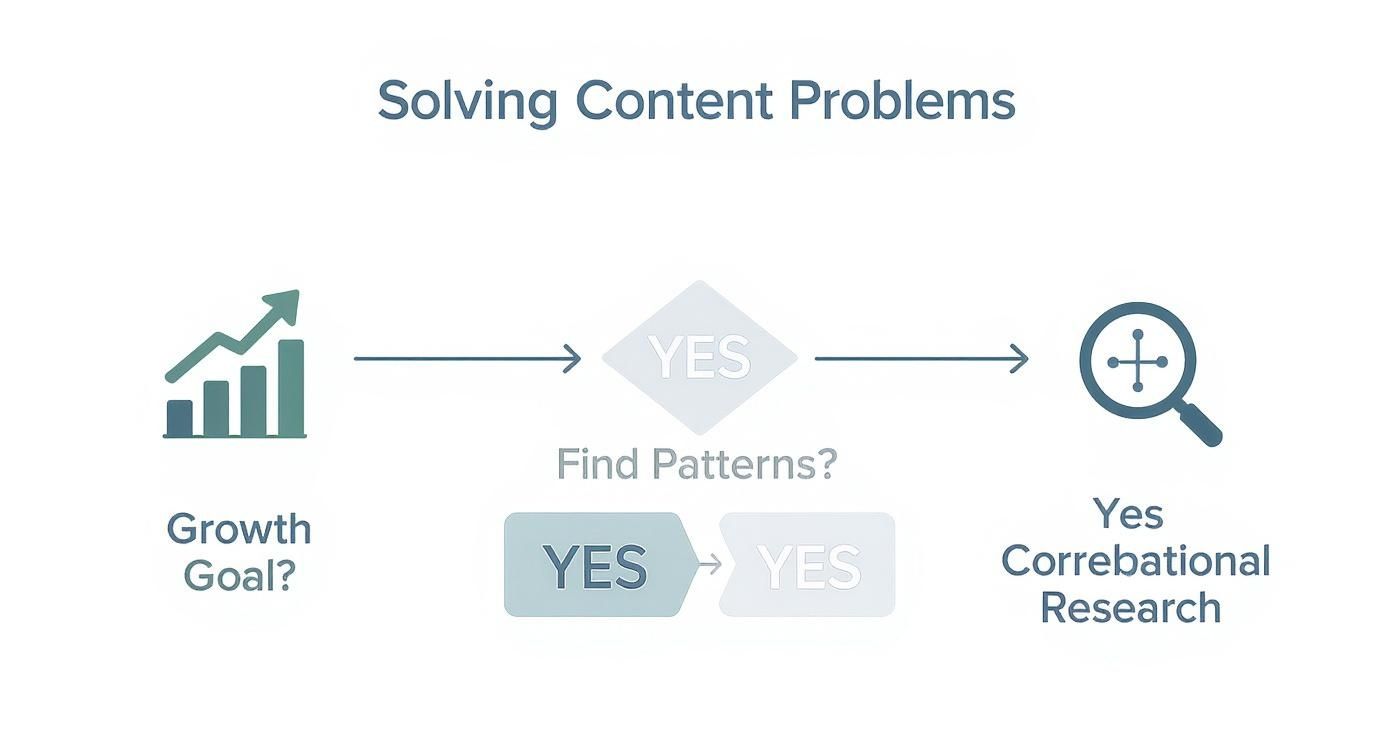
As the chart shows, once you’ve identified a growth goal and start looking for patterns, you’re naturally led toward correlational research—a key step in making smart strategic moves.
Putting Your Methods into Practice
Once you know which way you’re headed, it's time to actually do the work. Don’t ever feel like you have to stick to a rigid formula; mix and match methods to fit what you actually need and the resources you have.
The goal isn't to become a formal academic researcher. It’s to be a creator who makes informed, strategic decisions. Combining different forms of research is the most effective way to get there.
You can absolutely start small. Use free tools like Google Forms for your first surveys, then slowly layer in qualitative insights as you get more comfortable. If you’re looking to go deeper on specific techniques, these essential user research methods are a great place to start.
Over time, you’ll build a flexible research workflow that grows right alongside your brand.
Your Research Hub: The Engine for Infinite Content
Brilliant research is useless if it's buried in a forgotten folder. Your growing collection of articles, interview notes, survey results, and audience feedback is a goldmine for everything you'll create in the future. The trick is to build a central, searchable place where all those insights can live, breathe, and connect with each other. A space where you and your team can collaborate to create new meaning.
This is exactly where tools like Contesimal change the game. Imagine pulling in academic papers, fresh market data, and raw user interview transcripts and having it all become instantly discoverable.

When everything lives in one place, your team can finally start to surface those hidden connections between ideas. By methodically organizing all your different forms of research, you’re not just storing information. You’re building an engine to repurpose what you already have, generate new value, and fuel a continuous stream of content—turning your old content into a money maker.
Taming the Information Beast
Let's be real: the sheer volume of research out there is overwhelming. Globally, over 3 million research documents are indexed each year, with some fields like medicine pumping out hundreds of thousands of publications all by themselves. This information explosion is exactly why a solid organizational system is non-negotiable. You can see the scale of global research output for yourself—it's staggering.
Without a system, those golden nuggets of insight—the ones that could spark your next viral video or groundbreaking podcast episode—are as good as gone. A research hub acts as your team's collective brain, making sure no idea ever slips through the cracks. It turns a chaotic pile of documents into a strategic asset.
A well-organized research library transforms your past work from a static archive into a dynamic source of future creativity. It ensures every piece of information you gather contributes to long-term value.
From Stored Data to Actionable Insights
Just organizing your research is only the first step. The real magic happens when you make it actionable. A simple folder structure on a shared drive just isn't powerful enough to unlock the deep connections hiding in your content library. True value pops up when you can easily cross-reference different types of research—like connecting a hard statistic from a market report to an emotional quote from a user interview.
This is the job of modern content intelligence platforms. These systems don't just store your files; they help you analyze, connect, and collaborate on the knowledge within them.
With this kind of strategic management, you and your team can:
- Spark new content ideas by spotting trends across your entire research collection.
- Instantly find supporting data and juicy quotes to add depth and authority to new projects.
- Collaborate without the chaos by working from a single source of truth, killing redundant work.
By building a proper research hub, you create an engine that breathes new life into your content library, turning old assets into an endless well of fresh, high-impact material.
Common Questions About Creator Research
Let's tackle a few of the questions that come up all the time when creators start weaving these research methods into their workflow.
I’m a New YouTuber. Where Should I Even Start With Research?
If you're just getting started, the perfect combo is exploratory and descriptive research. Don't overcomplicate it.
Start with the exploratory stuff: fall down the rabbit hole of competitor channels, lurk in relevant subreddits to see what people are complaining about (those are your video ideas!), and watch the most popular videos in your niche to see what’s missing. This is all about brainstorming and finding your angle.
Once you have a rough direction, switch to descriptive research. Start sketching out a simple profile of your ideal viewer. What do they care about? Where do they hang out? As your channel grows, you can start layering in qualitative insights from your comment section and quantitative data from your YouTube analytics to keep sharpening your strategy.
How Can I Do This With a Tiny Budget?
You don't need a fat wallet for this. Honestly, some of the most powerful insights come from free tools and simple observation.
Here are a few ideas to get you going:
- Use Google Trends to see if a topic's popularity is rising or falling. It’s a great gut check before you commit to a video.
- Whip up a free survey with Google Forms. Just ask your audience directly what they want to see next.
- Do some informal qualitative digging. Just read the comments on your videos and your competitors' videos. Observe the conversations happening in Facebook Groups or on Reddit. It’s all right there.
The trick is to be scrappy. Focus on what your audience is already telling you with their online behavior.
How Often Should I Be Doing Audience Research?
Think of it as a constant pulse check, not a once-a-year physical. Your research rhythm should have two speeds: continuous monitoring and periodic deep dives.
You should be keeping an eye on your analytics, comments, and industry chatter pretty much constantly—weekly, if not daily. This is your continuous monitoring.
Then, every so often, plan for a deep dive. This could be a big annual audience survey or even just hopping on a call with a few of your most loyal fans every quarter. This two-part rhythm makes sure you’re catching the day-to-day shifts while also getting the richer insights that keep your content perfectly in sync with what your audience actually needs.
Ready to turn all that scattered research into a real content engine? Contesimal is built to help you organize your content library to create new value and ultimately make money with it. It’s designed to help you and your team collaborate, find those hidden connections, and spark your next big idea. Get your knowledge organized and start creating smarter content by visiting us at https://contesimal.ai.