
That blank page staring back at you? The silence of an empty audio track? Every creator knows that feeling. A solid podcast episode planning template is the one thing that can consistently pull you out of that rut, turning a jumble of ideas into a tight, professional-sounding show. It’s what separates creators who are hobbyists from those who are generating actual revenue, giving you a repeatable framework that saves hours and helps you build a valuable content library.
Why a Planning Template Is Your Secret Weapon
Let’s be real—that chaotic, “what do I say next?” feeling is the worst. A good plan completely eliminates it. Instead of winging it and hoping the episode connects, a template gives you the scaffolding to build a real narrative. This isn't just about getting organized; it's about respecting your listener's time and building a content asset you can repurpose later.
When you map out your episode, you’re creating a road map. It guides both you and your audience from a hook that grabs them right away to a conclusion that feels earned. This intentional approach is what makes a show feel polished and professional, and that’s the key to growing your audience across platforms.
Here’s what a simple, effective template looks like before you even start typing.
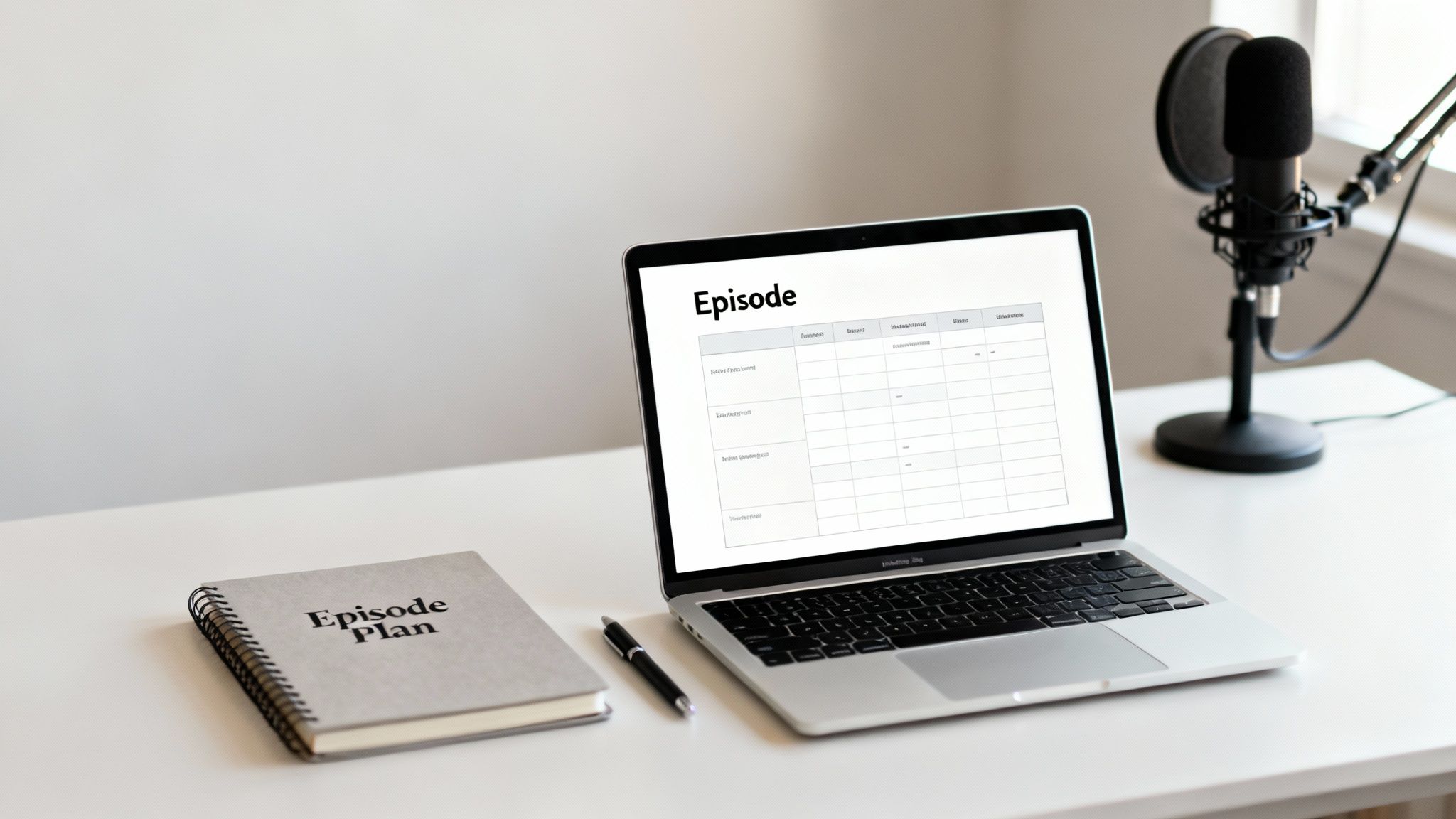
This structure breaks everything down into dedicated sections—from your main topic and guest research to specific calls-to-action—so you never forget a critical piece of the puzzle and can easily upcycle your content later.
The Competitive Edge of Consistency
The creator economy is absolutely booming. There are over 4.52 million podcasts out there, and with 55% of the U.S. population tuning in monthly, you need more than just a good idea to cut through the noise. A well-thought-out plan is your competitive advantage.
A template forces you to be consistent with your format, tone, and quality. That consistency is what builds trust. Listeners come back because they know exactly what they’re getting—value, every single time, without fail. This organized approach is the first step to reigniting your content library and bringing it to life.
A great podcast structure feels invisible to the listener. They aren't thinking about your episode's format; they're simply captivated by the seamless flow of your content from start to finish.
This planning pays off in a big way for small businesses using podcasts to connect with their customers. If you want to really understand the power behind this, you need to master content planning strategies that apply to any format.
Ultimately, a structured approach is the foundation for anyone who’s serious about growing their show. To see how this planning translates directly into growth, check out our guide on podcasting for small business.
Your Go-To Podcast Planning Template
Alright, enough theory. Let’s get a practical tool into your hands. I've put together a flexible podcast episode planning template that’s designed to guide you from a fuzzy idea all the way to a polished final episode. Think of it less like a simple checklist and more like a strategic framework that grows with you, whether you're just starting out or managing a huge content library.
Click below to grab your copy in whichever format fits your workflow best.
- Download the Google Docs Template
- Duplicate the Notion Template
- Download the PDF Template
This isn't about just filling in the blanks. Every section is there to make you think critically about your episode’s purpose, who you're talking to, and how you can squeeze more value out of it later. It's the first real step to organize your content library, understand its potential, and take action to create new value from it.
Breaking Down the Template Components
To really get the most out of this, let's walk through the key sections and the thinking behind each one. When you understand the why, the template transforms from a simple planner into a core part of your content engine. You'll see pretty quickly how a solid plan not only makes for a better episode but also makes your entire content ecosystem easier to manage and monetize.
The goal here is a seamless process, from that first spark of an idea to the final promotional push, ensuring no brilliant thought or potential social media hook gets lost along the way.
Here’s a quick look at the core components of the template. Each one serves a specific purpose, pushing you to think like a strategist, not just a host.
Core Components of the Podcast Planning Template
| Template Section | Purpose | Example |
|---|---|---|
| Episode Title & Topic | To nail down the episode's focus and craft a title that’s both compelling and easy for people to find. | Topic: AI in Creative Writing; Title: Can AI Co-Write Your Next Novel? |
| Target Audience Persona | To keep your ideal listener front and center, making sure your tone and content actually connect with them. | “Sarah, a 32-year-old freelance writer looking for tools to beat writer’s block.” |
| Key Talking Points | To give your episode a narrative spine and stop you from rambling. This is your roadmap for the conversation. | 1. Intro to AI writing tools. 2. Pros/Cons. 3. Real-world author examples. 4. Ethical concerns. |
| Guest Research | To arm you with insightful questions that go beyond the generic stuff, leading to a much deeper chat. | “Ask about their controversial blog post on AI ethics from last year.” |
| Calls to Action (CTAs) | To deliberately point listeners toward a specific next step, like subscribing or checking out a link. | “If you found this useful, leave us a 5-star review on Apple Podcasts.” |
| Repurposing Hooks | To flag potential soundbites and ideas ahead of time for creating social clips, blog posts, or other assets. | “Clip: The 60-second segment where the guest explains the biggest AI myth.” |
By thoughtfully working through each section, you're not just mapping out one episode; you're creating a detailed blueprint. This blueprint is invaluable if you're collaborating with a team, and it even makes it easier for tools like Contesimal to analyze your content library later, helping humans and AI collaborate to discover patterns and pull fresh ideas from your own past work.
Putting the Template Into Action
Having a killer podcast episode template is one thing. Actually turning it into a seamless part of your creative process is another entirely. A template is only as good as the thought you put into it, so let's walk through how to transform those blank fields into a dynamic roadmap for an amazing episode, from that first spark of an idea all the way to hitting record.
This simple flow shows you exactly how the template fits into your workflow.
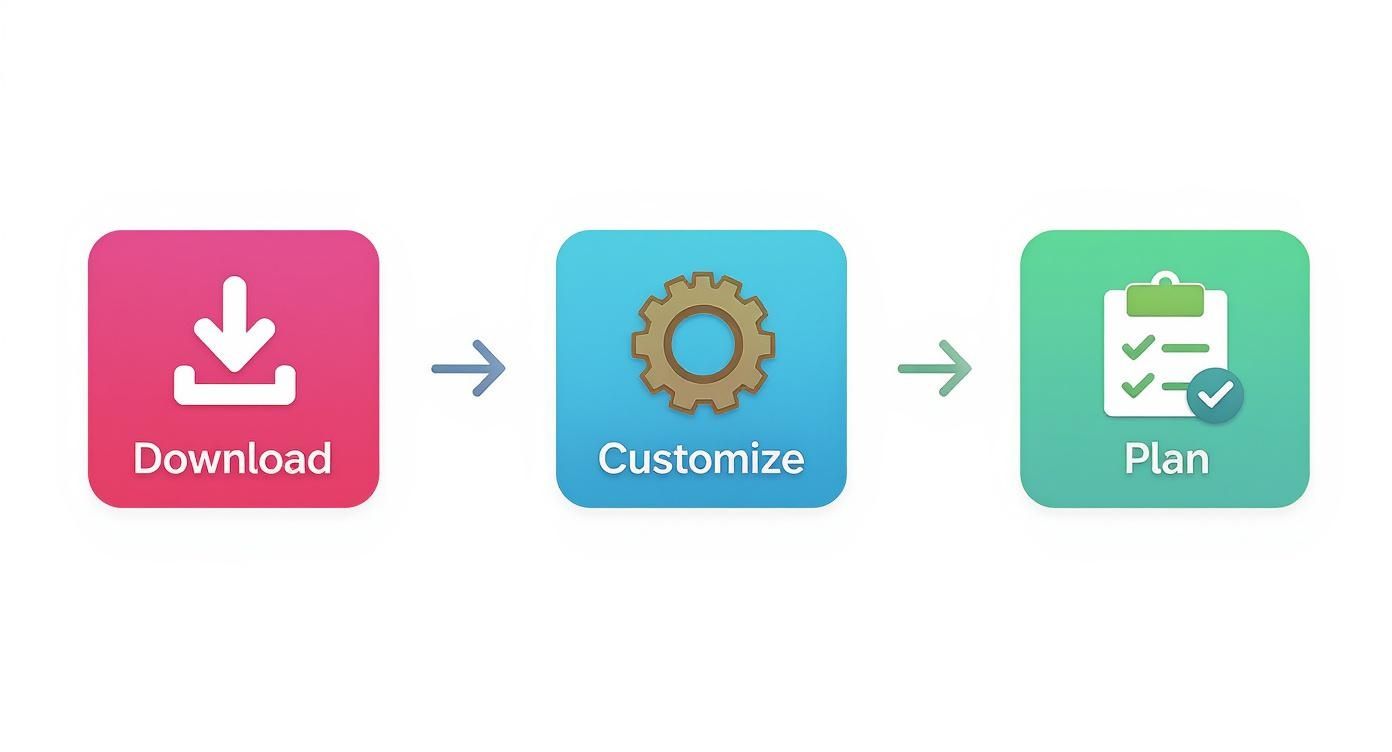
It’s pretty straightforward: you grab the template, tweak it for your show’s unique format, and then use it to map out every single detail. This is what ensures a polished final product, not just a rambling conversation.
From Vague Idea to Sharp Focus
Every great episode begins with a crystal-clear focus. Let's say you're planning an interview with a successful author who just launched their first book. This is where your template becomes your mission control for research.
Instead of just jotting down "Interview with Author," you start filling in the blanks with intention:
- Episode Topic: The author's journey from hobbyist writer to published pro.
- Target Audience: Aspiring writers feeling stuck and looking for real, actionable steps.
- Key Talking Points: Their biggest mindset shift, practical writing routines, and how they handled rejection.
See the difference? This simple step transforms a broad topic into a specific promise to your listener. You're no longer just talking to an author; you're building a guide for your audience through that author's experience.
The most compelling episodes feel like a guided journey. Your template's job is to map out that journey ahead of time, ensuring you never get lost and your listeners always know where you're headed.
Crafting a Narrative Arc That Hooks Listeners
Once your research and focus are locked in, it’s time to build the episode's narrative structure. This is where you script the most critical moments—the intro and outro—that frame the entire conversation and keep your audience glued to their headphones.
A strong hook is non-negotiable. Most podcasts lose a huge chunk of their audience in the first few minutes, so your intro needs to grab them immediately. Ditch the generic welcome and script a compelling question or a surprising stat related to your topic.
For our author interview, you could script an intro like this: "What if I told you the author of this year's biggest debut novel almost gave up writing completely? Today, we're finding out what changed."
That one sentence creates instant intrigue.
The main content then flows directly from your key talking points. Think of these less as a rigid script and more as a series of signposts. They keep the conversation on track and make sure you deliver the core value you promised your listeners from the jump.
Finally, the payoff is your outro. Don't just fizzle out with a "thanks for listening." Script a quick summary of the most actionable takeaways and include a clear call-to-action (CTA). This gives your listeners a satisfying conclusion and tells them exactly what to do next.
A well-planned episode makes post-production so much easier, but having the right tools is also a game-changer. If you're looking to improve your workflow, check out some of the best editing software for podcasts to complement your new planning process. This hands-on approach is what turns your template from a static checklist into a living document that guides your creativity.
Planning Beyond the Recording
Hitting the stop button on your recording doesn't mean the work is over. Not by a long shot. In fact, a brilliant episode can completely fizzle out if you don't give post-production and promotion the same attention you gave your initial prep.
This is where your podcast episode planning template gets a second life. It transforms from a recording guide into a post-production roadmap, steering you from a raw audio file to a polished, widely-heard piece of content.
That plan you filled out—loaded with key talking points and guest research—is now a treasure map for your editor. It gives them the context they need to make smart cuts, pinpoint the most powerful moments, and keep the narrative flowing. It's the difference between a quick, efficient edit and hours of painful guesswork, especially when you need to collaborate with others to grow.
Your Post-Production Checklist
A systematic approach here saves you from those "Oh, I forgot to…" moments. It keeps your quality high and makes the whole process smoother and faster. Think of this checklist as a natural extension of your planning template.
Here’s a practical rundown to get your episode from raw to ready:
- Audio Cleanup: Go through and slice out the distracting filler words—the "ums," "ahs," and "likes"—along with any awkward pauses or background hum that yanks the listener out of the moment.
- Level and Master Audio: Make sure everyone's voice is at a consistent volume. Then, apply mastering to give the whole episode that crisp, professional, broadcast-quality sound.
- Intro and Outro Music: Add your theme music. Drop in any sound effects or transitions you use. This frames the episode and hammers home your brand's sonic identity.
- Ad Placements: If you're running ads, insert them at the natural breaks you already marked in your template. This keeps them from feeling jarring or out of place.
From Show Notes to Social Buzz
Once your audio is sparkling, it's time to package it for the world. This means creating all the little assets that help people find, understand, and share your hard work. And guess what? Your plan is the source material for all of it.
Your show notes, for example, are a massive piece of podcast SEO. Pull the main keywords and themes directly from your "Key Talking Points" section to write a summary that grabs attention. Make sure to include links to any resources you mentioned and add timestamps for key segments. This makes your episode incredibly user-friendly and easier to find in podcast apps.
Think of your promotional assets as movie trailers for your episode. An audiogram—a short video clip with your audio waveform—can stop the scroll on social media and give people a real reason to hit play.
Your distribution shouldn't be random, either. Schedule your episode to go live at the same time each week to build audience anticipation. Get your social media posts ready ahead of time, using the killer quotes and insights you flagged as "Repurposing Hooks" in your template. This helps you take your longform content across platforms in one click.
Finally, write an email to your subscribers that does more than just announce a new episode. Sell the value inside. Tease the biggest takeaways to drive those clicks. When you coordinate all these efforts, your well-planned episode gets the audience it truly deserves.
Turning Your Planned Content Into New Assets
Every episode you plan is more than just a single piece of audio. Think of it as a seed—a valuable asset in your growing content library that can sprout into dozens of other things. When you use a podcast episode planning template, you're not just organizing your thoughts for a recording. You're building a blueprint for making money and multiplying your content, which is how you create infinite content value.
This is the exact point where creators shift from being hobbyists to becoming pros, turning their old longform content into a money maker today.

Monetizing Your Planned Segments
Your template makes monetization feel natural, not forced. By outlining your segments and transitions ahead of time, you can pinpoint the perfect spots to place sponsored messages or affiliate links where they genuinely make sense. This kind of intentional planning is crucial for getting a piece of the ever-growing podcast advertising market.
Seriously, global podcast advertising is on track to hit around $4.46 billion by 2025. A structured plan helps you match sponsorships with relevant episode content, which makes listeners more receptive and the ads more effective for everyone.
A well-planned episode is a monetizable one. When you know the flow of your content in advance, you can weave in revenue opportunities that feel like a seamless part of the listener's experience, not a jarring interruption.
Unlocking New Value Through Repurposing
Here's where the real magic happens. The true power of your plan is its potential for repurposing. That "Key Talking Points" section in your template? That's pure gold. Each one of those points can be spun off into its own asset, transforming a single podcast recording into a full week's worth of content.
This is exactly how you organize your content library to create new value from work you've already done.
- Blog Posts: Use your episode transcript and talking points to draft a detailed article. This is an absolute beast for SEO and helps you capture an audience that would rather read than listen.
- Social Media Carousels: Each key talking point can become a single, shareable slide in an Instagram or LinkedIn carousel. It's a fantastic way to break down complex ideas into bite-sized, digestible nuggets.
- Short-Form Video: Remember those incredible 30-60 second soundbites you flagged in your plan? Pull them. These clips are perfect for TikTok, YouTube Shorts, and Reels.
This approach makes your podcast the central hub of a much larger content ecosystem. Once you've meticulously planned your content, it's time to get it out there. For a deep dive, check out this comprehensive podcaster's guide to automated video clip generation to really maximize your social media growth.
By seeing each episode plan as a starting point, you start building a rich, interconnected library of assets. If you're looking for more ideas, our guide on how content repurposing adds value offers even deeper strategies for breathing new life into your old content. This process is fundamental to turning your library into a money-maker.
Common Questions About Episode Planning
Even with the perfect podcast episode planning template, you're going to have questions. It just happens. Building a smooth, consistent workflow doesn't happen overnight; it takes time and a bit of trial and error. Let's tackle some of the most common hurdles I see creators face when they're trying to nail down their process.
Getting these figured out early will help you move from planning paralysis to confidently hitting "record."
How Far in Advance Should I Plan Episodes?
If you can, try to plan your content at least one month out. This approach is often called "batching," and it's an absolute game-changer for staying sane and creative. It means you sit down and map out four or five episodes in a single session.
When you plan in batches, you start to see thematic connections between episodes you might have otherwise missed, making your show feel more cohesive. It also gives you a crucial buffer in your production schedule. The constant pressure of a weekly deadline disappears, which is huge for preventing burnout and giving your ideas room to breathe.
What Is the Most Important Part of the Template?
Honestly, every section plays its part in creating a polished episode. But if I had to pick one, the "Key Talking Points" section—your outline—is the absolute backbone of your show. This is where you actually build the narrative and make sure you deliver on the promise of your episode title.
A strong outline is your best defense against rambling. We've all listened to shows that go off the rails, and it's no fun. A good set of talking points keeps the conversation focused, ensures a logical flow from one idea to the next, and makes certain you hit all the critical information you wanted to share.
Think of your talking points not as a rigid script, but as a series of signposts. Each one guides you to the next destination, ensuring your listeners enjoy a smooth and compelling journey.
Can I Adapt This Template for Different Formats?
Absolutely. In fact, you should. The template is designed from the ground up to be flexible. Its real power comes from how you mold it to fit your show's unique format and your personal creative style.
Here’s how you might tweak it for different shows:
- For an interview show, you'll live in the "Guest Research" and "Interview Questions" sections. This is where you do the homework that leads to a deep, insightful conversation.
- For a solo episode, the "Key Talking Points" and "Script" sections will be your best friend. You'll want these to be far more detailed since you're carrying the entire narrative yourself.
- For a narrative-style podcast, you might even add a custom "Story Arc" or "Scene List" section to map out your storytelling structure before you write a single word.
How Does Planning Improve Podcast SEO?
This is a big one that people often overlook. Your plan is a surprisingly powerful tool for getting found. It starts when you define your target keyword in the "Episode Topic" section of the template.
From there, you weave that keyword and a few related terms into your "Key Talking Points." This helps you say them naturally during the recording, which podcast platforms and transcription services can pick up on. Finally, you use those same planned keywords to write a compelling episode title and detailed show notes—two of the most critical elements for discovery in podcast apps and on search engines like Google.
A great plan helps you create better content today and build a more valuable library for tomorrow. With Contesimal, you can take that organized library and unlock its full potential, using AI to discover new ideas, repurpose old episodes, and create infinite value from the work you've already done. Learn more at https://contesimal.ai.