Optimizing your content for search engines is all about making sure people can actually find it. It’s the art and science of creating and structuring your material so it ranks high in search results for the things your audience is looking for.
Ultimately, it’s about making your content discoverable, relevant, and genuinely valuable to both search algorithms and, more importantly, human readers. A great strategy turns your content library from a simple archive into a powerful engine for attracting the right people and creating infinite content value.
Building Your Content Foundation for Search
Before you even think about writing a single word, you need a rock-solid foundation. This is what separates content that gets seen from content that just disappears into the digital ether. It all starts with a deep, almost obsessive, understanding of who you're creating for and what they're really looking for.
Great SEO isn't about gaming the system; it's about building a strategic framework that lines up your expertise with your audience's needs. Organize. Understand. Take Action.
Think of it like building a house. You wouldn’t just start hammering up walls without a blueprint. For content, your blueprint has three core pillars: your audience, their intent, and your content’s structure. Nailing these ensures every article, video, or podcast you create has a clear purpose and a logical place in your content library. This is how you set yourself up for sustainable growth, not just a few lucky hits.
This workflow shows how the pros build that foundation, starting with the user and working back.
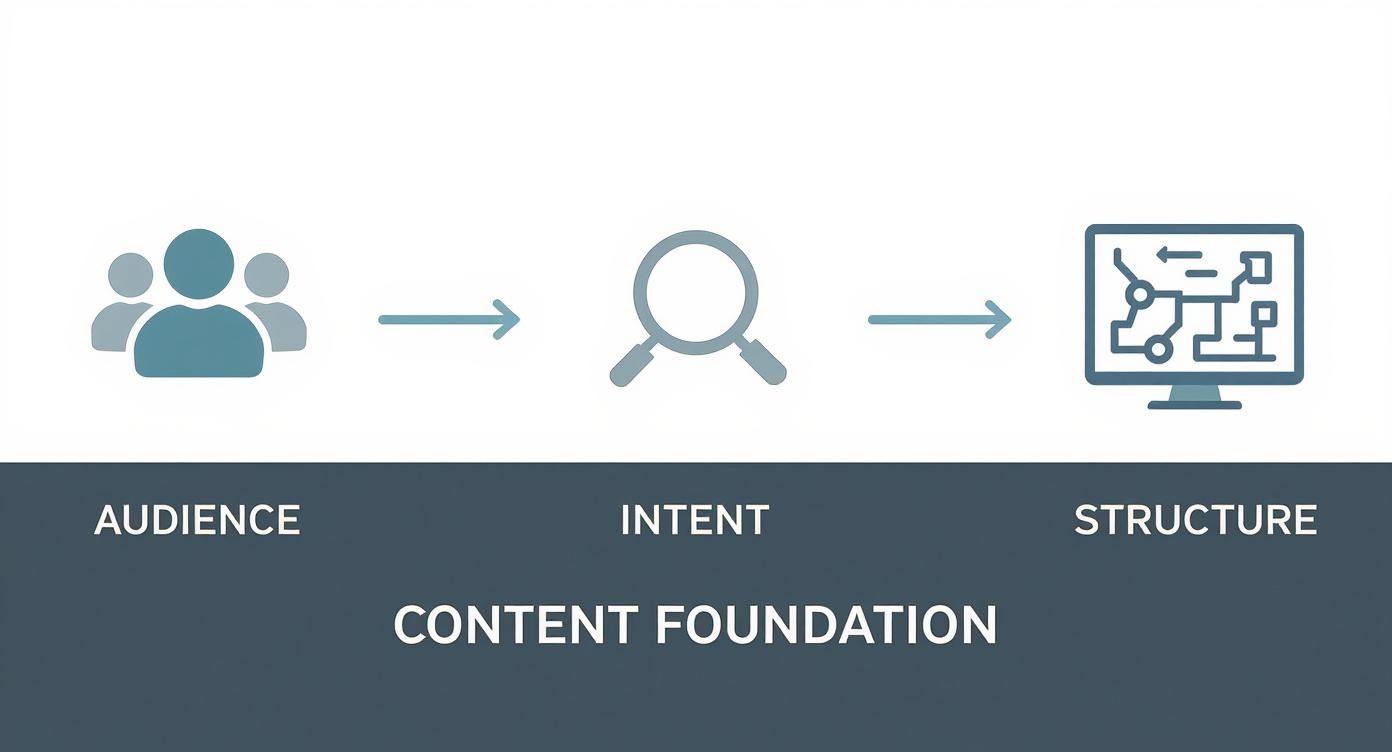
As you can see, it all flows from the user. You figure out their goals, then organize your information in a way that directly meets those needs.
Understand Your Audience Deeply
Effective optimization always starts with a crystal-clear picture of your ideal audience. Who are they, really? Are they YouTubers transitioning from a hobby into a business? Or maybe they're content marketers at a large publisher struggling to align content across a dozen platforms?
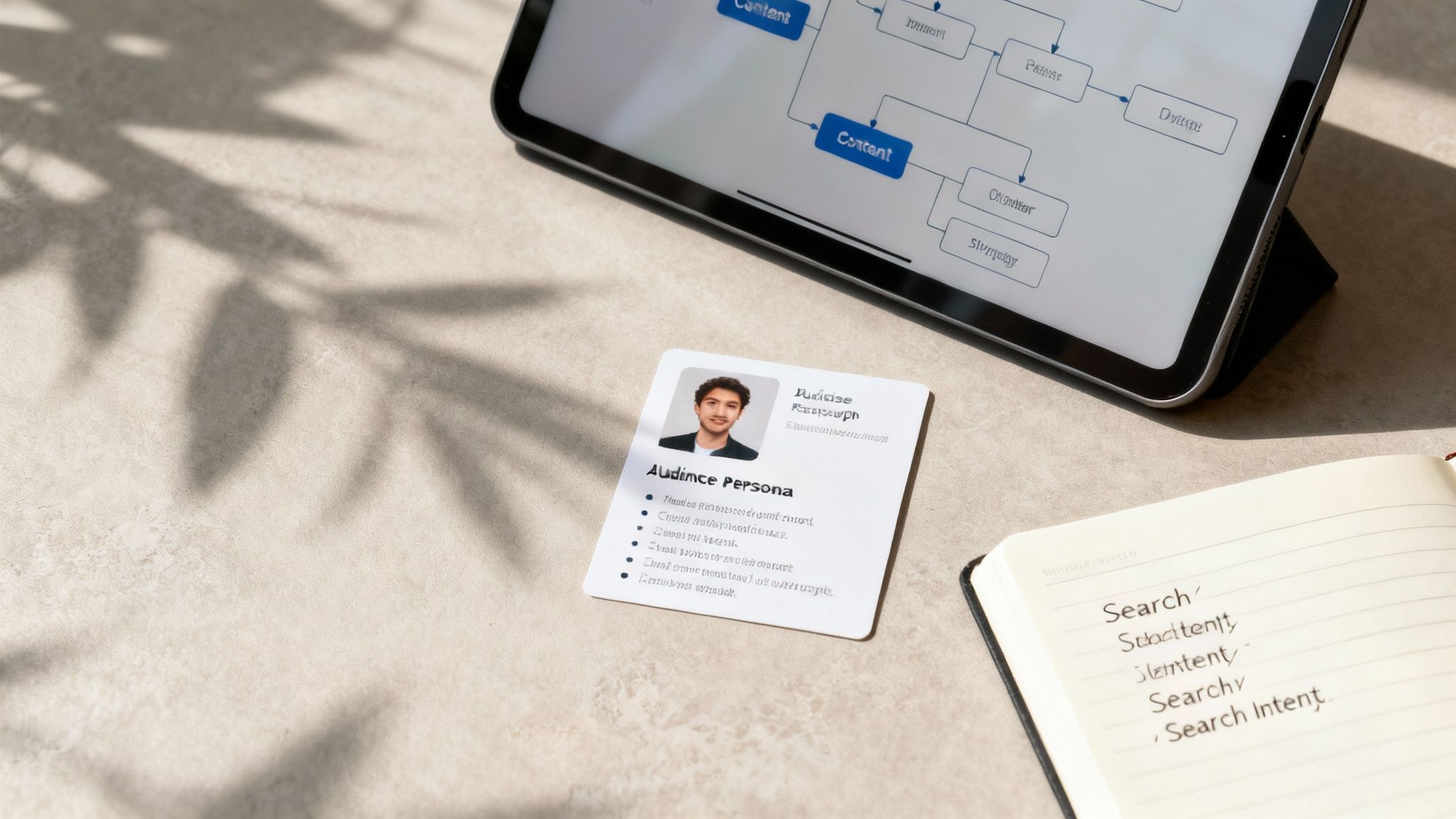
You need to create a detailed user persona. This isn't just a fluffy marketing exercise; it's a practical guide that should inform every piece of content you create.
Your persona should feel like a real person, with details like:
- Demographics: Their age, where they live, and what their job title is (e.g., Podcaster, Content Executive, Filmmaker).
- Goals: What are they trying to accomplish with their content library? (e.g., grow an audience across platforms, generate revenue, experiment with new concepts).
- Pain Points: What keeps them up at night? (e.g., "I don't know what video to make next," or "How do I upcycle my old content without it feeling stale?").
- Platforms: Where do they actually hang out online? (e.g., YouTube, LinkedIn, specific industry forums).
Knowing these details helps you craft content that connects on a human level, making it far more likely to attract and keep the right creators, storytellers, and publishers.
Decode User Search Intent
Once you know who you're talking to, the next critical step is figuring out what they're asking. User search intent is simply the "why" behind any search query. It's the difference between someone typing "podcast microphone" (they probably want to buy one) versus "how to improve podcast audio" (they're looking for information and tips).
The core of modern SEO has shifted from just matching keywords to satisfying the underlying intent. If your content can meet the user's goal better than anyone else's, search engines will reward you for it. Period.
The competition is just staggering. With Google projected to handle around 190,000 searches per second by 2025, simply stuffing keywords into your content won't cut it. The proof is in the numbers: pages ranking in the top three spots grab an average click-through rate of about 36%. That's a massive advantage, and it all comes from aligning your content with what users truly want. You can see more data on this in Backlinko's SEO stats report.
To help you nail this, here’s a quick breakdown of the four main types of search intent.
Four Pillars of User Search Intent
This table breaks down the primary types of search intent, helping you align your content with exactly what your audience is trying to accomplish.
| Intent Type | User Goal | Example Keyword | Optimal Content Format |
|---|---|---|---|
| Informational | To learn something or find an answer to a question. | "how to edit a video" | How-to guides, tutorials, blog posts, long-form articles. |
| Navigational | To find a specific website or page. | "YouTube Studio login" | Homepage, product pages, login portals. |
| Commercial | To research products or services before buying. | "best cameras for vlogging" | Product reviews, comparison articles, buyer's guides. |
| Transactional | To complete a purchase or take a specific action. | "buy Adobe Premiere Pro" | Product pages, pricing pages, sign-up forms. |
Getting this right means you're not just creating content; you're creating the right content for the moment a user needs it most.
Map Out Your Content Architecture
Finally, you need a logical structure for all this amazing content. This is your content architecture, or taxonomy. It's how you organize your topics and subtopics into a coherent hierarchy that makes perfect sense to both users and search engines.
A well-planned architecture helps search crawlers understand how your pages relate to each other, which can give your rankings a nice boost.
For creators and publishers with a growing library, a solid structure is what prevents your site from becoming a messy, disorganized collection of random posts. It helps you spot content gaps, plan future topics, and create a powerful web of internal links that guides users deeper into your site. If you want to go deeper on organizing your assets, check out our complete guide to building a content playbook.
This strategic organization is what turns your content library into a valuable, interconnected resource rather than just a series of disconnected articles.
Crafting Content That Search Engines Love
Okay, you've got your strategy locked in. Now for the fun part: actually writing the stuff. This is where the rubber meets the road. Creating content that ranks isn't about gaming the system or stuffing keywords where they don't belong. It’s about creating something so genuinely useful and well-organized that search engines want to show it to people. You're playing a two-sided game: satisfying a curious human and a technical algorithm at the same time.
And it’s more than just the words you type. It’s about the entire package—the title that makes someone click, the headings that guide them through your thoughts, and the overall flow that keeps them from hitting the back button. Get these right, and you're building an experience that Google is designed to reward.
Write Magnetic Titles and Meta Descriptions
Think of your title tag and meta description as your digital billboard on the search results page. It's your one shot to grab someone's attention in a sea of blue links. If it's boring, it's invisible.
A solid title tag needs to be clear, stay under 60 characters, and include your main keyword. But honestly, the most important job it has is to promise a real solution to a real problem.
For instance, "Vlogging Tips" is just noise. No one's clicking that. But "10 Vlogging Tips for Beginners to Get Your First 1,000 Subscribers"? Now we're talking. It's specific, calls out an audience, and offers a tangible result.
Your meta description (keep it around 155 characters) is the ad copy for your page. While it doesn't directly influence your rank, a compelling one can make a huge difference in your click-through rate (CTR).
Structure Your Content with Clear Headings
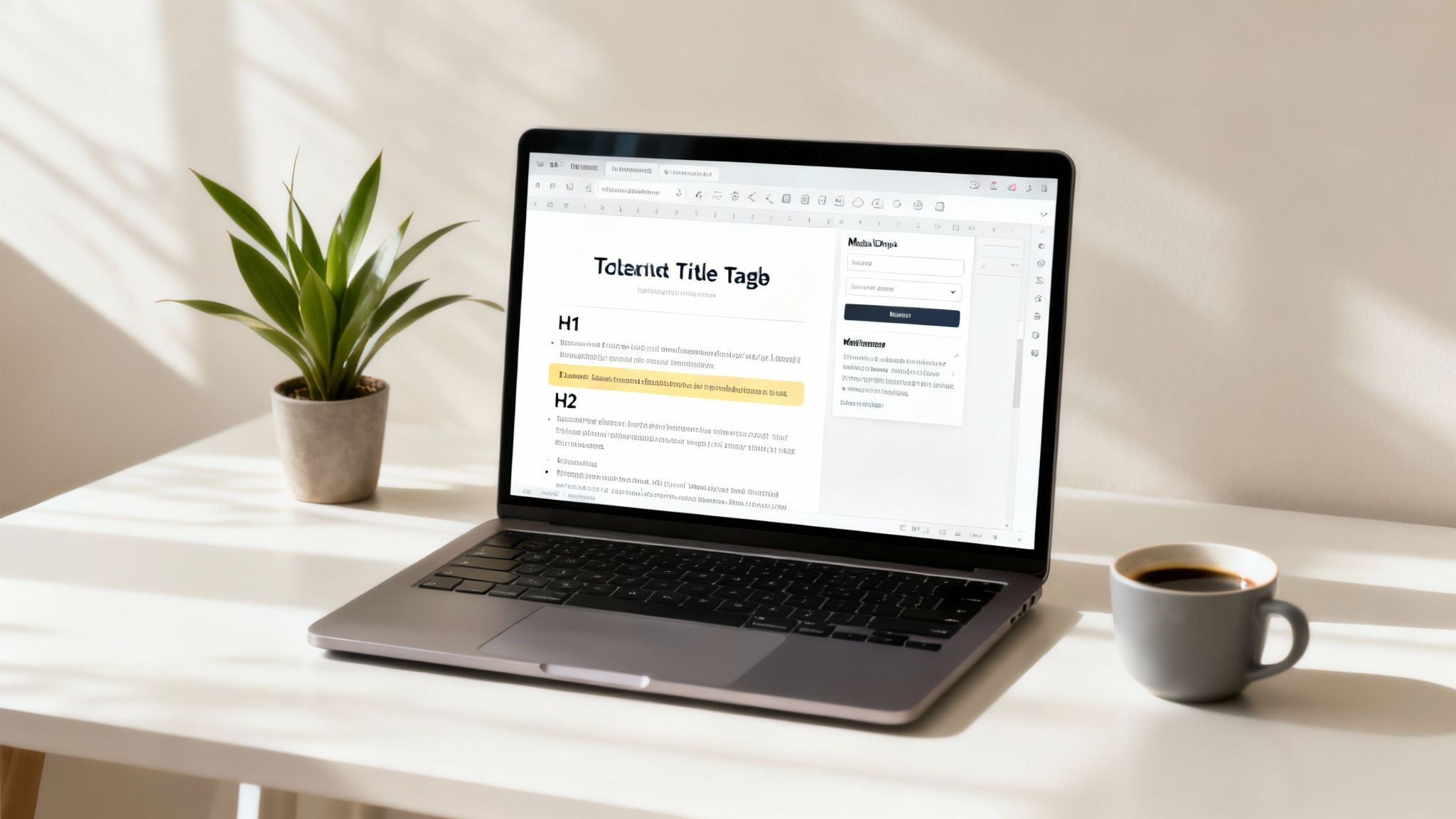
Once you've earned that click, the clock is ticking. You have seconds to prove to the reader that they're in the right place. This is where your heading structure (H1, H2s, H3s) is absolutely critical, both for optimizing content for search engines and for keeping humans from bouncing.
Your H1 is the main headline on the page; it should be a close cousin to your title tag, and you only get one. H2s are your main sections, and H3s are the sub-points within those sections. Simple.
Think of headings as chapter titles in a book. They create a scannable outline, letting readers jump straight to the good stuff without getting buried in a wall of text.
This structure pulls double duty:
- It helps your readers. People can scan your content and find what they need, fast. That keeps them on the page longer.
- It helps search engines. Crawlers get a clean map of your content's hierarchy, which helps them understand what your page is actually about.
Good structure signals that your content is organized, professional, and easy to digest. It’s a win-win.
Why Comprehensive Content Wins
Back in the day, you could get away with churning out short, 500-word blog posts. That strategy is dead. Today, search engines want to see that you've covered a topic from top to bottom, making your page the definitive resource.
The data backs this up. A deep dive into search results shows that pages on the first page of Google average around 1,890 words. Even more telling, content over 3,000 words tends to get three times more traffic, four times more social shares, and 3.5 times more backlinks. You can dig into some of these findings from the HTTP Archive yourself.
This isn’t about adding fluff just to hit a word count. It’s about anticipating and answering every single question a user might have on the topic, so they have no reason to go back to Google.
Enrich Your Content with Media and Links
Let's be real: text alone can be a snoozefest. To keep a modern audience hooked, you have to mix it up with visuals and strategic links. It's not just about looking good; it's about creating a richer experience.
- Images and Infographics: Visuals are perfect for breaking up long blocks of text and explaining complex ideas. Just make sure you use descriptive alt text so search engines (and visually impaired users) know what they're looking at.
- Videos: Got a relevant YouTube tutorial or a custom demo? Embed it. This can massively increase the time people spend on your page, which is a huge thumbs-up to search engines.
- Internal Links: This is one of the most underrated tactics. Linking to other relevant articles on your own site keeps people clicking around, exploring more of your content. It also helps search engines discover more of your pages and spreads link authority across your site.
By weaving these elements into your content, you're not just creating a blog post. You're building a valuable resource that ranks well, engages readers, and establishes you as an authority.
Mastering Technical SEO for Content Creators
Fantastic content means nothing if search engines can't find, crawl, and understand it. That’s where technical SEO comes in. It sounds way more intimidating than it is. For a content creator, it’s really about making sure there are no technical roadblocks between your hard work and your audience. You don't need to be a developer to get this stuff right.
Think of your website as a library. Your content is the collection of amazing books, but technical SEO is the shelving, the lighting, and the signs that guide people to the right section. If the lights are off or the aisles are blocked, even the best books will just sit there gathering dust.
Prioritize Page Speed and User Experience
We’ve all been there. You click a link, and the page just spins and spins. What do you do? You hit the back button. Search engines know this, and they penalize slow-loading pages because it’s a terrible user experience.
Even a one-second delay in page load time can lead to 11% fewer page views. Your goal should be to get your content to load in under three seconds. This isn't just a vanity metric; it directly impacts your ability to keep people on your site.
You can use free tools like Google's PageSpeed Insights to see how your site stacks up. More often than not, the culprits are simple fixes you can handle yourself.
Keep an eye out for these common speed killers:
- Massive Image Files: Before you upload a single image, compress it. A beautiful, high-resolution photo can be a huge file that slows everything down. Use a tool like TinyPNG to shrink file sizes without a noticeable drop in quality.
- Too Many Plugins: If you're using a CMS like WordPress, it's easy to get carried away with plugins. Each one adds code that can drag down your site. Do an audit and deactivate anything you don't absolutely need.
- Complex Page Elements: Fancy animations and sliders look cool, but they can be a major drain on performance. It's better to keep your design clean and focused on delivering the content as efficiently as possible.
Make Your Content Mobile-Friendly
This isn't optional anymore; it's the standard. Over 60% of all internet traffic now comes from mobile devices. Because of this, Google primarily uses the mobile version of a site for indexing and ranking—a policy called mobile-first indexing.
If your content is a pain to read or navigate on a phone, you’re pushing away the majority of your potential audience. Text should be readable without pinching to zoom, and buttons or links need to be easy to tap. Luckily, most modern website themes are "responsive" by default, meaning they automatically adjust to fit any screen size. You can quickly check your page with Google's mobile-friendly test tool.
Use Structured Data to Stand Out
This is one of the most powerful—and most overlooked—tools for optimizing content for search engines. Structured data, also known as Schema markup, is a snippet of code you add to your site to help search engines understand your content on a much deeper level.
Instead of just telling a search engine that a page has text and images, Schema markup tells it, "This is a recipe, and here are the ingredients," or "This is a product review, and this is the star rating."
This extra clarity allows search engines to show your content in more compelling ways right in the search results. We call these "rich snippets," and you’ve definitely seen them before:
- Review stars appearing under a product name.
- An event's date and location showing directly in the results.
- An FAQ dropdown that answers questions without a click.
These enhanced listings grab a user's attention and can seriously improve your click-through rate. While it sounds technical, many plugins and tools can generate this code for you automatically. Getting this right ensures your content doesn't just rank; it truly stands out from the crowd.
Amplifying and Repurposing Your Best Content
https://www.youtube.com/embed/RFlpwKQ0bEs
So you hit 'publish.' Pop the champagne, right? Not so fast.
Hitting publish isn't the finish line; it’s the starting gun. The real growth happens after your content goes live. It's all about making your work louder and breathing new life into everything you've already created. Too many creators treat their archives like a digital graveyard, but it's a goldmine. Reignite your content library and bring it to life!
The first, and maybe easiest, way to start digging is by building a smart internal linking strategy. This isn't just about dropping links wherever. It's a deliberate way to spread authority across your site and guide people—and search engines—to your best stuff.
Weave a Powerful Internal Linking Web
Think of internal links as the threads connecting your entire content library. Every single time you link from one of your articles to another, you’re creating a pathway. You're essentially telling Google, "Hey, see this new article? It's directly related to this other one that you already know and love. You should pay attention."
This simple act does a few critical things for you:
- It distributes authority: When a page has strong backlinks and ranks well, linking from it to a newer post passes some of that "link juice" along. This gives your new content an immediate head start.
- It improves user engagement: By suggesting other relevant articles, you keep visitors on your site longer. They click, they read, they explore. That increased dwell time is a massive positive signal to search engines.
- It helps with content discovery: A solid linking structure makes sure search engine crawlers can actually find and index all your pages, even older ones that might otherwise get buried.
A good rule of thumb is to link to 2-3 other relevant articles within each new piece you publish. Seriously, it's a low-effort, high-impact tactic that strengthens your entire library from the inside out.
The Art of Content Repurposing
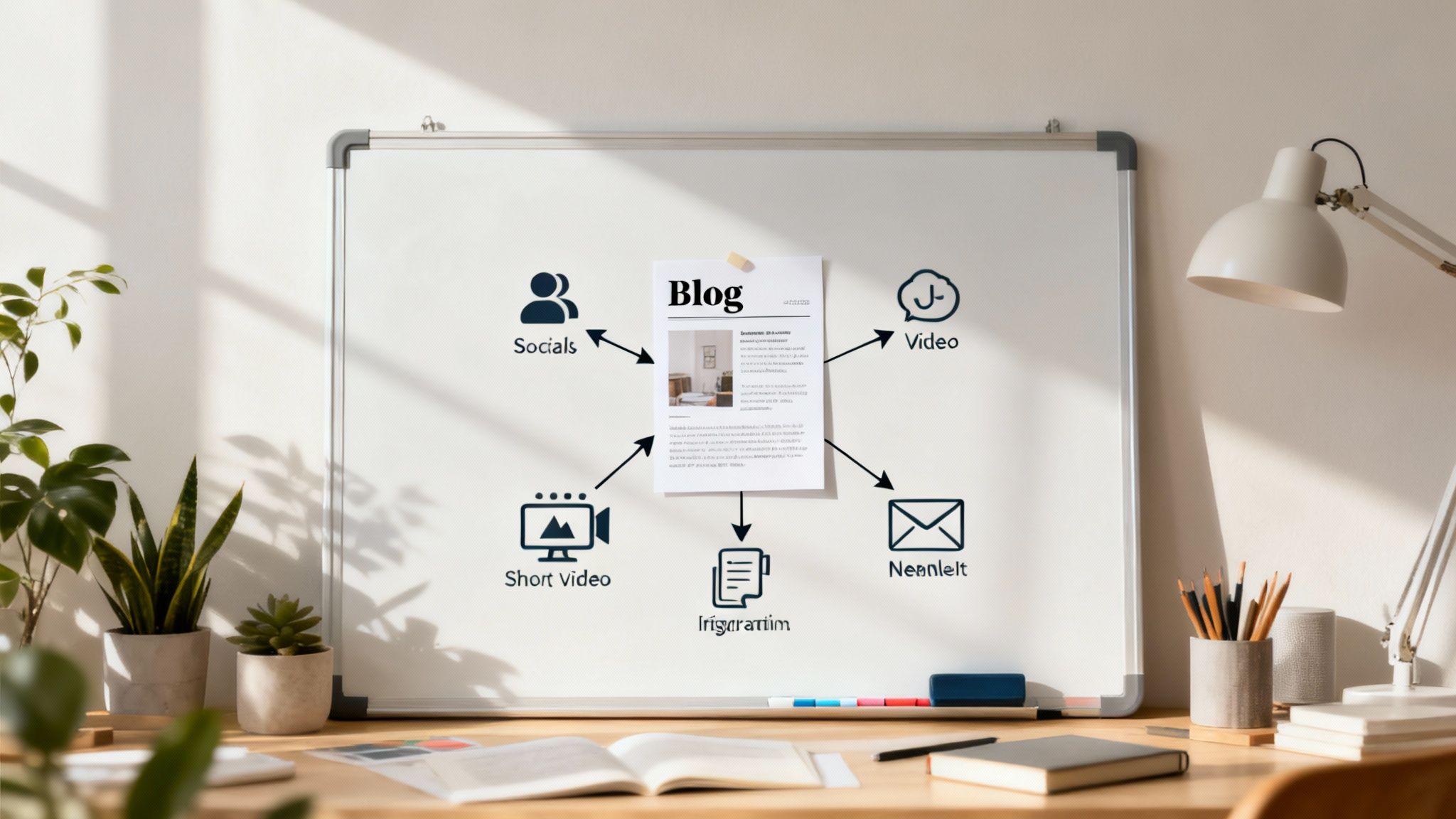
Beyond linking, the most powerful way to amplify your work is by repurposing it. This is the art of taking one killer piece of content and transforming it into a bunch of new formats to hit different audiences on different platforms. It's about working smarter, not harder, and squeezing every drop of value from your best ideas to create new value.
Why let a fantastic, in-depth YouTube video just sit on YouTube? That single video can be the seed for a dozen other pieces of content. This approach not only saves you a ridiculous amount of time but also ensures your core message gets the massive reach it deserves.
Repurposing isn't about being lazy; it's about being brutally efficient. You've already done the hard work of research and creation. Now, it's time to upcycle your old content and give it the largest possible stage.
For professional creators, especially those transitioning from hobbyist to a revenue-generating entity, this is non-negotiable. You can learn more about how content repurposing adds incredible value to your library in our detailed guide. It's the key to turning your existing assets into a powerful, money-making machine.
Content Repurposing Decision Matrix
Feeling a bit stuck on where to begin? This matrix is a simple guide to help you figure out how to best transform your long-form content for different platforms and audiences.
| Original Format | Target Platform | New Format | Key Tactic |
|---|---|---|---|
| Long-Form Blog Post | Instagram / Facebook | Carousel Post | Extract key statistics or steps and turn each into a visually appealing slide. |
| Podcast Episode | Blog / Website | Transcript with Highlights | Publish the full transcript for SEO value and pull out the most impactful quotes as blockquotes. |
| YouTube Video | Twitter / X | Short Video Clips & Thread | Cut 3-4 compelling 60-second clips from the main video and use them to start a conversation in a thread. |
| In-Depth Guide | Article Series | Break down the guide into 3-4 distinct sections and publish them as a series of LinkedIn articles over a few weeks. |
Once you start thinking this way, your content stops being a collection of one-off projects. Instead, your library becomes a living, breathing ecosystem where every asset supports and amplifies the others.
This is exactly where a tool like Contesimal comes in. It helps you organize your content library to discover and collaborate, making it seamless to spot the best pieces to upcycle and reignite their value across every single platform.
Future Proofing Your Content Strategy
The rules of search are in a constant state of flux. If you want to stay ahead, you can't just react to the latest algorithm update; you have to get inside the mind of tomorrow's searcher. A truly resilient strategy is built on predicting future user behavior, making sure your content library is an asset for years, not just a few months.
The biggest shift happening right now? The search results page itself is becoming the final destination for users. For creators who live and die by clicks, this changes the entire game.
Adapting to Zero-Click and Voice Search
The idea of a "zero-click" search—where someone gets their answer right on the results page without ever visiting your site—isn't some fringe concept anymore. It's the new normal.
By 2025, it’s expected that a whopping 58-60% of Google searches will end without a single click. This is only amplified by the rise of voice search, which is already used by over 20.5% of the global population. These users aren't scrolling through a list of blue links. They want one, clear, definitive answer. The data backs this up: 40.7% of voice answers come directly from featured snippets, and the average voice result is a tight 29 words.
This means optimizing content for search engines has evolved. It’s no longer just about ranking high; it's about owning the real estate on the SERP itself.
Your content needs to be structured to answer questions directly and immediately. Start thinking in terms of "snippable" content—clean, concise chunks of information that Google can easily lift into a featured snippet or a 'People Also Ask' box.
Here are a few ways to capture this prime digital real estate:
- Use Question-Based Headings: Ditch generic headings like "Video Editing Tips." Instead, use "How Do You Edit Videos for YouTube?" This perfectly mirrors what people are actually typing (or speaking) into the search bar.
- Provide Direct Answers Upfront: Don't bury the lede. Answer the question immediately below the heading in a short, punchy paragraph. You can always elaborate further down the page.
- Format for Scannability: Use bullet points, numbered lists, and tables. These formats are a magnet for featured snippets because they’re easy for both people and algorithms to parse.
The Role of AI in Content Creation
Let's get one thing straight: AI isn't here to take your job. It's here to be your most powerful collaborator. When used strategically, AI does the heavy lifting, freeing you up to focus on the creativity, nuance, and expertise that only a human can bring to the table.
For creators and publishers sitting on a mountain of content, AI is a total game-changer. It can sift through years of video transcripts, articles, and show notes to spot patterns, identify content gaps, and even suggest new ideas based on what’s worked before. Your archive transforms from a static library into a dynamic well of inspiration.
The most effective content strategies will blend human creativity with AI-powered efficiency. Contesimal helps humans and AI collaborate in a healthy and seamless way. AI can help organize and understand your existing library, while you provide the unique voice that builds a loyal audience.
Imagine being able to ask your own content library questions. You can literally ask, "What are the top three themes in my most popular videos?" This kind of insight used to take days of manual work. Now, you can get it in seconds.
By embracing this kind of collaboration, you can streamline your workflow, make smarter creative decisions, and consistently produce content that’s both authentic and perfectly tuned for modern search. This is how you start maximizing ROI and transforming your content library for lasting value. It’s not just about what you create next; it's about building a smarter, more valuable content ecosystem.
Burning Questions Answered
If you’re digging into SEO, you've probably got questions. It’s a big world. Here are a few of the most common ones I hear from creators and publishers who are just getting their sea legs.
Seriously, How Long Does This SEO Stuff Take?
I get it. You want results yesterday. But SEO is the ultimate long game—a marathon, not a sprint.
You might see some small wins pretty fast from quick fixes, but for a real, lasting impact from a solid content strategy, you should plan for 4 to 12 months. Factors like your site's current authority, how fierce the competition is in your niche, and the quality of your content all play a massive role.
The secret sauce isn't a trick; it's just plain consistency. Keep at it.
What's the Real Difference Between On-Page and Off-Page SEO?
This one’s fundamental, and it's super important to get straight. Let’s break it down simply.
-
On-Page SEO: This is everything you control directly on your own website. Think about the quality of your articles, your title tags, how you structure your headings, and your internal linking. This entire guide has been laser-focused on on-page SEO because it's where you have the most direct power to make a difference.
-
Off-Page SEO: This covers all the actions taken off your website to build up its reputation and authority. The classic example is earning backlinks—getting other credible websites to link back to your content.
You need both. One isn't more important than the other; they work together. Great on-page SEO makes your content worthy of a top spot, while strong off-page SEO builds the authority to actually get it there.
Think of it like this: on-page SEO proves your content is valuable and relevant. Off-page SEO is like having other experts in your field vouch for you, telling Google you’re the real deal.
Should I Actually Bother Updating Old Blog Posts?
Yes. A thousand times, yes! Refreshing and optimizing your old content is one of the most powerful and criminally underused SEO tactics out there. So many creators just let their archives collect digital dust.
Those older posts likely have some authority already, maybe a few backlinks, and a bit of history with search engines. By updating them with fresh info, tightening up the on-page elements, and realigning them with what users are searching for today, you can see huge traffic gains. It’s way less effort than starting a brand-new piece from scratch. This is how you unlock the hidden gold in your content library.
Ready to stop letting your content archive be a forgotten library and start turning it into a revenue-generating powerhouse? Contesimal is built to help creators organize, understand, and take action on their entire content library. It enables you to take your longform content across platforms in one click and turn your old content into a money maker today. Discover how to create infinite value from the work you've already done at https://contesimal.ai.