Let’s be honest. As a content creator, YouTuber, or blogger, your content library is probably a bit of a mess. It’s like a massive treasure chest filled with amazing stuff you created over the years, but trying to upcycle every single piece by hand is completely overwhelming. This is where most creators, transitioning from hobbyist to professional, get stuck.
An SEO automation platform is the smart assistant you wish you had. It systematically goes through your entire content archive, finds all the hidden opportunities, fixes the messy parts, and makes sure every single asset is pulling its weight to attract an audience and help you make money with it.
What Is an SEO Automation Platform?

Think about your ever-growing collection of blog posts, videos, and podcasts. For creators moving from a hobby to a full-time, revenue-generating gig, or for publishers sitting on a huge backlog, the problem is always the same. Your old content is a goldmine, but most of that gold is still buried.
Manually going back through hundreds—or even thousands—of posts to update titles, refresh keywords, or align them with what people are searching for today is a nightmare. It's simply not possible to do it all by hand and still have time to create new content. An seo automation platform changes the game by tackling this problem head-on, allowing you to organize, understand, and take action.
Transforming Your Content Library
This is where the magic really happens. Instead of just being a time-saver, these platforms are designed to turn that dormant archive into an active, revenue-generating machine. They take on the repetitive, data-heavy lifting so you can get back to being creative and experimenting with the next viral concept.
Here’s what they actually do:
- Organize your entire content library so you can finally see everything you have and how it all connects.
- Pinpoint the underperforming posts and videos that have serious potential with just a few tweaks.
- Automate optimization tasks like updating metadata, fixing broken links, and adding internal links.
- Dig up new content ideas based on the gaps in what you’ve already covered, helping you figure out that next new video.
We're seeing a massive shift toward this kind of automation. The global SEO software market was valued at $84.94 billion in 2025 and is expected to explode to around $295.06 billion by 2035. This isn't just about simple tools; this growth is fueled by AI and machine learning that can handle complex tasks like keyword analysis on their own. You can see how this trend is changing everything for creators by checking out the latest market research on SEO software.
The real power of an SEO automation platform is giving your past content a new future. It’s about reigniting your entire library to create infinite content value, making old assets discoverable and valuable all over again.
By connecting everything you've ever made—from YouTube videos and podcast episodes to blog posts and articles—the platform gives you a single, unified view of your creative universe. You start to understand what works, what flopped, and where your next big hit might be hiding.
This isn't about replacing your creative spark. It’s about giving that spark the data and the tools it needs to be more impactful, generate more views, and ultimately, be more profitable.
To really get a feel for the shift, it helps to see the old way and the new way side-by-side. The difference isn't just in the tools; it's a fundamental change in how you approach your content strategy.
Manual SEO vs Automated SEO Platform
| Aspect | Manual SEO (Traditional Approach) | SEO Automation Platform (Modern Approach) |
|---|---|---|
| Scale | Limited to a few high-priority pages at a time. | Can analyze and optimize thousands of assets simultaneously. |
| Process | Repetitive, manual tasks like keyword research and link updates. | Automates data analysis, content grouping, and optimization tasks. |
| Speed | Slow and methodical; can take weeks or months to see results. | Delivers insights and implements changes in minutes or hours. |
| Focus | Often reactive, fixing problems as they appear. | Proactive, identifying opportunities and preventing issues at scale. |
| Data | Relies on separate tools (analytics, keyword finders, etc.). | Integrates data sources into a single, unified dashboard. |
| Outcome | Incremental gains on individual pages. | System-wide improvements that lift the entire library's performance. |
Looking at this comparison, the takeaway is clear. While manual SEO still has its place for hyper-focused tasks, it just can't keep up with the scale and speed required to manage a modern content library. An automation platform gives you the power to treat your entire archive as a single, dynamic asset.
The Core Capabilities That Power Automation
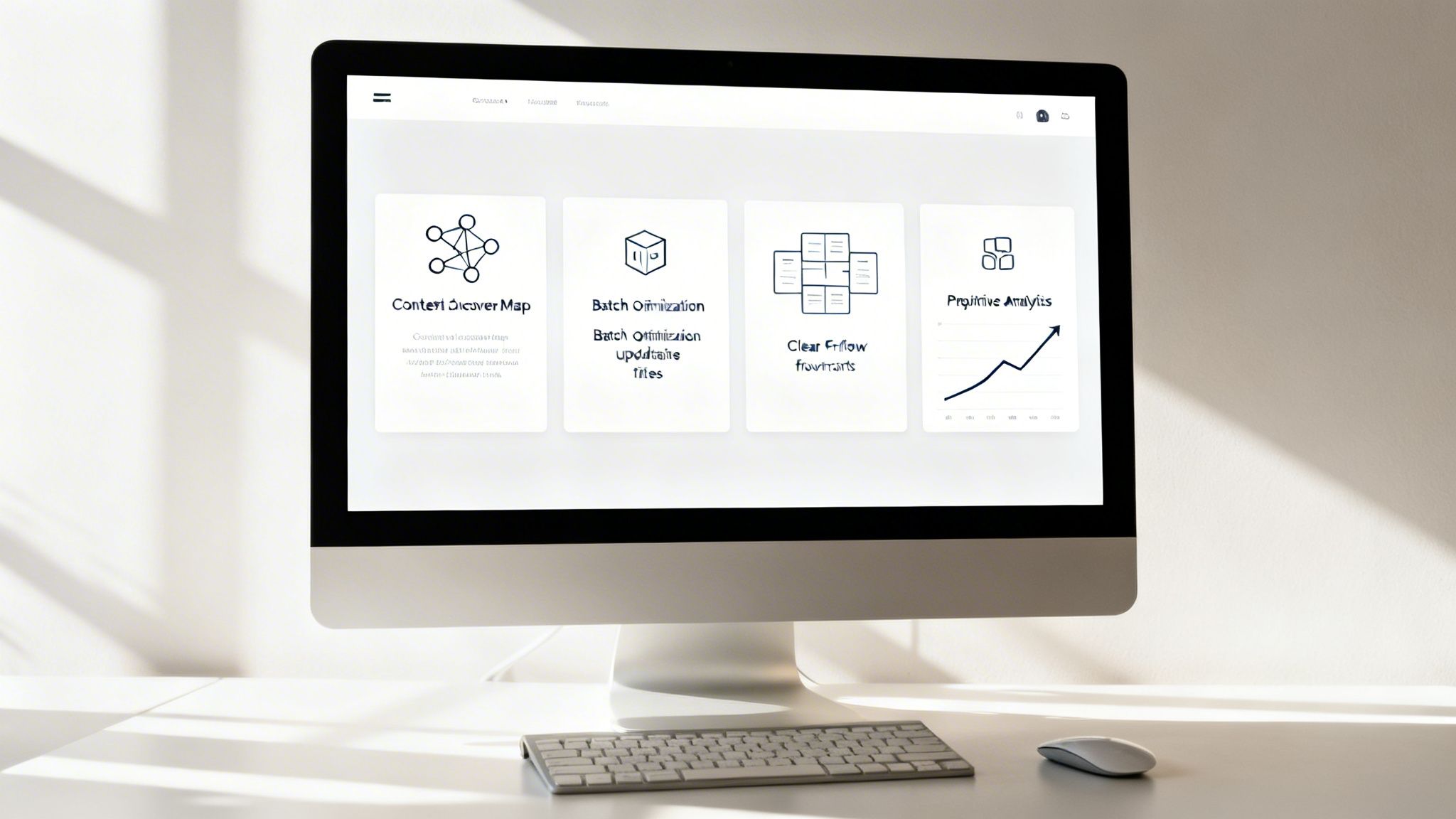
So, how does an seo automation platform actually turn a dusty, forgotten content archive into an active asset? To really get it, you have to look under the hood. It’s not just a grab bag of tools but a connected set of features built to help creators stop grinding and start working smarter.
Think of your content library as a sprawling city. The automation platform is the smart infrastructure that keeps it all running. It directs traffic, revitalizes old neighborhoods, and makes sure new construction is based on solid planning. These platforms are designed to handle the heavy lifting behind strong organic traffic generation strategies.
AI-Powered Content Discovery
First things first, an automation platform has to make sense of your entire content universe. Imagine you’re a podcaster with 500+ episodes. Trying to manually dig through all those transcripts to find related topics or guest mentions is a nightmare. It’s practically impossible.
AI-powered discovery acts like a super-librarian, instantly scanning and understanding every video, podcast, and article you've ever made.
- It Finds Your Power Pockets: The AI groups related content, showing you where you have deep authority. Suddenly, you can see all your videos on "beginner filmmaking" clustered together, ready to be turned into a playlist or content bucket.
- It Shines a Light on Gaps: It also points out valuable topics your audience loves that you’ve only touched on briefly. These are prime opportunities for your next big piece of content.
- It Maps Your World: The platform creates a visual map of your library, helping you see exactly how your "how-to" guides connect to your "product review" videos.
For any creator trying to move from hobbyist to pro, this is the foundation. It gives you that bird's-eye view you need to build a real strategy instead of just guessing what to make next.
Programmatic Optimization at Scale
Once the platform understands what you have, it gets to work on improving it. Think of a publisher with thousands of old blog posts. Going back to manually update titles, descriptions, and internal links for SEO is a soul-crushing task that literally never ends.
Programmatic optimization automates these updates across your entire library in an instant. A platform can analyze top-ranking content for a keyword and then suggest better titles for 100 of your related articles at once.
This isn't just about saving a few hours. It's about applying a consistent, data-driven optimization strategy to every single thing you own, making sure no asset gets left behind.
This isn’t some far-off future tech; it’s happening now. The best platforms can analyze historical performance, automatically tweak metadata, and spot chances to repurpose content for a quick visibility boost.
Workflow Automation and Analytics
Finally, a true seo automation platform connects the dots between insight and action. It’s not enough to just know what to do; the platform has to help you actually do it. This is where collaboration, workflow automation, and analytics come in.
Workflow automation smooths out the entire content process. For instance, when the AI flags an underperforming video that has high potential, it can automatically create a "refresh brief" for your writer or collaborator, complete with suggested keywords and title ideas. This is a key feature of advanced content intelligence platforms that blend data with the creative process.
Predictive analytics takes it a step further by helping you decide what to create next. By analyzing your past hits and current trends, the platform can forecast which topics are most likely to pop off, helping you bet on content that will deliver more views. This lets you double down on what works and experiment with new ideas backed by real data.
Reignite Your Content Library and Unlock Its Value
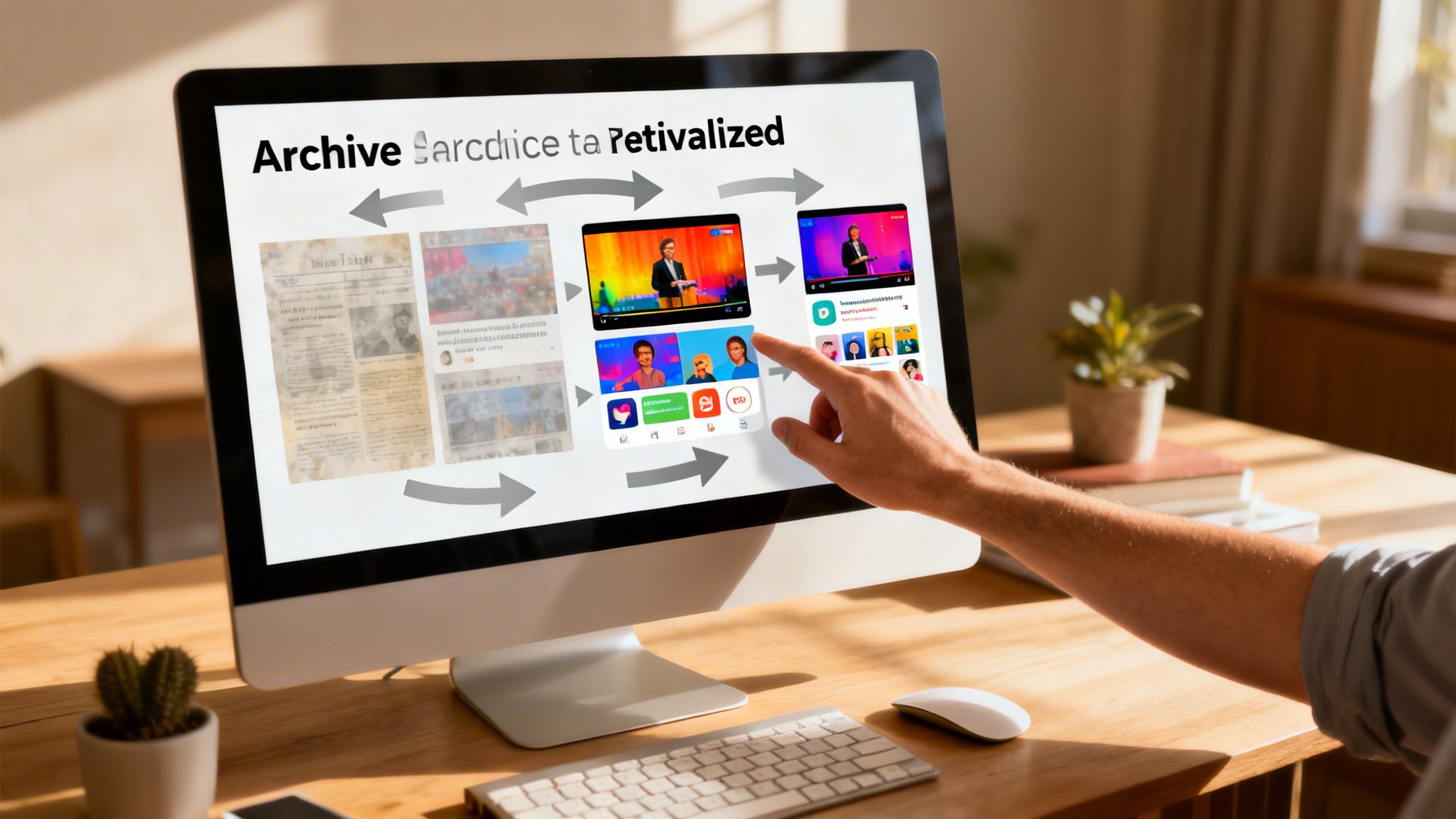
Every creator knows the feeling. You've poured thousands of hours into your content—videos, podcasts, blog posts. That archive of past work is a testament to your grind. But most of it just sits there, collecting digital dust and losing its punch.
An seo automation platform is built to fix this. Think of it as a tool that digs through your digital attic, finds the hidden gems, and polishes them for a new audience. Instead of letting your best work fade away, you can put it back on the front lines to make you money today.
For YouTubers and Podcasters
Let's say you have a back catalog of hundreds of long-form videos or podcast episodes. Going through them one by one to find new ideas is a soul-crushing, impossible task. This is where automation flips the script by systematically scanning your entire library for you.
A platform can rip through every transcript and start working its magic. It can:
- Spit out killer titles and hooks for new YouTube Shorts or TikToks by finding the most electric moments in your hour-long recordings.
- Pinpoint the perfect soundbites and quotes that can become audiograms or social media posts, breathing new life into old episodes.
- Rewrite stale video and episode descriptions to match what people are actually searching for today, making them discoverable all over again.
For any creator trying to go from a side hustle to a full-time gig, this is a total shift in workflow. It lets you take your longform content across platforms in one click, automating the messy work of repurposing content so you can pump out tons of new, optimized micro-content from a single video or podcast. All without burning yourself out.
For Bloggers and Publishers
Writers and publishers have the same problem, just with words. An archive of a thousand articles can feel more like a weight than an asset, with old posts getting zero traffic or becoming totally irrelevant. An automation platform turns that liability into an opportunity.
The system combs through your entire site, using data to show you exactly where the low-hanging fruit is.
By looking at page views and content topics together, the platform can flag underperforming posts that have a real shot at ranking with a simple refresh. It takes the guesswork out of what to update, pointing you toward the articles that will actually move the needle on engagement.
This isn't just about tweaking a few posts here and there. A smart seo automation platform helps you build a solid content strategy that links individual articles into a powerful, connected web. Once you start building those connections, you can even dig into advanced ideas like what is enterprise search to get even more organized and monetize your knowledge base.
From Dormant Archive to Dynamic Engine
The end goal here is to stop thinking of your library as a static collection and start seeing it as a dynamic system that constantly pulls in results. The platform connects your content plan to real-world outcomes, so you can actually see the ROI from your efforts.
The key outcomes are what matter:
- Increased Organic Traffic & Page Views: When you optimize old content and build strong topic clusters, your site's authority grows, and you start pulling in more search traffic.
- Higher Engagement Rates: Slicing and dicing content for different platforms keeps your audience hooked and shows them the full range of what you do.
- New Monetization Streams: Bringing old content back to life can unlock new affiliate income, drive leads, or boost ad revenue on posts you'd forgotten about.
The story is simple: a dormant archive is a huge missed opportunity. An seo automation platform gives you the toolkit to systematically organize, optimize, and monetize that history, turning your past work into a powerful engine for future growth. It lets you finally get the full return on all that creative sweat you've already put in.
How to Choose the Right Automation Platform
Picking the right SEO automation platform is a huge decision for your content's future. This isn't just another monthly subscription you can forget about. It's a choice that will dictate how you organize, optimize, and pull revenue from your creative work for years to come. The wrong tool just sits there collecting digital dust, but the right one becomes the engine room for your growth.
So, how do you get it right? You need a practical way to cut through the noise. The goal is to find a platform that feels like it was built just for you, whether you’re a solo YouTuber finally going pro or a massive publisher trying to wrangle a giant content library.
Evaluate Core Platform Features
First things first: look past the slick marketing and focus on what the platform actually does to solve your biggest headaches. A gorgeous dashboard is worthless if it can’t talk to the places where your content actually lives.
- Integration Capabilities: Does the platform play nice with your current setup? You need to see native integrations with [YouTube], podcast hosts (like [Libsyn] or [Transistor]), and your CMS (like [WordPress] or [Ghost]). If you’re stuck manually entering data, you’ve defeated the whole point of automation.
- Scalability and Performance: Can this thing grow with you? It needs to handle your 100 videos today just as smoothly as it will handle 1,000 videos next year—without grinding to a halt. Don't be shy about asking about ingestion speeds and processing power.
- User Interface (UI) and Experience (UX): Who was this built for—a creator or a technical SEO nerd? A great platform speaks your language. The workflows for finding content clusters and spotting repurposing ideas should feel intuitive, not like you're staring at a wall of raw data.
Getting this part right is more important than ever. The SEO services market is absolutely exploding, which tells you just how much businesses are zeroing in on search. It's projected to jump from $81.46 billion in 2024 to a staggering $108.28 billion by 2026. That 32.9% growth means the fight for your audience's attention is getting fiercer by the day, making a powerful automation tool a real secret weapon. You can read more about this wild market growth on xamsor.com.
Calculate the True Return on Investment
A platform’s real value is so much more than its price tag. The ROI isn’t just about saving a few bucks; it’s about creating new value and getting back your most finite resource: your time. A platform like Contesimal helps you see this clearly by turning your dusty content archive into an active, revenue-generating machine.
The most significant return from an SEO automation platform is the value of reclaimed creative energy. When you automate tedious optimization tasks, you free your team to focus on what humans do best—storytelling and building community.
Think about the ROI in these concrete terms:
- Value of Reclaimed Time: Add up the hours your team wastes on manual stuff like updating metadata or hunting for old clips. Multiply that by an hourly rate. That’s your direct cost savings, right there.
- Increased Content Output: How many more social clips, blog posts, or short-form videos could you pump out if repurposing was a one-click affair? Every extra piece is another "at-bat" for a viral hit.
- Revenue from Revitalized Assets: Start tracking the traffic and money coming from old posts and videos that the platform helped you dust off and refresh. This is brand-new income from work you already did.
When you're shopping for a platform, it’s easy to get lost in feature lists. To keep you on track, we've put together a simple checklist to help you compare your options and find the perfect fit for your needs as a creator or publisher.
Key Platform Evaluation Checklist
| Evaluation Criteria | What to Look For | Why It Matters |
|---|---|---|
| Core Integrations | Native connections to your CMS (WordPress, Ghost), video hosts (YouTube), and audio platforms (podcast hosts). | Avoids manual data entry and ensures your entire library is always in sync without extra work. |
| Content Ingestion & Processing | How quickly can it analyze your entire library? Does it handle video, audio, and text? | A slow platform creates bottlenecks. You need a tool that keeps up with your creation speed, especially for large libraries. |
| Content Discovery & Clustering | AI-powered topic analysis that automatically groups related content. | Helps you instantly see opportunities for content series, guides, and playlists without manually sifting through hundreds of files. |
| Workflow Automation | Can you create "if-this-then-that" rules? (e.g., "If video is published, create a blog post draft.") | This is where you reclaim serious time. True automation handles the repetitive tasks that drain your creative energy. |
| Repurposing Tools | Features that help you extract clips, generate summaries, or create social media drafts from existing content. | Turns one long-form piece into dozens of smaller assets, massively increasing your content output and reach. |
| User Experience (UX) | Is the interface intuitive for a creator, or does it require a data scientist to operate? | You'll only use a tool if it feels good to use. It should simplify your life, not add another layer of complexity. |
| Analytics & Reporting | Clear dashboards showing which revived content is driving traffic, engagement, and revenue. | Proves the ROI. You need to see exactly how the platform is making you money from your old content. |
By using this checklist to guide your conversations and demos, you’ll be able to see beyond the sales pitch. You'll be focusing on the practical, day-to-day value the platform can bring to your specific workflow.
Ultimately, by focusing on these practical criteria, you can find an SEO automation partner that doesn't just fit into your workflow but actively pushes your growth forward. It’s all about building a smarter, more valuable content library—and freeing yourself up to do what you do best: create.
Your Roadmap to Implementing SEO Automation
Bringing an seo automation platform into your workflow isn’t like flipping a switch and hoping for the best. It’s a phased process that takes your content strategy from chaotic and manual to organized and scalable. Think of this roadmap as your step-by-step guide to getting started without feeling like you're drowning in new tech.
The first step is always getting your content connected. The right platform should feel like an extension of your own creative brain, not just another piece of software you have to manage.
Phase 1: Content Ingestion and Audit
Before you can optimize anything, the platform needs to see what you’re working with. Phase 1 is all about plugging in your content libraries—your YouTube channel, your podcast host, maybe your blog’s CMS. Once everything is connected, the AI gets to work doing a full-blown audit.
It's like dumping all your Lego bricks on the floor and having a robot instantly sort them by color, size, and shape. The platform scans every video, transcript, and article, building a complete map of your entire content universe. Right away, this uncovers some quick wins, like finding your most valuable assets and flagging obvious technical problems.
Phase 2: Setting Up Automation Rules
Okay, your library is organized. Now you get to tell the platform what you want it to do. In this phase, you start defining the automation rules that will power your content strategy. This is where you move from just looking at data to taking real action.
You can set up workflows for specific goals you have in mind:
- Metadata Optimization: You could create rules to automatically suggest better titles and descriptions for older videos that aren't performing well, based on what people are searching for right now.
- Repurposing Opportunities: Instruct the AI to flag any long-form video that has more than three distinct, clip-worthy moments that would make great YouTube Shorts or TikToks.
- Content Brief Creation: How about automating the creation of content briefs for your writers? Set it up so a brief is generated whenever the system finds a high-potential "content gap" you could fill.
This visual guide shows the core steps for getting a platform up and running to integrate, scale, and evaluate your content strategy.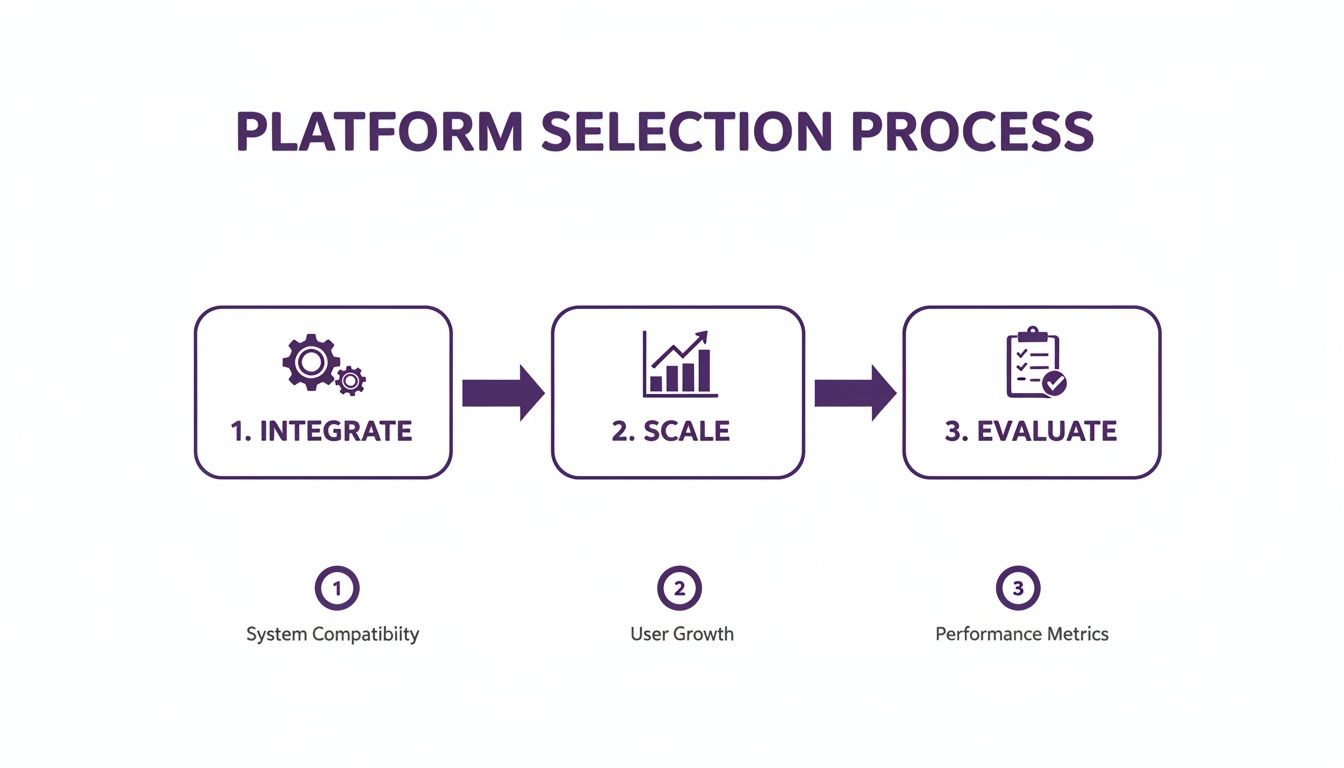
This process really just highlights a simple truth: successful implementation comes down to seamless integration, workflows that can grow with you, and constantly checking your results to fuel more growth.
Phase 3: Integrating Human Creativity
Let’s be clear: automation should never, ever replace your unique voice. This phase is all about making sure your team and the AI are working together. The platform is there to provide the data-driven suggestions, but your creative team still needs to provide that final human touch.
Think of the AI as a brilliant research assistant, not the creative director. It brings you the data, the patterns, and the opportunities, but you decide how to use them to tell a compelling story.
For example, the AI might spit out five new video titles it thinks will work. It’s up to your writer to pick the one that best fits your brand's tone and maybe tweak it to perfection. This human-in-the-loop approach is what keeps your content feeling authentic and genuinely engaging.
Phase 4: Monitoring and Iterating
Finally, automation isn’t a "set it and forget it" magic bullet. It’s a continuous improvement loop. The final phase is all about watching your results and tweaking your automation rules based on what’s actually working.
You'll use the platform's analytics to track how your revitalized content is doing. Did those new titles actually increase click-through rates? Are the repurposed clips bringing in new subscribers? This data feeds right back into your strategy, helping you make smarter decisions and fine-tune your workflows for even better results down the road.
Let’s be honest, when you hear "seo automation platform," you probably picture a robot mindlessly checking off a to-do list. For a long time, that’s pretty much what they did. But that’s old news. We're seeing a massive shift away from these platforms as simple "doers" and toward something much more interesting: genuine content intelligence partners.
The future isn’t about AI replacing you, the creator. Not even close. It's about building a partnership where the tech becomes your creative co-pilot, helping you navigate the messy, data-heavy parts of the job so you can focus on what people actually connect with—your stories and your voice.
From Task-Doer to Creative Co-Pilot
Think of it this way: the next wave of automation isn't here to take your job; it's here to supercharge your creativity. For any creator, that means letting the AI do the heavy lifting—like analyzing mountains of data—which frees you up to nail the human side of content. The storytelling, the emotional hooks, and the community you build around your work.
This is the whole idea behind tools like Contesimal. The goal is to build a healthy, seamless collaboration between humans and AI. It's about empowering you to discover hidden gems in your own content library and spot creative angles you might have otherwise missed entirely.
The ultimate goal is to create a system where humans and AI collaborate to generate meaning and value from a shared set of knowledge. The platform organizes the information, but the creative team curates it to tell compelling stories.
This kind of partnership is a game-changer for creators who are trying to scale up from a hobby into a real business. It gives you the structure you need to grow without killing the creative spark that got you here in the first place. We dig deeper into how this works in our guide on using AI for SEO.
Augmenting Human Ingenuity
Again, this isn't about handing the keys to a robot and letting it write your next blog post. It's about having a partner that brings you the insights to make that blog post so much better.
Imagine an AI that acts like a member of your creative team.
- Brainstorming Help: The AI flags a "content gap" after analyzing audience comments, then pitches you three video ideas to fill it. It even shows you the data on why each concept is likely to hit home.
- Narrative Structure: You're a podcaster about to launch a new series. The platform looks at your most popular episodes and suggests a story arc, pointing out the perfect moments for emotional beats or expert interviews based on what your listeners have loved in the past.
- True Audience Insight: Instead of you sifting through thousands of comments, the AI synthesizes all that feedback and search data into a clear persona of your ideal viewer. Suddenly, you know exactly who you're talking to and what they need to hear.
This vision of a creative co-pilot is already happening, blending the raw power of machine efficiency with uniquely human creativity. If you’re curious about the dedicated AI SEO services that are pushing search into this new territory, you can find providers who are all-in on this collaborative model.
Ultimately, this partnership frees you up to do what only you can do: build a real community around content that actually matters.
Frequently Asked Questions
Got questions? We've got answers. Here are a few of the most common things creators ask about using an SEO automation platform to scale up and grab a bigger audience.
Will an SEO Automation Platform Replace My Creative Input?
Absolutely not. Think of it less like a replacement and more like a super-powered creative partner. It’s the assistant you wish you had—the one who handles all the tedious, mind-numbing tasks you hate.
Imagine not having to manually analyze thousands of competitor pages or update metadata one by one. The platform does the heavy lifting. This frees you up to do what you do best: dream up big ideas, connect with your audience, and inject your unique brand voice into everything you create. It’s a partnership where the tech brings the data, and you bring the soul.
Is an SEO Automation Platform Only for Large Publishers?
While the big players with massive content archives get a ton of value, these platforms are a game-changer for any creator who’s serious about growth. If you're a YouTuber or podcaster who's ready to go from hobby to full-time gig, it helps you build a solid foundation from the start.
It gets your growing library organized, makes sure every video or episode is fully optimized, and shows you exactly what’s resonating with your audience so you know where to focus your energy. For content marketers, it’s a machine for repurposing, squeezing every last drop of value out of each asset, no matter how big or small your library is today.
The real magic is building a system for growth. It’s what takes you from being a solo creator to a collaborative powerhouse that knows how to build a real audience across every platform.
How Long Does It Take to See Results?
You’ll see a mix of quick wins and long-term gains. The short-term stuff often pops up within the first few weeks. The platform might spot a bunch of easy-to-fix technical SEO issues or find high-value pages with weak metadata. Fixing those can give you a nice, quick boost in rankings.
But the long-term value is where things get really exciting. Over a few months, the system gathers performance data and helps you build out entire topic clusters, leading to a steady climb in organic traffic and establishing you as an authority. Plus, automating your content repurposing gives you an immediate return by slashing your production time, letting you test out new ideas and find your next viral hit faster.
Ready to turn your content archive into a revenue-generating engine? With Contesimal, you can organize, understand, and take action on your entire content library. Reignite your past work and create infinite value today. Learn more at Contesimal.