Imagine your library of videos, podcasts, and articles is a sprawling goldmine. Right now, most of that value is buried, completely out of sight. Intelligent Document Processing (IDP) is the automated mining crew that brings it all to the surface. It uses AI to finally understand the meaning, context, and value inside every piece of content, not just scan it. For content creators, this is how you reignite your content library and bring it back to life.
Your Content Library Is an Untapped Goldmine
For years, creators, YouTubers, and publishers have been piling up massive digital archives. Videos, podcast episodes, blog posts, and research notes—they all tend to sit in separate folders, their potential completely locked away. This is the moment where many creators move from hobbyist to professional; you have a library of content, but figuring out how to generate more audience engagement or create the next new video feels overwhelming.
Trying to find a specific quote from an old interview or spot recurring themes across a dozen articles takes hours of manual digging, if you can even manage it. This is where you first see the real power of what is intelligent document processing. It transforms a chaotic archive into a smart, interconnected database, helping you organize, understand, and take action.
Think of IDP as a brilliant research assistant that never sleeps. It goes way beyond simple scanning or keyword searches. Instead, it uses advanced AI, like Natural Language Processing (NLP), to read, watch, and listen to your content, understanding it on a much deeper level.

From Static Files to Dynamic Assets
IDP automates the heavy lifting that turns a passive content library into an active, valuable asset. This is a game-changer for creators looking to upcycle old content, scale up, and find new revenue streams from work they've already done.
An organized, intelligent library becomes the foundation for all future content creation and repurposing. To get a better feel for this, exploring the features of the best digital asset management software can show you what a truly structured system looks like.
The real magic of IDP for a content library comes down to a few core jobs:
- Automated Tagging: It automatically identifies speakers, topics, brands, and key concepts in your videos and podcasts. No more manual metadata entry.
- Intelligent Classification: It sorts articles, scripts, and transcripts into custom categories you define, like "beginner guides" or "expert interviews."
- Key Data Extraction: It pulls out specific, valuable information—like powerful quotes, statistics, or viewer questions—from mountains of unstructured text.
Unlocking Your Media’s Full Potential
And this technology isn't just for text files. Modern IDP systems can process multimedia formats, turning your audio and video into structured, searchable data. To really squeeze every drop of value from your library, looking into methods like YouTube to text transcription can open up huge possibilities for repurposing and accessibility.
By applying IDP, you're not just organizing files; you're building a "brain" for your entire content history. This lets you ask complex questions and get instant answers, like "Show me every time I mentioned 'audience growth' in my podcasts" or "Find all positive viewer comments about our new product." This unlocks immense value, making your old content a rich resource for new ideas and strategic insights.
Beyond Scanning: How IDP Outshines Traditional OCR
When people hear "document processing," their minds usually jump to its ancestor, Optical Character Recognition (OCR). While OCR was a foundational step, comparing it to Intelligent Document Processing (IDP) is like pitting a simple point-and-shoot camera against a full-blown film crew. One just captures an image; the other understands the entire story.
Think of traditional OCR as a digital photocopier. It's great at taking a document—a script, an old article, or a set of production notes—and turning it into a flat text file you can search. It builds a digital filing cabinet, but it has zero clue what any of the words actually mean.
IDP, on the other hand, is your brilliant research assistant. It doesn't just digitize content; it reads, digests, and understands it. For creators, this is the game-changing difference between having a disorganized digital archive and having a dynamic, intelligent asset that helps you find your best material instantly.
The Limits of Just Seeing Text
Traditional OCR technology often hits a wall, especially when faced with the kind of messy, unstructured content creators deal with every day.
Its main weaknesses include:
- Struggling with Complex Layouts: OCR gets tripped up by columns, tables, and captions in magazine spreads or blog posts, often spitting out a jumbled mess.
- Ignoring Context: It can’t tell the difference between a speaker's name in a podcast transcript and a brand they just mentioned. To OCR, it's all just text on a page.
- Lacking Analytical Power: It can’t grasp the sentiment of viewer comments, summarize the key points from a series of articles, or spot recurring themes in your work.
To really appreciate the leap IDP represents, it helps to understand its roots. For a deeper look at the tech IDP builds on, check out this quick guide on mastering OCR for content scanning, extraction, and translation. It perfectly frames just how far we've come.
How IDP Adds the "Intelligence" Layer
IDP takes the raw text captured by OCR and feeds it through powerful AI and Machine Learning models, adding layers of genuine understanding. This upgrade is so significant that 63% of Fortune 250 companies have already deployed IDP solutions. The market isn't just growing; it's exploding, with a projected 29.6% CAGR through 2034, according to Fortune Business Insights.
Where OCR sees a block of text from a video transcript, IDP identifies the host, the guest, the questions asked, the products reviewed, and the overall tone of the conversation. It creates structured, meaningful data from chaotic, unstructured content.
This "intelligence layer" is what makes the magic happen. It allows a YouTuber to automatically find every clip where a specific product was praised or a podcaster to instantly pull all questions asked by guests across hundreds of episodes. The technology doesn’t just read the words; it understands their role and relationships, unlocking countless new ways to find, repurpose, and create.
The table below breaks down the practical differences and shows why IDP is such a massive step up for anyone working with content.
Traditional OCR vs Intelligent Document Processing
| Capability | Traditional OCR | Intelligent Document Processing (IDP) |
|---|---|---|
| Basic Function | Converts images of text into machine-readable text files. | Extracts text and understands its context, structure, and meaning. |
| Data Format | Outputs unstructured, plain text. | Outputs structured, labeled data (e.g., guest_name, product, question). |
| Layout Handling | Struggles with tables, columns, and mixed media. | Accurately interprets complex layouts and document structures. |
| Contextual Awareness | None. "Apple" is just a word. | High. Differentiates between Apple the company and apple the fruit. |
| Data Validation | No built-in validation; requires manual checks. | Automatically validates data against predefined rules and external sources. |
| Integration | Limited; often requires manual data entry into other systems. | Seamlessly integrates with other applications via APIs. |
| Use Case for Creators | Making old scripts or articles keyword-searchable. | Automatically tagging clips, identifying key topics, and analyzing audience sentiment to find the next viral concept. |
In short, while OCR digitizes your documents, IDP turns them into active, intelligent assets that work for you.
The Five Stages of the IDP Workflow
To really get what Intelligent Document Processing is all about, you need to see it in motion. Think of it as an automated content assembly line, taking all your raw, jumbled media and turning it into organized, valuable assets you can actually use.
This whole process unfolds in five distinct stages. Each step builds on the last, systematically unlocking the insights buried deep inside your content library.
This is a huge leap past older tech like basic OCR. The graphic below really drives home the difference between just scanning a document and truly processing it with intelligence.
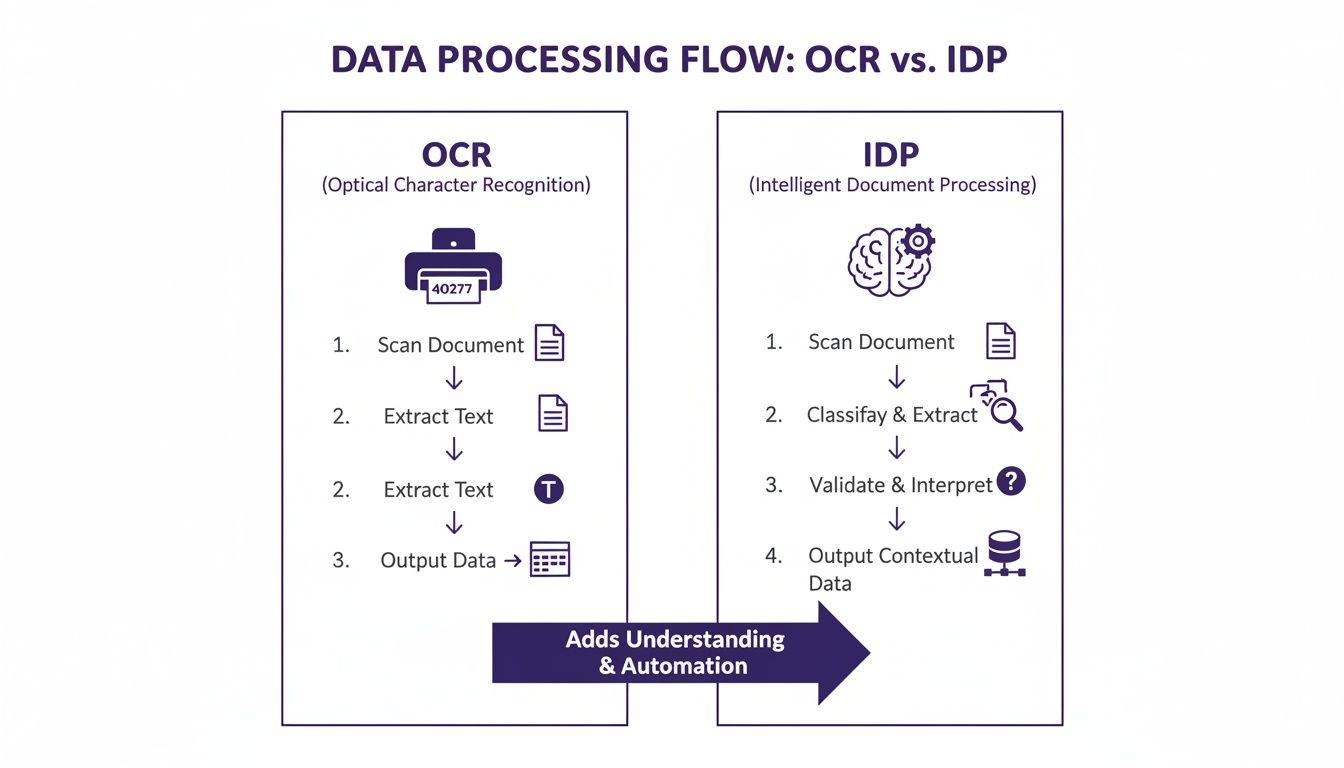
As you can see, OCR is just a quick conversion from image to text. IDP, on the other hand, is a full-blown workflow that layers on understanding and structure.
Stage 1: Ingestion and Pre-Processing
First things first, the system needs its raw materials. The ingestion phase is where you feed your content library into the platform. We're not just talking about PDFs and Word docs here; a solid IDP solution can handle the wide variety of formats modern creators rely on.
- Video files (MP4, MOV)
- Audio files (MP3, WAV)
- Transcripts and scripts (DOCX, TXT)
- Scanned articles and research notes (PDF, JPG)
Once everything is loaded up, the content moves to pre-processing. This is basically the cleanup crew. The system automatically straightens skewed images, filters out background noise from audio, and sharpens text quality. The goal is to give the AI models the cleanest possible data to work with. For a video creator, it's like having an automated assistant prep all your raw footage before the edit even begins.
Stage 2: Classification
With clean data ready to go, the system's next job is to figure out what it's looking at. Classification is like an automated sorting hat for your content. Using AI, the IDP platform analyzes each file and drops it into a predefined category that you've set up.
Imagine your entire podcast library getting automatically sorted into buckets like "Guest Interviews," "Solo Episodes," or "Product Reviews." This is way smarter than just organizing files in folders because it understands the content of the file, not just its name. This automated sorting is a crucial first step toward building a truly searchable, intelligent content database.
Stage 3: Extraction
This is where the real magic happens. The extraction stage is where the system acts like a meticulous researcher, pulling specific, structured bits of data from your unstructured content. It's not just finding keywords; it's pinpointing and isolating truly meaningful information.
For a YouTuber, this could mean automatically pulling:
- Brand names mentioned in a review video.
- Key topics discussed, complete with timestamps for creating video chapters.
- Powerful quotes from an expert interview.
- Questions asked by viewers in the comments section.
Suddenly, a 60-minute video is transformed into a rich dataset, all ready for you to analyze and repurpose. No more manually scrubbing through timelines.
Stage 4: Validation
Extracted data is only useful if it’s on the money. The validation stage is your quality control checkpoint. Here, the IDP system double-checks the extracted information against predefined rules or existing databases to confirm its accuracy.
For example, it might verify that a product name is spelled correctly or that a date is in the right format. Some systems can even flag data with a low confidence score, sending it over for a quick human review. This step ensures that the structured data you build your new content on is totally reliable.
Stage 5: Integration and Post-Processing
Finally, all this newly structured, validated data needs to be put to work. In the integration stage, the IDP platform pushes this valuable information out to the other tools in your creative stack.
This means your CMS, project management software, or a collaborative platform like Contesimal can be automatically updated with fresh insights. You can see how these systems connect in a detailed enterprise search software comparison, which shows just how vital that seamless flow of data is. Your organized content library becomes an instantly actionable resource, fueling new ideas and making your entire creation process smoother.
Putting IDP to Work for Creators and Publishers

This is where the theory behind intelligent document processing stops being an abstract idea and starts becoming a practical tool for your daily grind. This tech isn't just for massive corporations drowning in invoices. It’s a powerful ally for content professionals who need to work smarter, not harder.
The explosion in IDP adoption comes from a problem we all face: we're overwhelmed by data. Experts predict the world's data will hit a mind-boggling 175 zettabytes by 2025. A huge chunk of that is trapped in unstructured formats that no manual team could ever hope to sort through.
While finance and accounting departments led the charge—with 71% of Fortune 250 firms in the financial sector already using IDP—the creative industries are catching on fast. You can dive deeper into these market trends with this report from Polaris Market Research. For creators, this means finally getting a real handle on their ever-growing content libraries.
Let's move past the jargon and look at real-world scenarios where IDP can save you hundreds of hours, spark new ideas, and squeeze fresh value out of the content you've already made.
For the YouTuber and Video Creator
Picture this: you have a library of over 200 long-form videos. Trying to find that perfect clip for a compilation or a social media post is a nightmare of scrubbing through endless timelines.
With IDP, that all changes. You can feed your entire video archive into the system to automatically:
- Generate Timestamps and Chapters: The system listens to your dialogue, identifies key topic shifts, and instantly creates chapters for your YouTube descriptions. This improves the viewer experience and boosts your SEO.
- Create Highlight Reels: IDP can analyze your transcripts and even viewer comments to pinpoint the most engaging, most quoted, or most debated moments. It then flags them as perfect candidates for short-form clips.
- Track Brand Mentions: It automatically logs every single time you mention a sponsor or a specific product, creating an instant report for your brand partnerships without you lifting a finger.
For the Podcaster and Author
Your podcast episodes and book manuscripts are goldmines of quotes, stories, and recurring ideas. IDP acts as your personal archivist and research assistant, turning all that audio and text into an intelligent, searchable database.
A podcaster could feed hundreds of episode transcripts into an IDP system to:
- Identify Recurring Themes: Discover which topics you and your guests keep coming back to. This gives you the perfect foundation for a new book, a course, or a themed series.
- Extract Expert Quotes: Instantly pull all the most powerful quotes from industry experts you've interviewed. They'll be ready to go for social media graphics or promotional materials.
- Build a Knowledge Base: Create a searchable database of every question asked and answered on your show. This helps you spot content gaps and plan future episodes your audience is guaranteed to love.
For the Publisher and Content Marketer
As a publisher, your back catalog is one of your most valuable assets. IDP helps you analyze your entire archive to make smarter decisions about what to create next and how to get more mileage out of what you already have.
Instead of guessing what works, you can use IDP to analyze your entire content library and pinpoint exactly which topics, formats, and authors have driven the most engagement over time. This data-driven approach transforms content strategy from an art into a science.
For example, a publisher could analyze thousands of articles to:
- Pinpoint Content Gaps: Compare your published content against top-ranking competitor articles to see which keywords and topics you're completely missing.
- Identify Evergreen Performers: Automatically flag articles that consistently bring in traffic, marking them for updates and promotion to a whole new generation of readers.
- Optimize Internal Linking: The system can suggest relevant internal links by understanding the context of new drafts and finding related content hiding in your archive.
Each of these examples shows how IDP moves from a complex tech concept to a practical, time-saving tool. It organizes your past work to fuel your future creativity.
Choosing the Right IDP Solution for Your Content
Understanding what intelligent document processing can do is the first step. Finding the right tool to actually do it? That's a whole different ballgame.
The market is flooded with options, but most are built for corporate finance or legal teams—not for creators. As a creator or publisher, you need to hunt for features that play nice with your unique workflows and messy, diverse content libraries.
The ideal solution shouldn't force you to become a data scientist overnight. It should empower you to organize, analyze, and repurpose your life’s work without a painful learning curve. You’re looking for a platform that feels less like a clunky enterprise system and more like a smart partner in your creative process.
Must-Have Features for Creative Professionals
When you're looking at different IDP tools, ignore the generic promises of "automation." You need to focus on what will directly impact your content creation. Your checklist should be all about media, not just boring text documents.
Here’s what really matters:
- Support for Diverse Media Formats: Your library is way more than just PDFs. A platform built for creators must handle video files (MP4s, MOVs), podcast audio (MP3s, WAVs), and text like scripts and articles with equal skill.
- Customizable Classification: You need to teach the AI what you care about. Look for tools that let you create your own categories—things like "Behind-the-Scenes Clips," "Guest Anecdotes," or "Top-Performing Hooks"—so you can sort your content in a way that actually fuels your strategy.
- A User-Friendly, No-Code Interface: The platform’s true power comes from how easy it is to use. A slick, no-code interface means you can start organizing your library and finding gold in minutes, not months. No coding required.
From Organization to Collaboration
The right IDP solution does more than just organize your files. It should become the central hub where your team's creative energy comes together. This is where you connect the dots between your massive content archive and your team, turning a static pile of files into a living, breathing asset.
Platforms built with creators in mind, like Contesimal, are designed for exactly this. They help you turn a sprawling library into an intelligent, collaborative resource without the technical headache.
The best IDP solutions for creators aren't just data extraction tools; they are platforms for creating new knowledge. They should make it dead simple for your team to gather around insights, bounce ideas off each other, and squeeze fresh value out of the work you've already done.
This shift is huge for any creator moving from a solo act to a full-blown operation. Once you bring more people into your creative world, you need a system that helps everyone—from researchers to editors—find what they need and pitch in on the next big thing.
This is a core function of modern content intelligence platforms, which mix IDP with collaborative tools to spark creativity. The right tool doesn't just manage your content; it helps you and your team make sense of it together.
The Future of Content Is Collaborative AI
When you get a grip on what intelligent document processing is, its real magic becomes clear when you see what it unlocks next. IDP isn't the finish line; it’s the powerful engine getting your content ready for the next massive leap—a future built on a partnership between humans and AI.
Think of it like this: IDP is the brilliant archivist who meticulously organizes your entire content library. It pores over every script, watches every video, and listens to every podcast, turning all that messy, unstructured information into a clean, searchable database. It figures out precisely what you have and what it all means.
Once that foundation is built, generative AI comes into play. It takes the neatly organized knowledge IDP prepared and uses it as a launchpad to build entirely new assets. This is where your content library shifts from a passive archive into an active idea factory.
The IDP and Generative AI Partnership
This collaboration isn't about replacing creators. It's about giving your creativity a serious boost, taking the tedious work off your plate, and handing you an incredibly powerful assistant. The possibilities are practically endless when these two technologies team up.
Imagine this for a second:
- Automated Social Clips: IDP analyzes your hour-long podcast and pinpoints the three most insightful or emotionally charged moments. Generative AI then grabs those segments and automatically drafts compelling captions, titles, and hashtags for TikTok, Instagram Reels, and YouTube Shorts.
- Data-Driven Blog Posts: Your IDP system scans your top ten most-viewed videos, pulling out the core themes and questions that really hit home with your audience. Generative AI then uses those themes to outline a series of new blog posts, guaranteeing they cover topics you already know your viewers are hungry for.
- Infinite Content Repurposing: Instantly generate a webinar summary, a Q&A document from an interview, or a series of email newsletters based on key takeaways IDP has pulled from your latest white paper.
A New Era of Content Creation
This symbiotic relationship—understanding old content to create new content—is accelerating fast. The global IDP market, valued at USD 3.22 billion in 2025, is on a rocket ship to USD 43.92 billion by 2034, fueled by a blistering CAGR of 33.68%. For creators, this translates to tools that can slash content cycle times by 63% and hit stunning classification accuracies above 94%. You can dig deeper into these market projections and their impact here.
The future of content isn't humans versus AI. It's humans with AI. IDP provides the structure and understanding of your past work, creating the perfect raw material for generative AI to help you build what's next. This collaborative approach makes creating more, better, and smarter content not just possible, but easy.
This is the promise of collaborative AI. With IDP as the foundational layer, platforms like Contesimal enable a seamless workflow where humans guide the strategy, and AI handles the heavy lifting of discovery and initial creation. Your history doesn't just sit in a folder; it actively fuels your future.
Got Questions About Intelligent Document Processing?
You're not alone. When creators and publishers hear about IDP, a few common questions always pop up. Let's tackle them head-on so you can get a real feel for what this technology is all about.
Is This Just for Huge Corporations?
Not anymore. It’s true that intelligent document processing got its start helping massive companies sort through millions of files. But today’s cloud-based tools are built for creators and publishers of all sizes.
The real magic isn't just about handling massive volume. It's about pulling the hidden value out of your content, whether you have 100 videos or 10,000 articles. For a content maker, IDP is your secret weapon for organizing your entire library to spark new ideas and find killer repurposing opportunities. It's a game-changer even for small, scrappy teams.
How Much Tech Skill Do I Actually Need?
It really depends on the tool you pick. The old-school systems could be a nightmare, requiring a ton of technical know-how. But the new wave of IDP platforms, especially those designed for creative pros, are all about being user-friendly.
Look for tools with no-code interfaces and models that are ready to go out of the box. The goal is to let you connect your content and start finding insights without needing to call in a developer. This tech should be accessible to creative minds, not just engineers, so you can stay focused on your content strategy instead of getting bogged down in technical details.
Can IDP Really "Get" Creative Content?
Yes, and honestly, this is what separates modern IDP from everything that came before. Using advanced Natural Language Processing (NLP), these systems are trained to pick up on context, sentiment, and themes—not just basic keywords.
Think about it: a modern IDP can tell the difference between speakers in a podcast, figure out the overall mood of your YouTube comments, and even spot recurring creative patterns in your work. It goes so much deeper than a simple search, giving you a genuine understanding of what makes your content connect with your audience.
Ready to stop seeing your content library as a dusty archive and start treating it like your most valuable asset? See how Contesimal helps you organize, analyze, and unlock the true potential of your life’s work. Discover what your content is capable of at Contesimal.ai.