
47% of large enterprises had deployed or were actively piloting AI-enhanced enterprise search or knowledge management tools, and 80% of enterprises are expected to deploy generative AI by 2026, up from under 5% in 2023. Those figures point to a clear answer: knowledge management AI is worth evaluating, but only after you clean, govern, and structure the content it will search.
The popular advice says to connect your archive, open a chat window, and let AI discover the value hidden inside years of articles, transcripts, videos, and research notes. That advice skips the part that decides whether the system helps or harms your publishing operation.
A messy library doesn't become reliable because a language model can summarize it. It becomes a larger, faster source of confusion. For content creators, publishers, editors, researchers, and marketing teams, the winning sequence is simple: organize, understand, then take action. Clean the sources first, establish a usable taxonomy, and only then add the AI layer that helps people find and reuse what you've already created.
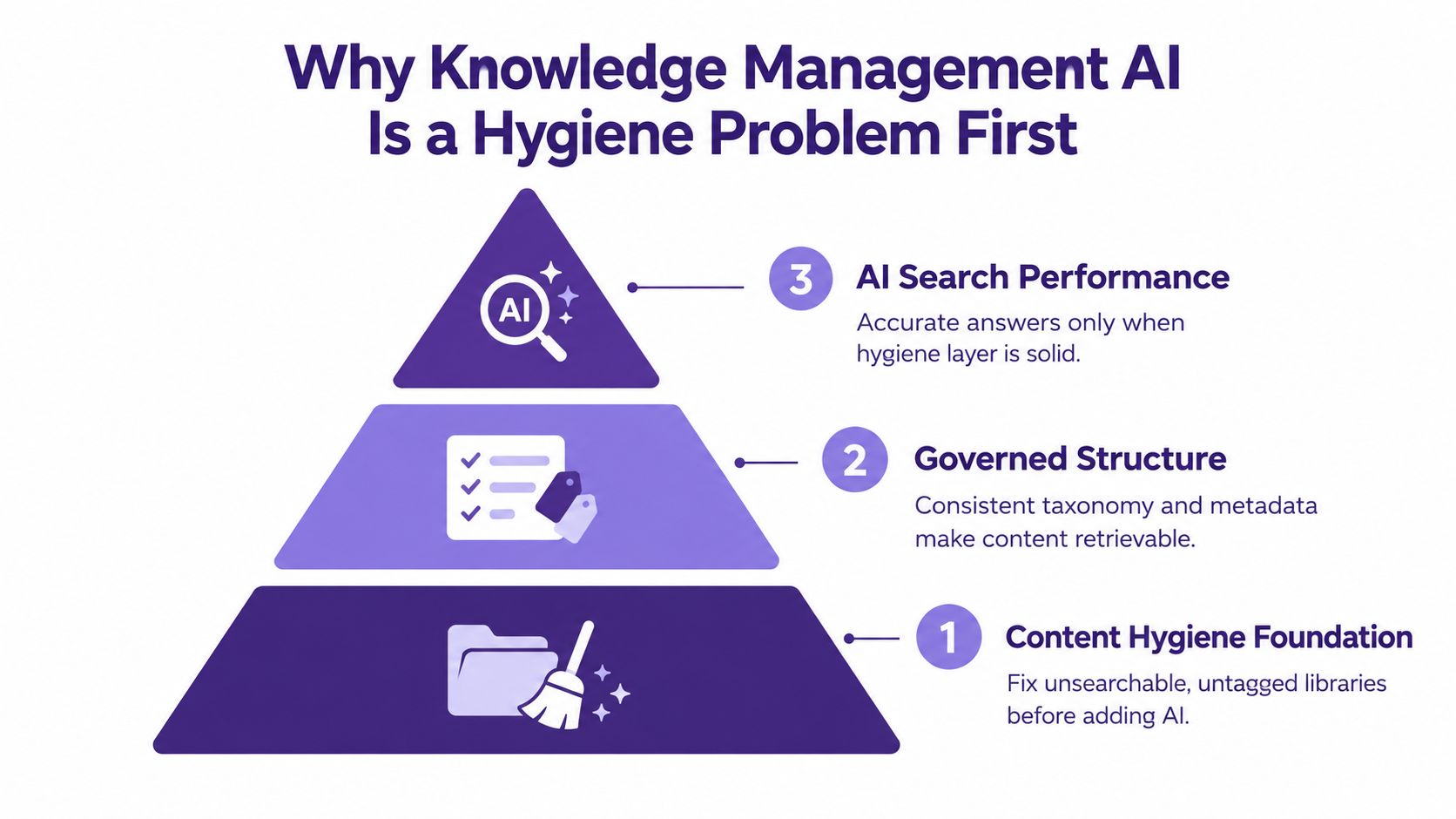
Why Knowledge Management AI Is a Hygiene Problem First
AI search does not fix a publishing library. It exposes how poorly that library is governed.
Teams adopt it because nobody can find anything. Articles sit in shared drives, transcripts use inconsistent episode names, research notes contain duplicate versions, and outdated PDFs remain available after an editorial decision changes. The first conflicting answers then trigger complaints about the model, although the retrieval system is selecting from the material the organization supplied.
A language model can summarize disorder, not remove it. If the source library contains duplicates, stale files, unclear ownership, or competing terminology, the AI layer will rearrange those problems into a polished response.
Practical rule: Treat AI search as a dependent system. Its answer quality cannot exceed the quality, authority, and accessibility of the sources beneath it.
The problem predates generative AI. Knowledge management grew from expert systems, organizational learning, and knowledge reuse, including the early shift toward explicit knowledge-based systems, DEC's XCON deployment, Dr. K. Wiig's formal introduction of the knowledge management concept, and the work of Nonaka and Takeuchi. The first knowledge management conference had already taken place by 1994. This history of knowledge management provides useful context: current tools add an AI layer to a long-standing operational need.
The failure arc is predictable
Content-heavy organizations usually encounter the same sequence:
- Duplication appears: Several versions of an article or transcript look equally authoritative.
- Naming drifts: One team uses “audience growth,” another uses “subscriber acquisition,” and search treats them as separate concepts.
- Ownership disappears: Nobody knows who approves updates or retires obsolete material.
- AI gets added early: A polished chat interface returns confident answers from an uncontrolled corpus.
Publishers should start with a source inventory, duplicate removal, a controlled vocabulary, metadata rules, and named owners. Define the fields that describe each asset, including its status, audience, topic, date, authority, and permissions. These metadata management best practices offer a practical reference for setting those controls.
Governed indexes measurably outperform ungoverned ones. That difference matters for editorial teams because a system can retrieve a stale draft as readily as an approved article unless status and authority are explicit. The operational priority is straightforward: govern the index before scaling generation, as explained in The analysis of RAG accuracy problems.
What Knowledge Management AI Actually Does
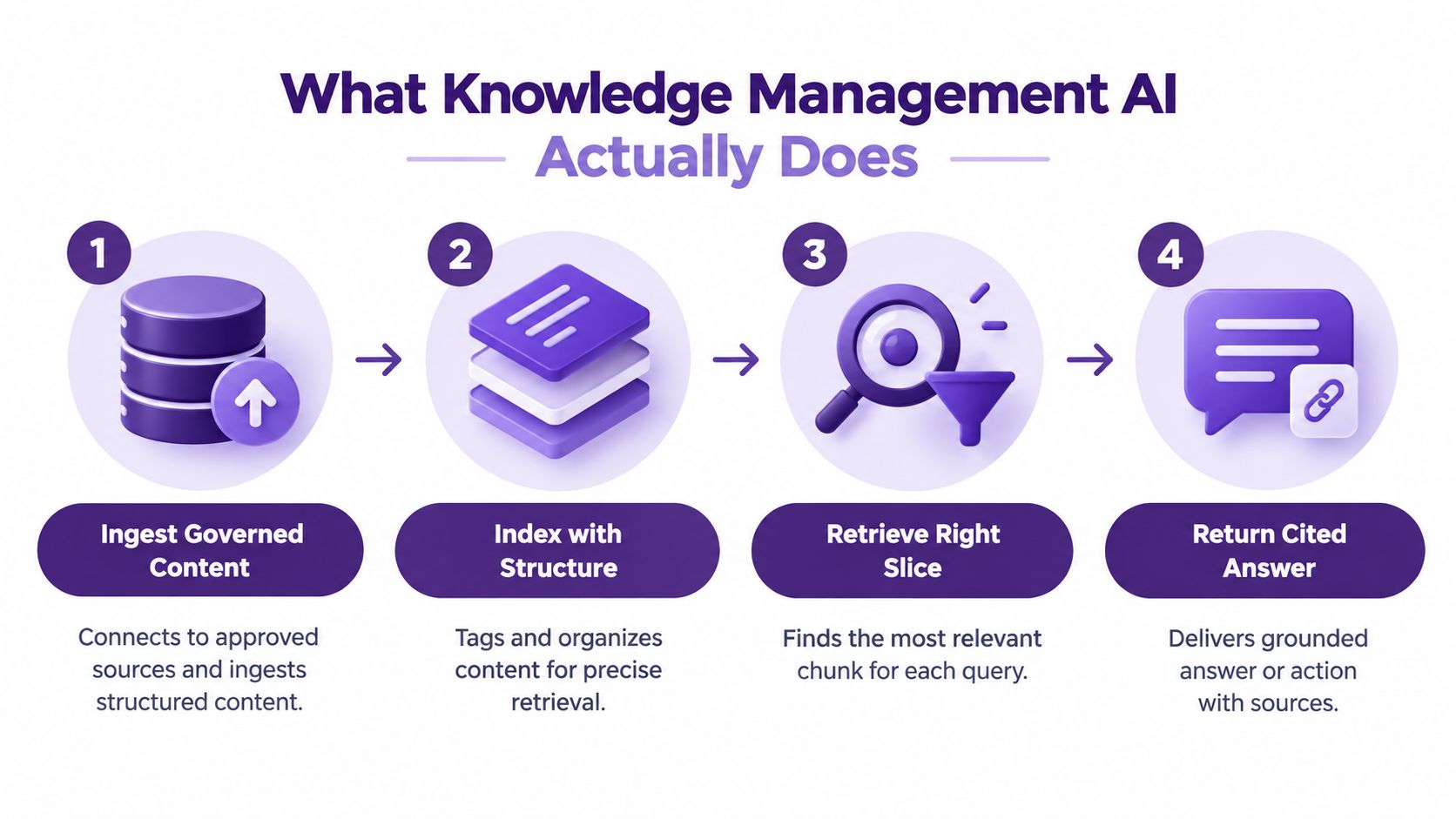
Knowledge management AI is best understood as an operating stack, not a chatbot. The stack connects approved content, normalizes it, applies structure, retrieves relevant passages, and produces an answer or summary that points back to its sources.
The workflow has evolved in layers. Shared drives and filing cabinets came first. Manual folders gave way to keyword search. Tags and filters improved discovery, but depended on people applying them consistently. Modern systems add semantic retrieval, embeddings, reranking, and conversational interfaces that can interpret a question rather than match only its exact wording.
That progression matters because AI doesn't replace the earlier layers. It depends on them.
Think like a research desk
A well-run research desk offers a better analogy than a magical assistant. The librarian classifies incoming material and maintains the catalog. The researcher finds the relevant documents and compares them. The editor turns that evidence into a concise brief, while preserving the references needed for review.
Knowledge management AI performs a similar sequence:
- Ingest approved material: Articles, transcripts, research notes, internal documents, videos, and other content enter through defined sources.
- Apply structure: The system uses metadata, taxonomies, entities, dates, topics, audiences, and permissions to describe each asset.
- Retrieve evidence: Search combines exact terms with semantic similarity to identify the most relevant passages.
- Generate a grounded response: A language model summarizes, compares, or organizes the retrieved material and attaches citations.
The desired output isn't “an interesting answer.” It's a decision-ready answer with traceable evidence. An editor should be able to see which article supports a claim. A producer should find the exact transcript passage behind a clip idea. A researcher should distinguish an internal note from an approved client deliverable.
The distinction between a generic chatbot and a knowledge management system is source control. A chatbot can produce fluent language from broad patterns. A governed KM system should answer from a defined body of knowledge, respect permissions, expose provenance, and make uncertainty visible.
For a practical overview of how these components fit together, see this guide to AI for knowledge management.
The Core Capabilities That Matter Most
Vendor demos overvalue the chat window because it's easy to show. A presenter types a natural-language question, receives a polished answer, and creates the impression that the hard work is finished. For publishers and content teams, the visible interface is the least important part of the system.
The evaluation should prioritize four capabilities, in this order:
Ingestion and normalization
The platform needs reliable connectors and a disciplined way to bring in articles, transcripts, PDFs, notes, and media records. It should identify duplicates, preserve dates and versions, normalize formats, and retain the relationship between a source file and its derived text.
If ingestion loses context, every later layer inherits the damage. A transcript without speaker identity is less useful for quote discovery. An article without publication date is risky for time-sensitive research. A PDF without its document owner is difficult to govern.
Taxonomy and metadata
Taxonomy gives the library a shared language. Metadata explains what each item is, who owns it, which audience it serves, when it was updated, and how it may be used.
Strong systems support controlled vocabularies, synonym handling, entity tagging, hierarchical categories, and custom fields. They should also let editors revise the structure without rebuilding the entire archive. Content organizations turn a pile of assets into a reusable knowledge base.
Retrieval
Retrieval combines keyword search with semantic search. Keyword matching protects exact terms, names, and titles. Semantic retrieval helps find conceptually related material even when the query uses different wording. Reranking then orders the candidate results by relevance.
Evaluate retrieval before answer generation. The EKRAG dataset contains 1,347 manually curated questions across five core question types and multi-hop settings, and it was designed to assess factuality over corporate documents, including financial and product information. The EKRAG benchmark reflects that complex enterprise questions test retrieval, ranking, and synthesis together.
Answer generation and citations
The chat layer interprets the question, composes an answer, and points users to supporting sources. It should preserve citations, identify gaps, and avoid filling missing evidence with plausible language.
The practical ranking is clear: ingestion and taxonomy do most of the operational work, retrieval carries the next share, and chat provides the visible finish. Those are editorial prioritizations, not measured percentages. Evaluate the boring plumbing first, then retrieval behavior, and the interface last.
How Content Teams Put It to Work
A podcast network, a B2B publisher, and a research consultancy may use the same knowledge management AI platform in completely different ways. The common asset isn't the interface. It's the organized archive behind the workflow.
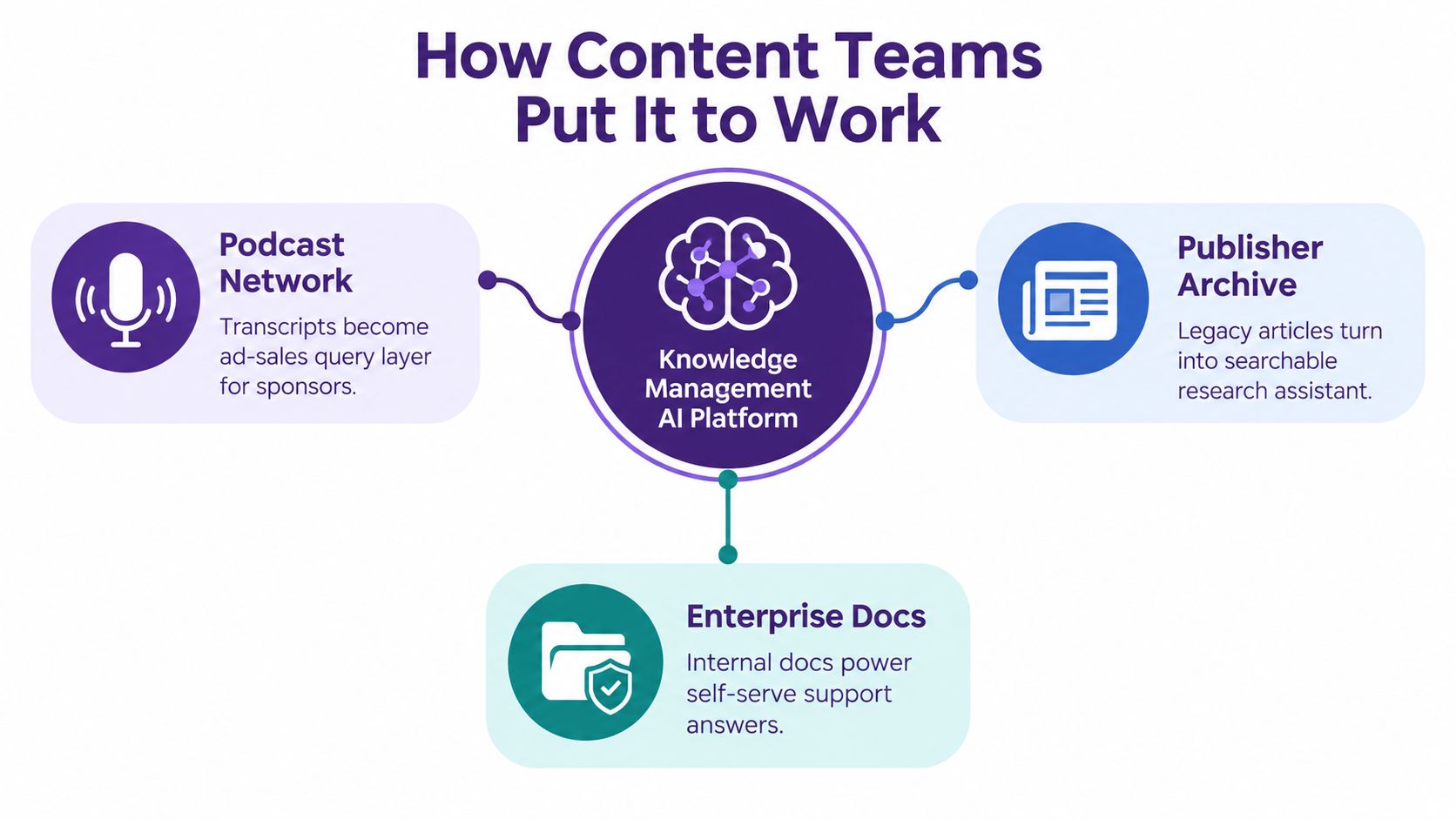
A podcast network turns transcripts into sales material
A podcast team has years of conversations, but a sponsor often needs a narrow answer: where did a guest discuss a particular business problem, customer segment, or category? Without search, a producer must remember the episode, open the transcript, find the passage, verify the wording, and create a clip or quote.
With governed transcript retrieval, the sales team can ask for relevant moments and receive passages tied to episode names, speakers, timestamps, topics, and rights information. The producer still reviews the context, but the request no longer begins with a manual archive hunt.
The workflow change: sponsors receive a faster path from a commercial question to a verified quote or clip candidate, while producers spend less time searching and more time editing.
A B2B publisher activates its archive
A publisher with five years of articles already owns a research advantage, but only if editors can retrieve it. An AI-assisted archive can surface evergreen references, identify related coverage, and help an editor compare a proposed brief with previous reporting.
The system shouldn't decide what the newsroom publishes. It should help the editor spot repetition, missing angles, dated assumptions, and useful background before assigning the piece. Teams that need help aligning archives with discoverability can also consider specialist content SEO services as part of a broader content operations program.
The workflow change: briefing starts with evidence from the archive instead of a blank page, making old work useful without pretending it replaces editorial judgment.
A research consultancy separates client knowledge
A consultancy may store deliverables, whitepapers, interview notes, and research frameworks across multiple engagements. That library can be valuable for pattern discovery, but it carries a serious boundary condition: one client's information must not surface in another client's workspace.
A permission-aware index lets analysts ask natural-language questions within approved scopes. The system can connect related evidence, preserve document provenance, and keep account-level access attached to the underlying content.
The workflow change: analysts self-serve routine cross-document research inside the correct permissions boundary, while sensitive synthesis remains subject to review.
The same principle applies to video creators, authors, screenwriters, and marketing executives. A reusable content library can support new episodes, campaign concepts, editorial packages, and audience experiments, but only when teams know what each asset contains and how it may be reused.
Ingestion Patterns and Taxonomy That Hold Up
Most ingestion failures begin with raw content entering an AI index before anyone defines what the content means. Don't upload the archive first and hope the model will invent a durable structure. It may create labels, but those labels won't automatically match editorial language, rights rules, audience segments, or business ownership.
Use an ordered implementation pattern. Each step creates the condition required by the next.
Start with a source audit
Catalogue every content type, owner, update cadence, version, and access rule. Include the embarrassing folders, duplicate exports, abandoned project files, unedited transcripts, and PDFs nobody wants to claim.
A source audit answers practical questions:
- What belongs in scope: Which articles, episodes, videos, research notes, and documents should the system search?
- Who owns it: Which editor, producer, researcher, or department approves changes?
- How current is it: Which sources change often, and which are historical reference only?
- What can users see: Which permissions must travel with the content?
Define the vocabulary before ingestion
Create a controlled vocabulary, synonym map, and entity list before documents enter the index. Decide whether “subscriber growth” and “audience acquisition” describe the same concept, and record that decision centrally.
A taxonomy should reflect how the team works, not how a vendor's demo is organized. This content tagging and taxonomy guide can help teams establish categories that support discovery and reuse.
Chunk according to content type
Articles should usually retain section boundaries. Transcripts benefit from speaker turns and timestamps. Research notes should preserve individual claims, supporting evidence, and source references. A single chunking rule across every format destroys useful context.
Enrich and govern at ingest
Apply metadata while content enters the system, not after a retrieval failure. Add topic, format, author, date, audience, rights status, client, and content lifecycle fields where they matter.
Finally, attach access governance to the indexed record. A technically strong answer that exposes restricted material is still a system failure. Validate retrieval with real queries, monitor stale sources, and update taxonomy rules as the organization creates new content.
Metrics That Reveal Real ROI
A large indexed archive proves only that files entered the system. Query volume proves only that people opened the door. Neither metric shows whether knowledge management AI returns evidence a publishing team can trust.
Track four categories together. Retrieval quality shows whether the system finds authoritative material. Productivity shows whether researchers complete defined tasks faster. Adoption reveals whether the tool fits daily behavior. Business outcomes connect the operating change to briefs, proposals, deliverables, and revenue.
A practical measurement model
| Metric Category | Example KPI | What It Predicts |
|---|---|---|
| Retrieval quality | Hit rate in the top three results, citation precision, and useful-answer rate | Whether users can trust the evidence |
| Productivity | Time per research task against the pre-deployment baseline | Whether the system changes work, not just search |
| Adoption | Weekly active users divided by eligible team members, plus queries per session | Whether usage is habitual and substantive |
| Business outcome | Time to create content briefs, proposal win rate when the system is referenced, and revenue linked to faster deliverables | Whether retrieval produces commercial value |
Set the baseline before launch. Self-reported time savings can identify promising workflows, but they should not replace observed task timing. Ask an editor to complete the same research task before and after deployment. Compare the final work product, source quality, and elapsed time.
Measure the chain, not the chatbot: governance affects retrieval, retrieval affects factuality, and factuality affects trust.
The relationship matters more than any isolated dashboard number. Governed data has been associated with 85% to 92% retrieval accuracy, while ungoverned sources have been reported at 45% to 60%, according to enterprise RAG accuracy analysis. A separate controlled comparison reported 6% hallucination with a curated domain knowledge base and 35% with general web-search retrieval, using the same source.
Use those figures as measurement context, not as a promise for your own archive. Test the system against real editorial questions, known answers, conflicting versions, and restricted sources.
The operating conclusion is direct. Weak retrieval produces contradictions. Persistent contradictions teach editors to stop asking the system important questions. ROI comes from authoritative content, useful metadata, controlled access, and repeated evaluation, not from a prettier chat interface. Publish the measurement rules before rollout, assign owners for each KPI, and cut any metric that cannot change a content or governance decision.
Common Pitfalls and How to Dodge Them
Knowledge management AI rollouts rarely fail because a team couldn't make a chatbot answer a question. They fail because leaders confuse a demonstration with an operating system.
Bolting AI onto a mess
Uploading an ungoverned archive creates a large search surface without creating reliable knowledge. The early warning sign is contradiction. Ask adjacent questions that should produce related answers, then inspect whether the system returns different versions, stale guidance, or sources with unclear authority.
Dodge it: Run a 48-hour source audit before AI ingestion. Identify duplicates, owners, dates, formats, permissions, and obvious conflicts. Keep uncertain material out of the first evaluation corpus rather than allowing it to contaminate the results.
Letting taxonomy drift
Auto-generated tags can look useful at first. Without curation, they multiply into near-duplicates and make retrieval less predictable. “Audience growth,” “audience-growth,” and “growth of audience” may become separate labels even though the editorial team treats them as one subject.
Dodge it: Hold a weekly taxonomy review during the evaluation period. Merge synonyms, retire labels nobody uses, and add terms only when they improve a real workflow. Assign an owner who can make decisions instead of asking the whole company to debate every term.
Trusting chat too soon
A fluent answer can pass a casual review while failing a factual one. The warning sign is a response that sounds certain but doesn't show the exact source passage, date, or permission context behind its claim.
Dodge it: Use a gated answer policy. Require citations, define a confidence threshold, and route unsupported questions to “not enough evidence” rather than a synthetic guess. Keep customer-facing or high-stakes answers behind human review until testing demonstrates reliable grounding.
The adoption gap makes this discipline urgent. A 2026 KM survey identified data security and compliance as a main blocker for 51% of respondents, while another benchmark found that 85% of organizations were piloting, implementing, or using AI but only 17% had embedded it into daily operations. The 2026 State of KM AI Report frames the problem accurately: adoption isn't the same as execution.
Your First 30 Days Evaluating a Platform
Don't compare vendors by counting features. Compare them by asking whether they can handle the content your team already owns, under the rules your team already follows.
Week one starts with real questions
Write three to five test queries from actual workflows. A podcaster might need a past guest quote. A publisher might need to resolve a rights question. A researcher might need to cross-reference prior studies. Use the exact wording people use at work, including incomplete questions and ambiguous terms.
For each query, define what a correct answer must contain. That may include the source title, publication date, speaker, timestamp, client boundary, or citation passage. If you can't describe correctness before the demo, you won't evaluate it consistently afterward.
Week two audits the corpus
Give vendors a representative sample, including messy folders and difficult formats. Ask how ingestion handles duplicate files, transcript structure, version changes, metadata, access permissions, and content removal.
Don't let a vendor select only polished documents. Your team won't work from a perfect demo library after launch.
Week three tests retrieval before presentation
Run the queries before judging the chat interface. Score whether the right source appears, whether the citation supports the answer, whether the system respects access boundaries, and whether it admits when evidence is missing.
The EKRAG benchmark's emphasis on factuality, multi-hop questions, and corporate documents offers a useful model for this evaluation. Test component behavior, not just the final prose. A polished answer can conceal weak retrieval.
Week four makes the decision
Score each platform on:
- Governed ingestion depth: Can it process your formats while preserving ownership, dates, versions, and permissions?
- Taxonomy flexibility: Can editors define, revise, merge, and maintain the vocabulary?
- Answer grounding: Does every material claim connect to an inspectable source?
- Workflow fit: Can creators, editors, researchers, and marketers use the system inside their real routines?
- Maintenance burden: Can a named team keep the corpus current without constant vendor intervention?
Semantic layers, knowledge graphs, and permission-aware retrieval are becoming important infrastructure for agentic workflows, particularly where teams need multi-step answers, lineage, attribution, and access control. Current knowledge management trends also point to user adoption, change management, and content quality as major implementation barriers.
Choose the platform that treats source hygiene as a precondition, not a marketing footnote. Contesimal is one option for teams that need AI-assisted organization, chat-based research, keyword search, browsing by themes and audiences, metadata management, and layered taxonomies across documents, podcasts, videos, and articles.
Content repurposing makes the business case concrete. 94% of 48 marketers surveyed by Referral Rock said they repurpose content, while 65% called it the most cost-effective approach and 48% called it the best use of time, as reported in content repurposing statistics from TapVid. Another summary reports that one blog post can become 8 to 12 pieces across formats, while teams with repurposing workflows can produce 47% more content at 35% lower cost per piece, according to content repurposing ROI data.
Contesimal helps content organizations organize and search documents, podcasts, videos, and articles, then collaborate with human and AI contributors to turn existing knowledge into new briefs, episodes, posts, and research. Visit Contesimal to evaluate whether your library is ready for governed AI search and faster content reuse.