Writing a review paper means taking a deep dive into existing research to give a complete picture of a topic. You’re not conducting new experiments; instead, you’re analyzing everything that’s already been published to spot trends, conflicts, and glaring gaps in what we know.
It’s a critical analysis designed to pull all that scattered information into one, authoritative document that offers a clear, consolidated perspective, helping you upcycle old content and create new value from your knowledge base.
Why Review Papers Are Your Secret Weapon

If you're a YouTuber, podcaster, or content marketer, you know the feeling. You’re staring at a mountain of articles, your own old videos, and endless studies, and it’s just… a lot. A review paper isn't just some dusty academic exercise; it's a powerful way to organize that chaos, cut through the noise, and plant your flag as an expert.
Think of it as creating the picture on the puzzle box lid. Instead of just adding another piece to the pile, you're the one showing everyone else how it all fits together. For content makers sitting on a growing library of their own assets, a well-crafted review paper becomes a cornerstone piece—something your audience will reference and share for years, helping you reignite your content library and bring it back to life.
Transforming Information Into Insight
This skill has become absolutely essential because of the sheer explosion in published work. Back in 1980, the world saw fewer than 1 million papers published. By 2014, that number had blasted past 7 million.
For creators like podcasters and bloggers, this flood of information is exactly why a review paper is pure gold. You’re the one doing the hard work of distilling key trends from a massive archive. You're the one helping your audience understand what matters.
Having your own content library organized from the get-go makes this whole process way smoother. When you can quickly pull up and analyze your own past work, you're in a much better position to do the deep-dive discovery a great review paper requires, helping you create infinite content value.
Different Tools for Different Jobs
Not all review papers are built the same. Knowing the different types helps you pick the right approach for what you're trying to accomplish. Each one serves a unique purpose.
Here are a few of the most common types:
- Narrative Review: This is what most people picture. It gives a broad overview of a topic, usually from a specific point of view. A YouTuber, for example, might do a narrative review summarizing how video editing software has evolved over the past decade.
- Systematic Review: This one is super structured and methodical. It follows a strict, repeatable process to find and analyze all the available evidence on a specific question. A marketing exec might commission one to figure out the ROI of influencer campaigns by looking at every published case study.
- Meta-Analysis: This is a purely quantitative, statistical beast. It combines the raw results from multiple scientific studies to find a common truth among different experiments. It’s a review of the numbers themselves.
The real magic of any review paper isn't just summarizing what other people have said. It’s about building a new narrative, connecting ideas that seemed separate, and creating a coherent argument that gives your audience a fresh way of looking at the subject.
Ultimately, writing a review paper forces you to get your hands dirty and really engage with your field. You'll learn to identify what is a credible source and, in the process, solidify your own expertise. It’s the journey from being a consumer of information to becoming a trusted authority who creates meaning for others.
Finding Your Focus and Defining Your Scope
Before you even think about writing, you need a solid game plan. This is the part that separates a sharp, impactful review paper from one that just sort of… wanders off and gets lost. It’s all about picking a topic that’s genuinely interesting but also manageable—not so huge it paralyzes you, but not so tiny you can’t find anything to write about.
The absolute cornerstone of your plan is the research question. Think of it as your North Star. Every single decision you make—from the sources you pull to the way you structure your argument—has to point right back to it. A fuzzy question guarantees a fuzzy paper. A sharp, specific question forces you to be clear and gives you direction from the jump.
Crafting a Powerful Research Question
For a content creator, your question needs to be immediately practical. Forget a generic topic like "social media marketing." A podcaster, for instance, should be asking something like, "What are the proven audio-editing techniques that demonstrably increase listener retention for interview-style podcasts?" Now that's a question. It's specific, you can measure it, and it's tied directly to a result they care about.
Or, let's say a content marketer is sitting on a massive library of blog posts. Their question could be, "Which long-form content structures have generated the highest organic search traffic for B2B SaaS companies in the last 24 months?" The question itself draws the map. Before you get too far, it really helps to have a gut check on what your audience actually wants to know. Getting a feel for understanding what your audience is searching for can clue you into common questions and knowledge gaps, making your final paper ridiculously relevant.
A well-defined research question isn't a limitation; it's a filter. It helps you instantly decide what information is critical and what is just noise, saving you countless hours of sifting through irrelevant material.
Setting Clear Boundaries for Your Review
Once you’ve locked in your question, you have to define the scope of your review. This just means setting up clear, non-negotiable rules for what content gets in and what gets left on the cutting room floor. If you don't set these boundaries, "scope creep" isn't just a risk—it's pretty much a guarantee. Your focused little review will balloon into an unmanageable beast.
Your inclusion and exclusion criteria have to be explicit. Think about these common parameters:
- Publication Date Range: Are you only looking at stuff from the last five years to catch the latest trends? Or are you trying to trace a concept's evolution from the very beginning?
- Source Type: Are you sticking to peer-reviewed academic articles only? Or are you open to analyzing industry white papers, conference talks, or even thoughtful YouTube video essays?
- Geographical Focus: Is your analysis global, or is it zeroed in on a specific market, like North America or Southeast Asia?
- Methodology: If you're looking at scientific studies, will you only include randomized controlled trials, or are qualitative case studies fair game too?
These rules are your guardrails. They stop you from getting lost down endless rabbit holes. Having this structure figured out from the very beginning is the secret to staying on track. For a deep dive into building out this foundational document, you can learn more about how to create a sample research plan to keep your project tight and purposeful.
All this initial planning ensures your final paper isn’t just focused and impactful, but that it actually, thoroughly answers the very question you set out to explore.
Building Your Research and Content Library
Now that you’ve got your focus dialed in, it’s time to start gathering your raw materials. This is where you lay the foundation for your entire argument. The idea is to cast a wide net at first, pulling in everything from traditional academic papers to valuable assets you might already have tucked away.
If you're a YouTuber or podcaster, this means looking beyond the usual databases. Your own library—packed with old videos, podcast transcripts, and blog posts—is an absolute goldmine. Seriously, you've already done half the work. Now it's just a matter of connecting the dots and creating new value. Modern tools make it a breeze to query your entire collection and instantly pull up relevant clips, quotes, or data points to back up your new review.
Kicking Off a Comprehensive Search
A systematic search is your best friend here. Start with the heavy hitters like Google Scholar, PubMed, or Scopus, depending on your field. But don't just stop after plugging in a few obvious keywords. You need to be smarter than that.
Think in terms of keyword variations and "strings." For example, instead of just searching for "video podcast engagement," get more specific with combinations like these:
- "YouTube podcast" AND "audience retention strategies"
- ("video content" OR "visual podcasting") AND "viewer engagement metrics"
- "Spotify video podcast" NOT "audio only"
This simple diagram breaks down how you move from a broad idea to something you can actually research.
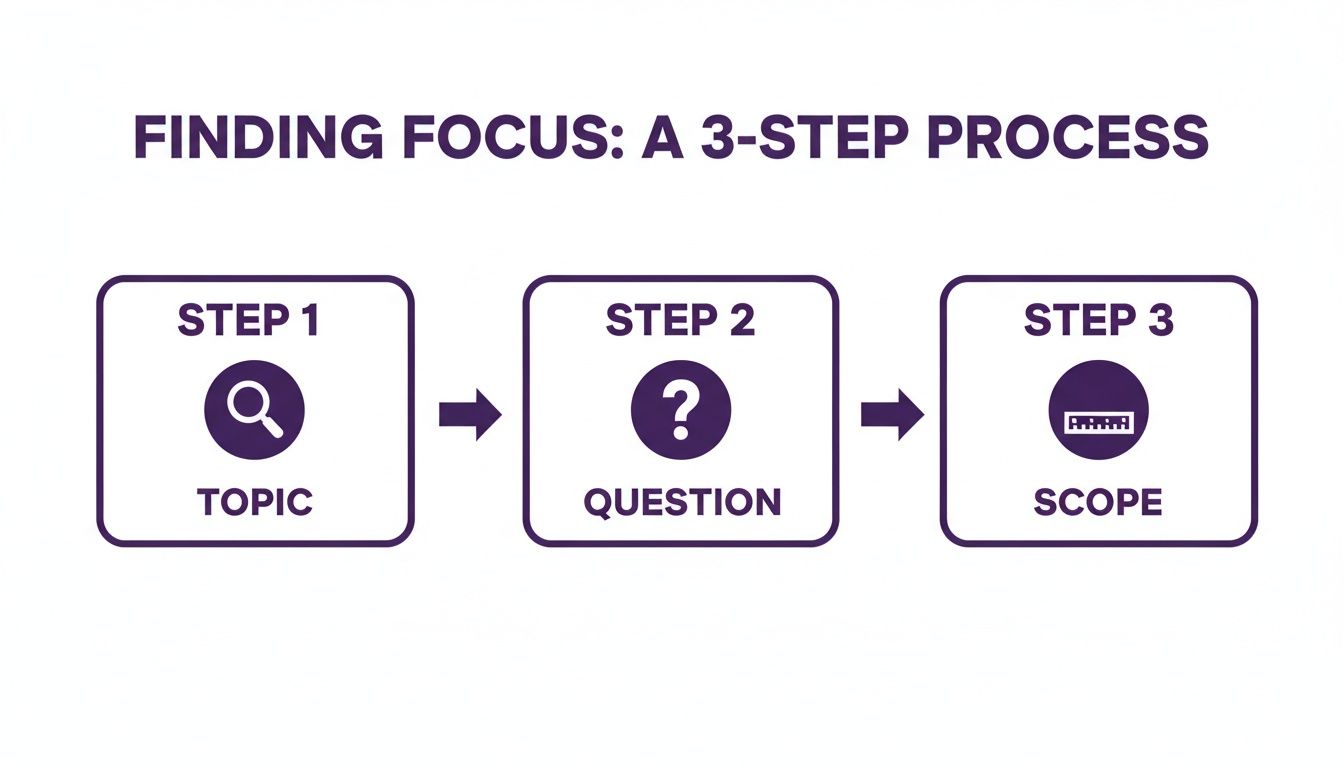
Following this Topic -> Question -> Scope flow acts as a filter, making sure every piece of research you grab actually serves a purpose.
Another killer technique is citation tracking. Found a foundational paper that’s a perfect fit? Dig into its bibliography to find older, core research. Then, see who has cited it to find newer, related work. This "snowballing" method often uncovers gems you'd completely miss with keyword searches alone.
Staying Organized From Day One
Let's be real: a messy folder of random PDFs and bookmarked links is a recipe for a headache. Organization isn't something you do at the end; it’s a habit you start with the very first article you save. A disorganized library makes it almost impossible to spot the connections, themes, and gaps that are the heart of a truly great review.
The most common pitfall is collecting sources without a system to capture their essence. Simply downloading a paper isn't enough; you need to process its key contributions immediately.
A structured approach is non-negotiable. Two of the most popular methods are the annotated bibliography and the literature matrix.
- Annotated Bibliography: For each source, you write a quick paragraph. What’s the main argument? What methods did they use? What were the key findings? Add your own brief critique. This forces you to actually engage with the material right from the get-go.
- Literature Matrix: This is basically a spreadsheet. Each row is a different source, and each column tracks specific info (e.g., Author, Year, Main Finding, Sample Size, Methodology, Limitations).
A well-organized matrix lets you sort and filter your sources in seconds. You can instantly see which studies used a similar methodology or which authors are beefing over a key point. If you're managing a big digital library, our guide on how to organize research papers has some deeper strategies to keep everything structured and easy to find.
Ultimately, your research library is more than just a folder full of files. It’s an active, dynamic workspace. Whether you're using dedicated software like Contesimal to collaborate with your team, catalog, and search your digital assets or a simple but effective spreadsheet, the system you choose is critical. It’s what will transform that chaotic pile of information into a coherent body of evidence, setting you up perfectly for the next stage: synthesis.
How to Synthesize Information Instead of Just Summarizing

This is it. This is the skill that separates a good review paper from a truly great one. Anyone can line up a bunch of summaries and call it a day, but that doesn't add any real value to the conversation.
Synthesis is where you graduate from being a reporter to becoming an authority. You’re not just repeating what others have said; you’re weaving their findings into a new, coherent argument that only you can make. Think of yourself as a detective at a crime scene. Summarizing is just listing the clues one by one. Synthesizing is explaining how all those clues connect to solve the mystery. You’re building a narrative, not a grocery list.
Moving Beyond the "He Said, She Said" Approach
The most common trap people fall into when learning how to write a review paper is the classic "book report" format. You know the one: each paragraph tackles a different source. This approach is lazy because it forces the reader to do all the heavy lifting of connecting the dots.
True synthesis does that work for them.
Your job is to organize the paper around themes, trends, and debates—not individual authors. Ditch the "Smith (2021) found X, while Jones (2022) found Y" structure. Instead, reframe the entire discussion around the core idea: "A major debate in the field centers on the relationship between X and Y." That simple shift immediately elevates your paper from a dull summary to a critical analysis.
The core of synthesis is your ability to create a new narrative from existing materials. You are telling a short, rigorous, and evidence-based technical story that leads to a takeaway your readers will care about.
This isn't a passive process. You have to actively hunt for the relationships between your sources. Don't just read what they say; constantly ask how they speak to each other.
- Do they agree or disagree? Where’s the friction?
- Does one study build on another's findings?
- Did they use different methods to arrive at similar conclusions?
- What’s the one thing that none of them seem to address?
This is where having a well-organized content library becomes an absolute game-changer. Using a tool like Contesimal lets you and your team collaborate and query your entire collection of research papers, transcripts, and notes to spot these patterns almost instantly. You can group sources by theme, track recurring keywords, and see how the conversation has evolved, making the whole synthesis process faster and much more insightful.
Practical Steps for Effective Synthesis
To get started, group your sources thematically. Let's say you’re a YouTuber writing a review paper on "The Impact of AI on Video Editing." Instead of dedicating a paragraph to each source, you’d build sections around key themes.
| Theme | Sources to Include | Synthesis Angle |
|---|---|---|
| Efficiency Gains | Articles A, B, and F | These sources all agree that AI tools slash editing time, but they clash on the actual percentage of time saved. |
| Creativity and Style | Sources C and D | Source C argues AI leads to generic creative styles, while Source D shows case studies where AI unlocked totally new artistic choices. |
| Audience Engagement | Podcast E, Article G | Both sources connect AI-driven edits (like automatic captions) to higher viewer retention, backing it up with hard numbers. |
This structure forces you to compare and contrast—which is the beating heart of synthesis. You're not just presenting facts; you're moderating a conversation between your sources, and you're the expert in the room.
Using Language That Signals Synthesis
Your choice of words is a powerful signal to the reader. The right phrasing shows you're analyzing, not just regurgitating. Sprinkle in phrases that demonstrate you’re thinking critically and building connections.
Here are a few sentence starters to get you in the right mindset:
- "While several studies highlight the benefits of…, a recurring limitation is…"
- "This finding converges with earlier work by…, suggesting a broader trend."
- "A key distinction between these approaches is…"
- "What all these sources overlook, however, is the critical role of…"
- "Taken together, these studies paint a picture of…"
By using these techniques, you make the leap from being a passive collector of information to an active creator of knowledge. You're the one providing the context, drawing the connections, and offering your audience a fresh perspective. And that’s the whole point of a powerful review paper.
Structuring and Writing Your Paper for Maximum Impact
You’ve got your research organized and your main themes sorted. Now for the fun part: bringing it all together. This is where you wrestle that messy web of ideas into a clean, linear story that persuades your reader.
The structure of a review paper is more than just a box-checking exercise. It’s how you guide your audience through a complex topic without losing them. A logical structure shows you’ve done the heavy lifting of organizing the chaos so they don’t have to. For creators, podcasters, and marketers moving from hobbyist to professional, this is where you cement your expertise and move from just having information to providing real insight.
The Anatomy of a Compelling Review Paper
Most review papers that actually get read follow a tried-and-true formula. The specifics might shift depending on your field, but the bones of it stay the same. Think of it as a universal blueprint for clarity.
Here’s a breakdown of the key sections and what you need to nail in each one:
- Introduction: This is your hook. You have to grab the reader, show them why this topic matters, and clearly state your core thesis or research question. Give them a quick roadmap of what you'll cover.
- Body Paragraphs: This is the heart of your paper. You'll organize this section by theme—never chronologically. This is where you lay out your arguments, compare different viewpoints, and dig into the major debates.
- Conclusion: Time to bring it all home. Summarize your most important findings, restate your main point in a fresh way, and, critically, point to the future. What are the gaps? What questions are still floating out there?
This structure just works. It follows the natural way people absorb information: introduce the problem, walk through the evidence, and then deliver the big takeaway.
Nailing the Introduction and Conclusion
Your intro is your first—and maybe only—chance to convince someone your paper is worth their time. It has to be sharp and compelling right out of the gate. I always recommend starting broad to set the scene, then quickly narrowing your focus to the specific problem or gap your review is tackling.
Your conclusion, on the other hand, should provide a sense of closure while sparking new questions. A weak conclusion just rehashes what you already said. A strong one emphasizes the implications of your findings. If you're a content creator, this could mean suggesting a new video series based on the gaps you identified or proposing a new content strategy for your company to expand value across your existing assets.
The goal is to leave your reader feeling smarter, but also with a clear sense of what should happen next. Your conclusion shouldn’t just be an ending; it should be a launchpad.
Maintaining a Clear and Credible Voice
As you write, remember that your tone and credibility are everything. Every single claim needs a citation. This isn't just about avoiding plagiarism; it's about building a foundation of trust. Citing your sources correctly shows you respect the larger conversation you're joining.
Consistency is also key. Whether you’re a YouTuber scripting a video or a marketer crafting a white paper, your personality can come through, but it should be layered over an authoritative, objective tone.
Use transitional phrases to create a smooth flow between your ideas. Little things like "Building on this idea," "In contrast," or "This discrepancy suggests that…" are like signposts for your reader. They guide them effortlessly through your argument. Honestly, learning how to write a review paper that really lands means mastering these small details. They’re what turn a bunch of paragraphs into a cohesive story that makes an impact.
Got Questions About Writing a Review Paper?
Even the best-laid plans run into snags. When you're deep in the weeds of writing a review paper, questions are going to pop up. It's just part of the process.
Here are some quick, no-fluff answers to the most common hurdles I see people face. Think of this as your "get unstuck" guide.
How Is a Review Paper Different from a Regular Research Paper?
A standard research paper is all about adding something brand new to the conversation. The author runs original experiments, collects fresh data, and shares their unique findings with the world. You’re essentially creating a new piece of the puzzle.
A review paper, on the other hand, doesn’t introduce new data at all. Its job is to take a step back and make sense of all the existing puzzle pieces. You’re synthesizing and analyzing the current research on a topic to paint a complete picture of what we know, where the debates are, and what gaps still need to be filled. For content creators, this means you can upcycle your old content and create new value from your existing library.
How Many Sources Should I Actually Cite?
Honestly, there’s no magic number. Anyone who gives you a specific count is just guessing.
The right number of sources depends entirely on your topic's scope and the journal's requirements. A tightly focused review might only need 20-30 landmark papers. But if you're tackling a broad, well-researched field, you could easily sail past 100 sources.
Forget quantity. Focus on quality and relevance. The real goal is to include enough sources to thoroughly cover the key arguments, counterpoints, and foundational studies. Once you feel like you've captured the entire conversation, you probably have enough.
What Are the Biggest Mistakes People Make?
The single most common pitfall is writing a glorified book report. You know the style: "Smith (2020) found this. Jones (2021) found that. Lee (2022) found something else." This just summarizes sources one by one without creating any new insight. Your job is to weave these sources together into a coherent narrative.
Other classic mistakes include:
- Picking a Topic That's Way Too Broad: A topic like "social media marketing" is a recipe for disaster. It's just too vast. Narrow it down to something you can actually cover, like "the impact of short-form video on B2B lead generation."
- A Haphazard Lit Search: Just grabbing the first few results from a Google search is a fast track to a biased, incomplete review. A systematic and methodical search is non-negotiable if you want to avoid missing pivotal studies.
- Forgetting to Be Critical: A great review doesn't just parrot what others have said. It actively evaluates the strengths, weaknesses, and biases of the existing literature. Don't be afraid to critique the research.
The most impactful review papers don't just collect information—they curate it. Your voice and critical perspective are what transform a list of facts into a valuable piece of analysis that establishes your authority.
Is It Okay to Include My Own Opinions?
Yes and no. While a review paper needs an objective tone grounded in solid evidence, your unique perspective is precisely what makes it valuable.
Think of it this way: your "opinion" shouldn't be a random personal belief. It should be a well-reasoned argument or a critical evaluation of the literature you're presenting. You are the expert guide leading the reader through this complex academic conversation.
It's your job to interpret the findings, point out what's significant, and draw conclusions based on the evidence. Just make sure every single assertion you make is directly supported by the sources you cite. That’s how your perspective adds analytical depth instead of just coming off as personal bias.
Ready to organize your content library and find the hidden connections needed for your next great review paper? Contesimal is designed to help creators and researchers collaborate, discover insights in their existing assets, and create new value effortlessly. Transform your archives into your next big idea by visiting https://contesimal.ai.