
Your book’s title is its single most powerful marketing tool. It’s the first handshake with a potential reader, the hook that stops them from scrolling, and often the last thing they remember when they recommend it to a friend.
A great title is far more than a label. It’s a promise. It tells your audience exactly what kind of experience they’re about to have.
The Power of a Title to Make or Break Your Book
A magnetic title can be the difference between a book that flies off the digital shelves and one that gathers dust.
Think about it. A nonfiction book called The Art of Decluttering is clear, sure, but it's also forgettable. Now, what about The Life-Changing Magic of Tidying Up? That second title doesn't just describe an action; it promises a complete transformation. It creates an emotional connection that’s impossible to ignore.
And for creators who already have a library of content—YouTubers, podcasters, bloggers—your past work is a goldmine for these kinds of powerful ideas. A popular video series or a recurring podcast segment that always gets high engagement might just hold the perfect phrase for your book title. You’re essentially turning proven audience interest into a discoverable, high-value asset, breathing new life into your content library.
Core Elements of a Compelling Book Title
A truly effective title isn't just a creative whim; it's a strategic blend of four key pillars. Each one plays a critical role in grabbing a reader's attention and holding it.
The table below breaks down these four essential elements.
| Pillar | What It Means | Why It Matters for Your Book |
|---|---|---|
| Promise | The value or outcome the reader will get. | It answers the reader’s question: “What’s in it for me?” |
| Hook | The element of intrigue that sparks curiosity. | It makes the reader need to know more, compelling them to click or flip the cover. |
| Summary | A clear hint about the book's topic or genre. | It ensures you attract the right audience and don’t confuse potential buyers. |
| Asset | Its ability to be memorable, searchable, and shareable. | A great title works for you long-term, driving sales through word-of-mouth and search. |
Mastering these pillars is what separates an average title from one that sells books for years to come.
This infographic shows you exactly how these pieces fit together, turning a simple idea into a powerful marketing asset.
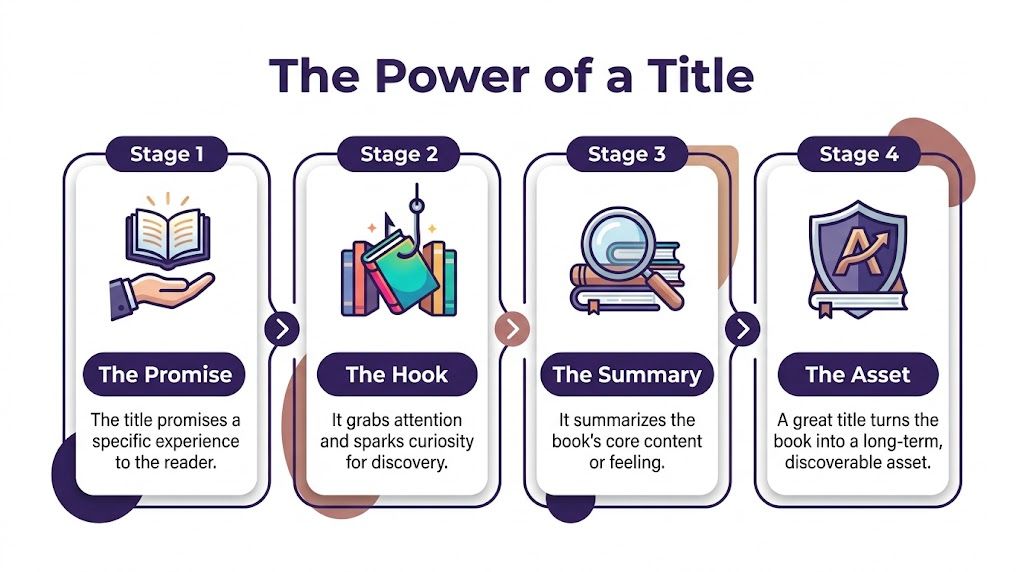
As you can see, the title is a strategic tool from start to finish. Learning to write a great hook is a huge part of this, and many of the same principles apply. If you want to dive deeper, our guide on good hook examples for essays is a great place to start.
A book title is the shortest, most powerful sales pitch you will ever write. It has to communicate genre, hint at the story, and be memorable enough to be shared over coffee.
So, how do you write a title that actually sells? You nail these four components:
Clarity: The title has to give a crystal-clear signal about the book’s subject or genre. A reader scrolling through Amazon should know instantly if they’re looking at a thriller, a self-help guide, or a historical romance.
Intrigue: Clarity is king, but you also need a spark of curiosity. A great title asks a question, hints at a juicy secret, or makes a bold claim that makes someone think, "I have to know more."
Memorability: Can a reader easily remember your title? Can they type it into a search bar without getting it wrong? Short, punchy, and unique titles almost always win.
Genre-Fit: Your title must align with reader expectations for its genre. A fantasy novel with a title that sounds like a corporate finance textbook will only confuse and alienate your target audience, killing its discoverability on platforms like Goodreads and Amazon.
By getting these elements right, any author can create a valuable asset that keeps attracting readers long after the launch party is over.
Generating Your Universe of Title Ideas
This is where the real fun begins. Before you can find that one perfect title, you need to create a whole universe of options. Seriously. The goal here isn't to wait for a single lightning bolt of inspiration, but to build a massive, messy, and diverse list of potential titles.
It’s so easy to fall in love with your first few ideas and stop there. Resist that urge. Right now, it's all about quantity over quality. The more raw material you generate, the stronger your final choice will be. Think of it as panning for gold—you have to sift through a lot of mud to find the nuggets.
Reverse Engineer the Genre Bestsellers
One of the best brainstorming hacks I know is to simply look at what’s already winning. Head over to Amazon, Goodreads, or even your local bookstore's website and pull up the top 20 bestsellers in your specific niche.
Don't just glance at the titles; dissect them. Look for the hidden patterns in their structure, tone, and word choice.
- Are they short and punchy, or long and descriptive?
- Do they ask a question?
- Do they use numbers or strong, emotional words?
You’re not looking to copy anyone. You’re trying to understand the unspoken language of your genre and figure out what makes your target readers click "buy."
Interestingly, one study of academic books found that a combined title and subtitle length of 9 to 12 words is a common sweet spot. This just goes to show that even in super-specific fields, certain formulas emerge simply because they work.
"A great title doesn’t appear out of thin air. It’s built from a foundation of theme, audience understanding, and a whole lot of wordplay. Your initial brainstorming session is where you gather the raw materials for that construction."
Mind Map Your Book’s Core
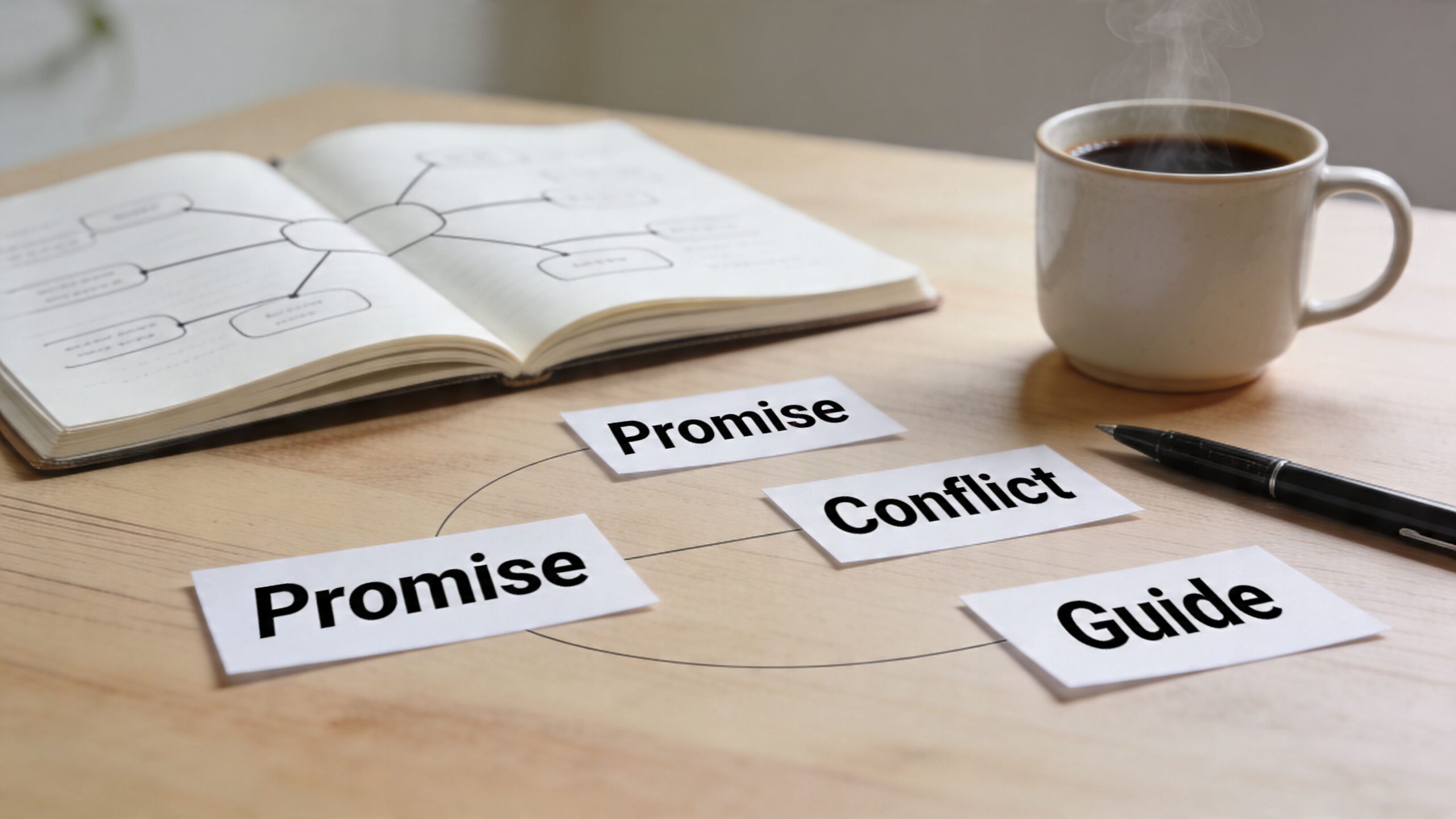
Grab a blank sheet of paper (or open up a digital canvas) and write your book's central idea right in the middle. Now, start branching out with everything related: themes, keywords, character feelings, and reader emotions.
To get the ball rolling, ask yourself some pointed questions:
- For Non-Fiction: What's the single biggest problem my book solves? What’s the core promise I'm making to the reader? What’s the most surprising or counterintuitive idea inside?
- For Fiction: What is the story's central conflict? What does my main character want or fear more than anything? What’s a powerful image or symbol that keeps showing up?
Let the ideas flow without judgment. Scribble down single words, quirky phrases, metaphors, and anything else that pops into your head. This visual free-for-all can spark connections you’d never find in a simple, orderly list.
Mine Your Own Content for Gold
If you’re already creating content on YouTube, a podcast, or a blog, you’re sitting on a goldmine. You have an audience-tested library of language that you know works.
Dive into your analytics and find your top-performing videos, episodes, or posts. Scrutinize the titles, thumbnails, and descriptions. Are there specific phrases or questions that consistently hook people? A hit video you made called "The 5 Habits That Destroyed My Productivity" could easily spark a book title like Productivity Destroyers or The Five-Habit Trap.
This isn't guesswork; it's using your own data to make a smarter decision. You can even use a platform like Contesimal to quickly search your entire content archive, pinpointing those recurring themes and popular phrases that are just waiting to be turned into a killer book title. It’s about recognizing the value in what you’ve already built and putting it to work to create infinite content value.
Finding the Sweet Spot: The Art of Balancing Clarity and Intrigue
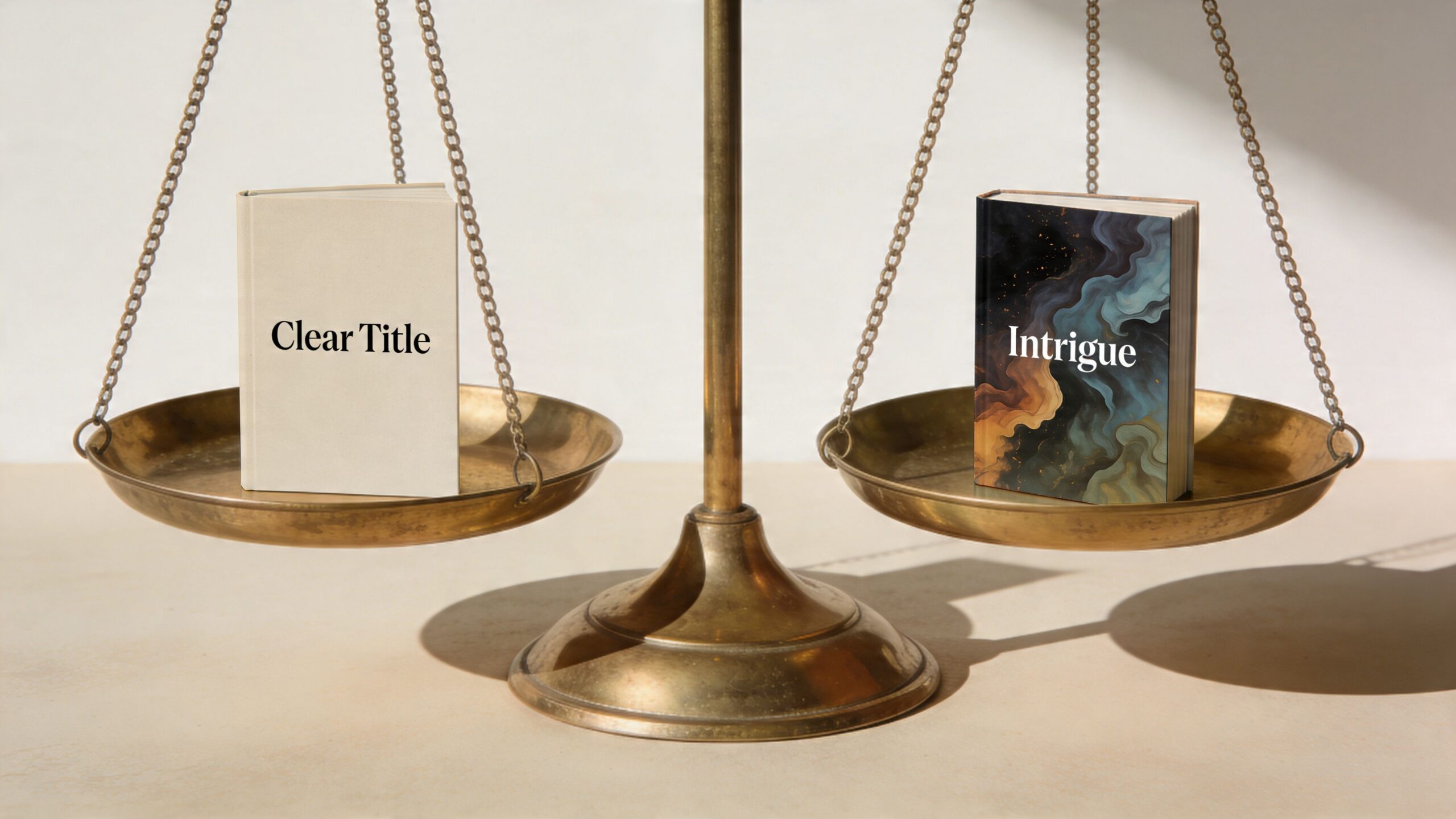
Alright, you’ve brainstormed a mountain of potential titles. Now for the hard part—refining that list down to the one. This is where most authors get stuck, caught in a tug-of-war between two powerful forces: clarity and intrigue.
A great title has to walk a fine line. Lean too hard into clarity, and you get something functional but completely forgettable, like A Guide to Financial Management. Yawn. But swing too far the other way with pure intrigue, and you end up with a title like The Cerulean Paradox—so mysterious that nobody knows what it’s about, so they just scroll right on by.
The magic happens when you signal your book’s purpose while sparking a flicker of genuine curiosity. It’s an art, not a science.
Dialing up the Intrigue With Your Word Choice
Turning a bland, descriptive title into something magnetic often just comes down to a few smart word choices. The right verb or a perfectly placed adjective can do all the work for you, adding an emotional punch that makes a reader need to know more.
Here are a few tricks I’ve seen work time and time again:
- Toss in a Power Word: Words like “secret,” “unspoken,” “last,” or “forbidden” instantly give a title a sense of weight and importance.
- Play with Sound: Alliteration or assonance can make a title feel more musical and stick in your head. Think The Great Gatsby or Gone Girl. The rhythm does half the work.
- Create a Clash: Mashing two conflicting ideas together is incredibly compelling. The Devil Wears Prada is a masterclass in this, mixing evil with the everyday.
- Ask a Question: A title that poses a question forces the reader to engage. Do Androids Dream of Electric Sheep? is a classic for a reason—it makes you stop and think.
Even small tweaks can make a world of difference. Let's take a dry, academic-sounding title and give it some life.
Before: A History of the Spice Trade
After: The Scent of Empire: How Spices Shaped the Modern World
See the difference? "Scent of Empire" is poetic and makes you curious, while the subtitle steps in to handle the job of explaining the topic. And that brings us to your most valuable player in this game.
Let Your Subtitle Do the Heavy Lifting
For non-fiction authors, the subtitle is your secret weapon. It’s what lets you have your cake and eat it too. You get to craft a main title that’s short, punchy, and creative, while the subtitle handles all the boring-but-necessary stuff like clarity, keywords, and the promise you’re making to the reader.
Think of it as a one-two punch:
- The Main Title: Grabs them by the collar with intrigue, emotion, or a bold claim.
- The Subtitle: Tells them exactly what they’re getting. It clarifies the topic, identifies the target audience, and explains the benefit of reading.
This strategy is pure gold, especially for anyone managing a large volume of content where discoverability is key. A sharp subtitle makes sure your work shows up in searches, while the main title gives it the personality to stand out. Getting that copy right is a skill in itself, and you can find more tips in our guide on effective copywriting for a website.
A subtitle is your title's best friend. It handles the boring but necessary work, freeing up your main title to be brilliant, witty, and unforgettable. It’s the ultimate partnership in book marketing.
When you’re pairing a title and subtitle, don't forget about length. Research on academic book title lengths found a surprisingly consistent sweet spot. The optimal combined length for a title and subtitle usually lands between 9 and 12 words. Literary criticism books averaged around 11 words, with social science titles just behind at 10 words. This isn't a fluke; it's an industry standard that has evolved because it works. It's just enough to be descriptive without overwhelming the reader.
This combo of a creative main title and a workhorse subtitle is a proven formula. It gives readers the information they need while delivering the compelling hook they want. Once you master this interplay, you can turn a simple title into a powerful asset that pulls in the right audience for years to come.
Optimizing Your Title for Search and Discovery
Look, you can come up with the most brilliant, witty, and evocative title in the world, but it’s completely useless if no one ever finds your book. Your title isn’t just a creative flourish anymore. It’s a signpost that algorithms on Amazon, Google Books, and everywhere else use to connect your work with the right people.
Getting a handle on search optimization isn't about becoming some kind of SEO guru overnight. Forget that. It’s about learning to speak the same language your readers use. When you can do that, you build a direct bridge from the words they’re typing into a search bar straight to your book.
Uncovering the Keywords Your Readers Use
Let’s start with some dead-simple keyword research. The mission is to figure out the exact words and phrases your target audience is using to find books just like yours. Don't overcomplicate it with fancy tools just yet. Start where your readers are.
Go to Amazon or Google and start typing your book’s general topic into the search bar. Pay very close attention to the autocomplete suggestions that pop up. Those aren’t random. They’re a live feed of the most common searches, giving you a peek directly into your reader’s brain.
Let’s say your book is about vegan baking. As you type, you might see suggestions like:
- "vegan baking for beginners"
- "easy vegan dessert recipes"
- "gluten-free vegan baking"
These phrases are pure gold. They tell you exactly what problems readers are trying to solve or what they're curious about. Keep a running list of these terms because they’re the foundation of a title and subtitle that actually gets discovered. If you want to go a little deeper, understanding how to write title tags for SEO offers some great parallel insights you can apply here.
Your subtitle is your secret SEO weapon. It carries the weight of keywords and clarity, allowing your main title to be creative and compelling without sacrificing discoverability.
The Strategic Power of the Subtitle
This is a massive missed opportunity for so many authors. They try to cram everything—the hook, the explanation, and the keywords—all into one main title. The result is almost always a clunky, confusing mess that doesn't do anything well. The smarter move is to divide and conquer.
Let your main title be punchy and memorable. Let it create intrigue. Then, let the subtitle do the heavy lifting for the search engines. This is the prime real estate to deploy all those valuable keywords you just found. It clarifies the book’s promise and makes it instantly understandable to both people and algorithms.
Here’s how it works for a book on public speaking:
- Main Title: Find Your Voice
- Subtitle: A Practical Guide to Overcoming Fear and Mastering Public Speaking for Introverts
See what happened? The main title is emotional and intriguing. But the subtitle is a keyword powerhouse: "practical guide," "overcoming fear," "mastering public speaking," and "for introverts." This one-two punch is incredibly effective because it appeals to human curiosity while satisfying the machine. This is also a key strategy for optimizing content for search engines to bring old titles back to life.
Breathing New Life into Your Content Library
These SEO principles aren't just for brand-new books. If you’re a publisher, a content executive, or a creator with a back catalog of assets, you can apply this thinking retroactively. Go audit your library. I guarantee you’ll find some hidden gems with fantastic content but weak, invisible titles.
Sometimes, all it takes is updating the subtitle with more relevant, search-friendly keywords to put that asset back on the map. It’s a small tweak that can spark new interest, drive fresh traffic, and start generating sales from work you’ve already finished. It's one of the most efficient ways to unlock new value from your existing library, turning those forgotten files into active performers.
Testing and Validating Your Final Title Choice
Alright, you’ve wrestled with words and now you have a shortlist of titles that feel right. But don't break out the good stuff just yet. This is the moment where many authors stumble—they fall in love with a title and leave its success up to a gut feeling.
That’s a huge gamble. A title isn't just for you; it's a marketing tool designed to make a reader stop, click, and buy. The validation phase is where you stop guessing what you think your audience wants and start listening to what they actually respond to.
Let Your Audience Pick the Winner
The goal here is simple: road-test your top 3-5 contenders to see which one actually performs. This doesn't have to be some expensive, complicated market research project. If you have an existing audience, you’re already sitting on the most valuable focus group you could ask for.
Here are a few high-impact ways I’ve seen work time and time again:
- Poll Your People: This is my go-to first step. It's fast, free, and incredibly effective. Just run a simple poll on X, in your Instagram Stories, or for your email list. Show them your top choices and ask, "Which one makes you want to read this book?" The key is to also ask why. The comments are often pure gold.
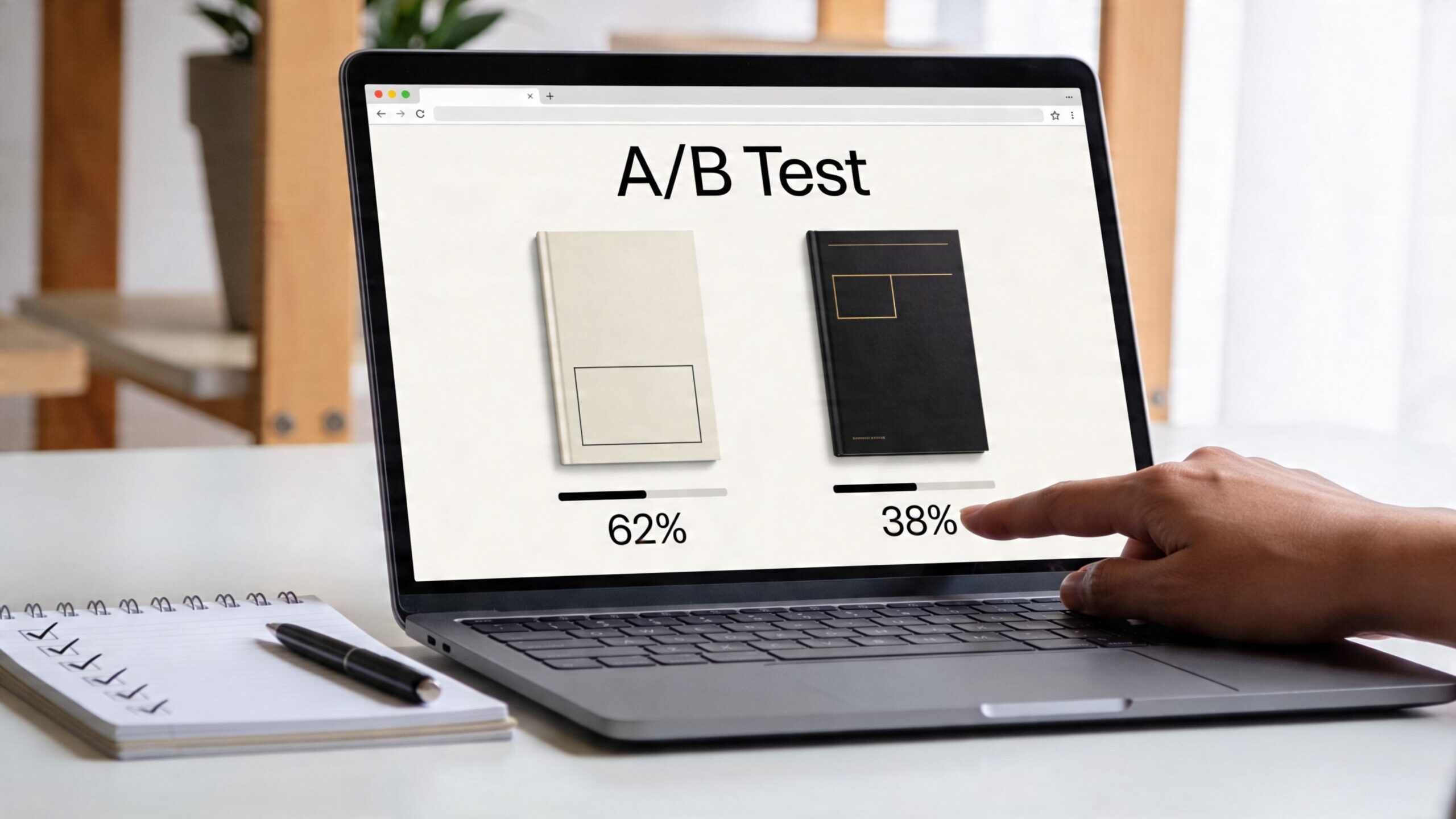
- Run a Simple A/B Test: This sounds technical, but it’s not. Create two identical social media ads with the same mock-up cover but swap out the titles. Run them with a small budget aimed at your target reader. In a few days, the data will do the talking. The title with the higher click-through rate (CTR) is the one grabbing more attention. It’s that simple.
- Use a Feedback Service: If you don't have an audience yet, platforms like PickFu are a game-changer. You can get fast, targeted feedback on your titles and covers from a specific demographic. You get votes, but more importantly, you get written explanations for why people chose what they did.
The most dangerous assumption in writing is thinking you know what your audience wants. Test it. Let the data tell the story. A title that wins a poll with a 70% majority is a much safer bet than a title you just have a good feeling about.
Performing Your Final Due Diligence
Once you’ve got a data-backed winner, there’s one final, non-negotiable step: making sure the coast is clear. A brilliant title that causes confusion or gets you into legal hot water is dead on arrival. This isn’t about shelling out for a lawyer; it’s about doing some basic homework to protect yourself.
First, do a deep search on the platforms where readers will find your book. You need to check for your exact title and any close variations on:
- Amazon (pay close attention to your specific book category)
- Goodreads
- Google Books
If you find another book in your genre with the same or a confusingly similar title, just walk away. It’s not worth the fight or the risk of getting lost in a sea of search results. Pick your runner-up and move on.
Finally, you need to do a quick trademark check. While you generally can't copyright a single book title, a title that's part of a series or brand (Chicken Soup for the Soul, for example) can absolutely be trademarked.
A quick search on the U.S. Patent and Trademark Office's search system is all it takes.
This quick search ensures you aren't accidentally stepping on an established brand's toes. Trust me, it's a five-minute task that can save you from a massive headache later on.
You’ve picked the perfect title. Awesome. But don’t trip at the finish line. How you format that title says a lot about your professionalism, and getting it wrong can make even the best book look amateurish.
This isn’t just about being a grammar stickler. It's about meeting a universal standard in publishing that shows you respect your reader and your own work. For authors and publishers managing a whole library of content, these small details are the foundation of a polished, valuable brand.
Getting the Formatting Right: Italics vs. Quotation Marks
When you mention a book title in an article, on your website, or in your marketing copy, you have to format it correctly. The rule is actually pretty simple once you get the hang of it.
For full-length, standalone works, italicization is the gold standard. This is the rule followed by the big-league style guides like the Chicago Manual of Style. The basic idea is to separate long works from short works.
Here’s a quick cheat sheet:
- Use italics for: Books, movies, full-length albums, and magazines. Think of it this way—if you can hold it in your hands as a single, complete product, it probably gets italics.
- Use quotation marks for: Chapters, articles, song titles, and short stories. These are pieces within a larger collection.
Still have questions? It's a common point of confusion. For a deeper dive that clears up any lingering doubts, check out this great resource: Are Book Titles Underlined or Italicized?
Capitalization That Looks Pro: Title Case vs. Sentence Case
Next up is capitalization. This is another one of those subtle signals that separates the pros from the newbies. You’ll mainly be dealing with two styles: Title Case and Sentence case.
Title Case is what you see on most book covers and in headlines. It feels important. You capitalize the first and last words, plus all the “major” words in between (nouns, verbs, adjectives, etc.). You leave the little words (like "of," "a," "the," "and") lowercase unless they're the first or last word.
Example of Title Case: The Life-Changing Magic of Tidying Up
Sentence case is exactly what it sounds like. You only capitalize the first word and any proper nouns, just like you would in a normal sentence. You’ll see this style used in reference lists, bibliographies, and some academic writing.
Example of Sentence case: The life-changing magic of tidying up
Nailing these formatting rules ensures your work looks polished everywhere it shows up. Whether you're a vlogger turning a hit series into a book or a publisher organizing a massive backlist, this attention to detail makes your entire content library look—and feel—more valuable.
Common Questions About Writing Book Titles
You've brainstormed, you've researched, but a few nagging questions are still rattling around in your head. It happens to every author.
Let's clear up some of the most common—and often confusing—points that pop up when you're trying to land on the perfect book title.
Can Two Books Have the Exact Same Title?
Legally speaking, yes. A book title itself can't be copyrighted. But that's where the simple answer ends and the strategic one begins.
If a title becomes synonymous with a brand (think Harry Potter), it can get trademark protection. More importantly, using the same title as another book, especially a well-known one in your genre, is just a bad move. You’re setting yourself up for a world of reader confusion and making your book an absolute ghost in online searches.
Always run a thorough search on Amazon, Goodreads, and Google before you commit. Seriously. Don't skip this.
How Important Is a Subtitle for a Non-Fiction Book?
For non-fiction, a subtitle isn't just important—it's everything. Think of it less as an add-on and more as the second half of a one-two punch.
Your main title gets to be creative and grab attention. Your subtitle has a much more critical job:
- It clearly states the book’s promise to the reader.
- It spells out who the book is for and the benefit they'll get.
- It's prime real estate for the SEO keywords your ideal reader is typing into a search bar.
A good subtitle instantly answers the reader's question, "What's in this for me?" Without one, you're leaving your book's discoverability and marketing power up to chance.
Should I Rely on an AI Title Generator?
AI title generators are a fantastic brainstorming partner, but they are a terrible final decision-maker. Use them to shatter a creative block or to see word combinations you might have missed.
Use AI as a starting point, not the finish line. Feed it your core concepts to generate a long list of possibilities, then apply the principles of clarity, intrigue, and SEO to refine the best options into a title that is truly unique to your book.
This approach gives you a helpful nudge while keeping you in the driver's seat. It's collaboration, not delegation.
How Long Should My Book Title Be?
There’s no magic number here, but shorter, punchier main titles are almost always more memorable. You want something that's easy for people to say, search for, and recommend to a friend.
For non-fiction, the winning formula is often a short, snappy main title paired with a longer, descriptive subtitle. For fiction, it's all about being evocative and fitting the expectations of your genre.
If you find yourself tripping over the words when you say it out loud, it's probably too long. A title that’s a mouthful will smother any hope of word-of-mouth marketing.
Ready to turn your entire content library into a goldmine of new ideas? Contesimal is the AI-powered platform that helps creators and publishers organize, understand, and generate new value from their existing assets. Stop guessing and start creating with data-driven insights. Discover what's hidden in your content at Contesimal.