Analyzing content performance is all about tracking the right numbers—views, engagement, conversions—to figure out how people actually interact with your work. It’s the process of turning a mountain of raw data into sharp, actionable insights, showing you what connects, what falls flat, and where to pour your creative energy next.
Stop Guessing What Your Audience Wants

Your content is giving you feedback 24/7, but are you listening? Every single view, comment, and share tells a story about what your audience truly craves. Learning to analyze content performance demystifies this entire process, turning a data-heavy chore into a direct conversation with your community.
This guide is built for creators—the YouTubers, podcasters, bloggers, and publishers who are ready to shift from hobbyist to a real, revenue-generating business. It’s all about systematically digging into your content library to create new value, upcycle your old content, and ultimately make more money with the assets you already own.
From Raw Data to Actionable Insights
The real magic of analysis isn't just seeing which video got the most views; it's understanding why. That's the key to organizing your content library, pinpointing what genuinely connects with people, and figuring out how to reignite your older assets. When you can turn performance data into real insights, you can finally stop guessing and start building on what you know already works. Organize. Understand. Take Action.
The way we measure success is always shifting. The focus has moved well beyond simple vanity metrics and toward more meaningful, genuine interactions.
As of 2025, 53% of marketers now track social media and website engagement as their key performance metrics. This shows a huge shift in how we think about content effectiveness. In fact, engagement rates—likes, comments, and shares—remain the top metric for 64% of content teams, proving that authentic audience interaction is the ultimate sign of quality content.
Building a Foundation for Growth
For any creator with a growing library of assets, this kind of analysis is foundational. It’s how you spot the concepts that can be expanded into a killer playlist or a whole new series. It’s also how you find those underperforming gems that, with a little polish, could be repurposed for entirely new platforms and audiences.
This systematic approach is non-negotiable for anyone trying to experiment with new ideas while still delivering consistent value.
But this process is so much more than just staring at a dashboard. It's about building a workflow that allows you and your team to collaborate around these insights. A well-defined strategy, laid out in a comprehensive content playbook, helps you organize, understand, and act on your findings to reignite your content library and bring it back to life.
Ultimately, analyzing performance is the engine that fuels your next big hit.
Defining Goals That Drive Real Growth
Before we even touch analytics, we have to agree on what "good performance" actually looks like for your business. It's a surprisingly easy step to skip. So many creators dive headfirst into a sea of data with no clear destination, and that’s a surefire way to get lost.
Vague goals like "get more views" or "grow our audience" are nice thoughts, but they’re not a strategy. They don't give you a roadmap for real, measurable progress. Effective analysis begins when you set specific goals tied directly to your business. This is the moment you stop just making content and start building a content-driven business.
From Vague Objectives to Specific Goals
Let’s get tangible. A meaningful goal looks completely different depending on who you are and what you're trying to build. The trick is to connect a content action to a business outcome.
Here are a few real-world examples:
-
For a YouTuber transitioning to professional: Instead of "get more views," a much stronger goal is to "increase average watch time on my 'Beginner's Guide' playlist by 15% this quarter." Why? Because this is directly tied to satisfying the YouTube algorithm (which loves session time) and boosting your ad revenue.
-
For a Publisher or Blogger: "Get more traffic" is way too broad. A better objective is to "increase newsletter sign-ups from our 'Case Studies' category by 20% over the next six months." This connects your content directly to building an owned audience—one of your most valuable assets for growing the value of your content.
-
For a Podcaster: Aiming for "more listeners" is just the start. A truly strategic goal is to "drive 500 clicks to our affiliate sponsor's link from the show notes in the next four episodes." Now you're measuring the direct monetary value your content is creating.
See the shift? We've moved from vanity metrics to actions that build a sustainable creative enterprise. This level of clarity is what separates hobbyists from professional creators who know exactly how to grow the value of their content library.
Connecting Goals to Key Performance Indicators
Once your specific goal is locked in, the next step is identifying the Key Performance Indicators (KPIs) that tell you if you're on the right track. Think of KPIs as the vital signs for your content's health. They are the specific numbers you'll monitor to measure progress.
Let's go back to our YouTuber who wants to increase watch time on a specific playlist. Their KPIs are pretty straightforward:
- Average view duration on videos within that playlist.
- Audience retention graphs to pinpoint exactly where viewers are dropping off.
- Click-through rate (CTR) on the playlist from their main channel page.
Each KPI gives you a different piece of the puzzle. A low CTR might signal that your playlist title or thumbnail isn't compelling enough. A sharp dip in retention 30 seconds into every video probably means your intros are weak.
Setting clear goals isn't just about accountability; it's about focus. It tells you which data points matter and which are just noise. Without a goal, every metric seems equally important, leading to analysis paralysis.
This framework is the bedrock of any effective content analysis. By starting with a clear, measurable business objective and tying it to a handful of relevant KPIs, you make sure every minute spent in your analytics platform is productive. You’re no longer just counting views; you're gathering intelligence to make smarter decisions, refine your strategy, and build a stronger, more profitable business.
Choosing Metrics That Match Your Medium
Here's a hard truth: not all metrics are created equal. Trying to judge a podcast by the same yardstick as a blog post is a fast track to confusing, useless data. A hit podcast sings a different data story than a viral video, and you need to know how to listen.
Effective analysis means ditching the one-size-fits-all approach. Resist the urge to obsess over universal vanity stats like raw page views or follower counts. Instead, your goal is to build a custom dashboard of KPIs that actually reflect how your audience engages with each specific format. When you focus on the right numbers, you get a much clearer picture of what’s truly working.
Key Metrics for Video Creators
For anyone creating on YouTube or other video platforms, success is about way more than just the view count. The algorithm heavily favors content that keeps people watching, so your primary focus should be on metrics that measure how captivated your audience is.
These are the core video KPIs that should be on your radar:
- Average View Duration: This is arguably your most important metric. It tells you, on average, how long people are sticking around. A higher duration signals to the platform that your content is valuable and engaging.
- Audience Retention: This graph is a goldmine. It shows you, second by second, where your audience’s attention peaks and where it drops off. A sudden dip might point to a boring segment, while a steady curve means you've hooked them.
- Click-Through Rate (CTR): This measures how many people who see your video's thumbnail actually click to watch it. A low CTR often means your packaging—your title and thumbnail—needs a rethink, even if the content itself is amazing.
Essential Data for Podcasters and Audio Producers
For podcasters, the analytics can feel a bit scattered, but the core principles are the same. You're looking for signs that people aren't just finding your show but are actually listening.
Zero in on these audio-specific metrics:
- Downloads and Trends: Total downloads give you a baseline for reach. But the real story is in the trend over time. Are downloads per episode growing consistently within the first 30 days of release? That's what you want to see.
- Listener Drop-Off Points: Many podcast hosts provide data on where listeners stop playing an episode. Just like video retention, this helps you pinpoint segments that aren't landing or intros that are too slow to get to the point.
- Follower Growth: This is a crucial indicator of loyalty. A download might be a one-time listen, but a new follower is someone who has decided they want to hear more from you. That's a huge win.
A common mistake is treating all downloads as equal. A listener who finishes an entire 45-minute episode is far more valuable than one who drops off after two minutes. Dig into your retention data to understand true engagement.
Metrics That Matter for Writers and Bloggers
Written content offers a rich set of data points that go far beyond simple page views. For bloggers, publishers, and content marketers, the goal is to measure how deeply readers are interacting with your words and whether that interaction leads to a desired action.
Make these metrics the stars of your dashboard:
- Time on Page: This metric reveals how long visitors are actually spending with your article. A low time on page for a long-form guide is a huge red flag that the content isn't holding their attention or solving their problem.
- Scroll Depth: This tells you how far down the page your readers are getting. Are they bouncing after the first paragraph, or are 75% of them making it all the way to your call-to-action at the end?
- Conversion Rate: This is where content meets business goals. Whether your goal is a newsletter sign-up, an e-book download, or a product purchase, this metric tells you exactly how effective your writing is at persuading readers to act.
For creators aiming to build a sustainable business, it's also critical to understand how written content contributes to search visibility. A key part of that involves learning more about optimizing content for search engines to attract a steady stream of organic traffic.
To bring it all together, think about your metrics this way: what you measure depends entirely on what you create. Different formats have different jobs, so they need different KPIs.
Key Performance Indicators by Content Format
| Content Format | Primary Engagement Metric | Audience Growth Metric | Conversion Metric |
|---|---|---|---|
| Blog Post | Time on Page, Scroll Depth | New vs. Returning Users | Newsletter Sign-ups, Clicks on CTA |
| Video | Average View Duration | Subscriber Growth | Clicks on End Screens/Cards |
| Podcast | Listener Drop-off Rate | Follower/Subscriber Count | Downloads of a Gated Resource |
| Infographic | Shares | Backlinks Acquired | Website Clicks from Social |
| Webinar | Live Attendance, Polls | Registration Rate | Demo Requests, Sales |
Ultimately, selecting the right metrics for each medium gives you the clarity to stop chasing vanity stats and start making strategic decisions that actually move the needle for your brand.
Mining Gold from Your Existing Content
Your content library isn't just a digital attic full of old work; it's a living, breathing database of audience feedback. It’s a goldmine. For every creator, publisher, or marketer, those archives hold the clues to your next viral hit, your next pillar article, and even your next successful product.
Instead of constantly chasing the "next new thing," the biggest opportunities often come from looking back. This is the shift from being a content maker to a strategic library owner—someone who knows how to dust off old assets and give them a new life. It's about letting your history inform your future.
Identifying Your Evergreen All-Stars
Every content library has them. They’re the "evergreen" pieces. These are the videos, blog posts, or podcast episodes that just keep pulling in traffic, month after month, long after you hit publish. They're your reliable workhorses, usually built around timeless topics your audience can't get enough of.
Finding them is your first job. Jump into your analytics and look for content that:
- Maintains steady traffic or views over a 6-12 month period, without you having to constantly promote it.
- Ranks for valuable keywords and consistently brings in organic search traffic.
- Still gets comments, shares, or other forms of engagement long after its launch party ended.
Once you’ve found these all-stars, your job is to put them back to work. Could that high-performing blog post be expanded into a detailed YouTube video? Could that popular podcast episode be chopped into a dozen shareable social media clips? These proven winners are your safest bets for repurposing because you already know people want them. This is how you take your longform content across platforms.
Finding Underperformers with High Potential
Just as valuable as your superstars are the "sleeping giants"—the content that should have done well but flopped. These pieces usually have a killer concept but were probably held back by a weak title, a boring thumbnail, or just bad timing. A good content audit is like a treasure hunt for these hidden gems.
Look for content with weird, conflicting metrics. That’s where the potential is hiding. For example:
- A blog post with a tiny number of page views but a ridiculously high time on page. This tells you the few people who found it loved it. The content is solid; the promotion or SEO was the problem.
- A YouTube video with a garbage click-through rate (CTR) but fantastic audience retention. This is a classic case of great content wrapped in bad packaging. A new title and thumbnail could completely turn it around.
The goal here isn't just to find what worked. It's to figure out why something didn't. When you diagnose the root cause—whether it was distribution, packaging, or timing—you can give that valuable content the second chance it deserves.
Using Tools to Surface Deeper Insights
As your library grows, trying to sift through everything by hand becomes a nightmare. This is the point where hobbyists become professionals. You need tools to help you organize your work, collaborate with your team, and spot patterns you’d otherwise miss.
Platforms like Contesimal are built for exactly this. When you pull your entire library of videos, articles, and podcasts into one place, you start to see the big picture. By creating a collaborative space for humans and AI, you can quickly find recurring themes, identify content clusters that your audience loves, and even pinpoint specific moments in a long video that drove the most engagement. This lets you and your team make decisions based on data, not just gut feelings.
Instead of guessing what your next video should be, you can look at your top performers and realize, "Hey, every time I talk about this specific topic, my retention spikes." That's not a guess anymore. That’s a data-driven insight telling you exactly where to point your creative energy. For a deeper look at this process, check out our guide on unlocking new value by mining your content library.
At the end of the day, a systematic audit of your past work is one of the smartest things you can do for your content strategy. It lowers your risk, saves you from creative burnout, and makes sure every new thing you create is built on a foundation of what’s already proven to work. Your history is your best playbook.
Turning Performance Data Into Action
All this data is useless if you don't do anything with it. Seriously. Poring over analytics is just academic until you use those numbers to make smarter, faster, and better decisions. This is where we close the loop between finding an insight and actually executing on it.
Moving from analysis to action means you need a repeatable workflow. For a lot of creators, especially if you're shifting from a side project to a real business, this means getting comfortable with making a hypothesis and testing it. It’s about building a system for constant improvement, not just throwing spaghetti at the wall to see what sticks.
I like to think about it as a simple, three-step cycle: organize, identify, and repurpose.
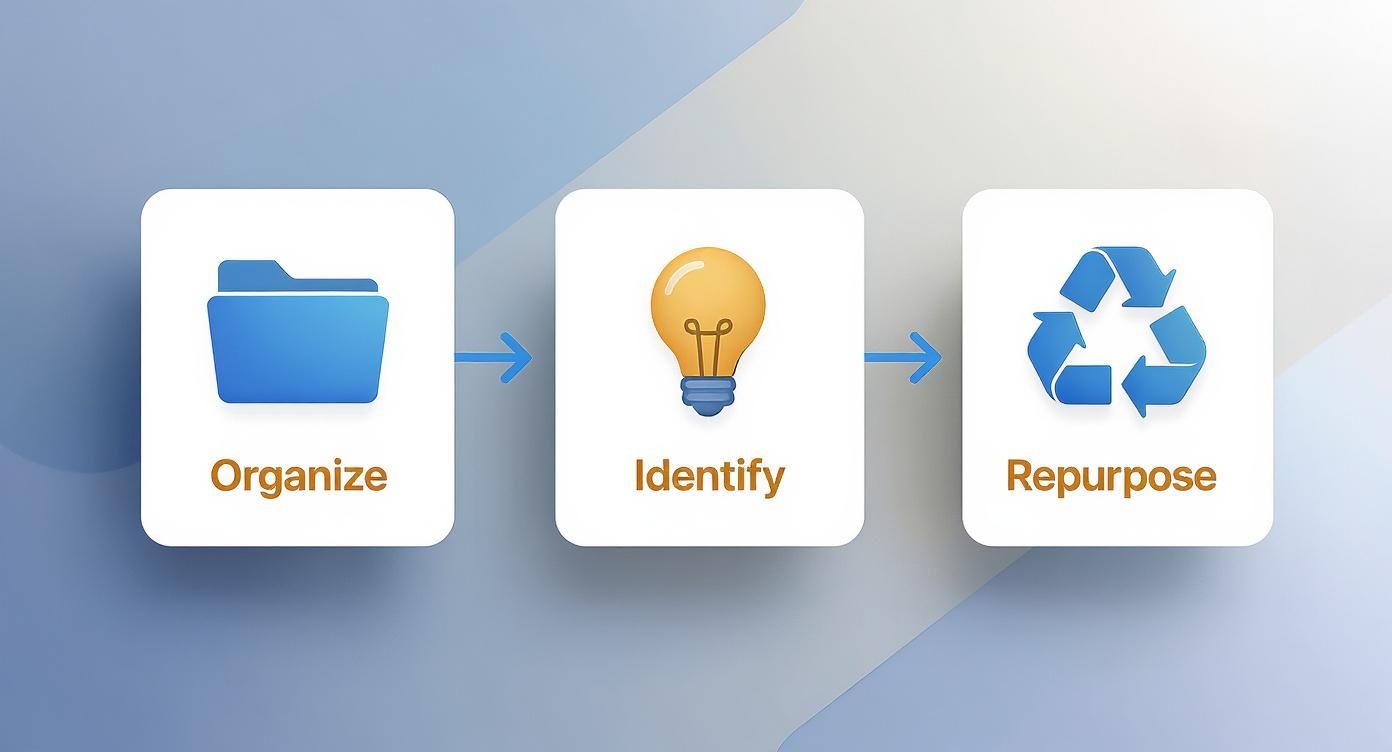
This just shows how you move from raw data to new content. You organize your assets, find opportunities hiding inside them, and then recycle those wins into fresh material. This is how you upcycle your old content and create new value.
Formulating Hypotheses for A/B Tests
A/B testing isn't some complex thing reserved for corporate marketing departments with giant budgets. It's an incredibly powerful tool for any creator who wants to sharpen their work. The idea is simple: change one thing and see what happens. This always starts with a clear hypothesis rooted in your data.
Let's say you're a YouTuber. You find a video with fantastic audience retention, but the click-through rate (CTR) is garbage. Your analysis tells you the packaging is the problem.
- Your Hypothesis: "My thumbnail is way too busy and blends in. I bet if I change it to a simpler design with a human face, the CTR will jump by 2%."
Boom. Now you have a specific, measurable experiment. Swap out the thumbnail, monitor the CTR for the next seven days, and see if you were right. This exact same logic works for blog post headlines, podcast titles, or newsletter subject lines.
Making Data-Informed Editorial Changes
Your performance data is the closest thing you have to a crystal ball for planning your content. It tells you exactly what your audience is hungry for. When you see a trend, you need to pounce on it.
Imagine you're a podcaster and you notice a massive listener retention spike during a five-minute segment where you interviewed an industry expert.
Insight: Your listeners are super engaged with this specific topic and guest format.
Actionable Next Steps:
- Greenlight a full-length follow-up episode dedicated entirely to that topic.
- Invite that same expert back for a deeper dive or even a recurring spot.
- Chop up that high-retention segment into short-form video clips for social media.
This isn't guesswork. It's a strategic move backed by clear audience behavior. You're doubling down on what already works, which massively increases the odds that your next piece of content will be a hit. This is how you start building content pillars that turn one successful idea into an entire series.
Responding to Conflicting Metrics
Sometimes, your data will send you mixed signals. Knowing how to read the tea leaves is a critical skill. A classic example for bloggers is a piece with high engagement but low conversions. Maybe a blog post has an amazing time on page—over six minutes—but almost nobody is clicking the call-to-action (CTA) for your newsletter.
What's that telling you? The content itself is magnetic. It’s holding people’s attention. But the conversion element is completely failing.
Here’s a quick troubleshooting checklist:
- Is the CTA even visible? Maybe it’s buried at the bottom of the page, and only 20% of readers ever scroll that far down.
- Is the offer compelling? "Sign up for our newsletter" is weak sauce. Is the value crystal clear and directly tied to the awesome article they just read?
- Is there too much friction? Are you asking for their life story on the sign-up form?
By mapping out that user journey, you can experiment. Try moving the CTA higher up. Rewrite the copy to be more persuasive. Simplify the sign-up process. This is how you turn a high-potential asset that's underperforming into a true workhorse for your business.
Got Questions? We've Got Answers.
As you start digging into your data, a few questions are bound to pop up. Making sense of content performance is a skill you build over time, so let's walk through some of the common hurdles creators and marketers run into when they start turning numbers into decisions.
How Often Should I Actually Be Analyzing My Content?
There’s no magic number here. The right cadence really depends on how fast you publish and how long your content stays relevant. A daily vlogger and an author of deep-dive evergreen guides live in two totally different worlds.
-
For high-frequency channels (think daily or multiple posts a week): You’ll want to do a weekly check-in. This keeps you agile. It lets you spot trends as they’re happening and react to audience feedback without getting lost in the noise of daily fluctuations. You’re looking for those immediate signals.
-
For content with a longer shelf life (weekly articles, pillar videos): A monthly deep dive is your sweet spot. This gives your content enough time to breathe and show its true colors. It’s the perfect window to see bigger trends in traffic, engagement, and how people are moving through your ecosystem.
-
For the big-picture strategy: A quarterly analysis is absolutely non-negotiable. This is where you zoom way out. You’ll assess which content pillars are actually driving growth, see how your experiments panned out, and use those insights to map out your next three months.
The goal is to find a consistent rhythm—one that’s frequent enough to guide your next move but not so frequent that you’re just chasing random spikes and dips.
What Are the Classic Mistakes People Make When Analyzing Content?
Oh, it's so easy to get tripped up when you're starting out. The biggest one? Chasing vanity metrics. A million views sounds incredible, but if your audience retention is only ten seconds, what did that view really accomplish? The same goes for raw follower counts without any real engagement.
Another huge pitfall is completely ignoring the qualitative stuff. The comments on your YouTube videos, the replies to your newsletter—that's pure gold. Numbers tell you what happened, but the comments tell you why. They reveal how your content made people feel.
Don't analyze your data in a bubble. A sudden dive in organic traffic might have nothing to do with your content and everything to do with a Google algorithm update. Always zoom out and consider what else is going on in the world.
And finally, watch out for "analysis paralysis." Your goal isn't to create the world’s most beautiful spreadsheet. It’s to find one or two things you can actually do with the data, then go test them. Perfection is the enemy of progress here.
What Tools Do I Really Need to Get Started?
You absolutely do not need a massive budget. Some of the most powerful tools are completely free, and you probably already have access to them.
Start with the native analytics built into the platforms you're already using. They’re designed for that specific format and are surprisingly robust.
Here's a barebones starter pack:
- For Your Website or Blog: Google Analytics is the undisputed king. It's the foundation for understanding your traffic, what people do on your site, and where they're coming from.
- For Your Videos: YouTube Studio is a treasure trove. It gives you everything from audience demographics and retention graphs to exactly which thumbnails are getting clicked.
- For Your Social Feeds: Every major platform—like Meta Business Suite—has its own detailed dashboard to track reach, engagement, and audience growth.
- For Your Podcast: Your podcast hosting provider (think Libsyn or Buzzsprout) is your source of truth for downloads, listener trends, and where in the world people are tuning in.
Once you get the hang of these and your needs get a bit more complex, you can start layering in more specialized tools. SEO platforms like Semrush or Ahrefs are fantastic for digging into keywords and seeing what competitors are up to.
For creators sitting on a mountain of past content, a tool to organize that library becomes a game-changer. This is where you can start to connect the dots across your entire archive, making it simple for your team to find, analyze, and repurpose your best work.
Ready to stop guessing and start building a content strategy based on what you know works? Contesimal is a platform designed to help you organize your content library, collaborate with your team, and uncover the hidden value in your archives. It revolutionizes research collaboration, enabling you to expand value across your existing assets. Turn your past performance into your future success. Explore Contesimal and see how it works.