
You probably already have more copywriting raw material than you think.
If you're a podcaster, blogger, YouTuber, or publisher, you've already spent months or years learning what grabs attention, what gets ignored, what people click, and what they skip. The mistake most beginners make when learning how to start copywriting is acting like they need to become someone else first. They open a blank doc, try to sound like a famous ad writer, and freeze.
A better path is to use the assets you already have.
That means treating your old videos, newsletters, episodes, posts, and landing pages as training data. You’re not starting from zero. You’re starting with proof of what your audience already responded to, plus a body of work you can reshape into samples, offers, and client pitches. That’s a much smarter way to begin than writing fake ads for brands you’ve never worked with and audiences you don’t understand.
If your goal is to get your first paying client in the next 90 days, focus on three things. Learn persuasion, practice daily, and package your existing content into a portfolio that feels relevant to real buyers.
Mastering the Core Skills of Persuasion
Copywriting isn't decorative writing. It's applied psychology.
Good copy gets a specific person to take a specific action. Sometimes that action is a click. Sometimes it's a reply, a sign-up, a purchase, or a booked call. The words matter, but the primary job is moving someone from indifference to action.

Think in outcomes, not sentences
New copywriters often obsess over wording too early. They ask, “Does this sound good?” A stronger question is, “Does this move the reader one step closer to action?”
That mindset shift changes everything.
A YouTube title isn't just a title. It's the part that earns the click. A podcast ad read isn't filler. It's a trust transfer from host to sponsor. A newsletter intro isn't throat-clearing. It's the part that decides whether anyone reaches the link.
One of the most useful persuasion frameworks to study is AIDA, which stands for Attention, Interest, Desire, Action. If you want a deeper walkthrough, this guide on the AIDA model in copywriting is worth reading.
Here’s what AIDA looks like in creator language:
- Attention gets the scroll to stop. Think headline, thumbnail text, subject line, or opening hook.
- Interest keeps the person reading or watching. You show them this is relevant to their problem.
- Desire connects the solution to a result they want. Benefits matter more than features.
- Action asks for a clear next step. Subscribe, click, buy, apply, reply.
If you’ve ever studied practical strategies for viral content, you’ve seen a related truth. The strongest content doesn’t wander into engagement. It earns attention fast, builds tension, and pays it off.
Use PAS when the pain point is obvious
A second framework I lean on a lot is PAS, which stands for Problem, Agitate, Solution. This one works especially well when your audience already feels the problem.
For example, say you help creators repurpose longform content.
- Problem: “You publish strong longform content, but most of it dies after one release.”
- Agitate: “That means your best ideas disappear into your archive while you keep scrambling for the next post, episode, or video.”
- Solution: “Turn your existing library into fresh assets, campaigns, and offers instead of starting from scratch every week.”
That’s copywriting. Not clever lines. Clear movement.
Practical rule: If your copy sounds polished but the reader still can’t tell what problem you solve, the structure is broken.
Every CTA needs a reason
One of the oldest persuasion lessons still works because it matches how people make decisions. Including the word “because” or giving a clear reason can increase compliance from 60% to 94%, based on a landmark study cited in this copywriting statistics summary.
That matters because weak copy often asks for action without justification.
Compare these:
- “Join the newsletter.”
- “Join the newsletter because you’ll get weekly breakdowns you can use in your next campaign.”
The second line gives the reader a reason to care. It doesn’t need to be flashy. It needs to be clear.
What works and what usually fails
When beginners ask me how to start copywriting, I usually tell them to stop trying to sound impressive and start trying to sound useful.
Here’s the trade-off in plain terms:
| Approach | What happens |
|---|---|
| Clever-first writing | Sounds sharp, often converts poorly |
| Audience-first writing | Feels plain, often performs better |
| Feature-heavy copy | Explains the thing, misses the result |
| Benefit-led copy | Connects the thing to a desired outcome |
A good working habit is to draft every line with one of these questions in mind:
- What does the reader want right now
- What’s making them hesitate
- What proof or explanation would reduce that friction
- What single next step do I want them to take
If you can answer those four questions, you can write solid copy for emails, landing pages, product blurbs, scripts, and offers. That’s the foundation.
Building Your Daily Copywriting Practice
Copywriters often don’t fail at copywriting because they lack talent. They fail because they practice randomly.
They read tips, watch breakdowns, save screenshots, and call that progress. It isn’t. Skill comes from repeated, deliberate reps. Copywriting needs a workout, not just inspiration.
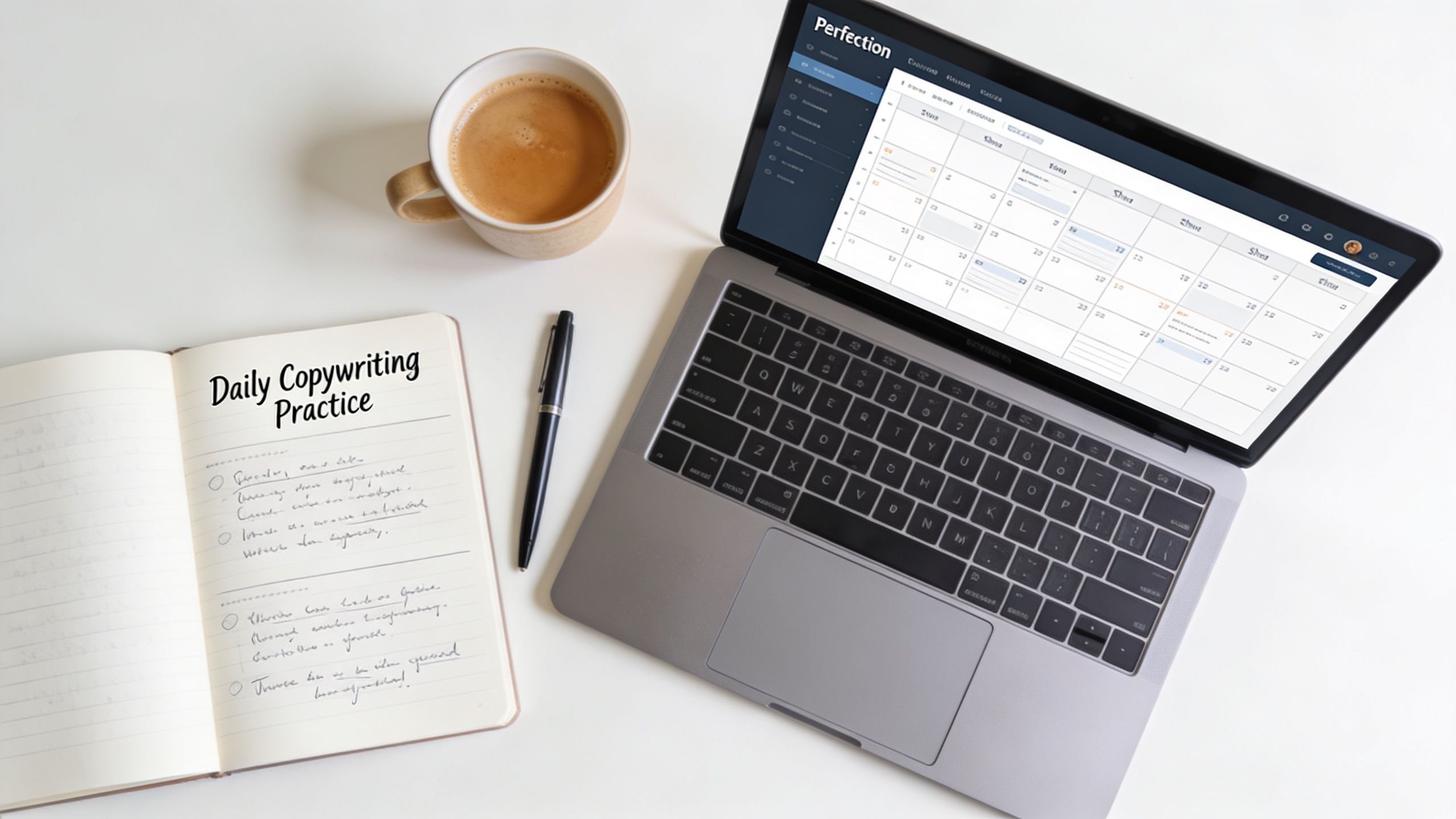
A practical starting routine is 90 minutes a day. In one widely shared breakdown of beginner training, copywriters who spend that time handwriting strong ads, analyzing structure, and reviewing fundamentals report 40% to 60% improvement in conversion performance within three months, while 80% of beginners tend to fail when they copy without analysis. That summary comes from this guide on daily copywork for new copywriters.
A daily practice that actually builds skill
You don’t need a fancy setup. You need a repeatable sequence.
Try this:
Hand-copy strong copy for 30 minutes
Pick one email, sales page section, landing page, product page, or ad. Write it out by hand. Slow enough to notice rhythm, transitions, and emphasis.Annotate what the copy is doing
Mark the hook. Circle the objection handling. Identify where the writer shifts from problem to promise. Notice where proof shows up.Review one core concept
Revisit AIDA, PAS, headline writing, CTA logic, or offer framing. Keep it focused.Write your own version
Don’t write about a random brand. Rewrite a section for your own content, your own audience, or a creator offer you understand.
That last step matters most. Copywork helps you internalize structure. Rewriting helps you build judgment.
Don’t just collect examples. Build a swipe file with notes
A swipe file is useful only if it helps you see patterns.
Most beginners save dozens of screenshots and never learn anything from them. A better swipe file is small, organized, and annotated. Save examples by job, not by vibe.
You might create folders like:
- Email subject lines that made you open
- Landing page hero sections that made the value obvious
- Podcast ad reads that sounded natural
- YouTube hooks that created immediate curiosity
- CTAs that felt specific instead of generic
Add a one-line note under each example. Why did it work? Was it urgency, clarity, novelty, proof, or specificity?
If you want more ideas for building a writing routine outside strict copy drills, Feather has a solid set of tips for practicing writing that pair well with this kind of structured repetition.
The point of copywork isn’t imitation. It’s pattern recognition.
Use one media source, then write from another
This is a simple drill I like because it stops your writing from getting stiff. Listen to a podcast segment, then write an email promoting it. Watch a video, then write a landing page headline for it. Read a long blog post, then write three social hooks and one CTA.
That cross-format move teaches you to translate value.
For a practical writing mindset that complements this routine, the advice in this piece on becoming a great writer through better habits is useful. Strong copywriters usually become strong by stacking habits, not by waiting for confidence.
A quick visual breakdown helps if you want to see this in action:
What to avoid in your first month
Three mistakes slow beginners down more than anything else:
| Mistake | Better move |
|---|---|
| Reading about copy instead of writing it | Write every day, even if it’s short |
| Copying style without understanding function | Annotate every example you study |
| Practicing on brands you don’t understand | Practice on creators, offers, and audiences you already know |
If you want to learn how to start copywriting without burning out, make the daily session small enough to repeat and serious enough to matter. Consistency beats heroic bursts.
Creating a Portfolio That Sells Without Clients
The usual beginner advice is to write spec ads for giant brands.
I think that’s weak advice for most creators.
If you write an imaginary Nike campaign, you’re borrowing somebody else’s market, somebody else’s audience, and somebody else’s credibility. The sample might look polished, but it doesn’t tell a prospective client much about whether you can understand a niche, work from existing material, or improve messaging around real content.
Your own content library is far more useful.

Your archive already contains market intelligence
If you’ve published interviews, essays, videos, ad reads, threads, newsletters, or episode descriptions, you already have source material. What's more, you already have context. You know which topics sparked replies, which titles got traction, which formats your audience preferred, and which ideas had enough depth to revisit.
That makes your archive more than old content. It’s a training set.
A modern shortcut for beginners is using AI tools to mine that archive for patterns. One overview of this workflow notes that creators can use AI-powered classification to identify strong themes and build client-ready samples 5x faster than the traditional route of writing purely speculative pieces. That angle is summarized in this video discussion on using content archives for copywriting practice.
Build portfolio pieces from content that already proved interesting
Instead of asking, “What fake ad should I write?” ask, “What real asset do I already have that deserves better copy?”
Here are stronger portfolio pieces for creators:
An email sequence for your best podcast episode series
Take a topic your audience already cared about and write emails that promote it with different hooks.A landing page for a video playlist or newsletter lead magnet
Package existing content into a focused promise.A homepage rewrite for your own creator brand
Tighten positioning, clarify audience, and improve CTAs.A set of YouTube titles and descriptions for older high-potential videos
This shows headline judgment and positioning skill.A launch page for a workshop, template, or digital product based on your archive
Even if the product doesn’t exist yet, the angle is grounded in your actual audience behavior.
Useful test: If your sample is built from material you already understand, you’ll write with more precision and less fluff.
What a strong no-client portfolio actually looks like
You don’t need dozens of pieces. You need a handful that feel relevant.
A practical portfolio can include:
Three to five niche-specific samples
If you want to serve podcasters, show podcast-focused work. If you want to serve newsletter operators, show email and landing page work.A short brief for each piece
Explain the audience, the problem, and the goal.Your strategic reasoning
Why did you choose that hook? Why this CTA? Why this structure?Before-and-after positioning when possible
Show the original title, page section, or email intro, then your revision.
That format sells better than a pile of disconnected writing samples.
If you want a useful reference point for the type of assets businesses hire copywriters for, this overview of website copywriting essentials is a helpful benchmark.
Why this beats generic spec work
Clients don’t just want pretty words. They want relevance.
A creator, media brand, or small publisher hiring their first copywriter is usually asking some version of these questions:
- Can this person understand my audience?
- Can they work with existing content instead of demanding everything from scratch?
- Can they make a proven idea more marketable?
- Can they organize messy information into a sharper message?
A portfolio built from your own archive answers all four.
That’s why I prefer this route for anyone learning how to start copywriting while also building a business around content. It gives you practice, positioning, and proof at the same time. You’re not pretending you’ve done the work. You’re showing how you think.
How to Find and Pitch Your First Paying Client
Once you have a small portfolio, the job isn’t “be everywhere.” It’s “be relevant in the right rooms.”
Beginners waste a lot of time spraying cold messages across job boards, generic freelance marketplaces, and inboxes that were never a fit. A tighter approach works better. Pick a niche you already understand, build a short list of buyers in that niche, and send specific pitches tied to real opportunities.
One practical client acquisition framework says 80% of first hires are based on portfolio relevance, not years of experience. The same process recommends creating 5 to 10 niche-specific samples, sending 50 personalized outreaches per week, expecting a 10% to 20% response rate, and working from proposals that convert at 30% to 50%. It also notes that many beginners land a first client in 4 to 6 weeks when they follow the funnel consistently, according to this guide on starting a copywriting business with no experience.
Where to look for buyers who already value content
Start with people who already publish.
That includes:
- Newsletter operators who need landing pages, welcome sequences, and promotion emails
- Podcasters who need episode descriptions, sponsor copy, and funnel emails
- YouTubers who need titles, descriptions, opt-in pages, and product copy
- Small publishers who need homepage messaging, subscription copy, and content promotion
- Agencies and content marketers who need overflow help on specific deliverables
These buyers are easier to pitch when you can say, “I already work in your world.”
A pitch that sounds useful, not needy
Bad beginner pitch:
“Hi, I’m a new copywriter looking for opportunities. I’m passionate, hardworking, and would love to help if you need anything.”
That puts all the work on the prospect.
A stronger pitch sounds like this:
I noticed your newsletter archive has strong educational content, but the signup and episode promotion copy could do more to move readers into your offers. I write email and landing page copy for creator-led brands, especially those sitting on underused content libraries. I put together a few relevant samples so you can see how I’d approach your audience. If it’s useful, I can send two specific ideas for your current funnel.
That works because it’s specific, observant, and low friction.
Keep your proposal simple
A beginner proposal doesn’t need agency theater. It needs clarity.
Include these elements:
| Proposal section | What to include |
|---|---|
| Problem | The messaging or conversion issue you observed |
| Objective | The result the copy should support |
| Deliverables | Exactly what you’ll write |
| Process | Discovery, draft, revision, final handoff |
| Timeline | A realistic schedule |
| Price | One clear number or a small set of options |
If you want examples of how to frame a proposal so it reads cleanly and quickly, these proposal models for executive summaries are useful to study. Don’t copy the format blindly. Borrow the discipline of making the first page easy to understand.
What to charge at the beginning
You do need to charge. Free work usually attracts messy projects, vague expectations, and weak respect.
Use a starter range that’s simple enough to quote confidently.
Sample Pricing for Beginner Copywriting Projects
| Service / Deliverable | Common Project Scope | Beginner Price Range (USD) |
|---|---|---|
| Email sequence | 3 to 5 emails for a launch, welcome flow, or promotion | $500-2k |
| Landing page copy | One focused page for a lead magnet, product, or creator offer | $500-2k |
| Website messaging refresh | Core homepage sections and CTA rewrite | $500-2k |
| Podcast or creator promo package | Promo emails, landing page copy, and CTA messaging | $500-2k |
That range is broad on purpose. Your first price depends on complexity, revisions, speed, and how narrow the deliverable is.
The trade-offs that matter early
There’s no perfect first-client strategy, but there are smart trade-offs.
Niche focus beats broad availability
“I write for creators and media brands” is easier to trust than “I can write anything.”Specific outreach beats volume without relevance
Fewer, sharper messages usually outperform generic mass outreach.Clear scope beats impressive language
Prospects care more about what they’re getting than how polished your pitch sounds.A paid test project beats endless unpaid samples
Small paid work can turn into a retainer. Free work often turns into silence.
If you're serious about how to start copywriting as a service business, treat outreach like part of the craft. The pitch is copy. The proposal is copy. The follow-up is copy. Client acquisition starts before the paid assignment does.
Your 90-Day Copywriting Action Plan
Most beginners don’t need more motivation. They need a calendar.
A ninety-day plan works because it gives enough time to improve, build assets, and start conversations without drifting into endless preparation. Keep it simple. One phase for fundamentals, one for packaging your work, one for outreach and delivery.
Days 1 through 30
The first month is for skill, not branding.
Research on headline performance remains one of the most useful starting points here. 8 out of 10 people only read the headline, and headlines with 10 to 13 words attract twice as much traffic and 1.5 times more shares than shorter ones, according to this roundup of copywriting headline statistics. That’s a reminder to spend real time on openings, titles, and hooks.
Your focus during this phase:
- Write daily using the practice routine you built earlier
- Study headlines from emails, videos, and landing pages in your niche
- Rewrite your own old content instead of creating random exercises
- Learn one framework well before chasing more terminology
A strong result for this month is simple. You should feel less intimidated by the blank page and more able to explain why a piece of copy works.
Month one standard: Don’t judge yourself by polish. Judge yourself by repetition and clarity.
Days 31 through 60
The second month is where individuals either become visible or disappear into more practice.
You now need assets that can sell your skill. Pull from your archive. Choose a few themes that already connect with your audience, then package them into portfolio pieces that look like real deliverables. A creator with a podcast might build email promotions and sponsor read rewrites. A blogger might create homepage messaging and lead magnet landing pages. A YouTuber might build title sets, descriptions, and funnel emails around a proven content series.
Use this month to assemble:
| Asset | What it proves |
|---|---|
| Portfolio samples | You can write for a niche |
| Short case-style notes | You can think strategically |
| A positioning line | You know who you help |
| A simple offer | You can package your work clearly |
You do not need a fancy website yet. A clean document or portfolio page with strong samples is enough if the work is relevant.
Days 61 through 90
The final month is about contact, conversation, and delivery.
Start a weekly outreach rhythm. Reach out to people whose content you already understand. Keep your message short, specific, and tied to a real opportunity. If someone shows interest, move quickly into a defined offer with a clear scope and price.
The goal in this phase isn’t to become a high-volume agency. It’s to get one paid project, deliver well, and turn that into momentum.
Use this checklist:
- Send personalized outreach consistently
- Track replies and objections
- Adjust your samples based on what prospects respond to
- Close a small project before chasing bigger retainers
- Overdeliver on communication and clarity
- Ask for a testimonial or referral after the work is done
One well-scoped first client teaches more than another month of passive studying.
If you follow the plan with discipline, ninety days is enough time to move from “I think I want to try copywriting” to “I have samples, a niche, and active client conversations.” That’s the real shift.
Frequently Asked Questions About Starting Copywriting
Do I need a degree or certification
No. Clients hire copywriters because the writing is useful, clear, and relevant to the audience. A certificate can help some people stay accountable, but it won’t replace practice, judgment, and a portfolio that matches the buyer’s world.
For most beginners, your energy is better spent writing every day, studying persuasive structure, and building a few strong samples.
What if I don’t have any client work yet
That’s normal. You don’t need client history to start. You need proof that you can think like a copywriter.
For creators, your own archive is the easiest place to find that proof. Rewrite your email signup page. Build a launch sequence for an old content series. Create stronger titles and descriptions for videos or episodes you already published. Those are legitimate samples because they solve real messaging problems.
How do I pick a niche
Start with overlap, not theory.
Choose the audience you already understand best. If you’ve spent years around podcasts, newsletters, YouTube channels, or editorial publishing, begin there. You’ll write faster, notice problems more quickly, and sound less generic in your pitches.
You can expand later. Early on, specificity helps more than flexibility.
How do I deal with imposter syndrome
By reducing the gap between what you promise and what you’ve practiced.
Imposter syndrome gets loud when you pitch work you haven’t trained for. It gets quieter when you’ve done the reps, built relevant samples, and narrowed your offer. You don’t need to pretend you’re an expert at everything. You need to be honest about what you do well and useful enough to solve one problem at a time.
Should I start with social posts, emails, or landing pages
Start with the format closest to the content you already make.
If you run a newsletter, begin with email copy. If you publish videos, work on titles, descriptions, and landing pages tied to those videos. If you’re a podcaster, start with episode promotion, ad reads, and funnel emails. Familiarity cuts friction.
How long before I feel good at this
Usually longer than you want, but faster than it feels when you practice the right way.
Copywriting gets easier in layers. First you stop freezing. Then you start spotting weak hooks. Then you learn how to structure offers and handle objections. Confidence tends to show up after evidence, not before it.
The fastest route isn’t trying to sound like a veteran. It’s doing enough focused work that you no longer need to guess on every line.
If you’re sitting on a growing archive of podcasts, videos, articles, or research, Contesimal can help you turn that library into usable insight instead of leaving it buried. For creators and publishers learning how to start copywriting, that means faster research, clearer pattern recognition, and a smarter way to build portfolio pieces from content you already own.