Writing an "SEO-friendly" blog post is really just about creating content that people and search engines both love. It boils down to picking a specific topic (or keyword), understanding why someone is searching for it, and then delivering a genuinely valuable answer. You're structuring your article so it's a breeze to read, while also using specific optimization tricks that help Google understand what your content is all about and why it deserves to rank.
Building the Foundation for High-Ranking Content
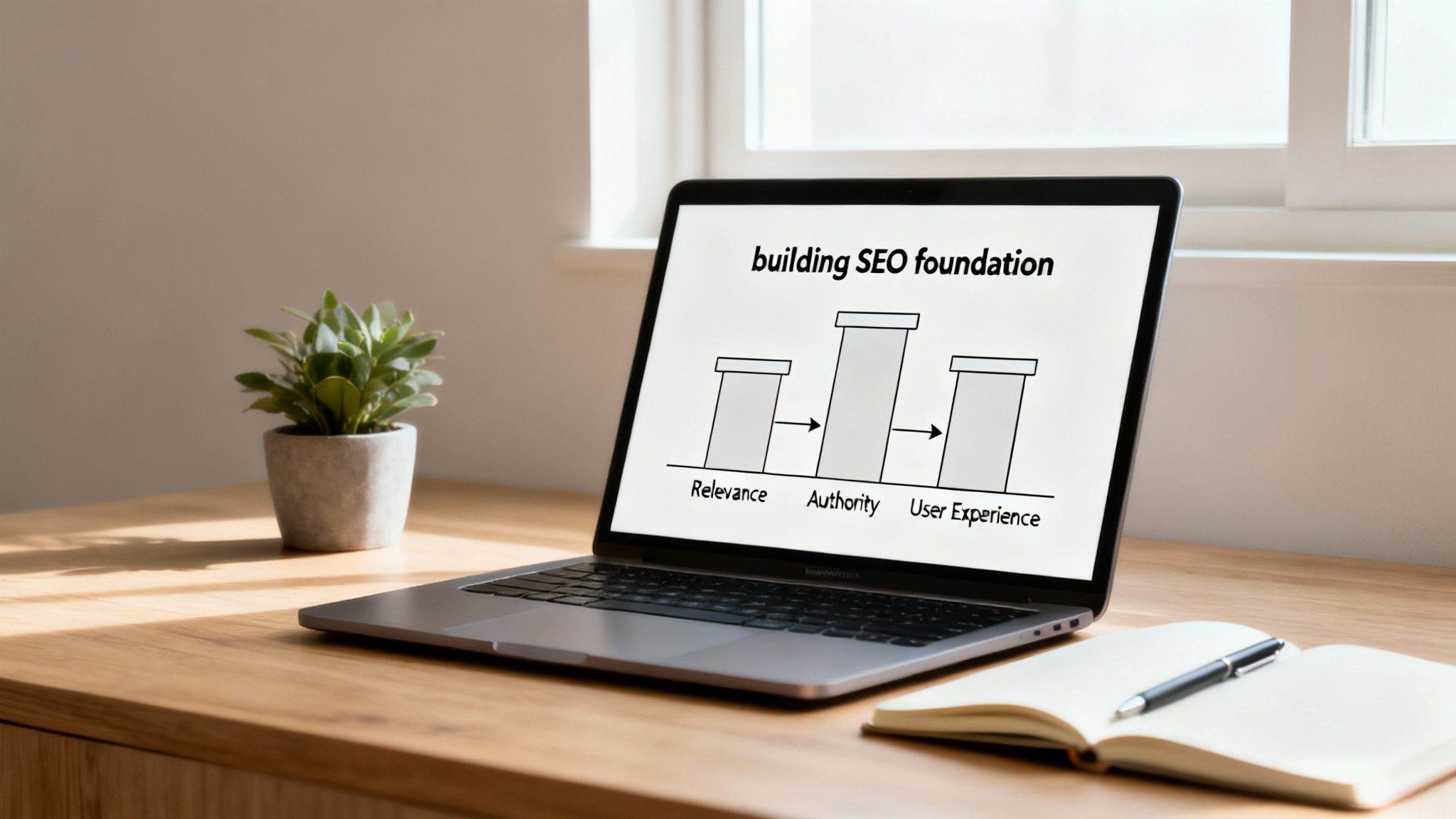
Before you write a single word, you have to get one thing straight: SEO isn't about jamming keywords into a page anymore. It’s about building content that search engines actually trust. This all comes down to three pillars: relevance, authority, and user experience. Nail these, and you've got a real shot at ranking. Get them wrong, and you’ll be invisible.
Imagine spending hours crafting the perfect blog post, hitting publish, and then… crickets. It just sinks without a trace in the search results. It's a brutal reality, but the top spot on Google gets a massive 27.6% of all clicks. That completely dwarfs the 15.8% for second place, and by the time you hit tenth, you're looking at a measly 2.4%.
This is why writing for SEO isn't just a "nice-to-have"—it's your ticket to getting seen at all.
What Search Engines Reward
At its core, Google's job is simple: give people the most helpful answer to their question. To figure that out, its algorithm looks at your content through a few key lenses.
- Relevance: Does your post actually answer the question behind the keyword? Are you meeting the searcher's intent head-on?
- Authority: Does your site look like it knows what it's talking about? This is backed up by both internal links from your own content and links from other reputable sites.
- User Experience (UX): Is your content easy to read? Can people navigate it without getting frustrated? Does it work well on a phone?
These three elements are completely intertwined. A super relevant post that’s a nightmare to read will flop. So will a beautifully designed article that misses the point of the search query. Before you get lost in the weeds of a single post, it's worth understanding how to build an overarching SEO strategy that gives your entire website a fighting chance.
For a quick reference, here are the key pieces that make up a blog post that's built to perform.
| Element | Its Role in SEO Success |
|---|---|
| Clear Keyword Focus | Aligns the content with a specific search query, making it relevant. |
| Compelling Title | Grabs attention in search results and includes the primary keyword. |
| Optimized Headings | Structures the content for readability and helps search engines understand the hierarchy of information. |
| High-Quality Content | Provides real value and answers the user's question thoroughly, which encourages longer visit times. |
| Internal & External Links | Builds authority and provides context by linking to other relevant pages on your site and others. |
| Optimized Media | Images and videos enhance user experience, with alt text providing additional SEO context. |
| Mobile-Friendliness | Ensures a good user experience on all devices, which is a major ranking factor. |
This table covers the fundamentals, but the magic happens when you bring them all together seamlessly.
Mining Your Archives for Content Gold
If you're already creating content—whether you're a YouTuber, podcaster, or professional publisher—your best ideas might be hiding in plain sight. Your existing library is a goldmine waiting to be reignited. Instead of trying to reinvent the wheel, look at what’s already resonating with your audience.
For example, a YouTuber can scroll through the comments on their most popular videos. You'll often find people asking the same questions over and over. Those questions are pure gold—they are audience-vetted ideas for new blog posts that you know people are looking for.
This approach gives you a massive head start. You’re not guessing what people want; you're using data. By turning concepts from your hit videos or podcast episodes into blog posts, you're tapping into proven audience interest and leveraging the authority you’ve already built. It's the smartest way to upcycle your old content, create new value, and turn your library into a money-maker.
Find Untapped Keywords and Topics in Your Own Content Library
Keyword research can feel like scrolling through endless, soul-crushing lists in some third-party tool. But what if your best keywords aren’t hiding in a spreadsheet at all?
What if they’re already in your own content library, just waiting for you to notice them?
If you’re a podcaster, YouTuber, filmmaker, or author who’s been creating for a while, this is your secret weapon. It's the unfair advantage that helps you move from hobbyist to professional.
The deepest insights come straight from the language your audience is already using. Instead of guessing what people might search for, you can comb through your most successful content to see what phrases, questions, and ideas truly connect. This is how you unearth authentic, high-intent keywords that generic tools almost always miss, helping you generate more audience across all your platforms.
Uncover Keywords Hiding in Plain Sight
Your first move is to start treating your content library like a research database. If you make videos, pull the transcripts from your top performers. Podcasters, your episode transcripts are a goldmine. For bloggers and writers, it’s all about the comment sections and your most-shared articles.
You’re hunting for recurring themes, specific questions, and exact phrases. These are the topics your audience is literally begging you to cover in more detail. It’s a shift from abstract keyword theory to concrete, audience-approved ideas for your next blog post or video.
- Spot Recurring Questions: Do viewers constantly ask about a specific technique in your video comments? That question isn't just a question—it's a powerful long-tail keyword.
- Identify Their Language: Pay close attention to the exact words your audience uses. They might say "fix grainy video" instead of the more technical "reduce video noise." Use their language, not industry jargon.
- Find Content Gaps: Did a brief mention of a topic in one video spark a dozen follow-up questions? That’s a massive signal telling you to create a dedicated, in-depth blog post on that exact subject.
This approach ensures you’re creating content for the real people who make up your community, not just for search engine crawlers. The keywords you find here are already pre-validated by your audience’s engagement.
For example, a podcaster talking about content marketing might notice listeners repeatedly asking about "repurposing old episodes." This isn't just a stray comment; it's a high-intent keyword cluster. An SEO-friendly blog post titled "How to Repurpose Old Podcast Episodes for More Traffic" is now a data-driven idea, not a wild guess.
Of course, once you’ve gathered these gems, you still need to see what you’re up against. A huge piece of the puzzle is understanding keyword difficulty and how to use that metric to your advantage. It helps you pick your battles and prioritize topics where you have a real shot at ranking.
By blending these raw audience insights with smart SEO metrics, you can strategically turn your existing content into a powerful engine for future growth. Every new piece you create will be perfectly positioned for success from the get-go.
Structuring Your Post for Readers and Search Engines
Once you've nailed down your keyword, it's time to build the skeleton of your article. How you structure your post is just as important as the words you write. It’s all about creating an experience that keeps people reading while signaling to search engines that you’ve got a high-quality, authoritative answer to their question.
A well-structured post is scannable, logical, and easy to get through. This has a direct impact on user experience metrics like dwell time—how long visitors stick around—which Google sees as a huge indicator of content quality. It’s a classic win-win: your audience finds what they need fast, and search engines reward you for it.
Crafting a Magnetic Headline
Your headline, or H1 tag, is your first and most critical shot at grabbing attention. It has to be compelling enough to earn a click on a crowded search results page while making it crystal clear what the post is about.
A few tips I've picked up over the years:
- Lead with your keyword: Get your main keyword as close to the beginning of the title as you can. It just works.
- Promise a clear benefit: What’s in it for the reader? Use words that set expectations, like "guide," "steps," "tips," or "examples."
- Add a little something extra: Numbers (like "7 Simple Steps"), brackets ("[New Data]"), or powerful adjectives really help you stand out from the noise.
A great title is part art, part science. You need that keyword relevance, but you also need a human touch that sparks real curiosity.
The Power of Subheadings
Think of your H2 and H3 subheadings as the signposts of your article. They break up giant walls of text into digestible sections, making it a breeze for readers to scan and find exactly what they’re looking for. This is a non-negotiable part of how to write SEO-friendly blog posts that people will actually read.
For search engines, these headings create a clear hierarchy. This helps them understand the main topics and subtopics you're covering, which is an easy way to signal the depth and breadth of your content.
A huge mistake I see all the time is people trying to be clever with vague subheadings. Just be direct and descriptive. If a section is about optimizing images, a heading like "Image Optimization Best Practices" is infinitely more effective for both readers and SEO than something ambiguous like "A Picture's Worth a Thousand Words."
This diagram lays out a simple workflow for turning your content analysis into actionable keywords that you can then use to structure your entire post.
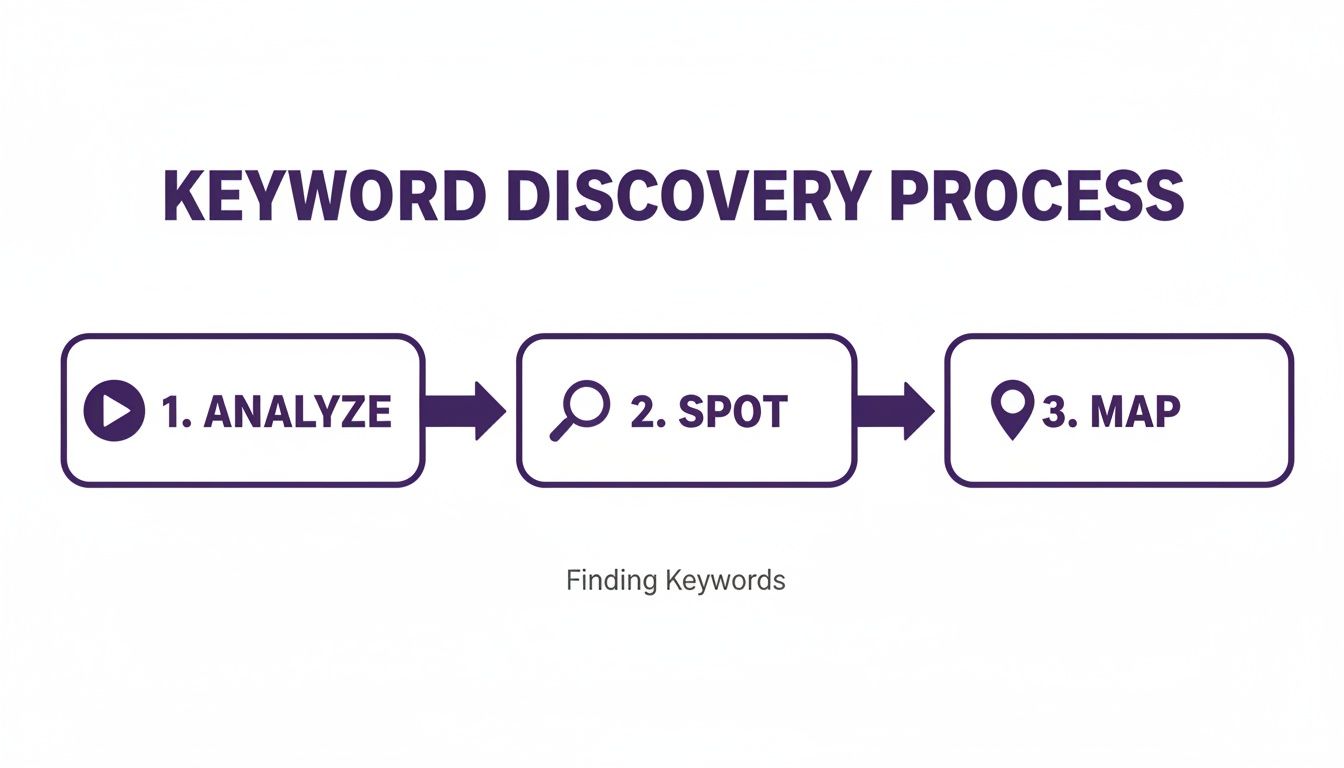
This process really drives home the point that the best structure starts with understanding the core topics your audience cares about. That understanding should directly inform your subheadings and the overall flow of the piece.
And the benefits of putting in this effort are massive. For instance, businesses that maintain an active blog see 55% more website visitors and an incredible 126% higher lead growth than those that don't. Deeper, well-structured content also attracts more authority; long-form articles can pull in 77.2% more backlinks than shorter ones, cementing their SEO value. You can explore more blogging statistics on Wix.com. The data doesn't lie—taking the time to structure your post thoughtfully pays off big time in traffic and authority.
Nailing the Critical On-Page SEO Details
With a solid draft in hand, it’s time to shift gears from writing to optimizing. This next layer is all about fine-tuning the on-page elements that search engines pay close attention to. These technical details are what separate a good piece of content from a great one that’s actually built to rank.
Think of it as the final polish before you show your work to the world. These on-page factors are direct signals to Google about your content's relevance and quality. Skipping this is like building a powerful engine but forgetting to connect it to the wheels—the post might be brilliant, but it’s not going anywhere without these critical connections.
Writing Meta Titles and Descriptions That Get the Click
Your meta title and description are basically your sales pitch on the search results page. They're the first thing a potential reader sees, and their only job is to convince that person to click your link instead of the ten others staring back at them.
For the meta title (or title tag), keep it under 55 characters. Any longer and it’s likely to get cut off. You’ll want to get your primary keyword in there, preferably as close to the beginning as you can without making it sound like a robot wrote it.
The meta description doesn’t directly influence your rank, but it’s absolutely vital for your click-through rate. Aim for around 105 characters and treat it like you’re writing ad copy. It needs to summarize the post’s value and toss in a hook or call to action that makes people curious.
Optimizing Images for Speed and SEO
Every single image you add to your post is another chance to optimize. Huge, uncompressed images will absolutely murder your page load speed, which is a major ranking factor. Before you even think about uploading, compress your images and use modern formats like WebP if you can.
But it’s not just about speed. Your image file names and alt text are huge opportunities.
- File Names: Don't just upload
IMG_8432.jpg. Rename that file to something descriptive, likeseo-friendly-blog-post-checklist.jpg. This gives search engines a clue about what the image is. - Alt Text: This is the text that describes the image for screen readers and search engine crawlers. Write a clean, simple description and work your keyword in if it feels natural. For example: "A content creator reviews an SEO-friendly blog post checklist on their laptop."
Good image SEO pulls double duty. It makes your page faster for users and more accessible for everyone, both of which send fantastic signals to Google.
Weaving in Your Links
Links are the threads that hold the web together.
Internal links—the ones pointing to other pages on your own site—are your way of guiding search engines through your content and showing them how everything is related. They also do wonders for keeping readers on your site longer, leading them down a rabbit hole of relevant posts. For a deeper dive, our guide on optimizing content for search engines is a great next step.
External links—those pointing to other reputable websites—are just as important. They show that you’ve done your homework and add a layer of credibility to your work. When you cite authoritative sources, you're telling Google that you’re providing well-rounded, trustworthy information, which is a huge part of building topical authority.
Let’s Talk AI, Multimedia, and Making Your Content Pop
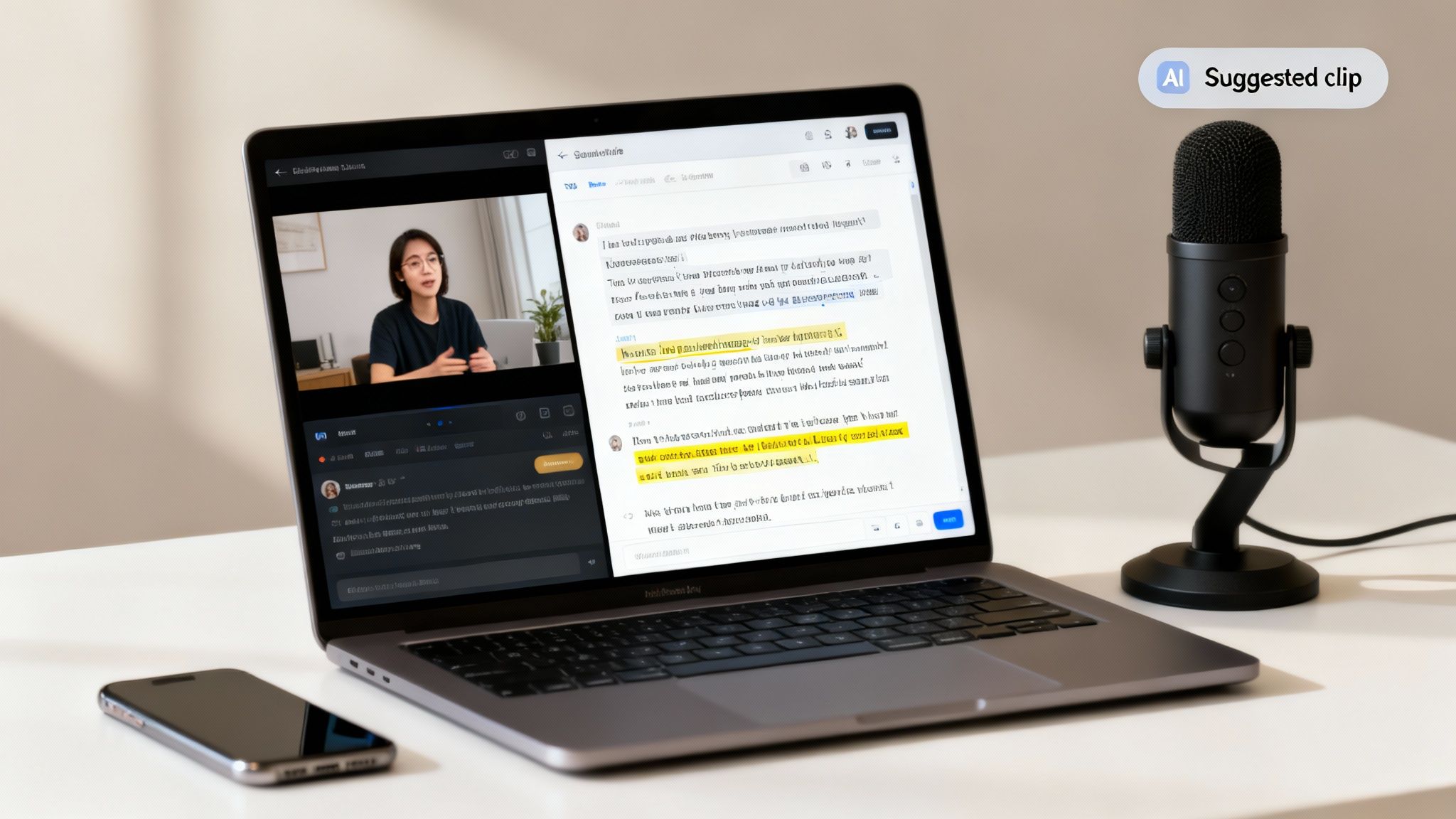
Let's be real: plain text, even when it's brilliant, can feel a little flat. Today, standing out means creating a richer, more dynamic experience for your readers. This is where you can bring in multimedia and, yes, a little help from AI to turn a solid post into something genuinely memorable.
If you’re already a creator, this is your chance to shine. Are you a YouTuber writing about video editing? Don't just tell people how to do something—show them. Embedding a quick, optimized clip from one of your videos provides instant value and keeps people on your page longer. That "dwell time" is a massive positive signal to Google.
Or maybe you’re a podcaster. You can easily get an episode transcribed and turn it into a keyword-rich blog post. Suddenly, your audio content is discoverable through text searches, pulling in traffic from long-tail keywords you would've otherwise completely missed. This is how you take your longform content across platforms and turn it into a money-maker.
Working Smarter with AI—Not Harder
The trick is to stop thinking of AI as some magic bullet that writes for you. Instead, view it as a super-intelligent collaborator. It’s here to help you organize, understand, and take action on the gold hidden in your content library. This is where the healthy and seamless collaboration between human creators and AI begins.
Imagine a tool that scans your entire archive of videos, podcasts, and articles. It could instantly suggest:
- The Perfect Video Clip: Pinpointing that one 30-second snippet from a year-old video that perfectly illustrates a point in your new blog post.
- Data Viz Ideas: Noticing a recurring theme in your content that would make for a killer infographic or chart.
- Transcript Gold: Highlighting sections of an old podcast transcript that align perfectly with high-intent keywords people are searching for right now.
This moves you beyond just guessing what might work. It's a data-driven way to enhance your content strategically. For a deeper dive into this, check out our guide on using AI for SEO.
Multimedia Isn't Just Eye Candy; It's an SEO Superpower
Folding different media types into your posts isn't just about making them look pretty. In the age of AI-driven content, the lines between quality and quantity are blurring—and multimedia is a massive part of that equation. In fact, companies using AI are already pumping out 42% more content each month than those who aren't.
Visuals are a huge piece of the puzzle. Images now appear in 35% of all Google search results pages in the US, and an incredible 88% of blog posts feature them. For filmmakers, podcasters, and publishers, this is a massive opportunity. Tools like Contesimal can revolutionize research collaboration by enabling you to expand value across your existing assets. It helps you blend chat-based research with a search of your own archives to generate SEO-ready drafts from content you've already created.
Considering that organic search drives 53% of all website traffic globally, leaving multimedia on the cutting room floor is like leaving money on the table. You can discover more insights about SEO statistics on seranking.com.
Measuring and Refining Your SEO Content Strategy
Hitting “publish” feels like the finish line, but really, it’s just the starting gun. Now the real work begins. You’ve just kicked off a feedback loop that will show you exactly what’s working, what’s flopping, and where your next big win is hiding in plain sight.
This cycle—publish, measure, refine, repeat—is what separates content that gets a quick spike of traffic from content that becomes a long-term, organic growth engine. It’s the secret sauce for professional creators who run content buckets and experiment with new concepts to hit on the next viral thing.
Key Metrics to Obsess Over Post-Publish
Once your post is live and Google has had a chance to index it, it's time to put on your detective hat. Your best friend here is Google Search Console. It gives you a direct, unfiltered look at how search engines and actual humans are finding and interacting with your hard work.
Here’s what you absolutely need to be tracking:
- Organic Traffic: This one’s the most obvious, but don't just glance at it. Are you seeing a steady climb over the first few months? That's a fantastic sign you're on the right track.
- Keyword Rankings: Pay close attention to the search queries your post is actually showing up for. You'll almost always discover you’re ranking for dozens of long-tail keywords you didn’t even think to target. These are pure gold for your next video or post idea.
- Click-Through Rate (CTR): This number tells you what percentage of people who see your post in the search results actually click on it. If your CTR is low, it’s a massive red flag that your meta title or description isn’t compelling enough to grab someone's attention.
Turning Data Into Action
Data is completely useless unless you do something with it. As you start watching these metrics, patterns will emerge, and they’ll tell you a story about what to do next.
Maybe you find a post that’s stubbornly stuck on page two for a really valuable keyword. Bingo. That’s your top candidate for a content refresh. Go back in, add more depth, find some newer statistics, or embed a helpful video to give it that extra push it needs to jump to page one.
Don't just publish and forget. Your analytics are a direct conversation with your audience. Listening to what the data tells you is how you turn a single blog post into a long-term asset that drives continuous value.
Getting a feel for your numbers is a skill that sharpens with practice. To fast-track that process, it helps to learn how to analyze content performance with a structured framework. This will help you pinpoint what’s really connecting with your audience and make smarter, data-backed decisions every single time you create something new.
Got Questions? We've Got Answers
You're putting in the work, but SEO can feel like a moving target. It’s natural to have questions, especially when algorithms shift and new trends pop up. Here are some no-nonsense answers to the questions I hear most often from creators trying to master SEO for their blogs.
How Often Should I Be Publishing New Posts?
Let's be real: consistency trumps frequency, every single time. While you might see some folks pumping out multiple posts a week, the smarter goal for most is one truly exceptional, deeply researched post per week.
It's always better to publish one powerhouse piece that genuinely helps your audience than four mediocre ones just to hit a quota. Focus on creating the single best resource on the internet for your chosen topic. That's how you win.
What’s the Magic Word Count for an SEO Blog Post?
There’s no secret number, but the data doesn't lie: comprehensive content consistently performs better. If you look at the first page of Google, the average post is somewhere in the 1,400-1,900 word range.
Why? A longer post gives you the space to cover a topic from every angle, answer all the follow-up questions a reader might have, and naturally weave in a wider variety of relevant keywords. Don't chase a word count; chase the goal of providing the most complete answer out there.
The goal isn't word count; it's value. A longer post that answers every potential question a reader has is more likely to satisfy their search intent, increase dwell time, and earn higher rankings.
Can I Just Let an AI Write My Whole Blog Post?
Look, using AI for brainstorming ideas, digging up research, and structuring your outline is a brilliant way to save time. But handing over the final draft to a robot? That’s a risky move.
Google has made it crystal clear that they value content showing real-world E-E-A-T (Experience, Expertise, Authoritativeness, and Trustworthiness). Those are the human qualities that AI often misses.
The best workflow is a partnership. You steer the ship, inject your authentic voice, and share personal stories that build a real connection with your readers. Let the AI do the grunt work, but you have to provide the soul.
Ready to unlock the hidden value in your content library and streamline your creation process? Contesimal helps you organize, understand, and act on your existing content, turning your archives into your next big idea. Discover how our AI-powered platform helps you collaborate and create more effectively. Explore what's possible at https://contesimal.ai.