
Your content team's real bottleneck probably isn't ideas. It's the daily scramble, a draft in Google Docs, a revision buried in Slack, a voice note someone forgot to transcribe, and a meeting invite that lands right when your editor finally found a clear hour to think. When that becomes the routine, creative work starts to feel like logistics with a deadline.
Asynchronous collaboration changes that rhythm. It lets creators move work forward without forcing everyone into the same hour, which matters more now that remote teams are mainstream. For a growing media operation, that is not just a staffing pattern, it is a workflow reality. It also matters for monetization, because the same habits that keep review moving can help a team turn a content library into new formats, new packages, and new revenue without rebuilding every asset from scratch. If you are setting up review handoffs in a content approval system, PostPulse's guide to content approval for developers is a useful reference point for how structured review can reduce friction.
A good async setup does more than remove interruptions. It gives editors, writers, and producers room to think before they respond, and it makes it easier to reuse existing material instead of treating every idea as a brand-new project. That is where a tool like Contesimal fits into the bigger picture, since content operations only scale when the team can access more value from the library it already has.
The End of Collaboration Chaos
A podcast producer in New York posts a rough cut in Slack at 6 p.m. London time. The writer answers by email the next morning with line notes. The editor sees the comments, but the approval question is still trapped in a meeting invite that no one has opened. By the time everyone agrees, the release has already lost momentum.
That is the hidden cost of sync-heavy content work. The problem is rarely that people are careless or disorganized, it is that real-time coordination becomes a tax on momentum when a team is distributed, specialized, and expected to ship again and again. Asynchronous collaboration cuts that waiting by letting people contribute when they are ready to think, not only when a calendar slot opens.
The shift is already showing up in work culture. The remote-work expansion of the 2020s made async normal for many teams, not unusual, and Timeeting shows that employees and knowledge workers increasingly expect it as a standard operating mode. For content leaders, that matters because the same habits that reduce meeting drag also protect focus for writing, editing, and packaging assets into new formats.
A strong content team does more than reduce meetings. It builds a system where ideas survive the handoff from research to draft to review to publication without needing a live call every time a decision changes. That matters even more for teams that want to scale output, improve reuse, and turn a library of existing assets into new formats and new revenue without starting from scratch.
A good async setup also changes how review works. It gives editors, writers, and producers room to think before they respond, and it makes it easier to reuse material instead of treating every idea as a brand-new project. For teams building a tighter approval process, PostPulse's guide to content approval for developers is a useful reference point for how structured review can cut friction. Contesimal fits into that same operating model, because content operations scale when a team can access more value from the library it already has.
What Asynchronous Collaboration Really Means
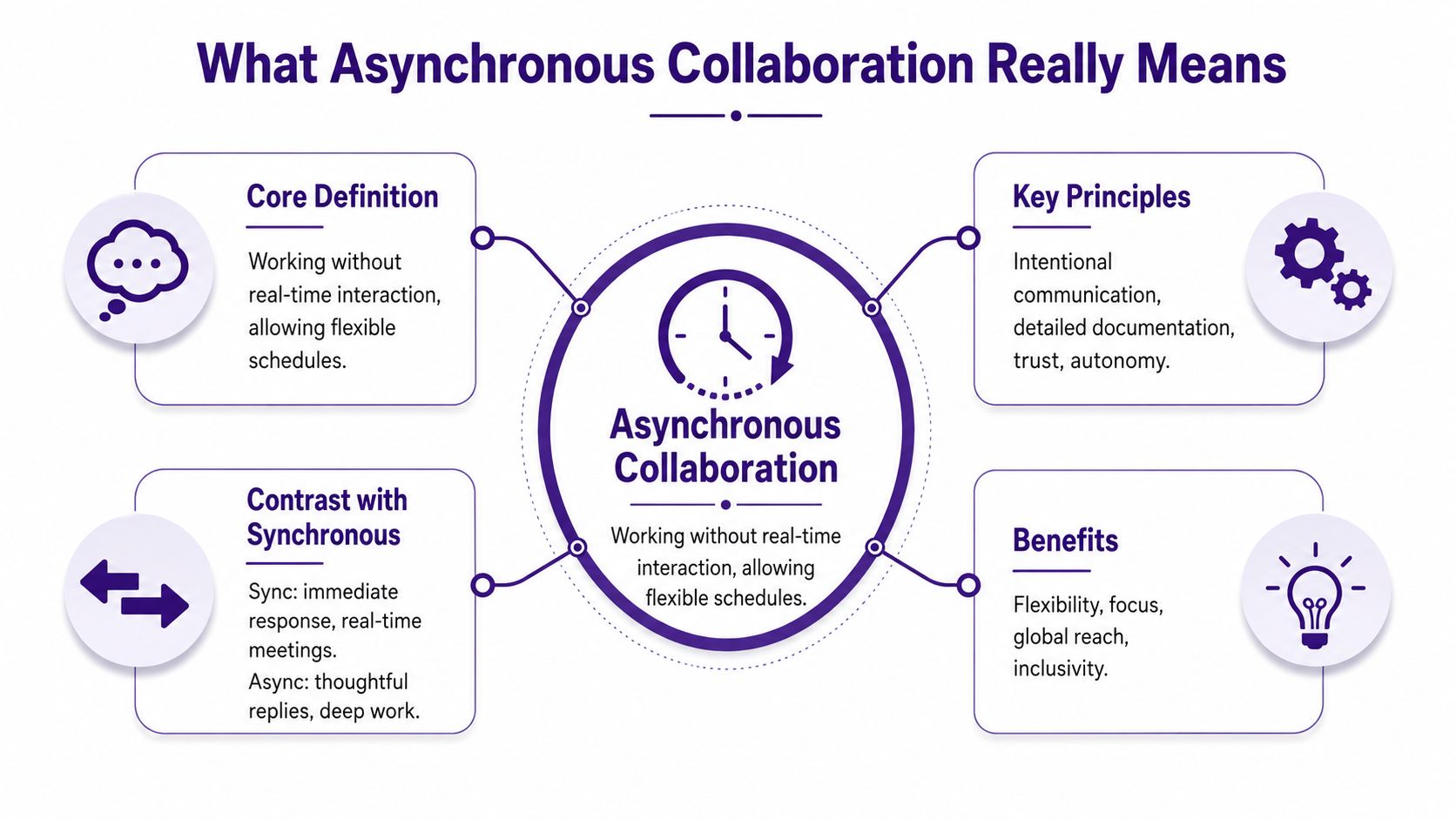
Asynchronous collaboration is working without real-time interaction, so people can contribute, review, and decide at different times while still moving one shared project forward. It's not the same thing as “everyone works whenever they want.” The stronger version has clear ownership, visible context, and written decisions that live with the work itself.
It is akin to a curated research library rather than a live press conference. In a press conference, the useful information depends on who's in the room and who can interrupt at the right moment. In a library, the material is organized, accessible, and reusable long after the first conversation is over.
The core mechanics
Async collaboration works when three habits show up consistently. First, people write enough context that others don't need to chase them for background. Second, they comment where the work lives, not in scattered private threads. Third, they make the next owner obvious so the project keeps moving after feedback arrives.
Practical rule: if someone can't understand the next step without asking a follow-up question, the async handoff isn't finished yet.
That's why async is less about speed in the moment and more about reducing avoidable friction across the whole workflow. TimeTackle's meeting analysis is helpful here because it shows which meetings really belong in async review rather than live discussion, especially when the decision can be documented instead of debated in real time (TimeTackle's meeting analysis).
The biggest mistake teams make is assuming async means silence. It doesn't. It means replies are thoughtful, traceable, and attached to the actual asset, whether that asset is a brief, a script, a storyboard, or a research memo.
What changes in practice
A live meeting asks people to react in the moment. Async asks them to respond with context, which usually means better notes, clearer rationale, and fewer “wait, what did we decide?” messages later. That difference becomes important the second your team starts repurposing content across formats or handing work between writers, editors, designers, and distribution leads.
Why Async Is a Superpower for Content Teams
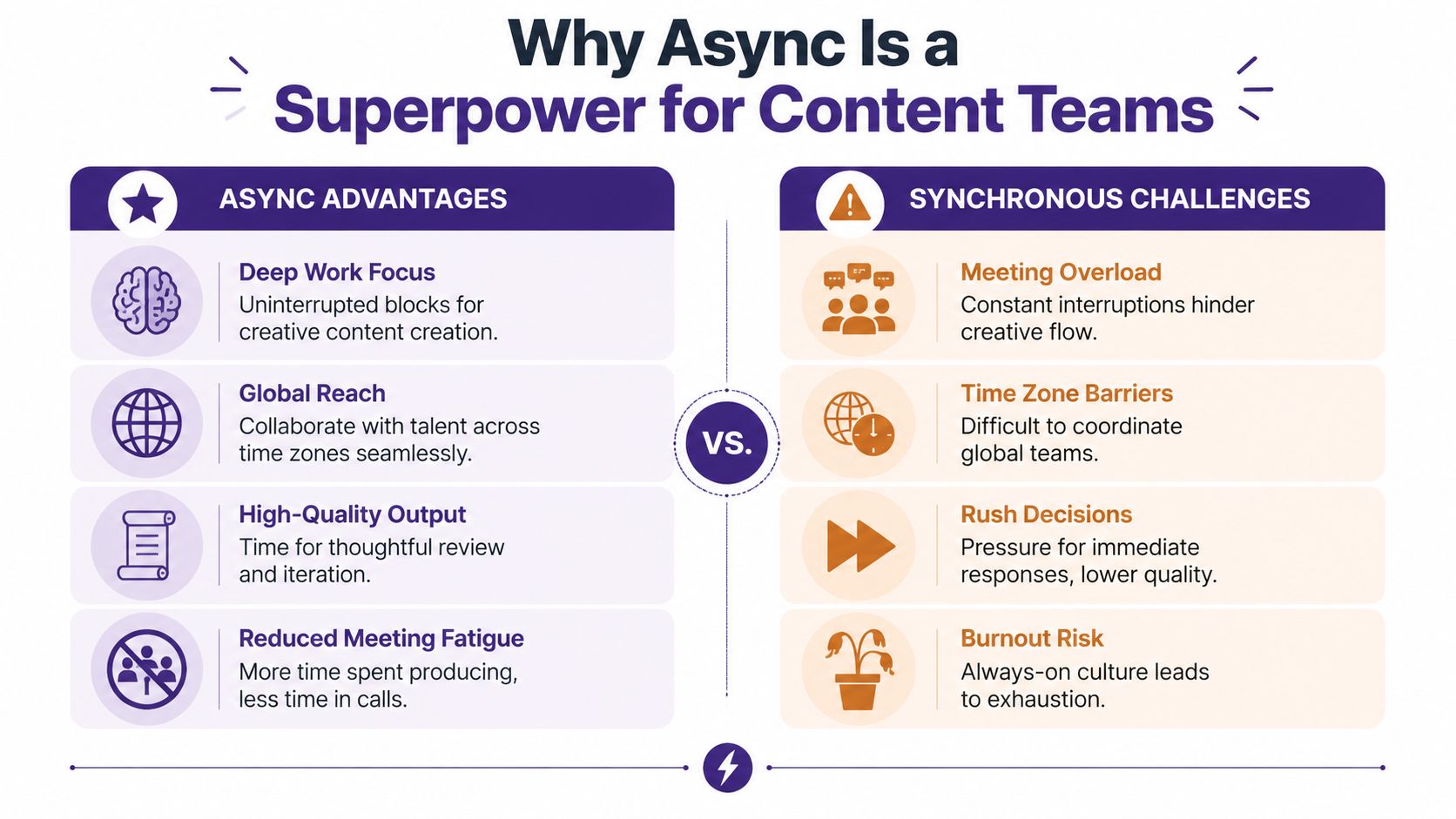
Content teams live or die by the quality of their decisions after the first draft. A strong article, episode, or video rarely comes from one quick conversation. It comes from layers of judgment, research, editing, packaging, and reuse, which is exactly where async workflows shine.
The most obvious benefit is deep work. Writers need uninterrupted blocks to shape arguments. Editors need time to read for structure, not just grammar. Strategists need space to connect an evergreen topic to the audience, the channel, and the monetization plan without getting pulled into a live check-in every hour.
The second benefit is reach. A content operation can work with talent across time zones without making one group wait for another group's working hours to open. That matters for publishers, podcasters, and video teams that want to source ideas, assign edits, and keep production rolling while the calendar keeps moving.
Content library value gets stronger in async systems
The third benefit is the one often underestimated. Async collaboration creates a searchable record of why a piece of content was made, what was rejected, what was changed, and what angle won. That history turns a content library from a pile of old assets into a working memory for future repurposing, research, and monetization.
That's where platforms like Contesimal fit naturally, because the value isn't only in storing assets, it's in organizing them so teams can collaborate around the knowledge inside them. A library with good async practices becomes easier to search, easier to extend, and easier to turn into the next article, clip, newsletter, or episode. For teams trying to monetize existing work, that matters more than chasing another meeting cadence.
A peer-reviewed study found that well-structured asynchronous communication reduced average task completion by 20.1 minutes, a 58.8% reduction versus synchronous methods, with the result reported as statistically significant at p<0.01 (PubMed Central study). For content teams, the useful takeaway is simple, review and decision-making can move faster when people don't have to wait for the same live room.
Content ops takeaway: async isn't just a convenience layer. It's a documentation engine for creative judgment.
For teams that already use project planning tools, the connection to execution is direct. A shared content calendar, a tracked review thread, and a clearly named approver can save a lot more than an hour here or there, because they preserve both momentum and context. If you want a closer look at how project structure supports that, this project management and collaboration guide is worth a read.
Practical Async Workflows for Creators
A good async workflow feels almost boring when it works well. Drafts move cleanly, comments land in the right place, and approval doesn't require anyone to ask where the latest version lives. The trick is to make each stage of the content lifecycle visible enough that the next person can pick it up without a meeting.
For writers and bloggers
Start with a brief that contains the angle, audience, reference material, and the decision criteria for approval. Writers should draft in a shared doc with tracked changes turned on, while editors leave comments tied to specific lines instead of rewriting the whole piece in email. That keeps the reasoning attached to the text.
One practical pattern is to separate feedback into two passes. The first pass covers structure, argument, and missing context. The second pass covers line edits, SEO cleanup, and publication polish.
For podcasters
Podcast teams work better when the script, guest prep notes, and edit list live in the same shared workflow. Timestamped feedback on audio cuts helps producers solve pacing issues without replaying an entire episode in a live call. Show notes should be drafted alongside the episode, not after it, because that's where the topic framing gets preserved for distribution and repurposing.
If the team needs a model for collaboration across creative disciplines, this article on mastering collaboration in music is a useful parallel, since it shows how layered creative work depends on clear handoffs, not constant interruption.
For video teams
Storyboard review works best when comments are attached to frames or timecoded rough cuts. Directors can annotate raw footage asynchronously, editors can respond in the same thread, and post-production notes stay tied to the version everyone is discussing. That avoids the classic problem of three different people using three different versions of the same file.
Here's a simple handoff sequence that works across most creator teams:
- Brief locked first: the goal, audience, and decision owner are clear before production starts.
- Work happens uninterrupted: the creator builds the draft, script, or cut without live interruptions.
- Feedback lands in context: reviewers comment on the asset itself, not in side channels.
- Revision ownership stays explicit: one person is responsible for merging the notes.
- Final approval is documented: no one should wonder who signed off.
- Publication and distribution are scheduled: the asset moves into the next channel without another round of debate.
Useful standard: if a note can't be tied to a specific line, frame, or timestamp, it usually isn't actionable enough yet.
For teams building editorial systems, the mechanics matter as much as the tool. A shared inbox, a project board, and a comment trail can do a lot of the heavy lifting when they're used consistently. This editorial workflow management guide pairs well with that thinking because it focuses on making editorial work visible before it becomes chaotic.
Navigating Common Asynchronous Challenges
Async collaboration breaks down fastest when teams pretend it has no downside. It does have trade-offs, and the biggest ones are human, not technical. People can feel isolated, decisions can stall, and complex creative work can lose shared context if the team doesn't design around those risks.
Shared understanding needs deliberate effort
Research on distributed collaborative design found that async teams can struggle with design interpretation, and shared understanding gets harder when people don't make knowledge visible through explicit practices (Cambridge study). That problem shows up in content teams when one person thinks a piece is meant to inform and another thinks it's meant to convert. The fix is written context, not more guessing.
Isolation is a real management issue
Academic research on asynchronous online collaboration also warns that lack of communication can lead to disconnection and isolation, especially when group tasks don't automatically become collaboration without deliberate interaction design (Northeastern research). A team can be highly documented and still feel cold if no one creates room for social continuity. A quick team ritual, a recurring brainstorm, or a lightweight review call can keep the human side intact.
Urgency still needs a path
Not every issue should wait for the next async window. Urgent approvals, breaking-news changes, and sensitive feedback still need escalation paths. The mistake is not using sync at all, it's pretending every issue can survive the same delay.
A workable team setup usually has three things:
- A clear escalation rule for urgent items.
- A single source of truth for decisions and assets.
- A shared expectation for where social interaction still lives.
If your team's communication is already messy, a tool won't fix it by itself. Cleaning up the workflow around the inbox first can help, which is why this guide to organizing your email inbox is a practical companion for teams trying to reduce hidden churn.
Implementing and Measuring Async Success
Moving to async works best when leadership sets the rules before changing the tools. Teams need to know what counts as a response, where decisions get recorded, and how urgent issues are handled. Without that groundwork, a new platform just adds another place for confusion to spread.
Doist's async guidance uses a 24-hour response expectation as a practical norm, alongside transparency so core discussions stay visible instead of trapped in private threads (Twist's async guidance). That's a useful starting point for media teams too, because it balances autonomy with accountability. The point isn't to answer instantly, it's to answer predictably enough that projects don't stall.
Track the right metrics
The most useful metric is communication latency, because delay variance is what usually disrupts handoffs. Teams should also watch documentation quality, workflow progression, and decision reversal rates. The key is to establish a 30-90 day baseline before changing processes, so there's a fair comparison later (async metrics guide).
That baseline matters because content teams often assume they're measuring improvement when they're only measuring activity. More comments do not automatically mean better collaboration. More meetings do not automatically mean more clarity either.
Rollout in phases
Start with communication norms, then move to tooling, then audit the handoffs. If your writers still use email for approvals, your editors still use Slack for final sign-off, and your producers still depend on calendar nudges for every decision, the problem isn't capacity. It's process design.
A clean rollout usually looks like this:
- Define response windows for urgent, standard, and low-priority requests.
- Name the official workspaces where drafts, notes, and approvals live.
- Document decision ownership so every asset has a clear next step.
- Measure before and after using the same work types.
- Review the exceptions where sync still adds real value.
Management rule: if the team can't explain why a meeting happened, that meeting probably should've been async.
Better systems start to change the business side of content too. Faster review cycles, cleaner approvals, and clearer asset histories make it easier to turn one piece of work into many, which is exactly why content libraries become more valuable when collaboration is documented well.
Building a Culture of Trust and Autonomy
Async collaboration works when managers trust people to do the work without hovering, and when creators trust the system enough to keep contributing to it. That's a culture shift, not a software feature. The strongest teams use documentation to create freedom, not surveillance.
For content organizations, that freedom has commercial impact. When ownership is clear and the history of each asset is searchable, teams can reuse, package, and distribute work with far less friction. The result is a library that doesn't sit still, it keeps generating new value because people can understand what's already there.
This is the core benefit of async for media teams. It's not just fewer meetings, it's a more thoughtful operating model that helps people organize, understand, and act on the work they've already made. And when your content library becomes simpler to explore, it becomes easier to monetize too.
If your team is trying to turn a scattered archive into a usable content engine, Contesimal can help you organize research, classify assets, and collaborate across human and AI workflows in one place. Visit Contesimal to see how a better content library can support stronger async collaboration, faster repurposing, and more durable creative value.