
More than 80% of data migration projects overran or were aborted in Bloor Research's widely cited 2007 customer survey, while a follow-up survey reported 38.3% of projects overran or were aborted, with an average overrun cost of $268,000. The historical migration-failure pattern still matters because the underlying problem hasn't changed: teams underestimate what they own, what depends on it, and what “correct” looks like after the move.
For media archives, CMS estates, publishing platforms, and creator libraries, migration isn't a glorified file copy. It's a decision about which stories, masters, transcripts, permissions, relationships, and retrieval signals deserve a future. The best practices for data migration begin before extraction, with discovery, classification, scope control, mapping, rehearsal, and evidence.
Why Most Data Migrations Drift Off Plan
The familiar failure statistic is a warning against treating migration as a weekend operation. A more recent enterprise summary reports that 73% of enterprise data migration projects fail to meet their stated objectives, while 80% of projects that proceed exceed original budgets by 150% or more, and timeline overruns average eighteen months beyond initial plans. The enterprise migration analysis attributes 68% of failure drivers to inadequate technical discovery and 61% to manual processes.
Those figures describe more than bad scripts. Projects drift because the initial inventory is fictional. A spreadsheet may say “articles,” “videos,” and “users,” while the source contains multiple article versions, orphaned video mezzanines, expired campaign pages, duplicate thumbnails, inherited permissions, broken taxonomy parents, and integrations nobody documented.
The spreadsheet is not the estate
A content record rarely travels alone. An article may depend on an author profile, a rights record, related content links, a search index, a subscription rule, and a taxonomy branch. A video may have a proxy, a mezzanine, captions, thumbnails, transcripts, usage restrictions, and a publishing history. Remove one relationship and the target may look populated while behaving incorrectly.
Cheap tooling doesn't solve that problem. A low-cost export can move bytes quickly and still preserve the wrong version, omit hidden fields, or flatten relationships that editors and audiences rely on. What protects the cutover is a single accountable migration lead, business owners who can make disposition decisions, and a time-boxed discovery phase before extraction code is written.
Practical rule: Don't approve a migration estimate until someone has tested the estimate against real records, not just vendor documentation.
| Drift Source | Early Countermeasure | Owner |
|---|---|---|
| Undiscovered legacy records | Crawl repositories and sample actual content | Migration lead |
| Content and media dependencies | Build dependency maps before transformation | Solution architect |
| Permission and rights complexity | Assign legal, editorial, and security owners | Governance lead |
| Spreadsheet-level estimates | Profile fields and inspect edge cases | Data-quality lead |
| Scope changes during build | Create a change-control process with explicit trade-offs | Programme sponsor |
A useful companion to this governance approach is DataTeams' guide to flawless enterprise data transfer tips, particularly for teams comparing transfer mechanics with the broader controls a migration needs. The central distinction is simple: extraction is a technical activity, but deciding what the business should inherit is a transformation programme.
Discovering and Classifying What You Actually Have
Discovery starts with access, not assumptions. Connect to databases, object stores, shared drives, DAM platforms, CMS instances, email-held archives, and workflow tools. Run crawlers where direct exports miss hidden paths, and export CMS content in a form that preserves identifiers, revisions, relationships, permissions, and timestamps.
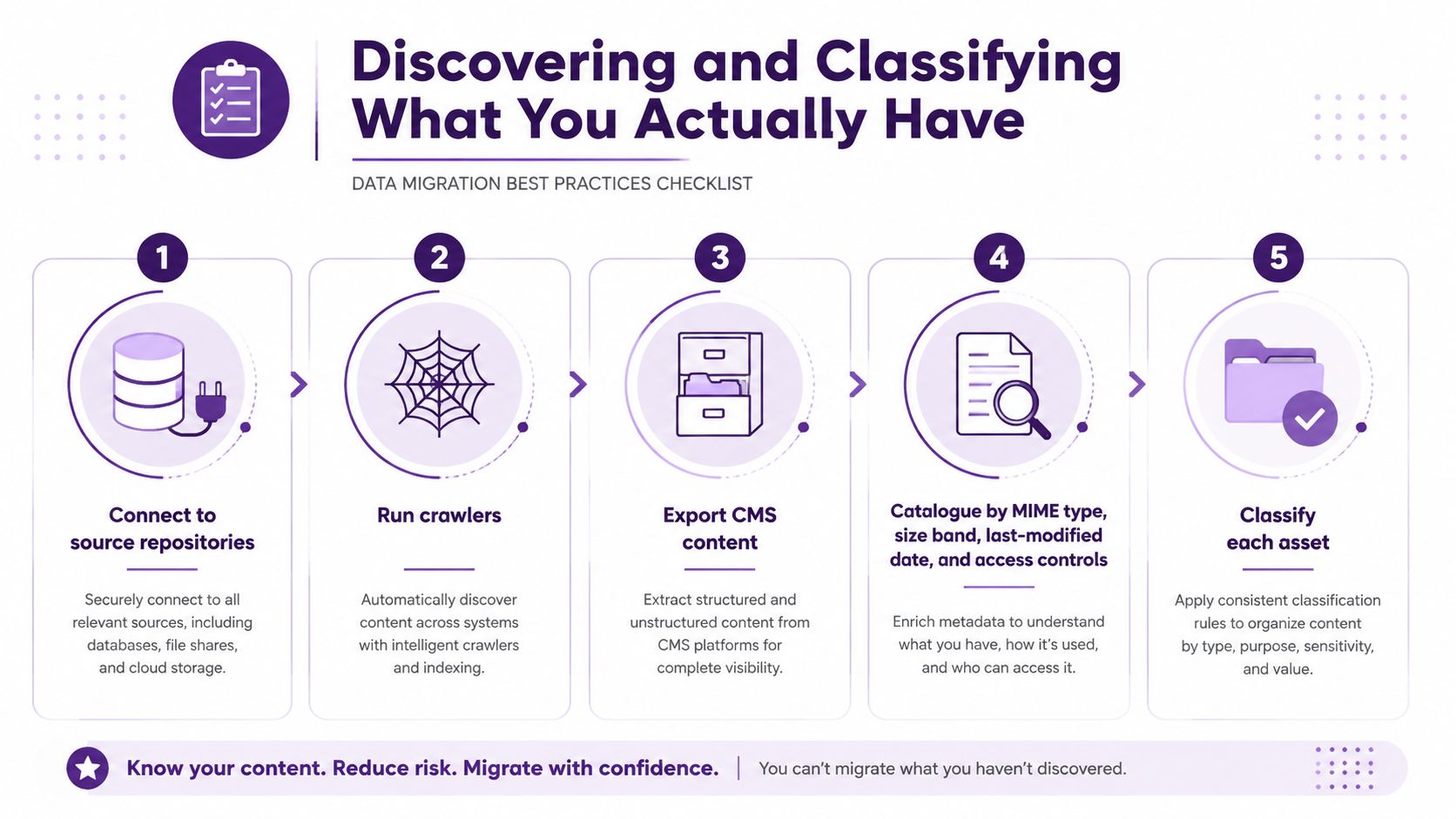
A discovery register should describe more than a filename. Catalogue each asset by MIME type, size band, last-modified date, access controls, owner, repository, and access frequency. For a media estate, distinguish raw camera files from edited masters, delivery proxies, captions, transcripts, thumbnails, and project files. For a publishing library, separate live articles from drafts, withdrawn versions, scheduled content, syndicated copies, and records with no parent publication.
Sample the fields people forgot
Documentation tells you what a system can contain. Sampling tells you what it contains. Select representative records across publication years, content types, business units, languages, and permission groups. Measure whether fields are populated, whether values follow the documented format, and whether relationships resolve.
A small sample often exposes the estate's real character. A “category” field may contain free text, obsolete labels, or several languages. A “date” may mean creation, first publication, last edit, or import time. A “rights” field may be blank even though a separate contract system contains the controlling information.
Use a classification output that becomes the source of truth:
- Identity: Stable ID, title, filename, repository, and content type.
- Lifecycle: Draft, active, retired, archived, or legally held.
- Relationships: Parent, child, related item, author, series, and media links.
- Quality: Duplicate status, missing fields, broken references, and format concerns.
- Disposition: Migrate, transform, archive, delete, or investigate.
- Ownership: Named person responsible for approving the decision.
For teams managing a large document library, document classification software can support the cataloguing workflow, but automation shouldn't replace review of ambiguous or high-consequence records. The final register needs a decision trail. If an editor later asks why an archive was excluded, the answer should be visible in the classification record, not trapped in a meeting memory.
Shrink Scope First, Then Move Anything
The assumption that every byte must move is one of the costliest habits in migration work. A content library usually contains material with very different value, activity, dependency, and compliance profiles. Moving all of it into the new platform transfers clutter and makes every later decision harder.
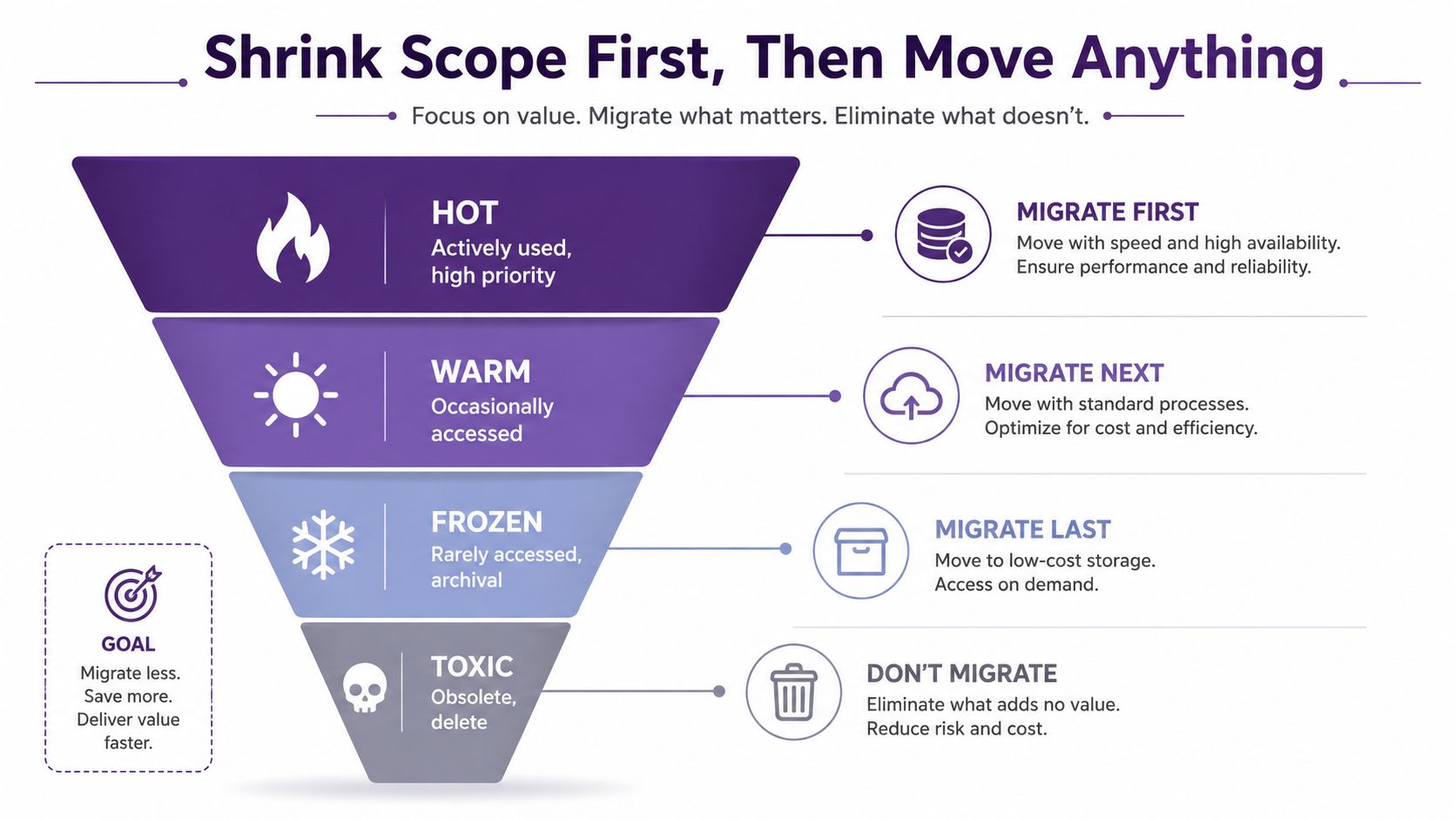
Use four practical tiers:
- Hot: Actively edited, revenue-linked, frequently retrieved, or operationally essential. Give these assets complete mapping, relationship testing, permissions review, and editorial acceptance.
- Warm: Occasionally accessed but still useful. Migrate them with a simpler, often read-only treatment, while preserving identifiers and refetchable metadata.
- Frozen: Rarely accessed historical material. Keep it in an archive bucket with a dependable retrieval path rather than forcing it into the active publishing model.
- Toxic: Duplicates, broken references, obsolete derivatives, or personal data without a lawful basis. Retire these before migration instead of carrying technical debt into the target.
Make disposition a business decision
Tiering should use last access window, edit frequency, business dependency, and compliance risk. None of those criteria works alone. An old investigative article may have low recent access but high editorial and legal value. A frequently downloaded proxy may be operationally busy yet replaceable from a protected master. A duplicate record may have a recent timestamp but no independent meaning.
An industry migration playbook argues for classifying data into hot, warm, frozen, and toxic categories and claims a minimum 35% footprint reduction before planning begins. Treat that figure as a cited industry claim, not a promise for your estate. The practical lesson is stronger than the number: measure what can leave the active path before you estimate the active path.
The trade-off is obvious. Archiving or deleting requires agreement, retention evidence, and retrieval design. But moving everything also carries risk, including longer reconciliation, more permissions to inspect, more records to test, and a less useful destination for editors.
The safest migration is often the one that refuses to move material nobody can justify keeping.
Mapping Schema, Taxonomy, and Metadata Without Losing Meaning
Field mapping has two layers. The first is structural: names, data types, lengths, nullability, cardinality, identifiers, and storage rules. The second is semantic: what a value means, how users retrieve it, which relationships it carries, and whether the target can represent that meaning without distortion.
Start with a field-by-field matrix. Then map taxonomy separately. Two systems may both use a field called “section,” yet one may store a single editorial department while the other expects a hierarchical publication tree. A field called “tag” may be a controlled vocabulary in one system and ungoverned text in the next.
Preserve the graph, not just the row
Keep foreign keys, parent-child IDs, shared tag relationships, series membership, and related-content links explicit. Flattening them into one metadata blob may make import easier, but it weakens search, navigation, recommendations, and editorial maintenance.
For media, rights and provenance deserve first-class treatment. Carry usage restrictions, embargo dates, contract references, creator attribution, and source history as fields that systems can validate. Don't hide them in comments where downstream users and controls can't reliably interpret them. Teams building a durable library may also benefit from metadata management best practices when defining stewardship and retrieval rules.
| Source field | Source type | Target field | Target type | Transformation rule | Owner |
|---|---|---|---|---|---|
| Legacy ID | String | Source reference | String | Preserve leading zeros exactly | Data owner |
| Section | Hierarchical label | Publication taxonomy | Hierarchical relation | Translate through approved taxonomy map | Editorial owner |
| Publish date | Timestamp | First published | Timestamp | Confirm timezone and business meaning | Product owner |
| Rights note | Free text | Rights status and restriction | Controlled fields | Extract approved values, retain evidence | Rights lead |
| Related IDs | Array | Related-content relation | Linked records | Resolve after target identifiers exist | Technical owner |
The mapping specification should name an owner on both sides, identify every transformation, and mark whether data is preserved, enriched, intentionally lost, or deferred for later cleanup. Test it with leading-zero IDs, multilingual slugs, retired taxonomy labels, null values, duplicate relations, and assets whose permissions don't match their parent content.
Staging, Cutover, and the Day-of Switchover
A reliable cutover week feels repetitive by design. The team isn't trying to perform one heroic transfer. It's draining uncertainty through rehearsals until the final switch has a short, controlled sequence.
A workable staged pattern looks like this:
- Day one: Freeze editorial writes on the legacy platform and start a delta sync for approved changes.
- Day two: Run a rehearsal cutover against the stable source and record every correction.
- Day three: Load the target, build search indexes, warm caches, and execute validation in staging.
- Day four: Repeat the process in a production-mirrored environment, including a timed rollback.
- Day five: Disable writes, run the final delta, switch routing, validate monitoring, and open traffic.
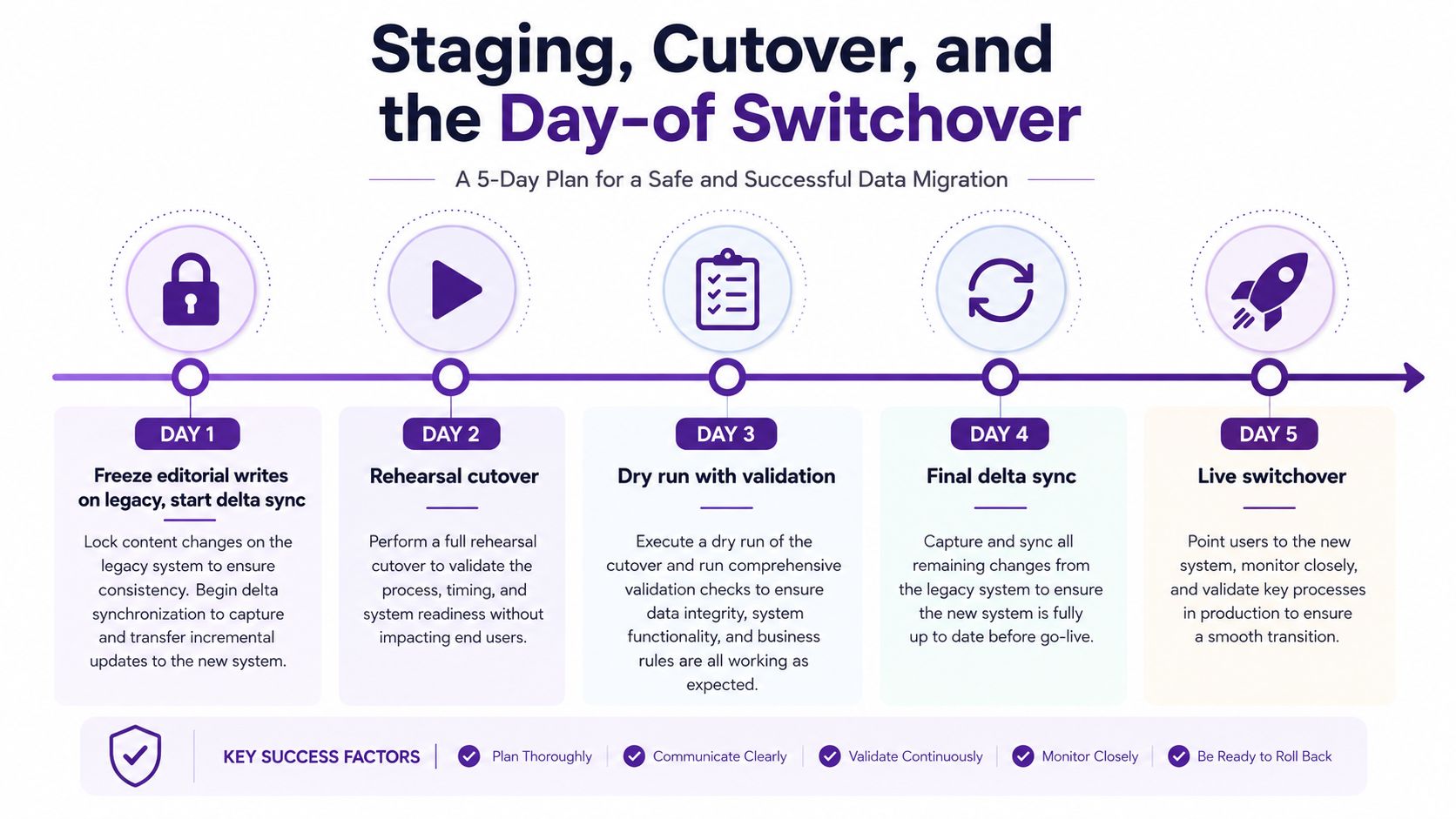
The day-of sequence should be written before the day begins. Assign one incident commander, create a visible war-room channel, give each task an owner, and record the decision contact for fix-forward versus rollback. AWS cutover guidance recommends freezing writes or ingestion, taking a final backup, running a final sync, switching routing, then testing and validating before declaring completion.
Rehearse the boring details
In the final window, the team should know who disables writes, who checks the delta, who confirms target health, who switches read endpoints, and who authorizes traffic. Pre-write the runbook, but keep secrets and sensitive operational details out of broad channels. Use observable checkpoints rather than verbal assurances.
A cutover succeeds when the team can explain what happens next without improvising.
The exact duration depends on the estate and its recovery requirements. Don't promise a short window because leadership wants one. Measure the sequence during rehearsals, include validation, and leave enough time to make a controlled decision rather than rushing into an unverified launch.
Validation, Reconciliation, and Rehearsed Rollback
Validation should proceed from mechanical completeness to business usefulness. A target can contain the expected object total and still fail when an editor searches for a series, a subscriber opens restricted content, or a page tries to render a missing media relation.
Use multiple layers:
- Object totals: Compare source and target row counts, asset counts, relationship counts, and other agreed totals.
- Payload integrity: Use checksums or hash comparisons where the payload must remain unchanged.
- Field fidelity: Compare transformed values, identifiers, dates, permissions, and taxonomy outcomes.
- Business behavior: Run queries and user journeys for search, related items, subscriptions, rendering, publishing, and downloads.
- Reconciliation ownership: Assign every difference to a named person with a disposition and evidence.
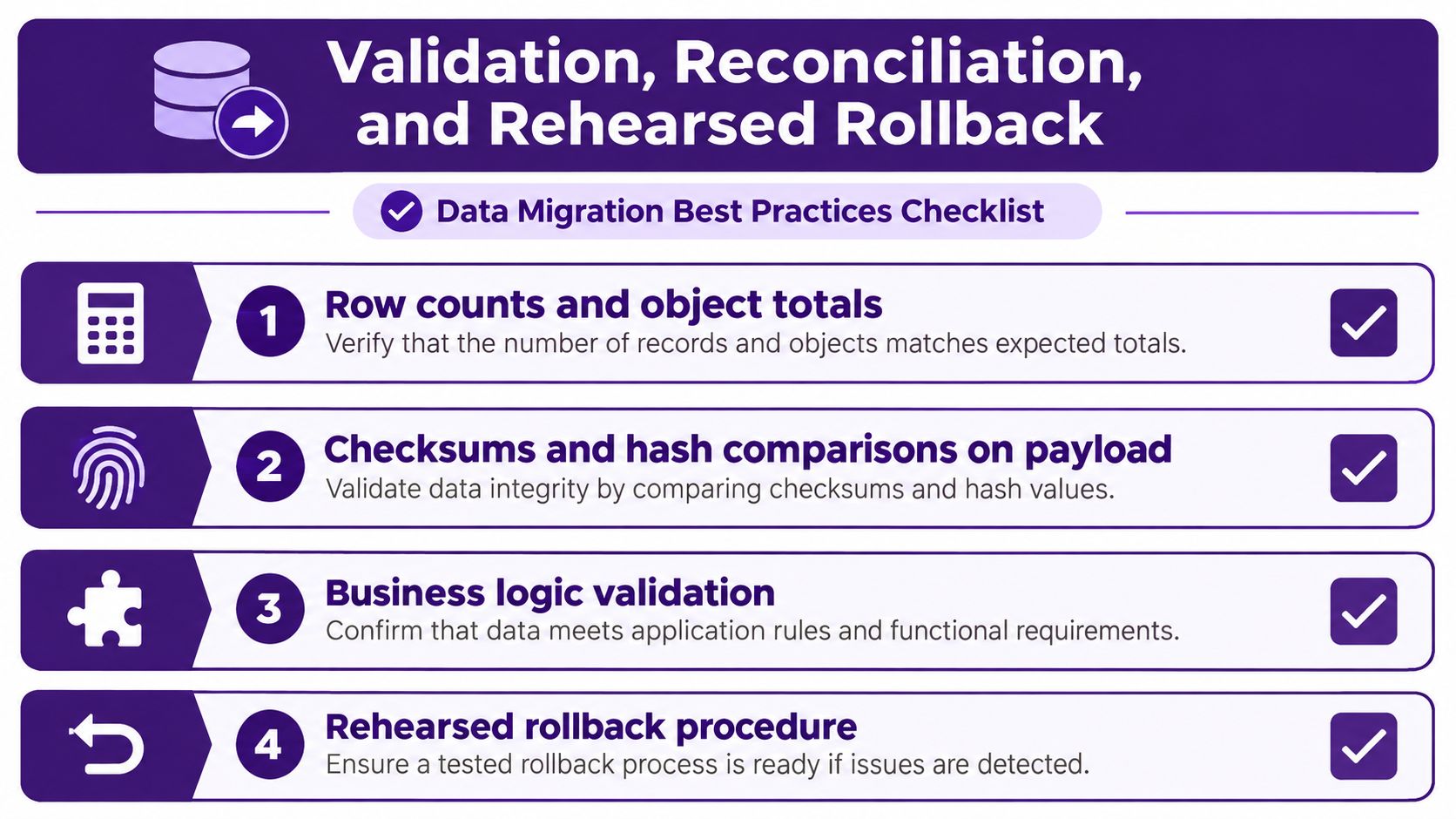
Publish pass and fail thresholds before the cutover. Otherwise, the war room becomes a negotiation about what “close enough” means while users are waiting. A migration validation playbook recommends combining row counts, checksums, and business-query behavior, with rollback checkpoints rehearsed before production.
Rollback is an operation, not a sentence
Test database restoration, source reactivation, routing reversal, and application recovery in staging. Time the sequence and document the conditions that trigger it. If nobody has executed the plan, the plan is only an intention.
Keep the source systems available during the post-cutover observation period. The rollback window should remain open for at least 72 hours before decommissioning source systems, allowing the team to catch delayed indexing, permission, integration, and retrieval defects. A post-migration review should capture what failed, what passed, and which ownership or mapping decisions need revision. A reusable post-mortem document template can keep that review evidence-based rather than anecdotal.
Where AI Helps, Where Humans Stay in Control, and Your Migration Checklist
AI earns its place where the work is repetitive, pattern-based, and easy for a person to verify. It can suggest classifications, identify likely duplicates, propose taxonomy matches, flag anomalous reconciliation results, and surface records that deserve manual inspection. One 2025 industry report says 73% of enterprises use AI agents for at least part of migration workflows, with reported gains of 60% faster completion, 85% fewer errors, and 50% lower costs. That report's AI migration claims should be treated as industry-reported figures, not guaranteed outcomes.
The boundary is judgment. An AI system can propose that “football,” “soccer,” and “world cup” belong under a canonical sports taxonomy. A senior editor must decide whether that taxonomy preserves the publication's voice and audience logic. AI can flag a possible duplicate, but a rights manager must determine whether two visually similar files have different licensing histories.
Keep people responsible for:
- Editorial meaning: Preserve voice, context, historical nuance, and intentional ambiguity.
- Rights and legal holds: Approve retention, takedown, embargo, and lawful-basis decisions.
- Public-facing changes: Review retagging, redirects, titles, slugs, and anything that changes discovery.
- High-context archives: Inspect documentaries, investigations, books, and source material where metadata doesn't capture the full value.
- Exceptions: Resolve records where confidence is low, relationships conflict, or the target cannot express the source meaning.
A printable migration checklist
- Discover: Connect repositories, crawl hidden stores, export CMS structures, and document dependencies.
- Classify: Separate hot, warm, frozen, and toxic assets using access, business, lifecycle, and compliance criteria.
- Decide: Approve what moves, what transforms, what archives, and what retires.
- Map: Define structural fields, taxonomy translations, relationships, rights, provenance, owners, and acceptable loss.
- Test: Run representative samples and edge cases, then record defects and decisions.
- Rehearse: Execute extraction, loading, indexing, validation, routing, and rollback in staging.
- Cut over: Freeze writes, back up, run the final delta, switch traffic, and monitor named signals.
- Reconcile: Compare completeness, fidelity, and business behavior, then assign every discrepancy.
- Observe: Keep rollback available, monitor usage and integrations, and complete a documented post-migration review.
If your content library is becoming a working knowledge base rather than a storage closet, Contesimal can help you organize documents, podcasts, videos, and articles for classification, search, and collaborative research. Visit Contesimal to see how your existing archive can become a more usable foundation for new content and revenue.