
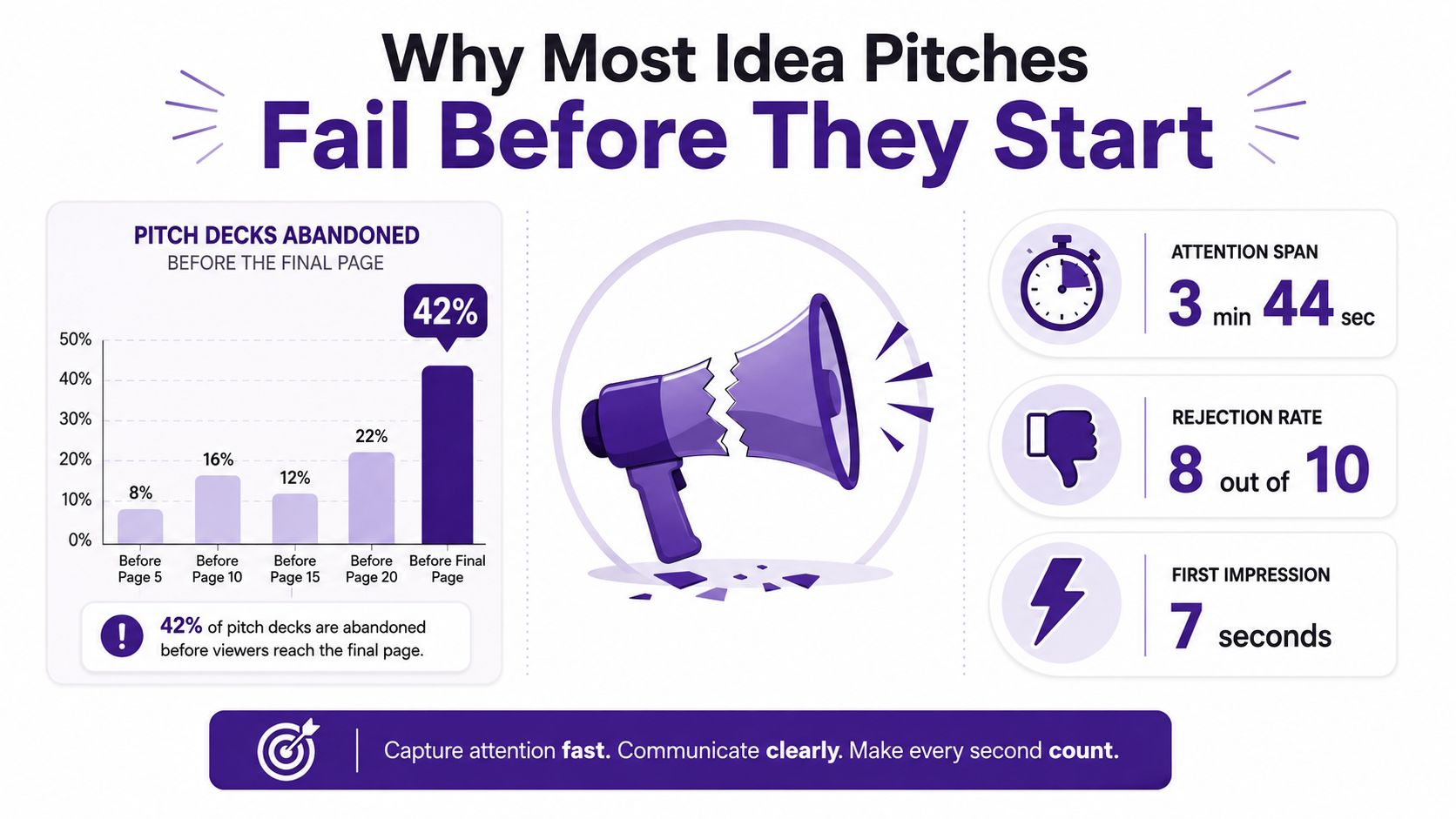
Only 58% of pitch decks are viewed to completion, which means 42% are abandoned before the final slide according to a 2026 analysis citing DocSend (Whitepage Studio). For creators, publishers, marketers, and producers, that changes the meaning of a strong pitch. Your idea doesn't win because it sounds exciting in full. It wins because a busy gatekeeper understands the value quickly, sees credible evidence, and knows exactly what you want next.
The most persuasive pitches I've seen don't rely on a dramatic concept alone. They connect a clear audience problem to proof already sitting inside a content library, then package that proof in a narrative that survives scrutiny. Whether you're proposing a podcast series, a YouTube format, a brand partnership, an editorial initiative, or a new research project, pitching an idea is a process of reducing uncertainty.
Why Most Idea Pitches Fail Before They Start
The first mistake is treating the pitch as a document instead of an attention system. The same DocSend analysis reports that decks around 10 slides have the highest completion rate at 32%, compared with a 22% average, while the first three slides account for 70% of the investment decision (Whitepage Studio). Those figures apply most directly to fundraising decks, but the underlying lesson travels well across creator businesses. The audience decides early whether the idea deserves more attention.
That's why a pitch can fail before anyone reaches the market slide, sample episode, budget, or closing ask. A creator may spend pages explaining personal history, production methodology, technical architecture, or cultural background, while the evaluator is still asking a basic question: What are you proposing, and why should I care now?
The opening loses people in predictable ways
Creators often bury the value proposition under context. A filmmaker describes the social issue for several paragraphs before naming the film. A content marketer presents research methodology before stating the editorial opportunity. A podcaster leads with the format mechanics instead of the listener tension that makes the series worth producing.
Technical detail creates a similar problem. Detail matters later, especially when someone asks about feasibility, rights, staffing, or production costs. On the opening slides, however, technical language can make an unfamiliar idea feel like work to understand.
A stronger opening answers three questions in sequence:
- Who has the problem? Name the audience or customer precisely.
- What keeps happening? Describe the recognizable tension, frustration, or unmet demand.
- What are you proposing? State the format, product, series, or initiative in plain language.
The average deck review time reported in pitch teardown guidance is about 3 minutes 44 seconds, and 82% of readers who reach slide 4 finish the deck (StartupOwl). The first four slides therefore need to function as a retain-or-lose window. Don't make the evaluator decode your premise before that window closes.
Practical rule: If a stranger can't explain the problem and proposed solution after seeing your opening, the pitch isn't ready for broad circulation.
Mining Your Content Library for Pitch Evidence
Your archive is more useful than a portfolio. It's a record of what your audience noticed, questioned, shared, revisited, or ignored. When you're pitching an idea, that history can turn an attractive promise into an evidence-backed proposal.
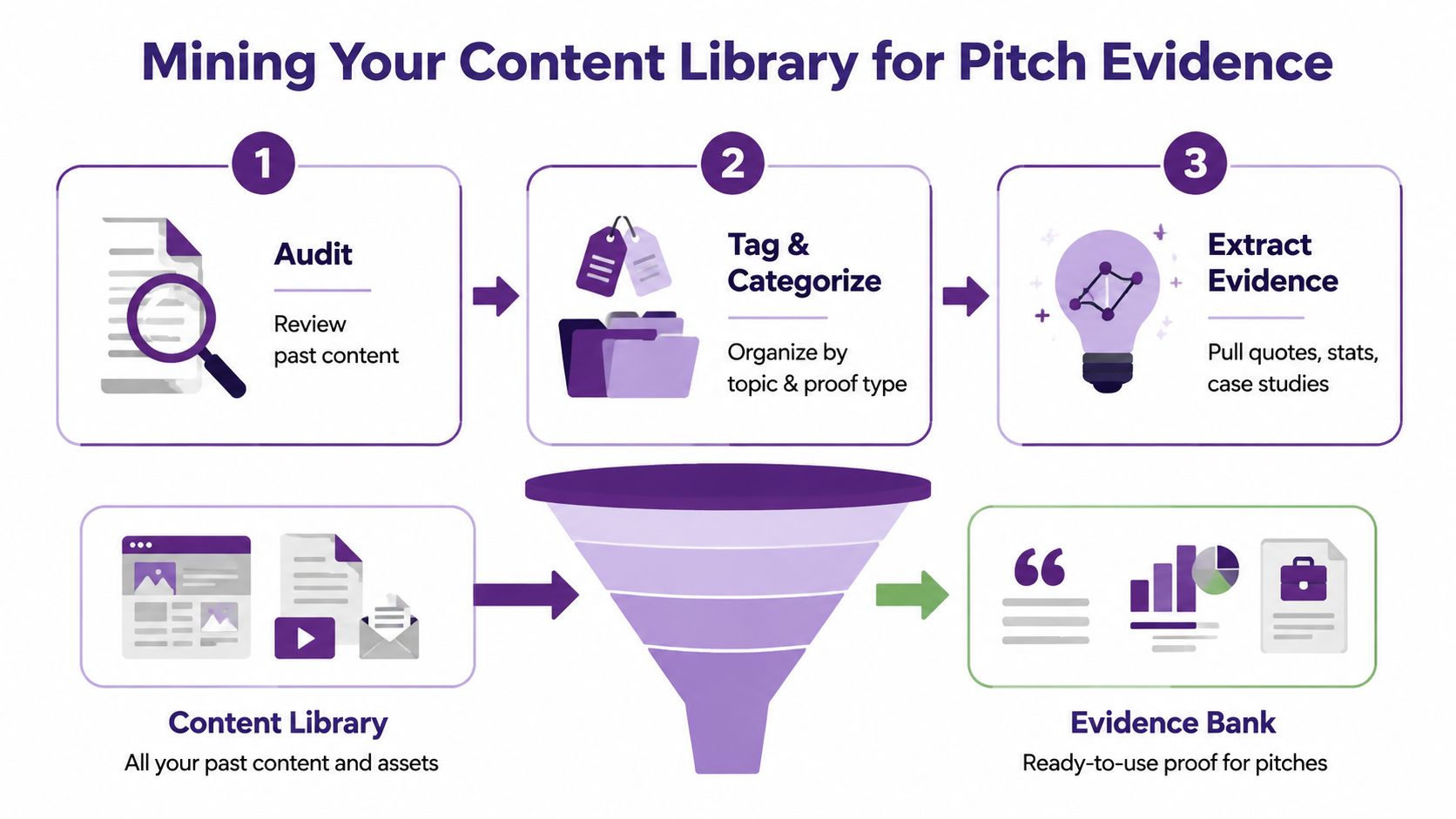
Start by gathering the material that already exists across your working ecosystem. Include podcast transcripts, YouTube descriptions, video scripts, blog posts, newsletters, social captions, audience comments, interview notes, research documents, and older concepts that never reached production. The point isn't to collect everything indiscriminately. The point is to create a searchable source base for discovering recurring signals.
Build an evidence bank before writing slides
Use a tool such as Contesimal to organize content by topic, audience, format, performance signal, and proof type. A chat-based research workflow can help you ask focused questions across the library instead of opening files one at a time. For example:
- Audit the archive. Find the pieces connected to a proposed subject, audience concern, recurring guest type, or successful format.
- Tag the evidence. Separate audience questions, repeat themes, strong reactions, high-performing topics, useful quotes, objections, and production precedents.
- Extract usable proof. Save the exact source, the relevant passage, and the reason it supports the proposed idea.
The important distinction is between evidence and decoration. A comment that asks for a follow-up episode may support audience interest. Several related pieces that repeatedly generate discussion may support a series theme. A back catalog that shows your team already has access to relevant expertise may support feasibility.
Don't turn every engagement signal into a grand conclusion. Say what the evidence supports. “Our audience repeatedly asks about this topic” is stronger than pretending the archive proves guaranteed success.
Search for patterns, not isolated winners
Useful research prompts include:
- Which topics recur across our strongest audience conversations?
- What questions appear in comments, emails, and episode notes?
- Which concepts have enough related material to become a repeatable series?
- Where do audience questions reveal a gap in our existing coverage?
- Which guests, sources, or formats already align with the proposed idea?
- What objections might an editor, sponsor, or budget owner raise?
Creators who want more help generating directions from existing material can also explore this viral content engine for creators, particularly when they're looking for ways to turn scattered archive signals into fresh concepts.
The final evidence bank should give you more than a list of links. It should show the chain from existing interest, to proposed format, to operational next step. For a deeper framework on turning archives into new concepts, see this guide to mining your content library for fresh ideas.
Building a Pitch Structure That Holds Attention
A strong pitch feels like a story with a commercial destination. It doesn't feel like a folder of facts arranged in the order you happened to discover them. Practical pitch-deck guidance recommends 10 to 14 slides for a core deck, with a lean, visual presentation version and a separate send version that can stand alone without the presenter (StartupOwl).
Use the structure as a narrative arc, not a rigid checklist.
Open with recognition
The hook should make the audience recognize the problem before you explain your credentials. For a podcaster, that might be a recurring listener question that existing episodes can't answer. For a YouTuber, it might be a format opportunity created by a clear gap in the channel's current coverage. For a content marketer, it could be a repeated customer concern that the editorial calendar treats only in fragments.
Then define the solution concretely. “A new content platform” is vague. “A six-part interview series that follows one audience problem from first question through practical resolution” gives the evaluator something they can assess.
Put proof before ambition
Proof can include relevant audience behavior, archived content patterns, a pilot outline, available talent, a production sample, or evidence that the team already understands the subject. It doesn't need to prove the idea will succeed. It needs to show that the proposal is grounded in something more substantial than enthusiasm.
A useful sequence is:
- Problem and audience, immediately.
- Solution and format, in concrete terms.
- Market, audience opportunity, or internal value, depending on the gatekeeper.
- Traction or proof of concept, drawn from your library where possible.
- Differentiation, including why your team can execute it.
- Business model or value exchange, such as sponsorship, subscriptions, licensing, reach, or strategic utility.
- Team, competition, financial readiness, and ask, presented without burying the actual request.
The widely cited 10/20/30 rule recommends 10 slides, a 20-minute presentation, and fonts no smaller than 30 points (MaRS). Treat it as a readability discipline rather than a law. A short internal approval pitch may need fewer slides, while a send version may need enough context to make sense without narration.
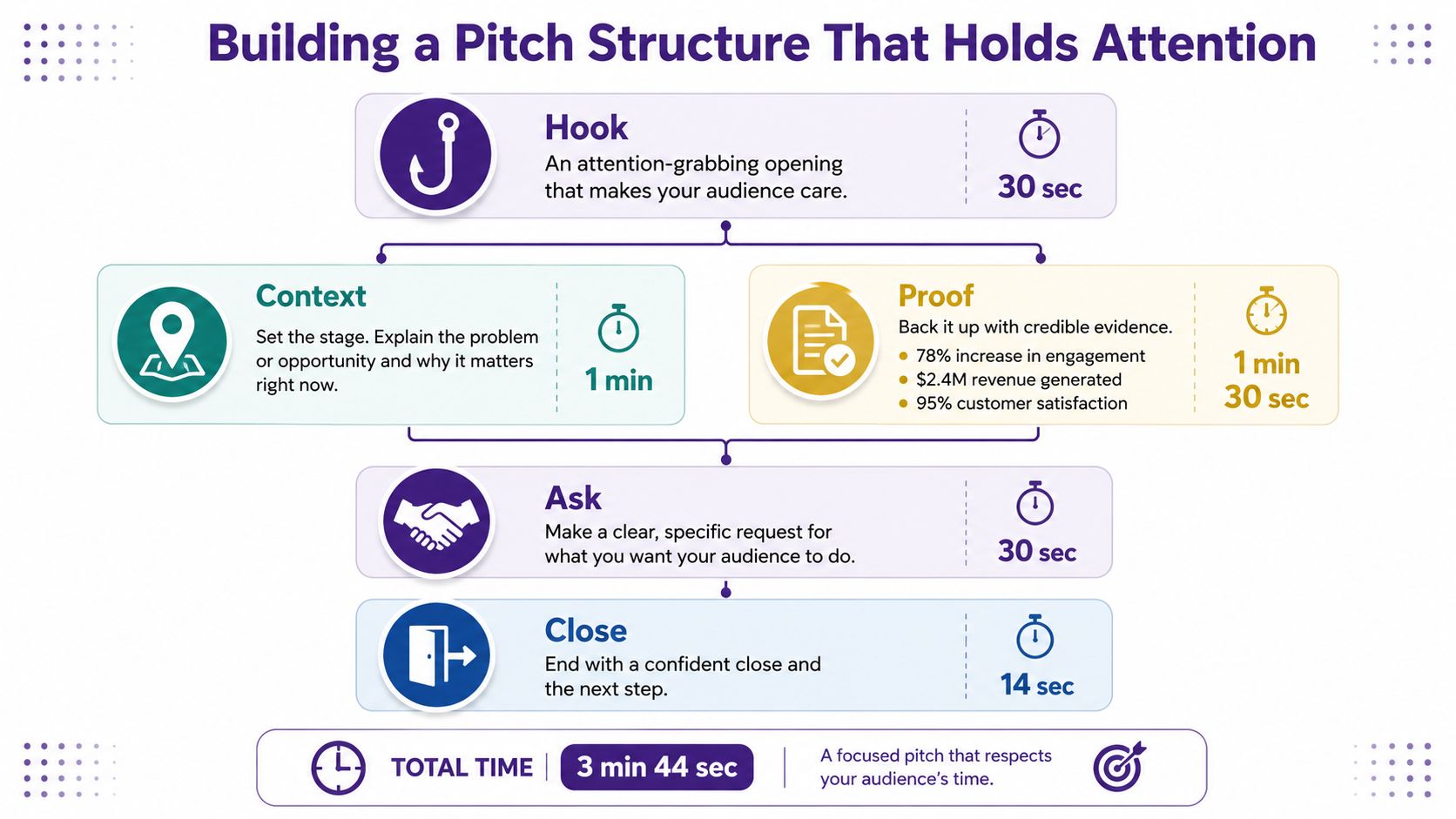
This short visual guide can help creators think about structure in writing as movement, not merely sequence.
The presentation version should support your voice, not compete with it. Keep text sparse, use visuals that clarify the idea, and place supporting detail in notes or the standalone send version.
Adapting Your Pitch for Different Gatekeepers
A strong concept does not need three different versions. It needs three different evidence priorities. Before asking for budget or approval, use your existing content library and AI research tools such as Contesimal to show which audience signals support the idea.
| Gatekeeper | Evidence to foreground | Practical question |
|---|---|---|
| Investor | Audience demand, repeatability, commercial model, competition, and use of funds | Can this become a repeatable business? |
| Editor in chief | Editorial fit, distinctiveness, timing, production capacity, standards, and audience usefulness | Why does this belong in our publication or channel now? |
| Brand partner | Audience alignment, engagement quality, brand safety, distribution, and activation value | What does the partnership make possible, and for whom? |
The same documentary series may therefore begin with a market opportunity for an investor, an editorial gap for an editor, or a credible audience relationship for a brand. Adapt the opening, not the underlying promise. A creator biography rarely earns the first minute unless it directly proves access, authority, or execution ability.
One concept, several openings
Consider a video series about how independent businesses use technology:
- Investor framing: “This repeatable series serves a defined business audience and creates sponsorship and licensing opportunities around a consistent editorial property.”
- Editor framing: “The series gives readers and viewers practical stories about technology adoption, with each episode built around a clear problem rather than a product announcement.”
- Brand framing: “The format places a relevant brand inside useful, character-led stories for an audience already interested in operational change.”
- Internal stakeholder framing: “The series extends existing reporting and gives the team a reusable format across video, newsletter, and social distribution.”
Your archive can make each version more credible. Pull recurring questions, strong comments, newsletter responses, retention patterns, or closely related posts, then connect those signals to the gatekeeper's decision criteria. AI research can organize themes and compare competing coverage, but verify the underlying examples before they enter the pitch.
Elevator pitches commonly sit in the 30-to-60-second range, with guidance translating that into roughly 50 to 200 words depending on pace and context (SayNow). Keep the spoken version focused on the name, category, customer, outcome, differentiating insight, and optional ask, a formula outlined by Startups.com.
For smaller channels, sponsorship discussions also require clear deliverables, audience fit, and negotiation boundaries. This small channel sponsorship negotiation advice can help creators present value beyond reach alone.
Preparing for the Questions That Decide Outcomes
The presentation controls the sequence, wording, and visual emphasis. The questions afterward reveal whether the idea has been tested beyond its polished opening.
Evaluators usually probe the claims your pitch compresses. They may ask who wants the idea, what evidence supports demand, how it differs from existing work, what resources it requires, what could fail, and how the budget creates value. Investors tend to examine market size, traction, and use of funds. Editors and brand managers may focus on staffing, approvals, distribution, and measurable outcomes. The questions vary by gatekeeper, but the credibility test remains.
Prepare answers from the archive
Build a question bank before the meeting. For every major claim, write the skeptical version of the question and attach the strongest evidence from your content library or research.
| Claim in the pitch | Likely question | Evidence to prepare |
|---|---|---|
| The audience wants this | How do you know? | Relevant comments, emails, recurring questions, and topic patterns |
| The format can repeat | What makes episode two possible? | Related subjects, guests, sources, and production resources |
| The idea is distinctive | Why this version? | Competitor review and a clear editorial or commercial difference |
| The budget is justified | What does the spend enable? | Deliverables, staffing needs, production steps, and distribution plan |
| The concept can grow | Where does it go next? | Repurposing paths, related formats, and audience extensions |
Contesimal can help organize archive themes, compare competing coverage, and surface questions that recur across your audience signals. Verify the underlying posts, comments, and examples before citing them. Research software can accelerate evidence gathering, but it cannot turn weak interest into proven demand.
Do not inflate limited evidence. If the archive shows curiosity rather than confirmed demand, describe the concept as an informed test and explain how you will validate it. That admission gives the gatekeeper a clearer view of the risk than an oversized claim.
Stress-test the uncomfortable answer
A brand manager may ask what happens if the content attracts attention without reaching the intended audience. An editor may question whether the concept depends too heavily on one contributor. An investor may ask what prevents a better-funded competitor from copying the format. Prepare a direct answer, one supporting proof point, and a next action that reduces the risk.
The strongest Q&A documents become working assets after the meeting. They help collaborators align, expose missing research, and keep presenters from improvising confident answers that the evidence cannot support. For conversations involving sponsors or clients, these 10 founder communication tips offer useful guidance on keeping expectations, decisions, and follow-up clear.
Running Your Pitch Process Like a Measured Funnel
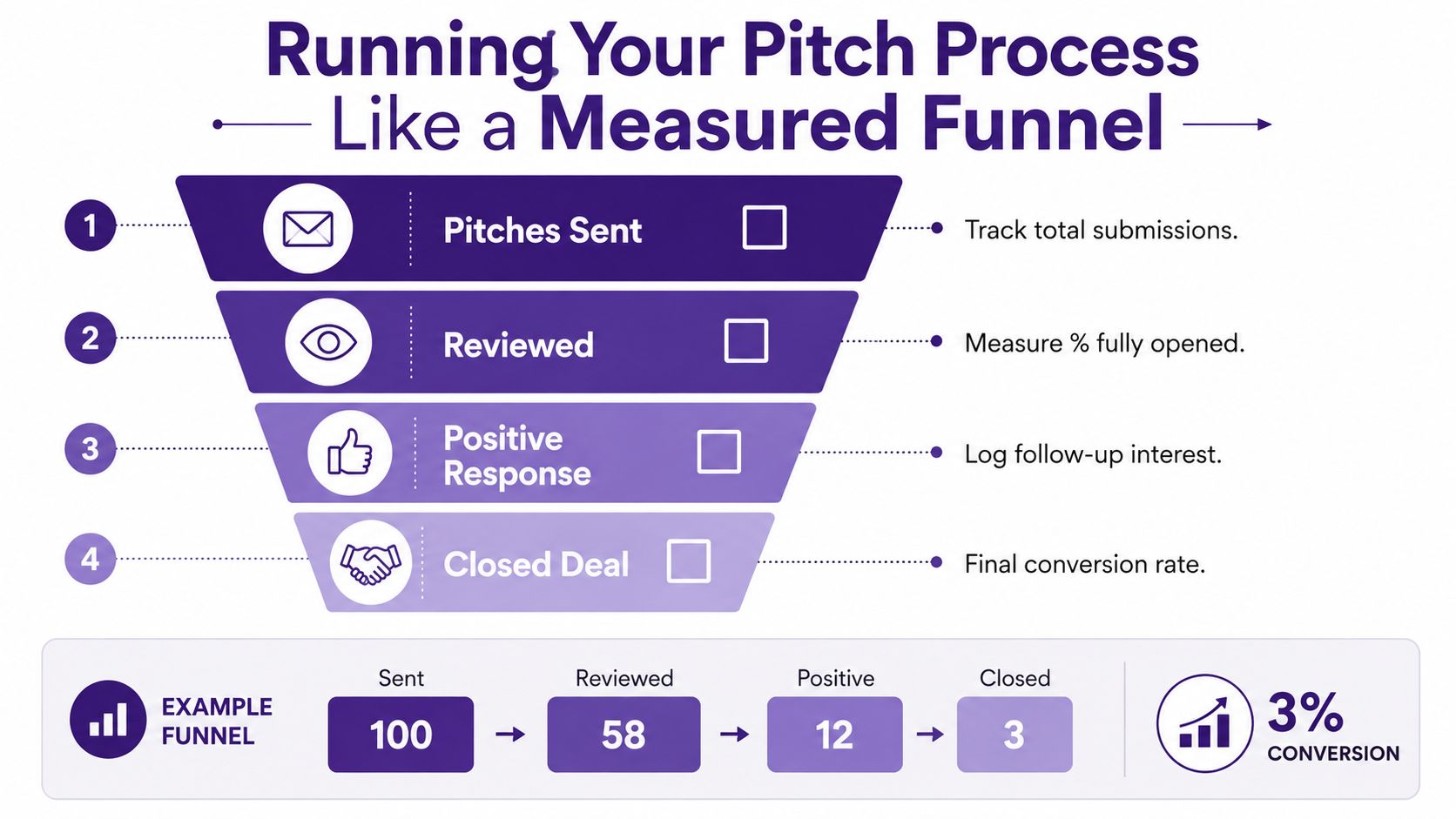
Pitching an idea is a volume-and-iteration process, not a single performance. Multiple summaries report that fewer than 1% of pitch decks secure funding, while one dataset records an average path of 58 investors contacted, 40 meetings, and 12.5 weeks for a successful raise (Pitch Deck Creators). Those benchmarks come from investor pitching, so creators should use them as a mindset shift, not a promise about their own conversion rate.
Track the stages that matter:
- Pitches sent: Record the gatekeeper, idea version, date, and intended outcome.
- Reviewed: Note whether the recipient opened or discussed the full material.
- Positive response: Separate polite interest from a specific request for a meeting, sample, budget, or follow-up.
- Closed deal: Log the approved commission, partnership, funding, or internal green light.
Test the opening on a non-expert reader before sending it to a high-value gatekeeper. Ask them to explain the problem, solution, audience, and requested next step without help. If they can't, revise the first slides rather than adding more detail at the end.
After every pitch, record what happened. Did the recipient misunderstand the idea, question the evidence, request a different format, or object to the budget? Review the result alongside slide count, content distribution, proof quality, and financial readiness. A practical guide to 10 founder communication tips can also help teams make follow-ups clearer and more useful.
Use your archive to improve the next version, not just to support the current one. The broader practice of insight generation helps turn repeated audience signals into sharper concepts, stronger evidence banks, and more disciplined decisions.
Contesimal helps creators, publishers, marketers, and researchers organize podcasts, videos, articles, and other library assets so they can find patterns and build evidence-backed pitches from existing work. Use Contesimal to turn your archive into a searchable source of audience insight, new concepts, and practical next steps before you ask for approval or budget.