
You've probably got this problem already. A podcast episode from last year contains a great expert quote. A blog post has a useful explanation you want to turn into a newsletter. A YouTube script references a book, an interview, and a website, but nobody on the team knows how to credit those sources consistently once the material moves across platforms.
That's where Chicago vs. MLA stops being an academic debate and starts becoming an operations question.
If your library includes articles, transcripts, scripts, research notes, archived interviews, and repurposed social posts, citation style affects more than formatting. It affects trust, editing speed, handoff quality, and how confidently your team can reuse old work. For creators moving from hobby mode into a real publishing workflow, that matters. When your archive is organized, understood, and actionable, old content doesn't sit there. It becomes new value.
Why Citation Styles Matter for Your Content Library
A messy content library creates a subtle credibility problem. A creator republishes an old essay as a LinkedIn post, turns a webinar into a blog article, then clips a podcast into a YouTube short. The facts may still be solid, but attribution starts drifting. One piece uses parenthetical references. Another drops bare URLs. A third names a source in passing with no clear trail back to the original material.
Readers notice that, even if they can't name the exact problem.
For creators, publishers, and content teams, citation is a signal. It tells the audience whether you handle ideas carefully, whether quotes came from somewhere real, and whether your archive can support republishing without turning into a game of editorial telephone. That's why Chicago and MLA are useful. They aren't just school formats. They're two different ways to show your work.
One practical challenge is that guidance for creators is thin. Existing guidance rarely addresses how content marketers and podcasters should choose between MLA and Chicago for non-academic audiences, where brevity and trust are paramount. That gap shows up fast when you manage old interviews, historical articles, and research-heavy scripts for public audiences.
What creators actually need
Many teams don't need citation theory first. They need a repeatable rule for repurposing.
- For blogs and articles: citation needs to stay readable on the page.
- For podcast show notes: attribution often needs more context than a brief parenthetical can carry.
- For video scripts and research docs: editors need to trace claims back to source material without slowing the workflow.
If you're tightening your standards, it helps to define what makes a source credible in the first place. Citation style doesn't rescue weak sourcing. It makes strong sourcing visible.
Practical rule: A citation style is part of your brand standard. If your library is valuable, your attribution system has to be reusable too.
Core Philosophies What MLA and Chicago Prioritize
MLA and Chicago solve different problems. If you understand that, the formatting rules stop feeling random.
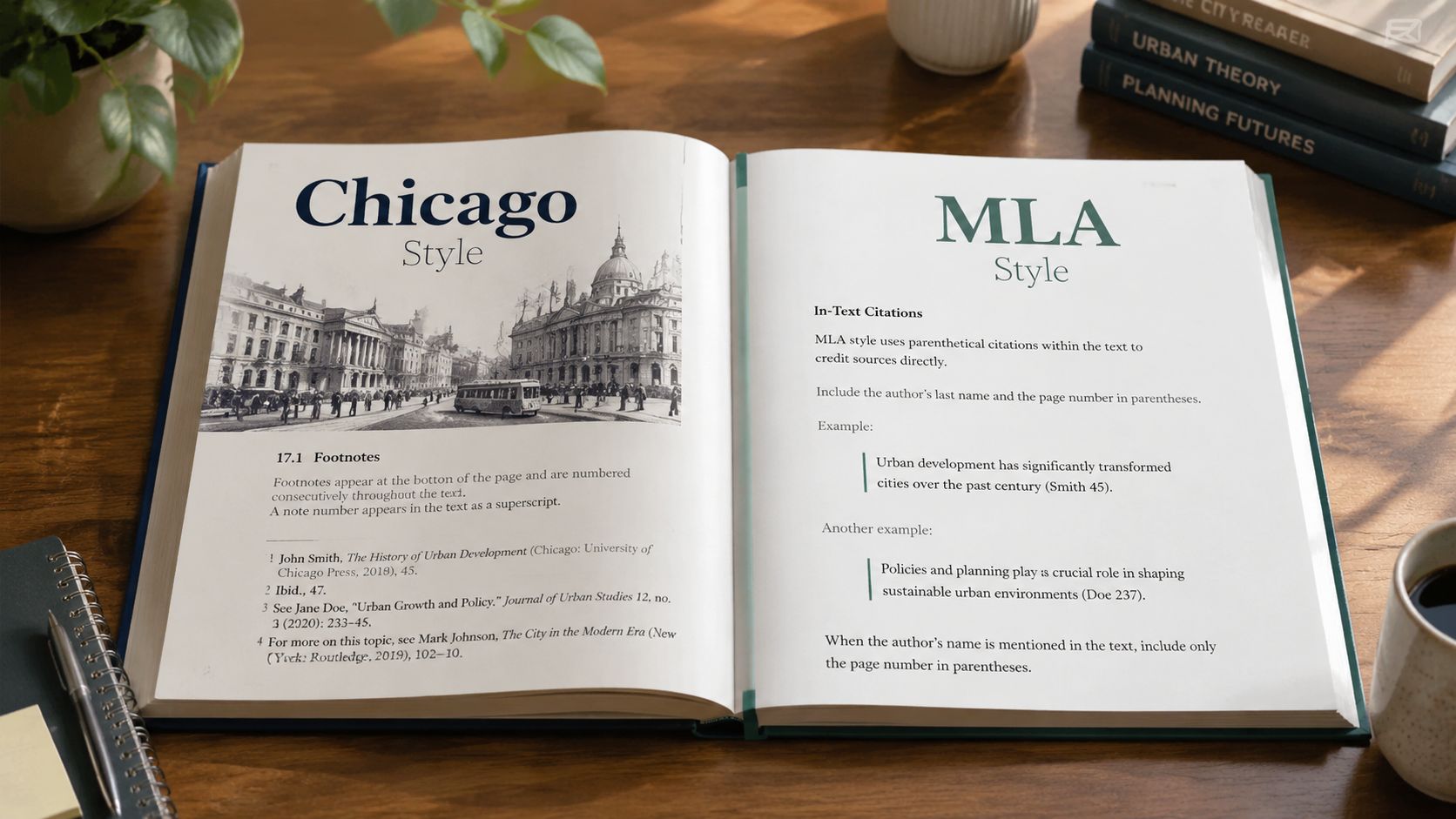
MLA focuses on location inside the text
MLA Style, now in its 9th Edition, is the standard for literary studies and uses an author-page format such as (Smith 45), as outlined in this MLA and Chicago comparison. The point is to keep the reader moving while still showing exactly where a passage appears.
That's why MLA fits close reading so well. In literary analysis, the page itself matters. A critic may build an argument around one line in a poem or one scene in a novel, so the citation needs to send the reader to a precise location fast.
For creators, that philosophy has a practical echo. If your content depends on quoting books, essays, transcripts, or written interviews, MLA's compact style can keep the main text cleaner. The source stays visible, but it doesn't take over the sentence.
Chicago focuses on source context and flexibility
Chicago works differently. Instead of one fixed approach, it gives writers options. The Notes-Bibliography system is common in humanities and history, while Author-Date serves fields that prefer date-centered citations.
That flexibility makes Chicago useful when source context matters as much as the quote itself. A footnote can hold more detail, and that detail can help a reader understand the source's origin, publication setting, or relevance. For research-heavy essays, documentary notes, or historical commentary, that extra room helps.
A simple way to remember the split is this:
- MLA asks: where in the text did this come from?
- Chicago asks: what source context should the reader see?
When your team understands that distinction, style decisions get easier. You're not choosing a prettier format. You're choosing the kind of reader experience you want.
A short walkthrough helps if you want to see those differences in motion.
Chicago often feels better for annotation-heavy work. MLA often feels better for quote-heavy work.
Citations in Action A Side by Side Look
If the theory still feels abstract, put the two styles next to each other. The differences become obvious fast.
| Element | MLA 9th Edition | Chicago 17th Edition (Notes-Bibliography) |
|---|---|---|
| In-text attribution | Parenthetical author-page citation, such as (Smith 45) | Superscript note number leading to a footnote or endnote |
| Final source list | Works Cited | Bibliography |
| Title page | Usually no separate title page | Separate title page for major works |
| Best fit | Close textual analysis and readable on-page citation | Historical writing, commentary, and source-rich notes |
| Reader experience | Minimal interruption in the main text | More source detail outside the main text |
One structural difference trips up teams constantly. Chicago formally requires a separate title page for major works, while MLA places author and title information on the first page of the text. That may sound minor, but it matters when editors convert a manuscript template from one style to another.
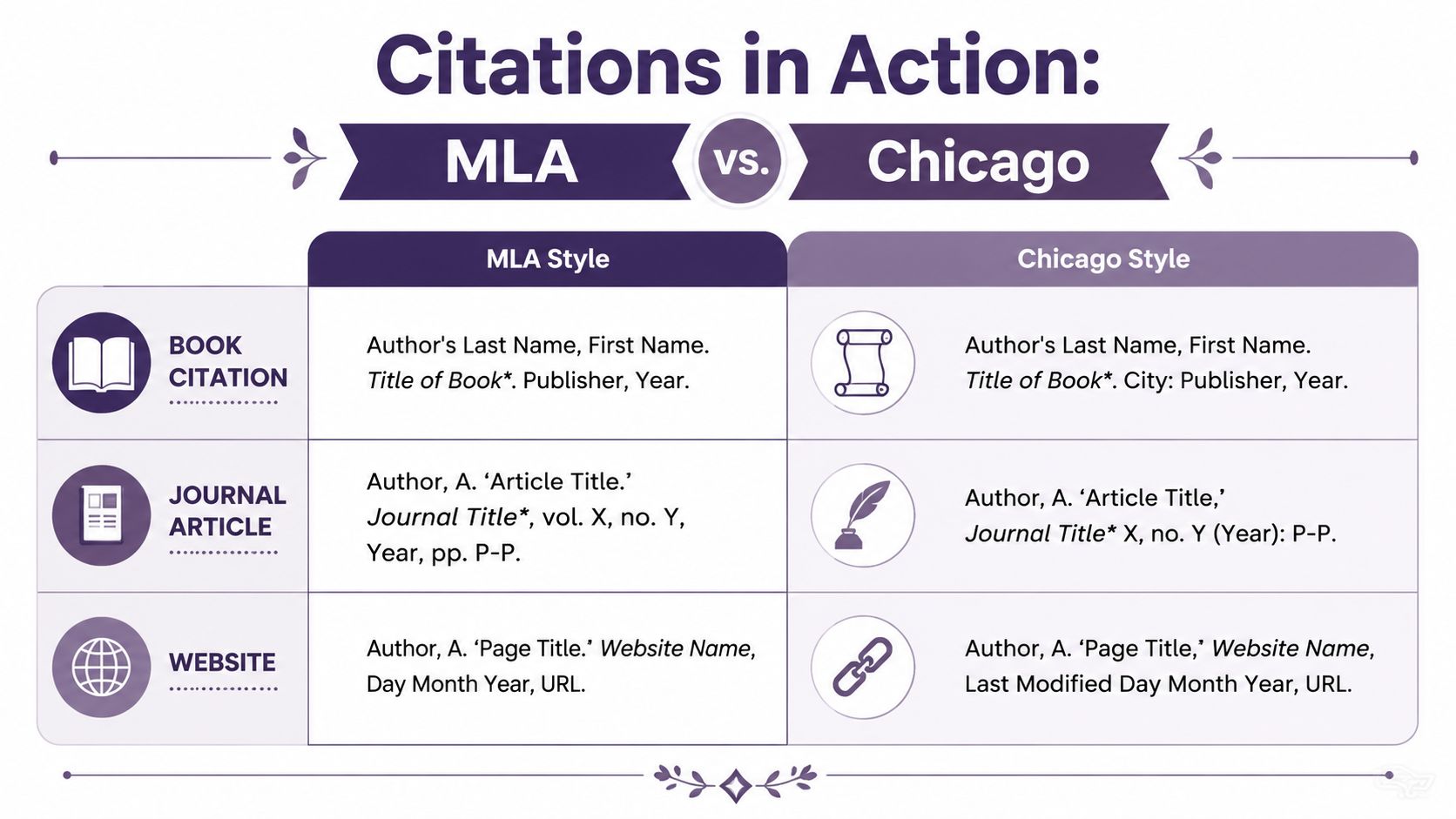
Book example
For a book, the overall source information is similar, but the structure changes.
- MLA Style: Author's Last Name, First Name. Title of Book. Publisher, Year.
- Chicago Style: Author's Last Name, First Name. Title of Book. City: Publisher, Year.
MLA tends to strip away anything it doesn't need for reader navigation. Chicago keeps a more formal publication frame.
Journal article example
Articles make the contrast clearer.
- MLA Style: Author, A. "Article Title." Journal Title, vol. X, no. Y, Year, pp. P-P.
- Chicago Style: Author, A. "Article Title," Journal Title X, no. Y (Year): P-P.
MLA separates parts with commas and labels volume and issue explicitly. Chicago compresses some of that information into a different punctuation rhythm.
Website example
Web sources create extra confusion because teams often improvise them.
- MLA Style: Author, A. "Page Title." Website Name, Day Month Year, URL.
- Chicago Style: Author, A. "Page Title," Website Name, Last Modified Day Month Year, URL.
If you paraphrase web material instead of quoting it directly, formatting can get slippery. Editors who want clear examples for citing paraphrases often find Humantext.pro's paraphrase citation guide useful as a practical reference.
What this means in real workflow
A blogger usually cares about uninterrupted reading. Parenthetical citation can be easier to live with on the page.
A documentary producer or podcast editor may prefer footnotes in a script packet or companion article because those notes can hold more source detail without cluttering the narration. That's especially useful when one sentence draws from an archive, an interview transcript, and a secondary source.
If your team is building templates, don't leave this to memory. Create a shared guide for recurring source types and standardize how to add citations in your publishing workflow so repurposing doesn't turn into manual cleanup every time.
The best citation style is the one your team can apply consistently across reused material.
Formatting and Punctuation The Subtle Differences
Citation style isn't only about references. It changes the shape of the page.
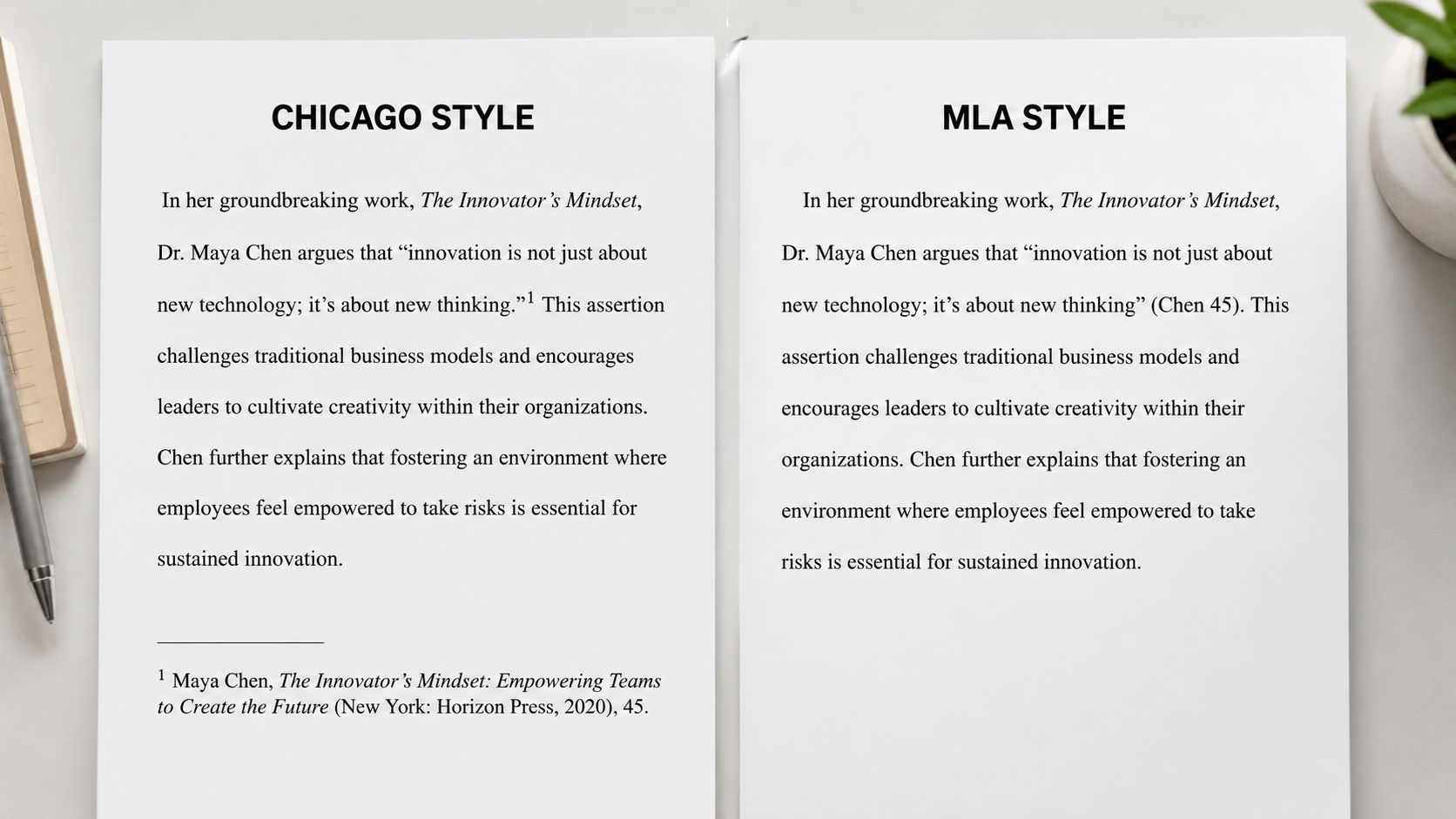
Page setup and visible structure
MLA is visually lean. It typically uses double spacing, standard margins, and a running header with the author's last name and page number. Chicago can feel more formal on long documents because of title-page expectations and note placement.
That difference matters when creators export research into public-facing formats. A citation style that looks polished in a thesis can feel stiff in a blog CMS. A style that reads cleanly in an article can feel too thin in archival notes.
Small punctuation choices that create big cleanup jobs
Editors lose time on tiny inconsistencies. These are the usual culprits:
- Title treatment: Keep your style consistent when you format source titles. If your team switches styles mid-document, titles are often the first giveaway.
- Citation punctuation: MLA parentheticals sit inside the sentence flow. Chicago notes pull source detail out of the line and into a note system.
- Source list naming: MLA ends with Works Cited. Chicago uses Bibliography in Notes-Bibliography projects.
A useful editing checklist
When converting a file, scan for these before you touch the wording:
- Check the title page first. If the document has one, it may already lean Chicago.
- Search for parentheses with page numbers. Those often signal MLA-style in-text citation.
- Look for superscript note markers. That usually means Chicago notes are in play.
- Rename the final source list correctly. Works Cited and Bibliography aren't interchangeable labels.
- Audit footnotes before publishing online. Some web platforms strip or mangle note formatting.
If your team works with notes frequently, it helps to keep a reference for citing a book in footnotes so editors aren't rebuilding note structure from scratch.
Editing shortcut: Don't start by fixing commas. Start by identifying the governing system. Once you know the style, the punctuation choices become easier.
Choosing Your Style Discipline and Platform Matter
For creators, the right answer usually depends less on academic tradition and more on format, audience, and reuse.
A literature professor writing a journal article already knows where they belong. A podcaster, YouTuber, editor, or content marketer usually doesn't get that kind of built-in rule. They're making a practical decision about readability, trust, and production speed.
When MLA is the better fit
MLA often works well when the content lives mainly on the page and the reader's attention needs to stay on the sentence.
Use MLA when:
- You publish quote-driven articles: Book commentary, essay analysis, and transcript-based posts benefit from concise parenthetical references.
- You want cleaner reading in blogs: Inline citations usually feel lighter than visible note machinery.
- Your team reuses written material often: If a blog post becomes a newsletter or script summary, MLA-style attribution can be easier to carry across formats.
When Chicago is the better fit
Chicago earns its place when the audience needs more context about the source, not just the source's location.
Chicago often makes sense for:
- Podcast show notes: Footnotes or note-style references can give background without crowding the spoken script.
- Historical or documentary content: Source provenance matters, and note-based systems leave room for that.
- Editorial packages with research layers: If a report includes commentary, source notes, and supporting references, Chicago can handle the complexity better.
Think like a content operator, not only a writer
A useful benchmark for repurposing is the 60/40 split, with 60% of content time spent creating new pillar content and 40% spent repurposing existing assets, according to this content repurposing guide. In practice, your citation style affects whether that repurposing time stays efficient or gets eaten by avoidable formatting fixes.
This underscores the 'so what?' in the Chicago vs. MLA decision. If the style you choose at the start doesn't travel well across your library, your repurposing process slows down. Editors patch things manually. Show notes and blog posts drift apart. A source that looked properly credited in one format becomes muddy in the next.
Here's a simple decision rule:
- Choose MLA when the main goal is readability inside the text.
- Choose Chicago when the main goal is context outside the text.
If your organization publishes across many channels, document that rule and use it consistently. Style drift is expensive, even when nobody notices it right away.
AI and Citation The New Challenge for Content Libraries
AI has changed the scale of the problem. A human editor can usually tell when a footnote has been flattened into a parenthetical or when a Works Cited page doesn't match the in-text references. An AI system can process much more material, but it can also carry formatting errors across a whole library very quickly.
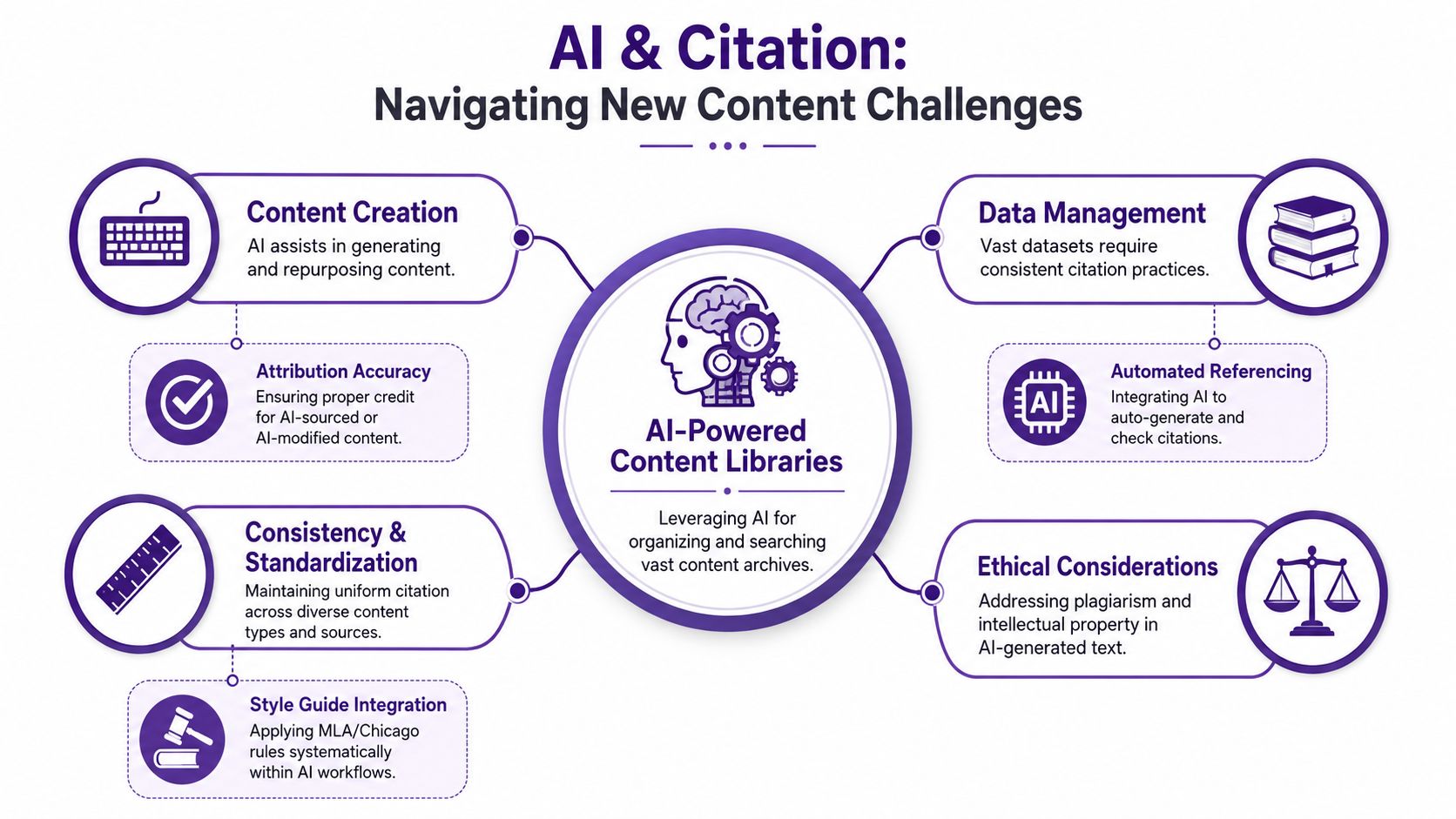
Mixed-style archives create hidden risk
Most mature content libraries are mixed by default. Older manuscripts may follow Chicago. Blog writers may have used MLA-like parentheticals. Podcast notes may include partial references or informal credits. Once AI starts summarizing, rewriting, or extracting from that archive, style inconsistencies don't stay isolated.
A source can get detached from its original format. A footnote can lose context when converted into a short quote card. A page citation can disappear when a book excerpt becomes a video script.
There's a deeper problem too. There is no data quantifying the error rates of AI tools when they automate citation formatting and switch between MLA's author-page system and Chicago's footnote system. For publishers and creators, that means you can't assume the automation layer is reliable just because the output looks polished.
What good oversight looks like
Human review still matters most in three places:
- At ingestion: label the original source type and original citation style if known.
- At transformation: check whether a summary, adaptation, or excerpt preserved enough attribution.
- At publication: confirm the final format matches the destination platform's standard.
This isn't only a scholarship issue. It's a discoverability issue too. Teams adapting content for search and answer-focused surfaces often need tighter editorial control, which is why some marketers also study Surnex's AI Overviews strategies when thinking about how structured, trustworthy information gets surfaced.
AI can speed up retrieval and reuse. It can't replace editorial judgment about attribution.
A strong content library needs a source of truth. Without one, automation multiplies confusion. With one, AI becomes much more useful because it can help organize and retrieve material without forcing editors to guess where a claim came from.
Quick Conversion Guide and Cheatsheet
When you need to switch a piece from one style to the other, start with the structural changes first. Then fix the details.
Fast reference
In-text citation
- MLA: uses parenthetical (Author Page)
- Chicago: uses a superscript note linked to a footnote or endnote
Final list of sources
- MLA: Works Cited
- Chicago: Bibliography
Title page
- MLA: usually no separate title page
- Chicago: separate title page for major works
Best practical use
- MLA: strong for readable, quote-heavy written content
- Chicago: strong for context-rich notes and archival explanation
Conversion checklist
- Start with the citation system: Don't edit punctuation until you've decided whether the document will use parentheticals or notes.
- Rename the source section: Works Cited and Bibliography signal different systems. Fix the label early.
- Check source order and formatting: Book, article, and website entries often need different punctuation and publication detail.
- Review templates for recurring formats: Blog posts, podcast notes, and scripts should each have their own style-ready version.
- Do one final attribution pass: Make sure every borrowed idea, quotation, and paraphrase still points back to a traceable source.
For teams managing a large archive, consistency matters more than perfection on the first draft. Pick the style that fits the platform, document the rule, and apply it the same way every time. That's how you turn an old content library into something reusable instead of something risky.
If you're sitting on a library of podcasts, videos, articles, and research documents, Contesimal can help you organize that archive, surface valuable source material, and turn past work into new creative output without losing track of what matters. It's built for teams that want to classify, search, collaborate, and create from their existing content with a cleaner human and AI workflow.