
You've probably got a crowded drive, a backlog of transcripts, half-finished outlines, published videos, old blog posts, and podcast episodes you know still have value. But when you try to reuse any of it, the process stalls. You open a transcript and think, “What was this really about?” Then you close it and move on to making something new.
That's the hidden tax of a growing content library. The problem usually isn't volume. It's that the library has no map.
For creators moving from hobbyist mode into a professional publishing rhythm, central idea meaning becomes more than a reading-class term. It becomes an operating tool. If you can identify the one core message inside each asset, you can sort your archive, pull clean clips, build smarter playlists, write stronger summaries, and turn old work into fresh outputs across platforms.
Your Content Library Is a Goldmine If You Have a Map
A creator with years of work behind them usually faces the same strange problem. They have plenty to publish, but they don't know what they already own. A podcast archive looks rich from the outside and chaotic from the inside. A YouTube channel with dozens of strong videos can still feel unusable when every episode lives as a title, a thumbnail, and a vague memory.
That's where the central idea comes in. It works like a map key. It tells you what each piece is trying to say.

Why old content feels hard to reuse
Most creators organize content by format first. Video. Podcast. Blog. Newsletter. That helps with storage, but not with strategy. If you want to repurpose well, you need to know the message inside the file, not just the file type.
A good example is a long interview episode. On paper, it might be “Episode 42 with a founder.” That label is too shallow to help you. Its usable value comes from the deeper point, maybe something like: small creators grow faster when they build repeatable systems before chasing scale. That sentence gives you options. Now you can cut short clips, write social posts, bundle related episodes, and connect it to a series.
Practical rule: If you can't say what a piece is arguing in one sentence, you'll struggle to reuse it well.
There's also a reader and viewer benefit. When the core message is stated clearly, the audience follows more easily. Best Writing's explanation of central idea notes that when a central idea is explicitly located in a thesis statement, readers achieve a 25-30% higher retention rate of supporting arguments compared to texts where the idea is implicit. The reason given is simple: an explicit anchor lowers cognitive load.
What this changes for creators
Once you start labeling assets by central idea, your library stops acting like a storage locker and starts acting like an editorial system.
- Audit faster: You can sort content by argument, not just title.
- Repurpose cleaner: Clips and excerpts stay faithful to the original message.
- Plan series better: Related ideas gather naturally into buckets and playlists.
- Monetize smarter: The archive becomes easier to package, sell, sponsor, or relaunch.
For professional creators, that shift matters. New value rarely starts with new recording time. It often starts with understanding what you've already said.
What a Central Idea Actually Is and What It Is Not
The simplest definition is the most useful one. A central idea is the most important message an author communicates about a topic. Foundational curricula also teach that informational texts often contain two or more central ideas, and those ideas are developed through examples, statistics, and expert quotes, as explained in Varsity Tutors' lesson on determining and analyzing central ideas.
For creators, that means the topic isn't enough. “Email marketing,” “electric cars,” or “creator burnout” aren't central ideas. Those are subjects. The central idea is the claim being made about that subject.
Think like an editor, not a label maker
If a topic is the folder name, the central idea is the reason the piece exists.
In creator terms, it's the sentence you'd say if someone asked, “Why did you make this?” Not the whole recap. Not the moral of life. Just the core point your evidence supports.
A useful companion concept shows up in positioning work too. Strong messaging depends on distilling a broad subject into a sharp claim. That's why RedactAI insights for professionals can be helpful if you're trying to tighten how you state what your work stands for. The same discipline applies here.
If you want a stronger feel for how message and organization work together on the page, this guide to structure in writing is also useful.
Central Idea vs. Related Concepts
| Concept | What It Is | Example (Content about electric cars) |
|---|---|---|
| Central Idea | The main message or argument about the topic | Electric cars are becoming practical for everyday drivers because charging access and vehicle design keep improving. |
| Topic | The general subject | Electric cars |
| Theme | A broad underlying message that can apply across many works | Innovation changes how people live. |
| Summary | A shorter retelling of the main points | The piece explains costs, charging, battery concerns, and why more drivers are considering electric cars. |
A topic tells you what the content is about. A central idea tells you what the content says about that topic.
Where people usually get mixed up
Three confusions show up all the time:
Topic for idea
“This video is about electric cars.” True, but incomplete.Theme for idea
“Change is inevitable.” That may be a broad takeaway, but it's too general to guide repurposing.Summary for idea
A summary can run several sentences and include many details. A central idea should feel tighter.
When you understand central idea meaning this way, your content gets easier to classify. You're no longer sorting by surface label. You're sorting by message.
A Step-by-Step Method to Find the Central Idea
Knowing the definition doesn't help much when you're staring at a transcript from a forty-minute podcast. You need a workflow that works on rough material, not just polished essays.
One durable method comes from reading instruction. St. Augustine University's guide to identifying the central idea lays out a six-step method: reading actively, identifying topic connections, determining the author's purpose, looking for repeated patterns or motifs, drafting a working thesis, and verifying it by checking each paragraph's role.
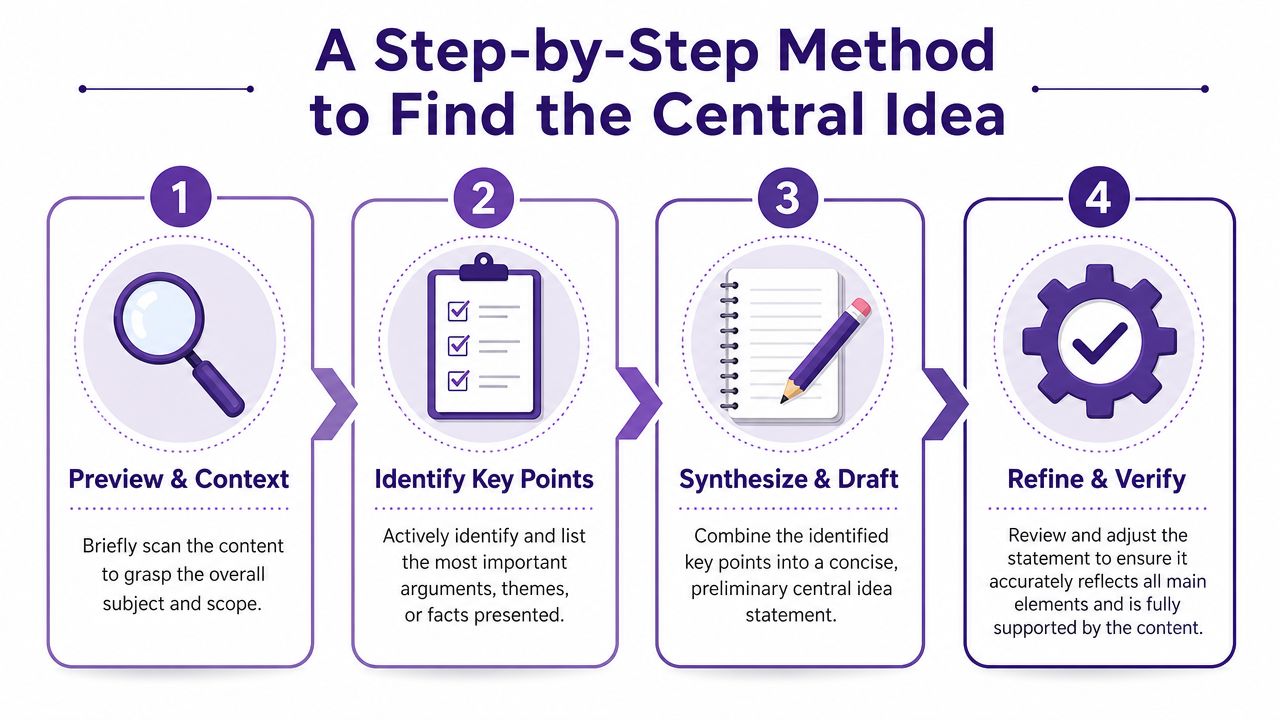
Step 1 through Step 3
Start with active review. Don't skim passively. Read the transcript, watch the draft, or review the article while marking the moments that carry weight.
Read or watch actively
Highlight claims, repeated phrases, transitions, and conclusion lines. If you hear the host return to the same point three times, that's a signal.Track the main topic and subtopics
Ask what the piece is broadly about, then note how side points connect back. A video on sponsorships might include pricing, audience fit, and negotiation. Those are subtopics, not separate core messages.Identify purpose and stance
Is the piece explaining, arguing, warning, comparing, or persuading? A creator saying “here's what I learned after doing this wrong for a year” is doing more than informing. They're advancing a position.
Editor's shortcut: Repetition matters. When a speaker returns to the same language, metaphor, or contrast, they're usually circling the core idea.
Step 4 through Step 6
Now tighten the material until it can survive in one sentence.
Look for motifs and patterns
Repeated ideas often hide under different wording. “Consistency,” “system,” “cadence,” and “publishing rhythm” may all point to the same core argument.Draft a working thesis
Write one sentence that completes this pattern: This piece argues that… If the sentence feels fuzzy, the idea probably is too. If you need help calibrating how compact that sentence should be, this explanation of how long a thesis statement is gives a practical reference point.Verify against each section
Check the opening, middle, and ending. Do the examples support your sentence? Do the side stories connect back? If a large section doesn't fit, either your draft is wrong or the content contains more than one central idea.
Here's a creator-friendly test:
- If it's too broad, it could apply to ten unrelated videos.
- If it's too narrow, it only describes one anecdote.
- If it's right, it explains why the whole piece hangs together.
A short teaching video can help reinforce the method before you apply it to your own archive:
A quick example
Suppose your podcast episode covers burnout, scheduling, outsourcing, and analytics. At first glance, that looks scattered. But if each section keeps returning to one point, your central idea might be: Creators avoid burnout when they build systems that reduce decision fatigue.
That sentence gives the episode an intellectual anchor. It also gives you cleaner titles, clips, and follow-up content.
Seeing the Central Idea in Action With Examples
Abstract definitions only go so far. The essential test is whether you can see the central idea across different formats.
A short informational text
Take a simple article about school lunches. The topic is obvious: school food. The summary might mention cost, nutrition rules, student reactions, and policy changes. But the central idea would be narrower and more pointed, such as: school lunch quality shapes student focus and should be treated as part of learning, not just cafeteria logistics.
That sentence works because the details support it. The examples aren't random. They build an argument.
A YouTube explainer video
A YouTube explainer often hides its central idea behind visuals, pacing, and voiceover. Suppose a video covers why some channels grow steadily while others spike and disappear. The topic is channel growth. The central idea might be: repeatable formats help creators grow more reliably than constant reinvention.
You can usually spot that by asking what each section is doing. Are the graphics, examples, and narration all defending one point? If yes, you've found the anchor.
For more practice with informational models, these examples of informative writing are a useful reference.
Good examples don't just state facts. They show what those facts are there to prove.
A podcast segment
Podcast episodes can be harder because spoken content wanders. A host tells a story, reacts to a guest, adds side notes, and doubles back. Still, the central idea is there if the segment has shape.
Say a podcaster spends several minutes talking about audience growth, then shifts into email lists, owned distribution, and platform risk. The topic looks broad, but the central idea may be: creators need owned channels because platform reach can change without warning.
That sentence earns its place because it explains the role of the supporting details. The stories and examples aren't the point. They're the proof.
Across text, video, and audio, the question stays the same: what is the content trying to get me to believe, understand, or remember?
Common Mistakes When Identifying a Central Idea
Most mistakes are understandable. The language around this concept is crowded, and creators often move too fast when labeling their own work.
Mistake one: naming the topic
Before: This episode is about content marketing.
After: This episode argues that content marketing builds trust when brands teach before they sell.
The fix is simple. Add the author's or creator's point of view.
Mistake two: grabbing one interesting detail
Before: The central idea is that short videos get more views.
After: The central idea is that creators use short videos to attract attention, then move viewers toward deeper content.
A memorable detail can support the idea without being the idea.
Mistake three: repeating a fact instead of the argument
Before: The video says creators post on three platforms.
After: The video argues that creators should adapt one message across multiple platforms instead of reinventing every post.
A central idea should sound like a claim, not a note you copied from the screen.
If your sentence reads like a label, a bullet from the transcript, or a random fact, keep going. The right version should connect the parts and reveal the purpose.
Putting the Central Idea to Work for Your Content
At this point, the concept stops being academic and starts paying rent.
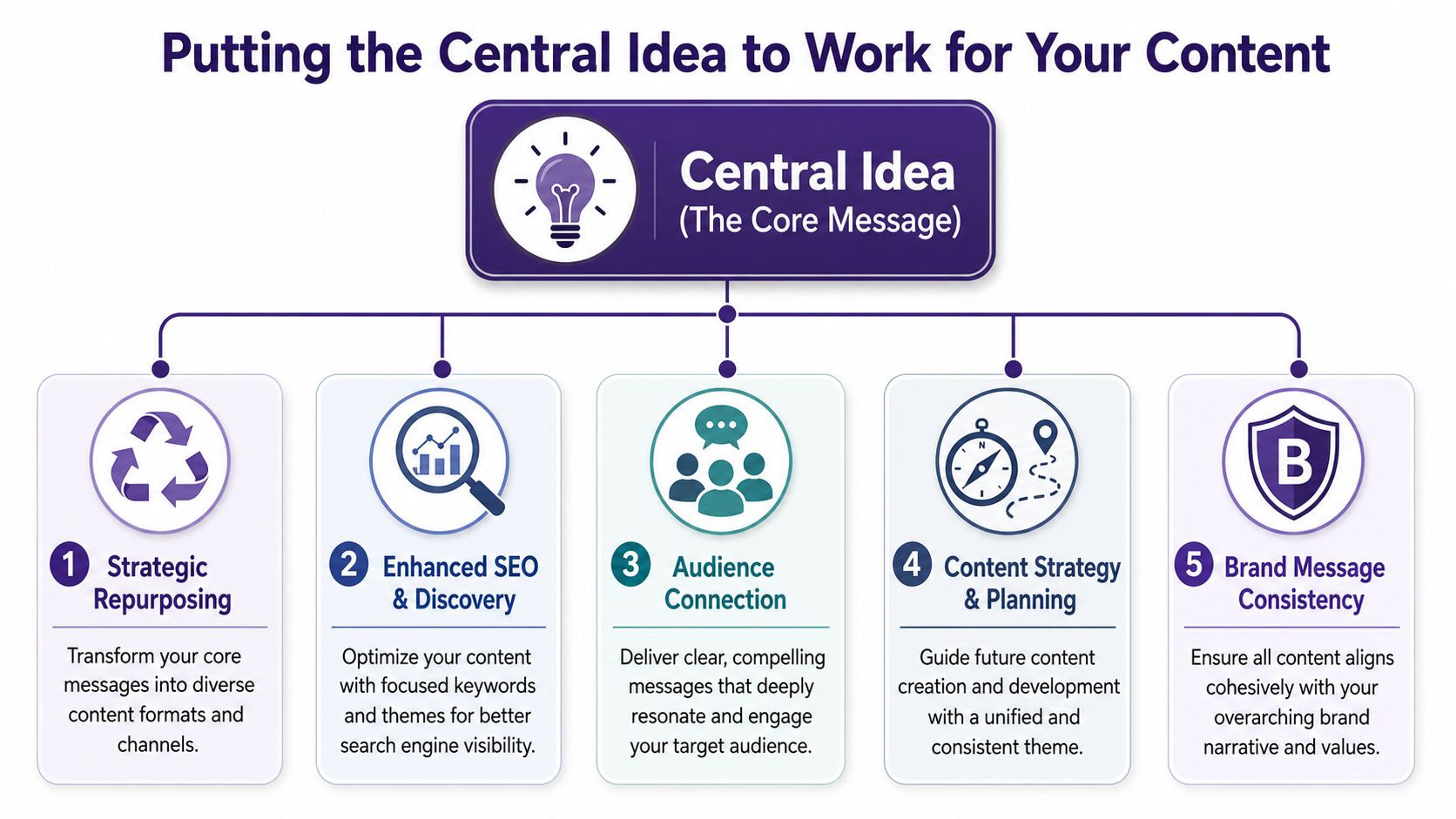
A clear central idea helps you turn one asset into many. If a podcast episode's core message is strong, you can turn that message into a short clip, a carousel, a newsletter section, a blog post summary, a series hook, or a talking point for the next episode. Repurposing gets easier because you're not pulling fragments at random. You're extending a coherent idea.
Why this matters more in creator workflows
Modern creator content often sprawls. Long podcasts, video essays, interviews, livestreams, and multipart series don't always state their thesis neatly at the top. That's one reason this skill has become more valuable. The verified data shows that 68% of modern content creators struggle to identify a single central idea in podcast episodes or video transcripts because the narrative arc is distributed over a long runtime, while 92% of educational resources on the topic focus exclusively on short informational texts, as noted in this background source on the gap between classroom models and longform creator content.
That gap hits real workflows. If you can't identify the core message, you can't confidently title the clip, pitch the episode, group related assets, or hand the work off to a teammate.
What central idea unlocks inside a library
A content library becomes easier to monetize when each asset is tagged by meaning, not just by title.
- Repurposing across platforms: One strong message can become reels, quote cards, email copy, and article intros.
- Playlist and series planning: Videos with shared arguments belong together, even when their titles look different.
- Editorial consistency: Teams can keep the brand voice aligned because the message is clear before distribution starts.
- Search and retrieval: Semantic tools can find content by idea, not just keyword matches.
That last point matters for growing teams. A platform like Contesimal lets users search content by meaning across articles, videos, podcasts, and large document sets, which is useful when a team needs to find themes, claims, and patterns inside an archive rather than exact wording.
The creator who knows the core message of their back catalog has an advantage over the creator who only remembers titles.
Professionalization isn't just about publishing more. It's about organizing what already exists so it can keep producing value. When you understand central idea meaning, you stop treating your archive like a pile of finished work. You start treating it like inventory.
If your library is full of useful material but challenging to explore, Contesimal is worth a look. It helps teams organize transcripts, articles, videos, and research by meaning so they can find patterns, surface strong ideas, and turn existing content into new publishing opportunities.