
You probably have a folder full of “good stuff” you meant to reuse.
A standout podcast episode. A video that pulled strong comments. A blog post that still gets search traffic. A workshop recording with ideas buried inside it. Then December hits, or your fiscal year wraps, and you try to do a year in review from memory. That's when everything blurs together. You remember being busy. You remember a few wins. You remember a few misses. You don't remember enough to make smart decisions.
That's the trap.
A useful year in review isn't a vanity recap. It's an operating system for turning last year's work into next year's output. For creators moving from hobbyist to professional, that matters a lot. Once you have a real library, your job isn't only to make the next thing. It's to organize, understand, and take action on what you already made, so old work starts producing new value across platforms.
That shift changes everything. You stop treating your archive like storage and start treating it like inventory.
Framing Your Year in Review Goals
Most creators start too wide. They say they want to “see what worked,” then open five dashboards, skim old thumbnails, check a few analytics tabs, and end up with a messy document full of observations they can't use.
A better approach starts with one page. Not a big planning deck. One page.
Choose outcomes before metrics
Your year in review should answer a business question, not just describe the year. For creators and publishers, the usual buckets are familiar:
- Audience growth: Are you trying to reach new viewers, listeners, readers, or subscribers across platforms?
- Engagement quality: Do you want stronger watch time, replies, saves, shares, or deeper on-site behavior?
- Revenue direction: Are you trying to support sponsorships, products, memberships, services, or licensing?
- Editorial focus: Do you need to decide which series, playlists, or recurring themes deserve another season?
If you don't pick the bucket first, every metric starts looking equally important. It isn't.
A podcast producer reviewing the year for sponsorship readiness should not spend the same energy on every social vanity metric. A YouTuber trying to build a repeatable series should not let one lucky spike dictate the whole strategy. Different goals require different evidence.
Practical rule: If a metric won't change what you publish next quarter, it doesn't belong in your main review.
Write goals that connect creative work to money
SMART goals are useful here because they force trade-offs. The trick is to write them in creator language, not corporate fog.
Instead of “grow brand presence,” write something closer to this:
- Publish a year in review asset that identifies the top recurring themes in the content library
- Select a short list of pieces worth updating, repackaging, or expanding
- Build a repeatable cross-platform workflow from one long-form asset
- Use the review to guide pitch angles, product ideas, or membership topics
That keeps the review tied to decisions you'll make.
If your operation is getting more collaborative, define who needs the output. The editor needs one kind of answer. The host needs another. The person handling growth needs a clearer map of what can be repurposed next. Teams that treat research as shared infrastructure usually make better use of their archive than teams that leave insights trapped in one person's notes. That's also why it helps to think about the purpose of research in content work as operational, not academic.
Build the one-page goal doc
Keep it lean. Mine usually includes:
| Item | What to write |
|---|---|
| Primary objective | The main result this review needs to support |
| Secondary objective | Useful, but not allowed to hijack the process |
| Core library segments | Series, formats, channels, or content buckets under review |
| Decision deadline | When the review must become action |
| Exclusions | What you are not evaluating this round |
The exclusion line matters more than people think. If you're reviewing the last year of podcast episodes, don't suddenly expand into five years of newsletters because one old issue still feels “important.” Scope creep kills year in review work faster than bad analysis.
Pick one theme for the story of the year
Before you open the data, force one provisional sentence:
This was the year we learned that ________.
You'll revise it later. But setting that sentence early gives the review shape. Without it, your findings stay disconnected. With it, you can test whether each observation supports the main narrative or just distracts from it.
Collecting and Analyzing Your Key Metrics
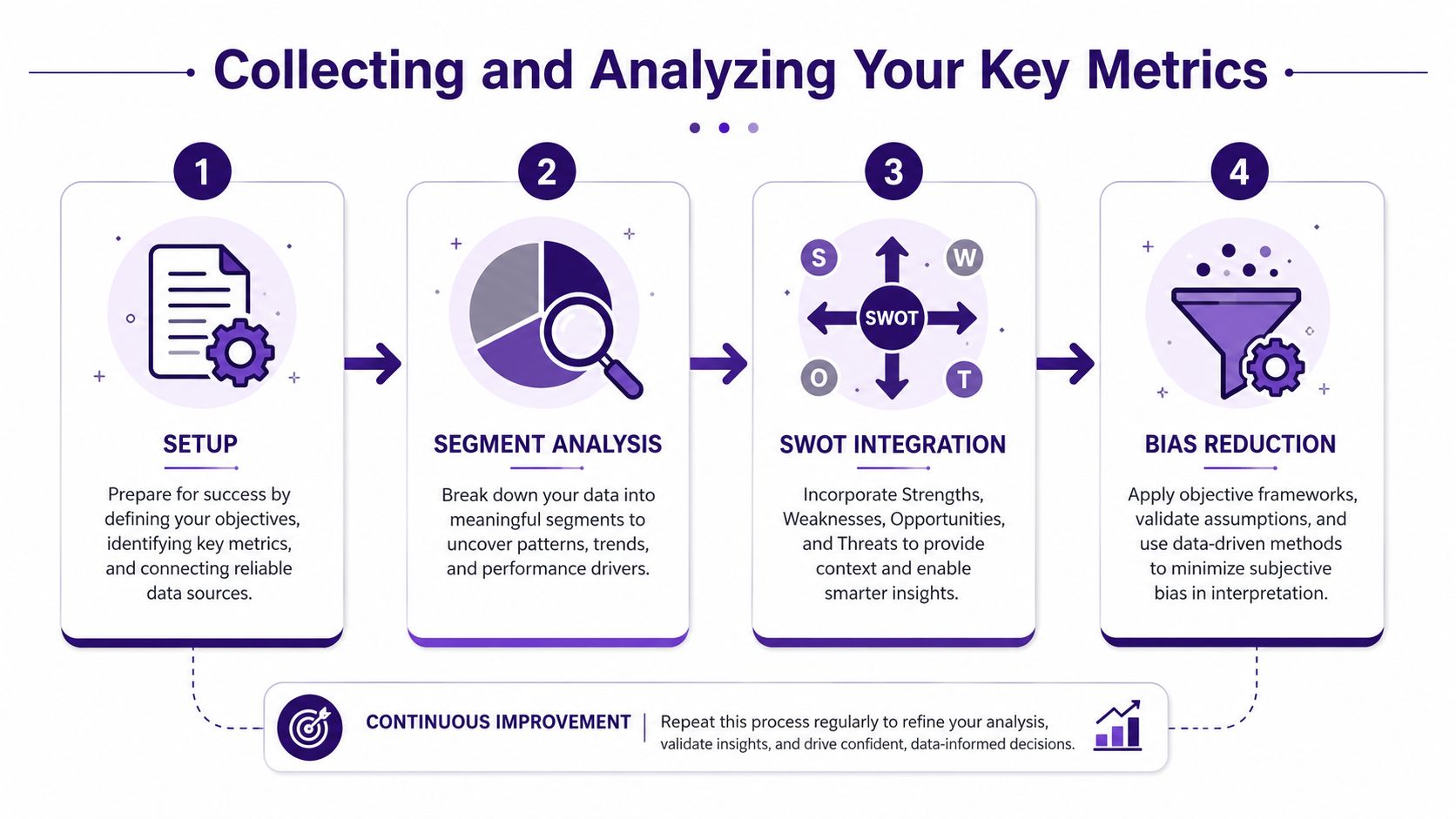
The strongest year in review documents don't rely on memory. They use a structured audit, then they test subjective impressions against records.
That matters because a four-segment year-in-review method with SWOT analysis can reduce retrospective bias by 40% and improve workflow optimization by 35%.
Split the year before you interpret it
Don't review the year as one lump. Break it into four segments. Quarters are a common and effective approach, though some editorial businesses prefer seasonal groupings if publishing rhythms change around launches, holidays, or event cycles.
Then pull data from the places where work happened:
- Traffic and on-site behavior: Google Analytics or your site analytics stack
- Video performance: YouTube Studio or platform reporting
- Podcast performance: your hosting dashboard
- Email performance: newsletter platform analytics
- Publishing records: editorial calendar, upload logs, production boards
- Commercial context: sponsorship tracker, product launch notes, or revenue reports
That last category is where many creators get lazy. They separate content performance from business results, then wonder why the review feels incomplete.
Pair performance with context
A metric only becomes insight when you can explain what happened around it.
Use a simple segment scorecard for each quarter:
| Quarter | What to capture |
|---|---|
| Output | What you published and how often |
| Performance | Which pieces moved and which stalled |
| Inputs | Topics, formats, guests, packaging, cadence |
| Constraints | Travel, burnout, team changes, launch pressure |
Then add a light SWOT pass. Strengths and weaknesses should be internal. Opportunities and threats should be external. Keep the language blunt. “We shipped inconsistently after trying too many experimental formats” is useful. “We explored dynamic content pathways” is not.
If you want a practical breakdown of what to pull from your archive and dashboards, this guide on how to analyze content performance is a useful companion.
Compare what you remember with calendars, publishing logs, and financial records. Memory is a storyteller. Records are editors.
Track energy, not just output
One of the most underrated moves in a year in review is logging how the work felt. Not in a dramatic journal sense. In a production sense.
A simple monthly note can capture:
- Energy level: Did the team feel steady, rushed, or depleted?
- Confidence: Were you publishing from a tested process or improvising every week?
- Friction: Did approvals, research, editing, or asset handoff slow production?
- Momentum: Which series got easier with repetition?
Patterns emerge. Some quarters produce more because the ideas are stronger. Others produce more because the process is cleaner. Those are not the same thing.
Make one scorecard, not fifteen
The audit should end in a single working document. Each goal gets a score, each quarter gets key observations, and each content bucket gets a short verdict: expand, refine, repurpose, pause, or retire.
That final classification is where the review becomes usable. Without it, you've just created a more organized pile of information.
Crafting a Compelling Year in Review Narrative
A good year in review isn't a spreadsheet pasted into public view. It's a story built from evidence.
Readers, listeners, and viewers don't stay because you gathered numbers. They stay because you gave those numbers meaning. That's why the best review pieces feel selective. They don't report everything. They reveal the few things that mattered.
Use a simple narrative arc
You don't need theatrical storytelling. You need shape.
A reliable structure for creator reviews looks like this:
Start with tension
Open with a challenge, surprise, or misread. Maybe you thought one format would carry the year and it didn't. Maybe an older series kept outperforming your newer experiments.Move through the turning points
Show the decisions that changed the outcome. These decisions may involve shifts in publishing cadence, topic focus, packaging, collaboration, or distribution.End with a forward-looking conclusion
Close on what you'll repeat, stop, or rebuild.
That structure works for solo creators, channel teams, and publishers because it mirrors how people experience a year. Rarely as a smooth climb. Usually as a set of corrections.
Turn metrics into scenes
The mistake is saying, “This post did well” or “This episode underperformed” and leaving it there.
Instead, anchor the data in a specific editorial moment. For example:
- A podcast episode landed because the host returned to a clear audience pain point instead of chasing a broad trend
- A blog post kept working because its search intent stayed useful long after publication
- A video series lost momentum when each installment drifted away from the original promise
Those are scenes. They help the audience understand why something happened, not just that it happened.
If your writing tends to flatten into recap mode, it helps to revisit the basics of structure in writing. A year in review still needs pacing, contrast, and payoff.
“The best review pieces don't celebrate output alone. They explain judgment.”
Pick a voice that fits the year
Tone matters. If the year was messy, say so cleanly. If it was a breakthrough year, avoid chest-thumping. If the team learned hard lessons, don't bury them under brand language.
A few practical calibrations help:
- Use celebratory tone when the result came from repeatable decisions, not luck
- Use reflective tone when the lesson matters more than the win
- Use light humor when it clarifies a mistake everyone recognizes, like overbuilding formats nobody could sustain
Creators often go wrong in one of two directions. They either write a victory lap that teaches nothing, or they write a therapy session disguised as strategy. Neither travels well.
Build around three kinds of proof
A solid review narrative usually blends:
- Performance proof from your analytics and publishing records
- Editorial proof from the actual choices you made
- Audience proof from comments, replies, sales conversations, or recurring feedback themes
That mix keeps the piece grounded. Numbers alone can feel sterile. Anecdotes alone can feel soft.
Show what changed your mind
The most convincing year in review content usually includes one moment where the creator or team admits they had the wrong assumption.
Maybe the archive produced better ideas than the brainstorm. Maybe narrower topics beat broader ones. Maybe one format was draining the team without giving enough back. That kind of admission builds trust because it sounds like real work, not polished hindsight.
In practical terms, your draft gets stronger when every major takeaway answers one question: What will we do differently because we now know this?
If a takeaway can't answer that, cut it.
Templates for Year in Review Episodes and Posts
Templates save time, but only if they force clear thinking. Bad templates become fill-in-the-blank fluff. Good ones keep your review tight, consistent, and easy to adapt across channels.
Below are three working formats I'd use.
Blog post template
This structure works well for bloggers, publishers, and creators who want one durable asset that can also feed email and social.
- Opening situation
What kind of year was it? One paragraph. Keep it honest. - What we set out to do
State the main objective and any secondary objective. - What worked
Name the formats, topics, or distribution decisions that held up. - What didn't
Include one clear miss and why it happened. - What surprised us
Pull from the archive, not just recent memory. - What we're taking forward
Series to continue, assets to repurpose, habits to keep. - Call to action
Invite the audience to watch, read, reply, subscribe, or revisit a key piece.
Video script template
Video reviews need momentum. Don't front-load every metric.
| Segment | Prompt |
|---|---|
| Hook | What changed this year that the audience should care about |
| Setup | The goal you started with |
| Midpoint | Wins, misses, and the moment the strategy shifted |
| Proof | Show examples, screenshots, clips, titles, or comments |
| Close | What's next and what viewers should watch for |
Use visuals aggressively here. Old thumbnails, timeline snapshots, quotes from comments, B-roll from production, and clips from standout episodes all help. A talking head plus a list of stats gets stale fast.
Podcast rundown template
Audio needs stronger transitions because listeners can't scan.
- Cold open with one sharp observation from the year
- Quick context on what you were trying to build
- Two wins worth unpacking
- One miss and the lesson behind it
- Archive pick from older content that still matters
- Next-year shift with a clear promise to the audience
Keep each segment anchored to one idea. Audio reviews fall apart when the host jumps between metrics, memories, and plans without signposting.
Customize without losing consistency
Your brand voice should change the phrasing, not the logic. A filmmaker can make the review more cinematic. A newsletter writer can make it more conversational. A B2B content team can make it more analytical.
What shouldn't change is the backbone. Every format still needs objective, evidence, interpretation, and next action. If one of those is missing, the audience feels it even if they can't name it.
Building an Editorial Calendar That Works
A year in review becomes valuable when it turns into scheduled output. If it stays as a document in Notion, Google Docs, or a shared drive, you've only completed half the job.
The calendar is where archival value becomes publishing value.
Audit the past year, then schedule from it
For repurposing, freshness matters. Strategic audits should focus on the past 12 months and target 5 to 7 repurposed pieces per long-form asset because that's the sweet spot for relevance and efficiency.
That guidance is practical for creators with a real back catalog. Last year's work is usually recent enough that the examples, references, and audience questions still hold. It also keeps you from wasting review time on assets that need a full rebuild.
Use a simple calendar grid
Don't overcomplicate this with ten workflow statuses if your team won't maintain them. Start with a compact planning table.
Sample 12-Month Editorial Calendar
| Month | Core Asset | Repurposed Pieces |
|---|---|---|
| January | Year in review flagship blog post | Email summary, short video clip set, LinkedIn post series |
| February | Best-performing podcast episode refresh | Show notes update, quote graphics, newsletter feature |
| March | Evergreen tutorial video | blog adaptation, short clips, FAQ post |
| April | Audience Q&A episode | social snippets, email answers, site resource page |
| May | Case-style breakdown or analysis post | carousel summary, discussion thread, script for video |
| June | Mid-year review | email note, audio recap, social cutdowns |
| July | Strong archive article update | SEO refresh, newsletter resend, short explainer |
| August | Playlist or series roundup | landing page, short promos, episode guide |
| September | Research-heavy long-form piece | infographic brief, email sequence, clip package |
| October | Seasonal or event-driven feature | teaser posts, follow-up article, short recap |
| November | Top lessons piece | quote pulls, social posts, podcast segment |
| December | Next-year preview | subscriber note, trailer, audience survey prompt |
Match production effort to capacity
An editorial calendar should reflect your real operating model, not your ideal self on a productive Sunday.
If your team is small, batch by function:
- Week one: choose archive pieces
- Week two: update scripts, stats, or framing
- Week three: create derivatives
- Week four: publish and distribute
That sequence works better than trying to fully complete one asset at a time across every platform.
Protect room for reaction
Even disciplined calendars need slack. You'll have breaking opportunities, trend moments, guest availability changes, or surprise audience questions worth answering. The goal isn't a rigid machine. It's a plan strong enough that reactive publishing doesn't derail your core schedule.
A good calendar gives your team confidence about what comes next. A bad one becomes a guilt document.
Repurposing Review Content Across Platforms
Most creators still treat repurposing like an optional bonus task. That's why it gets postponed. Then skipped.
The fix is to design the review asset as source material from the start. One long-form script, post, or episode should already contain enough structure to split into multiple channel-native pieces.
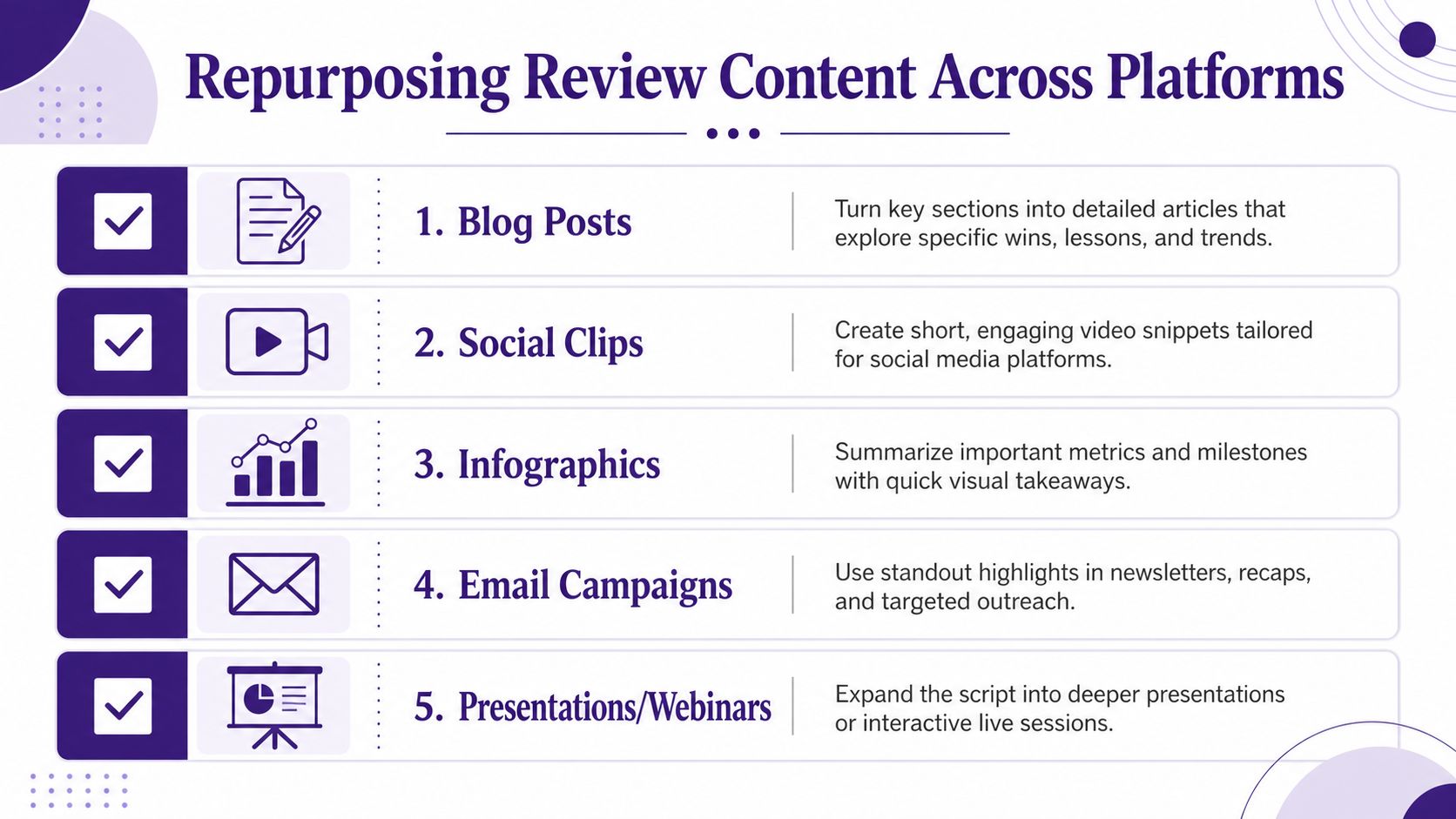
A useful benchmark helps here. A realistic repurposing floor is three distinct assets per long-form piece, and up to eight is achievable with a defined process.
Start with channel-native outputs
Repurposing works best when each asset feels built for the platform, not copied into it.
From one year in review flagship piece, you can usually create:
- A blog post that carries the full argument and archive examples
- Short video clips built around one lesson per clip
- An email edition that summarizes the big takeaway and points back to the main asset
- A visual summary for slides, carousels, or internal sharing
- A live discussion for webinar, stream, or community Q&A
The point isn't volume for its own sake. It's to let the same insight meet audiences where they already pay attention.
A quick visual checklist helps teams see the expansion path before they start production.
Build the asset tree before editing
Here's a workflow that consistently prevents waste:
- Draft the core review in long form
- Highlight strong standalone claims, moments, and examples
- Pull visual proof such as screenshots, charts, clip timestamps, or comments
- Assign each extracted element to one platform
- Edit for platform norms instead of pasting the same copy everywhere
That fourth step matters. When teams skip assignment and just “pull a few snippets later,” repurposing becomes random.
One flagship asset should create a small ecosystem, not a single post plus leftovers.
Use different hooks for the same underlying idea
A strong review lesson can travel in several forms:
| Source insight | Repurposed angle |
|---|---|
| Older content kept outperforming newer experiments | Blog post on archival ROI |
| One series format became easier to produce over time | Short video on sustainable formats |
| Team energy dropped when production complexity rose | Email on what to stop doing |
| Audience responded to narrower topics | Social thread on focus and packaging |
That's the true craft. Not resizing media. Reframing insight.
Sequence the work so it actually happens
Repurposing fails when it feels like extra work after the “real” piece is done. Build it into the production order instead.
For every long-form review asset, finish these before publication day:
- Clip list with timestamps or pull quotes
- Email draft with one main takeaway
- Social angle list with distinct hooks
- Visual brief for chart, carousel, or infographic needs
Once teams start doing this consistently, the archive stops being dead weight. It becomes a renewable supply of ideas, proofs, and formats.
Promoting Your Year in Review for SEO and Reach
Publishing a strong year in review isn't enough. You need a distribution plan that fits how people find and consume content now.
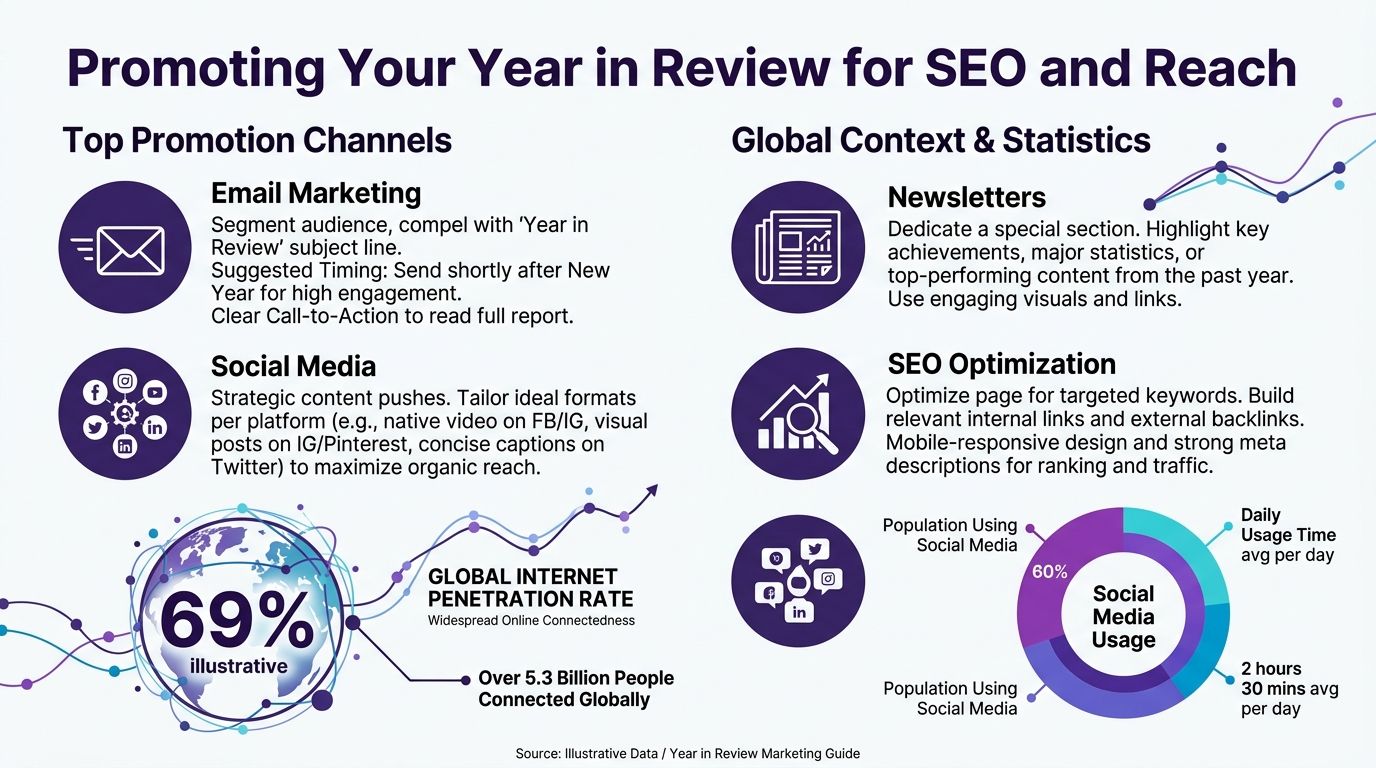
That environment is huge and uneven. By October 2025, 6.04 billion people were using the internet, equal to 73.2% global penetration, and more than 1 billion people were using AI tools monthly. That's useful context for promotion because it reinforces two things. Digital reach is broad. Attention is fragmented.
Match the channel to the job
Different channels do different work.
- Email is best when you want concentrated attention from people who already know you
- Search works when the review contains enduring lessons, frameworks, or examples people will look for later
- Social is useful for angle testing and for pulling attention toward the main asset
- Newsletters and communities help when the review is part of an ongoing relationship, not a one-off campaign
The mistake is using the same headline and same framing everywhere. A search title needs intent clarity. An email subject needs curiosity and relevance. A social hook needs speed.
Optimize the review asset for discovery
Year in review content can perform well in search when it includes durable utility, not just recap language.
A few practical moves help:
- Put the core topic near the front of the headline
- Use subheadings that reflect real audience questions
- Link to older assets that deserve renewed attention
- Refresh outdated examples before republishing or promoting
- Add clear summaries so readers and AI-assisted discovery tools can parse the piece fast
This is also where regional context matters. Teams working across markets often need sharper positioning and messaging choices than generic growth advice provides. If you want a grounded example, Scéaled's marketing advice for Irish businesses is a solid reference for adapting promotion to local commercial realities.
Build a promotion sequence instead of a single launch
A year in review usually has more promotional life than creators give it.
Try a staggered sequence:
| Timing | Promotion move |
|---|---|
| Launch day | Publish flagship asset and send primary email |
| Following days | Release clips, quote posts, or discussion prompts |
| Following week | Publish one derivative asset from the same review |
| Later in the quarter | Resurface a relevant insight when tied to a new release or trend |
This works because the review is often a hub asset. It can support future posts, episodes, presentations, and audience conversations if you don't burn it all in one announcement.
Promote the takeaway, not the format
People rarely care that you published a “year in review.” They care about the lesson inside it.
Lead with the insight:
- What changed in your strategy
- What your archive revealed
- What you're stopping
- What your audience should expect next
That framing travels better than “our annual recap is live.” Promotion improves when you package the conclusion, not just the content type.
Measuring Impact and Planning Next Year
By January, plenty of creator teams have a polished recap, a brief spike in attention, and no change in how they plan. The review did its job as content. It failed as an operating tool.
At this stage, many creator teams lose the plot. They publish a smart retrospective, collect positive feedback, and slip back into reactive production. The archive stays underused, the same bottlenecks return, and next year's review ends up saying the same things in cleaner design.
Score the review against goals
A useful year in review produces decisions you can defend in a planning meeting.
Start by scoring the review against the goals you set earlier in the process. Did it clarify what to keep producing, what to update, what to repurpose, and what to cut? If the answer stays vague, the review has not earned its keep.
Skip vanity interpretation here. Use a simple four-segment audit:
- Keep: assets or series that still attract attention, fit the brand, and can be repeated efficiently
- Refresh: archive pieces with proven demand that need updates, tighter packaging, or better distribution
- Expand: topics that produced above-average downstream value across clips, emails, posts, or follow-up episodes
- Retire: formats that drain time, require custom handling, or fail to support the editorial direction
That framework gives the review a financial and editorial lens at the same time. It also makes ROI easier to quantify, because each segment points to a specific next action instead of a vague takeaway.
Use a practical dashboard
A simple dashboard is enough if it helps the team make trade-offs.
Track the basics:
- Goal status: achieved, partial, missed
- Priority rank: what deserves resources next quarter
- Archive ROI: which older assets kept producing traffic, leads, subscribers, or sales support
- Repurposing ratio: how many usable derivatives came from each flagship piece
- Calendar decision: where each winning theme goes in next quarter's schedule
- Stop list: what the team will not repeat
For creator businesses, the repurposing ratio is often the missing metric. A flagship review asset that yields one email, three clips, two social posts, and one sales enablement piece is far more useful than a polished piece that goes live once and disappears. I prefer to log this as a simple output ratio by asset, then compare it against production effort. That quickly shows which formats create library value and which ones only create launch-day activity.
You can run this in Notion, Airtable, or Google Sheets. The tool matters less than using the same fields every quarter.
Add anti-goals
Planning gets sharper when you write down what the team will stop doing.
Anti-goals are practical guardrails:
- We won't launch a new series without a distribution plan and a repurposing path
- We won't build formats that depend on one editor's custom workflow
- We won't keep publishing outside our strongest topic buckets just because the idea feels interesting
- We won't treat high-effort content as successful unless it also improves the library
This usually saves more time than any new productivity system. Capacity disappears through exceptions, not only through workload.
Strong next-year plans are usually narrower than teams expect. Fewer formats. Clearer priorities. Better reuse.
Put next year on the calendar now
Annual reflection is too slow for any team publishing regularly. The better approach is a yearly review supported by quarterly checkpoints and a standing archive review.
Use a simple cadence:
| Review cadence | Purpose | Output |
|---|---|---|
| Monthly | Check archive resurfacing opportunities | 3 to 5 refresh or repost candidates |
| Quarterly | Score themes, formats, and repurposing yield | Keep, Refresh, Expand, Retire decisions |
| Annual | Reassess the full library and editorial direction | Next-year priorities and content calendar template |
That cadence closes the gap between insight and execution. It also gives you a usable calendar template. One slot for proven performers, one for archive refreshes, one for a test, and one flex slot for timely ideas. Teams that skip this structure usually overfill the calendar with new production and leave proven archive assets sitting idle.
Judge the library, not just the latest hit
Professional creators eventually stop measuring success one post at a time. The true asset is the library and its ability to keep producing value after publication.
Use the final pass of your review to answer five questions:
- Which themes are becoming durable intellectual property for the brand?
- Which formats produce the best repurposing ratio without overloading the team?
- Which archive assets deserve an update, re-cut, repost, or expansion?
- Which recurring audience questions should shape next quarter's calendar?
- Which content looked good at launch but created little long-term value?
Those answers should feed directly into next year's plan. If they do, the review becomes more than a recap. It becomes a system for deciding what your archive is worth, where to invest, and what to stop carrying.
Contesimal helps creators, publishers, and content teams turn their archives into usable research, structured knowledge, and new publishing opportunities. If your year in review keeps surfacing valuable old episodes, articles, videos, or documents that are hard to organize and reuse, Contesimal gives you a practical way to classify those assets, collaborate around them, and create new value from the library you already own.