
Most advice on how increase followers on twitter assumes you're starting fresh every morning with a blank page and endless energy. That’s not how most serious creators work. If you run a podcast, a YouTube channel, a publication, a newsletter, or a growing content brand, you already have raw material. The problem usually isn’t lack of ideas. It’s lack of a system for turning your back catalog into posts people want to follow.
That changes the playbook.
The accounts that grow steadily usually do four things well. They convert profile visits. They publish from a repeatable content engine instead of improvising. They engage in a focused way instead of trying to be everywhere. And they track what earns attention, curiosity, and follows.
If you already have episodes, articles, interviews, research notes, or archived posts, you’re sitting on more Twitter content than you think.
Your Profile Is The Ultimate Follower Conversion Tool
Someone reads a strong reply, clicks through, and lands on your profile for a fast gut check. In a few seconds, they decide whether your account is worth adding to their feed. That decision has less to do with clever wording than with clarity.
Analysts at Tweet Archivist found that stronger profile setup can materially improve follower conversion, especially when visitors immediately understand what they will get from the account. The same guide also notes that people scan profiles quickly, often in about three seconds, and tend to respond best when the account’s value is easy to place in one clear lane.

Pass the three second test
A profile should answer one question fast. Why follow this account instead of the next one?
That matters even more if you are repurposing a larger content library. A visitor who finds you through a clipped podcast insight, a quote from a YouTube interview, or a thread pulled from an old article needs to see that there is a system behind the account. The profile should signal that your posts are part of a bigger body of work, not random one-off thoughts.
Pick a primary promise. Teaching works. Sharp commentary works. Research curation works. Behind-the-scenes creator lessons work. What fails is blending all of them into a bio that sounds broad, polished, and forgettable.
Practical rule: If your bio could fit ten other creators in your niche, it will not convert well.
A clear profile usually makes three things obvious right away: who the content is for, what kind of posts to expect, and why your perspective is worth attention. If your archive is your edge, say so. For example, a podcast host can position the account around distilled lessons from interviews. A writer can frame the feed around sharp takes pulled from essays and research notes. A creator with a back catalog should let that depth show.
If your bio needs work, reviewing a few strong about me examples for creator profiles can help you sharpen the promise without sounding generic.
Use a face, not a placeholder
Your profile photo shows up beside every reply, quote post, and thread. It does a lot of trust-building before anyone reads a word.
For personal brands, a clean headshot usually beats a logo or abstract graphic because it makes the account feel current and accountable. There are exceptions. A media brand, product account, or established publication may get more mileage from a recognizable mark. But solo creators often hide behind branding that makes them easier to ignore.
A strong profile photo does three jobs well:
- Reads clearly at small size because many visits start from replies
- Matches your other channels so people recognize you across platforms
- Feels current and human so the account does not look abandoned
Fix the four profile elements that convert
Weak profiles usually break in the same places. The banner is decorative. The bio lists credentials instead of benefits. The pinned tweet is outdated. The link sends people to a page with too many choices.
Here’s the quick diagnostic:
| Profile element | What it should do | Common mistake |
|---|---|---|
| Banner | Reinforce what you post and who it’s for | Decorative image with no message |
| Bio | State the value of following you | Credentials with no audience benefit |
| Pinned tweet | Prove your value immediately | Old promotion or random post |
| Link | Send people to one clear next step | Generic homepage with too many options |
The pinned tweet deserves more attention than it usually gets. It is often the fastest proof that your account delivers. If you teach, pin the post that got the strongest saves, replies, or follows. If you publish interviews, essays, or videos elsewhere, pin the best entry point into that body of work. New visitors should be able to understand your best material without scrolling through weeks of posts.
Existing libraries give creators an advantage. Your pinned post does not need to be a fresh tweet every time. It can be a compact guide thread built from an older article, a clip from a strong episode, or a post that maps your best resources into one place. Done well, the profile becomes the front door to your whole catalog.
Your link matters too. A cluttered destination wastes the click you just earned. If you want a cleaner off-platform destination, set up create a custom URL for Twitter so your profile link looks intentional instead of improvised.
Refresh the pinned post whenever the top of your funnel changes. If one repurposed thread is pulling in profile visits, pin the post that best converts that attention into a follow or email signup. Profile optimization is not a one-time cleanup job. It is ongoing conversion work.
Build a Content Engine From Your Existing Library
A lot of Twitter advice is built around daily hustle. Post fresh thoughts. Chase trends. React faster. Stay online longer.
That can work for solo creators with lots of time and a high tolerance for platform chaos. It’s a weak system for anyone with a serious content archive. If you already have podcasts, webinars, essays, tutorials, interviews, or video transcripts, the better move is to build a library-first engine.
Repurposing historical content libraries for Twitter growth using AI tools remains poorly addressed. While tweets with images get 150% more retweets and videos see 10x engagement, few guides explain how to programmatically ingest archives to find those assets. The gap creates an opportunity to remix old content into threads and clips, potentially scaling growth 2-5x faster than teams starting from scratch, according to MeetEdgar’s Twitter follower guide.
Stop asking what to tweet today
The better question is what your archive can produce this month.
A single podcast episode can become a contrarian one-liner, a thread, a quote card, a short clip, a poll, and a follow-up reply sequence. One blog post can become three hooks, two visual posts, and a mini thread aimed at a narrower segment of your audience.
That’s the core idea behind content atomization. You don’t publish one asset once. You break one strong asset into multiple Twitter-native formats.
For creators building a repeatable system, a practical content repurposing strategy for multi-platform teams helps because it forces you to think in formats, not just topics.
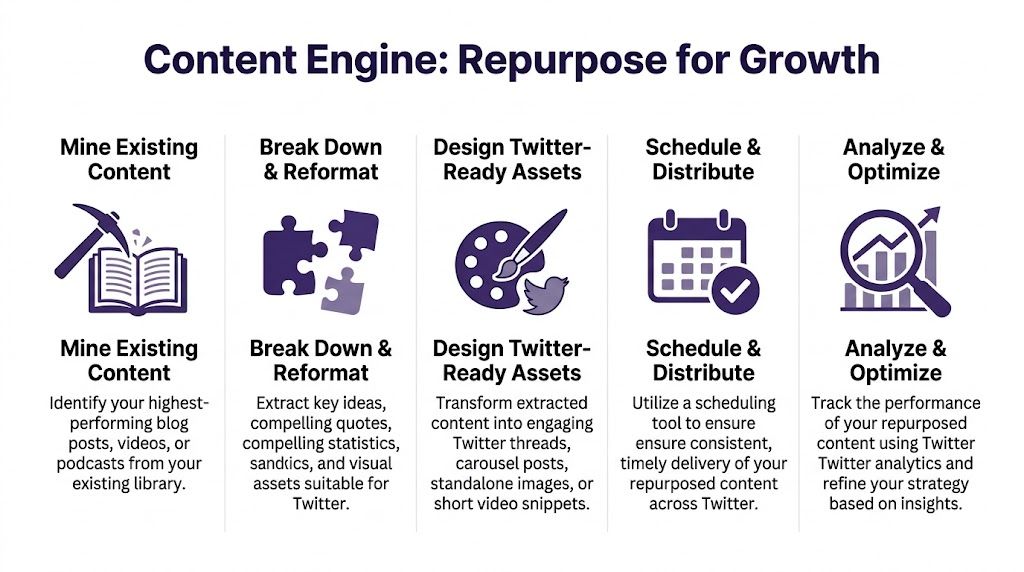
A five step workflow that actually scales
This is the workflow I’d use for a creator with a backlog.
Mine the archive for proven themes
Start with the episodes, posts, or videos that already triggered comments, shares, or long watch time on their original platform. Don’t begin with your newest material. Begin with the ideas your audience has already validated.Pull out modular assets
Look for opinionated lines, surprising lessons, clean stories, useful frameworks, and moments with emotional tension. Those become tweets. Screenshots, charts, and clips become your visual layer.Reformat for Twitter behavior
A podcast transcript is not a tweet. A paragraph from an article is not a hook. Rewrite for speed, curiosity, and scan-ability. Threads need a stronger opening than blog intros. Standalone tweets need a tighter angle than newsletter copy.Package by format, not by source
Build batches: ten single tweets, three threads, five visual posts, two clips. This approach helps most creators get faster. They stop reinventing the process every day.Schedule and review in cycles
Put the content into a weekly cadence, then review which archive-derived formats pulled the most attention and profile curiosity.
Old content usually fails on Twitter for one reason. It was republished in its original shape instead of rewritten for the feed.
What to extract from long form content
Different archive types produce different Twitter assets. That sounds obvious, but teams often miss it.
- From podcast episodes pull sharp opinions, debate-worthy questions, guest quotes, and short clips with one clear payoff.
- From YouTube videos look for visual demonstrations, before-and-after moments, walkthrough snippets, and thumbnail-worthy frames.
- From blog posts extract frameworks, mistakes, checklists, and opening lines that can stand alone without context.
- From interviews isolate disagreement. Agreement rarely spreads as well as a useful tension point.
- From research or editorial archives turn repeated patterns into threads. If the same issue shows up across years of content, that’s often a sign of durable relevance.
Short video is often the bottleneck because creators know the insight is in the footage but don’t have a clean editing workflow. If that’s your constraint, a roundup of Twitter video tools for clips and repurposing is useful when you need to turn long recordings into feed-ready assets quickly.
What works and what usually doesn’t
Some archive-based content performs well because it feels native to Twitter. Some falls flat because it still feels like it belongs somewhere else.
Usually works
- Tight threads built from a single lesson
- Clips with one idea per post
- Contrarian reframes from older material
- Visual summaries of frameworks
- Questions pulled from recurring audience pain points
Usually doesn’t
- Dumping article links with no angle
- Posting transcript chunks untouched
- Sharing clips with slow intros
- Recycling old promos
- Turning every post into a broad brand update
If you have a content library, you don’t need more ideas. You need better extraction, better packaging, and better distribution discipline.
Master Smart Engagement and Strategic Scheduling
You schedule a week of solid posts from your archive, hit publish, and nothing meaningful changes. Impressions come in, a few likes show up, then the posts disappear. The missing piece is usually not more content. It is the layer around the content: who you engage with, how you create profile curiosity, and when you show up live.

Twitter rewards accounts that feel active, relevant, and worth checking. That is why scheduling alone rarely gets follower growth to compound. People follow after repeated exposure across posts, replies, and profile visits.
For creators with a content library, this is good news. Your archive gives you an unfair advantage in conversations because you are not reacting from scratch. You can pull a sharp example from an old episode, a contrarian line from a blog post, or a lesson from a client pattern and turn a reply into a reason to click your profile.
Engagement that creates recognition
A reply should do one job well: make the right person curious enough to learn who you are.
The replies that help most tend to fit a few patterns:
- Add a missing detail that makes the original post more useful
- Share a concrete example from your own work or content archive
- Disagree with a clear point and explain why without turning the thread into theater
- Connect the post to a bigger pattern your audience keeps running into
That last one is where existing content becomes a growth engine. If you have already published interviews, podcasts, newsletters, or long-form articles, you have a stockpile of proof points. Use them. A short reply with a real example from prior work usually outperforms a clever one-liner because it signals depth.
Good replies act like previews of your best thinking.
Private Lists help here because they reduce noise and make your engagement more intentional. Segment peers, prospects, collaborators, and source accounts so your daily reply habit stays focused on people who overlap with your niche. Earlier research cited in this article noted that consistent posting, active replies, and targeted List-based engagement support profile visits and stronger reply performance. The practical takeaway is simple: engage where relevance is high, not where the crowd is loudest.
Scheduling that supports live momentum
The best scheduling system gives you coverage without making the account feel automated.
A workable rhythm usually looks like this:
| Content type | How to handle it | Why it works |
|---|---|---|
| Archive-based posts | Schedule in advance | Keeps strong ideas circulating without daily reinvention |
| Flagship posts | Publish manually when possible | Lets you stay present for early replies and quote posts |
| Clips and visuals | Batch and queue | Makes repurposed content consistent without draining time |
| Replies and follow-ups | Do live | Builds familiarity and increases profile visits |
This balance matters. If every post is scheduled and every reply is delayed, the account feels distant. If everything depends on real-time energy, consistency breaks the moment your week gets busy.
I usually treat scheduling as infrastructure and engagement as the conversion layer. The archive keeps the feed alive. Live interaction turns that activity into relationships and follows.
A short walkthrough can help if you want to tighten your posting workflow and cadence:
The other trade-off is volume versus responsiveness. Posting more can increase surface area, but only if you can support the posts with timely replies and a profile that converts curiosity. A smaller number of stronger posts, especially ones repurposed from proven source material, often does more than a packed schedule full of filler.
If you want to improve that system over time, review which post formats create conversation, profile clicks, and follow-through. A practical framework for analyzing content performance across channels makes it easier to spot what deserves to be reposted, clipped, threaded, or answered live.
Run Growth Experiments and Measure What Matters
A creator posts three times in a week from the same archive. One thread gets broad reach. One short post sends people to the profile. One clip brings in new followers. If you only look at likes, those three posts can look similar. They did very different jobs.
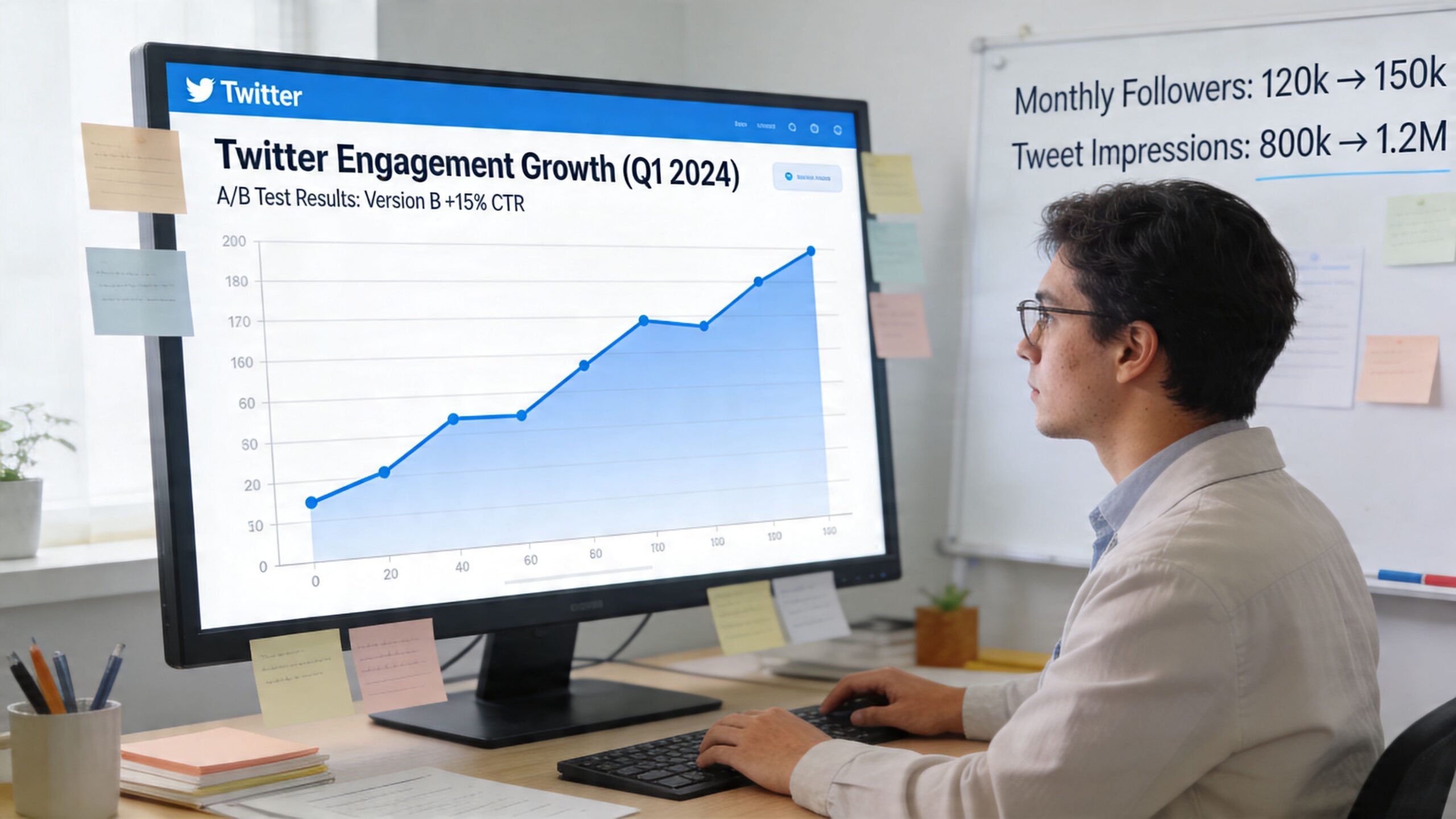
That is why growth review needs a simple operating model. Track the path from reach to curiosity to follow. Impressions show whether a post earned distribution. Engagement shows whether people reacted. Profile visits show whether the post made someone want to inspect the account. Follows show whether the account and post worked together.
Read the dashboard like an operator
Four metrics deserve regular attention:
- Impressions show whether the topic and format got reach.
- Engagement rate shows whether the post gave people a reason to respond.
- Profile visits show whether the post created enough interest to check who you are.
- Followers gained show whether that attention converted.
The useful read comes from the pattern, not a single number. A post with high impressions and weak profile visits probably reached people without giving them a reason to care about the account. A post with average reach and strong profile visits is often a better follower-growth asset, especially for niche creators building the right audience instead of chasing broad attention.
If you want a cleaner review process, use this framework for analyzing content performance across channels.
The best growth posts do more than get attention. They make the right person curious enough to check the account behind them.
Run smaller tests, not bigger guesses
Creators trying to grow on Twitter often change everything at once. Topic, hook, format, timing, tone. Then the result is impossible to learn from.
Run one-variable tests instead. Keep the core idea stable and change one input for a week.
| Test | Keep constant | Change |
|---|---|---|
| Hook test | same topic and format | direct claim vs curiosity-driven opening |
| Format test | same core idea | thread vs visual post |
| Source test | same posting cadence | recent content vs archive content |
| Angle test | same format | tutorial vs opinionated take |
This approach matters even more when you have a big content library. The goal is not just to find a good tweet. The goal is to learn which source material keeps producing strong Twitter assets. You want clear answers to questions like: do old podcast clips drive more profile visits than blog-based threads? Do contrarian takes from past interviews outperform polished educational posts? Does a short insight pulled from a long video convert better than a summary of that same video?
Those answers turn repurposing into a system.
Build a weekly review that improves the next batch
A weekly review can take 20 minutes if the checklist is tight.
Start with:
- Top posts by profile visits
- Top posts by followers gained
- Posts with strong engagement and weak conversion
- Posts with weak reach but strong ideas
Then diagnose the gap. Was the hook too generic? Did the post attract the wrong crowd? Did the format bury the payoff? Did an archive-based post outperform a fresh one because it carried more specificity, stronger proof, or a cleaner point of view?
Over time, this is how a content engine gets sharper. You stop treating each tweet as a one-off. You start identifying which parts of your archive consistently produce reach, which ones produce curiosity, and which ones bring in followers. That gives you a repeatable growth loop instead of a feed full of isolated experiments.
Your Blueprint for Sustainable Twitter Growth
Steady follower growth usually comes from a boring truth. The best accounts don’t rely on inspiration. They run a system.
That system starts with a profile that converts attention into follows. It grows through a content engine built from assets you already own. It gets stronger through focused engagement that creates recognition in the right circles. And it improves through regular experiments that show what deserves to be repeated.
For creators with a serious archive, this matters even more. You don’t need to live on the platform all day or manufacture a fresh opinion every morning. You can pull from your past work, shape it for the feed, schedule it with intent, and stay active in the conversations that match your niche.
That’s the practical answer to how increase followers on twitter without burning out. Stop treating Twitter as a daily performance treadmill. Treat it like a distribution layer for ideas you’ve already earned through your work.
The creators who win long term usually do one thing especially well. They turn old content into new relevance, then make that process repeatable.
If you want help turning your archive into a practical growth system, Contesimal is built for that job. It helps creators, publishers, and content teams organize large libraries, uncover patterns across past work, and turn buried material into usable ideas for distribution, research, and audience growth.