Yes, an interview is absolutely a primary source. Think of it as pure gold for any creator. It’s a raw, firsthand account straight from an individual, capturing their thoughts and experiences in their own words without any filter.
Understanding Why Interviews Are Primary Sources
Let's use a simple analogy. Imagine you're baking a cake. A primary source is like a fresh egg cracked right from the shell—it’s the original ingredient. A secondary source would be a pre-made cake mix that someone else put together.
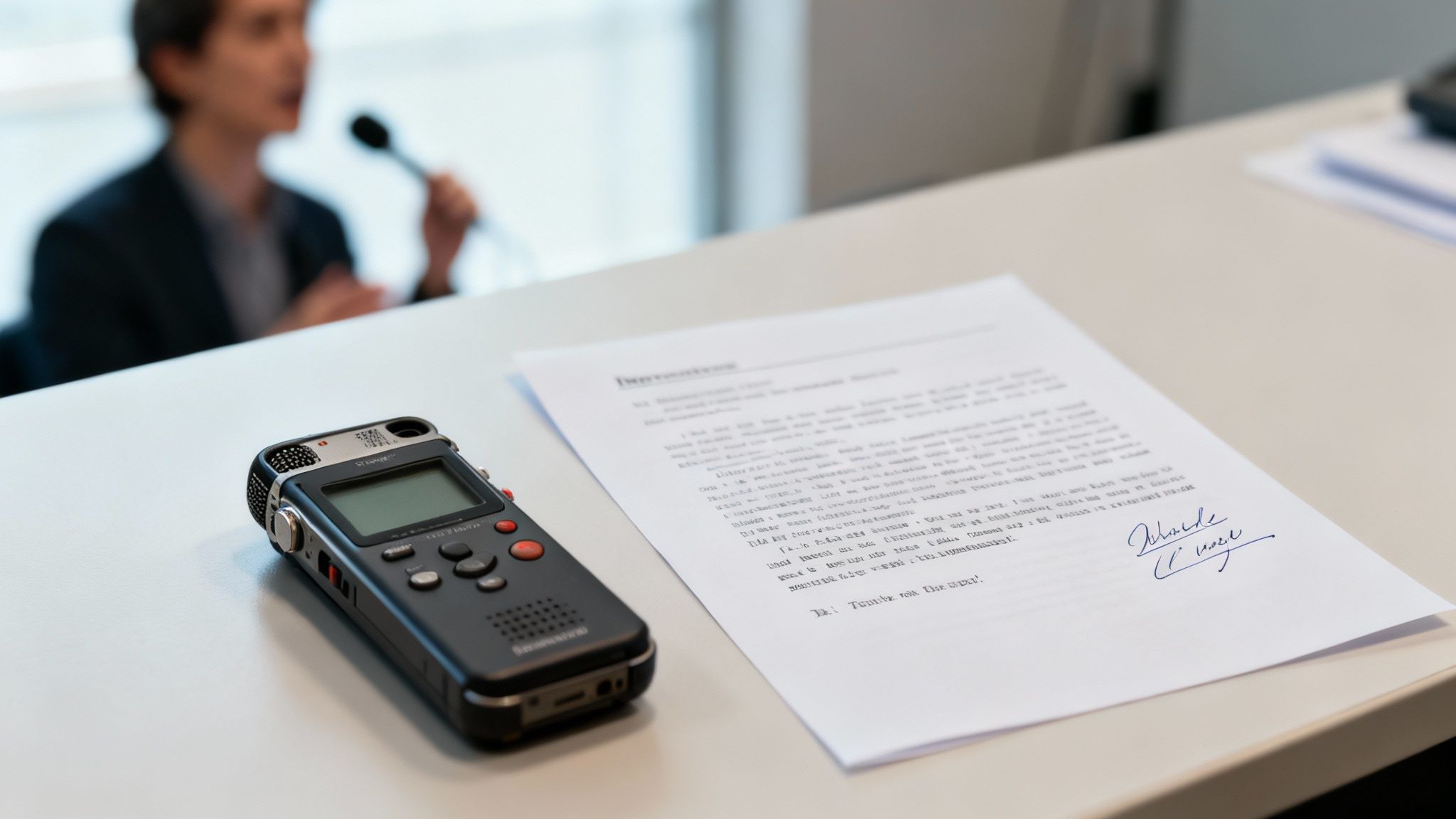
An interview, whether it's a video recording, an audio file, or a direct transcript, is that fresh egg. It’s the raw, unprocessed material straight from the source.
When you conduct or use an interview, you're tapping into information that hasn't been spun, summarized, or analyzed by anyone else. This is what gives your content a massive credibility boost. It's the difference between hearing a story directly from an eyewitness versus reading a newspaper article about what that witness supposedly said.
Distinguishing Primary from Secondary Sources
To really nail this down, let’s look at it from a creator’s perspective. A primary source is the event. A secondary source is the commentary about the event. An interview is your direct line to the heart of the story, making it a powerful tool for building trust with your audience.
This distinction isn't just academic—it's critical if you want to create original, compelling work. Relying on primary sources like interviews lets you pull out unique insights and craft narratives that your competitors, who are likely just rehashing secondary sources, completely miss.
A primary source provides direct or firsthand evidence about an event, object, person, or work of art. It is the raw material that research is built upon.
By weaving interviews into your content, you’re not just reporting on a topic; you’re bringing your audience one step closer to the real story.
Primary vs Secondary Source: A Quick Comparison
To make this crystal clear, the table below breaks down the key differences using an interview as the main example. You can see how the raw material (the interview itself) gets transformed into something entirely different once it's been interpreted.
| Characteristic | Primary Source (The Interview) | Secondary Source (Article About the Interview) |
|---|---|---|
| Origin | A direct recording or transcript of a conversation. | An analysis, summary, or interpretation of the interview. |
| Perspective | Firsthand account from the interviewee's viewpoint. | Secondhand account from the author's viewpoint. |
| Creator's Role | To gather raw, unfiltered information. | To interpret and provide context to the information. |
| Example for Content | The audio of your podcast interview. | A blog post summarizing the podcast's key takeaways. |
Seeing them side-by-side really highlights the unique power of a primary source. One is the raw evidence; the other is someone's take on that evidence. As a creator, getting your hands on the raw stuff is always the goal.
Why Primary Sources Are a Creator's Secret Weapon

Let's ditch the textbook definitions and talk about what really matters: impact. For any creator, from a YouTuber transitioning from hobbyist to professional to a content marketer managing a huge library, realizing an interview is a primary source is like finding a key to a secret garden. It unlocks a level of originality and authority that makes your work stand out.
Think of yourself as a detective at a crime scene. Primary sources are your direct clues—the fingerprints, the eyewitness accounts, the raw evidence. Secondary sources? They're the reports written by other detectives. Helpful for getting the lay of the land, sure, but they’re always one step removed from what actually happened.
When you only rely on what others have already chewed up and spit out, your content becomes an echo, not a voice.
Build Unshakeable Trust and Credibility
Using primary sources like interviews completely changes the game with your audience. It shows them you’ve actually done the homework. You're not just repeating what everyone else is saying; you're bringing them fresh, direct evidence from the people who were there. This builds a foundation of trust that's nearly impossible for competitors to copy.
When your audience sees you going straight to the source, they start to see you as a credible authority. And this isn't about sounding smart for the sake of it. It’s about delivering real value that helps them engage with the material on a deeper level.
Discover Unique Angles and Untold Stories
The internet is drowning in content that just rehashes the same five ideas. Primary sources are your lifeboat. When you conduct your own interviews or dig up archival ones, you stumble upon perspectives and tiny details that everyone else has missed.
Primary sources are vital for providing balance in the research record. Uncovering hidden and marginalized voices allows creators to tell stories that would otherwise be lost.
This is where the real storytelling magic happens. Imagine you're making a video about a historical event. Instead of quoting a textbook, you find an old interview with someone who lived through it. Their personal stories, their emotions—that’s the stuff that connects with people. No summary can ever capture that.
This approach gives you a serious competitive edge. You stop being just another voice in the conversation and start leading new ones based on completely original material. Those unique angles are what make your content stick.
The Power of Raw Material
At the end of the day, primary sources are raw ingredients for endless creativity. An interview isn't just one piece of content; it's a goldmine waiting to be excavated, ready for you to upcycle and create new value.
- For Podcasters: That one-hour interview? It can be a full episode, a dozen short clips for social media, and a "best of" compilation down the road.
- For Bloggers: The transcript can become a massive deep-dive article, a listicle of top quotes, and the fuel for several follow-up posts.
- For YouTubers: The video footage can be sliced into a main feature, a series of YouTube Shorts, and a bunch of behind-the-scenes clips.
When you treat interviews as the valuable primary sources they are, you start building a library of assets. You can return to this library again and again, finding new connections and creating new value. One conversation can be transformed into an entire ecosystem of killer content.
Putting Interviews to Work as Primary Sources
Alright, so we’ve established that an interview can be a primary source. That’s the easy part. The real magic happens when you put that idea into practice. For anyone creating content, interviews aren’t just a way to get a quick quote—they're the raw material that can power your entire strategy.
By getting good at different types of interviews, you can create truly original, compelling work that your competitors simply can't copy. Each style gives you a unique angle, from grabbing someone's immediate, gut reaction to saving a story that might otherwise be lost forever. These conversations are the building blocks of a powerful content library.
Capture Unfiltered Eyewitness Accounts
This is the most immediate, in-the-moment type of interview. Think of a journalist sticking a microphone in front of a witness at a breaking news event. Or a vlogger grabbing someone for a quick chat right after they’ve walked out of a huge industry conference.
These conversations are gold because they’re raw. They’re packed with genuine emotion, unfiltered thoughts, and the kind of sensory details that fade over time. For a content creator, this is your ticket to producing something that feels urgent, authentic, and deeply human.
Preserve Rich Oral Histories
Oral histories take things a step further. These aren’t just about what happened five minutes ago; they're interviews designed to capture and preserve personal memories, life stories, and community knowledge that might not exist anywhere else. You’re essentially documenting perspectives that mainstream history often forgets.
A podcaster, for example, could interview elders in a small town to save stories about local traditions before they disappear. A filmmaker might document the experiences of the first wave of pioneers in a particular field. This method has long been a cornerstone of historical research. Just look at the United States Holocaust Memorial Museum, which has gathered over 55,000 interviews with survivors and witnesses. That's an invaluable archive of primary sources for all future generations. You can learn more about how historical records are preserved through these methods from the Berkeley Library guide.
An oral history is more than just a story; it's a piece of living history. By conducting these interviews, you become a curator of unique human experiences, giving your audience access to knowledge they can't find anywhere else.
Generate New Insights with Expert Interviews
This is where you, the creator, get to step into a powerful role. When you sit down with a leading expert—a scientist, an artist, a top-tier CEO—you're not just reporting on existing information. You’re actively creating a new primary source that documents their most current thinking.
Imagine you interview a data scientist about an emerging AI trend. That conversation—your recording, your transcript—becomes a primary source that other people will cite down the line. It instantly positions you as a forward-thinker in your niche, someone who's generating the conversation, not just following it.
And the best part? A single interview is an incredibly flexible asset. That one chat can become the seed for a whole content ecosystem, which is the core idea behind effective content repurposing that adds value to your library. Think about it: one conversation can be spun into a full podcast episode, a dozen viral social media clips, a detailed blog post, and even a downloadable guide. You’ve just built a powerful content engine from a single, high-quality primary source.
When an Interview Can Contain Secondary Information
This is where things get tricky, a subtle but crucial distinction that trips up even seasoned researchers and creators. The interview itself—the recording, the transcript, the raw conversation you captured—is always a primary source. But the information inside that interview? That's not always firsthand.
Think of it like getting a sealed box delivered to your door. The box is a primary source; it came straight to you. But when you open it, you might find items someone else bought from a store and then packed. The container is original, but the contents have their own history.
An interview works the same way. It captures a direct conversation, making the recording or transcript a primary document. The real work is evaluating what the person actually says. In one breath, they might share a personal experience (primary information), and in the next, they might summarize a book they just read (secondary information).
Differentiating Firsthand vs. Secondhand Statements
Getting this right is all about credibility. If you accidentally present a secondhand summary as if it were a firsthand account, you risk misleading your audience.
Imagine you're interviewing a history professor about the Civil War.
- When she shares her personal opinions on teaching history, that’s primary information about her unique perspective.
- But when she starts summarizing another historian’s popular book on the topic, that part of her commentary is secondary information.
This decision tree helps visualize the flow and keeps the concepts clear.
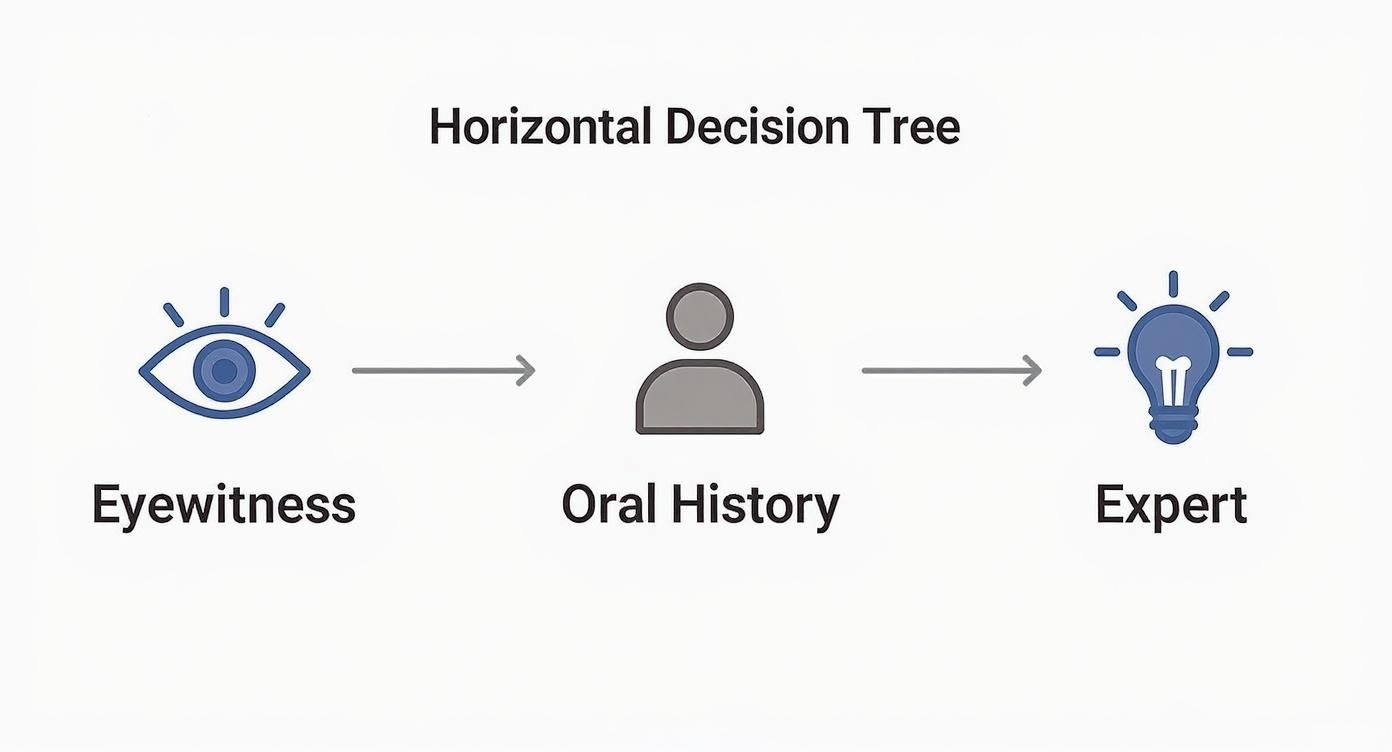
The graphic shows how different interview types—eyewitness, oral history, expert—all give you a direct line to a source. They are all valuable primary records. The key is to constantly ask yourself: Is my subject sharing their own lived experience, or are they interpreting or reporting on someone else's?
Your responsibility as a creator is to critically listen not just to who is speaking, but to what kind of information they are sharing. This practice separates amateur content from professional, authoritative work.
Understanding this nuance lets you represent the information you gather with total accuracy. You’ll know precisely when an interview is a primary source of direct evidence versus a primary source of someone’s secondary analysis. This careful distinction protects your integrity and builds a deeper trust with your audience, showing them you’re committed to getting the story right.
How to Judge the Reliability of Your Interview
So you’ve landed a great interview. Fantastic. But just because it's a primary source doesn't mean it’s flawless. Think of it like a raw diamond—it’s valuable, sure, but it needs a hard look before you put it on display.
Human memory is a funny thing. It’s messy. Biases can sneak in and color a story, and even the way you ask a question can nudge the answer.
For anyone creating content, learning to evaluate your own interviews isn’t just a good skill—it’s essential. It’s what separates casual storytelling from credible work. Being upfront about potential weak spots doesn’t undermine your content; it actually strengthens it. It shows your audience you’ve done the work and are committed to getting it right.
Your Credibility Checklist
Before you dream of hitting "publish," run your interview through a quick mental filter. The aim isn't to find a perfect source—because spoiler alert, they don't exist. The goal is to understand the context and see the potential cracks in the information you’ve gathered.
Knowing this helps you present it responsibly. Here’s what to look for:
- Potential for Bias: Does your interviewee have a personal, professional, or financial horse in this race? A CEO will talk about their product differently than an independent analyst would. You don't have to discard their perspective, but you absolutely have to acknowledge it.
- Memory and Time: How long has it been since the events they're describing? Memory isn't a recording; it degrades. An eyewitness account from yesterday will be sharper on the details than a story from 20 years ago.
- Consistency: Does the story hang together? Check their account against things they’ve said before or against established facts. Big contradictions are a red flag that means you need to dig deeper.
Corroborate, Corroborate, Corroborate
One of the most important things you can do is corroborate what your interviewee tells you. This just means you need to cross-reference their claims with other sources, both primary and secondary. If they mention a specific date, event, or statistic, your job is to find something else that backs it up.
Never treat a single interview as the absolute truth. The most reliable content is built on a foundation of multiple, verified sources that together paint a more complete and accurate picture.
This is fundamental. Even in formal academic research, where interviews are a cornerstone, they're almost never used in a vacuum. A 2019 study, for instance, noted that 78% of qualitative research projects in fields like sociology and psychology lean on interviews for data, but always as part of a broader body of evidence.
This habit of verification is the hallmark of what makes a source credible, and it will make your work stand out. When you confirm the key details, you add layers of authority and protect yourself—and your audience—from misinformation. It's the difference between being a reporter and just being a repeater.
Turning Your Interviews Into a Content Goldmine
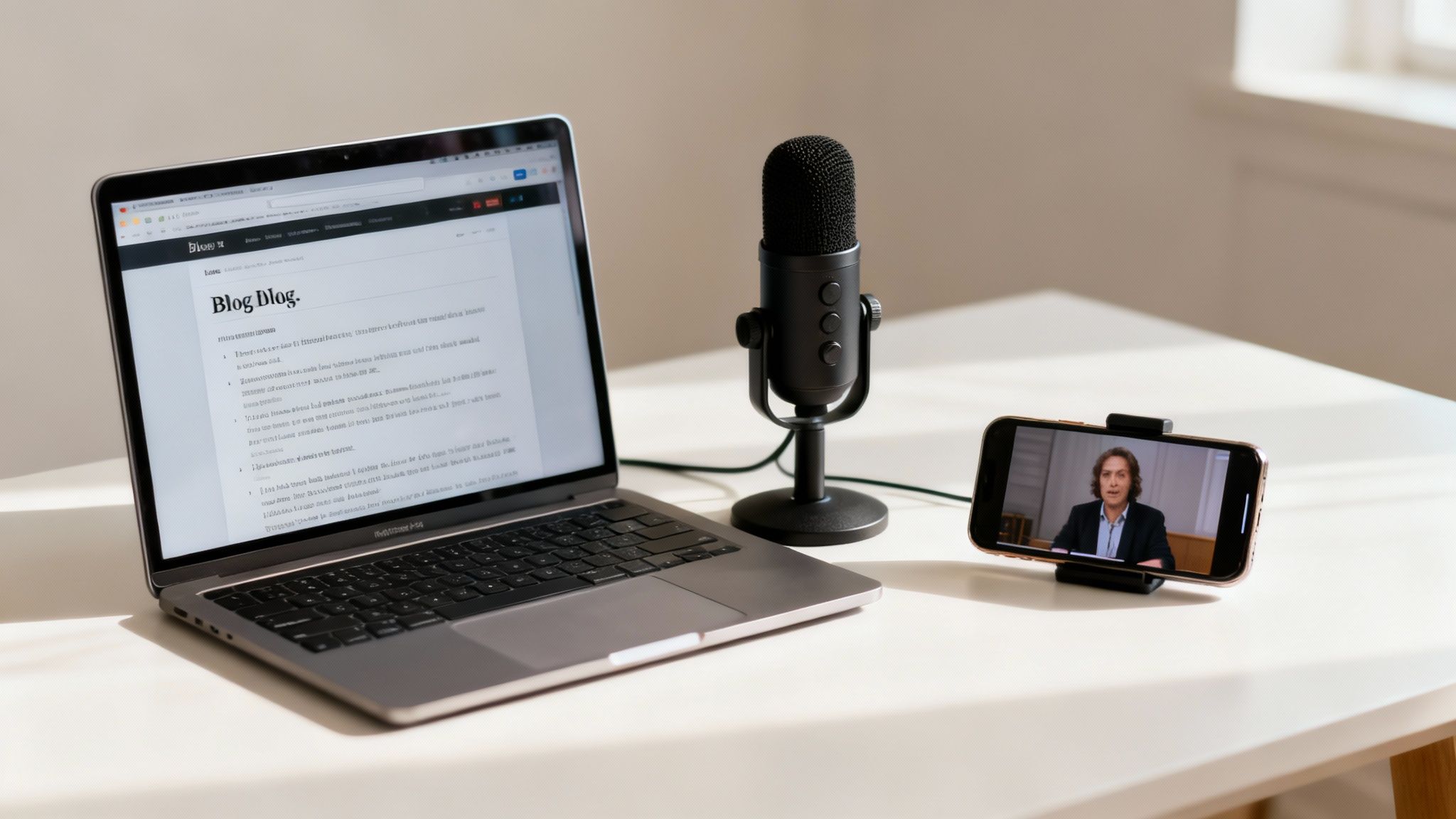
Okay, let's get down to business. Knowing that an interview is a primary source is one thing. Actually turning that raw material into a steady stream of killer content is another game entirely. This is where you reignite your content library and bring it to life. Organize. Understand. Take Action.
The whole process kicks off long before you hit the record button. You need to walk into every interview with clear content goals. Don't just show up to gather information; think like a content strategist. What specific quotes, soundbites, or stories do you absolutely need to walk away with?
This shift in mindset changes everything, especially how you frame your questions. You'll go from asking vague, open-ended questions to crafting sharp, focused ones designed to pull out those perfect, shareable moments.
From Raw Material to Repurposed Assets
The real magic happens once the interview is over. That raw recording isn't just a file—it's a goldmine, and your job is to dig out every last nugget of value. The secret is to stop thinking in terms of a single format.
A single one-hour video interview can be sliced, diced, and repurposed into an entire ecosystem of content that keeps your audience engaged across all your channels.
- Social Media: Pull the best quotes and turn them into eye-catching graphics for LinkedIn and Instagram.
- Short-Form Video: Chop up the most powerful moments into a series of punchy clips for TikTok and YouTube Shorts.
- Written Content: Get it transcribed and use that text to build a deep-dive blog post or a detailed guide.
- Audio Content: Strip the audio to create a podcast episode or promotional audiograms for social feeds.
Planning Your Content Pipeline
To pull this off without going crazy, you need a system. Start organizing your interview library not just by guest or date, but by topic, key quotes, and potential use cases. A well-organized library lets you constantly find new angles and connections, breathing new life into assets you already own.
This isn't just a theory; it's how major institutions operate. Take public health research, where interviews are an essential tool. The World Health Organization reported in 2021 that interviews accounted for 65% of primary data collection in their key studies. They don't just conduct these interviews and file them away; they meticulously organize and analyze them to generate ongoing insights.
When you see each interview as a collection of assets instead of a single piece of content, you build a sustainable and efficient workflow. This is how you escape the endless chase for the next new idea and start creating lasting value from the work you’ve already done.
This whole strategy starts with a solid foundation. You can check out our guide on how to write a great script for a YouTube video to see how that initial planning makes all the difference. When you treat your primary source interviews with this kind of strategic focus, you unlock a nearly infinite supply of content.
A Few Lingering Questions
You've probably got a few questions buzzing around. Let's tackle some of the most common ones that come up when people start using interviews in their work.
Is a Transcript of an Interview Also a Primary Source?
Absolutely. A transcript is the written twin of the original interview recording, making it a primary source through and through.
Think of it this way: the audio or video captures the raw emotion, tone, and pauses, which is incredibly powerful. The transcript, on the other hand, gives you a searchable, quotable, and easily digestible text version of that same firsthand account. Both are direct records of the event, just in different formats.
How Do I Properly Cite an Interview in My Work?
This is a big one, and getting it right is crucial for credibility. Citing an interview isn't complicated, but it does require a few key pieces of information: the name of the person you interviewed, the date it happened, your name as the interviewer, and the format (was it a personal chat, an audio recording, a video call?).
The exact layout will depend on the citation style you're following—like APA, MLA, or Chicago. Always, always double-check the specific rulebook for your required style to make sure every comma and period is in its right place.
What's the Difference Between an Interview and a Survey?
Both are fantastic ways to gather original information, making them both primary sources. But they go about it in completely different ways.
An interview is qualitative. It’s a conversation. You use open-ended questions to dive deep into someone's experiences, opinions, and stories. You get the "why" behind the "what."
A survey, on the other hand, is usually quantitative. It uses structured, often closed-ended questions (like multiple-choice or rating scales) to collect specific data points from a whole bunch of people.
In short, interviews give you rich, detailed context, while surveys give you broad, statistical insights.
Ready to transform your content library from a dusty archive into a dynamic asset? Contesimal helps you organize, search, and repurpose every interview, video, and article you've ever created. Discover hidden connections and generate endless new content today at https://contesimal.ai.