The whole semantic search vs keyword search thing boils down to a pretty simple idea: keyword search looks for exact words, while semantic search tries to understand your actual meaning.
Think of it like this: keyword search is the index at the back of a book. You look up "photosynthesis," and it points you to every page that uses that specific word. Semantic search, on the other hand, is like asking a librarian for "books about how plants make food from sunlight." The librarian gets what you mean, even if you didn't use the textbook term, and finds you the right resources.
The Evolution From Keywords to Conversations

For a long time, the content world ran on exact-match keywords. Success was all about finding the right phrases and stuffing them in. But then people started searching the way they talk, using more natural, conversational questions. The tech had to catch up.
This shift ended up creating a huge opportunity, especially for creators sitting on massive archives of videos, podcasts, and articles.
The real game-changer was Google's Hummingbird update back in September 2013. It was the first big step away from rigid keyword matching and toward understanding user intent. By adding natural language processing, Google could finally grasp synonyms and context, leading to a 20-30% jump in relevance for complex searches.
A New Way to Discover Value
This isn't just a Google story; it's about how you interact with your own content library. A simple keyword search inside your archive for "how to get more subscribers" might completely miss a killer podcast episode where you talked all about "audience growth strategies." Semantic search connects those dots.
As search behavior continues to move away from simple keywords, getting a handle on concepts like Answer Engine Optimization is becoming essential. For creators, this means your entire library of content can finally be organized and explored by ideas, not just words.
Key Takeaway: Semantic search turns your content archive from a static list of files into a dynamic, conversational knowledge base you can interact with to discover hidden connections and spark new ideas.
Once you grasp this difference, you can start unearthing forgotten gems in your own content, opening up new paths for audience growth and monetization. If you're curious about the mechanics, you might like our deeper guide on the fundamentals of an information retrieval system.
Keyword Search vs Semantic Search at a Glance
To make it crystal clear, here’s a quick breakdown of how these two approaches stack up. This table cuts through the noise and shows you the core differences at a glance.
| Attribute | Keyword Search | Semantic Search |
|---|---|---|
| Primary Goal | Finds documents containing exact words or phrases. | Understands the user's intent and the context of a query. |
| How It Works | Matches strings of text using indexes (lexical search). | Analyzes relationships between concepts using AI models. |
| Handles Synonyms | Poorly; misses content using different but related terms. | Excellently; understands "cheap" and "inexpensive" mean the same. |
| User Experience | Can be rigid and requires precise queries to work well. | Feels conversational and intuitive, like asking a person a question. |
Ultimately, keyword search is a literal-minded tool that's great for specific, known-item searches. But when you need to explore concepts and uncover insights, semantic search is in a league of its own.
How Each Search Technology Actually Works

To really get the difference between semantic search vs keyword search, you have to look under the hood. The core distinction isn't just about the results you see; it's about the fundamental machinery each system uses to process a query against your content library. They operate on entirely different principles.
Think of keyword search as a meticulous but literal-minded file clerk. It doesn’t understand ideas, only exact words. It relies on indexing and direct matching—a process that's fast and efficient for specific tasks but incredibly rigid in its thinking.
Semantic search, on the other hand, is more like a seasoned librarian or research expert. It goes beyond the words themselves to grasp the web of concepts they represent. This allows it to find connections that a simple word match would completely miss, which is where the real power for content discovery lies.
The Mechanics of Keyword Search
At its core, keyword search runs on something called an inverted index. Imagine making a master list of every single word in your entire content library—every article, transcript, and description. Next to each word, you list every single document where that word shows up.
When you type in a query, the system doesn't actually read through all your content. It just looks up your keywords in this massive index and instantly pulls the corresponding list of documents. Simple.
To rank these documents, it often uses a scoring system like TF-IDF (Term Frequency-Inverse Document Frequency). This algorithm gives more weight to documents where your keyword appears often (Term Frequency) but is also fairly rare across the entire library (Inverse Document Frequency).
Here’s a quick breakdown of how it works:
- Indexing: The system scans all your content and builds that inverted index, mapping specific words to their locations.
- Querying: A user enters a search term, like "YouTube monetization."
- Matching: The system finds every single document listed under "YouTube" and "monetization" in its index.
- Ranking: It then uses metrics like TF-IDF to score and order the results based on how frequently those exact words appear.
This method is lightning-fast for exact phrases. But it completely falls apart if a creator discussed "making money on YouTube" without ever using the word "monetization." To a keyword search engine, those are entirely different topics. If you want to go deeper on this, you can explore the principles of full-text search in our detailed guide.
Analogy: Keyword search is a dictionary lookup. You search for a specific word and get a precise, literal definition. It can't interpret nuance or tell you about related concepts that aren't spelled out on the same page.
The Intelligence of Semantic Search
Semantic search operates on a completely different level, using AI to understand language in context. Instead of just indexing words, it captures the meaning behind them using two powerful technologies: vector embeddings and knowledge graphs.
A knowledge graph is like a mind map of your content, connecting concepts and their relationships. It understands that "podcasting," "audio content," and "spoken-word media" are all related, and it knows that Joe Rogan and Tim Ferriss are both figures within that world.
Vector embeddings are where the real magic happens. An AI model reads your content and converts words, sentences, or even entire documents into a series of numbers called a vector. These vectors represent the content's position in a vast "meaning space."
Here’s the process:
- Embedding: An AI model processes your content (text, audio, video) and converts it into numerical vectors. Concepts with similar meanings are placed close together in this multidimensional space.
- Querying: Your search query—say, "how to build an audience"—is also converted into a vector.
- Similarity Search: The system then searches for content vectors that are closest to your query vector. It's not matching words; it's matching conceptual proximity.
This is exactly why you can find a video clip about "growing your subscriber base" even if the speaker never actually said the word "audience." The AI understands that the concepts are nearly identical. When put to the test, this approach delivers dramatically better results. A 2022 study on a corpus of 1 million documents found that semantic search achieved 92% recall compared to keyword's 68% for queries with synonyms, showing just how much better it is at capturing context. To see the full results, you can read more about the semantic search benchmark study.
How This All Shakes Out for Content Creators
It's one thing to talk about the tech behind semantic and keyword search, but what really matters is how it impacts your actual workflow. If you're a YouTuber, podcaster, blogger, or publisher, this shift from literal words to genuine meaning changes the entire game. It affects how you find old gems, come up with new ideas, and ultimately, upcycle your content library.
A classic keyword search is like working with one hand tied behind your back. It can only find what you explicitly tell it to, using the exact words you type in. This single limitation is why so many creators have a massive "content graveyard"—a huge archive of amazing videos, audio files, and articles that are basically lost forever. The real value is buried in the ideas discussed, not in a specific keyword someone happened to say.
Escaping the Content Graveyard
Let's say you're a YouTuber planning a compilation video on the best "growth hacking" tips from your past interviews. If you search your library for "growth hacking," you'll only get clips where someone said that exact phrase. You’ll completely miss the dozens of other times your guests dropped pure gold using slightly different language.
This is where the difference hits home:
- Keyword Search Misses: A guest who talked about "clever user acquisition tactics" or "low-cost marketing strategies to scale quickly."
- Semantic Search Finds: It gets that all these phrases point to the same concept as "growth hacking." It pulls up every single relevant clip, no matter the exact words used.
Suddenly, you can dig up forgotten moments and build far richer, more complete content from assets you already own. You stop leaving money and ideas on the table.
Key Insight: Keyword search makes you the librarian—you have to remember exactly what was said. Semantic search lets you ask your content library questions based on ideas, unlocking a much deeper layer of your own work.
Sparking New Ideas from Old Content
Semantic search isn't just about finding stuff; it's an engine for creativity. For podcasters, this means you can stop searching for a guest's name or a specific topic and start asking your archive more interesting, open-ended questions.
Picture this: you host a podcast on entrepreneurship. With a semantic-powered tool, you could ask your entire library of transcripts: "What are the most common fears new founders mentioned?"
A keyword search would be totally useless here. But a semantic system can scan every conversation, recognize recurring themes of fear, doubt, and uncertainty, and hand you a list of clips where those ideas pop up. Just like that, you have the raw material for a powerful new episode, a viral social clip, or a blog post—all sourced from the collective wisdom already sitting in your files.
Modernizing Your SEO and Discovery Strategy
The way people find content on Google and YouTube has already gone semantic. Users ask complex questions, and the platforms deliver answers that understand the context. If you want to keep up, your internal content process has to do the same.
Creators now need to adapt, which often means learning how to use AI for SEO to stay competitive. When you start organizing and searching your own content semantically, you begin to think like the very search engines that bring you new audiences. This alignment helps you spot content gaps, find popular sub-topics you didn't even know you covered, and create new material that directly answers the questions your audience is asking.
For professional creators and publishers managing a large library, this isn't just a nice-to-have. It’s a strategic necessity. It’s the difference between having a static, decaying archive and a living, intelligent asset that fuels your growth. Tools like Contesimal are built for this exact job, turning your library into a partner that helps you breathe new life into old work and generate fresh value.
Choosing Your Search Strategy for Different Goals
So, when it comes to semantic search vs keyword search, it's not about picking one and ditching the other forever. Think of it like a toolbox. You wouldn't use a sledgehammer to hang a picture frame, right? It's about grabbing the right tool for the job.
As a creator or publisher, knowing when to demand precision versus when to go exploring for concepts is what separates a good workflow from a great one. Adopting this hybrid mindset lets you be both a meticulous archivist digging for specifics and a creative explorer discovering new angles.
When to Stick with Keyword Search
Even with all the buzz around AI, the classic keyword search is far from obsolete. Its power is in its blunt, literal precision. It shines when you need to find a specific, known item and there’s absolutely no room for interpretation.
You’ll want to stick with keyword search for tasks like:
- Locating Exact Quotes: You remember a podcast guest saying, "audience engagement is everything," and you need that exact clip. A keyword search for the full phrase will nail it in seconds.
- Finding Specific Product Mentions: Let's say you're a YouTuber who reviews gear. Searching your archive for the exact model name like "Sony a7 IV" guarantees you only pull up clips where you talked about that specific camera.
- Verifying Factual Details: Need to double-check if you mentioned a certain statistic or a person's name in a past article? Keyword search gives you a quick, clean "yes" or "no."
This decision tree breaks it down simply: use semantic search when you need context, and keyword search when you need precision.
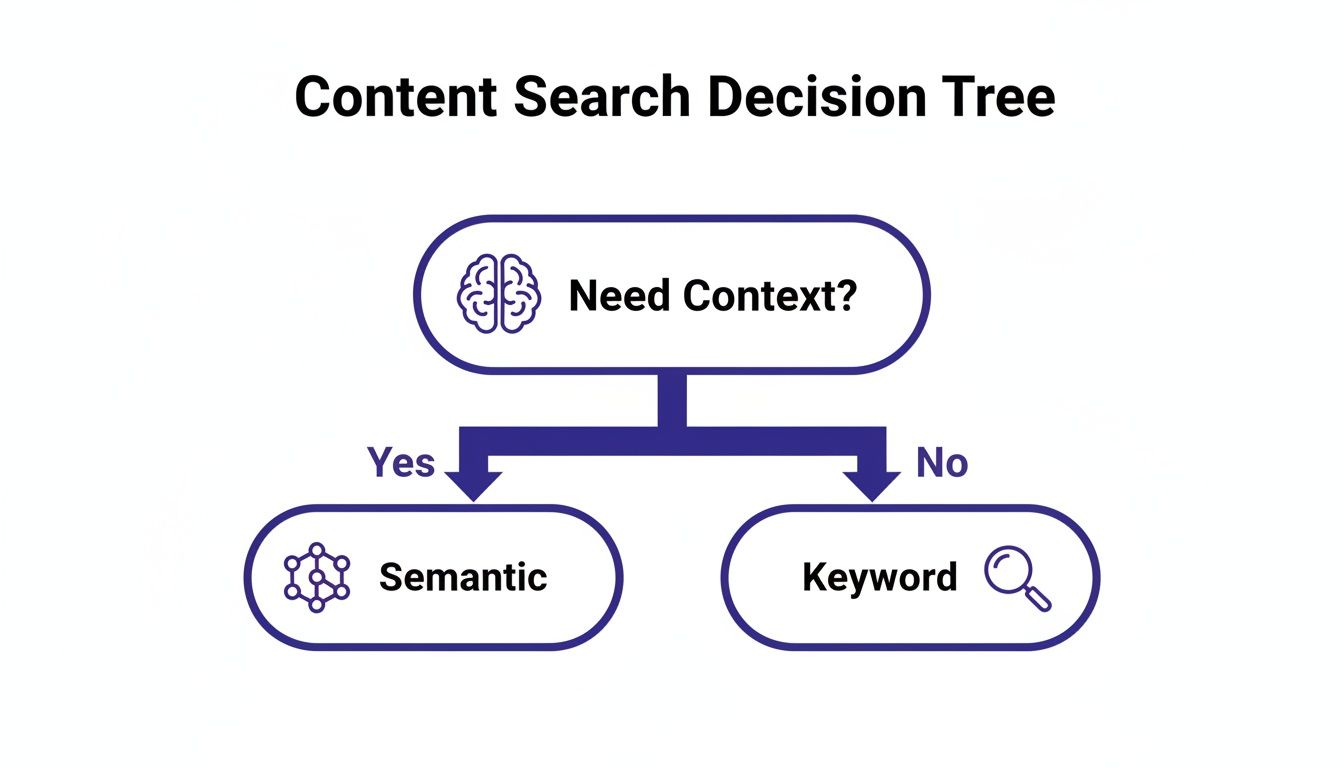
The big idea here is that your goal—whether it's about context or precision—should always dictate your choice of tool.
When to Embrace Semantic Search
Semantic search is your engine for discovery, creativity, and turning old content into new opportunities. It's what you use when you aren't just trying to find something, but to understand the web of connections running through your entire content library. This is where the magic of repurposing happens.
Lean on semantic search for goals like these:
- Brainstorming New Content Angles: You can ask your entire archive, "What are the common struggles my audience faces with content monetization?" and it will surface themes from dozens of videos, podcasts, and articles you'd forgotten about.
- Uncovering Thematic Connections: Imagine finding out that three different podcast guests, months apart, all talked about the importance of "authenticity" but used totally different words. That's a powerful compilation episode waiting to happen.
- Repurposing Archived Material: You can find every single time you discussed "building a personal brand"—even if you called it "creator identity" or "online reputation"—to create a massive, comprehensive new guide.
The shift toward semantic is happening fast. Its adoption is expected to hit 75% in enterprise systems by 2025, especially as AI costs have plummeted by 90% since 2020. A 2024 survey of 500 firms found that semantic search led to 55% higher user satisfaction on tricky queries because it handles paraphrasing, something keyword search fails at 70% of the time. You can explore the full findings on why semantic search is winning to see the data for yourself.
Key Takeaway: Keyword search is for finding what you know you have. Semantic search is for discovering what you didn't know you had.
Ultimately, any serious content operation today needs both. A modern tool like Contesimal is built on this hybrid power, giving you the ability to organize your library for both surgical, precise lookups and deep, creative explorations.
Unlocking Your Content Library with a Semantic Approach

Knowing the difference between semantic search vs keyword search is a great start, but the real magic happens when you put it into practice. For content creators, publishers, and marketers, this is your cue to stop thinking of your content as simple files in storage and start building a smart, conversational knowledge base. It’s time to stop letting your best work collect digital dust and start having an intelligent dialogue with your own archives.
Making this shift requires a deliberate change in how you organize everything, from research to your next big idea. It’s about turning a static library of videos, podcasts, and articles into a dynamic partner that helps you create your next standout piece. This jump from a passive archive to an active creative sidekick is how you reignite audience engagement and squeeze fresh value out of the work you've already done.
Re-Evaluating Your Content Organization
First things first: stop thinking about your content in terms of folders and file names. A semantic mindset organizes assets around concepts, themes, and ideas—not just keywords. This new layer of organization lets you see the whole forest, not just a bunch of individual trees.
To get the ball rolling, try these first steps:
- Audit for Themes, Not Keywords: Instead of listing which videos mention "SEO," start mapping out broader concepts like "audience building strategies" or "monetization tactics." Group content that tackles similar ideas, even if the phrasing is completely different.
- Embrace Transcripts and Metadata: If you create video or audio, accurate transcripts are non-negotiable. They’re the raw material semantic systems need to understand the spoken word. Just as important is rich metadata that describes the context of a piece.
- Think Like Your Audience: Organize your content around the problems you solve for your viewers or listeners. Create conceptual buckets like "Beginner Podcasting Mistakes" or "Advanced YouTube Analytics"—these are way more useful for discovery than folders sorted by date.
This groundwork prepares your library for a system that can understand it on a much deeper level. You're basically teaching it the language of your expertise.
The goal is to build a content library that thinks the way you do—connecting related ideas fluidly. When your archive is organized by meaning, it becomes an extension of your own creative brain, ready to surface the right insight at the right moment.
Transforming Your Research Workflow
Once your library is conceptually organized, your research process graduates from tedious manual searches to dynamic, conversational discovery. This is where you really start to unlock the power of your back catalog to fuel future creativity. Instead of asking, "Where did I mention 'brand deals'?", you can start asking much more interesting questions.
For example, a podcaster could ask their entire archive something like, "Summarize the top three pieces of advice my guests have given about negotiating sponsorships." A keyword search would come up empty, but a semantic system can pull together information from dozens of episodes to give you a concise, actionable answer.
This workflow has a direct impact on your creative output:
- Idea Generation: Query your library for recurring themes or unanswered questions. You might discover a topic you’ve touched on multiple times but never dedicated a full piece of content to.
- Content Repurposing: Instantly find every clip, quote, and article related to a single concept to create comprehensive guides, compilation videos, or "best of" podcast episodes.
- Fact-Checking and Consistency: Quickly verify what you've said about a certain topic in the past. This makes sure your new content is consistent and builds on your existing knowledge.
Platforms like Contesimal are built specifically for this transition. Contesimal ingests your entire content library—videos, podcasts, articles—and automatically builds a searchable semantic knowledge base. It handles the heavy lifting of indexing concepts and relationships, so you and your team can collaborate directly with your content as if it were a research assistant. If you manage a large volume of assets, understanding the nuances of enterprise search systems can shed even more light on the power of this approach.
Got Questions? We’ve Got Answers.
When you start digging into the differences between keyword and semantic search, a few questions always pop up. It's a shift in thinking, especially for creators trying to get more from their content library. Let’s tackle some of the common ones head-on.
Is Keyword Search Totally Dead for SEO?
Not at all, but its job has definitely changed. Think of keywords as signposts, not the destination. They still give search engines a basic clue about your content's topic.
But the real game is semantic. Instead of stuffing one exact-match keyword everywhere, the winning strategy is to own a topic completely. Cover it from all angles, answer the common questions, and explore the related sub-topics. Google thinks semantically, so your content needs to as well. Keywords are the starting point, not the finish line.
Can I Just Build a Semantic Search for My Own Content?
Honestly, building a serious semantic search system from the ground up is a massive undertaking. It demands deep expertise in AI, machine learning, and some pretty heavy data engineering. For most creators, bloggers, and even decent-sized publishing teams, it’s just not practical to build and maintain in-house.
That’s exactly why platforms built for this exist. They handle all the mind-numbing technical stuff behind the scenes. You can bring your content library to the party and get straight to the good part—using powerful search and discovery tools without writing a line of code.
The Big Idea: A dedicated platform makes semantic search accessible. It hands creators the kind of powerful discovery tools that used to require an enterprise-level engineering team, letting you focus on what you actually do best: making great content.
How Does This Help Me Come Up with New Content Ideas?
This is where things get really interesting. Semantic search is an idea machine because it finds patterns and connections your brain might miss. It lets you ask your own archive questions a keyword search could never dream of answering.
Imagine asking your library, "What are the biggest struggles my podcast guests mentioned about growing on YouTube?" A keyword search would fail because everyone uses different phrases. But a semantic system understands the meaning behind their words. It can sift through dozens of conversations, pinpoint those recurring pain points, and even show you the exact moments they were discussed. Suddenly, you have a list of proven, data-backed ideas for your next piece of content, sourced from the wisdom you already created.
Ready to stop guessing and start having a real conversation with your content library? Contesimal is the AI-powered platform built to help you organize your assets, uncover hidden insights, and create new value from your existing work. Explore how Contesimal can reignite your content today.