
You already have more content ideas than you think.
If you've been publishing for a while, the problem usually isn't a total lack of topics. It's that your ideas are scattered across old videos, half-forgotten blog posts, podcast transcripts, comment threads, email replies, and notes you meant to organize later. Then you sit down to plan next month's content and it feels like you're starting from zero.
That's the trap. Professional creators don't rely on inspiration alone. They build a repeatable system for finding content ideas from signals that already exist, then they prioritize the ideas most likely to create value, attract attention, and support revenue goals. If you're trying to grow from “I post when I can” into a real content business, that system matters as much as your creative skill.
The strongest approach starts close to home. Your archive shows what has already earned attention. Your audience tells you what they still need. Search behavior reveals broader demand. Structured brainstorming turns raw signals into usable angles. Prioritization keeps you from drowning in your own backlog.
Mine Your Own Gold in Your Content Archive
A lot of creators make the same mistake. They treat their archive like storage instead of infrastructure.
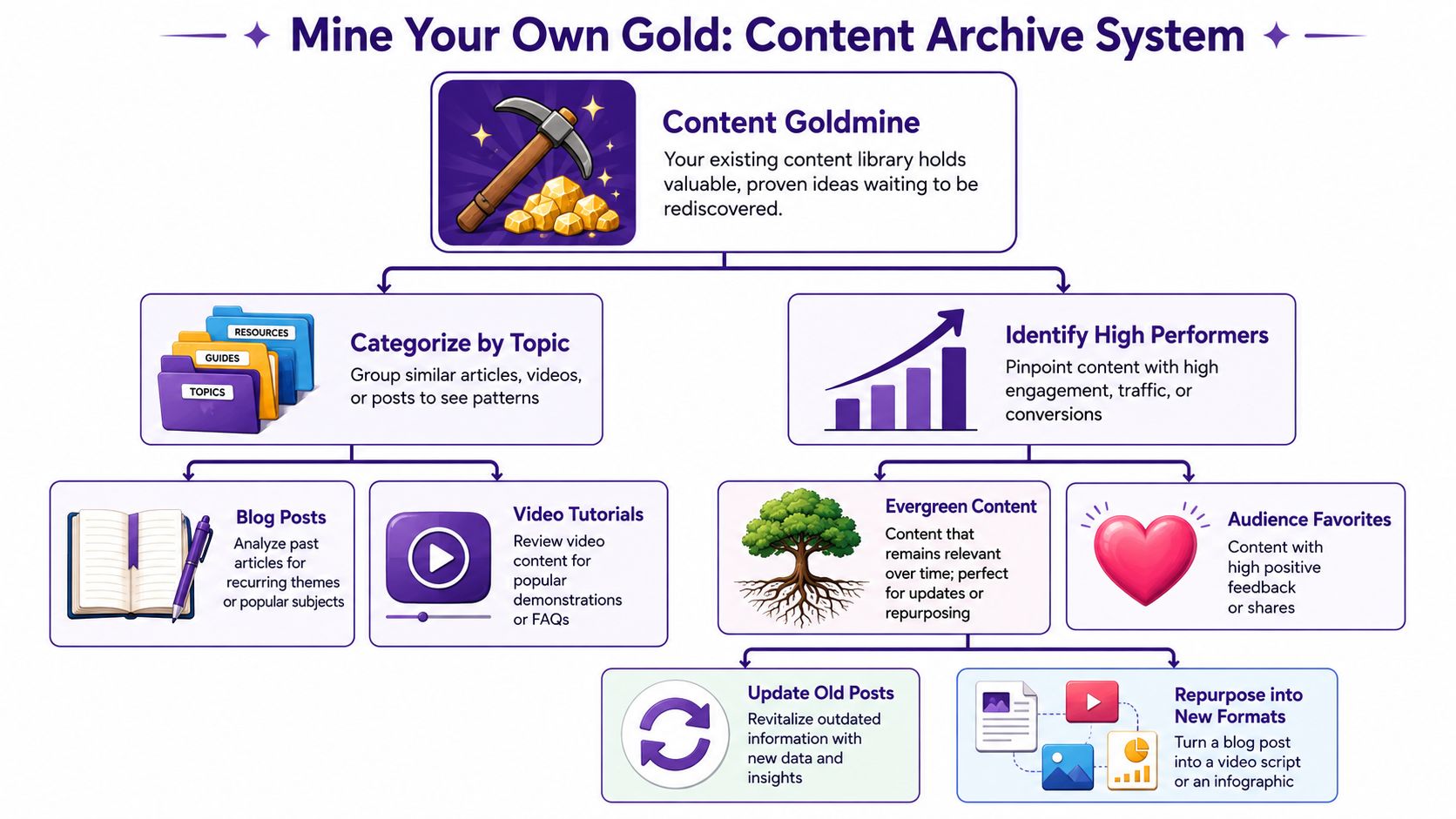
That old podcast episode, tutorial, newsletter, or essay isn't just past work. It's evidence. It tells you what topics held attention, what formats landed, what themes keep resurfacing, and where your audience wanted more than you gave them. One of the most overlooked ways to learn how to find content ideas is to study your own library first.
A major underserved angle in content ideation is using first-party signals from your own archive, support logs, DMs, comments, newsletters, and performance data as a systematic workflow rather than a throwaway tip, as noted in this discussion of underused idea sources.
Start with the assets that already proved demand
Pull together your content from every serious channel you own. Blog posts. YouTube videos. Podcast episodes. Email newsletters. Webinars. Downloadables. If you've never done a formal audit, a simple content inventory template for organizing existing assets helps turn a messy library into something you can inspect.
Then sort your archive in two ways at once:
| View | What to look for | What it gives you |
|---|---|---|
| Topic view | recurring subjects, themes, series, categories | content buckets you can keep building |
| Performance view | high engagement, strong traffic, conversions, saves, replies | evidence of what your market already values |
Many creators often stop too early. They identify a “top post” and assume the lesson is just “make more like that.” Usually the better question is: what exactly made that asset work?
Deconstruct the win, not just the topic
A strong post or episode rarely succeeds for only one reason. It might have worked because it solved a painful beginner problem, used a concrete format, addressed a controversial misconception, or hit a timely shift in your niche.
Review your high performers and break them into parts:
- Topic layer. What core subject did it cover?
- Audience layer. Who was it for? Beginner, advanced, buyer, fan, peer?
- Format layer. Tutorial, teardown, checklist, reaction, case analysis?
- Trigger layer. Curiosity, urgency, relief, ambition, identity?
- Follow-up layer. What question naturally comes next?
Practical rule: Don't copy your best old piece. Extract the pattern behind it.
That pattern is the asset. If one video about pricing for freelancers worked, the next ideas might not be “pricing again.” They might be “how to explain your rates,” “when to raise prices,” “pricing mistakes that scare off buyers,” or “a behind-the-scenes negotiation breakdown.”
Mine the audience trail around every asset
Your best ideas often live in the reactions around the content, not the content itself.
Check the comments on popular pieces. Read email replies. Review customer support tickets if you sell anything. Search DMs for repeated questions. Look at community chats and webinar Q&A logs. These are the closest thing to pre-validated idea demand you can get.
Look for signals like these:
- Repeated confusion means you need an explainer.
- Detailed objections often become myth-busting content.
- Smart follow-up questions can become your next series.
- Success stories hint at use cases worth unpacking.
- Same question across platforms suggests a durable theme, not a one-off request.
Creators who professionalize stop asking, “What should I make?” and start asking, “What has my archive already proved, and what unfinished conversation is sitting around it?”
That shift saves time. It also makes your future content more commercially useful, because it's rooted in topics your audience has already shown they'll spend attention on.
Let Your Audience Be Your Content Compass
Your archive tells you where you've been useful. Your audience tells you where the need is live right now.
That distinction matters. If you only work from historical performance, you can drift into repeating yourself. If you listen actively, you catch changing questions, new objections, and shifts in language before your content starts sounding stale.
Audience and owned-data analysis is powerful because it uncovers content gaps through real behavior. Social media use was already massive, with about one-third of the global population using social networks as of 2020, and content competition has intensified as the average blog post reached 1,427 words, which is more than 70% longer than a decade ago, according to this overview of audience-driven ideation. The takeaway isn't “post more.” It's “choose better.”
Ask in ways that produce usable answers
Most creators ask their audience weak questions and get weak inputs back.
“Any content requests?” usually produces vague replies. Better prompts create better raw material. Use prompts that force specificity:
- Problem-first prompts
“What are you stuck on right now in editing, publishing, pitching, or growing?” - Decision prompts
“What are you trying to choose between?” - Obstacle prompts
“What part of this process takes too long or feels confusing?” - Follow-up prompts
“What did you try already that didn't work?”
Use these in email, Instagram Stories, YouTube Community posts, LinkedIn polls, Discord channels, or private groups. The channel matters less than the quality of the prompt.
Read for language, not just topics
A good audience analysis session isn't just collecting subjects. It's capturing wording.
When someone says, “I can write the script but I freeze when it's time to title the video,” that phrase is more valuable than a broad label like “title optimization.” Real audience phrasing gives you stronger hooks, tighter headlines, and content that sounds like it came from inside the problem.
A simple workflow helps:
- Collect responses from comments, DMs, replies, polls, and support conversations.
- Tag them by theme such as strategy, tools, workflow, monetization, or platform-specific issues.
- Mark urgency based on emotional intensity or repetition.
- Group by audience level so beginner and advanced requests don't get mixed together.
- Turn each cluster into formats like tutorial, Q&A, checklist, teardown, or opinion piece.
If you need a cleaner way to review what's resonating before you choose what to make next, this guide to analyzing content performance across channels is a useful companion.
The audience rarely hands you a finished headline. They give you friction, stakes, and language. Your job is to shape that into content.
Watch your owned spaces more closely than public trends
Public platforms are noisy. Your owned channels are sharper.
Email replies, webinar questions, membership communities, and customer conversations are especially valuable because people tend to be more candid there. They'll tell you what they don't understand, what they've tried, and what outcome they want. That's far better than guessing from broad engagement patterns alone.
When you let your audience act as your compass, content planning stops feeling abstract. You're no longer brainstorming in a vacuum. You're responding to a visible need in words your audience already uses.
Decode the Digital Demand Signal with Search
Public search data gives you a different kind of signal. It's broader, less personal, and highly useful when you know how to read it.
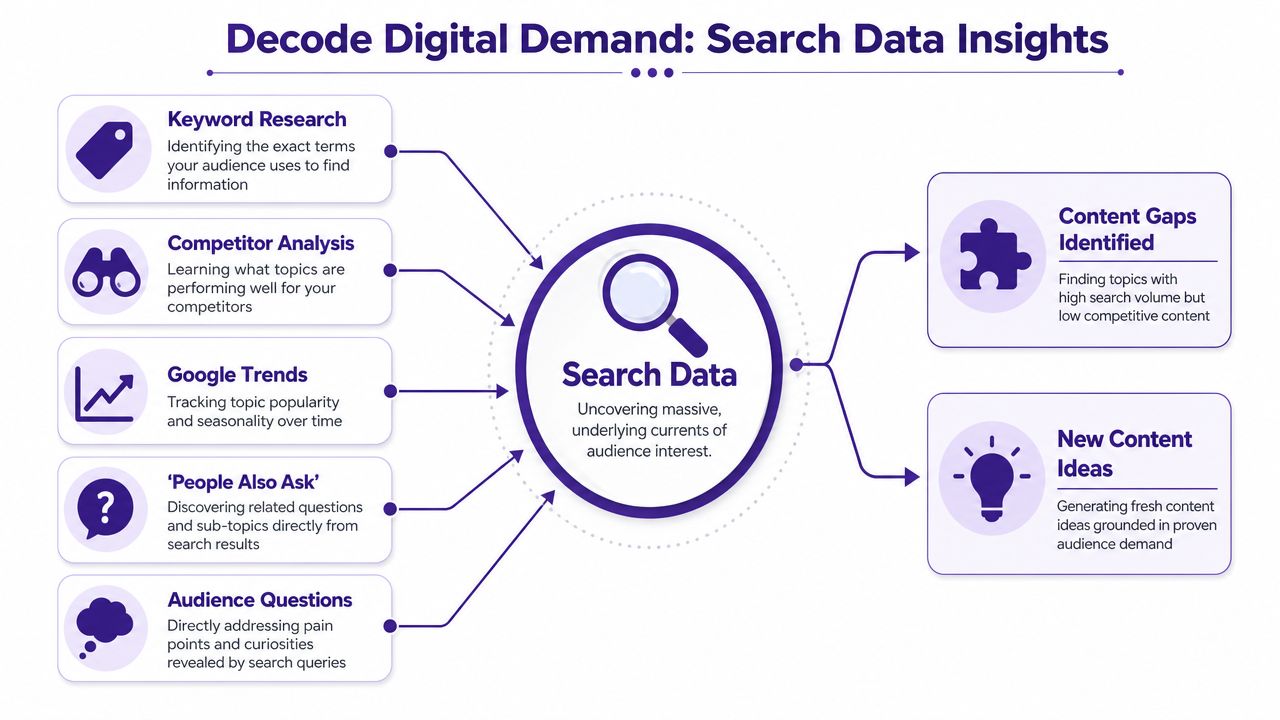
Google processes more than 8.5 billion searches per day, which is why search behavior is such a strong source of content demand, and Google Trends can help compare topics, spot rising interest, and surface related queries before they become saturated. For creators trying to learn how to find content ideas consistently, that matters because search turns ideation from guesswork into observation.
Use search to map intent, not just keywords
A lot of people do keyword research badly. They chase isolated terms and miss the underlying demand structure.
If you search a core topic and study autocomplete, related searches, and People Also Ask, you'll usually find an ecosystem of needs around it. That's more useful than a single keyword because it shows what stage the audience is in and what kind of content they need next.
For example, one broad topic can break into very different intents:
| Search pattern | Likely intent | Best content format |
|---|---|---|
| what is | basic understanding | beginner explainer |
| how to | practical execution | tutorial or walkthrough |
| best | comparison or selection | ranked list or buyer guide |
| vs | decision support | side-by-side comparison |
| why does | diagnosis | troubleshooting content |
That's how search becomes a planning tool. You're not just collecting phrases. You're identifying what kind of asset to build.
Use Google Trends for timing and angle
Google Trends is especially useful when you're deciding between adjacent ideas. Compare topics. Filter by geography. Check related queries. Look for rising interest, then ask whether your expertise matches the moment.
This is also a smart place to pair search behavior with format analysis. If you publish short-form video, it helps to study viral video patterns in your niche alongside search trends so you're not only chasing what people ask, but also noticing how high-performing creators package similar demand.
Search data is strongest when you combine it with audience context. A trend without fit is noise. A trend with fit becomes a timely asset.
Build clusters instead of one-off posts
The best use of search isn't producing a random pile of SEO articles. It's building a connected set of assets around a durable theme.
Start with one pillar question. Then gather the supporting queries around it. Those become subtopics, FAQs, examples, and platform variants. One search-driven idea can become a blog post, a podcast segment, a YouTube tutorial, several shorts, and an email sequence if the underlying intent is broad enough.
If search is part of your growth model, it also helps to review search engine optimization practices for content planning and structure so your ideas are discoverable after you publish them.
Search won't replace editorial judgment. It sharpens it. The point isn't to let Google dictate your voice. The point is to notice where visible demand already exists and meet it with something more useful than what's already out there.
Use Brainstorming Frameworks That Actually Work
Raw signals don't automatically turn into publishable ideas. You still need a mechanism that converts inputs into volume.
That's where most creators get tripped up. They collect notes, save screenshots, highlight comments, and open twenty tabs. Then they sit down to brainstorm and start judging every idea before it's fully formed. The result is a thin list of “maybe” topics and a lot of frustration.
A more practical workflow is to use content buckets and force idea volume first. One proven approach is to create buckets, then generate 15–20 ideas per bucket in a timed 60-minute session without editing, while also reverse-engineering high-performing posts by copying structure, format, and emotional trigger rather than wording, as described in this content ideation workflow.

Framework one with content buckets and a timer
Start by defining a small number of recurring buckets. For a creator business, those might be strategy, production, distribution, monetization, and case breakdowns. For a publisher, they might be reporting, commentary, explainers, interviews, and archives.
Then set a timer and generate ideas fast. No editing. No ranking. No “that's probably dumb.” Speed matters because your internal editor is usually the bottleneck.
Try prompts like these inside each bucket:
- Angle shift
What would this topic look like for beginners, advanced users, teams, or solo creators? - Format shift
Could this become a checklist, teardown, myth-buster, template, opinion, or live Q&A? - Outcome shift
What result does the audience want from this topic? - Mistake shift
What do people get wrong here over and over?
Framework two with pattern borrowing
Studying competitors is useful. Copying them isn't.
When a post, video, or episode performs well in your niche, don't steal the headline or the script. Study the construction. Was it a strong contrarian claim? A step-by-step teardown? A before-and-after transformation? A plain-language beginner guide? An emotional “stop wasting time this way” angle?
Write down the pattern in abstract terms:
| What you observe | What you keep | What you change |
|---|---|---|
| high-performing tutorial | structure and pacing | your examples, voice, and insight |
| strong comparison post | decision framework | your criteria and recommendations |
| emotionally charged hook | trigger and tension | your argument and evidence |
This method works especially well when paired with AI as a drafting partner rather than an idea replacement. If you're comparing options, this roundup of top AI content generation platforms is useful for seeing what kinds of tools support ideation, outlining, and iteration.
Framework three with constraint-based ideation
Some of the best ideas appear when you narrow the field.
Use constraints like:
- make the topic platform-specific
- make it only for one audience segment
- make it answer one expensive mistake
- make it usable in under ten minutes
- make it the opposite of common advice
Good brainstorming rarely feels magical. It feels structured, slightly messy, and productive.
If you want a professional content engine, stop waiting for perfect ideas to appear fully formed. Build conditions that make ideas easier to generate on command.
Turn Your Ideas into Action with Prioritization
An idea list can become another form of procrastination.
Smart creators separate themselves from busy creators not by merely generating more possibilities, but by choosing what earns production time. If you don't prioritize, your backlog becomes a museum of unfinished ambition.
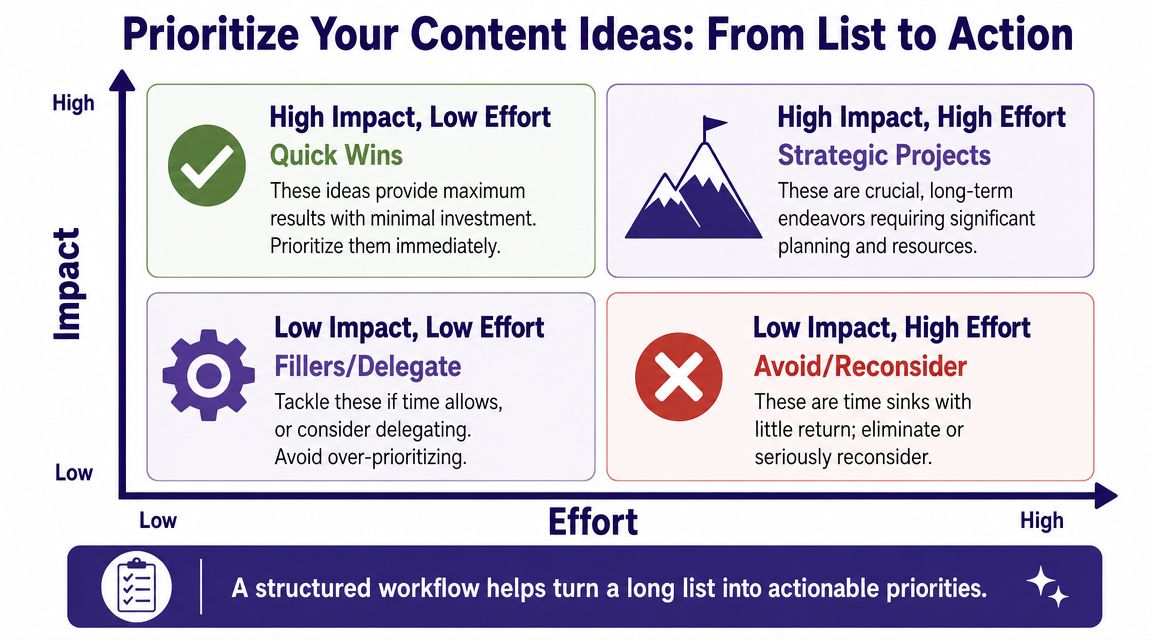
A simple impact versus effort matrix is still one of the most reliable ways to decide what comes next because it forces trade-offs into the open.
Score ideas by business value, not excitement alone
A creator usually overestimates novelty and underestimates usefulness. The idea that feels fresh to you isn't always the one that helps the audience most, and it isn't always the one most likely to strengthen your library.
Use four simple questions:
- Impact
If this performs well, does it help reach, trust, conversions, or retention? - Effort
How much research, production, editing, coordination, and promotion does it require? - Asset value
Will this piece remain useful, or is it disposable? - Expansion potential
Can it become a series, cluster, or cross-platform package?
Then place each idea in one of four buckets:
- High impact, low effort gets produced first.
- High impact, high effort becomes a planned strategic project.
- Low impact, low effort is filler only if it supports a broader goal.
- Low impact, high effort usually gets cut.
Validate before you overproduce
You don't need a massive production commitment to test an idea.
Before investing in a full article, video, or episode, test the angle in lighter formats. Post the hook as a social caption. Turn the thesis into a poll. Mention the topic in a newsletter and watch replies. Add the question to a Q&A. If the response is flat, revise the framing before the big build.
A short walkthrough can help if you want to think visually about sorting ideas into action:
Keep your calendar balanced
A strong content plan usually includes a mix, not a monoculture.
You need some quick wins. You need some authority pieces. You may need some audience-nurture content that won't explode but deepens trust. You may also want a few experimental formats to discover your next breakout concept.
The best next idea isn't always the biggest idea. It's the one with the clearest return for the effort required right now.
Prioritization protects your time. Even more, it helps you build a library with compounding value instead of publishing whatever happens to sound interesting on a Tuesday.
Answering Your Toughest Content Ideation Questions
The hardest part of how to find content ideas isn't collecting possibilities. It's dealing with the edge cases. Saturated niches. AI overload. Tension between audience demand and creative ambition. Repetition fatigue.
One of the biggest unresolved questions in content strategy is how to find ideas that are new rather than producing another version of what already ranks. Advice to “find an angle” is often too vague, and this discussion of unique content positioning captures why creators still struggle to identify real gaps without copying competitors.
How do you find a unique angle in a crowded niche
Stop trying to invent a brand-new subject. That's usually the wrong target.
Novelty often comes from one of four places: a sharper audience segment, a clearer use case, a stronger point of view, or a better format. “Email marketing tips” is crowded. “Email welcome sequence mistakes for paid newsletter creators” is more specific. “How a small editorial team structures welcome sequences” is a use case. “Why most welcome sequences are too long” is a point of view.
A useful filter is this: if the topic already exists, what's still underexplained, oversimplified, or aimed at the wrong audience?
How should you use AI without flattening your voice
Use AI for expansion and organization, not for outsourced originality.
Good uses include turning raw notes into categories, generating alternate angles, summarizing repeated questions, extracting themes from transcripts, or helping compare topic variants. Weak uses include asking for “ten viral post ideas” with no audience context and then publishing generic output.
If short-form platforms are part of your mix, this guide to viral TikTok video ideas is helpful because it shows how idea generation changes when speed, hooks, and trend adaptation matter more than long-form depth.
The key is simple. Feed AI your archive, your comments, your frameworks, and your constraints. Then judge the output like an editor. Don't confuse assistance with strategy.
What if audience demand and creative interest don't match
Don't choose one forever. Build a portfolio.
Some content should answer direct demand because it brings reach, trust, and commercial relevance. Some should reflect your deeper curiosities because that's where original thinking often comes from. The trick is to connect them. If you want to explore a topic your audience hasn't asked for yet, frame it in terms they already care about.
For example, a creator interested in narrative structure might package that interest as better hooks, stronger retention, or clearer messaging. Same passion. Better bridge to audience need.
How often should you run this ideation process
Light capture should happen continuously. Formal review should happen on a schedule.
Capture signals every week. Save comments, questions, search patterns, and promising angles as they appear. Then run a deeper review at a regular cadence that fits your publishing rhythm. Teams with larger libraries often benefit from a recurring editorial review because archive insights compound when someone is looking for them.
What do you do when every idea feels derivative
Tighten the brief.
Derivative ideas usually come from vague prompts. “Write something about productivity” invites generic output. “Create a practical breakdown for podcasters who publish consistently but can't turn old episodes into discoverable assets” produces a more distinct direction.
When in doubt, return to the system:
- inspect the archive for proven themes
- read active audience questions for live pain points
- use search to map public demand
- brainstorm at volume without self-editing
- prioritize ruthlessly
That combination doesn't guarantee brilliance every time. It does give you a dependable way to keep publishing useful work without burning yourself out or repeating yourself blindly.
If your content library is growing faster than your ability to organize and reuse it, Contesimal is built for exactly that next stage. It helps creators, publishers, and content teams turn archives, transcripts, research, and ongoing output into structured knowledge they can search, collaborate on, and convert into new content value. If you're ready to stop treating your library like storage and start using it like an asset, it's worth a look.