
Staring at a blank ad canvas with a strong listing and weak ideas is a familiar kind of frustration. You know the property has a story, but the ad still looks like every other exterior shot in the feed. That's usually the point where people start guessing, and guessing is expensive.
Real estate ad examples help most when you stop treating them like inspiration porn and start treating them like market research. Good examples show format choices, offer structure, visual hierarchy, and the practical questions buyers want answered fast. They also reveal what agents are doing to win sellers, not just clicks.
That matters because real estate advertising has become heavily visual and format-driven. Industry guidance keeps circling back to carousel ads, video tours, testimonials, neighborhood-focused creative, floor plans, maps, and price cues because buyers compare options side by side and want to self-qualify quickly, not admire one pretty photo in isolation (AdEspresso on real estate Facebook ads). If you want a broader starting point before building your swipe file, Adwave's advertising tips for agents is also worth a look.
1. Meta Ad Library
If you work in residential real estate and you only check one source, make it Meta Ad Library. It's the fastest way to see what agents, brokerages, builders, portals, and lenders are actively running across Facebook and Instagram right now.
That “right now” part matters. Curated galleries are useful, but live ads show the current language people are willing to put money behind. For housing, Meta's visibility around the Special Ad Category also makes this tool practical for studying compliant patterns, especially if you want to model fair-housing-safe phrasing instead of improvising your way into trouble.
What to study inside Meta
Search local competitors first, not national brands. A national portal can teach production value. A local team teaches market nuance.
Use it to compare:
- Creative variety: Are they using one hero image, a carousel, a short video tour, or testimonial-based creative?
- Message angle: Are they pushing “Just Listed,” neighborhood expertise, open house urgency, or seller education?
- Offer structure: Are they asking for a showing immediately, or are they using a lower-friction lead magnet first?
Practical rule: Save ads by pattern, not by platform. Build folders like “seller leads,” “luxury video,” “open house urgency,” and “neighborhood proof,” so your swipe file stays useful later.
One of the strongest reasons Meta works so well for real estate ad examples is that it mirrors how people discover listings socially. You'll keep seeing recurring formats because the category naturally favors them. Carousel ads are especially useful when an agent needs to show multiple listings or several angles of one property, and floor plans, neighborhood maps, testimonials, and price-range cues tend to reduce friction by answering practical buyer questions early, as noted in the earlier AdEspresso guidance.
Where it falls short
Meta Ad Library won't tell you what's converting. You don't get spend, lead quality, or downstream revenue. You're seeing the storefront, not the books.
Still, for active creative research, it's hard to beat. I treat it like walking a competitive retail strip. You can't see the register totals, but you can absolutely see who merchandises well.
2. Google Ads Transparency Center
Real estate campaigns don't live on social alone. Google Ads Transparency Center gives you a public view into ads from verified advertisers across Search, YouTube, Display, and Shopping, which makes it useful when you want to understand the full message ecosystem around a listing, neighborhood, or brand.
This tool is especially good for spotting format discipline. Search ads reveal how competitors frame urgency and intent. YouTube placements reveal how they package tours, community footage, or brand authority in video. Display units show which visual hooks they repeat when space is tight.
What it's best at
Google's library helps when you're building cross-channel consistency. If a brokerage says one thing on Search and another on YouTube, that gap is often a clue. Strong advertisers usually keep the same core promise and adapt the format, not the positioning.
Watch for the difference between:
- Search intent ads: Tight copy, direct value, strong CTA
- YouTube pre-rolls: Faster hooks, cleaner visual storytelling
- Display ads: Simple offer, recognizable brand cues, minimal clutter
A lot of marketers focus only on design inspiration and miss attribution thinking. That's a mistake in real estate. One industry article puts digital-ad ROI for real estate in the 150% to 400% range versus 50% to 150% for print, and it ties that advantage to measurable targeting and campaign tracking such as separate landing pages, call tracking numbers, and direct lead questions (AgentFire on real estate ad ROI). That's the core lesson behind studying ad examples on Google. You're not just collecting layouts. You're collecting funnel ideas.
The trade-off
The weak point is research depth. You can search advertisers, but you can't really explore the way a strategist wants to explore. No spend data. No performance view. No keyword-level visibility.
Still, if Meta shows you the social shelf, Google shows you demand capture. You need both if you want a serious swipe file.
3. TikTok Creative Center
If your listing ads still look like digital brochures, TikTok Creative Center Top Ads is a useful correction. Even if you never run a dollar on TikTok, the platform teaches pacing, hooks, and how to make a property feel lived in rather than merely photographed.
That's where many real estate ads fall apart. They present features. They don't create motion. Buyers don't experience a home as a bullet list. They experience flow, sequence, light, layout, and context.
What TikTok teaches better than most tools
The top-ads view is great for studying first-second decisions. You can see how advertisers open, how quickly they reveal the payoff, and how on-screen text supports the visual. For walkthroughs, neighborhood clips, and agent-led commentary, that matters more than polished drone footage.
A practical workflow is simple:
- Study the hook: What appears immediately? A kitchen reveal, a curb-appeal shot, a “wait until you see this backyard” caption?
- Study the rhythm: Do cuts feel too slow for social attention, or tight enough to hold interest?
- Study the framing: Is the ad selling the property, the lifestyle, or the local area?
Most weak real estate video ads fail in the first moments. They start like a slideshow when they need to start like a trailer.
TikTok is also useful because it forces economy. If the first few seconds don't earn attention, the rest of the tour doesn't matter. That discipline travels well to Reels, Stories, and YouTube Shorts. If you want extra perspective on short-form creative mechanics, UFO Performance Marketing's TikTok ads guide complements the platform's own examples.
What not to copy blindly
Don't copy TikTok aesthetics without copying TikTok clarity. Fast cuts and trending sounds won't save weak messaging. You still need price context, location cues, layout clarity, or a next step that makes sense.
Use TikTok Creative Center as a motion coach, not a strategy replacement.
4. AdEspresso by Hootsuite
AdEspresso's Facebook ads examples gallery is where I'd send someone who needs frameworks more than raw surveillance. Meta Ad Library is live and messy. AdEspresso is curated and interpretive. That makes it useful when you're trying to understand why a format keeps appearing.
It's also one of the better places to study real estate ad examples in editorial form. Instead of just scrolling ads, you get recurring structures. Photo ads, video ads, carousel ads, and lead ads each solve different problems, and that separation helps newer teams stop forcing one creative type to do every job.

Why curated examples still matter
Live libraries are great for seeing what exists. Curated breakdowns are better for pattern recognition. AdEspresso helps you notice details like image hierarchy, how much copy supports a carousel, and when testimonial-driven creative does more work than another glamor shot.
For content teams, the repurposing angle becomes particularly interesting. Real estate ads are built from reusable assets. Listing photos, neighborhood facts, testimonials, market commentary, floor plans, and clips from a walkthrough can all become distinct ad variants. If your team is also thinking about short-form adaptation, this kind of modular creative thinking overlaps with platform-specific execution in useful ways, much like the tactical constraints discussed in Contesimal's post on TikTok hashtags limits.
Best use case
Use AdEspresso when you need to move from “I need ideas” to “I need structures.” It's strong for teams that understand the property but haven't yet developed a repeatable ad system.
Its weakness is freshness. A curated example can still teach a timeless lesson, but it won't always reflect the newest placement behavior or current creative style. That's why I'd pair it with Meta rather than substitute it.
5. Walled Garden HQ
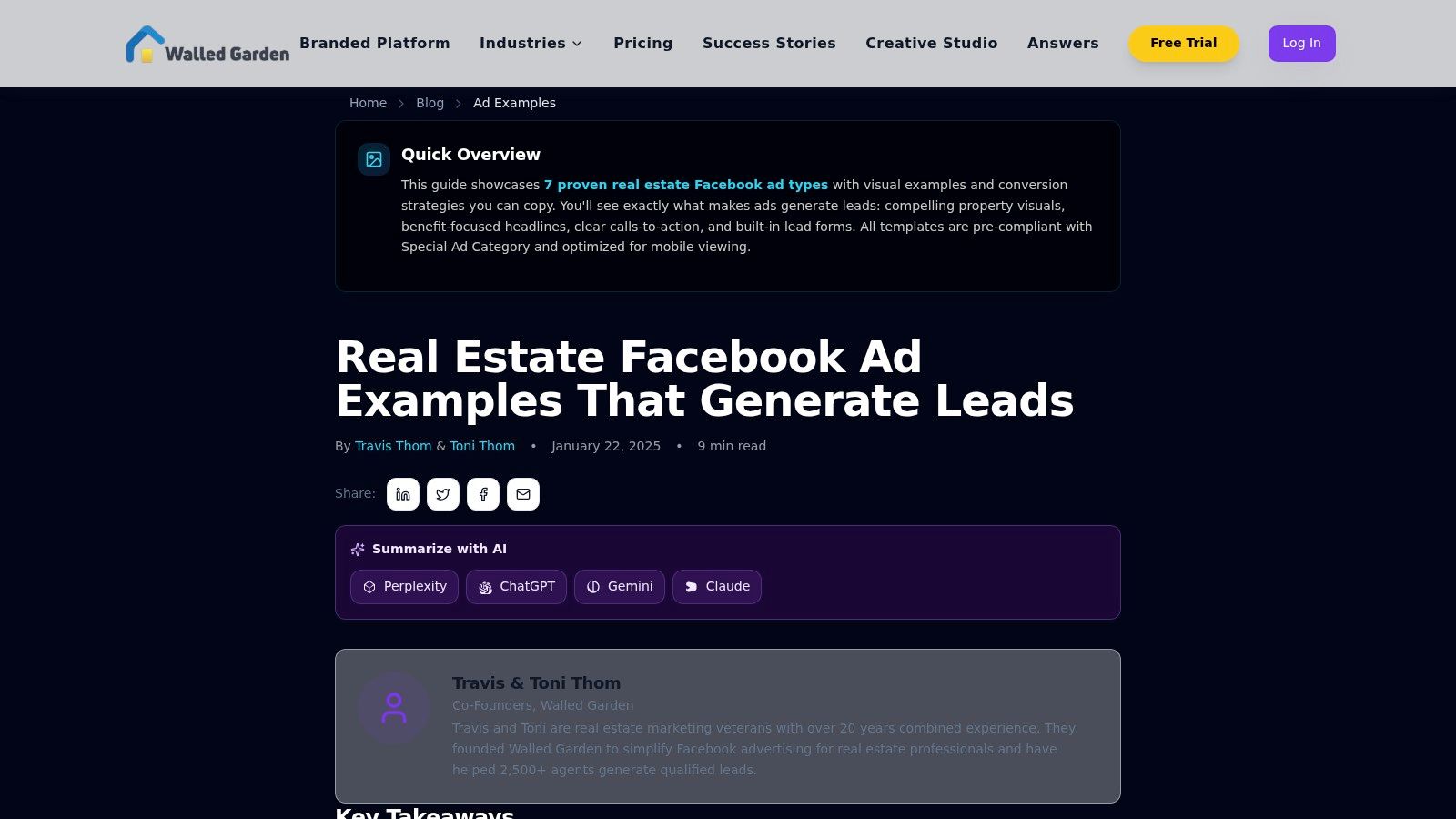
Walled Garden HQ's real estate Facebook ad examples feels closer to getting notes from a working operator than browsing a broad marketing gallery. That matters because housing ads have category-specific constraints, and generic social advice often breaks down once compliance, local targeting, and lead flow enter the picture.
This is one of the stronger options when you want examples tied to use cases. “Just Listed” is different from “Open House.” Seller acquisition is different from buyer inquiry. Educational lead gen is different from urgency creative. A practitioner-focused resource tends to respect those distinctions.
Where it becomes especially useful
Most collections of real estate ad examples lean too hard on listing promotion. Walled Garden HQ is more useful when you're thinking like an agent trying to build pipeline, not just fill a showing calendar.
That's important because one underserved angle in category coverage is how ads help agents win listings from sellers, not just attract buyers. Recent guidance points toward stronger seller-focused creative such as neighborhood segmentation, testimonial ads, transformation narratives, and before-and-after renovation storytelling, rather than relying only on polished listing posts (LeadSavvy on real estate advertising examples).
Good seller ads don't just showcase a house. They showcase the agent's marketing skill.
Practical limitation
This is narrower than a platform library. You won't get broad cross-channel visibility across YouTube, Search, or LinkedIn. But that focus is also the point. If you're building quick-test templates for a residential team, narrow can be more useful than broad.
It also pairs nicely with stronger copy discipline. If the visual side gives you the shell, Contesimal's guide to good advertising copy helps sharpen the message inside it.
6. Canva
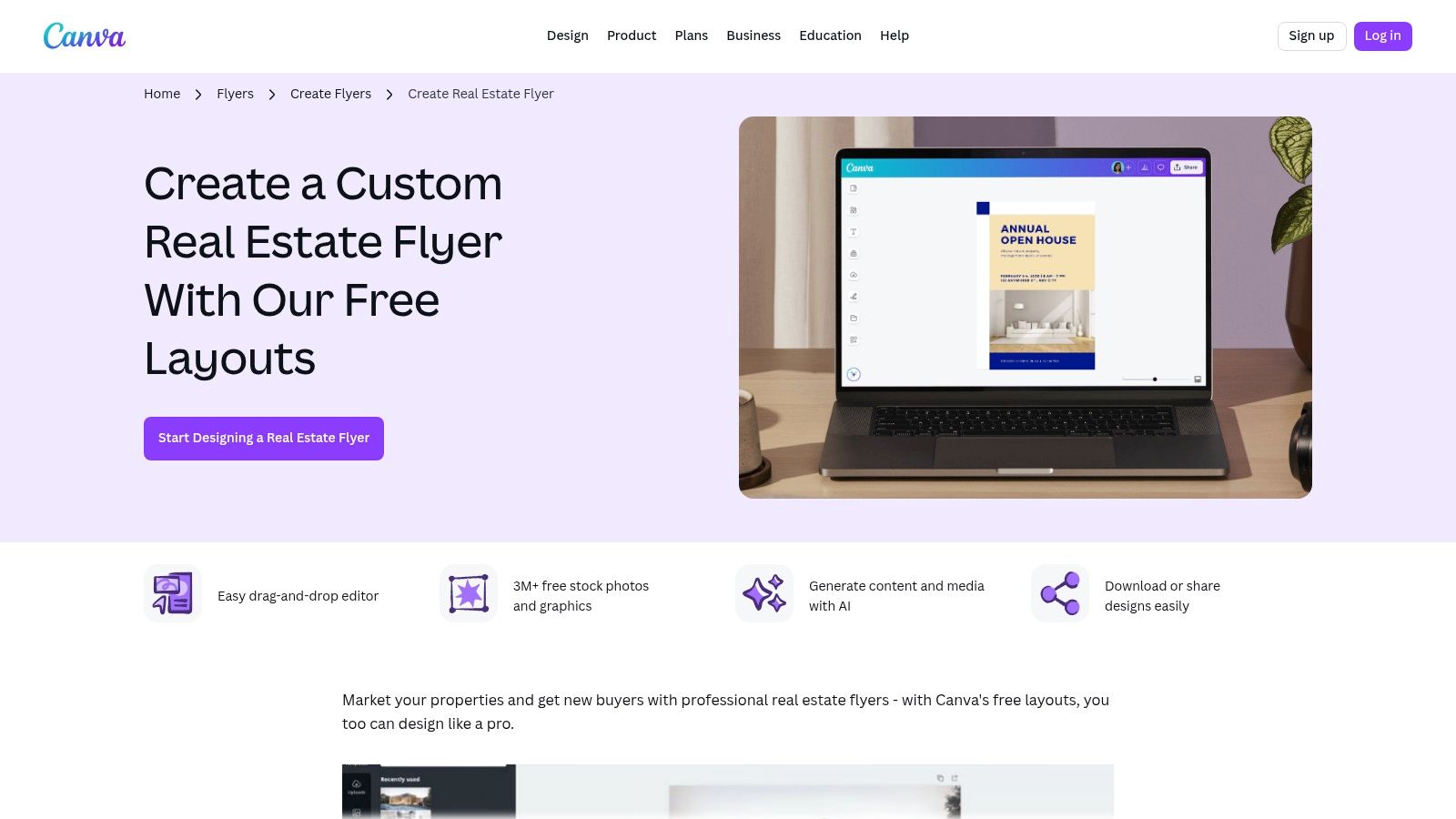
Canva's real estate flyer and ad templates isn't an ad library in the strict sense. It's a production tool. That difference matters. You don't go there to learn what's winning in-market first. You go there after research, when you need to turn patterns into testable creative fast.
That makes Canva valuable for teams with more ideas than design bandwidth. Once you've identified recurring elements from your swipe file, such as neighborhood maps, floor plan callouts, testimonial blocks, or price framing, Canva lets you produce variants without opening a heavier design workflow.
How to use Canva without making generic ads
The trap is obvious. Templates can make every agent look interchangeable. The fix is to treat the template as scaffolding, not a finished ad.
A better workflow looks like this:
- Import proven ingredients: Bring in headline patterns, testimonial snippets, neighborhood cues, or layout ideas from your swipe file.
- Build variants deliberately: Change one major variable at a time. Offer, visual order, CTA, or social proof.
- Match asset to funnel stage: Seller lead magnet ads need different layouts than “Just Listed” promos.
One of the cleaner seller-focused patterns in real estate is the low-friction “What's Your Home Worth?” offer. Independent guidance highlights it as an effective lead-generation format because the CTA is clear, the ask is minimal, and the campaign is optimized around qualified lead capture rather than immediate conversion (Saleswise on real estate Facebook ad examples).
What Canva does well and what it doesn't
Canva is excellent for speed, collaboration, and versioning. It's not a substitute for research or testing. A polished ad can still be strategically weak.
That's why I'd put Canva later in the process. First, study. Then sort. Then build. Canva is the workshop, not the field report.
7. LinkedIn Ads Library
LinkedIn Ads Library is the odd one out on this list, and that's exactly why it belongs here. If your definition of real estate stops at residential listing ads, you won't need it often. If you work with commercial brokers, property managers, REITs, proptech vendors, recruiting campaigns, or investor-facing offers, it becomes much more useful.
LinkedIn gives you a different lens on real estate ad examples. The message tends to be less about curb appeal and more about expertise, operations, trust, and business outcomes. That's valuable even for residential marketers because it shows how professionals position credibility when the audience is skeptical and busy.
What you can learn here
LinkedIn is especially good for studying:
- Professional positioning: How firms frame authority, specialization, and market knowledge
- Recruiting creative: How brokerages market themselves to agents, not consumers
- B2B ecosystem ads: Software, data, property services, and investment-related offers
This platform also balances the rest of your swipe file. Meta and TikTok can pull you toward visual excitement. LinkedIn pulls you back toward clarity, credibility, and sharp audience definition.
One useful creative reminder comes from a heavily engaged Zillow video example analyzed elsewhere. That walkthrough-style ad drew 33.6k likes and 2.9k shares, reinforcing how immersive formats can hold attention before a user ever reaches the listing page (BigSpy's real estate Facebook ad ideas). LinkedIn won't look like TikTok, but the broader lesson still applies. Show the experience, not just the feature list.
Best use case
Use LinkedIn when your campaign has a professional buyer, partner, investor, or recruit on the other end. It's also a strong reference point when you need to tighten strategic messaging across channels, especially if your team is building a broader campaign framework like the one discussed in Contesimal's sample strategic marketing plan.
7-Source Real Estate Ad Comparison
| Source | Implementation complexity | Resource requirements | Expected outcomes | Ideal use cases | Key advantages |
|---|---|---|---|---|---|
| Meta Ad Library (Facebook and Instagram) | Low, browseable public archive | Minimal; web access; free | Live Meta creatives/variants and compliance patterns (no performance data) | Building local swipe files, fair‑housing‑safe copy modeling | Source‑of‑truth for Meta creatives; Special Ad Category visibility |
| Google Ads Transparency Center | Low, searchable hub | Minimal; web access; free | Recent creatives across Search, YouTube, Display, Shopping (no performance data) | Reviewing multi‑channel formats, YouTube preroll and search ad messaging | Central view across Google properties; multi‑surface examples |
| TikTok Creative Center – Top Ads (U.S. region) | Low–Medium, filterable dashboard with previews | Minimal; web access; free; time to review videos | High‑performing short‑form video examples with engagement previews and trend cues | Short‑form hooks, pacing, sound selection, neighborhood walkthroughs | Second‑by‑second engagement previews and trend/creative insights |
| AdEspresso by Hootsuite – Facebook Ads Examples | Low, curated galleries and writeups | Minimal; web access; free | Editorial breakdowns, creative frameworks and historic examples | Learning headline/frame patterns, brainstorming ad concepts | In‑depth analysis and practical takeaways for creatives |
| Walled Garden HQ – Real Estate Facebook Ad Examples | Low, practitioner‑driven guides and examples | Minimal; web access; free | Practitioner templates and strategy notes for Facebook ad types | Small teams/agents testing proven housing ad formats and flows | Real‑estate‑specific, practitioner insights, compliance‑focused templates |
| Canva – Real Estate Ad Templates and Inspiration | Low–Medium, template editor and asset builder | Free/premium account for advanced features; design time | Rapid mockups, brand‑consistent assets, many variant outputs for testing | Fast creative production, on‑brand A/B testing, team collaboration | Large template library, easy drag‑and‑drop editor, collaboration tools |
| LinkedIn Ads Library | Low, public ad views on company pages | Minimal; web access; free | Active LinkedIn ad creatives for professional audiences (limited metadata) | B2B real estate, proptech marketing, REITs, recruiting campaigns | Visibility into professional‑audience ads; useful for B2B competitive scans |
Turn Your Ad Library into an Asset
Studying real estate ad examples is the easy part. Many teams can save screenshots. Fewer teams build a system that turns those screenshots into better campaigns.
That system is what makes the difference between random inspiration and repeatable output. A useful swipe file doesn't just store ads by platform. It organizes them by audience, offer, format, visual structure, CTA style, and funnel stage. When you do that, patterns become obvious. You stop asking, “What should we make?” and start asking, “Which proven structure fits this objective?”
Real estate is a strong category for this kind of disciplined reuse because the building blocks repeat. Listings change. Neighborhoods change. But the underlying assets keep resurfacing: photos, maps, floor plans, testimonial snippets, market observations, renovation stories, and walkthrough clips. Those pieces can be recombined for buyer ads, seller campaigns, open house promotion, recruiting creative, and short-form video.
A practical ad library should answer a few questions fast:
- Which formats keep appearing for this goal
- Which hooks work for buyers versus sellers
- Which assets are reusable across campaigns
- Which creative patterns deserve another test
The best part is that every campaign you run adds to the library. A “Just Listed” carousel. A neighborhood video. A seller lead magnet. A testimonial ad that helps win listings. Each one becomes future raw material if you tag it properly and keep the context attached.
That's where a platform like Contesimal fits naturally. Instead of letting ad concepts, past assets, creative drafts, and campaign learnings scatter across folders, docs, and chat threads, you can turn them into a searchable working library. Your team can find old winners, connect them to new briefs, compare formats, and generate fresh variations from what already exists. That's a much better use of historical content than letting it collect dust.
A strong swipe file is more than a mood board. It's operational memory. Once you treat it that way, your ad research starts compounding.
If you're sitting on a backlog of campaign assets, listing media, blog posts, videos, and research notes, Contesimal helps you organize that library into something your team can use. It gives creators and marketers a way to search, classify, connect, and repurpose historical content so old material can power new ads, sharper briefs, and faster production across channels.