
You probably have this problem already. You know there are great moments buried in old episodes, but when you need one sharp quote, one recurring theme, or one guest's opinion from two years ago, your archive turns into a maze.
That's where podcast transcript search stops being a convenience and starts becoming infrastructure. For creators, publishers, and teams trying to move from “we posted a lot” to “we're building a content asset,” searchable transcripts change the job. Your back catalog stops acting like storage and starts acting like a working library you can mine for clips, articles, newsletters, scripts, playlists, and follow-up episodes.
A lot of creators think this is mainly about searchability for audiences. It is, but that's only the surface. The deeper value is operational. Once your audio becomes structured, searchable text, you can organize it, understand it, and take action on it. That's how old longform content starts producing fresh value across platforms.
Your Podcast Archive Is a Goldmine in Hiding
Most podcast libraries don't have a content problem. They have a retrieval problem.
A creator with a few dozen or a few hundred episodes has already recorded patterns, stories, objections, frameworks, and memorable turns of phrase that can feed future work for a long time. But if those moments live only inside audio files and rough show notes, they're effectively locked away. You can't reuse what you can't find.
Why old episodes keep getting ignored
Teams usually repurpose from memory. They remember a popular interview, a strong guest, or a recent episode that's still top of mind. That's fast, but it leaves a lot behind. A better operating rhythm is to review the library deliberately. Industry best practice mandates conducting quarterly reviews of your content library to systematically identify repurposing opportunities by analyzing specific metrics including page views, conversion rates, and time-on-page, rather than relying on ad-hoc selection according to Cloud Present's guide to repurposing content.
That matters because your archive often contains material that was strong, just poorly surfaced. A nuanced answer from an older guest might be more useful for today's audience than a brand-new episode. A forgotten monologue might contain the exact hook for your next short-form video series.
Practical rule: If finding one quote takes longer than creating one new clip, your archive isn't organized enough to generate repeat value.
What searchable transcripts actually unlock
A searchable transcript library gives you more than a search box. It gives you a way to turn years of recordings into a reusable knowledge base.
That changes how creators work:
- For podcasters: Past interviews become source material for recap episodes, thematic compilations, and rebuttal-style follow-ups.
- For YouTubers and video teams: Spoken insights turn into scripts, chapter prompts, and short-form edits tied to proven topics.
- For publishers and editors: A transcript archive becomes a research layer for newsletters, articles, and issue-based packages.
- For marketers: Existing episodes can support campaign pages, lead magnets, and cross-platform content calendars.
The shift from storage to asset
The key mindset change is simple. Your podcast isn't just a feed. It's a library.
Once you treat it that way, podcast transcript search becomes part catalog, part research tool, and part idea engine. It helps you upcycle old content instead of letting it fade. It gives structure to experiments, playlists, recurring themes, and audience questions. For creators moving from hobbyist output to professional systems, that's one of the clearest ways to create infinite content value from work you've already done.
Getting Your Transcripts Ready for Search
Search quality starts long before indexing. It starts with transcript quality.
If your transcripts are messy, unlabeled, inconsistent, or full of formatting drift, your search results will feel unreliable even when the indexing engine is good. The goal isn't perfect literary transcription. The goal is dependable retrieval.
AI transcripts versus human cleanup
For most creators, AI transcription is the starting point because it's fast and scalable. Services such as Descript, Whisper-based workflows, Rev's automated options, and platform-native transcript tools can get a library into text quickly.
Human review still matters when accuracy carries editorial weight. That includes legal language, technical interviews, branded terminology, and multi-speaker conversations where attribution matters. A practical approach is hybrid. Use AI for first-pass transcription, then apply human cleanup to high-value episodes, cornerstone interviews, and anything you plan to quote heavily.
Here's the trade-off in plain terms:
| Approach | Strength | Weakness | Best use |
|---|---|---|---|
| AI-first transcription | Fast, inexpensive, scalable | Can miss nuance, names, overlaps | Bulk backlog conversion |
| Human transcription | Stronger precision and formatting | Slower, more expensive | Premium archive assets |
| Hybrid workflow | Balanced quality and speed | Requires process discipline | Most professional libraries |
What good enough actually means
For podcast transcript search, “good enough” means users can trust the result they click. That usually depends on a few basics more than perfect punctuation.
Focus on these first:
- Speaker labels: If two guests discuss opposing views, speaker diarization isn't optional.
- Timestamps: You need direct jumps back into audio or video.
- Stable formatting: Episode titles, dates, guest names, and segment markers should follow one pattern.
- Terminology normalization: Pick one spelling for recurring terms, brand names, and series labels.
- Light cleanup: Remove obvious filler clutter when it harms readability, but don't erase meaning.
Clean transcripts don't just help machines index your archive. They help humans trust what the machine returns.
A simple prep workflow
If you're organizing an archive for the first time, don't overengineer it. Use a repeatable checklist.
- Export or generate transcripts for every episode you plan to keep active.
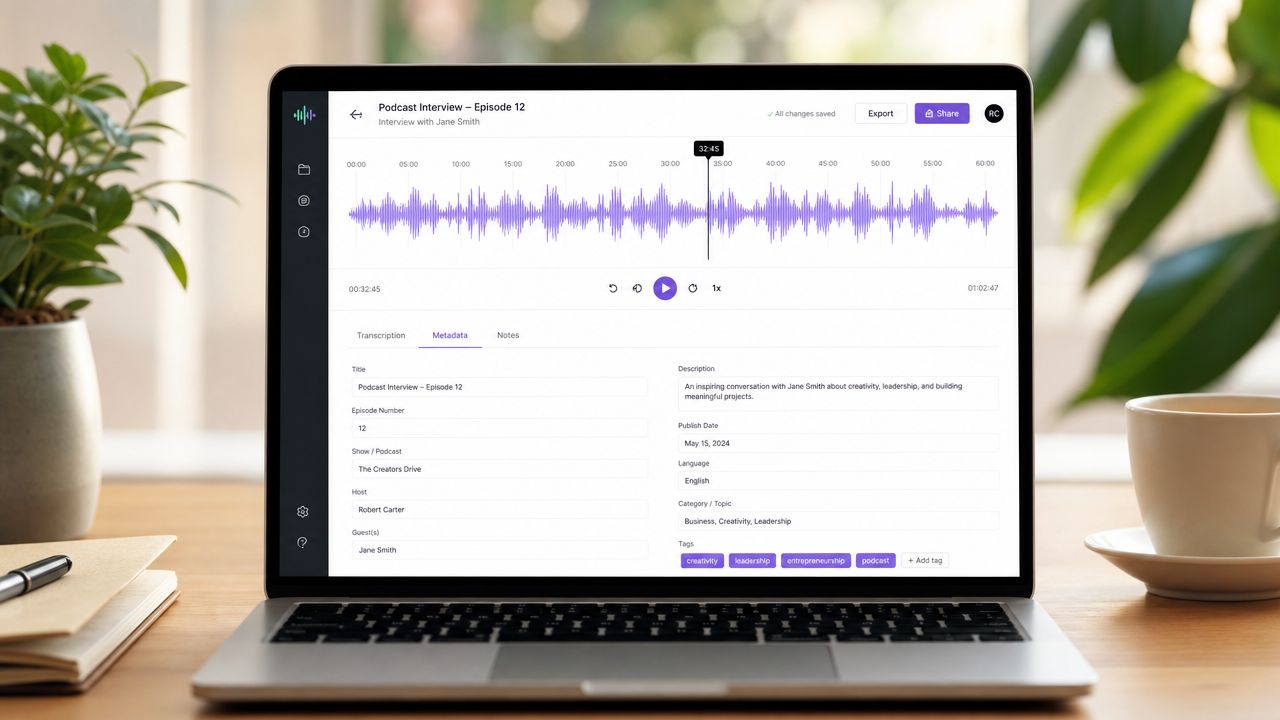
- Attach metadata such as publish date, guest, show name, category, and series.
- Review speaker assignments on interviews and roundtables.
- Standardize titles and filenames so downstream systems don't fragment the same concept.
- Store transcript and media IDs together so every match can resolve back to the source moment.
If you want a practical example of how transcript structure affects discoverability and reuse, this piece on Spotify podcast transcripts is useful because it frames transcripts as a working content layer, not just accessibility output.
Don't skip the boring fields
Creators often obsess over the transcript body and ignore metadata. That's a mistake. Date, guest, topic tags, and show format are what make later filtering useful. Without them, your future semantic search layer has less context to work with, and your team will still end up doing manual hunting.
A reliable archive feels boring under the hood. That's why it works.
Choosing Your Search Indexing Strategy
A creator searches their archive for "episodes where guests changed their mind about remote work." Exact-match search returns a few mentions of the phrase. It misses the stronger material. A founder describing "distributed teams falling apart," an operator revising their management approach two years later, and a panel debating hybrid culture without using the word "remote." Indexing strategy decides whether your archive acts like storage or like working memory.
Keyword search is reliable for known-item retrieval
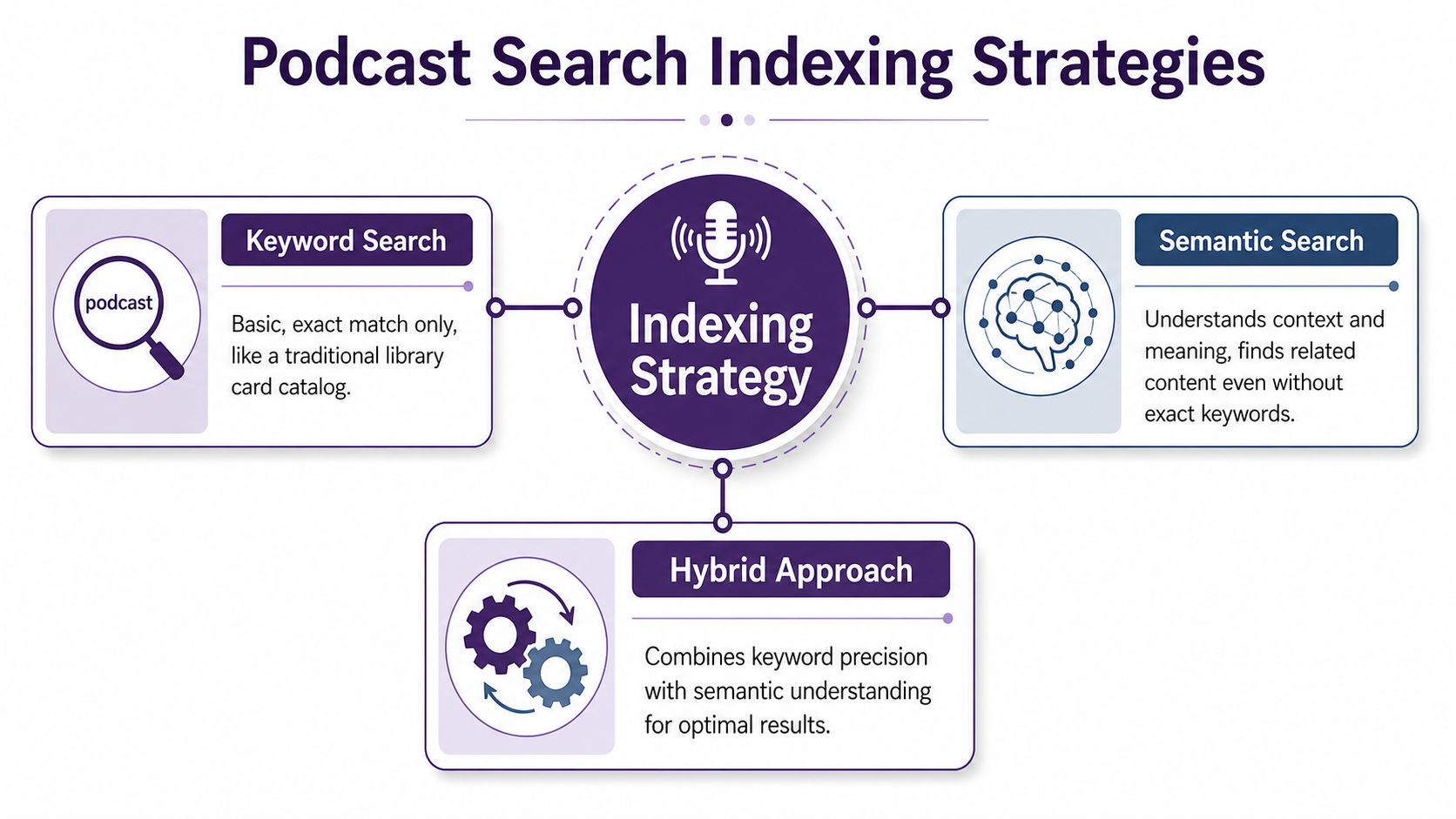
Keyword indexing does one job very well. It finds the exact word or phrase you asked for.
That makes it useful for quote checks, sponsor mentions, guest names, product terms, and recurring phrases. If you need every instance of "open loop," "intermittent fasting," or a surname with unusual spelling, full-text search is fast and predictable.
Its limits show up as soon as language gets loose. Guests rarely repeat the same wording across episodes, and they often describe the same idea from different angles. Someone can talk about exhaustion, overload, recovery, and boundaries without ever saying "burnout." A keyword index will often miss the pattern that matters.
Semantic search is better for themes, narratives, and idea development
Semantic indexing groups passages by meaning, not just wording. That changes the value of transcript search for any team trying to reuse a large archive.
Instead of asking, "Where did someone say this exact phrase?" you can ask for concepts. Search for "founder anxiety before product launch" and you can retrieve clips about sleeplessness, fear of public failure, team pressure, and second-guessing, even if none of those speakers used the same vocabulary. That is the difference between transcript lookup and archive intelligence.
This matters even more over time. A semantic layer can help surface how a topic evolves across guests, seasons, or market cycles, which is where new editorial angles often come from. That is how an archive starts generating follow-up episodes, newsletter themes, compilation clips, and research briefs instead of sitting there as static text.
A keyword index finds the line you remember. A semantic index helps you find the idea you want to develop.
Hybrid search is usually the right choice
For most podcast libraries, hybrid wins because creators and editors do not search in only one way.
They need exact matching for names, quotes, and fact checks. They also need semantic retrieval for topic exploration, analogy hunting, sentiment shifts, and related discussions that use different language. A good system combines metadata filters, full-text indexing, and embedding-based retrieval behind one search experience.
Use this as a practical rule:
- Use keyword search for exact wording, names, citations, and verification.
- Use semantic search for concepts, narrative threads, recurring tensions, and adjacent ideas.
- Use hybrid search when the archive needs to support research, repurposing, and daily production.
The user should not have to care which retrieval method produced the result. They care whether the result is relevant, trustworthy, and fast to use.
What to evaluate before you commit
Indexing choices affect more than recall. They shape what your team can do with the archive six months from now.
Check the basics first:
- Can the system filter by date, guest, show, and series?
- Can it return short, relevant passages instead of dumping whole transcripts?
- Can results connect to the exact moment in audio or video?
- Can it support both exact lookup and concept-based retrieval?
- Can your team use search output in editorial workflows, not just research?
Then check one harder question. Can the index support compound queries such as "episodes from 2021 to 2024 where guests became more skeptical about AI hiring tools"? That is where simple search starts to break down, and where a better indexing model starts paying for itself.
If you are comparing architectures, this explanation of how document indexing affects retrieval quality is a useful reference.
For teams with ambitious archives, indexing is not a backend detail. It determines whether your transcript library can only retrieve words, or whether it can help generate the next layer of content.
Designing a Powerful Search User Experience
A strong index can still fail in daily use if the interface makes people work too hard.
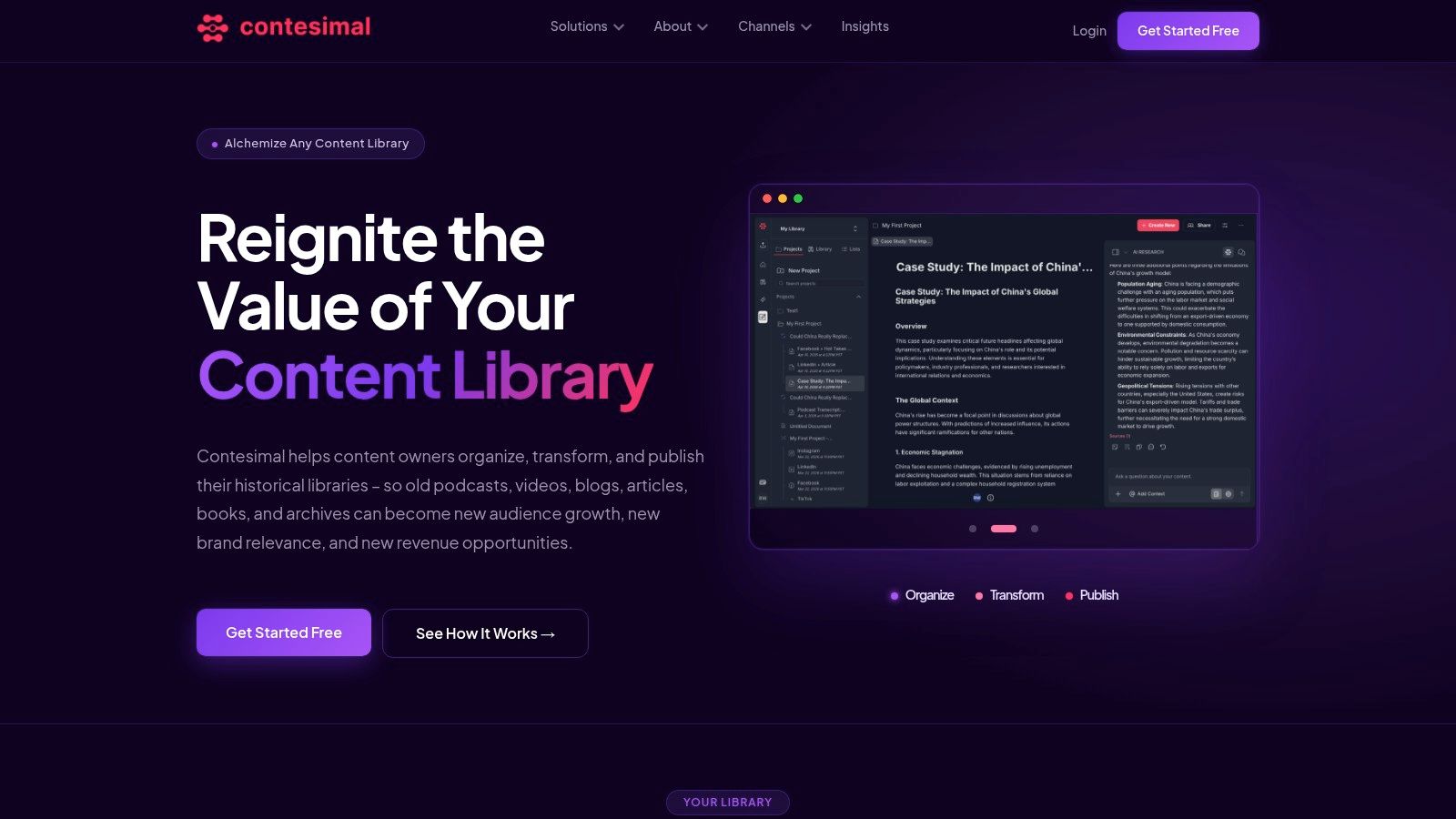
Creators don't want to inspect a wall of transcript text every time they search. They want confidence fast. They want to know whether a result is the right moment, who said it, when it was said, and how quickly they can turn it into the next asset.
The interface should answer four questions immediately
When someone searches your archive, the result screen should make these answers obvious:
| User question | What the interface should show |
|---|---|
| Who said this? | Speaker name and role |
| Where is it? | Episode title, date, series |
| Is this the right context? | Snippet with surrounding text |
| Can I use it now? | Clickable timestamp or clip jump |
If any of those are missing, users start opening tabs, scanning manually, and losing trust in the system.
Features that matter more than fancy AI
A lot of teams get distracted by summarization and chat features before they nail the basics. The basics carry more weight.
- Clickable timestamps: A search result should land at the exact spoken moment, not the start of the episode.
- Context snippets: Give users a few lines before and after the matched passage.
- Interactive transcripts: Highlight text during playback so users can validate a quote quickly.
- Faceted filters: Let users narrow by guest, topic, date, show, or content format.
- Saved searches and collections: Researchers and editors should be able to gather findings into reusable sets.
Design for editors, not just listeners
The most productive transcript search tools behave less like podcast apps and more like editorial workspaces. A marketer might want a cluster of quotes on one topic. A producer might want every guest mention of a recurring theme. A screenwriter or host might want contrasts between two guests' framing of the same issue.
That means the UX should support actions after discovery.
- Copy quote
- save passage
- export snippet
- open source transcript
- jump to media
- group results into a project
Those actions turn search into workflow.
A working example helps here:
Small details change adoption
The difference between a tool people admire and a tool they use every week usually comes down to small choices.
Workflow note: If users have to retype the same filters every time they research a topic, the interface is creating friction instead of reducing it.
Good search UX remembers recent queries, keeps filters visible, and makes result comparison easy. It doesn't force users to choose between listening and reading. It supports both. It also handles ambiguity gracefully. If someone searches “trust,” the system should help them refine whether they mean trust in media, customer trust, or trust between hosts and guests.
When teams start thinking this way, podcast transcript search becomes more than lookup. It becomes a collaboration surface for creators, editors, marketers, and researchers.
Unlocking Deeper Insights with AI-Powered Queries
A strong transcript archive starts to behave less like storage and more like research infrastructure.
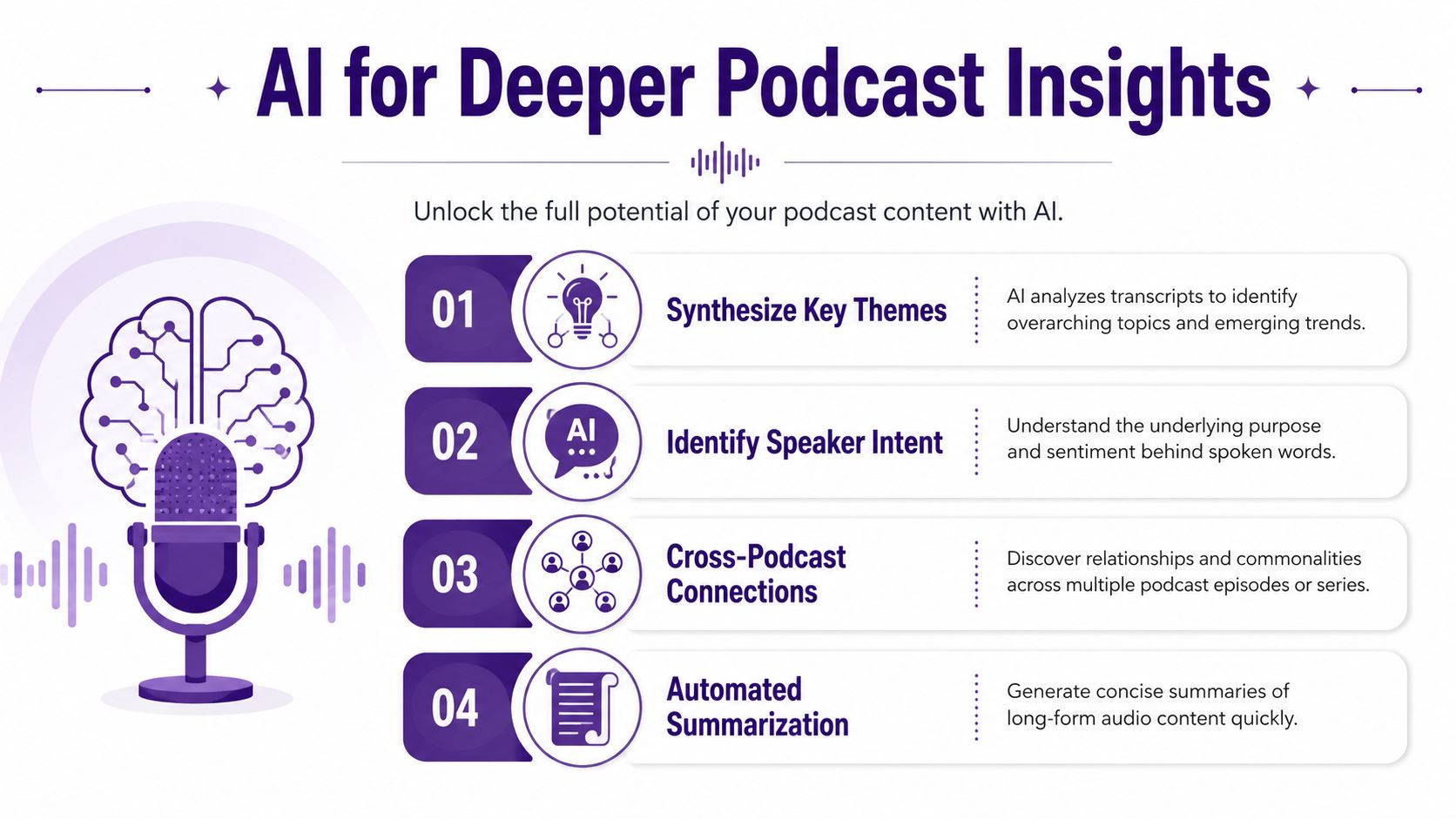
Once transcripts are indexed and segmented well, the questions get better. Instead of stopping at retrieval, you can ask for synthesis. How did a host's position on remote work shift over three years? Which guests kept returning to the same concern but used different language? Where does one narrative thread split into two competing schools of thought?
Better prompts produce better editorial angles
Loose prompts tend to return disconnected excerpts. Structured prompts produce material a team can use.
Try queries like these inside an AI-assisted transcript environment:
- Compare viewpoints: “Show how different guests framed creator burnout over time. Group by agreement, disagreement, and unresolved tension.”
- Track idea drift: “Pull every discussion of AI assistants in the archive and summarize how expectations changed across publication dates.”
- Find repeatable hooks: “Identify opening stories or analogies that consistently make abstract topics feel concrete.”
- Extract action: “Summarize practical advice mentioned in interviews with founders, then cluster by hiring, distribution, and product strategy.”
Semantic search starts to outperform plain keyword matching. A guest might discuss “fatigue,” “creative depletion,” and “burnout” in different episodes. A semantic system can connect those threads even when the wording changes. That gives editors a way to spot patterns that basic transcript search would miss.
Cross-episode synthesis creates the real editorial value
Single-episode lookup is useful. Cross-episode comparison is where the archive becomes materially more valuable.
The practical advantage is temporal synthesis. You can trace how an idea matured, where a prediction failed, which objections stayed consistent, and which guests changed their position after market conditions shifted. That kind of analysis supports stronger follow-up interviews, sharper newsletters, and better repackaging decisions because it is grounded in your own body of work instead of generic trend reporting.
For teams building repeatable research workflows, 1chat research insights offers useful context on how AI-assisted discovery is changing knowledge work.
Search the negative space
Some of the best story angles sit in the gaps.
An archive can reveal topics that come up indirectly, questions guests keep dodging, or assumptions that never get stated clearly because everyone in the conversation treats them as obvious. AI is helpful here, but only if you use it carefully. Models are good at surfacing patterns in hedging, repetition, and omission. They are also capable of over-interpreting weak signals. The fix is straightforward. Treat these results as editorial leads, then verify them against the source transcript and audio before publishing.
Prompts that work well here include:
- Find omissions: “Which expected topics rarely appear in interviews about this subject?”
- Spot hesitation: “Identify passages where speakers hedge, soften, or avoid direct claims.”
- Map blind spots: “Compare audience-interest topics with topics barely discussed in the archive.”
- Surface tension: “Show where hosts and guests seem to disagree politely without stating it directly.”
That approach often produces stronger original angles than quote hunting alone. Search explicit statements when you need evidence. Search omissions and weak signals when you need a fresh premise.
Tools should help teams reason, not just retrieve
The product differences matter at this stage. Some tools stop at finding a line in a transcript. Others support clustering, summarization, comparison across episodes, and iterative questioning. Tools such as NotebookLM, custom vector search stacks, and AI-powered search workflows in Contesimal are useful when the goal is to examine a library, test hypotheses, and generate new content from patterns inside it.
That is the shift. Your archive stops being a static record of what you published and starts functioning as an active creative partner.
Bring Your Entire Content Library to Life
At some point, every serious creator runs into the same ceiling. Publishing more isn't enough. You need your existing work to keep working.
That's what podcast transcript search really solves. It gives your archive structure, memory, and reusability. It helps teams collaborate around what they've already made instead of reinventing the wheel every week. For publishers, producers, and creators with a real library, that shift is operational and commercial at the same time.
The archive becomes a system
Once your episodes are searchable, themes become easier to package, revisit, and expand. A single interview can feed clips, essays, rebuttal episodes, topical playlists, and sales collateral. A recurring conversation thread can evolve into a vertical. A set of overlooked passages can become the seed of the next format.
The hidden advantage is editorial confidence. You stop guessing what's in the library because you can inspect it directly.
The missed value is often indirect
The strongest future use cases won't come only from obvious quote retrieval. They'll come from finding underexplored patterns in what speakers avoid, soften, or leave unresolved. Data from conversational AI analysis indicates that 43% of high-value insights in podcast interviews lie in omitted topics or hesitant phrasing, yet 95% of transcript search interfaces lack hallucination-resistant thematic gap detection, according to PrismaScribe's guide to buried podcast value.
That's why treating transcripts as static accessibility files is too limited. They're research material. They're product input. They're creative fuel.
If you're also thinking about how this search layer connects to broader reuse across channels, ManuscriptReport's guide to boosting reach is a worthwhile companion read because it ties discoverability to practical repurposing choices across formats.
Start with order, then build leverage
You don't need a perfect enterprise stack on day one. You need a usable system. Clean transcripts. Reliable metadata. A sensible index. An interface people will use. Then you can layer on semantic search, AI prompting, collections, and collaboration.
That's how a podcast archive comes back to life. Not as storage, but as an active library that keeps generating new ideas, new assets, and new opportunities to make money from work you've already done.
If you want a practical way to organize transcripts, search across a content library, and collaborate with AI on new angles, Contesimal is built for that kind of workflow. It ingests podcasts and other content types into a searchable research environment so teams can classify material, surface patterns, and turn historical content into new output.