
You're probably staring at a sentence you've written for a script, article, caption, or email and thinking: Do I put a comma before because, or will that make me look careless? That hesitation is normal. This is one of those grammar points that seems tiny on the page but can change the meaning of a sentence fast.
For professional creators, that matters. If you publish often, repurpose across platforms, and turn one idea into a podcast intro, a YouTube description, a newsletter, and a blog post, small punctuation choices can either preserve your meaning or muddy it. The comma before because isn't just a schoolroom rule. It's a tool for controlling how your audience reads what you meant.
Why This Tiny Comma Causes So Much Trouble

Writers get tripped up here because they've usually heard a simplified rule: don't use a comma before because. That advice isn't useless, but it's incomplete. The core issue is meaning.
Sometimes the phrase after because gives the essential reason for what happened. Sometimes it adds extra commentary. Sometimes, especially in negative sentences, the comma changes the sentence so much that leaving it out creates the opposite meaning.
That's why this punctuation mark keeps showing up in editor debates, writing forums, and style discussions. It looks small, but it sits right where logic and rhythm meet.
A linguistic analysis found exactly 6,354 instances of because immediately following a comma in a search corpus of English usage, which shows that even though many style guides prefer no comma, writers do use it in real published language in this Language Log analysis.
Practical rule: If you're unsure, don't ask “Is a comma allowed?” Ask “What meaning am I trying to protect?”
That shift helps. You stop treating punctuation like a trap and start treating it like an editing choice.
For creators, that's useful beyond grammar. If you script podcast episodes, build article libraries, or adapt content across channels, precision saves time later. You won't need to keep fixing lines that readers or listeners interpreted the wrong way.
The Core Rule Essential vs Extra Information
The easiest way to understand the comma before because is to think in movie scenes.
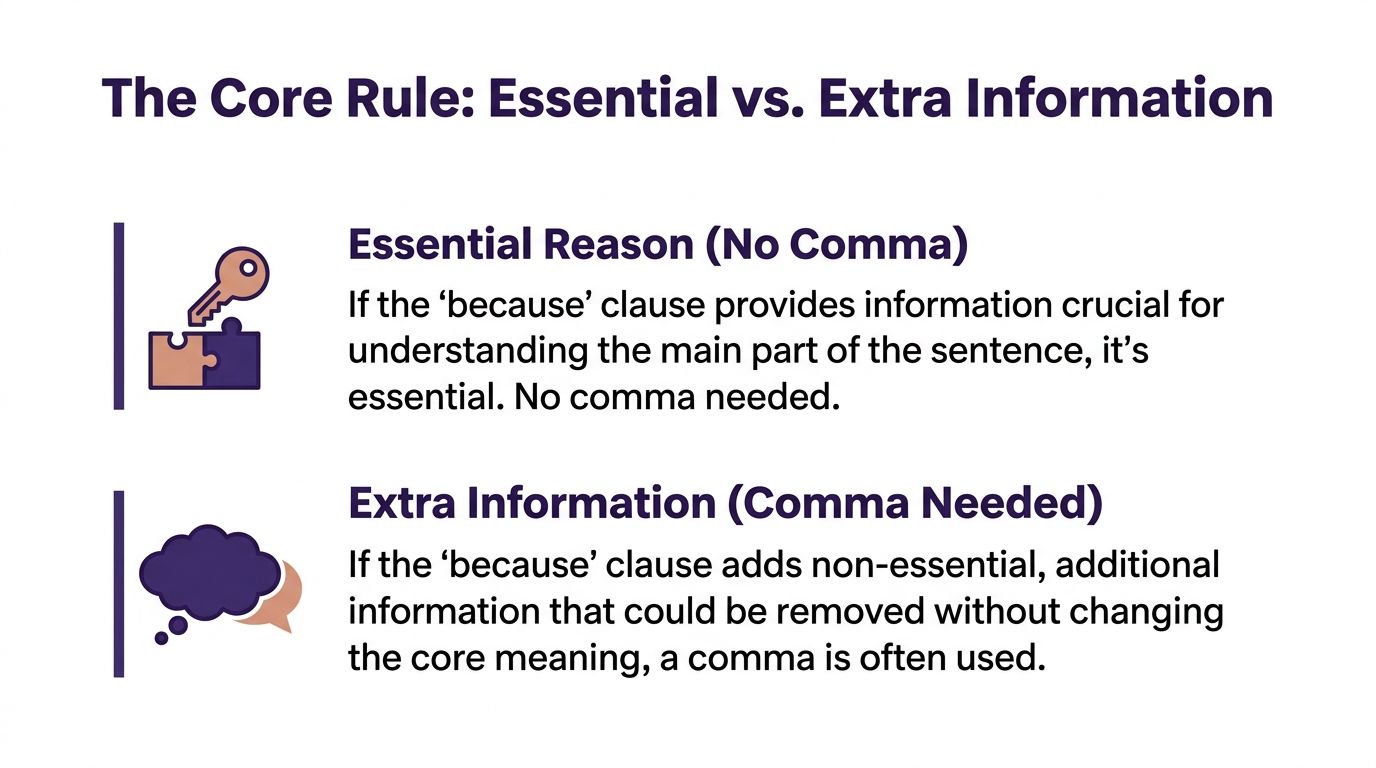
Some scenes are essential. If you cut them, the plot breaks. Other scenes are bonus scenes. They add flavor, tone, or context, but the main story still works without them.
The because clause works the same way.
When the reason is essential
If the phrase after because gives the main reason, don't use a comma.
- I revised the script because the opening felt slow.
- She changed the headline because the first version sounded vague.
- We delayed the episode because the audio needed cleanup.
In each sentence, the because clause answers the core question: Why? If you remove it, the sentence loses its point.
When because carries the main load of explanation, leave the comma out.
When the reason is extra
If the phrase after because adds side commentary rather than the core reason, a comma can help.
- He was a strong editor, because he never rushed a sentence.
- The campaign felt polished, because every detail had been checked twice.
These have a more reflective, explanatory tone. The clause after because feels less like the engine of the sentence and more like added interpretation.
That's one reason tone matters. In conversational digital writing, writers sometimes choose the comma to create a slight pause for emphasis or clarity, especially in longer sentences. If you're trying to sharpen your sense of voice across contexts, it also helps to understand the difference between informal vs formal writing, because punctuation often shifts with tone as much as with rule.
A quick side by side test
| Sentence | Meaning effect |
|---|---|
| I stayed home because I was tired. | The tiredness is the direct reason. |
| I stayed home, because I was tired. | The reason sounds more parenthetical or stylized. |
In clean, standard prose, the first version is usually the safer choice. The second may work if you want a deliberate pause, but it needs to sound intentional.
What most writers should do by default
If you're drafting quickly, use this default:
- No comma when the clause gives the direct reason.
- Comma possible when the clause feels added, reflective, or nonessential.
- Stop and inspect any sentence with a negative verb, because that's where confusion spikes.
That last point matters more than the default rule.
The Critical Exception Preventing Ambiguity in Negative Sentences
Here, the comma before because stops being optional style and becomes a precision tool.
Take this sentence:
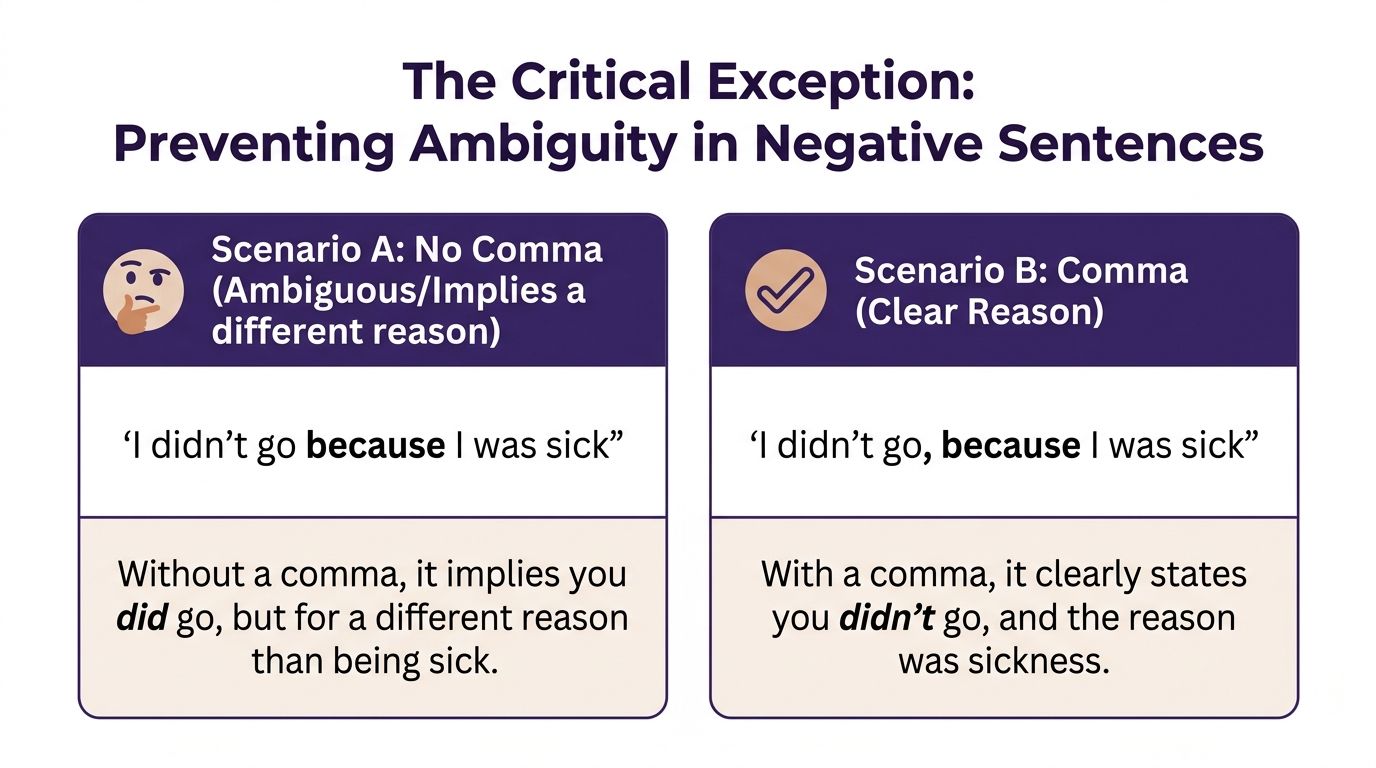
I didn't go because I was tired.
That can mean two very different things:
- You didn't go, and tiredness was the reason.
- You did go, but not because you were tired.
Those meanings point in opposite directions. The sentence is unstable without help.
Most grammar content skips this nuance, but the distinction matters. A writing guide discussing this issue notes that many explanations fail to show how negative statements become ambiguous, and that the comma changes whether the reason is being denied or stated in this Scribbr explanation of comma use with because.
What the two versions mean
Look at the pair closely:
- I didn't go because I was tired.
- I didn't go, because I was tired.
The first often implies: I did go, just not for that reason.
The second clearly means: I stayed home, and tiredness was why.
A negative main clause changes the job of the comma. It no longer just affects rhythm. It protects meaning.
Examples creators actually use
Here are a few versions that sound like real working copy:
We didn't cut that segment because it was boring.
This suggests the segment was cut, but boredom was not the reason.We didn't cut that segment, because it was boring.
This means boredom was the reason it stayed out.She didn't reject the sponsor because of the fee.
This suggests she rejected the sponsor, but for some other reason.She didn't reject the sponsor, because of the fee.
This means the fee caused the rejection.The editor didn't rewrite the passage because it was unclear.
This can imply the passage was rewritten, but not for clarity.The editor didn't rewrite the passage, because it was unclear.
This states that lack of clarity was the reason for not rewriting, though many editors might recast the sentence entirely for smoothness.
When to rewrite instead of punctuate
Sometimes the cleanest move isn't adding a comma. It's rewriting.
Try:
- Because I was tired, I didn't go.
- I didn't go because of traffic, but because I was sick.
- I skipped the meeting because I was tired.
If a negative sentence feels slippery, rewrite first and punctuate second. That's often the best editorial decision.
How Major Style Guides Handle Because
Professional teams need consistency. A freelancer can follow instinct. A publication, newsletter team, or editorial operation usually wants a stable standard.
The broad split is simple. AP prefers restraint. MLA gives more guidance for edge cases. Chicago is often treated by editors as more meaning-driven and flexible, though the key contrast documented in the source material here is between AP and MLA.
A summary of that contrast appears in this explanation of AP and MLA handling of comma use before because.
Where AP and MLA differ
The Associated Press style position is conservative. It generally leaves the comma out unless the sentence would be “completely misread without it.” That's a useful standard if you write news, captions, tight web copy, or anything where brevity matters.
MLA is more explicit about negative verbs. It recognizes that some sentences need the comma to prevent the reader from attaching the meaning incorrectly.
If your team works with citations, academic sources, or heavily edited longform, it's worth aligning punctuation rules with your broader documentation habits, including how you add citation correctly in editorial workflows.
Style guide positions on comma before because
| Style Guide | General Rule | Key Exception |
|---|---|---|
| AP | Usually omit the comma before because | Use it if the sentence would be completely misread without it |
| Chicago | Often handled by meaning and clarity in practice | Editors may allow flexibility where punctuation prevents confusion |
| MLA | More nuanced than a simple no-comma default | Negative verbs may require a comma to preserve intended meaning |
What to choose for your team
If you manage a content operation, a practical policy looks like this:
- Use AP-style default for short, direct, high-volume content.
- Adopt MLA-style caution for negative sentences.
- Allow editorial discretion in complex sentences where clarity beats rigidity.
That gives writers enough freedom to be precise without turning every line into a grammar debate.
Quick Tests for Writers and Editors on a Deadline
Deadlines don't leave much room for grammar meditation. You need quick checks that work inside a draft, a transcript, or a final proof.
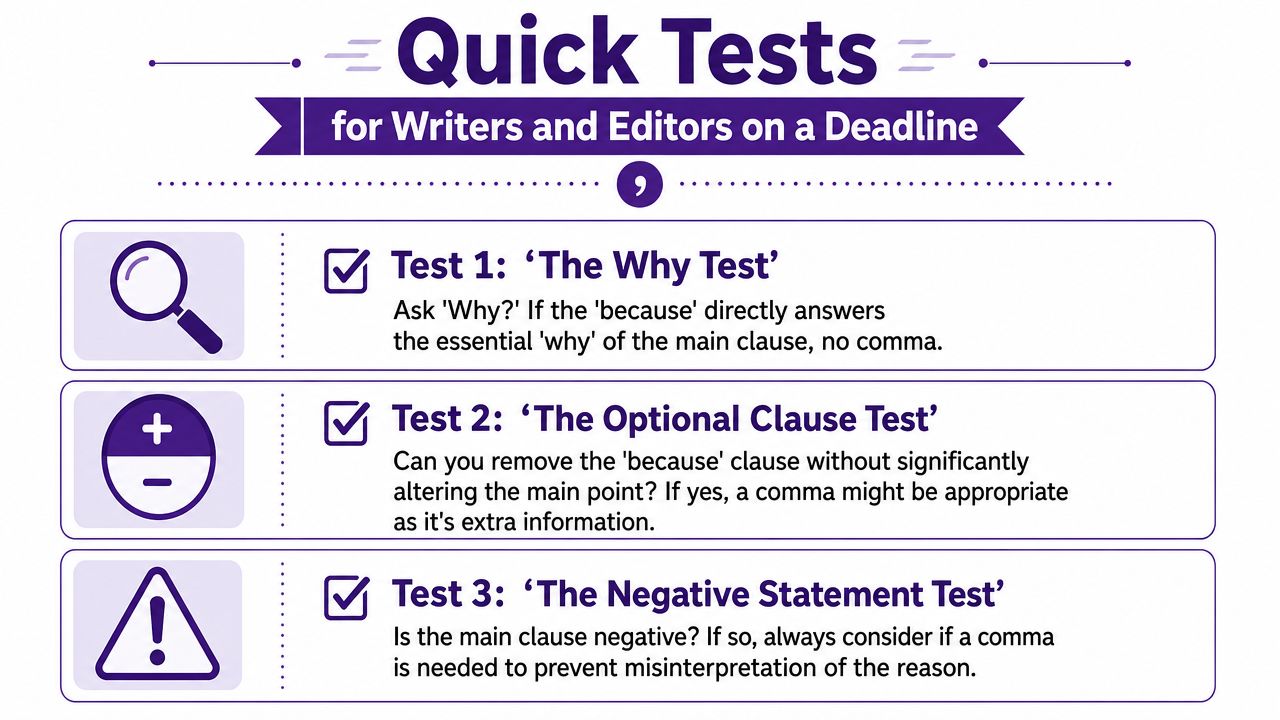
The why test
Ask the sentence a direct question.
Why did this happen?
If the because clause gives the essential answer, skip the comma.
- We updated the title because search intent changed.
The reason is central, so no comma.
The removal test
Delete the because clause for a moment.
If the main sentence still says almost everything you need, the clause may be extra and a comma may fit.
- The intro was stronger, because the second draft had better focus.
That sentence can survive without the clause. The explanation feels added.
If removing the clause leaves a hollow shell, don't use a comma.
The negative statement test
Circle any sentence with didn't, wasn't, can't, won't, or another negative verb. Slow down there.
Ask yourself: Could a reader think I mean the opposite of what I intend? If yes, use a comma or rewrite.
This kind of decision often appears during late-stage editing, when writers are polishing clarity rather than restructuring ideas. If you want a good overview of how these checks fit into broader editing stages for authors, that breakdown is worth reading.
A fast checklist
- Direct reason? No comma.
- Extra commentary? Comma may help.
- Negative sentence? Check for ambiguity immediately.
That's usually enough to make the right call in real time.
The Comma as a Strategic Tool for Clarity
Strong creators don't treat punctuation as decoration. They use it to guide attention, pace meaning, and reduce friction.
That's why the comma before because matters more than it seems. In some sentences, omitting it is cleaner. In others, adding it protects your meaning. Writers and editors increasingly treat that choice as a matter of clarity and pacing, not blind obedience to an oversimplified classroom rule, as reflected in discussions gathered in this grammar forum thread about using a comma before because for clarity.
If you create across formats, this mindset pays off. One clear sentence becomes a stronger caption, transcript line, article paragraph, and email snippet. Precision travels well. Confusion does too.
The deeper point is bigger than one comma. Structure shapes trust. If you want to improve how your ideas land, it helps to think deliberately about structure in writing, because readers feel organization before they can explain it.
A useful standard is simple: write the sentence so your audience doesn't have to guess. That's not fussy editing. That's professional respect.
If you're building a serious content library, clarity at the sentence level compounds into value at the catalog level. Contesimal helps creators, publishers, and content teams organize existing assets, collaborate with humans and AI, and turn past work into new opportunities across formats and platforms. If you want to reignite your archive, create new value from what you've already made, and build a system that supports growth beyond the hobby stage, it's worth a look.