
Your archive is probably full of valuable material that behaves like a junk drawer. A podcast producer has recordings, transcripts, guest research, and abandoned scripts scattered across drives. A publisher has years of articles in a CMS, but nobody knows which interview contains the missing angle for next week's feature. A video team remembers that “someone covered this topic once,” then starts researching from scratch.
Enterprise knowledge management turns that pile into a working system. It helps content organizations capture, organize, govern, and retrieve collective knowledge so the right person can find the right asset at the right moment. The payoff isn't just tidier folders. It's the ability to reuse research, develop stronger ideas, coordinate contributors, and turn existing content into new audience and revenue opportunities.
What Enterprise Knowledge Management Actually Means
A podcast producer sits at a desk surrounded by episode recordings, raw transcripts, guest notes, and half-finished scripts. The files contain years of expertise, but the archive offers little help when the producer needs a quote about audience growth or a clip about a recurring theme. A publisher can face the same problem inside a polished CMS. Five years of articles may be technically searchable while remaining practically invisible.

Enterprise knowledge management is the discipline of capturing, organizing, governing, and retrieving an organization's collective knowledge. For a content organization, that knowledge includes episodes, video files, transcripts, briefs, interview notes, research documents, audience questions, editorial decisions, and the context around each asset.
Basic file storage answers one question, “Where did we put this?” Knowledge management answers several more:
- What does this asset contain?
- Who should be able to use it?
- Which other assets relate to it?
- Is the information current and trustworthy?
- What new work could it support?
A folder named Final Episodes is storage. A system that connects an episode to its guest, topics, audience segment, publication date, claims, rights status, transcript, clips, and related articles is knowledge management.
The difference between a repository and a reusable system
A wiki can hold information. A document management system can control files. A CMS can publish articles. None of those automatically creates a reliable knowledge layer. Enterprise KM adds intent, structure, ownership, relationships, and reuse.
That distinction matters for creators moving from individual production into collaborative publishing. Once editors, researchers, producers, writers, freelancers, and AI tools contribute to the same library, memory alone stops working. People need shared definitions and dependable paths back to source material.
The modern discipline has deep roots. The term was reportedly first used by Karl Wiig in 1986, appeared in a McKinsey internal study in 1987, and entered broader public management discourse at a Boston conference in 1993. By 1995, knowledge management had gained widespread management attention through influential works and conferences, marking its shift from informal knowledge sharing to a recognized enterprise discipline. KMWorld's history of knowledge management provides that historical context.
For a content team, the practical definition is simple: organize what you already know so people can discover, trust, and transform it. That transformation might produce a newsletter, a short video, a sponsorship deck, a new episode, an SEO cluster, or the research foundation for a book.
The Core Building Blocks Every System Shares
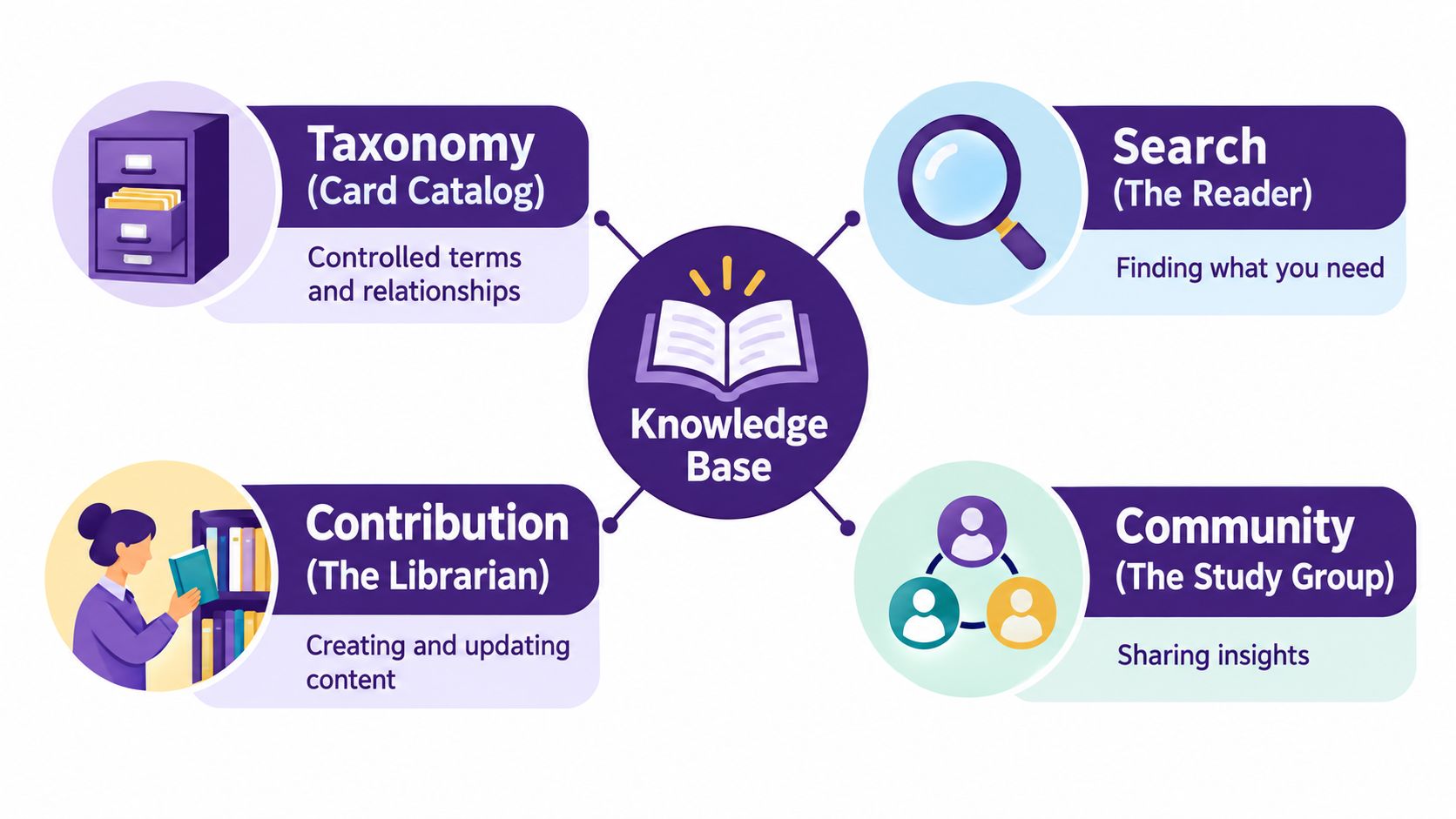
A public library makes the mechanics easier to see. The books matter, but the library becomes useful because people can classify, find, maintain, and discuss them. Enterprise knowledge management works the same way.
Taxonomy is the card catalog
Taxonomy gives the archive a shared language. It defines controlled terms, categories, tags, and relationships so similar assets don't scatter across competing labels. A video about independent publishing might otherwise appear under “publishing,” “self-publishing,” “creator economy,” or “book marketing,” depending on who uploaded it.
A useful taxonomy can connect topic, format, audience, person, project, stage, rights, and freshness. Knowledge-management research describes taxonomy as an enterprise-wide subject map and recommends a lifecycle of knowledge audit, requirements analysis, tool selection, and continuous refinement as the organization changes. This research on taxonomy architecture explains why classification affects tagging, storage, and search.
Search is the front desk and the stacks
Search should do more than match an exact phrase. Keyword search is useful when you know the wording, while semantic retrieval helps connect related ideas expressed differently. A producer searching for “how creators build recurring revenue” should be able to find an interview tagged with “subscriptions,” even if that exact phrase never appears in the transcript.
For a deeper explanation of how discovery works across large content libraries, see this guide to enterprise search fundamentals.
Governance is the librarian
A librarian decides how materials enter the collection, who can access them, which edition is authoritative, and when an item needs correction or removal. KM governance does the same for content.
Set ownership for important collections. Record publication and review dates. Preserve versions instead of replacing source material without a trace. Apply permission-aware access to unreleased episodes, licensed research, private interviews, and client documents. Resources on canonical memory and versioning are useful when teams need to preserve a trusted history of changes.
Collaboration is the reading room
The archive becomes more valuable when people can annotate, comment, connect ideas, and contribute context. An editor might flag a strong quote. A researcher might add a related source. A producer might note that a segment has already been adapted into a short-form series.
Every enterprise KM tool, from a Confluence workspace to a specialized content platform, expresses some version of these four functions. The names vary, but the operating question stays constant: can your team find trusted knowledge, understand its context, and build on it without starting over?
Common Architectures for Content Organizations
Content organizations rarely begin with a clean slate. A podcast network may use cloud storage for recordings, a CMS for articles, a project tool for production, and separate analytics for audience behavior. A publisher may have several brands with different workflows and no realistic way to migrate everything immediately.
Three architectures cover most practical choices.
Centralized repository
A centralized model moves transcripts, videos, briefs, research, and metadata into one governed store. It can work well for a single brand with one editorial standard and clear ownership. The tradeoff is migration effort. Teams must clean duplicates, reconcile naming conventions, map permissions, and maintain integrations with production tools.
Federated layer
A federated model leaves source systems in place while adding a shared index and taxonomy across them. This often fits organizations with multiple shows, brands, or acquired properties. Teams can keep working in familiar tools while gaining a common discovery layer.
The main challenge is governance consistency. If one brand marks content as reviewed and another doesn't, the search experience may surface assets with very different levels of trust. A clear information architecture framework helps teams decide how systems, categories, and user journeys should relate.
AI-mediated layer
An AI-mediated model adds retrieval and reasoning above the archive. Instead of returning only links, it can summarize a transcript, connect related assets, identify missing coverage, or suggest ways to adapt a long interview into several formats. It also raises the stakes for permissions, freshness, and source verification.
| Architecture | Best Fit | Migration Cost | Governance Consistency | Retrieval Quality |
|---|---|---|---|---|
| Centralized repository | One brand with a unified editorial operation | High | High when centrally managed | Strong when metadata is consistent |
| Federated layer | Multiple brands or systems that can't migrate quickly | Moderate | Variable unless shared rules are enforced | Strong across sources when indexing is reliable |
| AI-mediated layer | Large archives where browsing no longer scales | Moderate to high | Depends on governed source data | Potentially high, with verification requirements |
Most content organizations should start with a federated layer. It respects existing workflows while creating a shared taxonomy and search experience. AI mediation makes more sense after the underlying categories, permissions, ownership, and freshness rules are stable. Otherwise, the organization risks producing faster answers from unreliable material.
Why Knowledge Gap Detection Beats Search Speed
A fast search box can still leave an organization ignorant. If nobody records the questions that return weak, empty, or confusing results, the team sees only a usability problem. It misses the editorial opportunity underneath.
APQC's 2025 KM research points toward a more useful direction, measuring what people ask that the organization cannot answer rather than focusing only on repository size or search success. That shift matters for content teams because unanswered questions often reveal the next valuable asset.
The signals can come from several places:
- Low-result queries: People search for a topic and receive nothing relevant.
- Repeated requests: Producers keep asking the same subject-matter expert for background.
- Abandoned searches: Users start looking, then leave without opening a useful result.
- Unresolved themes: Audience questions appear in comments, emails, and interviews but never become planned content.
- Duplicate research: Different teams build separate briefs because they can't find the earlier work.
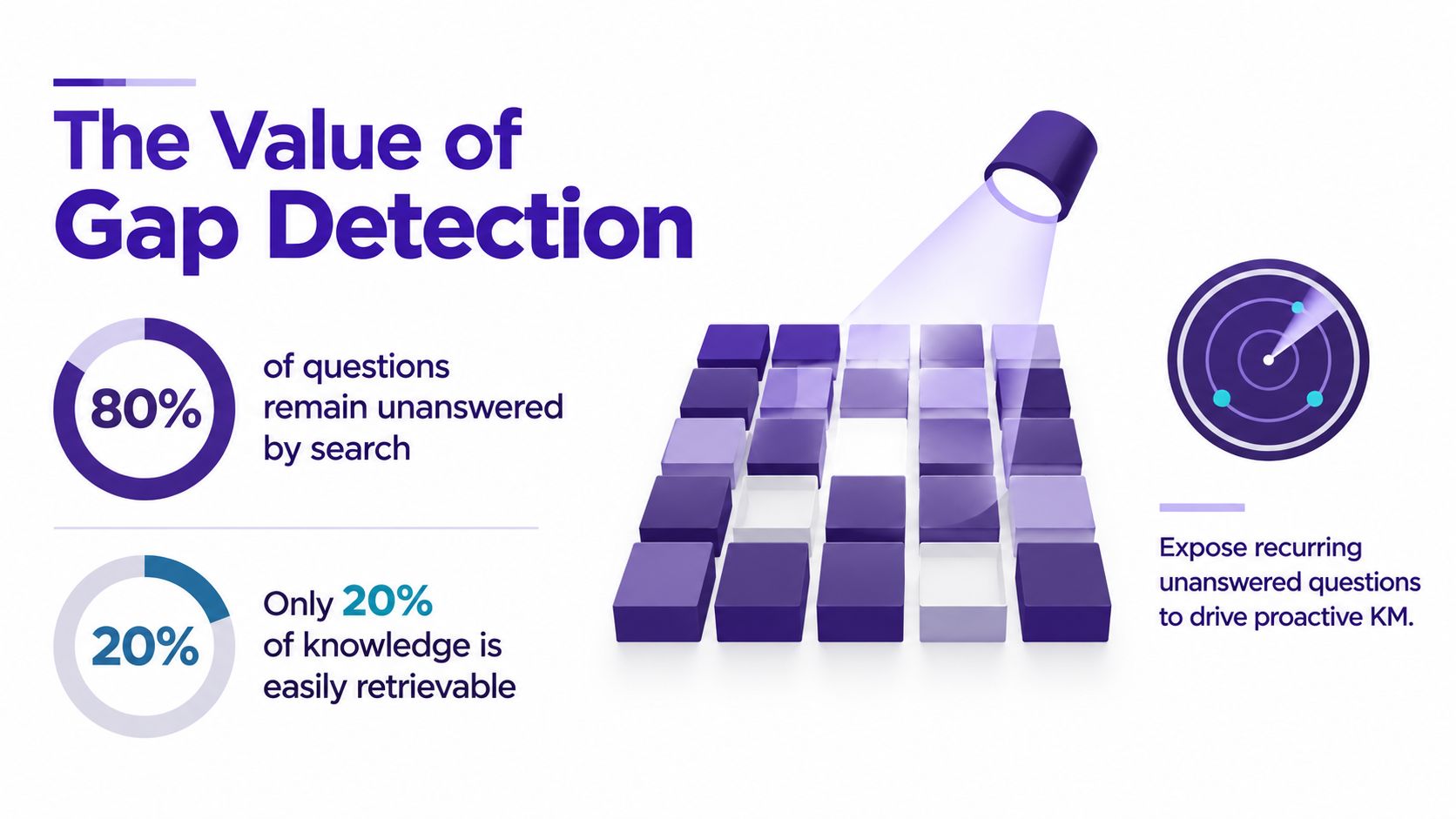
The supplied visual presents an 80% unanswered and 20% easily retrievable framing, but that specific split isn't included in the verified evidence for this article, so it shouldn't be treated as an enterprise benchmark. The operational principle remains sound: track unanswered demand instead of pretending every search has succeeded.
Turning gaps into editorial decisions
Suppose a podcast network sees recurring questions about pricing creative services. Its archive contains scattered conversations about proposals, retainers, and client negotiations, but no coherent episode or guide. That gap can inform a new series, a newsletter, a downloadable resource, or a sponsorship package for a relevant software category.
A publisher might discover that readers repeatedly ask for practical explanations beneath opinion pieces. A video team might find that viewers want beginner material while its archive is weighted toward advanced interviews. These aren't merely search defects. They're signals about content demand, missing expertise, and potential reuse.
Operational rule: Treat an unanswered question as a content brief until someone can explain why it shouldn't be answered.
Knowledge gap detection also exposes internal risk. If only one editor knows how a recurring series is produced, the archive has a single point of failure. If a topic appears under several disconnected labels, the team has a taxonomy problem. If reliable research exists but no one can find it, the organization has a retrieval problem.
That's why gap detection deserves its own KPI. Better search helps people use what exists. Gap analysis tells you what to create, clarify, refresh, or capture next.
A Practical Implementation Roadmap
A content organization doesn't need to reorganize its entire history before learning whether KM works. Start with a bounded archive, a real workflow, and a group of users who will give direct feedback.
1. Audit the archive
Inventory what exists and where it lives. Include published articles, raw media, transcripts, briefs, research, rights information, production notes, and informal sources such as shared documents or team conversations.
Record obvious metadata, including owner, format, topic, publication state, and access restrictions. Don't begin by moving files. The audit should reveal duplication, missing context, inaccessible sources, and collections nobody maintains.
2. Define a lightweight taxonomy
Build categories around audience questions and content use cases, not the internal org chart. A creator library may need topic, audience maturity, format, person, series, funnel stage, rights, and update status. It probably doesn't need a complicated hierarchy with dozens of rarely used labels.
Test proposed terms against real searches. If editors use one phrase and producers use another, choose a preferred term and preserve synonyms for discovery. Taxonomy research has reviewed 168 papers drawn from 10,511 conference papers published since 2012, showing that structured classification is a researched KM mechanism rather than vague administrative work. The taxonomy study offers additional background.
3. Pilot ingestion and tagging
Select a representative collection, such as one podcast season or one editorial topic. Ingest the material with automated transcription, suggested tags, entity extraction, and human review. AI can propose metadata, but a person should resolve ambiguous names, sensitive subjects, rights details, and conflicting dates.
Over-tagging is a common failure. If every asset receives an exhausting list of labels, contributors stop trusting the system and search results become noisy.
4. Establish governance before broad access
Assign owners for major collections. Define what “reviewed,” “approved,” “archived,” and “deprecated” mean. Set rules for permissions, version history, corrections, and freshness checks.
Governance doesn't need to be bureaucratic. A short record showing who owns an asset, when it was last reviewed, and whether it can be reused can prevent expensive confusion later.
5. Iterate from retrieval and gap reports
Ask users to run real searches and label results as useful, partially useful, or wrong. Review unanswered questions and repeated requests. Update the taxonomy where users speak differently from the original design team.
A pilot may take days or weeks, while a multi-brand rollout can take much longer. The exact schedule depends on archive size, source-system complexity, and review capacity. Sequencing matters more than speed. Don't ingest everything before testing the taxonomy, and don't open sensitive collections broadly before permissions are clear.
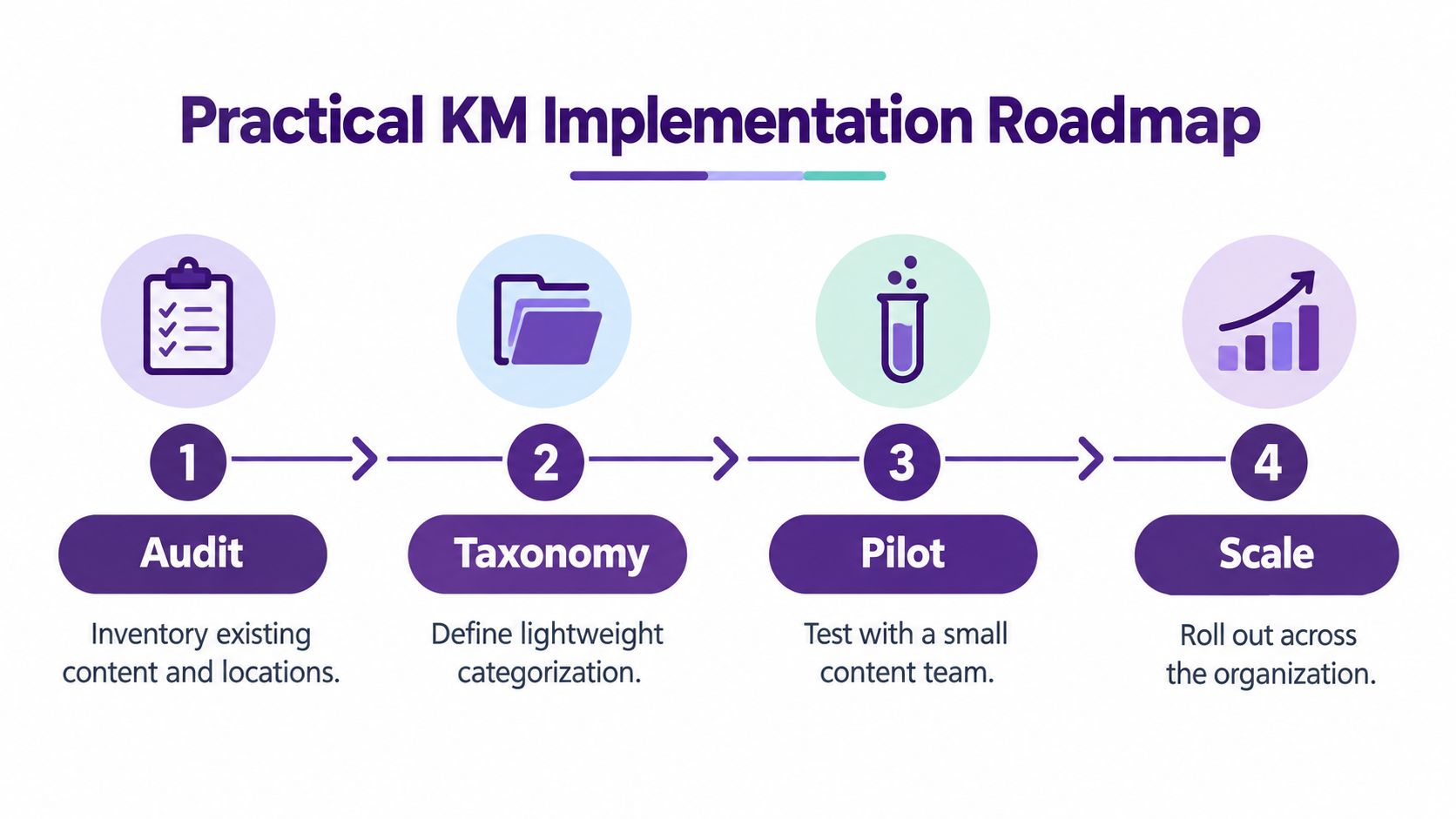
A practical guide to building a knowledge base can help translate those phases into concrete collection, structure, and maintenance decisions.
The best implementation is the one that fits into production. If tagging requires a separate administrative ritual, contributors will avoid it. If the system captures useful context during research, editing, and publishing, the archive improves as part of normal work.
KPIs That Reveal Whether the System Is Working
Document counts are easy to present and nearly useless on their own. A large archive can still produce poor answers, duplicate research, and stale recommendations. Measure whether people can use the knowledge.
| KPI | What It Measures | Healthy Benchmark | Warning Signal |
|---|---|---|---|
| Retrieval accuracy | Whether useful, authoritative assets appear for real queries | Improve steadily in tested query sets | Relevant material is buried or incorrect sources rank first |
| Unanswered-question rate | How often searches return nothing useful | Decline as gaps are addressed | Repeated questions produce empty or vague results |
| Reuse rate | How often retrieved assets support new outputs | Increase across formats and teams | The archive is consulted but rarely turns into published work |
| Content freshness | Whether important assets remain current and usable | High-value collections receive regular review | Old claims, outdated rights, or obsolete guidance remain active |
Retrieval accuracy
Test real queries from producers, editors, and marketers. Compare the first results with a human-reviewed answer set. Atlan reports 85–92% retrieval accuracy for governed data and 45–60% for ungoverned sources, linking the difference to certification, freshness, completeness, and permission-aware curation. Its analysis of retrieval accuracy problems supports measuring retrieval separately from generated answer quality.
Unanswered-question rate
Log searches that return no useful result, not just searches with zero matches. A result can exist and still fail because it lacks context, is inaccessible, or answers a different question.
Reuse rate
Track whether an episode becomes a clip, article, newsletter, social post, research brief, or sales asset. Reuse is where archive organization meets content economics.
Freshness
Review high-use assets more often than obscure material. A stale sponsorship deck, outdated policy, or expired rights note can cause larger problems than an old low-traffic transcript. The dashboard should diagnose where the system needs curation, not reward teams for uploading more files.
Turning Your Archive Into an Operating System
An archive becomes an operating system when every new piece of work can draw from what came before. A podcast network can use guest research to brief a related show. A video team can turn a transcript into a newsletter, a clip list, and a set of questions for a follow-up interview. A publisher can mine old conversations for the missing angle in a new feature.
That value depends on the mechanics already covered. Taxonomy connects related themes. Governance tells the team what can be trusted and reused. Retrieval brings the relevant source material into the workflow. Gap reports reveal what the archive still can't answer. The result is more than a cleaner library. It's a repeatable production system.
A strong archive can support scripts, social clips, sponsorship decks, SEO clusters, audience research, editorial calendars, and product ideas. It can also help a growing creator organization bring more people into the process without forcing every new contributor to learn through scattered conversations.
From storage cost to compounding value
The market's scale reflects how central knowledge systems have become. One recent forecast places the knowledge management market at USD 901.2 billion in 2025, USD 1,049.9 billion in 2026, and USD 4.8355 trillion by 2036, with a projected 16.5% CAGR. Another estimates USD 885.6 billion in 2024 and projects USD 2.5 trillion by 2030, with an 18.7% CAGR. These estimates differ substantially, but both frame KM as major infrastructure rather than a filing exercise. The market analysis from Fact.MR contains those projections.
For content businesses, the commercial connection is direct. Better reuse can support more consistent publishing, stronger sponsorship packages, deeper audience journeys, and more efficient research. The system doesn't guarantee revenue, but it makes the assets behind those outcomes easier to find and activate.
Teams looking to improve the layer beneath discovery should also review these metadata management best practices. Metadata is the connective tissue between an old asset and its next use.
The strategic shift: Stop asking whether your archive is full. Ask whether it helps the team make the next valuable thing.
Contesimal supports content organizations with AI-assisted classification, chat-based research, keyword search, browsing by themes and audiences, metadata management, and layered taxonomies across documents, podcasts, videos, and articles. If your archive is ready to become a working knowledge system, visit Contesimal to explore how your team can organize existing assets, collaborate with human and AI contributors, and turn past content into new opportunities.