
You just recorded a strong episode. The idea's clear in your head, the guest nailed one great line, and you know exactly what the clip should do. Then you write the show notes in six minutes, dash off the newsletter, and ask your editor for "the good part near the middle." Three versions of one idea now exist, none of them says the same thing, and next month nobody on your team will find that great line again.
What Written Communication Skills Cover and How to Fix Each Miss
That scramble is where written communication skills earn their keep. Say a creator runs a weekly video, a newsletter, and show notes from the same recording. The script promises a cheaper workflow, the newsletter opens with a backstory about the studio, and the show notes list topics without naming the benefit. Each piece is readable on its own. Together, they force the audience, and your future teammate, to guess which claim matters.
Here's a working definition you can use on any desk. Written communication skills are the choices that let another person grasp your point and act on it without a meeting, a follow-up thread, or a replay. That's not a talent reserved for editors. It's what a host does in a title, a producer does in a brief, a marketer does in a subject line, and a publisher does when they name a topic the same way twice.
Jars in a pantry make a useful comparison. A vague label doesn't spoil the ingredient, but nobody reaches for it. Unlabeled ideas sit the same way in a content library. The episode is still good, the transcript still exists, and the insight is still in there somewhere. But if the written label says "big update" or "thoughts on process," nobody reaches for it when it's time to make a post, answer a viewer, or build the next video.
The Five-Part Scorecard
Score every draft on five components before you worry about polish. Clarity means one claim, a concrete subject, and an active verb. Structure means the point, the path, and the ask arrive early. Tone means warmth and authority match the relationship. Audience adaptation means insider terms get defined or swapped for plain words. Grammar and accuracy means names, numbers, and links survive a reread.
| Component | Strong writing looks like | Typical miss | 60-second test |
|---|---|---|---|
| Clarity | One claim, a concrete subject, and an active verb | Stacked claims and a vague this or it | Can a new viewer restate the point in one sentence? |
| Structure | Point, path, and ask before the backstory runs long | The request buried after process notes | Does the opening already say what to do? |
| Tone | Warmth and authority fit the relationship | Cheerful wording on a hard message | Would the reader feel respected, not managed? |
| Audience adaptation | Specialist terms defined or swapped for plain words | Insider labels in a public post | Could a first-time listener act without a glossary? |
| Grammar and accuracy | Names, numbers, and links survive a reread | A typo that changes a fact or a name | Do the details still match the source file? |
Use the 60-second test column. Read the draft once, out loud if you can, and answer the question in the row. If you hesitate, that row is your fix. Don't rewrite the whole piece yet. One weak row usually explains why the whole draft feels muddy.
Fixing Clarity When a Sentence Carries Too Much
Clarity fails most often inside a single sentence. A sentence holding two claims makes the reader pick which one to remember, and they'll often pick the wrong one. Split it. "We moved the launch because the captions failed and the sponsor wants a new intro" becomes two sentences with two owners. Now a teammate can act on captions without waiting on the sponsor.
Next, hunt the vague this and it. "Let's post this Thursday and link it everywhere" sounds decisive in a meeting and means nothing in a thread a week later. Replace the pronoun with the specific noun, such as the episode, the offer, or the deadline. "Let's post the pricing episode Thursday and link the offer in the description" survives a handoff. That one swap is dull, cheap, and wildly effective.
Practical rule: If a sentence needs the sentence before it to make sense in search results, it isn't a label yet. Give it its own noun.
Accessible wording isn't a style preference, it's a comprehension gain. In a controlled study of scientific abstracts in Frontiers in Psychology, readers rated traditionally written abstracts at 44.4% mean readability and 47.9% mean understanding, compared with 66.3% readability and 57.9% understanding for abstracts rewritten in a more accessible, engaging style. Your show notes aren't a scientific abstract, but the mechanism transfers. Shorter conceptual distance lets readers spend attention on your claim instead of decoding your sentence.
So run a quality gate on high-value passages. Find the lines with dense terminology, long sentences, or several embedded claims. Rewrite them with explicit subjects, active verbs, and one primary idea per sentence. That's the whole move. You're not dumbing anything down, you're removing the toll booth between the reader and the point.
Fixing Structure, Tone, and Audience Fit
Structure is where good ideas go to wait. If your ask sits after three paragraphs of context, busy readers will skim, feel vaguely informed, and do nothing. Move the point, path, and ask up front. Say what this is, how you'll cover it, and what you want next. Backstory can follow for readers who want it. If you want a deeper look at ordering ideas so readers don't backtrack, our guide to building structure in writing walks through the sequencing choices in detail.
Tone is subtler, and it's where clean drafts go wrong. A cheerful note about a missed payment reads as careless. A stiff, legal-sounding thank-you reads as distant. Match warmth and authority to the relationship and the stakes. A first-time viewer needs welcome and orientation. A longtime collaborator needs directness and respect for their time. Neither needs your most formal voice by default.
Audience adaptation is the glossary problem. Every team has insider terms, and that's fine internally. The miss happens when those terms leak into public copy undefined. Define a specialist term at first use, or swap it for the plain action it stands for. "Pillar asset" means little to a new listener. "The main episode we build clips from" tells them exactly what's happening and why it matters.
- Define at first use: Keep the precise term when precision matters, then add a short plain explanation right after it.
- Swap when you can: If the plain word loses nothing, use the plain word and save the jargon for internal tags.
- Test with an outsider: Ask someone outside the project what the piece is, who it's for, and what to do next.
That outsider test catches what your team can't. You've seen the recording, you know the guest, and you remember the context. A first-time reader has only the words. If they can't answer those three questions, the draft isn't finished, no matter how clean the grammar looks. For more on holding a reader through a full piece, it helps to explore the essentials of engaging posts and compare your opening against what keeps people scrolling.
Fixing Accuracy and Knowing When to Stop
Accuracy is the least glamorous row and the one readers judge fastest. A misspelled guest name, a wrong date, or a broken link tells a careful reader that the rest may be sloppy too. Do one slow reread that checks only names, numbers, and links against the source file. Don't try to improve style during that pass. Mixing the two jobs is how a fixed sentence introduces a new wrong date.
Readability scores can help you spot trouble, but treat them as an early warning, not the editor. A low score tells you a passage may be denser than it needs to be. It doesn't tell you whether a technical term is justified for your audience. Expert readers sometimes need precise vocabulary. The score flags the sentence, you make the call.
Try this before your next publish. Score one recent email and one show-note draft against the five rows. Don't average them into a feeling. Find the lowest score and fix that row first. One repaired weakness usually lifts the whole piece more than a general polish pass ever will, and it takes about ten minutes.
Why Content Teams Feel the Cost
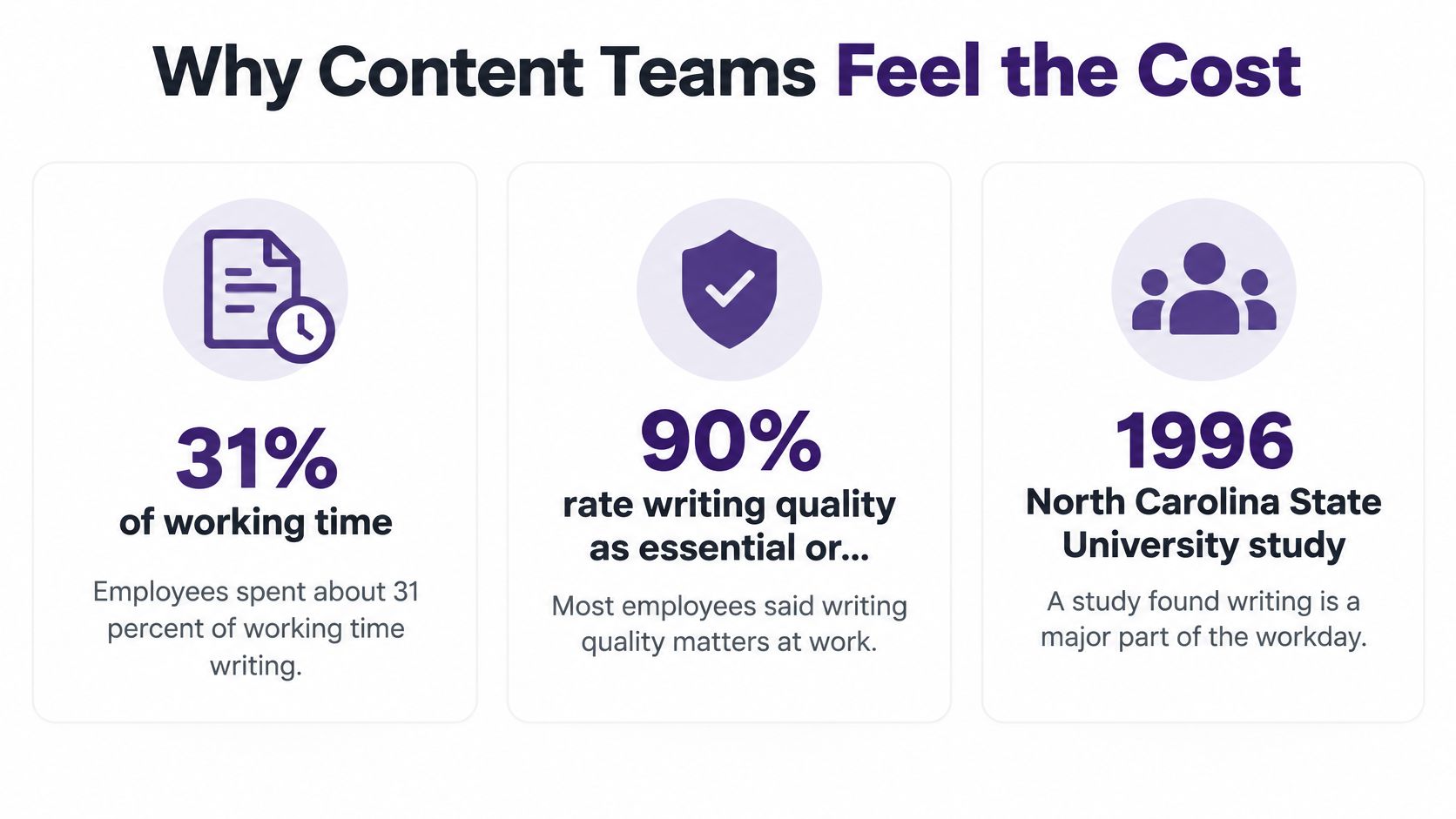
Start from the bill, not a pep talk. The 1996 North Carolina State University study of workplace communication reported that employees across professions spent approximately 31% of their working time writing. It also found that 90% of respondents considered writing quality either essential (50%) or very important (40%) to job performance. Writing quality mattered for advancement too, with 82% rating it essential (45%) or very important (37%).
Nobody on a content desk escapes that load by being technical. In that same study, engineers performed 60% of their writing by request, compared with 52% across the broader respondent group. Your editor, producer, and thumbnail designer are in the same position. They write briefs, captions, notes, and handoffs all week, whether or not "writer" appears in their title.
Now translate that onto a publishing schedule. A fuzzy brief becomes a reshoot because the host answered a question nobody asked. A muddy newsletter loses the click that a clear ask would have earned. A transcript nobody can scan never becomes a second asset, so the idea gets recorded again from scratch in three months.
Three Scenes You Probably Recognize
Say a YouTuber runs a 40-video playlist on one topic. A viewer asks a question in the comments, and the creator knows an older episode answered it, but every title says some version of "my process" or "big lessons." They film a new reply instead of linking the old answer. The library had the asset. The label hid it.
Say a podcaster's show notes summarize the conversation in the order it happened. The guest's best line sits in paragraph four, unnamed, with no timestamp. A marketer hunting for a clip quote gives up and writes generic copy. The episode performs fine, but its most shareable sentence never travels.
Say a publisher's archive uses five names for one topic across years of posts. A marketer searches one name, finds two pieces, and commissions a new post that already exists under another label. That's not a creativity problem. It's a retrieval problem, and it bills you in duplicated work. Teams thinking through how messaging habits shape this kind of friction may find useful angles in the 1chat blog, which covers everyday communication choices in modern workplaces.
Every hour spent decoding old copy is an hour not spent on the next original idea. That's the stake. Weak writing doesn't just read badly once. It makes your whole library harder to interpret, retrieve, and repurpose, which is exactly where the money in a back catalog lives.
Formats From Email to Show Notes
Different formats do different jobs, but each one follows a shape you can reuse. Learn the shape and you stop inventing structure under deadline pressure. You'll also start leaving behind the one searchable sentence a future teammate needs.
| Format | Job of the piece | Shape to use | What to keep for reuse |
|---|---|---|---|
| Get one decision or next step | Subject, two lines of context, one ask, one deadline | The decision and the date | |
| Article | Teach one idea a searcher can use | Answer, steps, worked example, next action | The answer sentence and subheads |
| Script | Be clear when spoken on video or audio | Hook, promise, three beats, spoken call to action | The promise and the ask in text |
| Show notes | Leave a scannable record of the episode | Title, three takeaways, timestamps, links | Takeaways and timestamps |
Email and Article
An email carries one decision. The subject states it, two lines give context, one sentence makes the ask, and one date closes it. Example subject, "Guest clip approved for Thursday." The body asks for a yes on the title and doesn't tour the whole edit. The sentence a teammate will search later is the decision itself, so write it plainly. Fill-in line, Subject [decision] / Ask [action] by [date].
An article answers the search on the first screen. Give the answer, then the steps, then one worked example, then a note on what to do with an older related post. Say a cooking creator updates a knife skills post. The opening answers which grip to use, the steps show it, one example applies it to an onion, and the close points readers to the older sharpening post. Fill-in line, Answer [one sentence] / Steps 1. [step] / Next action [step]. The answer sentence is your reuse label, so make it quotable.
Script and Show Notes
A script is written for the ear. Use a hook, a promise, three beats, and a spoken call to action that still makes sense if the on-screen graphic fails. Short sentences help because listeners can't reread. Our notes on writing for podcasts go further on phrasing that survives being heard once. Fill-in line, Hook [line] / Promise [benefit] / Beats [three points] / Spoken ask [call to action], also typed in the text.
That last clause matters. Here's the edge case teams miss. A script can sound natural and still be a bad archive if the spoken ask never appears in text. Six months later, nobody can search for what the episode asked viewers to do. Type the ask into the script document and the show notes, every time.
Show notes are the scannable record. Use a clear title, three takeaways in plain words, timestamps, and links a viewer would open. Skip the paragraph that retells the episode in order. Fill-in line, Title / Takeaways [three lines] / Timestamps / Links. Each takeaway is a future search result, a future clip caption, and a future newsletter line, all in one.
The sentence a future teammate would search is the label on the asset. Write that sentence on purpose, in every format.
Don't invent a new piece to practice this. Paste one existing asset into the matching shape and see what falls out. The gaps you find, a missing ask, a buried takeaway, an untyped call to action, are your edit list. Fix the shape once and every future repurpose gets faster.
When Polished Writing Loses Trust
A cleaner draft isn't always a better message. That's the uncomfortable finding worth sitting with. A 2025 study of 1,100 working professionals found that AI-assisted messages were often judged more professional, yet heavy AI use in supervisor communications substantially reduced perceived sincerity, with only 40% to 52% of employees viewing high-AI messages as sincere, compared with 83% for low-assistance messages.
The image below shows the everyday version of that choice, two drafts of the same note with very different warmth.
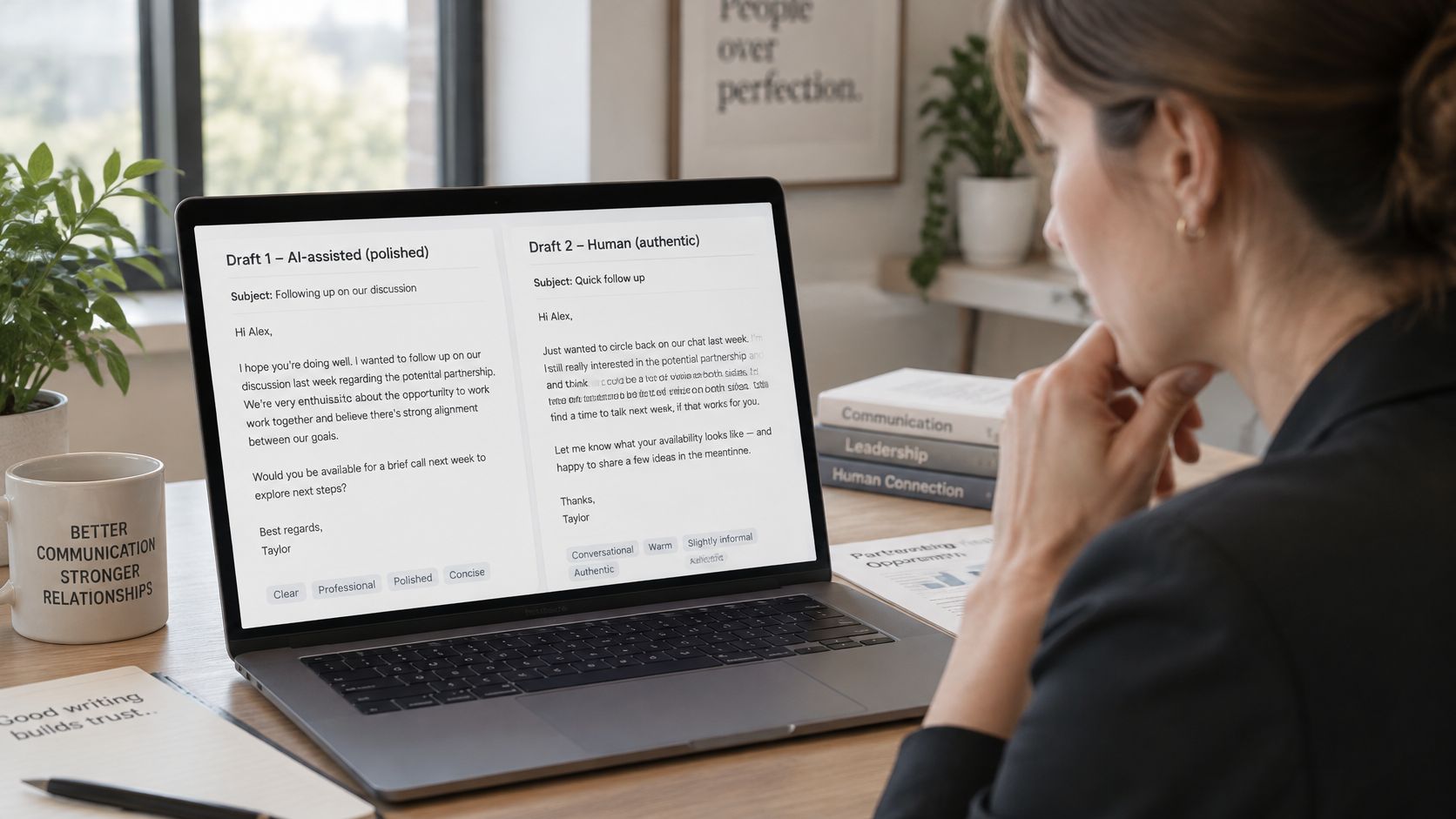
Professionalism ratings moved the same way. They fell from 95% for low-AI messages to 69% to 73% for heavily AI-assisted messages. Readers weren't punishing errors. They were reading heavy polish as reduced care, and that reading cost the sender both sincerity and professional standing.
| Message type | Perceived sincerity | Perceived professionalism |
|---|---|---|
| Low-assistance supervisor messages | 83% | 95% |
| Heavily AI-assisted supervisor messages | 40% to 52% | 69% to 73% |
Two Lanes for Two Kinds of Writing
Split your work into two lanes. Transactional pieces, such as upload reminders, timestamps, and factual corrections, can take a strong machine pass. Nobody needs your soul in a caption fix. Relational pieces are different. Praise for an editor, notes on a host's performance, a brand thank-you, or a conflict message all need lines the recipient can recognize as yours. The line between these lanes tracks closely with choices about informal vs formal writing, where register signals how much personal presence a message carries.
Watch the difference on one missed deadline. The polished version says, "I wanted to reach out regarding the deliverable timeline and express that alignment on expectations will be important moving forward." It's smooth, chilly, and says almost nothing. The relational version is shorter. "The edit landed a day late, so we missed the sponsor slot. I should have flagged the risk Tuesday. Can you send the revised cut by noon tomorrow?" It names the fact, owns the impact, and asks for one next step.
The short video below is worth a watch before your next round of revisions, as a reminder of how tone lands on a real reader.
Use one test before you accept any rewrite. Mark any sentence you wouldn't say on a call, and rewrite it in your own cadence. Then tag library items as transactional or relational so a later repurpose doesn't sand the human lines off a relationship. The question to ask isn't whether the draft got cleaner. It's which sentences must still sound like us.
Exercises and Metrics That Show Progress
You don't need a course to get better at this. You need three short exercises run on real work, plus a few signals tracked long enough to show a trend.
Exercise 1, the restatement. Hand a draft to a teammate who missed the recording and ask them to write the point in one sentence. If their sentence drifts from yours, the opening failed, not the teammate. Rewrite the opening until a cold reader lands on your claim without help.
Exercise 2, the jargon swap. Pick one in-house label, such as "pillar asset," and replace it with the plain action it stands for. Then check whether a new viewer still knows what to do. If the plain version works in public copy, keep the label for internal tags only. You'll be surprised how many cherished terms are just habits wearing a uniform.
Exercise 3, the social read. Take a grammatically better suggestion from any tool and score it for authority, warmth, directness, and inclusion. A suggestion can fix a comma and still sound like a stranger, a boss, or a brand you aren't. Rejecting a correct edit for social reasons isn't sloppiness. It's judgment.
Why the Social Read Matters
Readers detect more than correctness. The 2025 EdAssist Education Index from Bright Horizons reports research in which human assessors identified AI-generated writing with 68.1% accuracy and human-written text with 86% accuracy, mainly from tone, relationship, language choice, content, and structure rather than grammar alone. Your audience is running the same detection on every note you send.
The habit to break is uncritical acceptance. That same source reports a 2025 cross-institutional study in which 54.5% of students accepted AI writing-assistant suggestions most of the time, while 28.6% accepted them about half the time. Accepting by default trains your voice out of your own library, one reasonable suggestion at a time.
| Signal | How to measure | Target | A miss means |
|---|---|---|---|
| Restatement | A teammate states the point in one sentence | Matches the intended claim | The opening is unclear |
| Comprehension | Three questions on the main claim, five-piece sample | Most answers correct | Density is hiding the idea |
| Tone rejection | Share of suggested lines sent back for voice | Trending down from a month-one baseline | A cleaner line was socially wrong |
| Reuse time | Minutes from labeled draft to a second format | Faster than the unlabeled baseline | Structure is blocking repurposing |
Run those four signals for a month on five ordinary pieces, not one hero post you're polishing for a launch. Ordinary work is where your habits live. A comprehension miss means cut density. A tone miss means the suggestion was socially wrong even though the grammar improved. A slow reuse time means your labels still aren't doing their job.
Measure the trend, not the trophy. One great post proves you can do it once. Five ordinary pieces improving month over month proves your team changed its habits.
Scale the Skill Across a Library
Skip the style guide nobody will open. Run a four-week loop on work you've already published, and let the repairs teach the standard.
The infographic below lays out the loop at a glance.
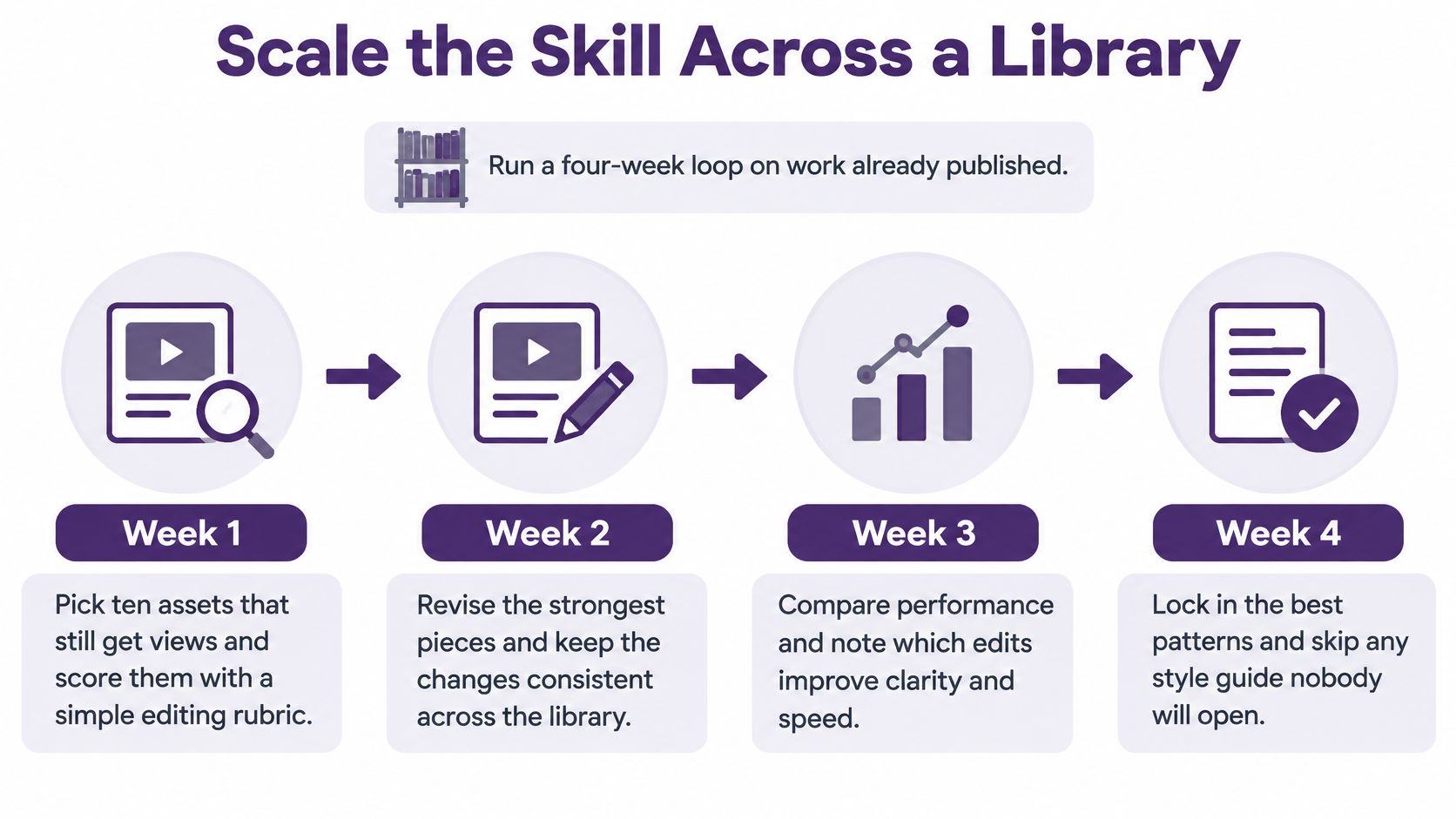
Week 1. Pick ten assets that still get views and score them with the five-part card. Don't fix anything yet. You're building a map of where your library stands, and the pattern across ten pieces will tell you more than any single bad draft.
Week 2. Rewrite only the weakest opening, ask, and searchable label on each piece. Resist the full rewrite. Those three elements decide whether an asset can be found and reused, and they're fast to repair. This is also where research agents can help on a larger catalog, since Step 2 of our workflow locates specific keywords, recurring themes, and hidden stories across hundreds of hours of historical media, and you can create dossiers and share findings.
Week 3. Have a second person run the restatement and tone checks, and log every time a human overrules a generated line and why. That logging habit mirrors the NIST AI Risk Management Framework appendix on human-AI interaction, which organizes responsible AI work into four functions, govern, map, measure, and manage, and says organizations should collect data about how often and why people overrule AI outputs. NIST released a Generative AI Profile for the framework on July 26, 2024. Your override log becomes a small, honest record of where machine polish helps and where it hurts.
Week 4. Publish one repaired piece in a second format and note what the clearer writing made possible. Step 3 of our workflow extracts context and transforms unstructured material into structured insight, and you can mix content sources to create new angles, drafts, scripts, and campaigns. Then, in Step 4, your team refines outputs, and you can generate final social assets, blogs, or newsletters ready for distribution. The clearer your labels going in, the less cleanup that refinement takes.
For a library too large to skim by hand, Contesimal's library organization can run the same loop by tagging items as transactional or relational, so the human lines stay protected while the factual pieces move fast. Keep the scope small at first. Start with one playlist or one show, score ten pieces this week, and fix the five openings that block reuse. That's a finishable job, and it pays you back every time someone searches the archive instead of starting over.
Your library already holds the ideas, and clearer written labels are what turn those recordings and posts into assets your team can find, trust, and reuse across platforms. Contesimal helps you organize that library, surface the themes and lines worth reviving, and turn old longform work into fresh posts, scripts, and newsletters with your voice intact. Visit us, bring one playlist or one show to start, and score your first ten pieces this week.