
Snowball sampling is a non-probability, chain-referral method in which a few seed participants recruit eligible peers, who recruit further peers in successive waves. That chain is the whole design: access travels through people who already know each other, and nobody's chance of being picked is known in advance.
So why do so many write-ups treat a longer chain as a more trustworthy sample? If the next person only appears because the last person knew them, extra names can redraw the same circle with sharper lines. The useful question isn't "how many people did we find?" It's "who could this chain never reach, and is that okay for what we're trying to learn?"
What Snowball Sampling Means in Plain Terms
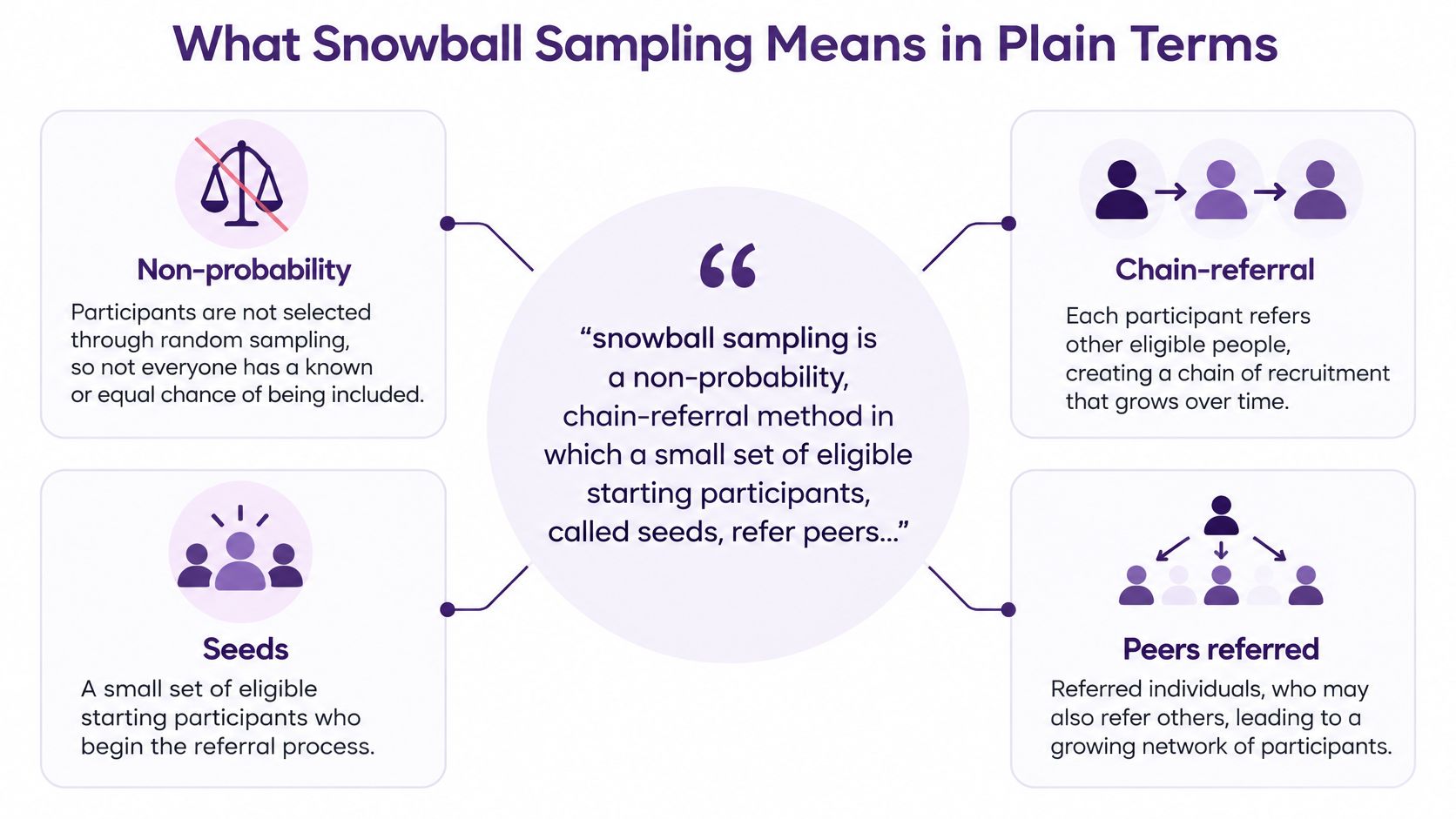
Snowball sampling is a non-probability, chain-referral method in which a small set of eligible starting participants, called seeds, refer peers who meet the study criteria, and recruitment continues through successive waves.
Three labels keep the picture straight. Seeds are wave zero, the people you recruit first because they already fit. The people those seeds refer are wave one. Everyone after that, named by someone already in the study, sits in a later wave.
Think of a snowball on a hill. It starts small and picks up more snow each turn, but the path still depends on the slope it rolled down. A chain that starts inside one friend group keeps rolling through that friend group.
A random draw works from a list, and every member has a known chance of selection. Referrals follow social ties instead, so each person's chance of appearing stays unknown. A Springer review of chain-referral designs notes that the approach is especially useful for hidden, stigmatized, rare, or geographically dispersed populations whose sampling frame is incomplete or unavailable, and that the sample can't ordinarily support unbiased estimates of population prevalence.
A hobby-community chain
Say you're studying people who left a niche hobby community. You ask three former members to refer others, and each new interview names the next contacts. You didn't pick from a membership roll. You followed introductions.
Before you write the methods paragraph, place the choice inside a fuller research methodology so a reader can see what the design is for. Set eligibility yourself, apart from who gets named. Start seeds in deliberately different networks, and log each chain plus how deep the waves go. The method is strongest for themes, social mechanisms, terminology, or relationships, not for a population parameter.
Restate the definition without the jargon. Then name the seeds and the waves for the study you want to run.
How a Snowball Sample Grows Wave by Wave
The first week feels slow because you're still hunting starting contacts. Once those people pass the invitation along, names arrive faster than you can screen them. A short walk-through of the waves makes the pace easier to picture.
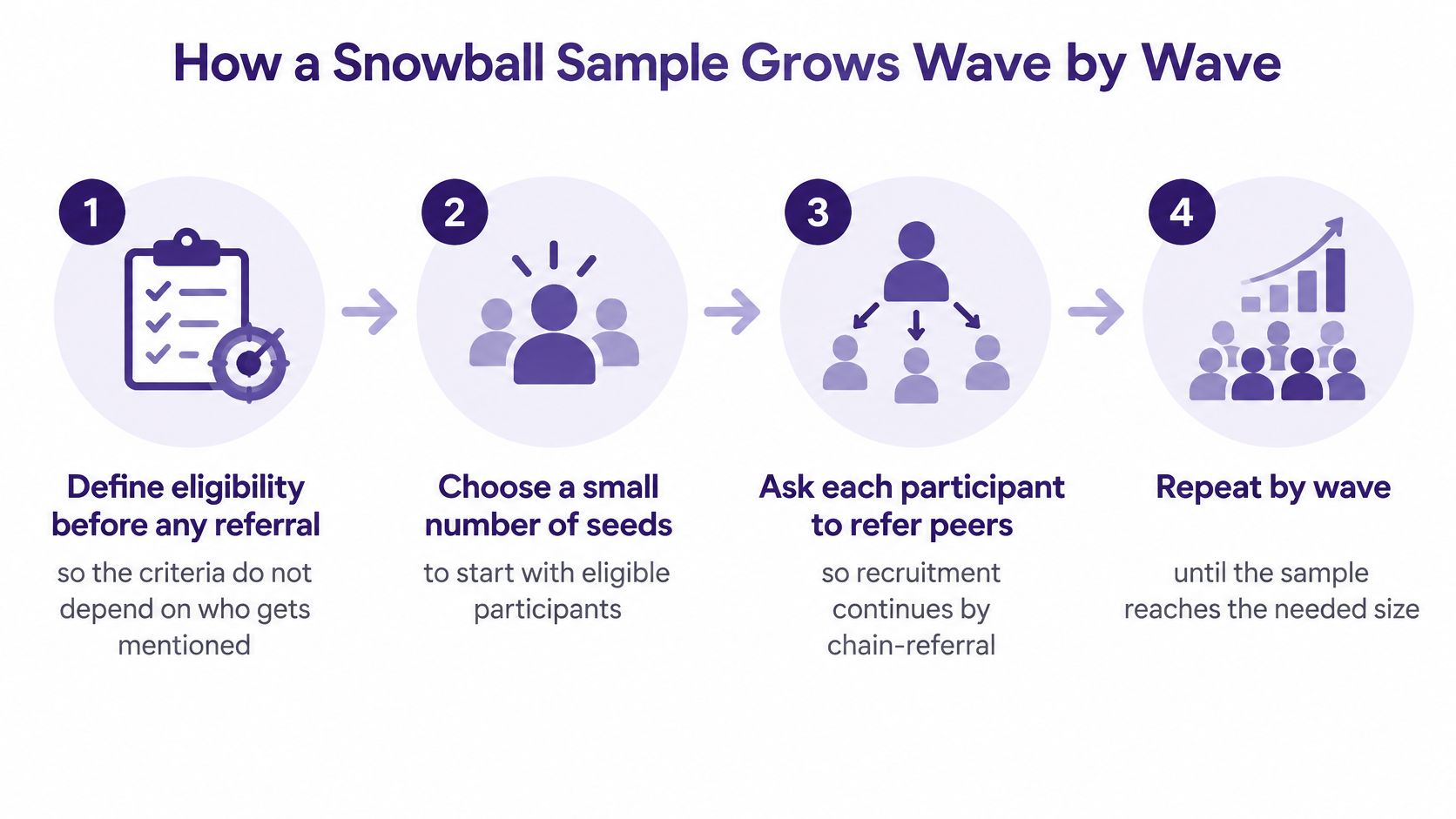
A standard procedure, as set out in Heckathorn's account of chain referral, begins with a small group of initial contacts. Each is asked for a fixed number of eligible people, those recruits are approached, and they refer further people until a predetermined sample size or enough information is reached. Seeds picked for access, not at random, limit unbiased population estimates.
- Write eligibility before any name appears. If the rule shifts to match whoever gets mentioned, the chain defines the study instead of the question.
- Pick a small set of seeds from different corners. One club, one city, or one group chat tends to reproduce itself. Contrasting starts give you more than one slope.
- Ask each seed for a fixed number of peers, or to forward a neutral invitation. A cap stops one popular person from filling the whole sample.
- Screen recruits against the written criteria, then interview those who qualify. A referral is a lead, not automatic enrollment.
- Ask each new participant for referrals and log who named whom. A chain you can't trace is a story you can't defend.
- Count referrals made and people who qualified in each wave. Stop at the target size, or when new interviews repeat themes you already have.
If you want a quick check on whether later interviews are only echoing earlier ones, you can design interactive quizzes that reuse the same prompts with each new wave and show you where answers stop changing.
A healthy finish has several chains from different seeds, a wave depth you can point to, and a log a skeptical reader could follow without calling you.
Snowball Sampling Compared With Other Sampling Methods
| Method | How participants are chosen | Needs a sampling frame | Supports population estimates |
|---|---|---|---|
| Simple random sampling | Every member has a known chance of selection | Yes | Yes |
| Purposive sampling | Researcher picks cases by set criteria | No | No |
| Snowball sampling | Current participants refer eligible peers | No | Generally not |
| Respondent-driven sampling | Structured referral waves with limited recruitment and weighting | No | Only under explicit weighting assumptions |
Read the columns left to right. The first says who does the choosing. The second says whether you need a list of the population before you start. The third says whether the numbers can stand in for the wider group.
Simple random sampling is the benchmark. A known chance of selection is what lets you estimate population values. Purposive sampling lets you hand-pick cases that match criteria you set, which is right for a deep look at specific situations and wrong for a head count of everyone.
Snowball sampling needs no list, which is why it shows up when no frame exists. It generally can't estimate prevalence. Respondent-driven sampling is the formal relative. Columbia University's description of RDS treats wave zero as the seeds, wave one as people the seeds recruit, and later waves as recruits from earlier participants. Those studies commonly begin with approximately 3–15 seeds, who receive a predetermined number of recruitment coupons, plus two incentives: one for completing the study and another for successfully recruiting eligible peers. Any estimate still rests on weighting assumptions.
Practical rule: Pick the row from the question you need to answer, not from whichever method is easiest to start this week. Circle the column your study actually cares about, then live with what that column refuses to promise.
Strengths and the Selection Bias Built Into Referrals
Referral earns its place when a list doesn't exist.
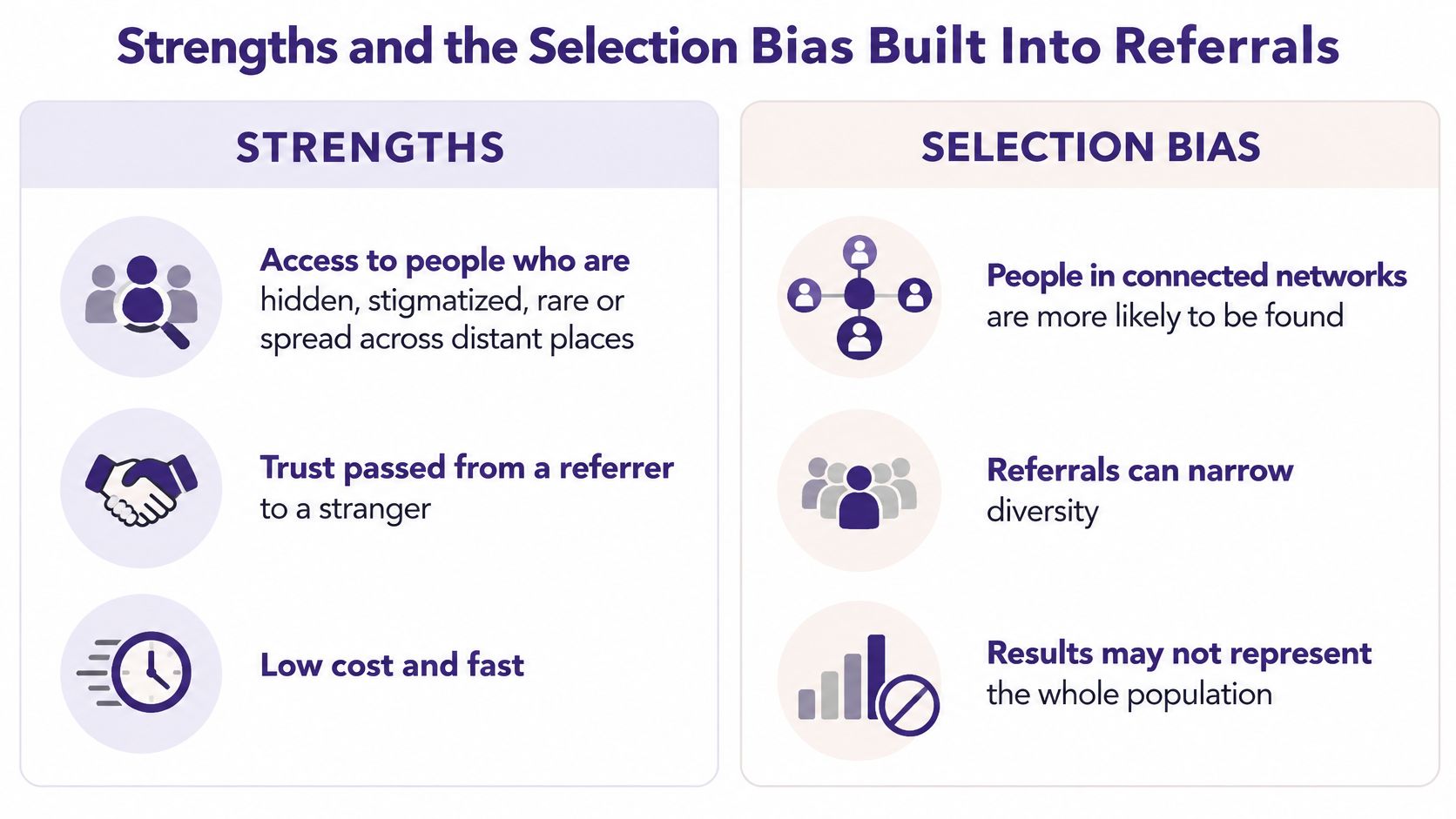
- Hidden, stigmatized, rare, or far-flung groups: A trusted introduction reaches people a mail-out never finds.
- Trust handed from a known person to a stranger: The referrer vouches for you before you speak.
- Low cost once seeds are in: The community does the searching.
- No complete roster required: You can start without pretending you have one.
The risk that wrecks inference is network-dependent selection bias. People tend to refer others who resemble them in characteristics, behavior, or social position. Highly connected individuals create more chances to be recruited. People outside those networks, or with few social ties, can be left out.
Why the skew compounds
Bias from the first, convenience-based seeds carries into every later wave, and both its size and its direction stay unknown. A bigger chain doesn't repair that. As a review of referral bias puts it, a larger referral chain can reproduce the same network-specific composition more precisely rather than make it representative. Ordinary snowball samples shouldn't be treated as probability samples or analyzed with standard survey generalization claims.
Safeguards you can do:
- Several seeds from contrasting subgroups, not one well-connected starter.
- A watch on referral-tree concentration, so one branch doesn't swallow the sample.
- A comparison of traits across waves, to see whether later people still match the first.
- A record of nonresponse, including people who were named and never joined.
- Findings written as context-bound evidence, unless separate validation supports a wider claim.
Worked Examples and How to Refer Safely
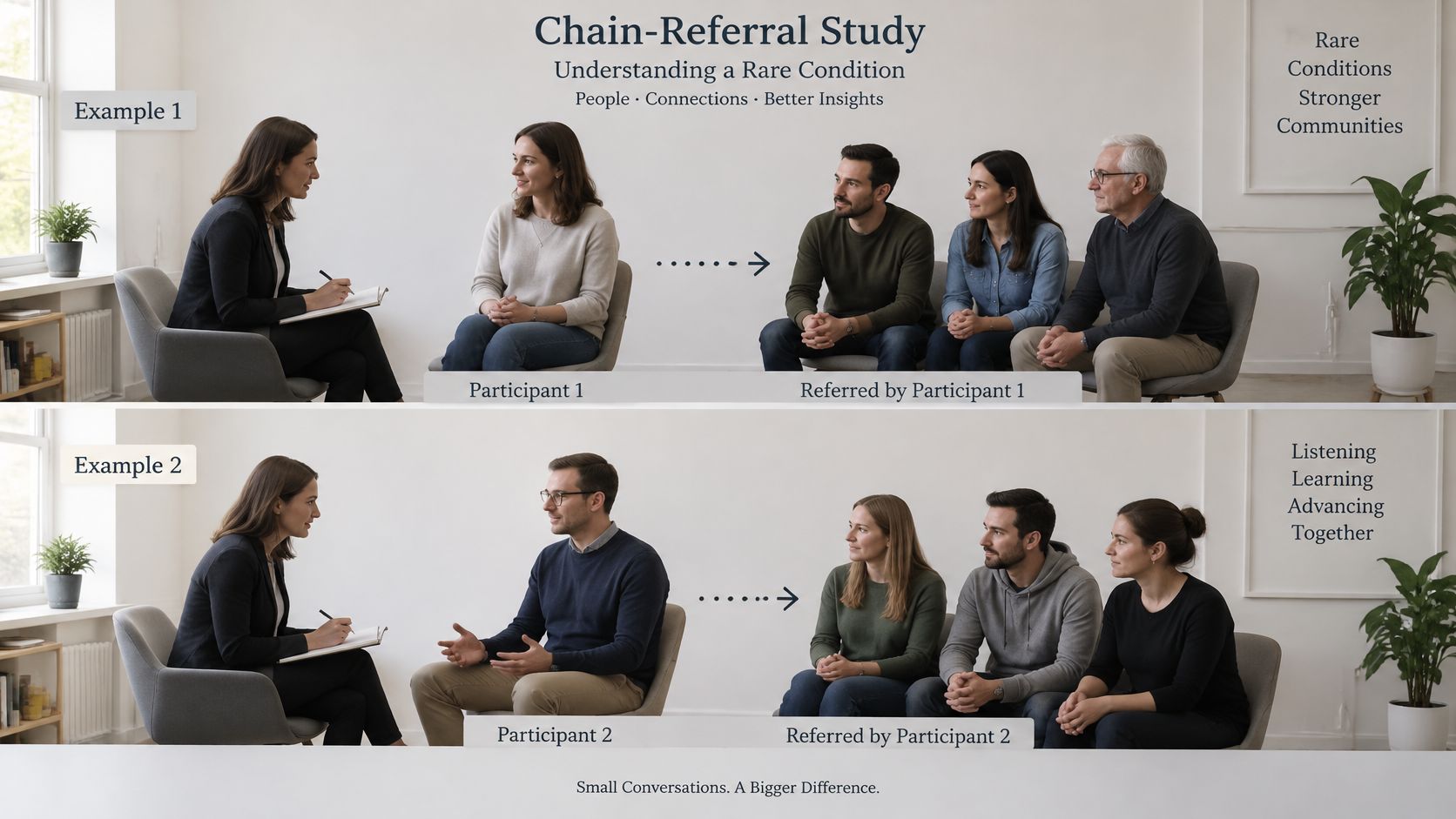
A clinic researcher wants people living with a rare condition who appear in no registry. Three members of a patient group act as seeds. Each interview ends with a request to forward a neutral invitation, not a request for someone's name. The log shows two regions filling quickly and a third staying thin. The study can describe how people found care and the words they use for it. It can't say how common the condition is, or that the thin region has fewer cases. Thin may only mean the seeds didn't know anyone there.
A content analyst wants the audience of a niche podcast. Superfans from different forums are the seeds. Interviews surface recurring themes and a shared vocabulary. Those findings describe the people the chain reached. They don't estimate the share of all listeners who hold a view. For turning those transcripts into codes you can defend, a clear content analysis write-up keeps themes separate from head counts.
Referring without outing someone
The step most introductions skip is privacy. A referral can disclose that another person may belong to a stigmatized or sensitive population before that person has consented. Central Michigan University's compliance guidance flags the same risk when the referrer is a community authority figure, because an invitation may feel obligatory rather than voluntary.
- Forward a neutral invitation. Participants shouldn't hand you another person's identity, and the note shouldn't reveal why you think someone qualifies.
- Don't tie staying enrolled to recruiting. People should be able to withdraw without pressure, and referral tracking should stay separate from their answers.
- Get ethics review for sensitive groups. Messaging apps make referrals fast and leave durable social traces, including in creator communities and cross-border work.
Hard to reach doesn't mean safe to identify through friends. If the conversations themselves need tighter questions, it helps to conduct more insightful user interviews so the referral step isn't doing the work the interview guide should do.
When Snowball Sampling Is Defensible
Most explainers mention bias and then stop at "we reached saturation." That's convenience dressed up as a decision. Saturation tells you themes stopped changing inside the chain you built. It doesn't tell you the chain covered the population.
| Research goal | Snowball fit | Why |
|---|---|---|
| Map themes or terminology in a hidden community | Good fit | Referrals reach people who appear on no public list |
| Study a stigmatized or rare group with no list | Good fit, with safeguards | No sampling frame exists; use several seeds from contrasting subgroups |
| Explore social networks or relationships | Good fit | The referral chain is itself the object of study |
| Estimate the prevalence of a condition | Poor fit | Inclusion probabilities are unknown, so estimates can't be unbiased |
| Make population-wide claims from the sample | Poor fit | Network position decides who appears in the sample |
Exploratory discovery can surface themes, terms, mechanisms, and relationships. Representative measurement generally can't, unless a stronger design or explicit weighting assumptions are justified. A methods note from the University of Mainz is blunt on the next point: adding more referral waves doesn't automatically repair selection bias, because later participants remain conditioned by the original seeds and network structure. Report the chains, why each seed was chosen, referral-wave attrition, network position, and the stopping rule. "Saturation was reached" on its own is not that report.
A six-item go or stop check
- No usable sampling frame exists for this population.
- The goal is themes, terms, or relationships, not a population estimate.
- Eligibility is fixed apart from who gets referred.
- Seeds come from contrasting subgroups.
- Every chain and wave depth will be logged.
- A neutral invitation and ethics review are planned where the topic is sensitive.
Yes on the first two, with the rest arranged before you start, means snowball sampling is defensible. A population estimate plus a frame you already have means stop and use a probability design. Write the six answers into a short protocol, the kind of plan you'd keep beside a sample research plan, and recheck after wave one. If nearly everyone traces back to one network, you don't have breadth. You have one slope, drawn more carefully.
If your next study lives inside a library of interviews, episodes, and old posts, Contesimal gives teams a shared place to classify that material, search it, and turn scattered notes into structured insight. Shared research sessions let you keep seed logs, theme lists, and chain notes where collaborators can use them, instead of burying the method in one person's folder. Visit Contesimal and start with the library you already have.