
If your content team feels like it’s herding cats, you’re not alone. The chaos of scattered emails, endless Slack threads, and spreadsheets that look like cryptic crossword puzzles is the reality for too many creators. This is where editorial workflow management software steps in to help you reignite your content library and bring it back to life.
Simply put, this software is the central nervous system for your entire content operation, pulling everything from a half-baked idea to the final published piece into one place. It creates a single source of truth, ending the confusion and making sure writers, editors, and marketers are all on the same page and hitting their deadlines.
The Conductor for Your Content Orchestra
Think of your content team as an orchestra. You have brilliant musicians—the writer, the editor, the designer, the social media manager—each a master of their craft. But without a conductor, all you get is noise. A beautiful symphony requires everyone to play in harmony, following the same sheet music and hitting their cues at just the right moment.
Editorial workflow management software is that conductor. It organizes the creative chaos into a smooth, predictable production line. No more digging through emails to find the "final_final_v3.docx" or wondering if a piece has been approved. The entire process becomes visible, trackable, and honestly, a lot less stressful. To really get it, you have to understand What is workflow automation and how it completely changes the game.

From Manual Chaos to Automated Clarity
For so many creators, the "workflow" is really just a series of manual tasks held together by good intentions and frantic follow-up messages. A proper software solution replaces that shaky foundation with solid ground, helping you organize, understand, and take action.
A well-defined editorial workflow eliminates bottlenecks by automating task assignments and notifying stakeholders at the right time, ensuring seamless progress through each stage.
This is a fundamental shift from being reactive to proactive. Instead of chasing people down for feedback or assets, the system does the heavy lifting. It automatically moves content along the assembly line, pinging the right person when it’s their turn to step in. This newfound clarity frees up your team from mind-numbing admin work so they can focus on what they were hired to do: create incredible content.
The difference is night and day. Let’s break down just how much things change when you move from a manual process to one powered by dedicated software.
Manual vs Automated Editorial Workflows
| Stage | The Old Way (Manual Chaos) | The New Way (Automated Clarity) |
|---|---|---|
| Ideation | Ideas are scattered in emails, personal notes, or random documents, easily lost forever. | Ideas are captured and prioritized in a central backlog where everyone can see and contribute. |
| Assignment | Tasks are dished out via Slack or email, with no easy way to track who’s doing what. | Writers get automatically assigned tasks that come with clear briefs and firm deadlines. |
| Creation & Review | Multiple file versions float around (you know, "final_v2_final.docx"), causing confusion. | All content is created and edited in a single platform that tracks every change. |
| Approval | Endless email chains with conflicting feedback from different stakeholders create gridlock. | A clear, linear approval chain notifies stakeholders one by one when it's their turn to review. |
| Publication | A last-minute scramble to format and schedule the approved content leads to errors. | Content is automatically pushed to your CMS or social channels as soon as it gets the final green light. |
Looking at it side-by-side, it’s clear how one path leads to burnout and missed deadlines, while the other creates a calm, efficient, and scalable content engine.
Solving the Hidden Costs of a Broken Workflow
A disorganized workflow does more than just cause headaches; it actively sucks the life out of your creative energy, your budget, and your team’s spirit. When you’re stuck relying on endless email chains and scattered spreadsheets, you create a tangled web of "hidden costs" that quietly poison your entire content operation. These aren't obvious line items on a budget, but you feel them in missed deadlines, inconsistent quality, and outright creative burnout.
The frustration is real. Just think of the hours you’ve wasted hunting for the right version of a script, or the sheer panic that hits when an approval gets buried in a crowded inbox. It turns out you're not alone. Research shows that a staggering 68% of content teams struggle with workflow inefficiencies, which leads to a massive drop in productivity. This isn't just about being annoyed; it's about losing precious time that could have been spent upcycling old content to create new value.
Every minute your team spends fighting administrative friction is a minute they aren't using to connect with and grow your audience. This operational drag is a direct tax on your creativity and, ultimately, your bottom line.
Reclaiming Wasted Time and Energy
A broken process turns creators into part-time project managers. Instead of dreaming up killer hooks or perfecting an edit, they're chasing down feedback, manually updating tracking sheets, and trying to decipher who’s supposed to do what next. This constant context-switching is a productivity nightmare.
Bringing in a dedicated editorial workflow management software completely changes the game. It provides a clear, automated path for every single piece of content, pulling your team out of the logistical quicksand.
An effective workflow system transforms your process from a series of frantic, manual handoffs into a smooth, automated assembly line. It gives everyone on the team the clarity to focus on their specific role without worrying about what’s happening upstream or downstream.
This shift creates a ripple effect. You don't just get back the hours previously lost to admin tasks; you also see a huge boost in team morale. Creators can finally get back to doing what they love, which means better work and less burnout. For those looking to dig deeper, this resource on Mastering Content Workflow Management offers fantastic insights into structuring these processes.
From Inconsistent Quality to Brand Integrity
Inconsistent output is one of the most obvious symptoms of a broken workflow. When there’s no standardized process for reviews, fact-checking, or brand alignment, quality becomes a total crapshoot. One article might be perfectly polished, while the next is riddled with errors because a key review step was accidentally skipped.
That kind of inconsistency chips away at your brand's reputation and erodes the trust you've built with your audience. A structured workflow fixes this by building quality control right into the process itself.
- Standardized Checklists: Make sure every piece of content—whether it's a video, podcast, or blog post—goes through the same essential checks for SEO, brand voice, and factual accuracy. No exceptions.
- Clear Approval Chains: Content moves systematically from writer to editor to final approver. This guarantees the right eyes see it at the right time, every time.
- Centralized Assets: Everyone works from the same style guides, templates, and approved assets. This eliminates guesswork and ensures a consistent look and feel across all your platforms.
By putting a system in place, you’re no longer just hoping for quality; you’re engineering it. This consistency is what builds a loyal audience that trusts your content and keeps coming back for more. It's the foundation you need to scale your creative work without sacrificing the quality that got you here in the first place.
Essential Features of Top Workflow Platforms
Picking the right editorial workflow software can feel like you’re staring at a wall of tools in a hardware store. They all promise to fix your problems, but the real trick is finding the one that actually solves your specific creative bottlenecks. Forget the generic feature lists for a second. Let's dig into the non-negotiable parts that separate a good platform from a great one.
Think of these features less like a checklist and more like the core ingredients for turning creative chaos into a smooth, predictable production line. Without them, you're just winging it and hoping for the best. With them, you can build a content engine that actually scales, whether you’re a YouTuber transitioning from hobbyist to professional or a publisher looking to grow the value of your content.
Customizable Workflow Stages
Your creative process is yours. It's unique. A generic, one-size-fits-all workflow is never going to feel right. The best software lets you build and customize stages that perfectly mirror how your team already works, all the way from "Crazy Idea" to "Final Edit Approved."
This isn’t just about changing a few labels. It’s about building a digital assembly line that’s perfectly tailored to your content. For a podcaster, that might look like: Episode Idea > Guest Booked > Outline > Recording > Audio Edit > Final Mix > Published. That level of customization means the software finally adapts to you, not the other way around.
Centralized Asset Library
Seriously, how many hours have you burned digging through messy folders, old emails, and random cloud drives just to find a single logo file or a piece of B-roll? A centralized digital asset library is the cure for that headache. It puts every single file—from raw video footage to final thumbnails—in one place where you can actually find it.
This is way more than just storage; it’s about creating a single source of truth for all your creative assets. This becomes a total game-changer when you want to repurpose content. When you can instantly find every asset tied to an old project, turning a long-form video into ten social media clips suddenly becomes painless. To get a better handle on this, check out some of the best digital asset management software out there.
Seamless Collaboration and Communication
The best ideas happen when people work together, but disorganized communication can kill creativity before it even starts. We’ve all been trapped in those endless email chains with conflicting feedback—it’s the classic sign of a broken workflow. Modern platforms fix this with real-time collaboration tools built right in.
You want features that keep the conversation tied directly to the content itself:
- In-line commenting: Lets editors drop feedback right on a document, a specific video timestamp, or a design element. No more confusion.
- @mentions: Lets you tag a specific team member to get their eyes on something, which keeps everyone accountable.
- Version control: Tracks every single change, so you can easily roll back to an earlier version and see exactly who changed what, and when.
These tools mean you stop jumping between your work and your chat app, keeping the entire feedback loop in one place where it makes sense.
Powerful Integrations and Automation
Let’s be real—your editorial workflow doesn't operate in a bubble. It has to connect to all the other tools you use every day, like Google Drive, Slack, your video editor, and your CMS. The best editorial workflow management software acts as a central hub, playing nice with your entire tech stack.
A platform's real power is measured by how well it automates the handoffs between different tools and people. When a writer marks a draft as 'Ready for Review,' the system should automatically ping the editor in Slack. No manual effort needed.
This is the stuff that frees your team from the boring, administrative grunt work. Automation handles the tedious parts—like sending reminders and updating statuses—so your creators can get back to what they do best: making incredible content that hooks your audience and drives growth.
How Different Creators Use a Streamlined Process
Theory is great, but seeing how editorial workflow management software actually works in the real world is where it really clicks. Every creator has their own unique set of headaches, and a flexible system is all about solving those specific logistical nightmares. This isn't about cramming everyone into the same cookie-cutter process; it’s about building a custom assembly line for your brand of creativity.
Let's pull back the curtain on how three completely different content teams—YouTubers, podcasters, and content marketers—can build a process that just works. These examples should help you picture exactly how a structured workflow can fit into your day-to-day and finally bring some order to the chaos.
This visual breaks down the core functions that let creators collaborate, organize, and integrate their tools.
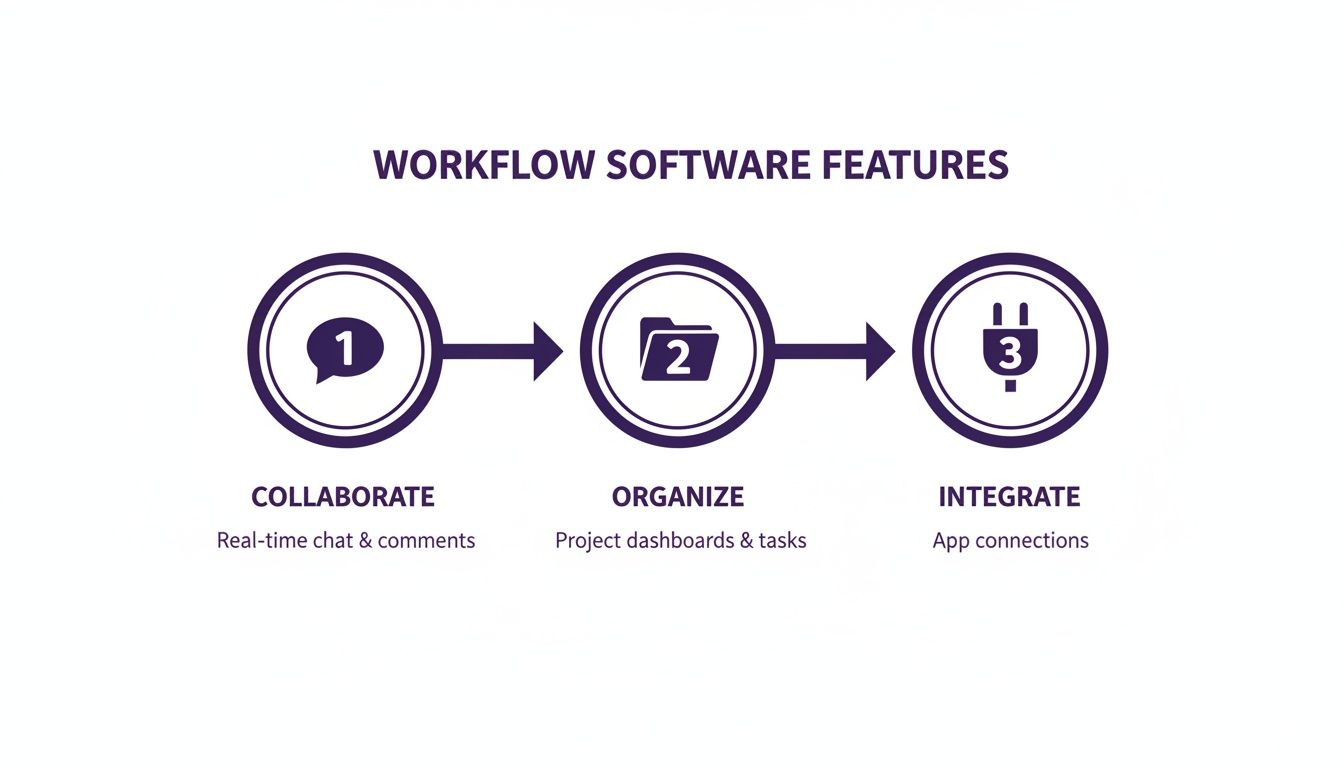
It shows how a successful setup is built on smooth collaboration, one central place for organization, and smart integrations—the real foundation for any creator’s process.
The YouTuber: From Script to Screen
For video creators, production is a multi-layered beast. You've got scripting, storyboarding, filming, multiple rounds of edits, and feedback flying in from all directions. Without a system, it's a recipe for disaster.
A YouTuber can set up a workflow that mirrors their exact production cycle. This simple act transforms the process from a frantic scramble into a predictable, repeatable system that actually scales as the channel grows.
A typical YouTuber workflow might look something like this:
- Video Idea: A backlog where new concepts are dumped and prioritized.
- Scriptwriting: The writer gets assigned the task with a clear brief and a deadline.
- Storyboard/Shot List: The creator or a designer maps out the visual plan.
- First Cut Review: The editor uploads the initial draft for timestamped feedback.
- Final Polish: The video moves to a final editor for color grading and sound mixing.
- Thumbnail & SEO: The marketing person jumps in to create the thumbnail and dial in the title and description.
- Scheduled: The finished video is approved and queued up for publication.
The Podcaster: Juggling Guests and Audio
Podcasters have to manage episode planning, guest coordination, recording times, and complex audio edits. Trying to handle all of that through scattered emails and text messages is a nightmare, especially when you’re working with guests and remote editors.
A dedicated workflow gives you a central hub for every single episode, from the first spark of an idea to the final published audio file. It makes sure guests have the info they need, editors have the right files, and deadlines are crystal clear.
A structured podcast workflow gives you a bird's-eye view of your entire production pipeline. You can see at a glance which episodes are in planning, which are ready for editing, and which are scheduled, eliminating last-minute panics.
This level of organization doesn't just save time; it makes you look far more professional to guests and collaborators. For a deeper dive into wrangling all these moving parts, checking out best practices for project management and collaboration can offer some solid frameworks.
The Content Marketing Team: Managing Multiple Channels
For a content marketing team, the biggest challenges are volume and alignment. They’re running a multi-author blog, getting SEO reviews, coordinating social media, and making sure every single piece of content ties back to bigger campaign goals.
Editorial workflow management software becomes the command center that keeps this whole operation from falling apart. It creates a single, unified process where writers, editors, SEO specialists, and social media managers can all work together without stepping on each other's toes.
Here’s a glimpse at how a marketing team might structure their workflow:
- Content Brief Created: The strategist lays out the article's goal, keywords, and target audience.
- Draft Submitted: The writer finishes the first draft right inside the platform.
- SEO Review: The draft is automatically passed to an SEO specialist for optimization feedback.
- Editorial Review: The editor polishes the copy for clarity, style, and brand voice.
- Final Approval: The head of content gives the final sign-off.
- Promotion Plan: The social media manager gets to work creating promotional assets and scheduling posts.
This kind of system ensures that every piece of content is strategically aligned and quality-checked before it ever sees the light of day, turning the content program into a reliable engine for growth.
Moving Beyond Workflow to Content Intelligence
Standard editorial workflow management software is great for handling the content you're creating right now. Think of it as the assembly line, making sure your current projects move smoothly from a rough idea to a published piece. But what about the mountain of value sitting dormant in everything you've already made? That's where the real magic begins, allowing you to create infinite content value.
This is the jump from just managing tasks to embracing content intelligence. It's about turning your archive from a digital graveyard into a living, breathing asset that actively sparks new ideas. Instead of just organizing your production process, this approach plugs your entire library back into the creative circuit, making it searchable, understandable, and ready for action.

This evolution is catching on fast. The market for this kind of software is expected to explode, rocketing from USD 13.4 billion in 2025 to a staggering USD 158.6 billion by 2035—that’s a growth rate of 28.0% every year. The numbers don't lie. More and more teams are seeing how the right tools can transform chaotic content operations into efficient, insight-driven machines that boost audience reach and SEO. If you want to dig into the numbers, you can explore the full market projection details on Future Market Insights.
Unlocking Your Content Archive with AI
Picture this: you need a specific quote from a podcast you recorded two years ago. Or maybe a particular B-roll clip from a video shoot last summer. The thought of manually scrubbing through hours of media is enough to make anyone's eyes glaze over.
This is where AI-powered search completely changes the game. It acts like a super-powered search engine for your own library, transcribing audio and video, identifying objects, and letting you find that needle-in-a-haystack moment in seconds.
- For Podcasters: Instantly find a guest's killer one-liner to create a punchy social media audiogram.
- For YouTubers: Quickly pull every clip where you mentioned a certain topic to assemble a new "best of" compilation.
- For Publishers: Surface every article that mentions a key person or event to build out a comprehensive new feature.
This capability alone turns your past work from a locked-away liability into a dynamic resource, ready for your next big idea.
Building a Smart Knowledge Base
Of course, a powerful search tool is useless if your archive is a total mess. The other half of the content intelligence puzzle is organization. I'm not talking about just dumping files into folders, but building a smart taxonomy—a structured, layered system of tags and categories that gives your content context and meaning.
A smart taxonomy turns your library from a messy digital attic into an organized, searchable knowledge base. It’s the difference between a pile of books and a library with a card catalog.
This kind of structured approach helps you see connections and patterns you would have otherwise missed entirely. By organizing your content around key themes, concepts, or even customer personas, you create a solid foundation for real creativity. For anyone looking to go deeper, our guide on what content intelligence platforms can do for your business is a great next step.
With a platform like Contesimal, this process gets even smarter. It doesn’t just help you organize what you have; it helps you understand it. By blending powerful search with AI-driven insights, it reveals the hidden relationships between different pieces of content. You can finally see which topics resonate most with your audience and where the real opportunities for new content are hiding.
This is how you stop just managing a workflow and start leading a real content strategy.
How to Measure Your Return on Investment
Bringing on new software is always an investment, and every creator or publisher needs to know it’s actually paying off. Figuring out the return on investment (ROI) for editorial workflow management software isn't just about staring at your bank account. It's about measuring real gains in efficiency, quality, and your team's creative firepower.
When you finally ditch the chaotic spreadsheets and never-ending email chains for a structured system, you get benefits you can both see and feel. The idea is to build a rock-solid case that shows this software isn't just another line item on an expense report—it's a strategic move that helps you organize your content library to create new value and ultimately make money.
Tracking Quantitative Metrics
The most straightforward way to see your ROI is to look at the hard numbers. These are the concrete data points that prove a direct impact on your production pipeline and, ultimately, your bottom line. It's a good idea to start tracking these metrics before and after you roll out the software to get a clear before-and-after picture.
-
Time to Publication: How long does it take for a raw idea to become a published piece of content? A well-oiled system can easily slash this time by 30% or more, simply by crushing the bottlenecks that slow down reviews and approvals.
-
Content Output: Keep a running tally of the total number of articles, videos, or podcasts your team ships each month. When your team isn't bogged down by administrative grunt work, you’ll often see a healthy jump in overall output.
-
Cost Per Piece of Content: Do the math. Figure out the total cost—including everyone's time—to produce a single piece of content. As your team gets more efficient, this number should start to drop, proving the software is paying for itself.
Assessing Qualitative Benefits
Of course, not every win shows up on a spreadsheet. These qualitative gains are just as critical because they speak to the health and sustainability of your entire creative operation. Think of them as the foundation for your brand's long-term success.
The real value of a streamlined workflow is that it frees your team from logistical friction. This reclaimed creative energy translates directly into higher-quality, more innovative content that connects with your audience.
These less-tangible benefits often include:
- Improved Team Morale: When creators get to focus on creating instead of chasing down approvals, they're happier and more locked in. This means less burnout and a much better chance of keeping your top talent around.
- Enhanced Content Consistency: A standardized workflow is your secret weapon for making sure every piece of content meets your quality and brand standards. That consistency builds trust with your audience and solidifies your brand’s reputation over time.
- Better Collaboration: With centralized communication and clear task ownership, misunderstandings fade away, and a truly collaborative spirit takes over. Ideas get shared more freely, which almost always leads to more creative and effective content.
Got Questions? We've Got Answers.
Jumping into the world of editorial workflow management can kick up a few questions. We’ve tackled some of the most common ones to help you see exactly how these tools fit into your creative process.
Is This Software Only for Big Teams?
Not a chance. While huge publishing houses and marketing teams definitely get a lot out of better collaboration and oversight, this kind of software is an absolute game-changer for solo creators and small crews.
Think about a YouTuber or podcaster who's moving from a hobby to a real business. A good workflow system helps you establish a professional process right from day one. It's how you organize your avalanche of ideas, nail down your production schedule, and build a solid foundation so you're ready to grow. It’s like building an organized content engine before you're drowning in chaos.
How Long Does It Take to Get Set Up?
The time it takes to get rolling varies, but modern cloud-based tools are built for a quick start. Most teams can get a basic workflow up and humming in just a couple of days.
The smartest way to start is to keep it simple. First, map out your core production process—the absolute essentials. Then, you can start layering in more automation and cool features as your team gets the hang of it.
Platforms like Contesimal also focus on fast, programmatic uploads, which means you can pull in your entire existing content library from the moment you start. You can begin tapping into the value of your archive almost immediately, no long, manual setup required.
Can Workflow Software Actually Help Me Repurpose Content?
Absolutely. On a basic level, a good workflow tool creates a central hub for all your content, making everything easy to find, adapt, and reuse. That alone saves an incredible amount of time.
But the really advanced systems take it a big step further. Instead of just helping you find what you’re looking for, they use AI to proactively spot repurposing opportunities you might have missed. This means the software can actually help you discover amazing clips, quotes, or ideas buried in your archive that can be effortlessly spun into new social posts, articles, or video shorts. This is how you take your longform content across platforms and turn old content into a money maker.
Ready to go beyond simple to-do lists and finally unlock the hidden gold in your content library? Contesimal uses AI to turn your archive into an active asset, helping you find fresh ideas and repurpose content with zero friction. Organize your work, understand your library, and start making smarter moves today. Discover how it works at https://contesimal.ai.