
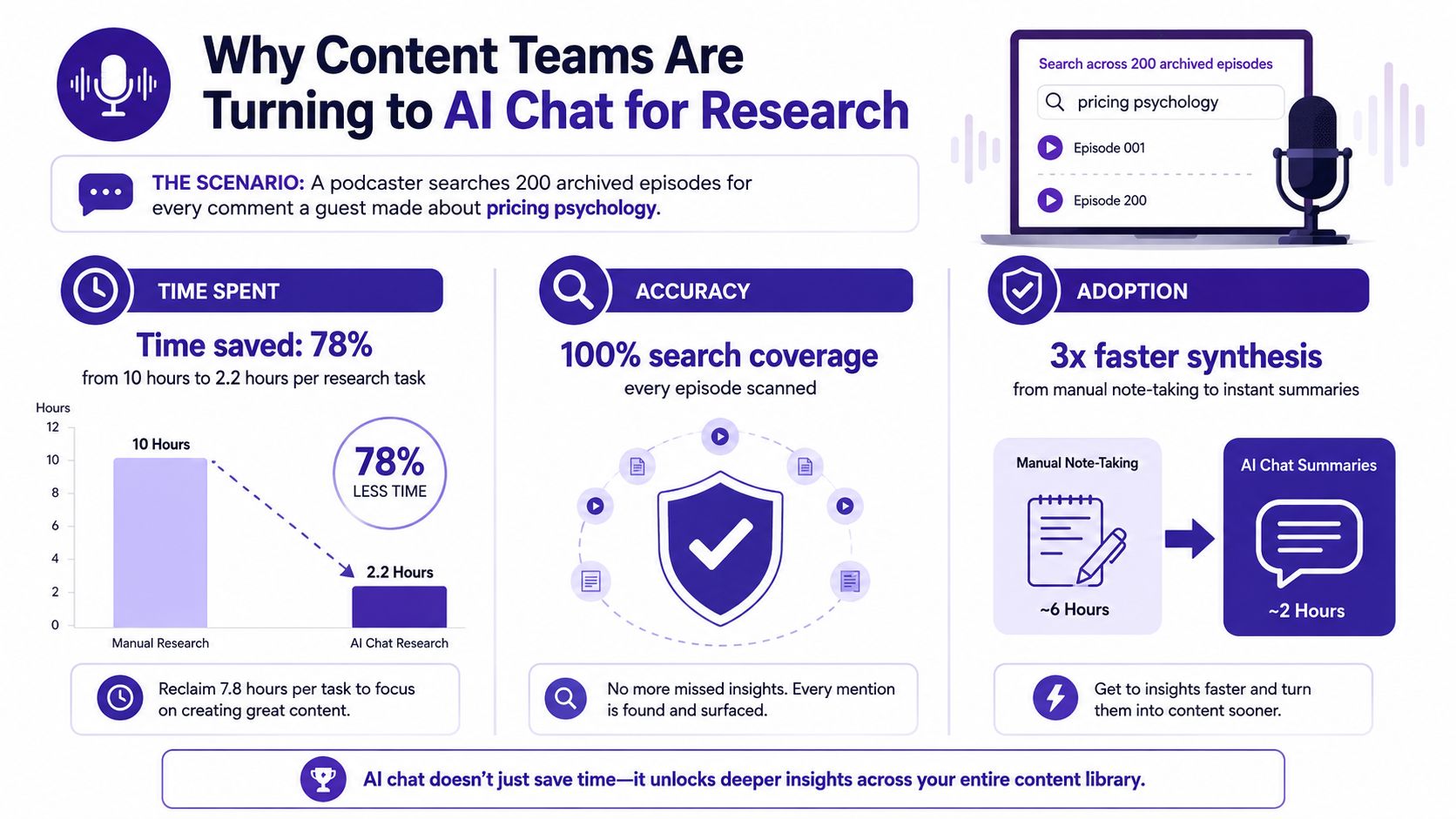
A podcaster sits down to prepare a new episode about pricing psychology. The source material already exists, scattered across 200 archived episodes, but finding every relevant comment from past guests means scrubbing audio, scanning transcripts, and rebuilding context from half-remembered notes. By the time the research is finished, the original idea may have lost its momentum.
That workflow is changing. AI chat for research gives content teams a conversational way to interrogate their own archives, retrieve relevant passages, compare themes, and turn discoveries into new editorial assets. The important distinction is that research chat works best as a layer over an organized content library, not as a general-purpose answer box.
Why Content Teams Are Turning to AI Chat for Research
The podcaster's problem isn't a lack of content. It's the opposite. Years of interviews, articles, videos, newsletters, and production notes create a valuable archive, but the value remains difficult to access when files are poorly labeled or disconnected from one another.
A conventional search query might find an episode title or an exact keyword. It often misses a guest who discussed pricing without using the phrase “pricing psychology,” or a related insight buried in a transcript with inconsistent formatting. Conversational research lets the podcaster ask a richer question: Which guests described how customers react to price changes, and where did their explanations disagree?
That question changes the task from manual recall to structured discovery. The system can identify relevant passages, show the source episode, group related ideas, and help the researcher compare how different guests approached the same subject. The human still decides whether the interpretation is fair, whether a quote is publishable, and whether the new angle adds value.
Why the timing matters
Chat tools have moved quickly from novelty to workplace infrastructure. A major 2024 survey experiment in Denmark examined 100,000 workers across 11 occupations and reported that about half had used ChatGPT, with usage especially high among younger, less experienced, higher-achieving, and male workers. Adoption varied sharply by role, from 79% among software developers to 34% among financial advisors, showing that task fit and information intensity shape practical use. Read the full Danish workplace study.
For content teams, the implication is straightforward. Libraries are expanding faster than people can reread them, while audiences expect fresh interpretations of familiar material. Podcasters need episode themes and quotable clips. Publishers need new angles that don't duplicate earlier coverage. Marketers need to turn one strong asset into coordinated material across platforms.
A useful overview of the broader chatbot category is GetIntel on the best chatbot software, especially when a team is comparing conversational tools. But the decisive question isn't which chatbot sounds most natural. It's whether the tool can search a defined corpus, preserve provenance, and help a team create new value from what it already owns.
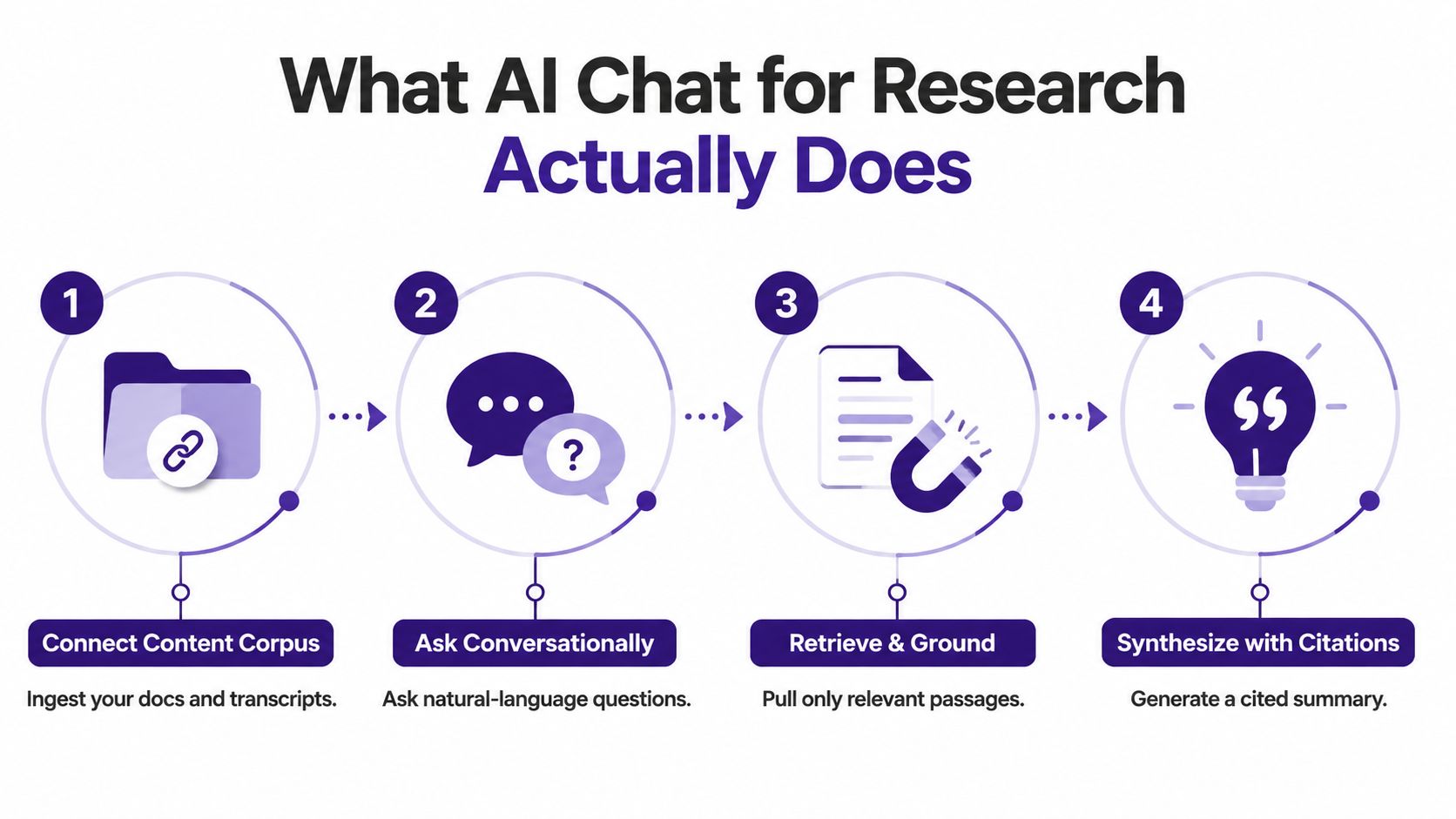
What AI Chat for Research Actually Does
AI chat for research is a conversational interface connected to a defined body of material. Instead of answering only from a model's general knowledge, it retrieves passages from documents, transcripts, videos, or articles that the team has selected, then uses those passages to produce a summary or analysis.
Think of the system as a librarian with a very fast assistant. You ask, “Which interviews discuss customer hesitation before a premium purchase?” The retrieval layer finds the most relevant sections. The language model then explains the common pattern, points out differences, and links the answer back to the original material.
Three technical ideas make that possible:
- Retrieval: The system searches the connected corpus for relevant passages rather than treating every file as equally important.
- Context: The model works from the material placed in its active working space. Like a desk covered with papers, that space has limits, so long or poorly segmented sources can reduce answer quality.
- Grounding: The answer is anchored to retrieved source passages. Strong grounding makes it easier to inspect what supports a claim and identify what the system couldn't find.
The workflow usually looks like this: connect the content, ask a natural-language question, retrieve relevant evidence, and synthesize an answer with references. A research-grade setup also records the scope of the query and the sources used, so another team member can reproduce the result.
Audio creates an extra challenge. A transcript isn't just text, it's the product of speech recognition, speaker labeling, timestamps, interruptions, and context. Teams working with recorded conversations can use this voice transcription context guide to understand why context quality affects downstream research.
Practical rule: Treat every generated answer as a map back to your material, not as a replacement for the material.
A general explanation of the interaction layer is available in this guide to AI chat interfaces. The key distinction is scope. A generic chatbot may produce a polished answer from broad training, while a research layer should tell you which episode, document, author, or timestamp supports the answer.
The Real Benefits and Honest Limitations
AI chat earns its place in research when it reduces friction without hiding uncertainty. It can scan a large archive faster than a person can manually revisit every source, summarize recurring themes in a consistent format, and surface connections that might remain invisible when each document is read in isolation.
It also introduces failure modes that matter to editors. Retrieval can return a plausible but incomplete passage. A model can smooth over disagreement between sources. A citation can look authoritative without making verification easy.
| Dimension | Where AI Chat Helps | Where It Still Struggles |
|---|---|---|
| Archive retrieval | Finds related passages across transcripts, articles, and notes using concepts as well as exact terms. | Misses relevant material when transcripts are incomplete, poorly segmented, or inconsistently labeled. |
| Synthesis | Groups recurring themes, contrasts viewpoints, and creates a first-pass brief from multiple sources. | Can flatten important distinctions or present a disputed interpretation too smoothly. |
| Research speed | Reduces the need to scrub every recording or reopen every document during early exploration. | Larger uploads and complex multimodal summaries can add processing overhead. |
| Response latency | Retrieval itself can be fast. One benchmark recorded retrieval at about 0.02 seconds. | Generation often dominates the wait. The same benchmark recorded time-to-first-token from 0.548 to 1.056 seconds, with token processing around 0.054 to 0.067 seconds per token. Review the multimodal retrieval latency benchmark. |
| Citations | Source links and quoted passages help researchers inspect support for a claim. | Citations don't automatically create trust. A 2025 study found that citations didn't significantly change trust in chatbot answers on politically controversial questions, while another experiment found that users sometimes trusted answers more when citations were present, even when some citations were random, and trusted them less after checking. Read the citation and trust research. |
| Coverage | A curated corpus can make the research boundary explicit. | The answer inherits gaps, bias, and framing from the selected material. |
What the table means in practice
The best use is not “ask the bot for the truth.” It's “ask the system to locate and organize evidence, then inspect the evidence yourself.” Keep source passages visible, require links or timestamps, and treat unsupported claims as unfinished work.
Conversational retrieval also needs better evaluation than a static question-answer test. IBM's MTRAG benchmark uses 110 extended conversations across finance, general knowledge, IT documentation, and government knowledge to test turn-by-turn retrieval accuracy and ambiguity handling. Explore IBM's conversational retrieval benchmark.
That matters because research questions evolve. A follow-up such as “Which of those examples involved a direct price objection?” depends on the prior turn, the source boundaries, and the system's ability to resolve “those examples” correctly.
Use Cases for Podcasters, Publishers, and Researchers
The strongest workflows begin with owned or licensed material. The prompt matters, but the source library determines whether the resulting answer can support an editorial decision.
| Persona | Typical Query | Source Library | Output Artifact |
|---|---|---|---|
| Podcaster | “Find every guest who described customer resistance to a premium price, group the explanations by theme, and include episode timestamps.” | Episode transcripts, audio metadata, guest notes, show notes | A research brief, clip shortlist, or draft outline for a follow-up episode |
| Publisher | “Which subjects have we covered repeatedly, and where do our articles disagree or leave an unanswered question?” | Article archive, source notes, editorial calendars, corrections | An assignment brief with previous coverage, source trails, and potential angles |
| Academic researcher | “Cluster these findings by method and conclusion, identify counterexamples, and separate direct evidence from interpretation.” | Papers, annotated notes, datasets, literature reviews | A literature-review matrix or evidence-graded draft |
| Market researcher | “Compare how customers describe the same problem across interviews and flag language that appears in only one segment.” | Interview transcripts, survey responses, call notes | A theme map, segment summary, or question list for the next study |
| Screenwriter or author | “Locate earlier scenes where the protagonist avoids direct confrontation and list the behavior, motivation, and unresolved thread.” | Drafts, character notes, research files | A continuity report or revision plan |
Prompt shape matters
A vague request, such as “Tell me what our archive says about pricing,” invites a vague summary. A stronger prompt specifies the corpus, the desired evidence, and the output:
“Search only interview transcripts tagged pricing and customer behavior. Return the guest name, episode, timestamp, exact supporting passage, recurring theme, and any contradiction between guests. Don't infer motives that aren't stated.”
That format helps the system retrieve rather than improvise. It also gives an editor something concrete to review.
Podcasters can use the same findings for several outputs, from show notes to short-form clips and newsletter angles. This connects research to repurposing, a practice reported as mainstream among marketers. One 2026 summary says 94% of marketers repurpose content, while 46% identify repurposing as the single best-performing content marketing strategy. Review the content repurposing data summary.
Publishers gain a similar advantage when archived reporting becomes a starting point rather than a dead end. The archive can reveal what has already been said, which sources recur, and where a new assignment could contribute something distinct.
How Contesimal Integrates AI Chat Into a Content Library
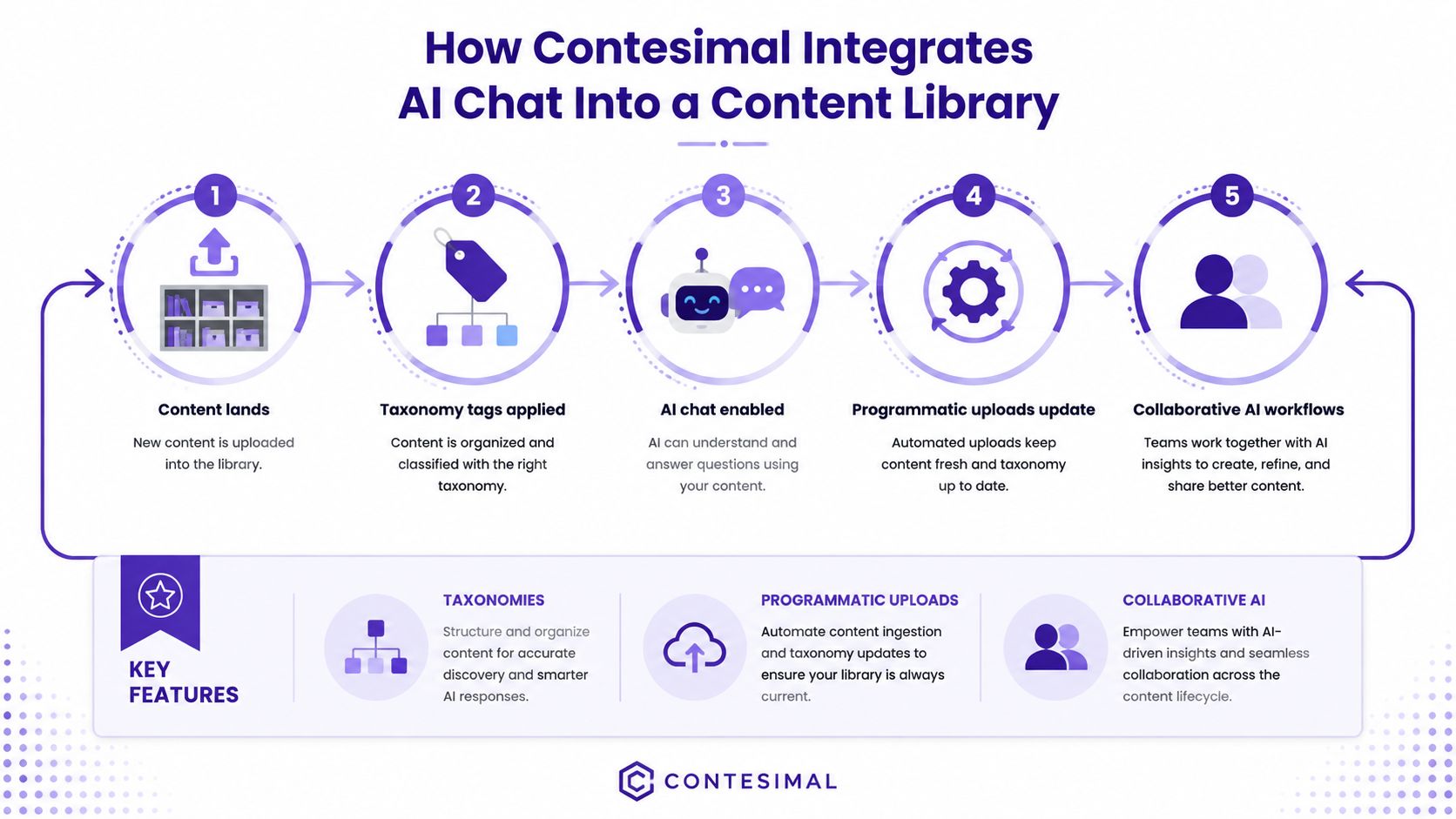
A useful integration starts before the chat box. Content enters a central library through ingestion or programmatic uploads, then receives labels that describe what it is, who created it, when it appeared, and which subjects it covers.
Those labels form a taxonomy, a structured vocabulary for the archive. A podcast library might distinguish guests, industries, themes, formats, and audience questions. A publisher might classify articles by desk, topic, author, source type, and publication date. The taxonomy gives the retrieval layer boundaries, so a researcher can ask for “episodes about subscription pricing” rather than searching every asset equally.
The integration pattern
- Content lands in the library. Documents, podcasts, videos, and articles become searchable assets instead of isolated files.
- Metadata narrows the field. Taxonomy terms and identifiers let users filter by episode, author, date, format, or topic.
- Chat retrieves from the selected slice. The user asks a question in ordinary language, while the system searches the relevant corpus.
- Programmatic uploads keep the library current. New content can enter the same structure rather than creating another disconnected archive.
- Collaboration turns findings into shared work. Teams can review conversations, preserve useful answers, and hand prompts or source trails to colleagues.
This is different from opening a blank chat window and pasting a few documents. A standalone session may help with a single task, but it usually doesn't provide a durable taxonomy, stable identifiers, or a shared research trail after the conversation ends.
Contesimal is one example of this library-centered approach. It combines a chat-based research surface with tools for classifying, organizing, and searching documents, podcasts, videos, and articles, while supporting programmatic uploads and collaboration between human and AI contributors. Its relevance is the architecture, the chat sits on top of a content library rather than floating apart from it.
Teams exploring this model can also review the practical role of an AI research assistant in a broader workflow. The important design test is whether the system helps people move from stored content to traceable findings and then from findings to new editorial work.
Governance and Best Practices for Reliable Research
Reliable research chat depends on controls that are easy to follow during a busy production cycle. Start by deciding who can access sensitive drafts, unpublished interviews, customer information, or internal strategy documents. Not every contributor needs the same permissions, and a shared research environment should make those boundaries visible.
Keep an audit trail for the questions asked, the sources retrieved, and the answers used in an editorial artifact. Retention rules should also distinguish between material that belongs in the long-term library and temporary working files that shouldn't remain available indefinitely.
A verification checklist
- Open the cited source: Don't approve a claim because the interface displays a citation. Read the underlying passage.
- Check the surrounding context: Confirm that a quote hasn't been separated from a qualification, correction, or opposing statement.
- Verify dates and versions: A current conclusion may not apply to an older source, and a changing document needs a clear version trail.
- Flag missing support: An answer without a source link, passage, or timestamp is a lead for investigation, not publish-ready evidence.
- Record uncertainty: Ask the system to distinguish direct statements, reasonable synthesis, and unresolved interpretation.
University guidance for generative AI research recommends disclosing AI-generated text when appropriate, preserving prompts and full responses where required, and identifying the tool, version, and date. It also warns that chatbot outputs can contain inaccurate citations that researchers must verify. Review the University of Wisconsin research citation guidance.
Make good habits repeatable
Use scoped queries tied to taxonomy terms instead of asking broad questions across the entire library. Save prompt templates for recurring tasks, such as quote extraction, contradiction checks, source comparison, and episode planning. Keep exploratory conversations separate from publish-ready research records, so brainstorming doesn't become confused with verified evidence.
A request for information template can help teams standardize how they define missing material, ownership, deadlines, and required sources. Use this request for information template as a starting point for a repeatable intake process.
Governance isn't paperwork added after the creative work. It's what lets a team reuse AI-assisted findings without losing editorial accountability.
Moving From Surface Answers to Structured Research
A smooth summary can hide weak evidence. That's the central problem with using AI chat only as a faster search box. The system may produce a coherent paragraph while leaving the reader unsure which sentence came from a source, which sentence combines several sources, and which sentence is an unsupported inference.
Structured research begins with a more disciplined question. Define the scope, lock the corpus, and state what counts as evidence before asking for a conclusion. Require the system to cite material inside the archive, flag contradictions, and assign a confidence description to each claim.
A stronger research protocol
- Define the question. Replace “What do our guests think about pricing?” with a question that identifies the audience, subject, source type, and intended decision.
- Lock the corpus. Specify which episodes, documents, dates, or taxonomy categories the system may use.
- Set grading rules. Separate direct quotations, repeated observations, single-source claims, and model interpretation.
- Capture provenance. Record the document identifier, author, date, transcript timestamp, and supporting passage for every important assertion.
- Invite disagreement. Ask the system to find counterexamples, conflicting findings, and gaps in the available material.
- Prepare a reviewable output. Use a research matrix, evidence table, or briefing format that another person can audit.
This approach turns gap-finding into an explicit task. Instead of asking only what the archive contains, ask what it doesn't establish, which topics have thin coverage, where sources disagree, and what new reporting would resolve the uncertainty.
Academic adoption shows why that distinction matters. A 2026 study reported that 67.1% of participants were aware of ChatGPT, but only 11.4% said they used it in academic research. Use concentrated on lower-risk activities such as paraphrasing and literature searching, while about half reported improved efficiency and 46.4% raised ethical concerns. Read the academic research-use study.
The lesson for content teams is practical. AI chat can accelerate discovery, but research quality comes from the surrounding system, organized sources, visible provenance, explicit evidence rules, and human review. That's how a dormant library becomes a dependable research instrument and a source of new content value.
Contesimal provides a library-centered way to organize documents, podcasts, videos, and articles, then use AI chat to retrieve themes, source passages, and new opportunities across that material. Visit Contesimal to explore how your team can turn existing content into structured research and reusable editorial value.