
Most advice about project management for software teams starts in the wrong place. It starts with the framework.
That's backward.
Software teams usually don't fail because they picked the wrong ceremony names. They fail because they add process without being clear about the problem they're trying to solve. One team needs predictability. Another needs faster feedback. A third doesn't need more meetings at all. It needs cleaner ownership and fewer hidden dependencies.
Rethinking Project Management for Modern Software Teams
The default belief is simple: more structure produces better delivery. In practice, that often turns into weekly status theater, bloated boards, and reporting that exists mainly to comfort people outside the team.
That's not a management system. That's drag.
Reporting from Big Tech points to a more useful question: not whether teams need project management, but how much is needed. Teams forced into one standard methodology reported lower satisfaction, while teams allowed to choose their own way of working were more satisfied and productive, which suggests the right level of process depends on team maturity and project risk (Pragmatic Engineer).
Start with the failure mode
Before choosing Scrum, Kanban, Jira workflows, or planning rituals, identify what keeps breaking.
- Missed deadlines: The team probably needs better planning detail, clearer sequencing, or stronger dependency tracking.
- Constant thrash: The issue is often intake and prioritization, not execution.
- Slow delivery with lots of meetings: Process is likely too heavy for the team's actual risk.
- Stakeholder frustration: Expectation-setting and scope control are usually the missing pieces.
A senior team working on a narrow product area can handle more autonomy than a newly formed cross-functional team building a risky integration. Treating them the same creates predictable problems. The experienced team feels suffocated. The newer team feels abandoned.
Process should remove ambiguity, not create ceremony.
Use process like guardrails, not concrete walls
The best project management for software teams creates just enough structure to answer a few practical questions:
- What matters right now?
- Who owns it?
- What could block it?
- How will we know it's done?
If your current setup doesn't answer those questions quickly, it's either too vague or too complicated.
For teams that build client-facing products, this balance matters even more because technical work and delivery expectations collide fast. A useful companion resource is this guide to web dev project management, which looks at the delivery side from a web project lens.
A simple calibration model
Use a heavier touch when risk is high. Stay lightweight when the team is stable and trusted.
| Team context | PM style that usually works |
|---|---|
| New team, unclear scope | More explicit planning, tighter check-ins |
| Stable product team | Lightweight rituals, strong async updates |
| Platform or infra team | Flow-based intake, dependency visibility |
| Agency or client work | Strong milestone control, clearer approvals |
Software engineering teams rarely require a reduction in discipline. Instead, they need better-targeted discipline. That distinction matters.
Scrum, Kanban, or Hybrid Which Is Right for You?
Scrum and Kanban are often presented like rival camps. They're not. They're scheduling and coordination tools for different operating conditions.
If your team delivers in batches, benefits from fixed planning windows, and needs a shared commitment for a short horizon, Scrum can work well. If your team gets interrupts all day, handles support, infrastructure, or product changes that don't respect sprint borders, Kanban is usually the better fit.
And a lot of software teams land somewhere in the middle.

What the data says, and what it doesn't
Benchmark data indicates that Agile projects are 28% more successful than traditional ones, but that doesn't mean the framework itself does the heavy lifting. The same benchmark says project success is driven more by technical skills (48%) and good internal communication (26%) than by Agile methods alone (19%) (Wimi project management statistics).
That matches what most engineering managers eventually learn. A weak team won't become strong because it uses story points. A misaligned organization won't become aligned because it renamed meetings.
Scrum is a train schedule
Scrum works like a train timetable. The train leaves at a set time, and everyone decides what cargo goes on before departure.
That structure helps when teams need rhythm and commitment. Sprint planning creates a short planning horizon. Reviews force demoable progress. Retrospectives create a built-in improvement loop.
Scrum tends to work best when:
- Work can be planned in chunks: Product development fits this better than interrupt-heavy support work.
- Priorities are relatively stable for a short window: Not forever, just long enough to complete a sprint.
- The team needs predictability: Sprint boundaries help expose overcommitment quickly.
Scrum gets clumsy when leadership keeps injecting urgent work mid-sprint. At that point, the problem isn't Scrum. It's that the operating model and the true nature of the work no longer match.
Kanban is traffic flow
Kanban is closer to traffic management. Instead of loading a train on a fixed departure time, it controls how much work enters the system and where bottlenecks form.
That makes it a strong fit for engineering teams that need flexibility. Bugs arrive unpredictably. Production issues don't wait for planning day. Priorities shift.
Kanban tends to work best when:
- Unplanned work is normal
- The team needs continuous delivery
- You want bottlenecks to become visible fast
Kanban fails when teams use it as an excuse not to plan. “We're flexible” often means “we never finish anything” unless there are clear work-in-progress limits and disciplined ownership.
Methodology Comparison
| Attribute | Scrum | Kanban |
|---|---|---|
| Planning cadence | Time-boxed sprints | Continuous flow |
| Priority changes | Usually limited during sprint | Allowed as work changes |
| Roles | More prescribed | More flexible |
| Best for | Product delivery with planned increments | Support, platform, maintenance, mixed intake |
| Main risk | Too rigid under frequent change | Too loose without discipline |
A hybrid model often works best. Many teams keep sprint planning and retrospectives, but run a Kanban-style board inside the sprint. That gives them rhythm without pretending all work is predictable.
If you want a more detailed look at planning mechanics, this piece on agile project management sprint planning is useful.
Pick the framework that matches the shape of your work, not the one your industry likes to talk about.
Defining Who Does What and When
A lot of project friction gets blamed on methodology when the true issue is ownership. Teams don't know who makes trade-off calls, who cleans up backlog noise, or who's responsible for unblocking work that stalls between functions.
That's where roles and rituals matter. Not as theater, but as operational clarity.

Roles that actually matter
Titles vary. Responsibilities shouldn't.
Product owner or product lead. This person decides what matters now. They shape priorities, clarify scope, and answer the ugly question every software team faces: “What are we not doing yet?”
Scrum master, delivery lead, or flow manager. Good teams need someone watching the system, not just the tickets. This role clears blockers, protects focus, and notices when work keeps aging in review or handoff states.
Engineering team. Engineers aren't there to receive tasks like a service desk. They help refine scope, identify risk, break work into pieces, and challenge plans that look tidy on paper but won't survive contact with production.
When these lines blur, teams drift into silent assumptions. That's usually where delays start.
Meetings should buy clarity
Most recurring meetings are defensible in theory and wasteful in practice. Keep the ones that reduce uncertainty.
- Daily stand-up: Useful when it surfaces blockers and coordination needs. Useless when people recite status updates to a manager.
- Backlog refinement: Worth keeping if it turns vague ideas into buildable work.
- Planning session: Necessary when the team needs shared commitment and sequencing.
- Retrospective: Valuable only when it produces one or two real process changes, not a list of grievances nobody owns.
If your team is feeling off, it helps to understand team misalignment causes before adding another sync. Misalignment usually shows up in planning long before it shows up in the shipped product.
Cadence rules that hold up
Don't schedule ceremonies because a framework says so. Schedule them because a team needs a decision point.
A practical setup looks like this:
- Short daily syncs for active coordination.
- Weekly backlog review to keep upcoming work clean.
- Regular planning at the cadence your delivery model requires.
- Retrospectives often enough to matter, but not so often they become scripted.
There's also a people dimension that teams often miss. A strong PM system depends on trust, feedback, and communication habits, not just board columns. This article on qualities of an effective team complements that side well.
A meeting earns its place when it changes decisions, removes risk, or improves coordination. If it does none of those, cut it.
From Backlog to Done The Technology Layer
Software teams love tools, which is part of the problem. They'll spend weeks debating Jira versus Linear while their actual workflow still has three different meanings for “in progress.”
The tool matters less than the design.

Build the board around real handoffs
A usable board mirrors how work moves. For most software teams, a simple structure is enough:
| Stage | What it means |
|---|---|
| Backlog | Not ready yet, still being prioritized or clarified |
| Ready | Clear enough to pick up |
| In Progress | Actively being built |
| In Review | Waiting on code review, QA, design, or approval |
| Done | Meets the team's finish criteria |
That's plenty to start.
The mistake is creating a dozen micro-states that nobody updates. A workflow should reveal where work slows down. It shouldn't become a tax on the team.
Define done at each stage
Teams get into trouble when columns are just labels. Every state needs an entry and exit rule.
For example:
- Ready: The ticket has acceptance criteria, dependencies are visible, and someone on the team could start without a side meeting.
- In Progress: There's active ownership. It isn't sitting idle because the assignee got pulled elsewhere.
- In Review: The code or artifact is ready for review, not “mostly done.”
- Done: It meets the team's agreed definition, which might include merged code, checks passing, documentation updated, and release steps completed.
Tools either help or hurt. Jira handles complex enterprise workflows well, but it can encourage overconfiguration. Trello is fast for simple boards, though it can become messy at scale. Linear is clean and opinionated, which many product teams like. Asana can work for cross-functional orgs where engineering work intersects with marketing, design, or operations.
The right choice depends on how much complexity you need. That's also why teams working across multiple content and production streams often borrow ideas from adjacent workflow systems. There's a useful parallel in editorial workflow management software, where the same rule applies: the platform should support the process, not become the process.
Configure lightly, then tighten where pain appears
Start with the minimum viable workflow and improve from observed friction.
Good questions to ask after a few weeks:
- Where does work sit the longest?
- Which columns mean different things to different people?
- What gets reopened most often?
- Which handoffs require side-channel messaging?
That's the signal.
A short visual walkthrough can help if your team is still designing how work should move across a board and through planning cycles.
A good board reduces conversation overhead. It doesn't eliminate conversation. If your team still needs Slack threads, docs, and direct discussion to ship, that's normal. The board is the shared map, not the whole terrain.
Using Engineering Metrics to Drive Improvement
Most software metrics go bad for the same reason. Someone turns a system signal into a people score.
Then the gaming starts.
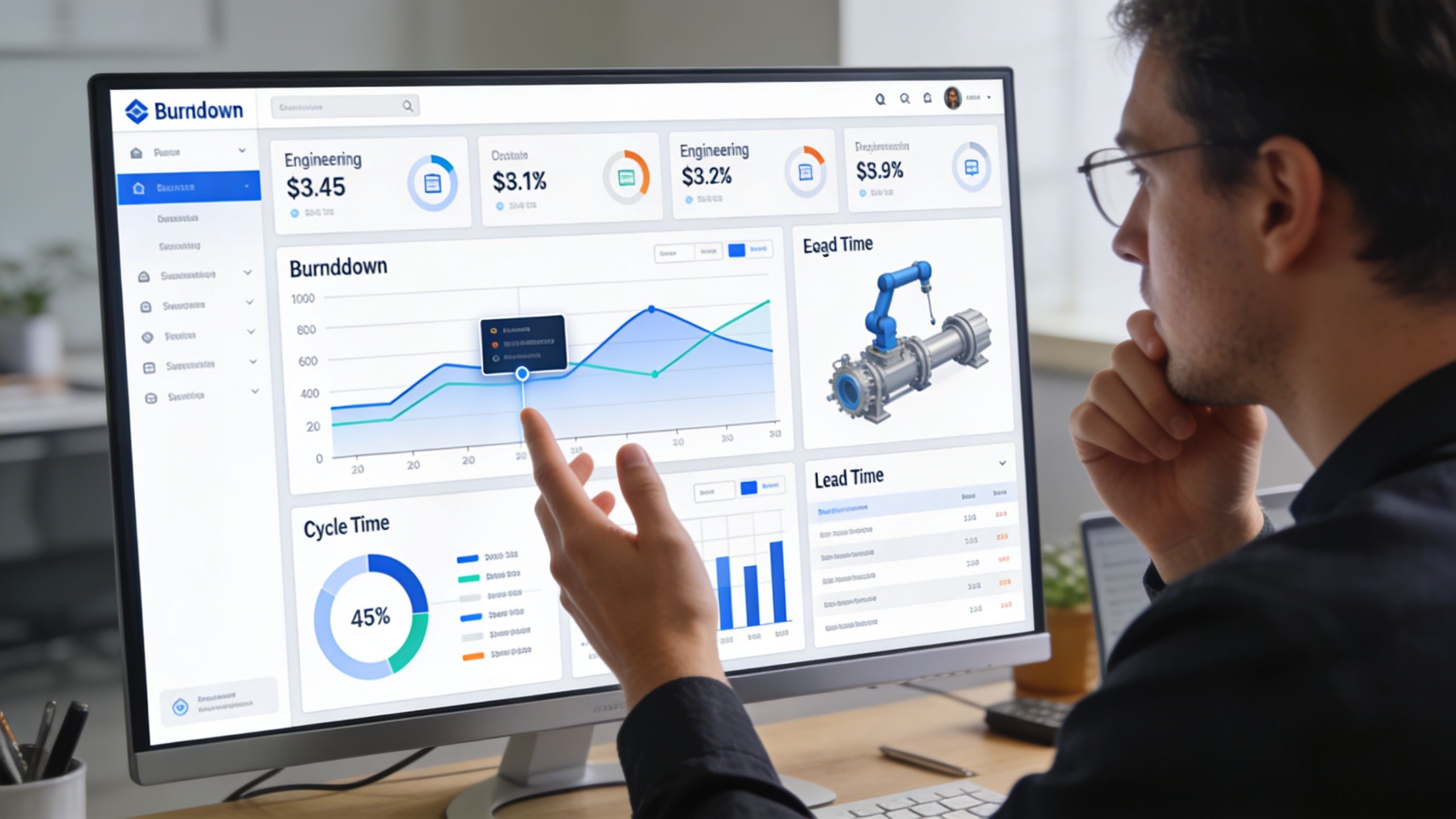
The best metrics in project management for software teams describe flow, risk, and bottlenecks. They should help the team ask better questions, not pressure individuals into looking busy.
Start with flow metrics
A small set is usually enough.
- Cycle time: How long work takes once the team starts it.
- Lead time: How long it takes from request or commitment to delivery.
- Deployment frequency: How often the team ships.
- Work in review: A local signal that often exposes bottlenecks in approval or QA.
These metrics work because they show where the system slows. They don't assume one engineer caused the slowdown.
Avoid fake certainty in status reporting
PMI highlights a common trap in software delivery: using “% complete” as the main status metric. Tasks can sit at 80% indefinitely, which makes the reporting look reassuring while the schedule drifts. PMI recommends tracking explicit completion criteria and using schedule detail that's fine-grained enough to reveal slippage while still being maintainable (PMI on software project risk pitfalls).
That's practical advice.
If a team says a feature is 90% done, ask a different question: what exact conditions are still unmet? If nobody can answer clearly, the percentage was fiction.
Practical rule: Measure completion by observable exit criteria, not optimism.
Read metrics like a mechanic, not a judge
A long cycle time doesn't automatically mean the team is slow. It may mean work items are too large. Or reviews take too long. Or dependencies sit outside the team. Or release approvals are clogged.
That's why metrics need context.
Consider a few examples:
| Metric pattern | Likely issue |
|---|---|
| Fast start, slow finish | Review or QA bottleneck |
| Long lead time, short build time | Intake or prioritization delay |
| Work ages in progress | Too much parallel work |
| Frequent reopenings | Weak acceptance criteria or rushed handoffs |
This is also why engineering leaders should spend time studying teams that share process lessons from real product environments. Formbricks has thoughtful writing on building an open-source experience management suite, and it's the kind of engineering perspective that helps teams think in systems rather than checklists.
Keep the feedback loop healthy
Metrics help when teams review them together and connect them to one small change at a time. They harm performance when leadership uses them to rank people.
A healthy rhythm looks like this:
- Look at trends, not isolated blips.
- Pair the metric with examples from recent work.
- Identify one likely bottleneck.
- Make one process adjustment.
- Recheck after a few cycles.
That's enough. You don't need a dashboard packed with vanity charts. You need signals that help the team finish meaningful work with less friction.
Scaling and Adapting Your PM Practices
Project management for software teams doesn't stay still for long. The process that fits a six-person product squad usually breaks when the org adds platform dependencies, multiple stakeholders, compliance requirements, or parallel roadmaps.
Scaling doesn't mean copying the same rituals everywhere. It means preserving clarity while adding coordination where complexity has increased.
What changes as teams grow
Small teams can get away with shared context. Larger groups can't.
Once multiple teams contribute to the same initiative, a few things become necessary:
- Dependency tracking: Not as bureaucracy, but so one team's delay doesn't blindside three others.
- Decision rights: Teams need to know who can resolve scope conflicts and priority trade-offs.
- Higher-level planning windows: Not to micromanage execution, but to expose sequencing and resourcing problems early.
- Escalation paths: When work is blocked across teams, someone needs authority to unblock it fast.
The trick is to add these layers without dragging every team into heavyweight reporting. Mature teams should keep local autonomy wherever possible.
AI changes the shape of coordination
As teams adopt AI tools for coding and planning, project management shifts away from simple task tracking. Guidance on AI-accelerated delivery points toward a stronger focus on coordination, risk sensing, and dependency management, with a central challenge of preventing scope creep and false confidence while keeping strategy aligned to faster execution (Lark on software development project management).
That shift is already visible in day-to-day work.
AI can help draft tickets, summarize meetings, generate implementation options, and accelerate coding. What it can't do reliably is decide which trade-offs matter most to the business, which risks are hidden in a vague requirement, or whether a fast-looking path creates future operational cost.
The manager's job becomes narrower and more important
As execution speed increases, the value of project leadership moves upward.
Less time should go into chasing updates. More time should go into:
- Clarifying scope boundaries
- Detecting hidden dependencies
- Testing assumptions before they become commitments
- Making sure faster delivery doesn't create strategic drift
That's the essential adaptation. Not more dashboards. Better judgment.
The strongest teams treat process as a living system. They trim what no longer helps, tighten what keeps slipping, and revisit assumptions when the team, product, or tooling changes. That's how project management stays useful instead of turning into ritual.
If your team also manages a growing library of research, episodes, articles, or production assets, Contesimal can help organize that knowledge so humans and AI can work from the same source of truth. It's especially useful for creators, publishers, and content teams that want to turn existing work into new output without losing context, consistency, or momentum.