
You've recorded the interview, published the episode, cut a few clips, and moved on to the next deadline. Months later, a client asks for the exact moment a guest discussed audience research. You remember the conversation, but not the episode, timestamp, or speaker. Your archive is full of valuable material, yet finding one usable sentence still means opening files, scrubbing timelines, and hoping your memory cooperates.
Speaker identification changes that workflow. By separating voices, matching them to known people when appropriate, and attaching speaker information to transcripts, it turns raw audio into structured content data. For podcasters, video creators, publishers, and content marketers, that data can make an old library searchable, easier to repurpose, and more useful to the audience you're building.
Why Your Audio Archive Is a Goldmine Waiting to Be Indexed
A podcaster with a large back catalog often knows the archive contains strong material. The problem is retrieval. A guest's best comment might be buried inside an interview, a panel recording, or a video whose filename says almost nothing about its contents. Without searchable transcripts and reliable speaker labels, the archive behaves like a room full of unlabeled tapes.
Speaker identification gives each section of a conversation an identity signal. Instead of searching only for a phrase, you can ask which guest discussed a topic, locate every appearance by a recurring contributor, or separate a host's questions from a guest's answers. That makes the archive useful for clip selection, show notes, newsletters, articles, social posts, and research.

The key distinction is between a transcript that merely contains words and a transcript that contains context. A transcript can tell you that a sentence exists. Speaker metadata can tell you who said it, where that person entered the discussion, and whether the same person appears across multiple episodes. That extra layer helps editors work faster and helps content teams build useful collections around people, themes, formats, and audience questions.
Creators who are organizing a growing library may also benefit from broader guidance on resources for content creators, particularly when they're moving from individual production toward collaborative publishing. Speaker data fits naturally into that shift because it gives humans and AI a clearer way to explore existing material.
Think of it as document indexing for sound. A practical guide to document indexing offers the same basic lesson: information becomes more valuable when people can find, classify, and connect it. Your audio archive deserves that treatment too.
Understanding Diarization, Recognition, and Verification
Diarization, recognition, and verification support different archive tasks. Choosing the wrong one can leave a transcript neatly formatted but still too weak for search, editing, attribution, or content reuse.
Diarization sorts the conversation
Diarization answers one specific question: “When did the speaker change?” A mailroom sorter can group letters by sender without reading each return address. Diarization works similarly. It separates voices and keeps their labels consistent, even when it does not know anyone's name.
A diarized transcript might look like this:
- Speaker A: Welcome to the show.
- Speaker B: Thanks for having me.
- Speaker A: Let's start with your publishing process.
For a podcast, that separation can distinguish host questions from guest answers. It gives editors a workable structure for locating clips and reviewing episodes, while named attribution requires another layer.
Recognition maps a voice to a person
Recognition answers: “Which known speaker does this voice resemble?” The system compares a voice representation with a gallery of known speakers. A creator may supply recordings or an approved roster covering recurring hosts, contributors, and interview guests.
That roster-based method is called closed-set identification. It assumes the correct person appears among the candidates, an assumption that can fail in a large archive containing unfamiliar guests, producers, callers, or background voices.
Open-set identification allows the system to reject a voice as unknown. In the VoxBlink2 benchmark, a probe utterance must either match a known gallery speaker or be rejected as unknown. The benchmark includes more than 100,000 speakers, making it useful for testing systems outside a fixed laboratory roster.
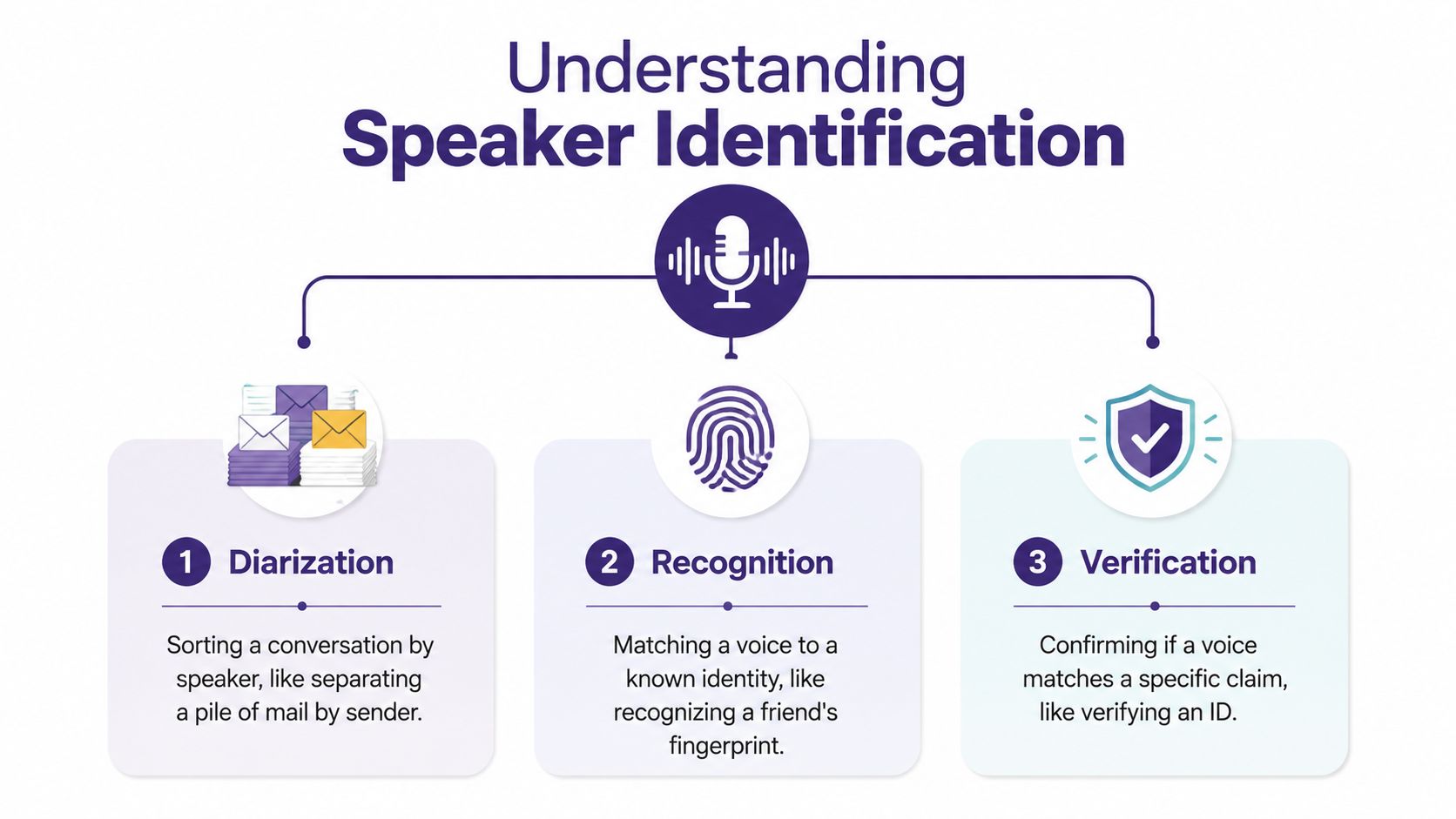
Verification tests a specific claim
Verification asks: “Is this the person they claim to be?” A bank clerk checking an ID tests one stated identity against a threshold. The clerk is not selecting the closest-looking person in a crowd. Audio verification applies the same logic to a segment containing a claimed target speaker.
The NIST speaker detection overview frames speaker detection as determining whether a specified target speaker is speaking during a speech segment. That distinction matters for sensitive interviews, legal recordings, and archival material. Diarization may be enough for consistent labels. A named match or defensible identity decision calls for recognition or verification, plus suitable review controls.
These terms also appear in related media workflows, including AI song detection. Keeping the tasks separate helps a content team choose the right system: separate voices for indexing, identify known people for archive search, or verify one person's presence before publishing or monetizing material.
How Modern Speaker Identification Algorithms Actually Work
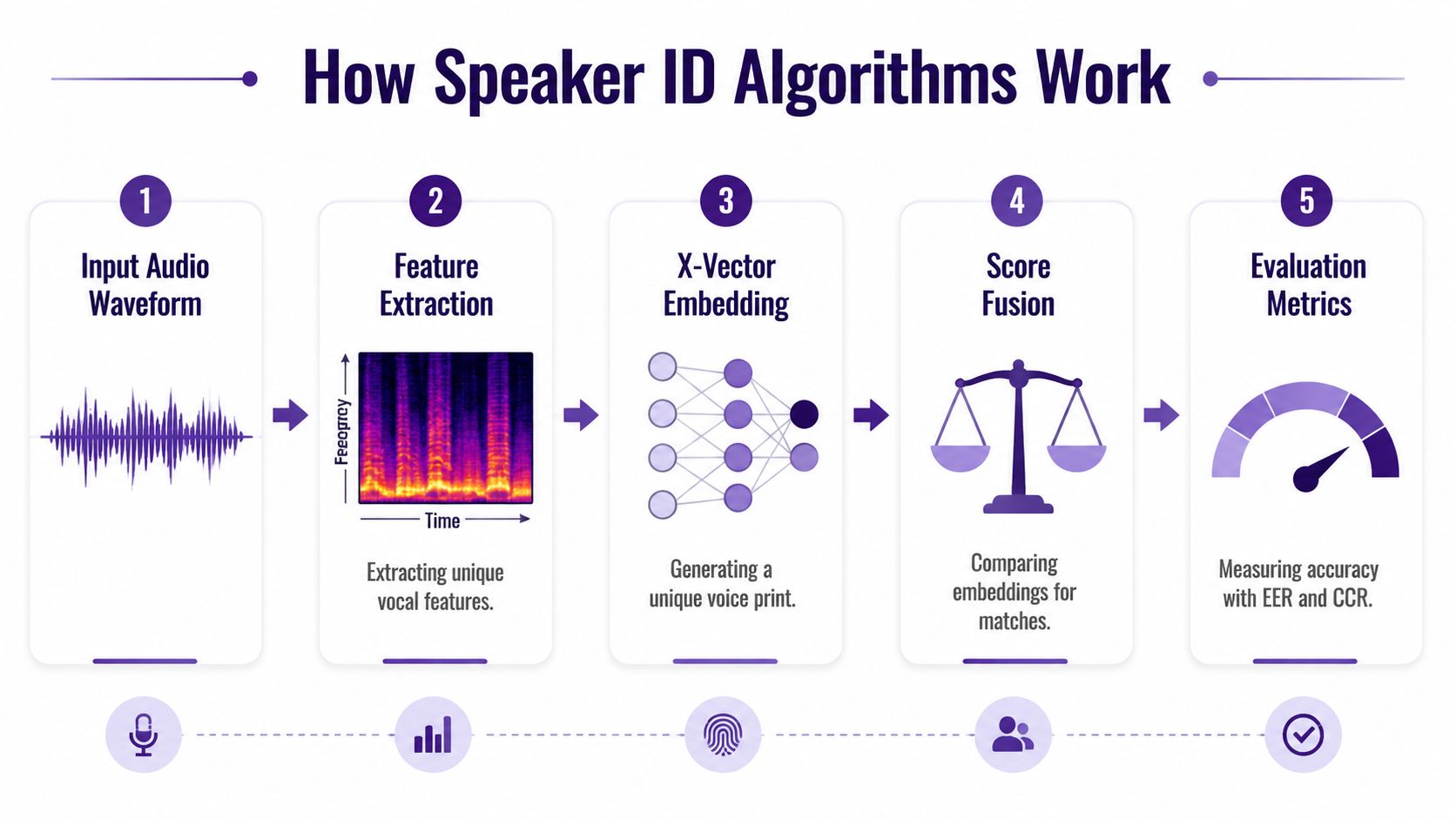
A contemporary system doesn't listen to a recording the way an editor does. It turns sound into measurements, compresses those measurements into a representation of the speaker, and compares that representation with other voices.
From waveform to voice representation
The first stage takes the audio waveform and locates speech-bearing regions. The system then extracts patterns related to the voice, such as spectral structure, timing, and vocal quality. These patterns can be affected by the microphone, room, codec, background noise, speaking style, and language, so the model has to distinguish speaker traits from recording conditions.
Many modern systems use x-vector embeddings. An embedding is a compact numerical representation of an audio segment. An x-vector aims to preserve information that helps distinguish one speaker from another while making the raw recording easier to compare computationally. It isn't a photograph of a voice, and it shouldn't be treated as an infallible voice fingerprint. It's better understood as a comparison-ready summary.
The pipeline typically looks like this:
- Input audio: The system receives the podcast, interview, meeting, or video soundtrack.
- Feature extraction: It measures patterns that may help distinguish speakers.
- Embedding generation: An x-vector model converts a segment into a speaker representation.
- Comparison: The system scores how closely representations match.
- Decision: A classifier or threshold turns scores into labels, matches, or rejections.
Why the backend isn't the whole story
A common buying mistake is to focus only on the model name. Published results show why the entire pipeline matters. One multiple x-vector approach reported 95.84% speaker identification accuracy on the Speakers In the Wild “core-core” condition and 96.30% on “core-multi,” with EER values near 1.06% to 1.07% (published x-vector evaluation). Those are benchmark results, not a promise for your untreated panel recording.
Embedding extraction depth, score fusion, segmentation, and channel conditions can all change the outcome. Score fusion combines evidence from multiple models or representations, much like an editor checks a quote against the waveform, transcript, and surrounding conversation instead of trusting one clue.
Identification and verification also use different evaluation language. Accuracy measures the proportion of correctly identified speakers, while equal error rate, or EER, is the threshold where false accepts and false rejects are equal (speaker recognition metrics guidance). Ask vendors which task their number describes. A strong verification score doesn't automatically tell you how well a system will label every speaker in a busy archive.
Where Speaker Identification Fails and Why It Matters
Speaker identification works best when the recording gives the model clean, distinct evidence. Real content rarely behaves so politely. Guests interrupt, microphones differ, rooms ring, and a speaker's voice changes when they laugh, whisper, read a script, or become animated.
Accent and language create another layer of risk. Recent multilingual research reported that a performance gap fell from 15% to 1% and verification error fell from 15% to 5% in noisy conditions, but other work still finds strong bias and higher errors for non-native English speakers and speakers from tonal-language backgrounds (multilingual speaker identification research). The useful conclusion isn't that multilingual systems solve fairness. It's that language coverage and rigorous testing can make a meaningful difference, while uneven performance can remain.
The failure modes editors should expect
- Similar voices can merge: Two speakers with comparable vocal qualities may receive one label.
- One voice can split: A single speaker may appear under multiple labels after a major change in delivery or recording conditions.
- Overlap can confuse attribution: When people talk at once, the system may attach words to the dominant voice or assign mixed speech incorrectly.
- Unknown speakers can be forced into known identities: A closed roster may produce a confident-looking wrong match instead of an unknown result.
Mixed-speaker content deserves special caution. Podcasts, interviews, court audio, and panel discussions can contain interruptions, audience remarks, off-mic comments, and overlapping speech. Research on speaker bias and identity leakage shows that models may rely on shortcuts such as timbre or pitch, while courtroom listener studies found a substantial bias toward the different-speaker hypothesis under varied recording conditions (research on speaker bias and diarization).
Production rule: Treat speaker labels as editorial evidence, not automatic truth.
Audit a sample that includes accents, languages, microphones, noisy environments, and group discussions. Record where labels switch, where unknown voices appear, and where the system expresses high confidence despite weak audio. For quotes, legal material, public accusations, or monetized claims, require a human to verify the waveform before publication.
Turning Podcast Archives into Searchable, Monetizable Assets
The commercial value of speaker identification appears after the labels enter your content system. A transcript marked “Speaker A” is useful. A transcript connected to a named guest, episode, topic, format, quote, and timestamp becomes much more powerful.
Suppose a marketing team has a long interview with a founder. Once the host and guest are separated, an editor can search only the guest's answers for product lessons, objections, origin stories, or memorable phrasing. The team can then turn those moments into short clips, a written feature, newsletter material, social posts, and internal research notes without replaying the entire conversation from the beginning.
Give every episode several ways to be found
A useful archive can organize content by more than title and publication date:
- People: Hosts, guests, recurring experts, narrators, and contributors.
- Themes: Topics discussed by each speaker, not just topics in the episode description.
- Formats: Interview, panel, monologue, tutorial, debate, or live recording.
- Editorial opportunities: Quotable passages, unanswered questions, contrasting opinions, and potential clip moments.
- Rights and review status: Material approved for reuse, awaiting review, or restricted to internal research.
This structure supports a more deliberate repurposing loop. A content executive can find every episode featuring a particular expert. A YouTube producer can locate the strongest answer before opening the video editor. A publisher can connect an interview to related articles, books, or research. A blogger can retrieve the original spoken context before turning a quote into written copy.
Transcription is still foundational, so it helps to compare workflow considerations in a practical 2026 podcast transcription overview. Once the transcript exists, speaker labels add the attribution layer that makes searching more precise.
For teams building a searchable archive, podcast transcript search should connect phrases with people, timestamps, and related assets. The payoff isn't merely faster retrieval. It's a larger surface area for ideas, where old material can support new episodes, campaigns, playlists, and audience questions.
Evaluating Speaker Identification Tools for Your Workflow
Choose a tool by testing your archive, not by admiring a benchmark screenshot. Upload representative samples that include your normal microphones, rooms, accents, languages, interruptions, and editing style. Then review both the labels and the moments where the system appears uncertain.
NIST has coordinated Speaker Recognition Evaluations since 1996, and its evaluation plans define tasks and rules before testing begins. The program includes fully automated text-independent recognition, human-assisted recognition, and separate biometrics and forensics work, which shows why “accuracy” needs a clear task definition (NIST speaker recognition program).
| Criteria | Open-Source | Commercial Platform |
|---|---|---|
| Control | You control models, processing, and configuration. | The provider manages the technical stack. |
| Setup | Requires engineering knowledge and maintenance. | Usually offers a ready-to-use workflow or API. |
| Privacy | Can support local processing, depending on the implementation. | Requires careful review of storage, retention, and processing terms. |
| Testing | You build your own evaluation set and review process. | You still need to test your own recordings, despite vendor benchmarks. |
| Human review | You design the review interface and escalation rules. | Some platforms provide workflow features for ambiguous results. |
| Best fit | Teams with technical capacity and unusual requirements. | Creators and organizations prioritizing operational speed and integration. |
Check whether the tool exports timestamps, speaker labels, confidence information, and machine-readable data. Confirm that it can connect with your content management system, search layer, editing workflow, and permission model. For transcription-specific workflow decisions, see this podcast transcription software guide.
Privacy deserves equal attention. Voice data can be sensitive, so define who can access speaker profiles, how long files remain available, whether people have consented to identification, and when an editor must replace a person's name with a neutral label.
Making Speaker Identification a Strategic Content Asset
Speaker identification becomes strategic when it changes what your team can do with material you already own. Start with an archive audit. List the shows, interviews, videos, and recordings that contain recurring guests or commercially useful themes, then choose a manageable pilot rather than processing everything at once.
A good pilot should answer practical questions:
- Can editors find a specific speaker's comments quickly?
- Do labels remain stable across the recording?
- Which accents, rooms, and microphones cause trouble?
- Can approved moments move into clips, articles, newsletters, and social posts?
- Does the metadata help your team create more consistently?
NIST's evaluation history illustrates the value of repeatable testing. Its first Speaker Recognition Evaluation ran in 1996, followed by more than 15 additional evaluations over the next two decades, creating a recurring comparison framework for the field (historical overview of NIST evaluations). Your content team doesn't need a research laboratory, but it does need a repeatable review set and clear acceptance rules.
The strongest workflow pairs AI with human judgment. AI can index, cluster, and surface likely matches. Editors can confirm identity, correct ambiguity, protect privacy, and decide whether a moment is safe and useful to publish. That collaboration turns an archive from storage into an active source of ideas.
Contesimal helps content teams ingest and organize podcasts, videos, articles, and other library assets with transcription and speaker identification built into a broader research workflow. Visit Contesimal to explore how your archive can become easier to search, connect, and repurpose.