
You publish a strong episode, video, or article. It gets a burst of attention for a few days, maybe a week, and then it drops into the archive with everything else.
That's the point where a lot of creators make the wrong decision. They assume the answer is to make the next thing faster.
Usually, the bigger opportunity is sitting behind them, not in front of them. A growing library of interviews, tutorials, essays, clips, newsletters, and notes can become a real distribution engine if it's organized, repackaged, and pushed through the right channels with discipline. That's what separates random posting from a real content distribution strategy.
If you're moving from hobbyist creator to operator, this shift matters. Your archive isn't dead weight. It's inventory.
Beyond Publish The Shift to a Distribution Mindset
Creators often treat publishing like a finish line. Record the podcast. Edit the video. Write the post. Hit publish. Move on.
That approach works for a while, especially when the library is small. But once you have dozens or hundreds of assets, “publish and forget” becomes expensive. You've already paid for the idea, the recording time, the editing, and the creative energy. If each piece gets one launch and then disappears, you're underusing the asset.
What professionals do differently
Professional teams document how content moves after publication. That's not bureaucracy. It's how they make distribution repeatable.
By 2023, 73% of B2B marketers and 70% of B2C marketers reported having a documented content marketing strategy according to Digital Applied's content marketing statistics roundup. That matters because documented strategy gives you a way to define channels, set KPIs, and compare what's working instead of relying on memory and instinct.
A creator feels this in a practical way. Without a documented system, your week sounds like this:
- Monday: Post the full video on YouTube
- Tuesday: Cut one clip because you remembered
- Wednesday: Forget to email the list
- Thursday: Repost the same link everywhere
- Friday: Wonder why reach feels inconsistent
With a system, the same asset has a planned path.
Practical rule: If distribution depends on your mood, it isn't a strategy.
The archive is where leverage starts
A lot of people ask, “What should I create next?” too early. A better question is, “What do I already own that can travel farther?”
A podcast episode can become a blog summary, a short video clip, a carousel, a newsletter angle, a quote graphic, a sales asset, or a searchable resource page. A long article can become a thread, an email lesson, a script, or a talking point for live content. Once you see content this way, the job changes. You stop making isolated posts and start building a system for extracting value from ideas across time.
If you need help tightening the channel side of that system, this social media strategy guide is a useful companion because it gets practical about how planning and platform decisions fit together.
The key shift is simple. Distribution isn't promotion sprinkled on top of creation. It's the operating model that makes your library useful, discoverable, and monetizable over time.
Foundation First Audit and Organize Your Content Library
Before you distribute better, you need to know what you have.
Most creators don't have a content strategy problem first. They have a retrieval problem. Great clips are buried in full interviews. Strong arguments are trapped inside old newsletters. Evergreen tutorials are hidden in folders labeled “final-final-v2.” If your library is messy, you can't repurpose at speed.
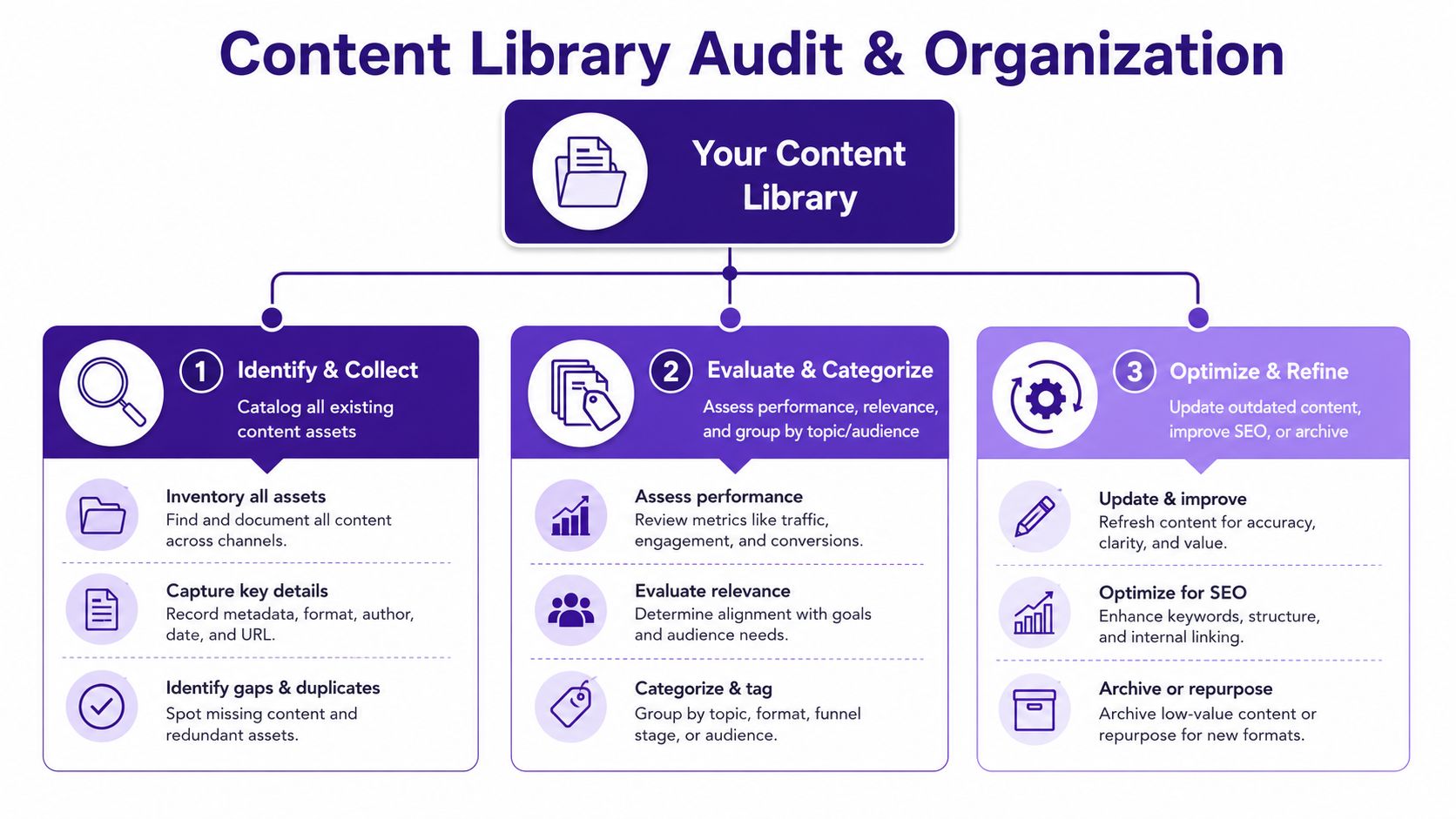
Start with a real inventory
Your first pass should be boring and complete. That's a good thing.
List every asset you can find across your blog, podcast feed, YouTube channel, drive folders, newsletters, PDFs, webinars, and social posts. If you want a simple structure to start from, use a content inventory template and adapt it to your workflow.
Track basics such as:
- Asset type: Video, podcast, blog post, email, webinar, PDF
- Core topic: The main subject, not the working title
- Audience fit: Beginner, advanced, buyer, subscriber, client, reader
- Current status: Evergreen, dated, underperforming, worth refreshing, ready to repurpose
Don't overcomplicate this first layer. You're building visibility, not a museum catalog.
Build a taxonomy you'll actually use
A useful library needs more than folders. It needs a taxonomy, which is just a structured way to classify content so people and tools can find it later.
The mistake is tagging everything by format only. Format helps you store content. It doesn't help you reuse it. A practical taxonomy also includes topic, audience, intent, and repurposing potential.
A podcast episode about creator burnout, for example, might be tagged like this:
| Content element | Example tag |
|---|---|
| Format | Podcast episode |
| Topic | Creator workflow |
| Audience | Professional creators |
| Intent | Education |
| Repurpose options | Clips, email, blog summary, quote posts |
That structure pays off later when you need “every advanced clip about editing workflows” or “every evergreen piece for newsletter nurture.”
A searchable library turns old work into raw material. An unorganized library turns old work into clutter.
Treat your owned hub as the center
This part matters more than many creators realize. 9 in 10 marketers use their own website as a key distribution channel, which reinforces the value of a controlled home base, as noted in Proper Expression's content marketing statistics. Your website, resource library, or archive hub is where you can organize, link, update, and route people deeper into your ecosystem.
That's why the library audit isn't just cleanup. It's strategic preparation for distribution.
Use this simple decision framework as you review each asset:
- Keep and feature if it's still relevant and supports a core topic.
- Refresh and relaunch if the idea is strong but the framing is outdated.
- Archive if it no longer matches your positioning or audience.
Once your content is visible, tagged, and grouped, repurposing stops feeling like guesswork. It becomes a retrieval exercise.
Map Your Audience to the Right Channels
Posting everywhere feels productive. Usually it's just expensive in time.
A solid content distribution strategy doesn't start with platforms. It starts with audience behavior. You're trying to answer a practical question: where does this specific person want this specific format, and what do they want to do next after consuming it?
The three mistakes that waste the most effort
Expert guidance consistently points to three common failure modes: choosing channels before understanding the audience, failing to adapt the format to the platform, and posting without a measurable KPI framework, as summarized by WG Content's content distribution strategy guide.
Those mistakes show up everywhere:
- A creator posts the same horizontal video link on every platform and calls it distribution.
- A publisher pushes dense thought leadership into channels built for quick interaction.
- A marketing team stays “active” on five channels but can't say which one drives meaningful action.
None of those problems are fixed by posting more. They're fixed by better mapping.
Build a lightweight audience profile
You don't need a giant persona deck. You need a few operational details you can use every week.
Focus on these questions:
- What are they trying to solve? Learn, compare, be entertained, validate a decision, find a tool.
- Where do they discover ideas? Search, newsletter inbox, YouTube, LinkedIn, social feeds, communities.
- What format do they prefer there? Short clips, deep articles, swipeable summaries, audio, live discussion.
- What action matters after consumption? Subscribe, visit your site, watch the full version, reply, buy, share.
That combination tells you not just where to post, but how to shape the content so it feels native.
Content Format to Channel Mapping Example
| Content Format | Primary Channels | Primary Goal |
|---|---|---|
| Long-form video | YouTube, website | Deep engagement |
| Podcast episode | Podcast platforms, newsletter, website | Loyalty and repeat listening |
| Short clip | Reels, TikTok, Shorts, LinkedIn video | Discovery |
| Thought leadership article | Website, LinkedIn, newsletter | Authority and search visibility |
| Email summary | Newsletter | Retention and return visits |
| Quote graphic or carousel | Instagram, LinkedIn | Attention and saves |
This isn't a universal map. It's a starting point. The right answer depends on your audience and your business model.
Match native behavior, not personal preference
Creators often distribute according to what they like making. Audiences respond to what they like consuming on that platform. Those are not always the same thing.
If you run a podcast, your audience may love the full conversation in audio form and still prefer quick tension-filled clips on social before they commit to the whole episode. If you write thoroughly researched articles, readers may discover them through a concise email takeaway rather than through a direct link dropped on social.
The practical move is to assign each channel a job. One channel drives discovery. Another deepens trust. Another captures the audience into owned media. When every channel has a role, you stop treating distribution like duplication.
The Repurposing Workflow From One to Many
Repurposing works best when you stop thinking in posts and start thinking in assets.
A single strong piece of pillar content should give you multiple entry points into your ecosystem. That matters even more now because content discovery is scattered across search, social, AI interfaces, and closed platforms. As Mimeo's content distribution strategy article notes, a core challenge is distributing content when social reach is declining and search behavior is fragmenting across Google, AI, and closed platforms. Repurposing creates resilience because your audience gets more than one way to find you.
Here's what that looks like in practice.
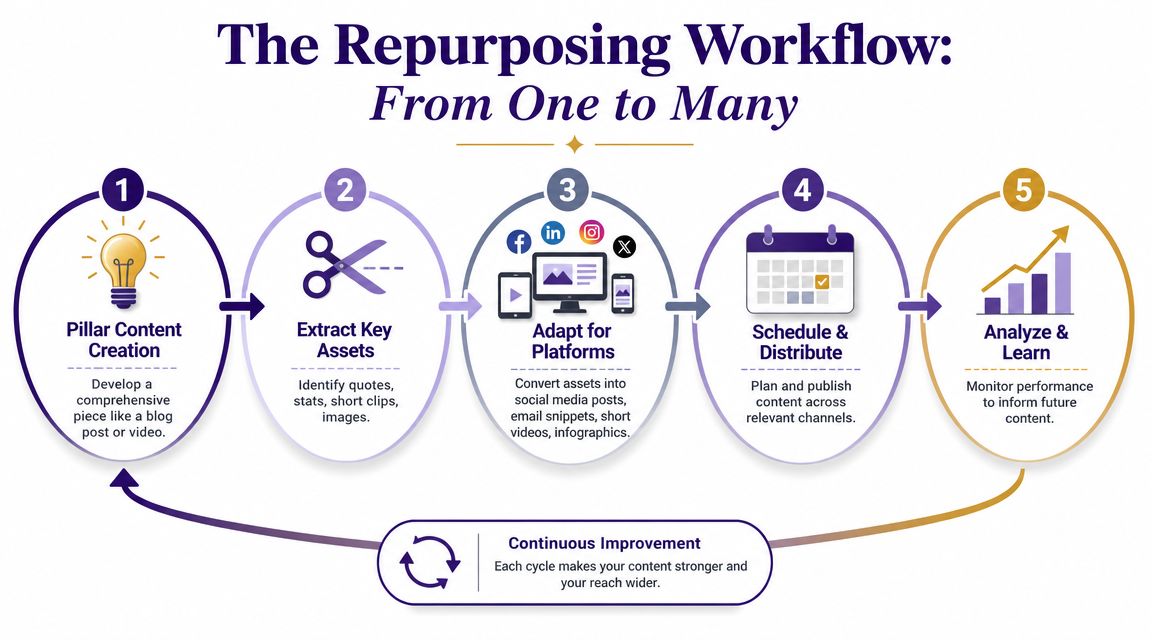
Start with one pillar asset
Say you recorded a one-hour podcast interview about how creators turn archives into revenue.
That full conversation is the source asset. Don't ask, “Where should I post this?” Ask, “What's inside this that deserves its own life?”
Look for:
- Strong moments: A sharp opinion, useful framework, memorable analogy
- Searchable ideas: Questions people type into Google or ask in communities
- Emotional beats: Surprise, tension, disagreement, relief, clarity
- Actionable segments: Steps, mistakes, checklists, examples
If you need a practical example of turning an audio conversation into written content, this content marketers' podcast repurposing guide is a useful reference because it shows how one source asset can branch into multiple formats.
Turn one source into multiple outputs
From that single episode, you might create:
- A full video or audio release on the primary platform.
- Several short clips built around one insight each.
- A blog post that summarizes the episode in a search-friendly format.
- An email that frames the strongest takeaway for subscribers.
- A carousel or quote post that gives one self-contained lesson.
- A discussion prompt for LinkedIn or a community post.
- A resource page update on your website that links the episode to related assets.
The point isn't volume for its own sake. The point is adapting one idea to the way people consume content in different places.
Adapt the hook, not just the file format
A common mistake is clipping content mechanically. Trim sixty seconds, add captions, publish everywhere.
That produces content-shaped objects, not native assets.
A short video clip needs a fast opening line because attention is fragile. A blog post needs structure and search intent. An email needs a reason to click or reply. A carousel needs one idea broken into a sequence. The source insight can stay the same, but the packaging has to change.
Working rule: Repurposing is not resizing. It's reframing.
This is also where systems help. A structured archive makes it easier to locate reusable moments, connect them to themes, and package them for different channels. Tools vary, but a platform like Contesimal's guide to content repurposing strategies is relevant if you're building a workflow around organizing and transforming existing library assets rather than constantly starting from zero.
A short walkthrough can help anchor the process:
Use a repeatable production pattern
The most sustainable workflow is batch-based.
Record or publish the pillar asset first. Then schedule a separate session to extract clips, write summaries, draft email angles, and prep social versions. Don't switch between creative modes every hour. You'll lose speed and quality.
A clean repurposing loop looks like this:
| Stage | What happens |
|---|---|
| Source review | Rewatch, relisten, or reread the pillar asset |
| Asset extraction | Pull clips, quotes, themes, timestamps, takeaways |
| Platform adaptation | Rewrite for email, blog, short video, social, community |
| Publishing | Schedule releases across selected channels |
| Feedback capture | Note what topics and formats triggered useful response |
That's how one asset becomes many without becoming repetitive.
Execute Your Plan with Scheduling and Automation
A content distribution strategy breaks down in execution, not theory.
Most creators know they should repurpose. The importance of consistent distribution is widely acknowledged. The failure happens when every post depends on remembering what to do next. That's why scheduling matters. It removes decision fatigue and turns good intentions into operating rhythm.
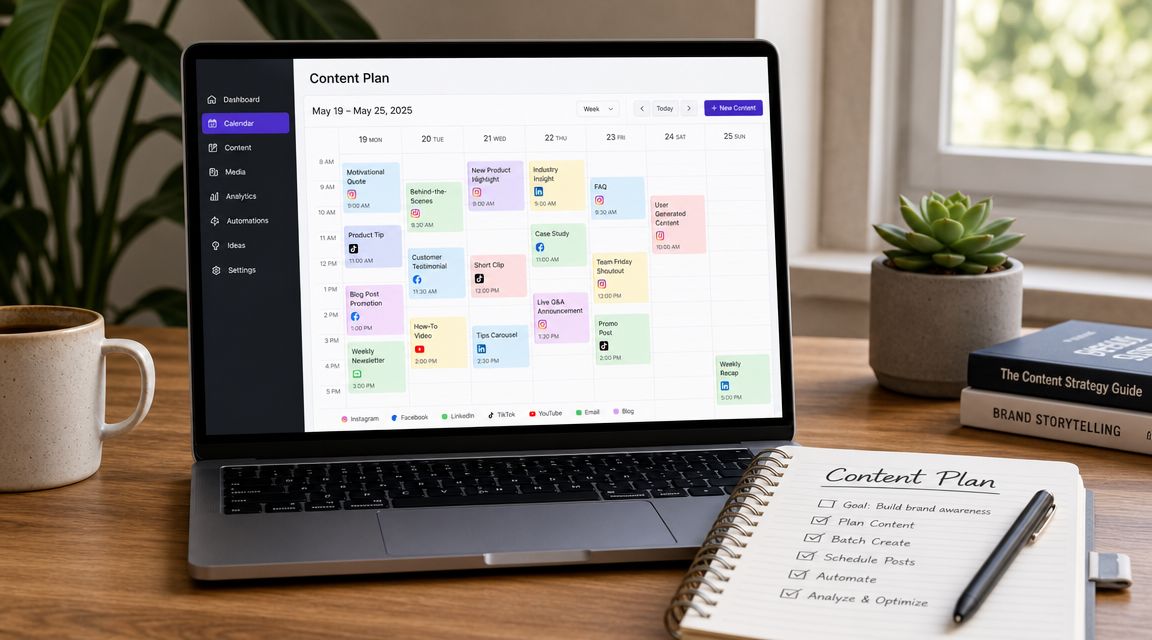
Why ad hoc posting falls apart
When distribution is improvised, three things usually happen.
- The easy assets get posted first: You share the obvious clip and ignore the better but slower opportunities like blog summaries or email follow-up.
- Channel timing becomes random: Good content lands at inconsistent times because nobody owns the calendar.
- The archive never compounds: Old assets don't get refreshed because all effort goes to whatever is newest.
A calendar fixes this by giving each asset a planned sequence. Publish the pillar episode. Follow with clips. Send the email. Re-surface a related older piece. Update the website hub. That rhythm creates coverage without requiring daily reinvention.
Batch the work by function
Batching saves attention, not just time.
Draft several social posts in one sitting. Write newsletter blurbs in another. Edit clips in a dedicated session. When you group similar tasks, you make fewer context switches, and the output is more consistent.
A simple weekly structure might look like this:
- Monday: Finalize the pillar asset
- Tuesday: Extract clips and quotes
- Wednesday: Write email and blog derivative
- Thursday: Load the scheduler
- Friday: Review comments, replies, and site behavior
If you're exploring systems for streamlining repeatable publishing work, this overview of content automation for busy marketers is useful because it frames automation as operational support, not a replacement for judgment.
Use automation where repetition is the problem
Automation should handle repetitive steps, not editorial thinking.
Scheduling tools can queue channel-ready posts. Editorial calendars can track dependencies. Collaborative workspaces can keep researchers, editors, and producers aligned around the same library. If your archive is large, retrieval and classification matter just as much as publishing.
That's where tools differ. Some help with scheduling. Some help with drafting. Some help teams search and organize existing assets so repurposing opportunities are easier to find. For creators or publishers formalizing that side of the process, content marketing automation workflows are worth studying because the primary gain comes from connecting organization, production, and distribution rather than treating them as separate jobs.
Don't automate your voice. Automate the steps that keep your voice from showing up consistently.
The best systems feel boring in a good way. You know what happens after publish day. The team knows where assets live. Nothing important depends on memory.
Measure What Matters to Optimize and Grow
The fastest way to waste distribution effort is to measure the wrong thing.
A post can get likes and still fail. A niche article can get modest traffic and still become one of your most valuable assets if it pulls the right people deeper into your ecosystem. Measurement only helps when it matches the job of the channel and the role of the asset.
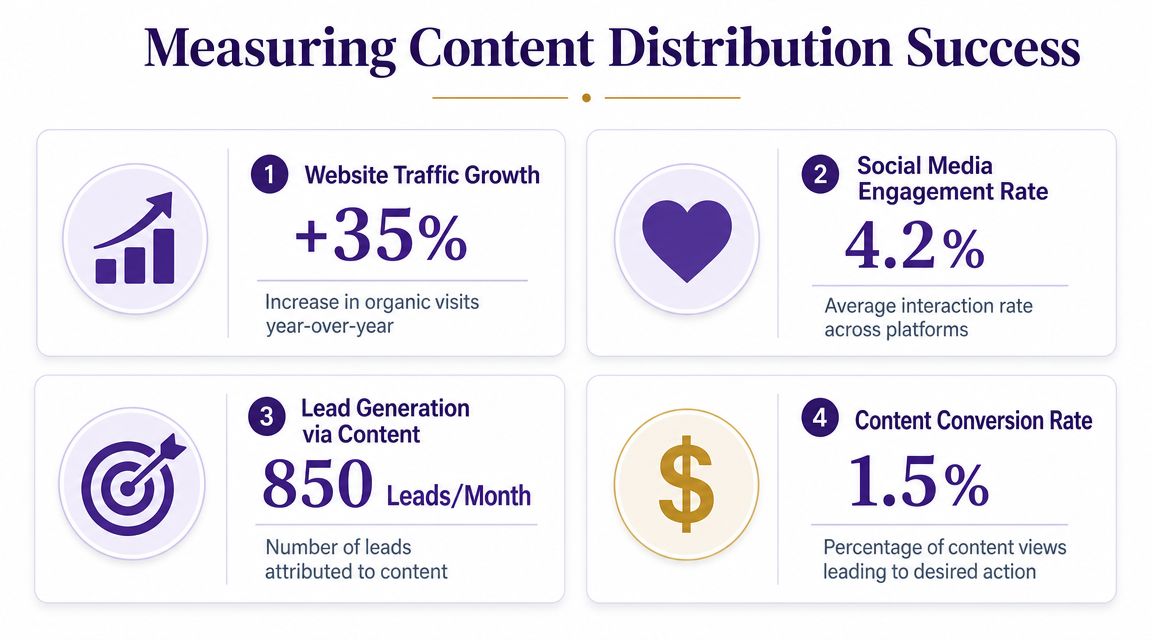
Use channel-specific KPIs
A high-performing workflow is a closed measurement loop. You publish, track channel-specific KPIs such as traffic, engagement, and conversions, then use those signals to reallocate effort and refresh assets. Aira's guide to content distribution strategy describes this as a continuous optimization system rather than a one-time launch.
That's the right mental model.
Measure by channel role:
- Owned channels: Traffic quality, time spent, return visits, subscriber actions
- Earned channels: Referral patterns, brand mentions, qualified visits
- Paid channels: Cost efficiency, landing page behavior, assisted conversions
This keeps you from judging every platform by the same metric.
Look for patterns you can reuse
The point of measurement isn't reporting. It's decision-making.
If your best-performing clips all start with a hard opinion, that's a packaging lesson. If archived how-to posts keep attracting search traffic, that's a refresh priority. If newsletter readers click on summaries but ignore direct episode links, your framing needs work.
A practical review cadence should answer these questions:
| Question | What to do next |
|---|---|
| Which topics keep earning attention over time? | Refresh and re-promote them |
| Which formats get consumed but not clicked? | Improve CTA and sequencing |
| Which channels introduce new people best? | Increase native adaptations there |
| Which assets still matter but feel dated? | Update headline, intro, examples, or visuals |
The useful metric is the one that changes your next action.
Feed performance back into the library
This is how mature teams gain an edge. They don't just measure campaigns. They enrich the library.
When an asset performs well, tag it as proven. When a topic repeatedly underdelivers, mark it for reframing or retirement. When a clip style works, document the hook pattern. Over time, your archive becomes smarter. It doesn't just store content. It stores evidence.
This is the payoff of a professional content distribution strategy. Distribution data doesn't live in a dashboard graveyard. It flows back into planning, repurposing, and editorial judgment.
If you're sitting on a growing archive of podcasts, videos, articles, or research, Contesimal can help you organize that library, make it searchable, and turn older assets into new material for distribution and repurposing. For creators and publishers trying to move from scattered content to a working system, that kind of structure is often the difference between constantly creating and compounding.