
You've got years of episodes, articles, videos, interviews, notes, and drafts sitting in folders, drives, and publishing systems. You know there's value in that library. You also know AI might help you tag it, search it, repurpose it, and turn old work into new revenue. The hard part isn't the promise. It's figuring out which vendor can handle your content without wasting your time or exposing your archive.
That's where a strong Request for Information template earns its keep. For publishers, podcasters, marketers, and professional creators, an RFI isn't procurement theater. It's the first serious filter. It helps you organize. Understand. Take action.
If you're moving from hobbyist workflows into a more formal content operation, this matters even more. Teams that want to reignite a content library and bring it to life need more than a generic intake form. They need a document that helps them vet AI partners around ingestion, taxonomy, collaboration, and data use before a sales demo starts steering the conversation.
Why Generic RFI Templates Fail for Content and AI
Most RFI documents were built for broad procurement situations. They work well enough when you're comparing standard services or straightforward software categories. They break down fast when the thing you're buying has to understand a messy archive of podcasts, videos, transcripts, articles, and metadata.

A generic template usually asks broad questions like “Describe your platform capabilities” or “How do you support content workflows?” That sounds reasonable until you're trying to compare vendors on issues of genuine importance, such as archival ingestion, layered taxonomy design, retrieval quality across unstructured media, or whether the platform can support collaboration across editorial and research teams.
The problem isn't that standard templates are useless. The problem is that they're too vague for this category.
According to Arphie's RFI guidance, 78% of RFIs fail to yield actionable insights because questions are too open-ended. That number tracks with what content teams run into in practice. If your question invites marketing copy, you'll get marketing copy.
What content organizations actually need to ask
An AI platform for a content library isn't just a tool purchase. It's a decision about how your archive gets interpreted. A publisher with decades of interviews, a YouTube team with playlists and clips, or a podcast network with a large back catalog needs answers to questions like these:
- Ingestion fit: Can the vendor process mixed media formats and historical archives without requiring a cleanup project first?
- Taxonomy depth: Can the system support layered topic structures, recurring themes, entities, and editorial concepts?
- Workflow reality: Will editors, marketers, and researchers be able to use it, or is it built only for technical teams?
- Data boundaries: What happens to your content once it enters the vendor's environment?
Those aren't edge cases. They're the core of the buying decision.
Generic procurement language hides content risk. Specific questions expose it.
If your library is central to how you publish, monetize, and repurpose work across platforms, your RFI has to reflect that. A good starting point is understanding how content intelligence platforms differ from generic AI tools. The best vendor isn't the one with the flashiest demo. It's the one that can handle your archive, preserve context, and support new value creation from what you already own.
The Anatomy of a Powerful RFI
A solid Request for Information template does one job well. It gets comparable answers from multiple vendors without turning the process into a full proposal cycle. That only works when the document is structured clearly from the start.
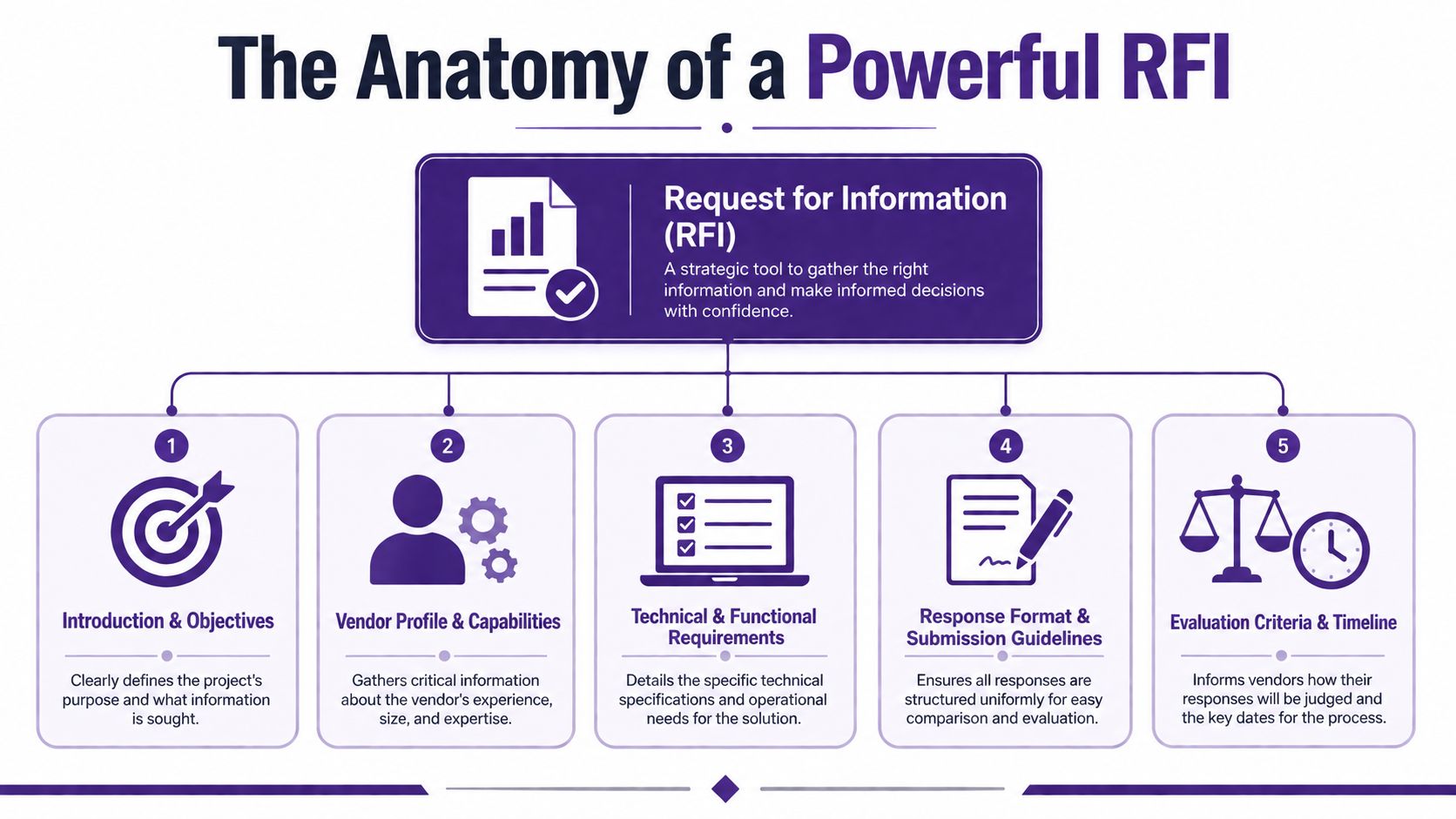
Responsive's RFI guide notes that standard RFI templates are structured around five universally recognized sections: project description and goals, company information, vendor requirements, submission instructions, and the specific requested information. That structure matters because it creates a common frame for evaluating vendor skills, credentials, and solution experience.
The five sections that make an RFI usable
Here's what belongs in each part, and why it matters.
| Section | What it should do |
|---|---|
| Project description and goals | Explain the business problem, the content environment, and what you're trying to learn from vendors |
| Company information | Give enough background so vendors understand your publishing model, asset types, and team context |
| Vendor requirements | Set baseline expectations around capability, scope fit, and operational readiness |
| Submission instructions | Control the format, deadline, contact point, and response rules so answers stay comparable |
| Requested information | Ask the actual questions that let you assess fit, risk, and next-step viability |
Why the statement of need matters most
The most overlooked part of an RFI is usually the clearest one. You need a direct statement of need. Not a slogan. Not a vision paragraph. A plain description of the problem.
Practical rule: If a vendor can't tell what problem you're solving from the first page, the rest of the response will drift.
For a content organization, that statement might describe a fragmented archive, inconsistent metadata, difficulty finding reusable moments across longform media, or the need to turn old content into new assets across channels. The point is to help vendors respond to the same real-world challenge, not to guess what you meant.
Administrative details are not busywork
A strong template also includes fields that look routine but save real time later. Standard practice includes a unique RFI number, date, project name and number, and a clear response deadline in order to keep the process traceable and visible. Good templates also rely on clear, singular questions instead of multipart prompts that invite incomplete answers.
Use this checklist before you send anything:
- Name the project clearly: Vendors should know whether this is about search, repurposing, research, metadata, or all of the above.
- Define the response format: Tell vendors whether to answer inline, attach a document, or use a spreadsheet for technical responses.
- Keep questions singular: Ask one thing at a time so you can compare answers cleanly.
- State the deadline plainly: Don't bury submission timing in a paragraph.
An RFI is a qualification tool. If the structure is loose, your shortlist will be weak before the demos even begin.
Customizing Your RFI Template for AI and Content
Once the structure is in place, important work starts. A generic Request for Information template then becomes useful for a publisher, podcast network, video team, or content marketing group.
The key is simple. Ask vendors questions they can answer concretely. Don't ask them to impress you. Ask them to reveal how their system behaves around your library, your workflows, and your constraints.
Start with your actual content environment
Before drafting questions, write down what your team is trying to manage. Be specific about asset types, archive condition, and what “value” means inside your business.
That usually includes items like:
- Library format mix: Podcasts, video, transcripts, blog posts, PDFs, show notes, image captions, internal research
- Operational goal: Better search, faster repurposing, editorial planning, rights-safe discovery, monetization support
- Team use case: Editors, marketers, producers, researchers, or executives who need access in different ways
A vendor can only answer well if your RFI reflects your library's reality.
Replace vague prompts with answerable ones
One of the biggest mistakes in AI procurement is asking broad capability questions that invite polished but useless responses. Content teams need prompts that force technical and operational clarity.
| Vague Question (Avoid) | Specific Question (Use This Instead) |
|---|---|
| How fast is your platform? | What information do you need from us to assess file ingestion performance for archived video and audio libraries? |
| Can you organize content? | How does your system support taxonomy creation across episodes, articles, clips, and recurring editorial themes? |
| Is your search good? | How does your platform handle retrieval across unstructured historical media where metadata is incomplete or inconsistent? |
| Can your AI help with repurposing? | Which outputs can your system support from longform assets, such as clips, summaries, thematic groupings, or research extraction? |
| Is your platform secure? | What restrictions can be applied to prevent submitted content from being used for general model training or unrelated product improvement? |
That shift matters. It turns the RFI from a branding exercise into a qualification document.
Ask about behavior, not branding. “How do you support podcasts with inconsistent metadata?” gets a better answer than “Are you built for media teams?”
Add a data-use clause before sharing anything meaningful
This is the part many teams miss. Standard RFI templates often treat the process as non-binding, which is fine for procurement mechanics but incomplete for AI vendor review. If you're sharing examples from a historical content library, you need language around permitted use.
According to the Results for America model RFI material, 65% of AI vendors in 2025 have updated their data policies to allow broader training rights. That creates a practical risk. If your RFI doesn't explicitly restrict training use, a publisher's archive can be exposed before a formal agreement is signed.
Include language that addresses:
- Evaluation-only access: Materials shared during the RFI process may be used only to prepare a response.
- No training rights: Submitted content may not be used for general model training, tuning, benchmarking, or product development unless separately agreed in writing.
- Confidential handling: Archival files, transcripts, and metadata must be treated as confidential evaluation materials.
- Retention limits: Vendors should state whether they retain sample materials after the review period and how deletion is handled.
If your legal team wants a stronger first draft, it can help to review resources on find AI tools for legal professionals, especially when you need help refining language around review rights, confidentiality, and model-training restrictions.
Ask about taxonomy, not just features
Most AI vendors can talk about search, summarization, and chat. Fewer can explain how they'll help a content business create durable structure across a large archive.
That's why your RFI should ask about:
- Taxonomy design support: Can the vendor help define themes, topics, entities, and nested content relationships?
- Metadata enrichment: How does the system handle missing, weak, or inconsistent metadata?
- Cross-format relationships: Can it connect an article to a podcast episode, a clip, a transcript section, and later derivative content?
- Editorial usefulness: Will outputs make sense to humans who plan, package, and repurpose content?
Teams that want a sharper internal view before sending an RFI should revisit metadata management best practices. A messy metadata environment doesn't disqualify you from using AI, but it should shape the questions you ask.
RFI Examples for Publishers Podcasters and Marketers
A good Request for Information template should bend to your use case without collapsing into vagueness. The easiest way to see that is through examples.
Podcast network with a large back catalog
A podcast group wants help with automated transcription, chaptering, topic clustering, and highlight discovery across years of episodes. Their problem isn't lack of content. It's that strong moments disappear into old audio unless a producer remembers them.
Their RFI might include questions like:
- How does your platform process historical podcast episodes that have inconsistent transcript quality?
- Can your system identify recurring themes, guests, and concepts across multiple shows in one network?
- What output formats can support repurposing into clips, newsletters, social posts, or episode research briefs?
- How do editorial teams review and correct generated structure before publication use?
This kind of buyer isn't just shopping for automation. They're trying to turn old longform content into a money maker by making the archive searchable, reusable, and easier to package across platforms.
Book publisher reviewing a backlist
A book publisher has a large backlist and wants to identify titles with adaptation potential, resurfacing opportunities, and thematic connections across authors and genres. They don't need a generic content AI pitch. They need a platform that can help organize, understand, and act on decades of material.
Their key RFI questions might look different:
- How does your platform handle ingestion and analysis of full-text book files, summaries, and rights metadata?
- Can your system support layered taxonomies that combine genre, theme, audience, historical setting, and adaptation signals?
- How do users compare patterns across a catalog without flattening nuance between titles?
- What controls are available for rights-sensitive material and unpublished content?
The strongest vendor response here won't be the one with the broadest feature list. It'll be the one that understands editorial complexity and the value of preserving context.
Publishers don't need AI that merely summarizes books. They need systems that help people discover patterns inside a catalog they already own.
Marketing team managing a crowded content library
A marketing department has years of blogs, webinars, videos, and campaign assets. The team wants to align content across channels, identify gaps, and extract more value from longform work, making repurposing operational rather than occasional.
One useful benchmark comes from Cloudpresent's repurposing guide, which recommends planning to extract 5–7 repurposed pieces from every single piece of long-form content. That ratio gives teams a practical target when they're trying to move from ad hoc reuse into a repeatable content system.
Their RFI questions might include:
- How does your platform identify reusable segments across webinars, blogs, and video transcripts?
- Can the system group assets by campaign theme, funnel stage, or audience problem?
- What workflows support collaboration between strategy, editorial, and distribution teams?
- How does the platform surface content gaps or underused assets without requiring manual tagging of the entire archive first?
For teams trying to create infinite content value, the RFI should focus on whether the vendor helps the library become more usable over time, not just more searchable on day one.
Evaluating Responses and Shortlisting Partners
Once responses start arriving, enthusiasm becomes a liability. Vendors will use polished language. Some will answer directly. Others will sidestep hard questions with feature lists and sales positioning. Your job is to separate signal from performance.
A simple process helps.
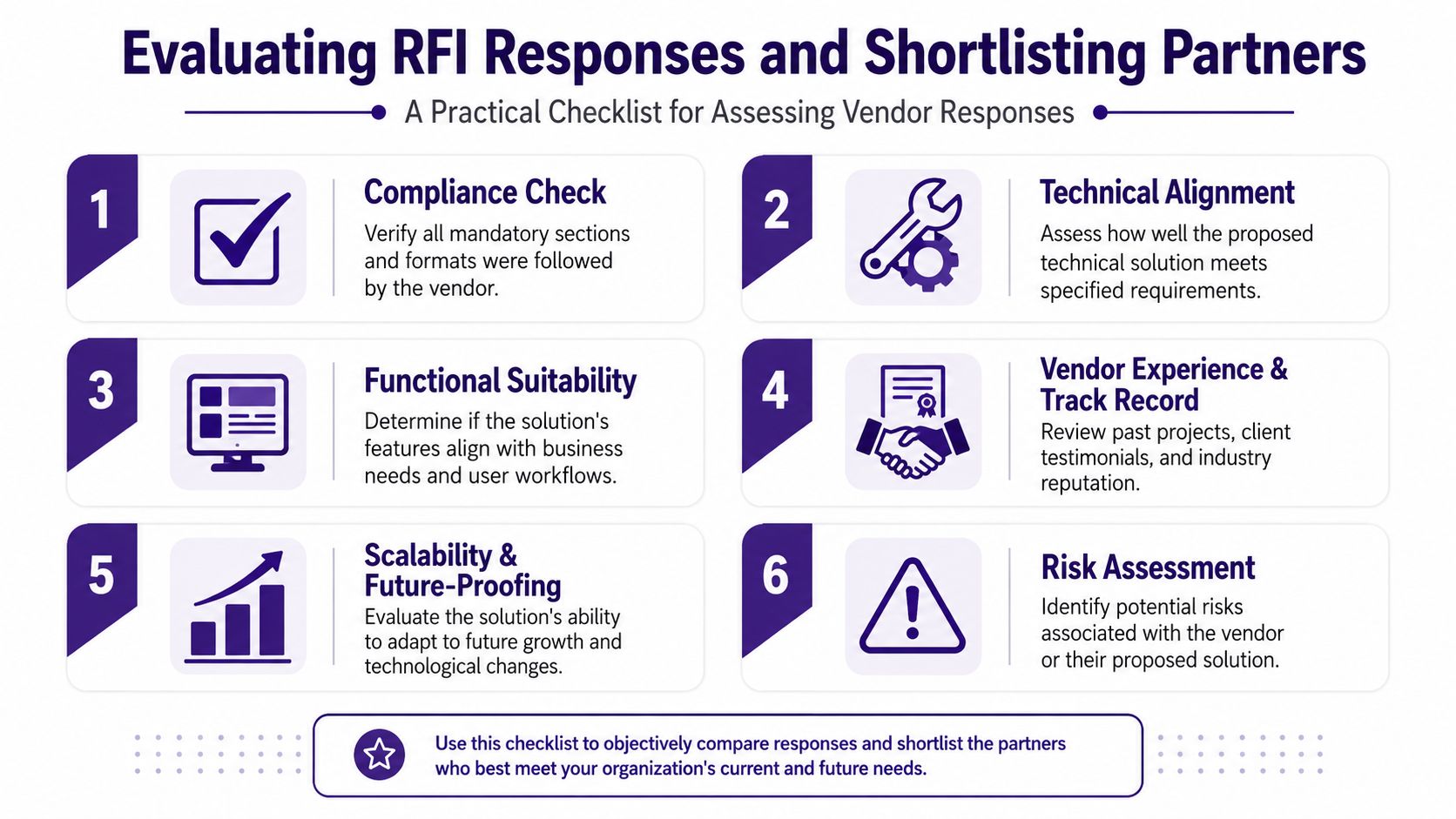
The underlying template should already include tracking fields for status, vendor name, and dates so your team can see what's pending, received, or under review and avoid timeline bottlenecks, as described in Inspectly's request for information template guidance.
Build a scorecard before you read the answers
Don't wait until the first response lands. Decide your criteria first so the best writer doesn't win by default.
Use a lightweight scorecard with categories such as:
- Technical alignment: Does the platform appear able to handle your asset types, ingestion realities, and taxonomy needs?
- Workflow fit: Can editorial, research, and marketing teams use it in practice?
- Data governance: Did the vendor answer clearly on retention, confidentiality, and training restrictions?
- Implementation realism: Does the response reflect the condition of your current library, or does it assume everything is clean and structured?
- Clarity of response: Did they answer the question asked, or swap in generic product language?
Keep notes beside each score. Short comments are often more useful than the number itself.
Watch the vendor explain their thinking
Some teams like to add a follow-up call after the written review. That can help, but only after you've marked the initial responses. Otherwise the strongest presenter can wash away a weak written submission.
This walkthrough can help frame what to look for during review:
Red flags that deserve immediate scrutiny
A weak response usually reveals itself quickly.
- Evasive language: The vendor talks around your question instead of answering it.
- Heavy jargon: Terms like “intelligent layer” or “semantic acceleration” appear, but concrete process details don't.
- No archive realism: The response assumes your metadata is complete, your files are clean, and your workflows are uniform.
- Missing restrictions: The vendor doesn't address content handling, retention, or training boundaries.
- Template noncompliance: They ignore your format, skip sections, or miss the deadline.
If you're comparing broader search-oriented vendors, it helps to review an enterprise search software comparison alongside the RFI responses. It gives your team another lens for understanding whether a tool is built for retrieval alone or for deeper content operations.
Common Pitfalls and Best Practices
Some RFIs fail because vendors are weak. Many fail because the document itself sets the wrong terms. If you want usable answers, you need to avoid the mistakes that shut good vendors out or invite bad responses in.
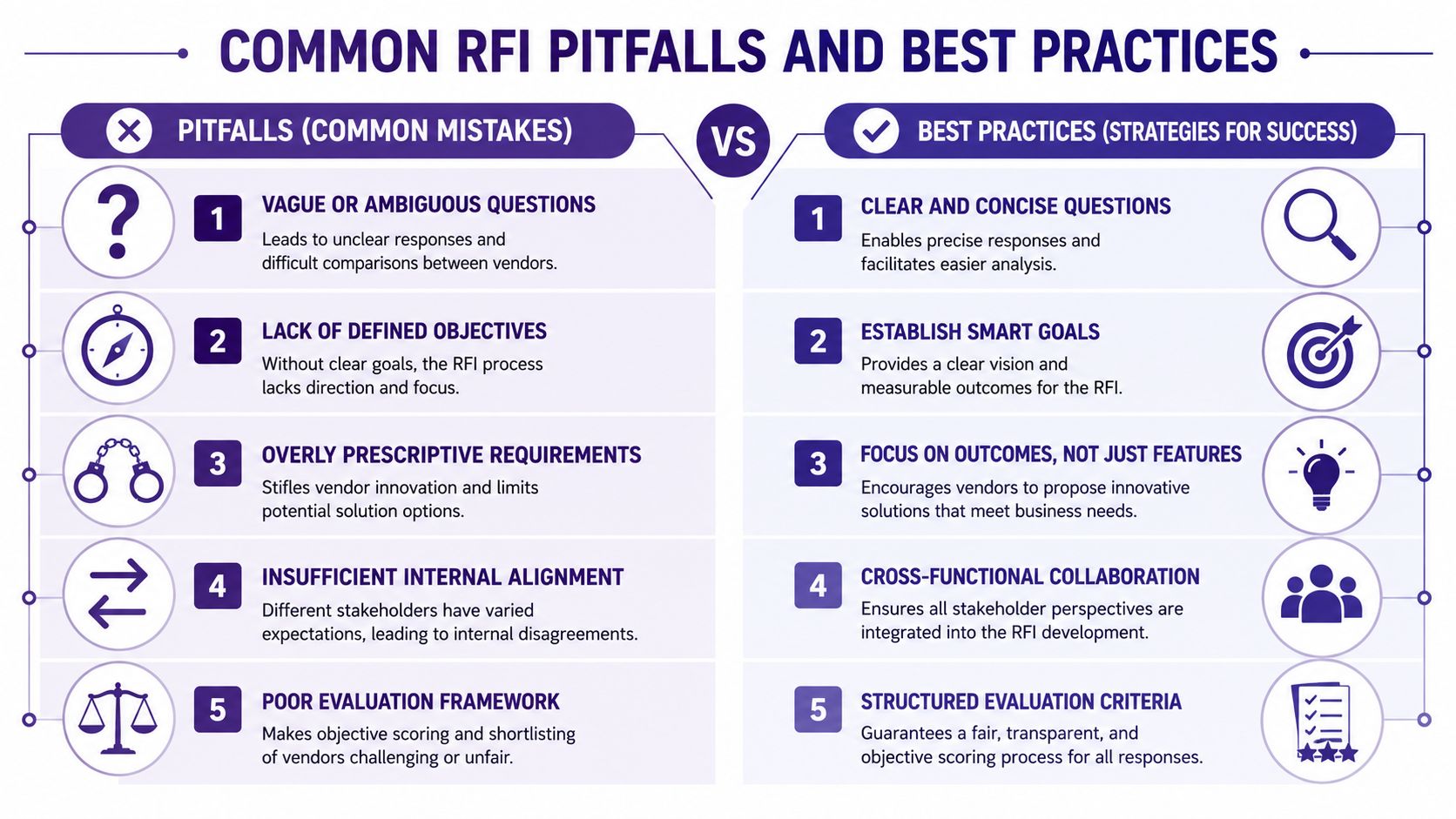
One of the biggest errors is overreach. According to Thomasnet's guidance on effective RFIs, over-specification can lead to a 30–40% reduction in initial vendor engagement when RFIs start mimicking RFPs. If you ask for pricing, full solution design, and implementation detail too early, some strong vendors will walk.
Do this
- Focus on essential information: Ask only for what you need to decide whether the vendor belongs on the shortlist.
- State the problem clearly: A direct statement of need gives vendors enough context to answer well.
- Use discrete questions: One prompt, one answer. That makes comparison possible.
- Define review criteria internally: Your team should know what matters before responses arrive.
- Protect your archive: Add data-use restrictions before sharing examples or samples.
Avoid that
- Turning the RFI into an RFP: Don't demand formal proposals before qualification.
- Writing broad prompts: Vague questions produce vague answers.
- Hiding the content reality: If your library is messy, say so. The right vendor won't be scared off.
- Letting legal review lag behind: AI procurement raises handling and policy issues earlier than many teams expect.
- Treating every response as equal: A complete, direct answer should carry more weight than a flashy one.
A good RFI doesn't ask vendors to prove everything. It asks them to prove the few things that matter most right now.
There's also a governance layer that many content teams now need to consider, especially if they operate across regions or handle sensitive archives. For a useful overview of emerging obligations, this EU AI Act compliance guide is worth reviewing alongside your internal legal process.
One final best practice matters outside procurement too. OneWrk's content repurposing strategy recommends setting a minimum standard that every piece of content you publish, regardless of format, must deliver genuine value and reflect brand standards. That same rule applies when evaluating AI partners. If a platform helps you produce more output but lowers quality or muddies editorial standards, it's solving the wrong problem.
If your team is trying to turn a historical library into something searchable, collaborative, and commercially useful, Contesimal is built for that reality. It helps content organizations organize archives, work with human and AI contributors in the same environment, and uncover new value across podcasts, videos, articles, and research collections.