
You're halfway through a draft, the quote is good, and the paragraph around it feels awkward. The problem usually isn't the quote itself. It's the missing bridge, the line that tells the reader why this voice matters right here and right now.
Why Most Quote Transitions Fall Flat
Writers usually blame punctuation when a quotation feels clumsy, but the actual issue is often logic. If a quote lands without setup, the reader has to stop and do the work of figuring out why it's there. That's the moment the draft starts to feel patched together instead of guided.
A weak transition usually looks like a floating quote. The sentence before it makes one point, the quote makes another, and the paragraph never explains the connection. That breaks flow in essays, but it hurts repurposed content even more, because a podcast transcript, blog excerpt, and research note all depend on the same basic sense of continuity.
The better question is not, “Did I add enough quotation marks?” It's, “Did I earn this quote?” Purdue OWL's guidance on transitions emphasizes that transitions should highlight connections between ideas, and that logic matters more than decorative phrasing. For writers who want a plain-English reference on that craft, write smooth story transitions is a useful companion resource.
Practical rule: If you can't say in one clean sentence why the quote belongs here, the quote probably needs a paraphrase instead.
That's why strong quote integration feels almost invisible. The writer shows the reader the path, then brings in the evidence. The reader never has to wonder why the source voice appeared, because the surrounding sentence already answered the question.
The Three Part Structure Behind Every Clean Quote Transition
The cleanest way to handle transitions into quotes is the TLQ model, which stands for Transition, Lead-in, Quote. It's simple enough to remember in the middle of an edit, but strong enough to prevent the most common failures. The sequence matters because each part does a different job.
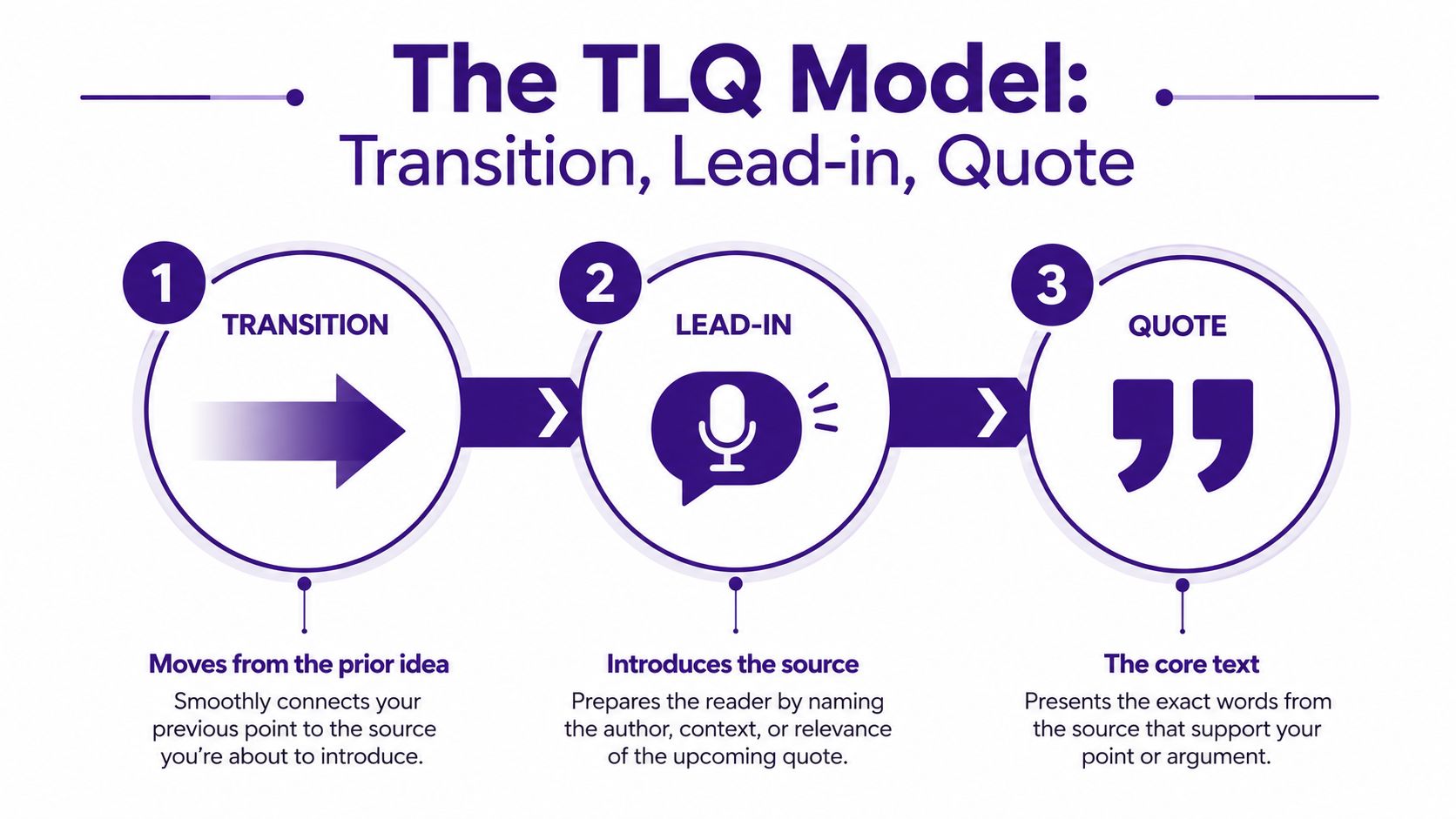
Transition
The transition is your bridge from the prior idea. It tells the reader, “Stay with me, because this evidence fits the claim I just made.” In the teaching material provided, the transition is the part that moves from a general point to a specific example.
Lead-in
The lead-in answers the basic questions, who, what, and where before the quote appears. That's where you identify the speaker or source so the reader isn't ambushed by a quotation with no owner. The University of Nevada, Reno's quote integration guidance treats this kind of source identification as part of the sentence's logic, not an optional ornament.
Quote
Then comes the quote itself. The key mistake here is to let the quotation stand alone as if it were self-explanatory. The quoted material needs a frame, or it reads like a clipped fragment that got copied in too early.
A sentence built with TLQ might look like this: the writer states a claim, adds a lead-in, inserts the source's words, and then explains the point again in context. That final step keeps the paragraph from feeling like a collage of borrowed language. The instructional sheet on quote integration calls a quote with no sentence-level support a floating quote, and that's exactly the problem you're trying to avoid.
The Quote Sandwich Method with Real Before and After
The quote sandwich takes TLQ one step further. Instead of just introducing a quote cleanly, you also explain what the quote does for the argument after it appears. That's the part many writers skip, and it's why their paragraphs feel like they stop instead of land.
A weak version looks like this:
The organization says its new workflow is easier to use. “The process is intuitive and saves time.”
That second sentence technically contains a quote, but it doesn't do any analytical work. The reader learns what was said, then gets left alone with it. There's no reason to care beyond the quotation itself.
A stronger version keeps the point, adds the source, and follows with interpretation:
The organization says its new workflow is easier to use. In its product note, the team explains, “The process is intuitive and saves time.” That matters because the claim shifts from general praise to a specific promise about user friction.
That last sentence is the bread of the sandwich. It tells the reader why the quote belongs in the paragraph and how it supports the argument. Writing advice on incorporating quotes and statistics often says there should be at least as much explanation as evidence, and this is the practical version of that rule. The quote gives you proof, but the analysis does the persuading.
The best quotation in a paragraph is rarely the longest one. It's the one your own words know how to use.
This is also where many writers make the wrong choice with partial quotes. If a phrase can be folded into your own sentence cleanly, that often reads better than dropping in a full block of borrowed language. The sandwich method keeps the writer in control of the paragraph instead of letting the source voice take over.
Signal Phrases and Reporting Verbs That Carry Weight
A quote can be correct and still feel misread if the lead-in gives the wrong signal. A reader notices that mismatch fast. The phrase before the quotation works like a label on a file folder, it tells the reader whether the source is presenting a claim, clarifying a process, weighing evidence, or warning about a risk.
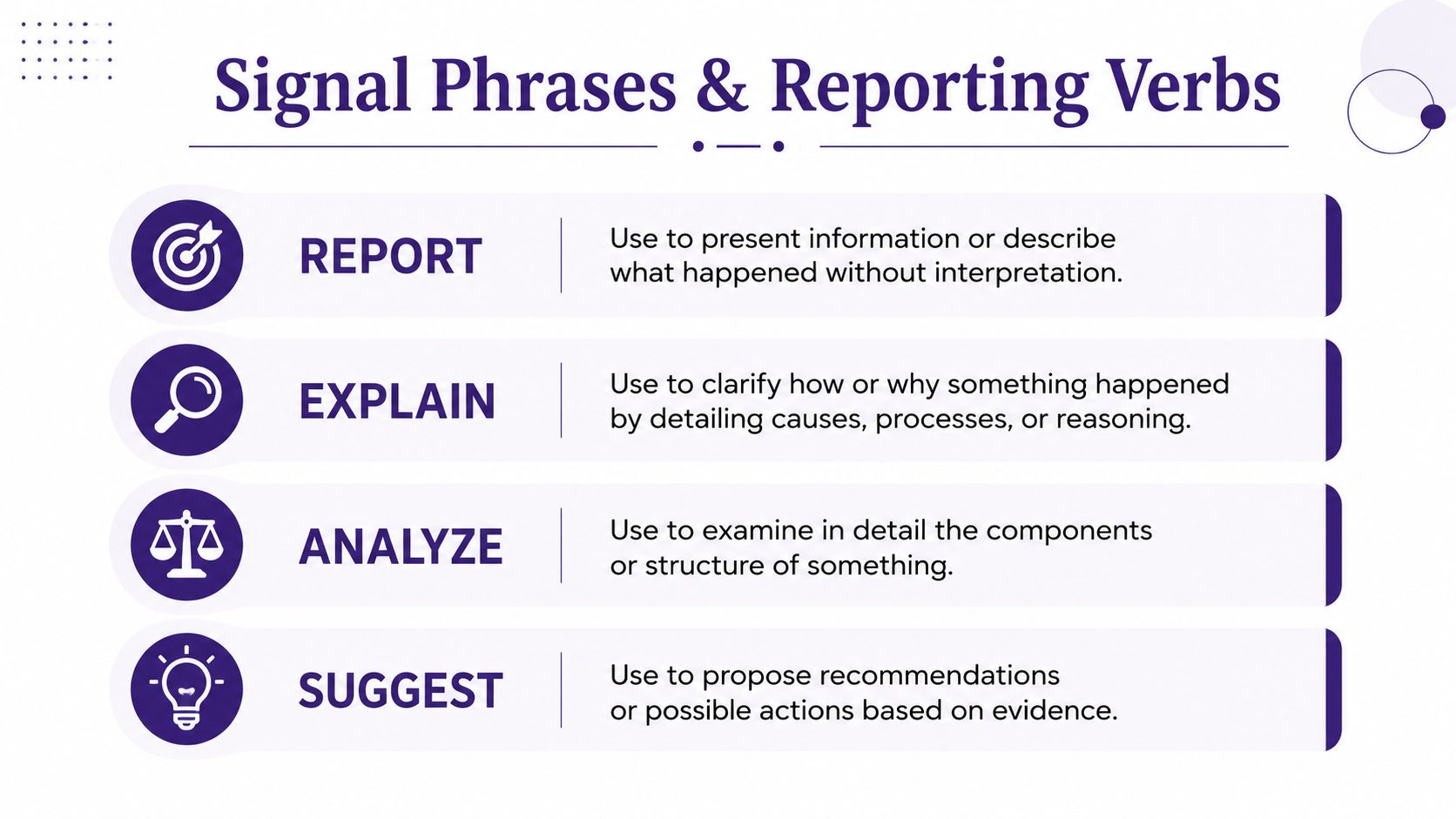
Match the verb to the relationship
Use the verb that matches the source's job in the paragraph. If the source is offering a position, argues, contends, or states fits that role. If the source is clarifying a process, explains, describes, or details tells the reader to expect instruction rather than opinion.
When the source is making sense of evidence, analyzes, interprets, or observes gives the quote analytical weight. If the source is giving ground or drawing a line between two ideas, admits, acknowledges, or contrasts sets that relationship clearly. If the source is pointing out a risk, warns, cautions, or notes prepares the reader for a cautionary point.
The same quote can feel different in the paragraph depending on the verb in front of it. According to is neutral, which makes it useful in some settings, but repeated too often it can flatten the voice of the piece. Says can be even softer, especially in written arguments, because it does little to show whether the source is claiming, explaining, or analyzing. The internal guide on signal phrase basics gives a clear refresher on how that phrase works in practice.
The main check is simple. Ask what the source is doing, then choose a reporting verb that names that action instead of hiding it. Guidance on reporting verbs shows the same idea in a visual way, and the chart for reporting verbs and their meanings is useful when you want to compare the options at a glance. That judgment matters in any draft, including work shaped with automated blog post writing tips, because the first pass may give you a quote, but the human edit has to decide whether the lead-in tells the truth about the source's role in the paragraph.
When Not to Quote at All
A weak transition can be a sign that the quote should come out, not that the sentence around it needs more decoration. If the line before the quotation cannot explain why the source voice belongs there, the paragraph is often stronger without direct quotation. Writers resist that choice because quotes sound authoritative even when they do not add much.
A quick test helps. If your own sentence already states the idea clearly, the quote may be repeating it. In that case, paraphrase the source, summarize the point, or keep the analysis and remove the quotation.
That same standard appears in guidance on credible sourcing, where the source has to earn its place in the paragraph rather than appear by default. The same idea applies across formats, because a quote that belongs in a research note may feel like extra weight in a blog post or script. The source can still matter, but the form of evidence should match the job the paragraph is doing.
Good editing often means protecting the reader from unnecessary quotation marks.
A draft often improves quickly once the writer starts removing quotes that do not pull their weight. One quote becomes a paraphrase, another becomes a short embedded phrase, and a third disappears because the writer's own explanation already does the work. The result is usually cleaner, faster, and easier to reuse later.
Matching the Transition to Your Format and Genre
Different formats handle transitions into quotes differently, and that's where a lot of general advice falls short. A journalism feature, an academic essay, and a podcast script don't ask the quote to do the same job. The transition should match the medium, not fight it.
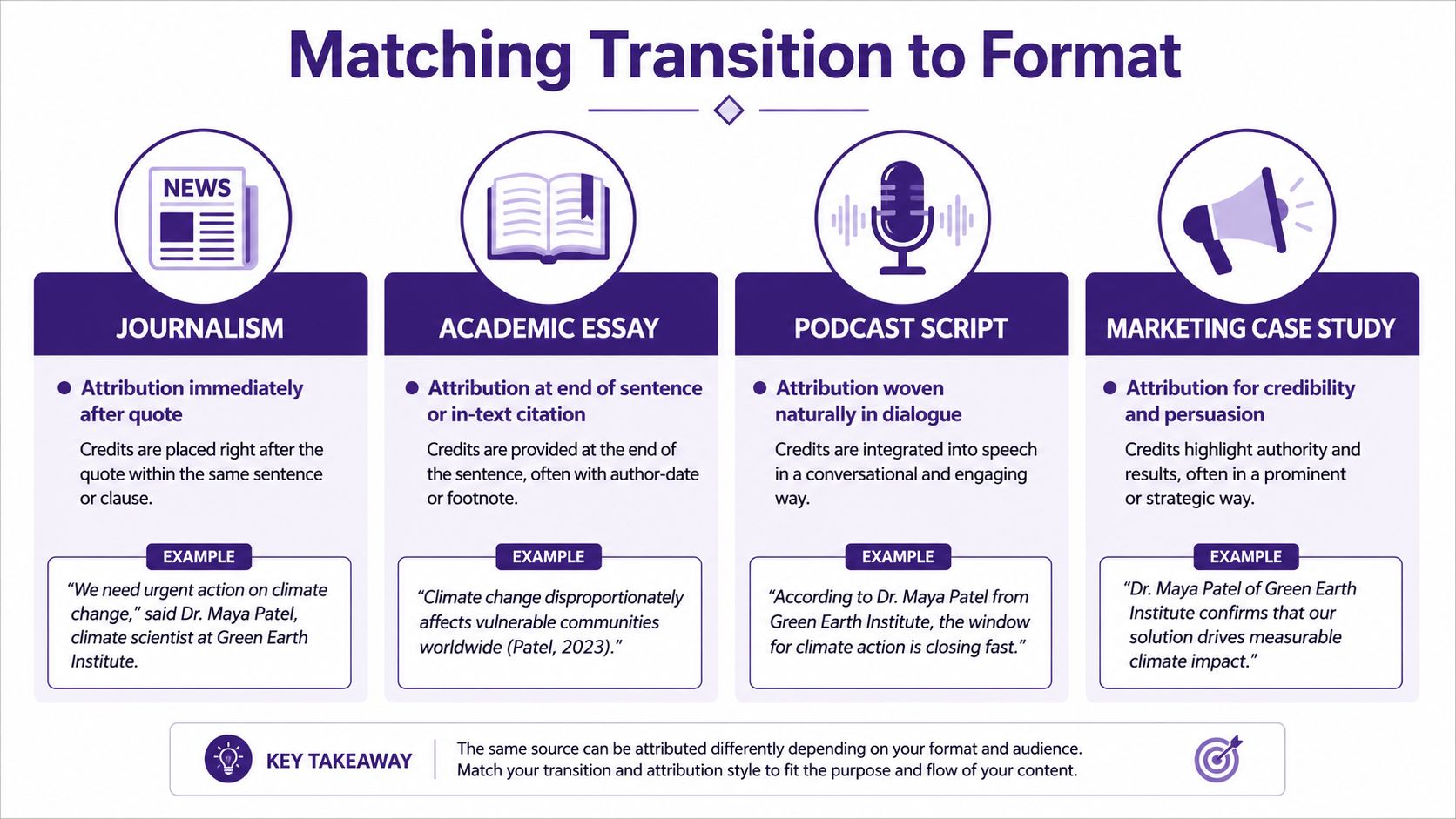
Journalism
In journalism, attribution often lands immediately after the first sentence of a long quote. The first line gives the reader the gist, then the attribution makes the speaker visible. That convention fits news writing because readers want clarity fast and don't want to wait until the end to know who is speaking.
Academic essay
In academic writing, the signal phrase usually comes first, then the quote, then the citation logic follows the sentence. That structure keeps the source integrated into the argument. Columbia College's guidance also notes that full-sentence introductions with a colon are common when the writer wants a stronger lead-in.
Podcast script
In a podcast script, a quote can be blended more fluidly into spoken narration. The host voice often leads directly into the source voice, then returns to commentary. That rhythm sounds natural in audio because the listener hears the change in voice instead of reading punctuation.
Marketing case study
In a marketing case study, the quote often works best when it supports a result or decision. The transition tends to be shorter, more functional, and more selective. The goal is not to showcase the quote as literature, but to make the proof easy to absorb.
For a useful contrast between tonal registers, the internal discussion of informal vs formal writing helps clarify why the same source line can feel right in one format and wrong in another. Journalism instruction also gives a strong reminder that attribution style is rhetorical, not just mechanical.
A Quick Checklist for Drafting Quote Transitions
Before you publish, run every quote through a fast audit. If the paragraph fails any one of these checks, the transition probably needs work.
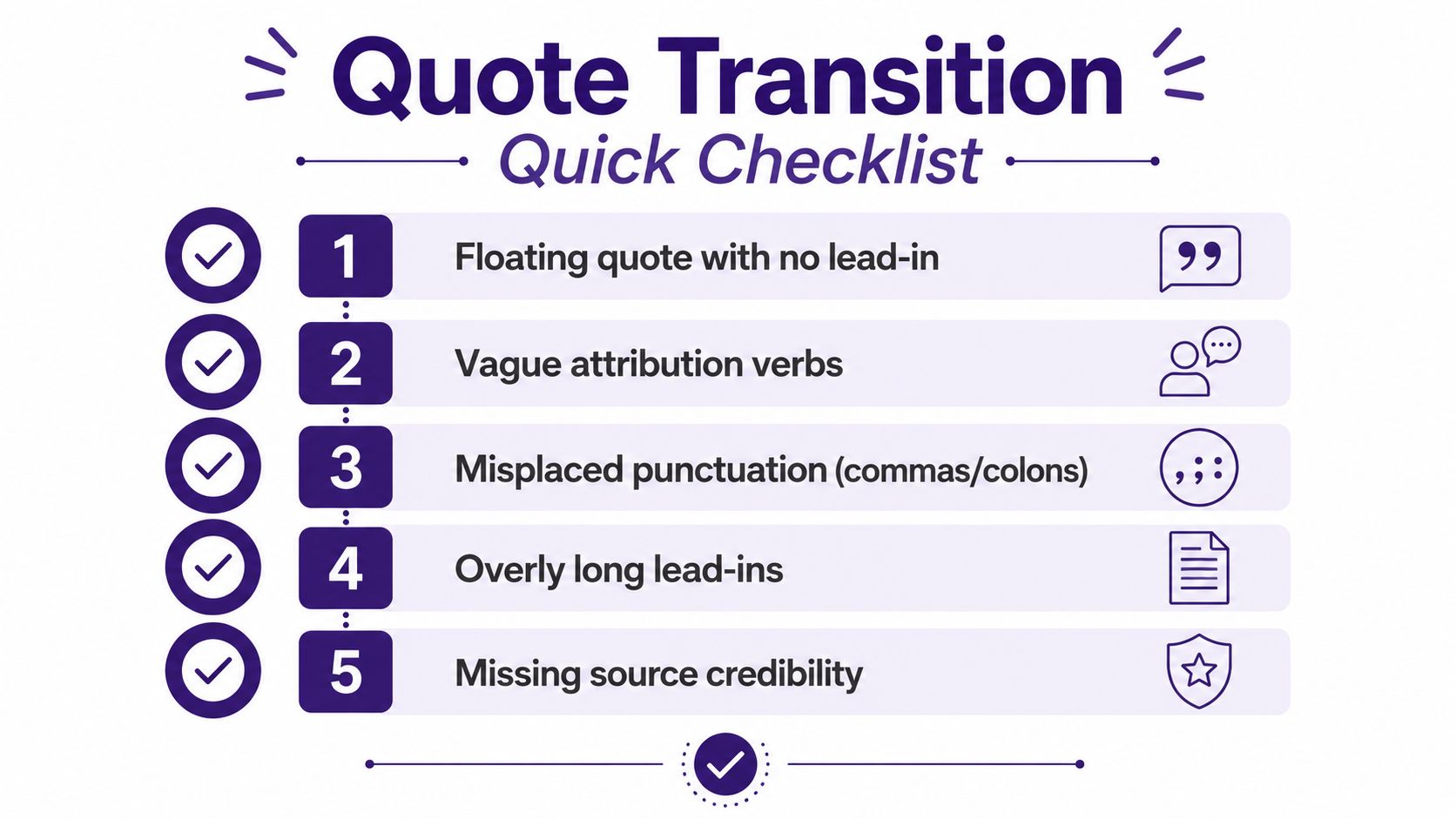
- Floating quote with no lead-in: Add a sentence that names the speaker or sets up the idea.
- Vague attribution verb: Replace says with a verb that matches the source's role.
- Misplaced punctuation: Check whether your comma or colon matches the type of lead-in you used.
- Overly long lead-in: Trim the setup so the quote still feels like the point, not an afterthought.
- Missing source credibility: Ask whether the source deserves direct quotation in this format.
A simple self-check catches most problems. Read the paragraph aloud and listen for the moment the quote enters. If the transition sounds abrupt, you probably need more context or a shorter quotation. If the analysis after the quote only repeats the quote, the paragraph still isn't finished.
Strong quote transitions also make your content easier to reuse later. A cleanly attributed line can move from a longform article into a script, a social post, or a research summary without losing its source identity. That's the advantage of getting the mechanics right, your evidence stays portable.
Contesimal helps creators, publishers, and research teams organize their content library so strong evidence doesn't get buried after the first draft. If you're turning old material into new articles, scripts, or episode ideas, visit Contesimal and see how a well-structured library can keep your best ideas easy to find, reuse, and build on.