
Agentic orchestration is the control-plane layer that decides which autonomous AI agent acts, when it acts, what context it receives, and which rules govern its work. In one 2026 enterprise survey, 73% of decision-makers said a gap exists between their agentic AI vision and today's reality, while 81% said fully autonomous enterprise operations without agentic orchestration are a “pipe dream” (Camunda).
You may already feel that gap. Your team has a podcast backlog, years of blog posts, video transcripts, newsletters, and social ideas scattered across folders. One AI assistant can summarize an interview, draft an article, suggest clips, and write social copy, but once you ask it to manage the whole chain, context gets lost, instructions collide, and nobody knows which version is ready to publish.
That's the point where “use AI for this task” becomes “design a system that can move work safely.” Agentic orchestration gives your content operation a coordinator. It assigns research, drafting, repurposing, quality assurance, approval, and publishing to the right workers, while keeping the larger goal and the audit trail intact.
The Moment One AI Model Is Not Enough
A creator opens a five-year content library and spots an opportunity. An old podcast episode contains a strong idea that never became a blog post. A video includes a useful explanation that could become a short clip. Several articles discuss the same theme from different angles, but no one has had time to connect them.
The first attempt is familiar. Someone gives one AI model the transcript and asks it to research the archive, identify the strongest angle, write a polished article, extract social posts, check factual claims, optimize the headline, and prepare everything for scheduling. The model produces something impressive enough to create optimism, but not reliable enough to remove review.
The draft may use the wrong source. The social copy may flatten the nuance from the interview. The SEO refresh may change a claim that should have remained untouched. A publishing step may happen before a human editor has approved the final version. The model isn't necessarily failing because it lacks language ability. It's being asked to perform several different jobs with different permissions and success criteria.
The tipping point for content teams
A single assistant is useful when the task is contained. It becomes awkward when the workflow includes:
- Research: Find relevant material across articles, videos, transcripts, and notes.
- Creation: Turn selected evidence into a draft suited to a specific audience.
- Repurposing: Adapt the source into clips, newsletters, posts, or updated pages.
- Quality assurance: Check factual support, tone, formatting, duplication, and brand rules.
- Distribution: Prepare or trigger publication only after the correct approval.
These jobs need different context and different boundaries. A research agent should retrieve evidence, not invent a headline. A publisher should move approved assets, not rewrite them. A human editor should be able to pause the process when the source material is ambiguous.
Practical rule: If one prompt contains several jobs, several tools, and several approval decisions, you're probably designing an orchestration problem.
The useful question isn't whether one model can complete the whole task in a demo. It's whether your team can understand, control, correct, and repeat the workflow when the happy path disappears.
Defining Agentic Orchestration in Plain Language
Think of a busy intersection. Autonomous AI agents are vehicles, each carrying out a particular job. Tools are exits and roads leading to search systems, content databases, calendars, analytics platforms, or publishing tools. Context is the information inside each vehicle, such as the source transcript, audience brief, editorial rules, or previous agent output.
The orchestrator is the traffic controller. It decides which vehicle moves first, where it goes, what route it can take, and what happens if the road is blocked.
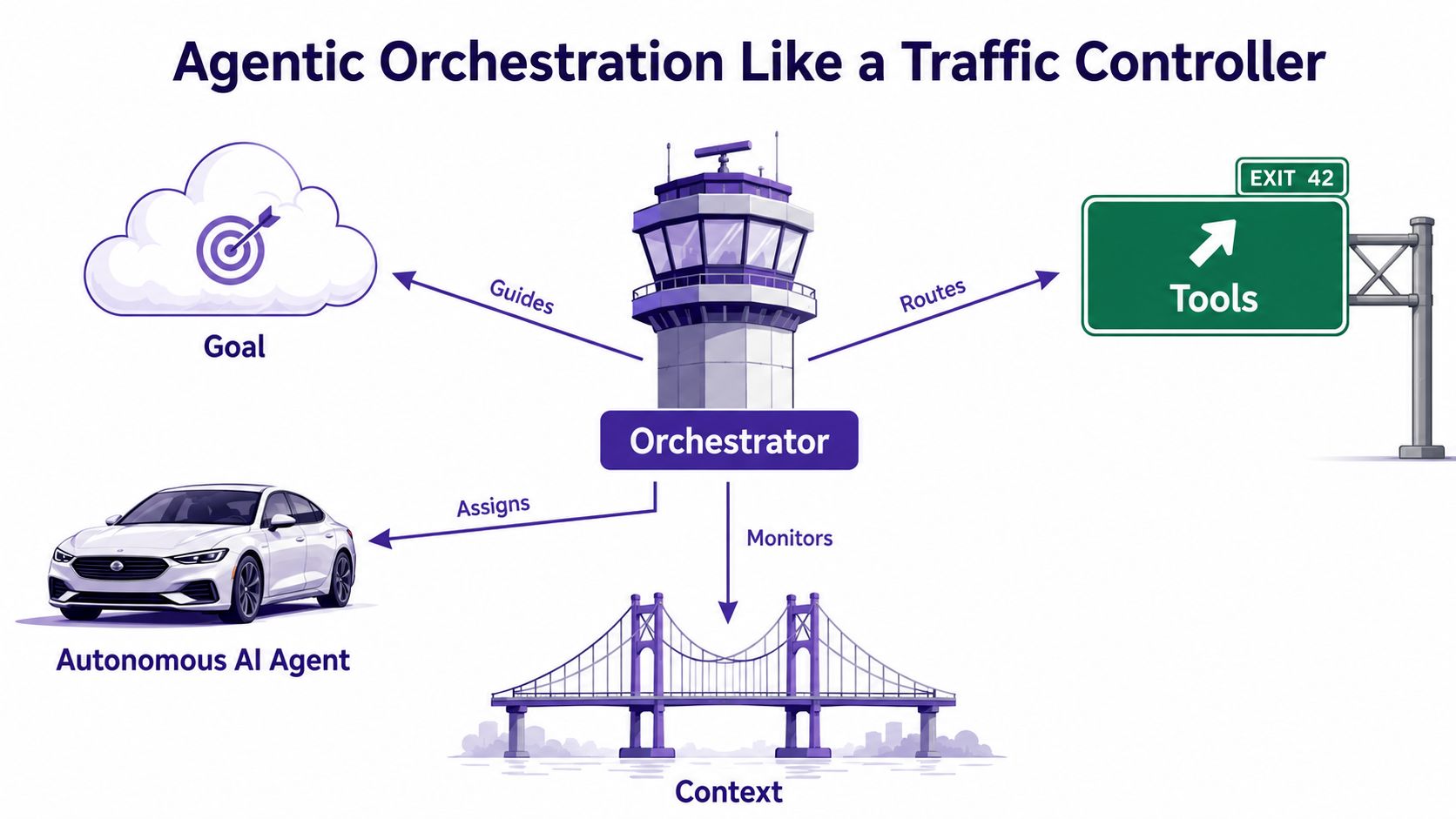
The five jobs that make coordination real
A precise definition has several parts. Agentic orchestration determines:
- Which agent acts. It routes a retrieval task to a research specialist and a formatting task to a production specialist.
- When the agent acts. It can enforce sequence, parallel work, waiting periods, or approval gates.
- What context the agent receives. It passes the relevant transcript, research findings, constraints, and prior state instead of dumping the entire library into every prompt.
- Which tools the agent may invoke. It can restrict access to search, databases, analytics, file systems, or publishing actions.
- How the workflow behaves over time. It manages shared state, handoffs, retries, pauses, conflict resolution, and termination.
That last job separates orchestration from simple delegation. An agent can decide how to pursue a narrowly defined goal. The orchestrator manages the wider process and keeps the system from losing track of what happened.
For teams learning the difference between a chat interface and a connected workflow, this guide to AI chat interfaces offers useful context. A conversational screen may be the front door, but orchestration is the machinery deciding which capability operates behind it. Teams also exploring collaborative AI communication can compare practical patterns in the 1chat blog for teams, especially when multiple people need to work around shared conversations and knowledge.
How an Orchestration Layer Is Actually Built
The cleanest architecture separates the control plane from the execution plane.
The control plane answers questions such as: Who may act? Which policy applies? Which agent should receive this task? How will the system evaluate the result? What should be logged? The execution plane performs the work through agents, tools, workflows, and APIs.
The control plane
A production-oriented control plane commonly includes:
- Policy and identity: Define what each agent, person, or service is allowed to do.
- Routing: Select the next agent, workflow, or human reviewer.
- Evaluation: Check whether an output meets the task's requirements.
- Observability: Record events, tool calls, state changes, latency, and failures.
- Audit: Preserve a trace of actions so the team can reconstruct what happened.
The execution plane is more concrete. It contains the research agent retrieving passages, the drafting agent producing prose, the image tool creating an asset, the content management API saving a page, and the workflow engine moving the task from one state to the next.
This separation also clarifies the role of connectors. Protocol layers such as MCP-style connectors can standardize how agents request context and invoke tools, while centralized policy determines whether those requests are permitted. The agent can ask for a search or an API action, but the control plane should decide whether that action is available in the current workflow.
Five coordination patterns
Microsoft's agent workflow guidance names five coordination modes:
- Sequential: Agents work one after another, useful when each step depends on the previous output.
- Concurrent: Agents work in parallel, useful when separate research tasks can run independently.
- Handoff: One agent transfers control to another, such as a researcher passing an evidence bundle to a writer.
- Group Chat: Agents collaborate through a shared conversation.
- Magentic: A manager agent dynamically coordinates specialist agents.
These patterns give content teams a practical vocabulary. A podcast-to-article workflow might use sequential research and drafting, concurrent headline and social ideation, a handoff to QA, and a human approval before publication.
For a broader look at managing agents, tools, and their operational relationships, the agent management system overview from SpecStory, Inc. is a useful companion. Content organizations can also connect this architecture to content intelligence platforms, where structured libraries and searchable knowledge provide the context agents need.
Where Agentic Orchestration Came From
Agentic orchestration grew out of workload automation, but it changes what the workflow can do. Earlier systems depended on fixed scripts, scheduled jobs, and predictable handoffs. Robotic process automation added software bots that could repeat actions across interfaces. Agentic orchestration brings AI agents, human reviewers, and deterministic systems into one governed process, so selected steps can respond to incomplete information or changing conditions.
For a content team, the difference appears in everyday work. A script can move a file between folders. An RPA bot can enter metadata into a publishing interface. An agent can read an interview, identify a useful theme, select an approved research tool, and produce a structured brief. The orchestrator controls how that flexible reasoning connects to the rest of the workflow, including review and publishing rules.
| Dimension | Script-Based Automation | Robotic Process Automation | Agentic Orchestration |
|---|---|---|---|
| Flexibility | Follows predefined instructions | Repeats interface actions | Adapts selected steps to context |
| Judgment | Minimal | Limited and rule-bound | Supports reasoning within defined boundaries |
| Governance | Rules live in scripts and schedules | Controls focus on bot access and execution | Coordinates identity, policy, state, evaluation, observability, and audit |
| Best-fit use cases | Stable, repeatable jobs | Repetitive work across existing interfaces | Multi-step processes involving agents, tools, systems, and people |
The market is expanding with this architectural shift. One industry report estimated the agentic AI orchestration and memory systems market at USD 6.27 billion in 2025, projecting USD 28.45 billion by 2030 and a 35.32% CAGR over that period (BMC). These figures are projections, not guarantees. They do show why organizations are evaluating orchestration as a distinct capability.
Process complexity adds pressure. A 2026 survey cited by BMC found that organizations manage an average of 50 endpoints in business processes, with that footprint growing 14% year over year. For a content operation, those endpoints might include a content library, transcription service, search index, analytics system, project board, email platform, and publishing stack.
The orchestrator gives those systems a controlled way to work together. It can pass the right context to an agent, enforce which tools are available, record decisions, and route exceptions to a person. That makes agentic workflows more manageable than a collection of disconnected prompts and automations.
A Content Workflow Under Orchestration
A long-form interview enters the system. The goal is not merely to summarize it. The team wants a podcast clip, a blog post, a newsletter, three social posts, and an SEO refresh, while preserving the original meaning and making every claim traceable to the source.
The orchestrator creates a workflow state and sends the transcript to a research agent. That agent searches the content library for related episodes, recurring themes, supporting articles, and previous treatments of the same idea. It returns a structured dossier, not a vague paragraph, with source references and open questions.
Handoffs with a purpose
The draft agent receives the interview transcript, the research dossier, the audience profile, and the editorial brief. It doesn't need every document in the library. It needs the selected context and the rules relevant to its assignment.
Next, the orchestrator routes the approved draft to a repurposing agent. That agent creates platform-specific adaptations, such as a newsletter introduction, social posts, and a short-form video outline. It can work concurrently on independent formats, but the source claim set remains shared so each asset stays aligned.
The QA agent checks structure, unsupported claims, tone, repeated ideas, broken references, and missing approvals. If a retrieval call fails, the orchestrator can retry or route the task to a fallback path. If the QA agent finds an ambiguity, the workflow pauses rather than guessing.
The human editor then reviews the package. Only after approval does the publisher prepare the assets for distribution. The orchestrator records which agent produced each output, which tools it used, what changed during revision, and where the human made the final decision.
Teams focused on discoverability can pair this workflow with practical guidance on content visibility for teams from Surva.ai. The underlying principle is simple: reuse should preserve meaning, not multiply disconnected drafts. A well-organized information retrieval system helps the research step find the right source before downstream agents begin creating derivatives.
Governance and Best Practices for Production Use
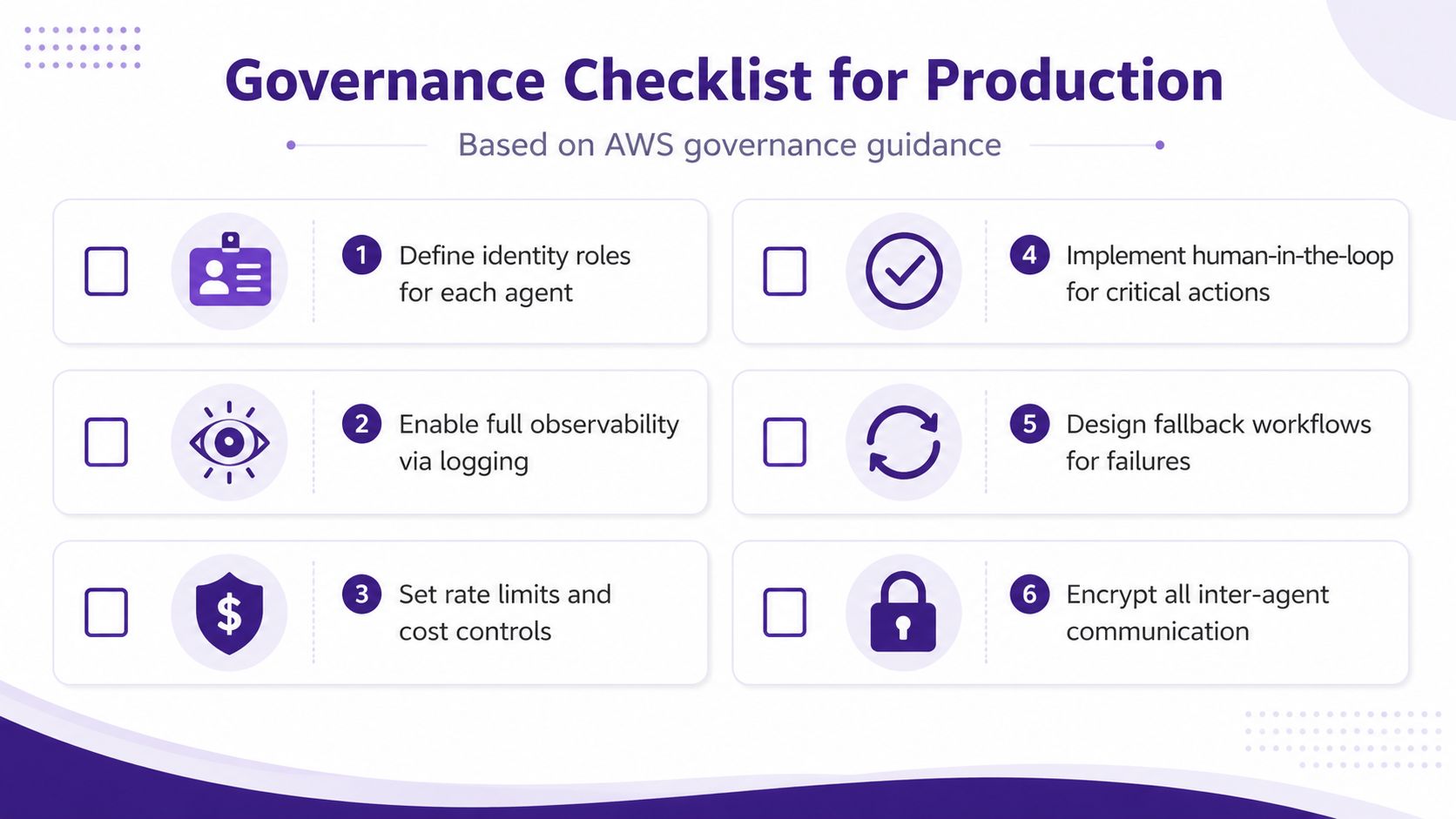
Governance works best as an operating checklist, not a decorative slide. AWS guidance identifies several areas that organizations need to manage, including agent, tool, and MCP registries, model management, platform standards, multi-level access controls, and audit requirements (AWS).
Controls worth implementing early
Start by giving every agent and tool a defined identity. The system should know which agent can retrieve content, which can create drafts, and which can trigger publication. A registry makes those relationships visible and gives administrators a place to manage versions and permissions.
Then add:
- Access boundaries: Restrict sensitive tools and publishing actions to approved roles.
- Audit logging: Capture prompts, outputs, tool calls, handoffs, approvals, and failures.
- Circuit breakers: Stop execution when the workflow enters an unsafe or unexpected state.
- Alignment auditing: Review whether agent behavior continues to match the intended policy.
- Geographic, financial, and temporal limits: Prevent actions outside approved regions, budgets, or time windows.
- Rate limits and computational quotas: Keep repeated calls from consuming uncontrolled resources.
- Human checkpoints: Require review before consequential actions, such as publication or external communication.
A governance white paper also recommends non-tamperable black-box logging and executive accountability, while placing the orchestrator at the primary point of control and responsibility (governance framework for autonomous agents).
Choosing a governance model
AWS describes three approaches:
- Centralized: One team owns policies and controls across the organization.
- Federated: Individual teams manage their own agent environments within shared standards.
- Hybrid: A central group governs foundational controls while specialist teams manage local workflows.
A small content team may begin with a lightweight centralized model. Larger publishers may need a hybrid arrangement, where editorial groups own workflow decisions but a platform team controls identity, audit, tool access, and shared infrastructure.
What Can Go Wrong Without a Strong Orchestration Layer
A content workflow can look fine in a demo and still fail in production. Research finds the wrong source, drafting uses it, repurposing multiplies the error, and QA sees only the final asset. Without shared state and clear logs, the team cannot trace which decision introduced the problem.
Common failure modes include:
- Runaway loops: An agent keeps planning or calling tools after the useful work is finished.
- Silent failures: A missing source or broken connector disappears into the workflow instead of triggering an alert.
- Compounding costs: Chained tool calls and retries consume more resources than the team expected.
- Governance gaps: An agent reaches a dataset or publishing tool outside its assigned role.
- Context drift: A social post or newsletter no longer follows the original brief or approved evidence.
These failures are harder to diagnose when agents can delegate tasks, retry calls, or request more context independently. The orchestrator should preserve state, record each handoff, apply permissions, and stop the run when a condition requires review. It also needs clear recovery paths, so a failed fact check pauses publication instead of sending a polished mistake downstream.
A platform adoption tracker cited by Camunda reported strong enterprise use of managed agent platforms. Adoption does not prove production success, yet it signals a preference for coordinated control over isolated model experiments.
Human supervision can hide weak design in a marketing demo. A production content system must pause, retry, escalate, and explain without someone watching every tool call.
Getting Started and Common Questions
Start with one workflow your team already understands. Map the path from source material to published asset, mark every handoff, and separate tasks that need judgment from tasks that should remain deterministic.
Choose one coordination pattern. Sequential routing often suits research followed by drafting. Concurrent work can support independent social adaptations. Handoff works when a specialist should transfer responsibility with a structured context package.
Before expanding, define the allowed tools, approval gates, failure paths, and logging requirements. Instrument the workflow before adding more agents. Otherwise, you'll create a larger system without learning which part needs improvement.
Common questions
What's the difference between an AI agent and an orchestrator?
An agent performs a defined task and may reason about how to complete it. An orchestrator coordinates the wider process, including routing, context, permissions, state, retries, pauses, handoffs, and termination.
Do small teams need orchestration?
Not for every task. If one person asks an assistant to summarize a transcript, a full multi-agent layer may add unnecessary complexity. It becomes useful when your team repeatedly moves one source through research, creation, QA, repurposing, approval, and distribution.
How does this connect to a content library?
Orchestration gives agents a controlled way to search, interpret, and reuse existing material. A platform such as Contesimal can help content organizations classify, organize, and search documents, podcasts, videos, and articles so human and AI contributors can turn archived knowledge into new formats.
Contesimal helps content organizations organize historical libraries, search across documents, podcasts, videos, and articles, and collaborate with AI while developing new content from existing assets. Visit Contesimal to explore how a structured content library can support orchestrated research, repurposing, and editorial workflows.