
A semantic search knowledge graph connects your content's “strings,” or keywords, to actual “things,” or entities, so a system can interpret meaning instead of matching text alone. Google's Knowledge Graph launched in May 2012 with information about 500 million entities and 3.5 billion facts, marking a major shift toward entity-based search.
You've probably felt the problem without having a name for it. Your archive contains years of interviews, podcast episodes, articles, scripts, research notes, and video clips, yet finding the right material for the next project still depends on memory, filenames, and increasingly desperate keyword searches.
A semantic search knowledge graph transforms the archive from a pile of files into a network of ideas. It can connect a person to an interview, an interview to a topic, that topic to related episodes, and those episodes to audience questions. The difficult part isn't just adding more data. It's ensuring the system understands what people mean when their words don't match your taxonomy.
The Problem With Your Digital Archive
A creator opens a folder called “marketing,” searches for “audience growth,” and finds almost nothing useful. The best episode might be filed under “distribution,” an article under “community,” and a video under the guest's name. The knowledge exists, but the labels don't agree.
That's digital hoarding. Teams keep producing valuable material, but the archive becomes harder to use as it grows. Manual folders and basic tags describe where a file sits or which words appear in it. They rarely describe the relationships that make the file useful.

From files to connected ideas
Suppose a publisher wants to create a new package about independent filmmaking. A document search may return pages containing “independent filmmaking.” A connected archive can also surface interviews with producers, articles about financing, a podcast about festival distribution, and a writer's notes about creative control.
That difference matters because audiences rarely use the exact vocabulary inside your files. They ask questions such as:
- Discovery: “Which episodes explain how creators find their first audience?”
- Repurposing: “What older interviews could support a video about sustainable production?”
- Planning: “Which guests have discussed the relationship between storytelling and community?”
- Collaboration: “What research already exists before we commission another article?”
A graph gives those questions connective tissue. It represents entities, such as people, topics, publications, formats, and projects, then records meaningful relationships between them. The archive becomes easier for humans to browse and more useful for AI systems that need grounded context.
The economic shift
Old content doesn't create value merely because it exists. It creates value when a team can find it, understand it, combine it with newer material, and adapt it for a new audience or platform.
That opens practical routes for creators moving from hobbyist work toward a revenue-generating operation. A podcast library can support newsletters, clips, research briefs, and themed collections. A publisher's back catalogue can inform new editions, explainers, and editorial packages. A filmmaker's unused research can become the foundation for a treatment or development conversation.
Practical rule: Treat every archive item as both a finished asset and a possible connection to another idea.
How a Semantic Search Knowledge Graph Works
A useful mental model is a restaurant menu. The words on the menu matter, but the categories and relationships matter more. “Apple” may describe a dessert, a juice ingredient, or a company mentioned in a business feature. The surrounding context tells the system which meaning applies.
A semantic search knowledge graph usually combines three building blocks.
Entities are the things
An entity is an identifiable person, place, organization, creative work, topic, product, or event. In a content library, entities might include a guest, a podcast series, a filmmaking technique, a publication, or a recurring audience question.
The distinction is important. “Apple” as a string is ambiguous. “Apple Inc.” and an apple used in a recipe refer to different entities. A system must link each mention to the right identity before it can retrieve reliable material.
Relations describe the connections
A relation explains how two entities interact. An episode can feature a guest. A guest can discuss a topic. A topic can relate to a production method. A production method can appear in several articles and videos.
These connections let the system answer questions that document lookup can't answer directly. It can follow a path from a theme to the people who discussed it, then from those people to the formats where the theme appears.
Libraries and digital humanities projects use this approach to integrate heterogeneous sources and support discovery, retrieval, navigation, visualization, semantic indexing, classification, and query recommendation. The value comes from giving people an interpretable map while also giving machines structured material to process, as described in this overview of knowledge graphs in libraries and digital humanities.
Embeddings represent meaning
An embedding represents the meaning of text as a position in a mathematical space. Content with related meaning tends to sit closer together, even when the wording differs.
Embeddings help a system recognize that “how to attract listeners” and “growing a podcast audience” may address a similar need. The graph adds identity and relationship constraints, so retrieval doesn't rely only on general similarity.
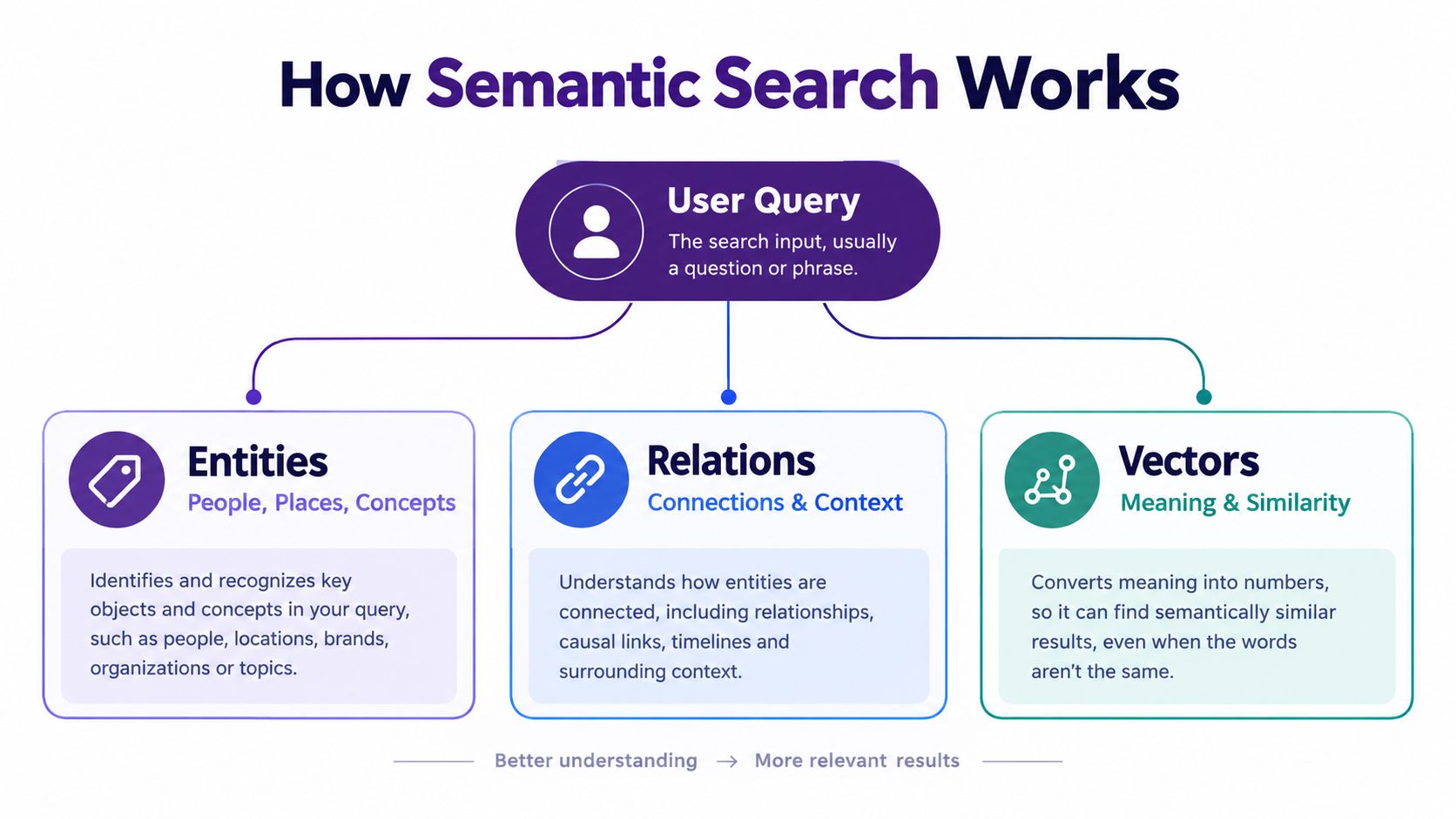
A strong workflow begins with the natural-language question, identifies likely entities and intent, searches semantically related material, then traverses relevant relationships. The result should include not only a plausible passage, but also the surrounding evidence that explains why it belongs.
That combination is why graph-based retrieval can connect semantic search with grounded context. Vector similarity helps find meaning. Graph structure helps preserve context.
Why Keyword Search Fails at Discovery
Keyword search isn't useless. It works well when the user knows the exact phrase, filename, or subject label used by the team. It becomes fragile when the question is ambiguous, conversational, or spread across several related sources.
Consider a researcher asking, “Which guests have explained how independent creators turn expertise into a repeatable content format?” The archive may contain the relevant material under “productization,” “editorial systems,” “series development,” or a guest's name. Exact matching sees separate phrases. Semantic retrieval can connect the underlying concepts.
This problem is called lexical mismatch. The user's language and the source's language refer to the same idea without sharing the same wording. A knowledge graph helps by linking terms to entities and relationships rather than treating every phrase as an isolated string.
Single-hop and multi-hop questions
A single-hop question may need one relevant passage. A multi-hop question requires a chain of evidence:
- Find an author or guest.
- Identify the topic they covered.
- Locate related work by another person.
- Compare the ideas across formats.
- Build a grounded answer from the connected material.
Flat retrieval may return a highly similar paragraph while missing the relationship that makes the answer complete. In a Semantic Scholar testbed, Explicit Semantic Ranking improved the production system by 6% to 14%, with the strongest gains on difficult queries where word-based ranking performed poorly, according to the research paper on explicit semantic ranking.
A separate evaluation found that graph traversal performed strongly on multi-step reasoning, with correctness around 89% and informativeness around 91%. A GraphRAG-style pipeline also produced at least 12% higher context precision, a 32% reduction in no-coverage cases, and at least a 19% increase in full coverage compared with dense vector retrieval in the reported evaluation. Those results are detailed in this evaluation of graph-based retrieval and multi-step reasoning.
Why this matters to discovery
A keyword index asks, “Where do these words appear?” A semantic search knowledge graph asks, “Which entities and relationships could answer this question?”
That distinction matters for content repurposing. The next newsletter, episode, or video may not exist as a ready-made file. It may emerge from connections across several older assets. Better retrieval doesn't merely save searching time. It gives the editorial team more raw material for original combinations.
For a focused comparison of the two approaches, see this guide to semantic search versus keyword search.
The Hidden Challenge and Schema and Intent
Adding graph structure won't automatically make an archive intelligent. A poorly aligned graph can make search more complicated while preserving the same discovery failures.
The central problem is the gap between human intent and system vocabulary. A creator may ask for “stories about building trust with a niche audience.” The taxonomy may contain only “marketing,” “engagement,” and “community.” Those labels aren't wrong, but they don't express the user's full intent.
More structure can create more friction
Taxonomies organize knowledge into broad topics and narrower categories. Semantic networks allow richer links across topics. Both are useful, but neither removes the need for careful modeling.
A rigid hierarchy forces an item into one branch. A graph can connect it to several concepts, but only if the system recognizes the entities correctly. If “audience trust,” “credibility,” and “editorial authority” remain disconnected, adding more nodes won't solve the search problem.
Content teams should therefore treat taxonomy design as an editorial activity, not only an IT task. The people who produce and reuse content understand the language audiences use, the distinctions that matter, and the terms that change meaning across formats.
Entity linking is the bottleneck
Entity linking maps a mention in text to the correct entity in the knowledge model. Disambiguation chooses between competing meanings. These steps affect every later result.
A system that links a guest's name to the wrong person can return convincing but irrelevant material. A system that treats a series title as an ordinary phrase may fail to connect its episodes. A system that recognizes “distribution” only as a marketing category may miss discussions of film distribution or publishing distribution.
Research on graph systems continues to identify schema-light environments, candidate ranking, and efficient retrieval as difficult problems. The practical lesson is simple: natural-language search still needs a strong alignment layer, as discussed in this research on querying knowledge graphs without knowing the schema.
A larger graph isn't automatically a more useful graph. The graph must reflect the questions your people actually ask.
Before building an elaborate model, collect real queries from editors, producers, marketers, and researchers. Compare those phrases with the existing taxonomy. Then improve aliases, entity rules, relationship types, and review workflows where the mismatch is greatest. A clear taxonomy strategy for content organizations can keep the structure flexible without turning it into an unmaintainable label jungle.
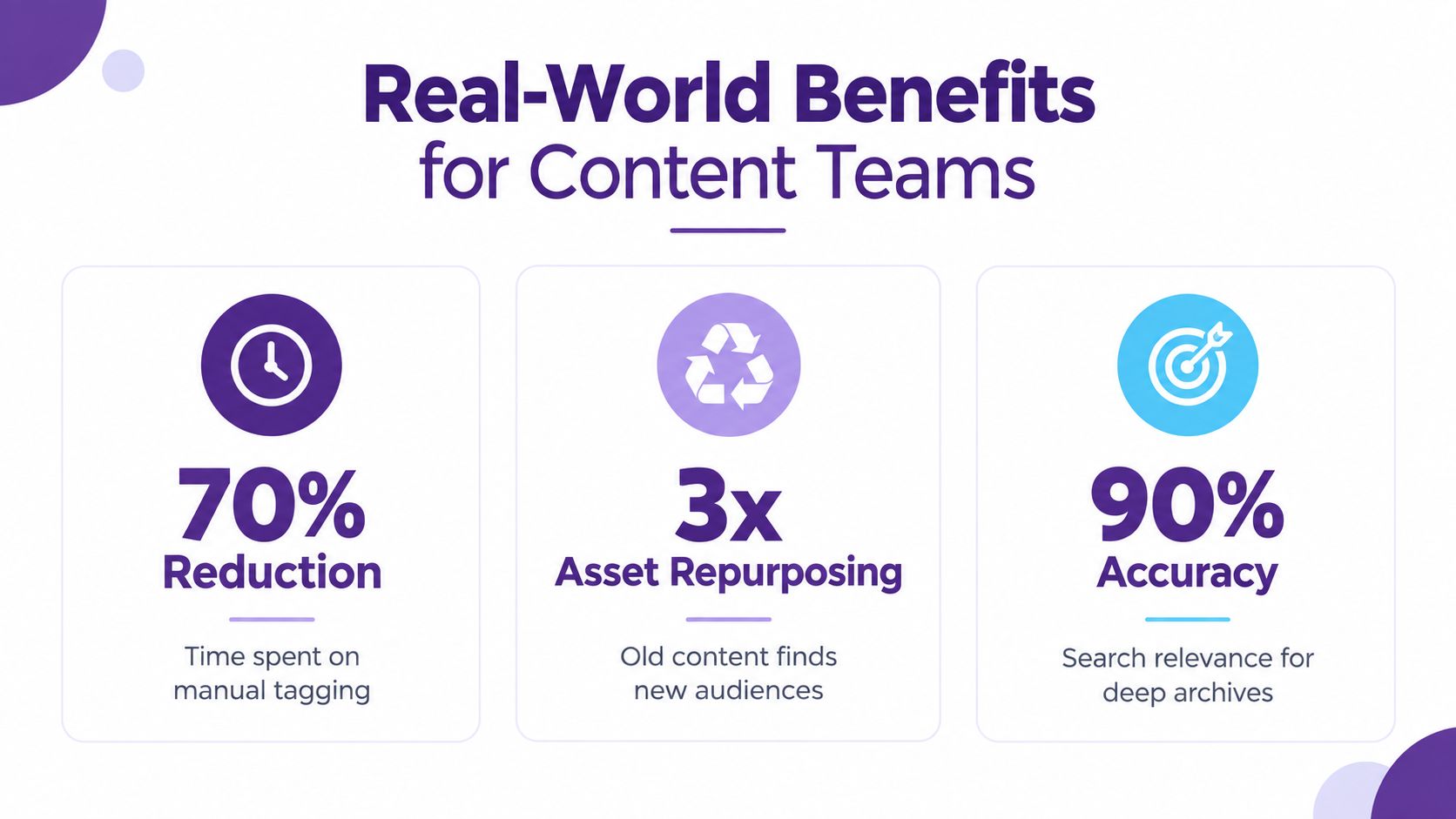
Real-World Benefits for Content Teams
The strongest use cases begin with a commercial or editorial question, not a technology demo. A podcaster may want to develop a new series from past conversations. A publisher may want to assemble a themed package from scattered archives. A content executive may need one idea adapted across video, article, newsletter, and social formats.
A semantic search knowledge graph supports those activities by exposing relationships that manual browsing tends to overlook. It can connect a recurring theme to the people who discuss it, the formats where it performs well, the questions it answers, and the gaps that deserve new reporting.
Repurposing becomes a research workflow
Repurposing works best when a team can see more than one asset at a time. A graph-backed query might reveal:
- A dormant theme: Several older episodes discuss a topic that has returned to public attention.
- A missing format: Strong research exists in articles, but no short video explains it plainly.
- A useful contributor: One past guest has expertise that connects two separate editorial areas.
- A content series: Multiple related questions can support a playlist, newsletter sequence, or guide.
This approach helps teams move beyond publishing once and forgetting. Old longform material can become source material for new work, provided editors can verify the original context and select appropriate excerpts.
Collaboration gets a shared memory
Human and AI contributors need a common evidence base. Editors bring judgment, voice, standards, and audience knowledge. AI can help surface relationships, cluster material, and suggest routes through a large collection. Neither role works well when the archive is fragmented across private folders and inconsistent labels.
Contesimal is one platform option for this workflow. It combines a chat-based research interface with classification, layered taxonomies, metadata management, programmatic uploads, and fast ingestion for documents, podcasts, videos, and articles. Teams can use it to search a connected content library, collaborate on ideas, and turn historical material into inputs for new editorial and distribution work.
Value comes from action
Search relevance is only the first step. The team still needs to decide which idea deserves production, which source is trustworthy, which rights apply, and which audience segment should receive the result.
The useful sequence is:
- Organize the archive around entities, topics, formats, and relationships.
- Understand what audiences and colleagues mean when they search.
- Take action by creating, updating, packaging, or distributing the right material.
The commercial value comes from that final movement. A connected archive can support more informed programming, better internal research, and a clearer path from past work to future content.
The broader market context reflects that shift. The semantic search and enterprise knowledge management segment held 47.8% of the Enterprise Knowledge Graph Market, and a market projection describes the broader market expanding from USD 1.99 billion in 2026 to USD 8.89 billion by 2034 at a 20.6% CAGR, as reported in this Enterprise Knowledge Graph Market analysis.
Implementing Search at Scale
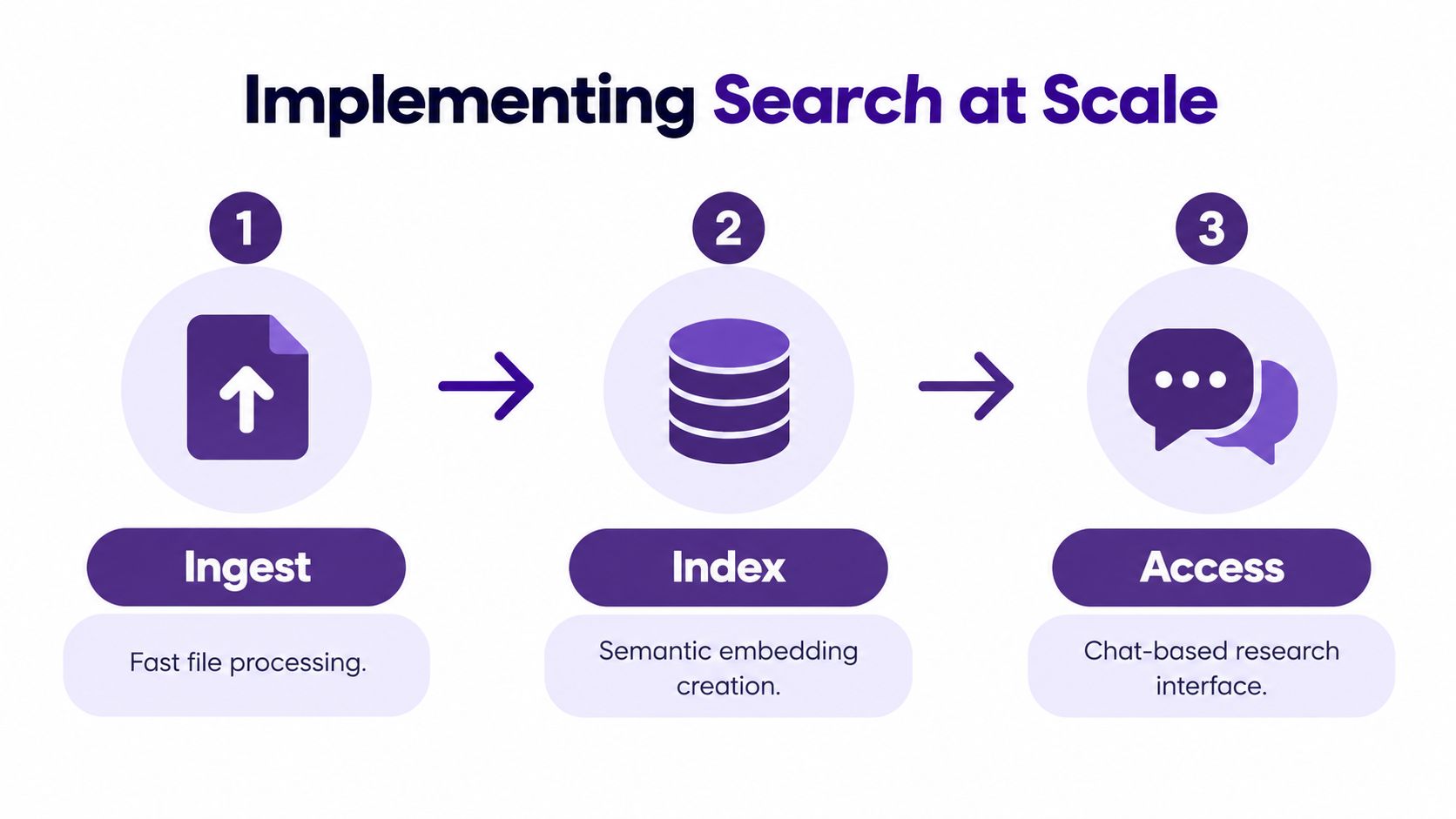
A practical implementation has three jobs: bring content in, create a useful index, and make the knowledge accessible at the moment someone needs it.
Ingest without creating another silo
Start with the archive you already have. Bring in articles, transcripts, scripts, notes, video metadata, and audio descriptions. Preserve dates, authorship, series information, source references, rights details, and publication status.
Programmatic uploads suit organizations with regular publishing pipelines. Fast file ingestion suits teams that need to make a large existing collection searchable. Neither approach is enough if the system stores content as isolated documents and leaves the team with another basic search box.
The ingestion layer should preserve provenance. Editors need to know where a passage came from, which version is current, and whether an AI-generated suggestion reflects one source or several.
Index meaning and relationships
The indexing stage should identify entities, generate semantic representations, and create relationships between relevant items. It should also handle aliases and ambiguity. A guest may use a professional name in one episode and a full name in another. A concept may appear under technical language in a research note and everyday language in a newsletter.
Don't automate every judgment. Let the system propose links and classifications, then give editors a clear way to approve, reject, or correct them. Those corrections improve the archive's usefulness because they encode the organization's own distinctions.
Access through interaction
A chat interface can make the archive approachable for people who don't know its schema. A producer can ask a natural-language question instead of remembering whether a topic belongs under “growth,” “distribution,” or “audience development.”
The interface should show supporting sources, related entities, and unanswered gaps. It should help a researcher move from one result to the connected material, rather than presenting an opaque answer with no route back to the evidence.
A useful guide to semantic search tools can help teams compare platforms by ingestion, indexing, interface, integration, and review capabilities.
Treat implementation as an ongoing editorial system. Taxonomies evolve, names change, new formats appear, and audiences ask unfamiliar questions. Human review keeps the graph useful when the language of the organization moves faster than its original schema.
Looking Ahead and the Future of Content Intelligence
Knowledge graphs are moving toward hybrid systems that combine structured relationships, semantic retrieval, real-time relationship analysis, and generative AI. The practical direction is less about replacing one search method with another and more about coordinating several methods around a reliable evidence layer.
That matters for media and research organizations because their archives are rarely clean. They contain conflicting versions, incomplete metadata, changing terminology, uncertain attribution, and material that requires editorial verification. A future-ready system must expose uncertainty instead of hiding it behind a confident answer.
A maintenance roadmap
Begin with a narrow, valuable use case. Choose one archive, one audience, and one recurring question that currently requires too much manual searching. Measure usefulness through the quality of retrieved sources and the number of productive editorial actions that follow, not through the size of the graph.
Then establish operating rules:
- Review entities: Confirm people, organizations, works, and topics before they influence recommendations.
- Track provenance: Keep the source and version attached to every important claim.
- Audit relationships: Remove links that no longer reflect the content or editorial meaning.
- Collect failed queries: Treat unsuccessful searches as evidence of missing aliases, concepts, or relationships.
- Protect judgment: Require human approval for sensitive, high-impact, or publication-ready outputs.
Patent activity suggests practical experimentation is growing unevenly rather than exploding. Reported filings rose from 15 in 2021 to 17 in 2024 and 31 in 2025, according to this semantic knowledge graphing market coverage. The figures point to continuing development, but they don't prove that every organization needs a graph project.
The better question is whether your team can turn its archive into a navigable knowledge base. If users still need to know the exact filename, tag, or internal category before they can find an asset, the entity-linking problem deserves attention before you add more complexity.
The first step is manageable. Collect real questions from your team, test them against a representative part of the archive, inspect which entities and relationships the system recognizes, and improve the taxonomy where human language and system language diverge. That process turns semantic search from an abstract AI feature into a practical content intelligence discipline.
Contesimal offers a searchable, interconnected workflow for organizing documents, podcasts, videos, and articles with layered taxonomies, semantic discovery, and a chat-based research interface. Visit Contesimal to explore how your existing content library can become a more useful source of research, collaboration, and new content.