
Subscriptions increased by 719% for Gramophone during the measured period after its archive was digitized and offered through paid access, according to an Exact Editions publisher case study. That's a publisher-specific result, not a forecast for your back catalog. But it reframes the work: old content isn't just material to preserve. Organized properly, it can become a product people discover, use, and pay for.
AI search visibility adds another discovery challenge. Your strongest interview, explanation, or archival finding might help answer someone's question without bringing that person to your website. Working creators need to distinguish being accessible, being cited, and earning a lasting audience relationship. Those are different outcomes, and they need different scores.
What AI Search Visibility Actually Measures
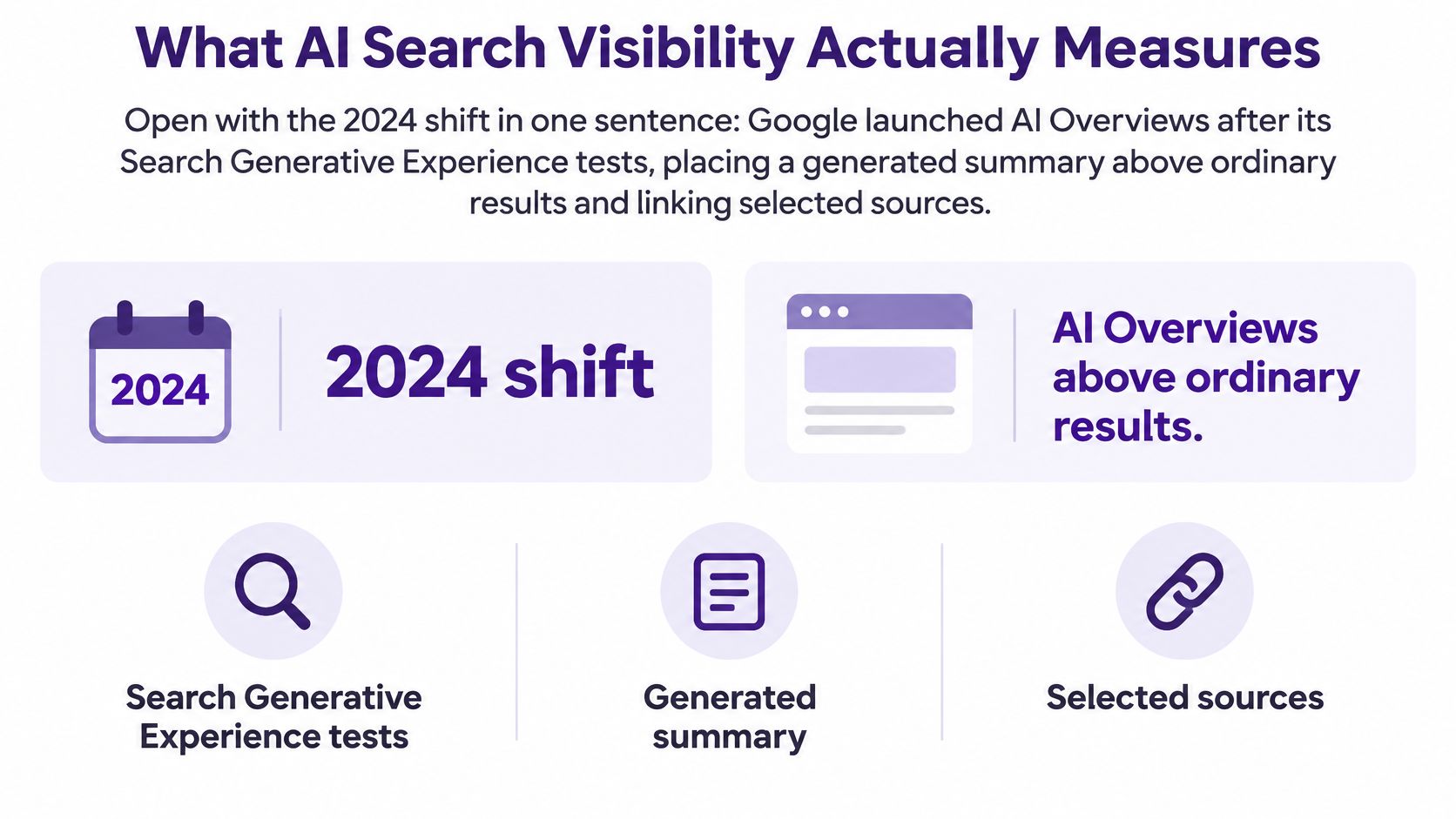
Google launched AI Overviews in 2024, following its Search Generative Experience experiments, placing generated summaries above ordinary results and linking selected sources, as described in The Verge's examination of AI search and publishing. AI search visibility means both ranking on a results page and being named or cited inside the answer people see first.
That distinction matters because a prominent organic result doesn't guarantee selection for the generated answer. Nor does selection guarantee a visit.
A moving sample, not a permanent position
The coverage figures show why a snapshot makes a poor strategy. Semrush's analysis of more than 10 million keywords documented substantial expansion and contraction during 2025, as reported by Search Engine Land.
AI Overview coverage and click impact, 2024–2025
| Signal | Scope | Figure |
|---|---|---|
| News-query AI Overviews, May 2024 | Press Gazette investigation, reported by The Verge, news searches | Almost 25% |
| All tracked queries, January 2025 | Semrush, 10 million+ keywords, reported by Search Engine Land | 6.49% |
| All tracked queries, March 2025 | Semrush, 10 million+ keywords, reported by Digiday below | Over 13% |
| All tracked queries, July 2025 | Semrush, 10 million+ keywords, reported by Search Engine Land | 24.61% |
| All tracked queries, November 2025 | Semrush, 10 million+ keywords, reported by Search Engine Land | 15.69% |
| Position-one CTR when an Overview appears | Ahrefs, 300,000 keywords, reported by Digiday below | Down 34.5% |
The March coverage and position-one click-through figures come from Digiday's review of AI publishing metrics. These samples cover different query populations and periods. Don't combine them into a universal probability that your next article will appear in an Overview.
The visual distinction is simple: search systems can display your page as a result, select it as evidence, or do both.
Keep separate scores
For a publisher, podcaster, or YouTuber with a back catalog, use these categories:
- Eligibility: Can the relevant system access, extract, and attribute the asset? This is an operational readiness check, not proof that retrieval occurred.
- Citation: Does the generated answer reference the asset, and does the reference support its claim?
- Downstream relationship value: Does exposure contribute to a visit, search, signup, listen, or purchase?
A click belongs in the last category. It isn't interchangeable with a citation.
For terminology, this comparison of AI search versus traditional search helps separate answer selection from ordinary ranking. When building a tactical checklist, Netco Design LLC's AI search visibility strategies offer a complementary resource. Use any checklist to define experiments, not promises of inclusion.
Practical rule: Don't give an asset a single visibility grade. Record whether it's usable as evidence, whether it gets cited, and whether people subsequently engage.
How to Sample Citations Over Several Weeks
Start with a repeatable observation process, not a dashboard's biggest number. A spreadsheet is enough if you preserve the prompt, response, date, engine, and cited destination.
Build an audience-language query set. As a manageable starting exercise, write thirty to fifty prompts covering archival research, episode discovery, topical comparisons, and factual questions. Include the wording listeners use in comments and readers use in support emails, not just editorial keywords.
Repeat the prompts under documented conditions. Run them across your target engines and dates. Keep wording stable during the baseline, and record settings, account state, and whether web retrieval was enabled when those details are available.
Log the evidence, not just the outcome. Save the response and destination URL, then classify the citation using the fields below. An answer can mention your show while citing somebody else.
Report segmented ranges. Separate results by engine, intent, and content type. Show observed citation rates with confidence intervals, keeping repeated observations of the same query grouped when estimating uncertainty.
What belongs in the log
Fields to log on every AI search run
| Field | How to record it | Pitfall to avoid |
|---|---|---|
| Mention | Yes or no, per engine and date | Treating one screenshot as the benchmark |
| Citation share | Percent of runs that cite you | Blending engines into one score |
| Citation position | Order of your link inside the answer | Comparing rank across different engines |
| Cited-text prominence | How much of the claim uses your passage | Counting a name-drop as substantive use |
| Supports the claim | Yes or no against the sentence | Calling an unsupported mention a win |
| Day-to-day source overlap | Jaccard similarity across dates | Expecting a fixed source list |
| No-citation runs | Share of answers with zero sources | Assuming every engine always cites |
A multi-engine citation study found average day-to-day Jaccard similarity of cited sources of only 0.34–0.42, while 57.8% of ChatGPT runs returned no citations. Those findings describe the study's tested conditions, not every use of that assistant.
Jaccard similarity measures the overlap between source sets relative to their combined unique sources. You don't need to calculate it manually to understand the editorial implication: a changed citation list isn't automatically evidence that your content deteriorated.
A screenshot proves what appeared in that run. It doesn't establish your normal visibility.
For a practical baseline, collect observations over two to four weeks. That's a working protocol, not a deadline by which improvements should appear.
Connect each cited URL to a document-level provenance record: the original article, transcript, recording, author, and publication details. Say an answer repeatedly cites a transcript rather than its companion blog post. Your team can inspect the exact passage and question match instead of guessing that the entire podcast brand has gained authority.
Avoid the familiar traps: a screenshot mistaken for a benchmark, engines blended despite different retrieval behavior, and bare brand mentions counted as citations. A useful log should tell an editor which asset to improve next.
How to Structure Assets So Answers Can Select and Cite Them
Build an evidence architecture, not a page stuffed with AI-related keywords. A reader or retrieval system should be able to find the answer, identify its source, and check its scope without reconstructing an entire episode.
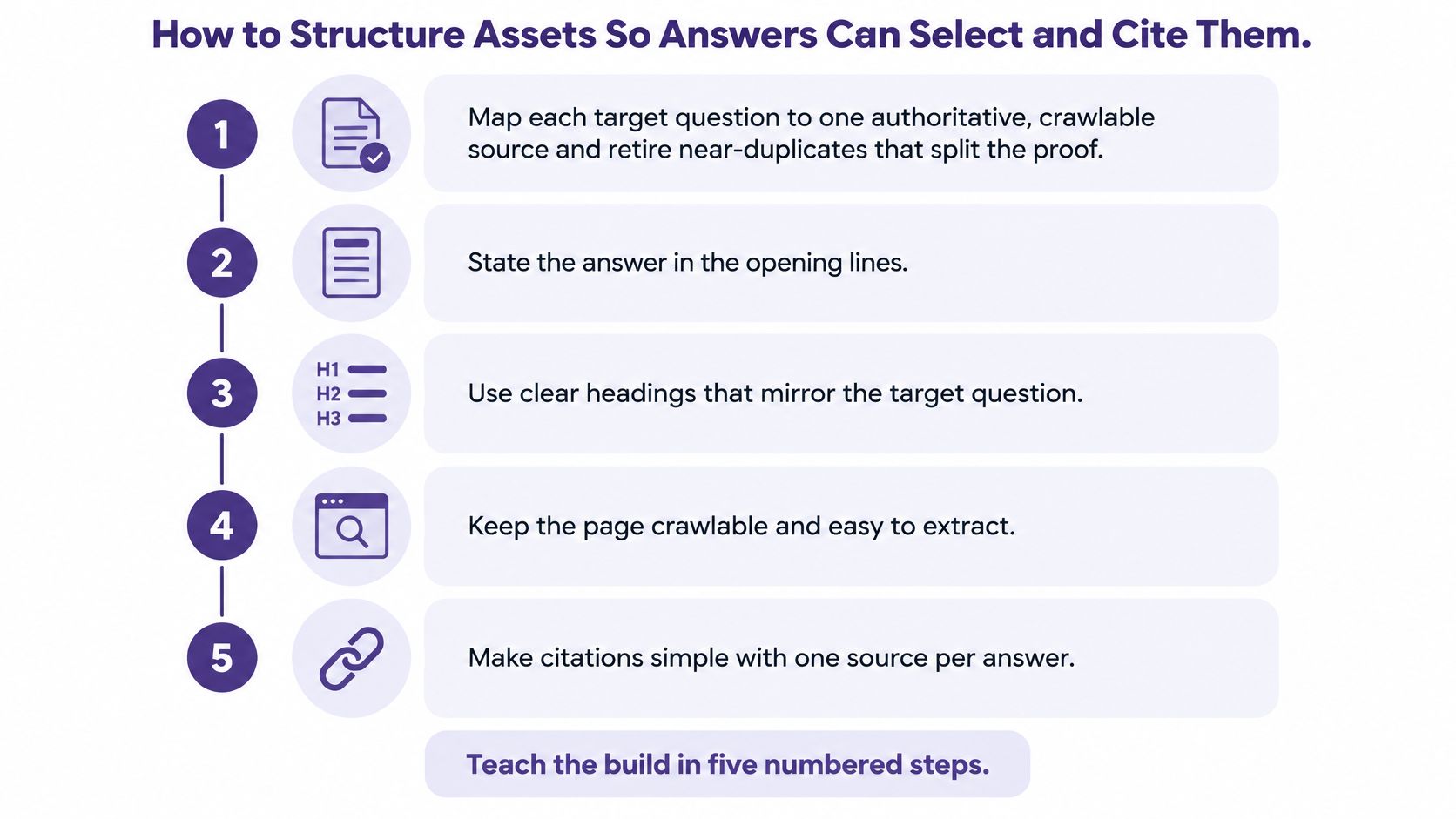
This visual summarizes the publishing work.
Build the source before polishing the wording
Map the question to an authoritative page. Choose the asset with the strongest evidence, then consolidate near-duplicates where appropriate. Preserve useful historical versions, but make the preferred source clear through canonicalization, redirects where warranted, and internal links.
Put the answer in the opening lines. Say a filmmaking interview explains why a production changed locations. Publish that explanation directly before the conversational detail. Keep qualifications attached so an extracted sentence doesn't overstate the speaker's point.
Place proof beside the claim. Include relevant dates, measurements, names, episode identifiers, and original references in accessible HTML or clean transcript text. A chart image can illustrate evidence, but it shouldn't be the only place the evidence exists.
Normalize the identifying details. Use consistent speaker names, publication dates, timestamps, and heading hierarchy. When audio, video, and article versions describe the same work, designate a canonical reference page and make the relationships explicit.
Evaluate the resulting answer. Check citation recall, whether claims have support; citation precision, whether each citation supports its associated proposition; and source prominence, how visibly your evidence contributes. Record errors alongside successes.
Don't remove necessary context just to create a tidy excerpt. A self-contained passage should preserve uncertainty, attribution, and the population or situation to which a claim applies.
The accompanying video offers another format for exploring the topic.
Test what makes an archive item selectable
An older source can be useful even when it isn't the top organic result. Treat that as a testable possibility, not a reason to abandon conventional SEO.
Evaluate these attributes independently:
- Authority: Identify the host, author, or guest and their relevant expertise. A name alone isn't an explanation of credibility.
- Topical completeness: Assemble a series page that connects the material needed to answer the question, rather than sending readers through unrelated tags.
- Extractable claims: Write clear sentences with their dates, units, and attribution intact.
- Freshness: Add an editorial update explaining what remains accurate and what changed. Don't relabel old reporting as new.
- Cross-format corroboration: Check that the article, transcript, and recording agree. An automatic transcript error shouldn't become the published fact.
Log the cited passage, source format, author expertise, publication details, and organic position. Change one attribute at a time where practical, so you can distinguish an editorial improvement from ordinary output variation.
Statistics and quotations aren't magic citation bait. Their apparent benefit can depend on a source already being retrieved, so relevance and accessibility come before stylistic optimization. Watch for outdated facts, unsupported totals, inaccessible PDF-only evidence, and proof buried in untranscribed audio.
The quality gate is attribution: an evaluation across Bing Chat, NeevaAI, Perplexity, and YouChat found 51.5% of sentences fully supported and 74.5% of citations correctly supporting their propositions. Inclusion alone isn't a pass.
How to Align Taxonomy and Query Intent
A tag called interviews tells an editor the format. It doesn't explain whether an episode answers a historical question, compares methods, or introduces a particular guest.
Organize the library around topic, query intent, and format. For example, an interview about documentary sound could belong to a sound-production topic, a methods-comparison intent, and audio, video, and transcript formats. Keep those dimensions separate so collaborators can combine them without inventing a new tag for every intersection.
Make the labels serve a destination
Assign an intent before adding tags. Ask what someone could accomplish with the asset. A piece can support several questions, but name its primary purpose.
Choose a canonical taxonomy node. Send comparison queries toward a useful comparison page, not a generic archive containing everything with the same keyword.
Write metadata in audience language. Fill titles, descriptions, speaker names, and episode fields consistently. Keep entity spellings aligned across platforms, including abbreviations and alternate names.
Prune the vocabulary. As a maintenance rule, review tags attached to fewer than three assets and merge near-synonyms. Keep exceptions for useful collections rather than deleting every small category automatically.
Query intent mapped to taxonomy node and metadata
| Query intent | Taxonomy node | Asset example | Metadata to fill |
|---|---|---|---|
| Archival research | Historical series | Back-issue run with dated index | Publication date, volume, issue |
| Episode discovery | Host or guest | Episode page with transcript and timestamps | Speaker names, episode number, timestamps |
| Topical comparison | Theme cluster | Comparison article linking two episodes | Theme tags, entity names, dates |
| Factual question | Claim library | Dated quote with original reference | Date, measurement, source reference |
Use the mapping as a library-sheet template, not a requirement to rebuild your entire site. Start where inconsistent naming prevents the team from finding related material.
A maintained content-tagging taxonomy also supports repurposing decisions. An editor can find the best-supported explanation for a newsletter, while a producer locates the corresponding recording for a clip. They're working from the same knowledge instead of independently rediscovering it.
How to Score Value When Nobody Clicks
In an analysis of more than 68,000 Google searches, Pew Research Center found that users clicked a traditional result on 8% of visits with an AI Overview, compared with 15% without one, according to Mashable's coverage of the findings. The same analysis found that only 1% clicked a cited link inside the Overview, while sessions ended on 26% of visits with a summary versus 16% without one.
That doesn't make citations worthless. It makes citation visibility an exposure measure, not a substitute for audience or revenue measurement.
Use a relationship scoreboard
Choose a thirty-day review window as an operational checkpoint, not a promised time to results. Compare consistent periods, preserve your query set, and annotate publishing campaigns or other events that could explain changes.
Value to track when AI citations do not send clicks
| Outcome | What to log weekly | 30-day sign of movement |
|---|---|---|
| Citation visibility | Share of sampled runs that cite you | Stable or rising citation share on the query set |
| Brand recall | Branded search volume for show, host, or title | Lift versus the four weeks before |
| Assisted conversions | Conversions with an identifiable AI-sourced assist | An assisted path invisible in last-click reporting |
| Subscriber growth | Newsletter, channel, or podcast follows | Signups coinciding with cited themes |
| Downstream searches | Later queries naming your entity | Relevant new queries you didn't target directly |
| Direct engagement | Direct site visits, app opens, episode plays | Direct or owned-channel use following mentions |
Branded searches are a proxy for recall, not a direct measurement of what someone remembers. Likewise, signups on citation days indicate a possible association, not proof that the citation caused them.
Optimizing only for citations can raise apparent visibility while the traffic and relationship metrics that pay for the work get worse.
Use Google Search Console to inspect branded queries, your analytics platform to examine referral and conversion paths, and newsletter or podcast dashboards to track owned-audience activity. Keep newsletter opens separate from direct website traffic, and prioritize clicks or meaningful listening where available.
Follow the asset into human activity
Suppose an archival interview keeps appearing in answers about independent film financing. Check whether people subsequently search the host's name, visit that episode, subscribe to the associated newsletter, or play related episodes.
You won't observe every path. Record an AI-sourced assist only when you have evidence, such as a referral, a signup response, or another identifiable touchpoint. Label timing-based connections as hypotheses.
A disciplined content-performance analysis connects the claim, episode, author, or theme to a meaningful next action. If exposure rises without engagement, examine the destination: does the cited page offer a relevant next episode, useful email series, or credible subscription benefit?
The question isn't whether the system noticed your archive. It's whether a person found a reason to return.
Run One Series Through the Protocol This Week
Choose a series, playlist, or back-issue run that already has an audience. Don't begin with the entire archive. Pick material an editor understands well enough to check quickly and a producer can realistically republish.
A week with something to show for it
Day one, inventory the series. List each asset, its source file, public destination, owner, rights status, and the audience question it can answer. Mark missing transcripts and uncertain facts for review.
Day two, start the observations. Write ten prompts in real audience language as a small pilot. Run them on the engines you care about, preserve the answers, and schedule continued sampling beyond this first week.
Day three, repair a useful destination. Fix a canonical page or transcript so the answer, date, names, and episode identifier appear in readable text. Add a next step that fits the visitor's purpose, not an unrelated subscription popup.
Days four through seven, publish and inspect. Record citations and any observed movement in branded searches, signups, or listening. Treat these early observations as a baseline, not evidence of lasting improvement.
Turn the gap into the next asset
If people ask a comparison question and your archive contains the evidence but no comparison, commission that page. If a guest's explanation is useful but buried in a recording, publish an edited transcript excerpt with the original context and a route back to the episode.
Choose distribution formats deliberately. The comparison might become a newsletter; the explanation might become a short video with captions; the original episode remains the source. Repurposing should change the presentation for the audience without changing the underlying claim.
Give a collaborator responsibility for checking facts and another for preparing publication. A growing creator business needs shared sources and clear ownership, not a founder who remembers where every good passage lives.
Organize the series, see which assets answer systems already trust, then republish the gaps. One series shipped this week beats a sitewide schema project that never leaves the backlog. That's how a hobbyist library starts acting like a revenue-bearing one.
Contesimal helps teams classify articles, podcasts, videos, and research into layered taxonomies, search their archive through chat, and collaborate with human editors and AI around shared sources. Visit Contesimal to organize your first series and turn its strongest evidence into the next script, newsletter, or citable page.