
Your hard drive is full of reviews you already forgot. An old film take. A product test from last spring. A podcast episode where you ranked books, restaurants, or gear and moved on. You've treated them as one-off posts, not assets, and they've been sitting there losing relevance.
Every solid example of evaluation essay follows the same repeatable pattern. You state a thesis, name your criteria before you judge, support each call with evidence, then deliver a clear verdict. That structure is why an evaluation travels well across platforms. Once you can see it, you can cut a long piece into a video, a newsletter item, and a fresh article without starting from zero. It also helps to compare longevity clinic review sources and notice how different publishers weight criteria. The Maricopa Open Digital Press chapter on evaluation essays makes a useful point here, warning against vague standards like "good" or "effective" without operational definitions or thresholds. Balanced doesn't mean equal space for both sides. A subject can pass minor criteria and still fail a necessary one, and your weights should show that.
Here are seven formats worth studying, with a repurposing move for each one.
1. Film Review Evaluation Essay
Roger Ebert didn't open with vibes. He opened with a judgment, then earned it. His reviews for the Chicago Sun-Times, which earned him a Pulitzer Prize for criticism in 1975, remain a widely studied model because the criteria stay visible throughout. You always know whether he's talking about story, performance, or direction.

How the Structure Works
A strong film evaluation assesses plot, acting, direction, cinematography, sound, and thematic impact. You state a thesis about overall merit, then back each judgment with a specific scene or creative choice. Pauline Kael's criticism in The New Yorker took a sharper, more personal route, while Letterboxd member reviews compress the same logic into structured scales. Different voice, same bones.
Say you're reviewing a slow-burn thriller. Your thesis might be that the film succeeds as atmosphere but fails as payoff. You'd prove the first half with lighting and sound design, the second with the final act's dropped threads.
Practical rule: Pick your criteria before the screening, not after your opinion hardens.
- Name three to five criteria first: Use them as section headings so readers can scan and disagree productively.
- Repurpose one review three ways: Turn it into a video script, a podcast segment, and a carousel of key quotes.
- Tag by genre, director, and theme: That taxonomy lets you build themed best of roundups later without rereading everything.
If you're building study material from reviews, exam-board-aligned practice for Film Studies pairs well with this format, since named criteria map cleanly onto essay questions.
2. Book Review Evaluation Essay
The New York Times Book Review has long served as a benchmark for concise, authoritative evaluation. The format is disciplined. You summarize briefly, then judge argument, originality, style, structure, and contribution to its field. Summary is seasoning, not the meal. Too many creator reviews flip that ratio and become plot recaps with a star rating stapled on.
That discipline has deep roots. The WAC Clearinghouse history in The Value of Writing traces formal assessment to 1912, when Edward L. Thorndike and associated researchers produced the "Scale for the Measurement of Quality in English Composition" to judge writing against defined levels. A later milestone came in 1961, when Paul Diederich, John French, and Sydell Carlton identified five dimensions readers used, including ideas, form, mechanics, and wording. You still see those categories in book reviews today.
A Worked Angle
Say you're evaluating a business memoir. Your criteria could be evidence quality, usefulness for early-stage founders, and honesty about failure. The Guardian's books section often models that audience-specific framing, and Goodreads readers do a rougher version with star ratings plus written rationale. Always state who the book is for, and who should skip it.
For sharpening how you analyze an author's persuasive moves, this guide on how to write a rhetorical analysis gives you a useful companion structure.
- Pair an old review with new context: Add an author interview or updated sales context to create a fresh article.
- Split one review into a series: Publish one short post per criterion across a week.
- Resurface reviews by theme: Search your library for older titles matching a trending topic, then update for new readers.
3. Product Evaluation Essay
Product evaluations live or die on method. Readers don't trust your pick, they trust your process. Wirecutter, founded in 2011 and later acquired by The New York Times, built a large audience by explaining exactly how each pick was tested. Consumer Reports does the same with lab ratings, and good YouTube tech reviewers show side-by-side tests on camera.
Here's the infographic version of the format's trade-offs.
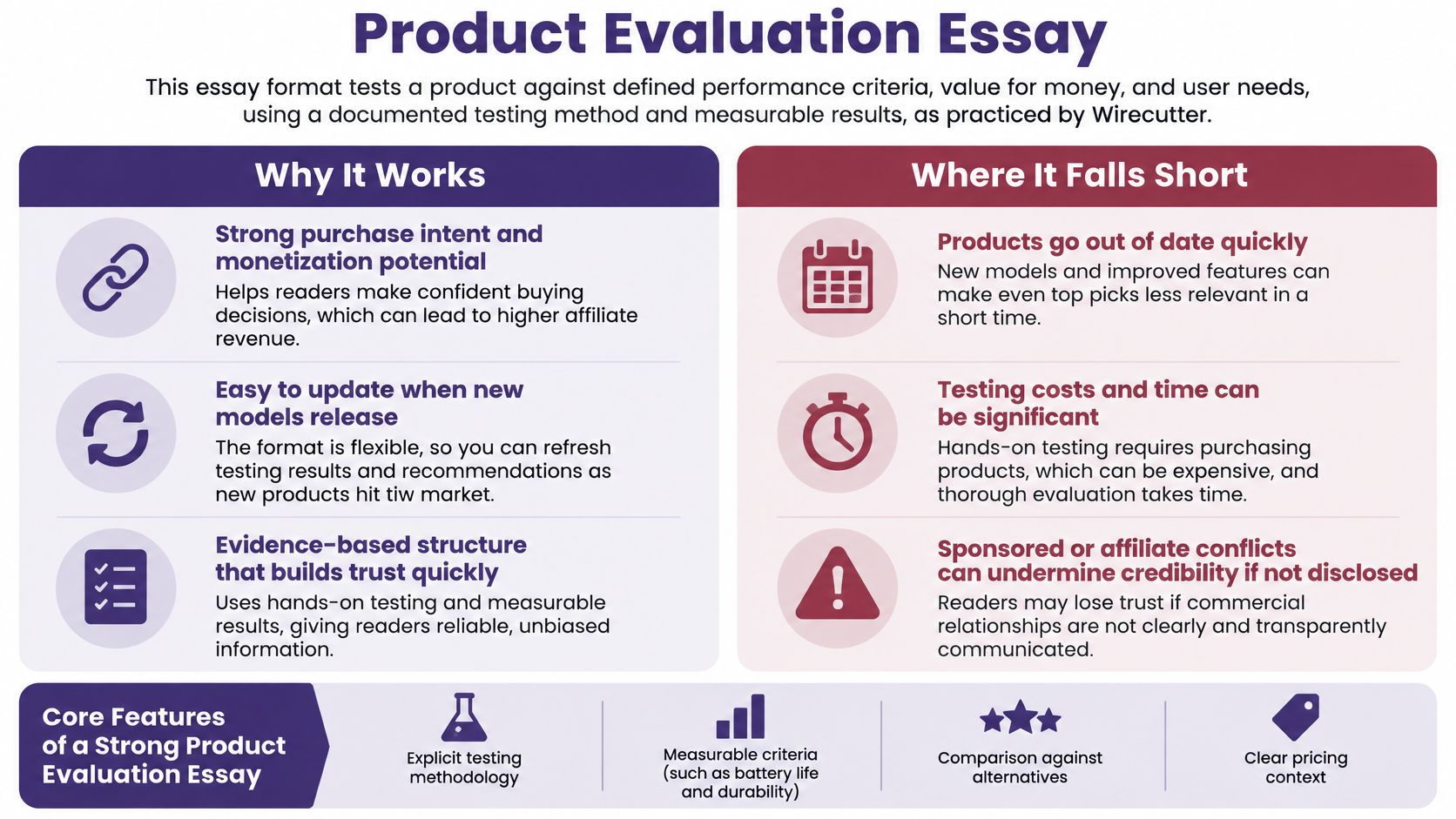
Why Criteria Need Numbers and Limits
Reliability improves when you define terms. A recent study applying the 6+1 Trait Writing Rubric, reported in PMC, found Cohen's kappa at 0.903 with a 95% confidence interval from 0.840 to 0.965. That's very high inter-rater agreement, and it shows what happens when a rubric specifies what quality looks like. But don't fake precision. A score built on squishy evidence is still squishy.
Say you're testing noise-canceling headphones. Publish criteria up front, like battery life, call quality, and comfort over two hours. Report how you tested each one. End with a recommendation by buyer type, not a universal winner.
This short video walks through how a hands-on test can support a written verdict.
- Publish testing criteria at the top: Readers can verify your method instead of guessing.
- Refresh evergreen guides on a schedule: Link each update to newer videos or podcast episodes.
- Organize by use case: One research effort can then feed a guide, a short, and a newsletter roundup.
4. Restaurant Review Evaluation Essay
A list of dishes is not a review. Ruth Reichl, a former restaurant critic for The New York Times, is often cited because she combined sensory detail with cultural context. She told you what a room meant, who it welcomed, and whether the cooking delivered on its promises. Michelin Guide inspectors work more anonymously, but the criteria logic is just as strict.

Weighting Changes the Verdict
The standard criteria are food quality, service, atmosphere, value, and consistency. The trick is weighting. A neighborhood spot can be excellent for affordability and poor for accessibility or dietary needs. Both things can be true, and your essay should say which audience gets which verdict. That's where many Yelp and Google reviews fall down. They score everything and explain nothing.
Say you're evaluating a tasting-menu restaurant for a date night guide. Atmosphere and pacing might outweigh value. For a family guide, you'd flip those weights completely. Same restaurant, different essay, both defensible because the criteria are named.
A restaurant doesn't fail in general. It fails for a specific diner, on a specific night, against specific expectations.
- Revisit after a year: A follow-up evaluation creates a new angle and shows whether consistency held.
- Turn one review into three formats: Cut it into a short video, a local newsletter item, and a podcast talking point.
- Group by neighborhood or cuisine: You'll build a repeatable series instead of scattered one-offs your audience can't browse.
5. Music Album Review Evaluation Essay
Pitchfork, founded in 1996 by Ryan Schreiber, popularized numerical scoring alongside long-form critique. Love the scores or hate them, they've taught a generation of readers to expect a verdict you can argue with. Rolling Stone album reviews lean more on cultural placement, and Album of the Year aggregates critic scores so you can see consensus and outliers at a glance.
Judge the Attempt, Not Just the Result
An album evaluation covers songwriting, production, performance, sequencing, and place within an artist's catalog. Start by stating what the album attempts. A lo-fi bedroom record shouldn't lose points for lacking studio polish it never wanted. It should lose points if the songs underneath that aesthetic don't hold up.
Say an artist releases a stripped-back folk album after two electronic records. Your thesis might be that the risk works lyrically but the sequencing sags in the middle. Track order becomes your evidence. You can show where momentum drops and which two songs should have swapped places.
- Build playlist roundups: Group older reviewed albums by theme or mood so archived reviews get a second life.
- Re-evaluate on anniversaries: Classic album retrospectives earn fresh search traffic with honest reassessment.
- Tag artist, genre, and era: You'll rediscover relevant reviews fast when a related artist trends.
One caution. A decimal score suggests more certainty than your evidence probably supports. Use scores to summarize, not to substitute for reasoning. Your paragraphs still have to carry the verdict, or readers will remember the number and forget you.
6. Podcast or Video Series Evaluation Essay
This is the format most creators skip, and it's the one that pays you back fastest. A series evaluation judges a body of episodes on format, production quality, host dynamics, research depth, consistency, and audience value. You're not reviewing an episode. You're auditing a pattern. Podcast retrospectives after a season finale and independent reviews of long-running YouTube series both work this way.
Turn Your Back Catalog Into Evidence
Say you run a weekly interview show. Pull your episodes by theme, format, and performance. You might find solo episodes retain listeners better than panels, or that a recurring segment drives most of your shares. That evaluation becomes your planning document for the next season. It tells you which buckets to fund with your limited time.
- Audit by theme and format: Identify your top three repeatable concepts before chasing new ones.
- Write the evaluation as a plan: Each weak criterion should produce one concrete change next season.
- Classify episodes and transcripts: Contesimal can help organize episodes, transcripts, and videos so performance patterns become visible across the library.
For a sense of how series get judged on listener value, browse this roundup of podcasts that make you smarter and note which criteria the picks share.
Collaboration matters here too. A Cambridge Judge Business School report on human and AI interaction describes an experiment with 162 participants where AI collaboration didn't automatically improve creativity, even after 10 rounds of tasks. Improvement came when humans and AI refined ideas through critical feedback and iterative exchanges. Use tools to sort and suggest. Keep the judgment calls yourself.
7. Program or Policy Evaluation Essay

This format asks a harder question. Did the thing work, what did it cost, and what happened that nobody planned? Program evaluations are common in education, public health, and corporate training, and they're the most defensible Example of Evaluation Essay structure you can borrow. Opinions matter less here. Outcomes matter more.
The Four-Level Template
The Kirkpatrick Model, developed by Donald Kirkpatrick and first published in 1959, evaluates programs at four levels, reaction, learning, behavior, and results. Corporate training teams use it to judge courses, government agencies publish similar logic in public health evaluations, and universities blend student surveys with outcome data. Each level asks whether the previous one changed anything.
Say you're evaluating your own online course or a sponsor's training program. Learners liking it is level one. Changed behavior at work is level three. Most published evaluations stop at level one and declare victory early. Don't be that person.
Honest test: If your evidence is only that people enjoyed it, you don't have an evaluation yet. You have applause.
- Use a four-level framework: Structure any published evaluation so readers can follow reaction through to results.
- Turn reports into case studies: Internal evaluations can become public whitepapers that attract B2B audiences.
- Keep source data searchable: Future teams reuse findings only if they can find them.
If you're deciding what belongs in the framework, this breakdown of what to evaluate will help you set scope before you collect evidence.
How the seven evaluation essay examples compare
| Item | Subject Judged | Typical Output | Best Repurposing Format |
|---|---|---|---|
| Film Review Evaluation Essay | Plot, acting, direction, cinematography, sound, and themes | Criteria-based review with scene evidence and an audience recommendation | Video script, podcast segment, or social carousel |
| Book Review Evaluation Essay | Argument or narrative, style, originality, and contribution | Brief summary, critical assessment, and reader recommendation | Newsletter, book-club discussion, or short social posts |
| Product Evaluation Essay | Performance, value, and user needs | Documented tests, product comparisons, and buyer recommendations | Updated buying guide, video, or podcast |
| Restaurant Review Evaluation Essay | Food, service, atmosphere, value, and consistency | Sensory account with a rating and dining recommendation | Short video, local newsletter item, or podcast segment |
| Music Album Review Evaluation Essay | Songwriting, production, performance, sequencing, and genre context | Critical review with a score and listening recommendations | Themed playlist, audio clips, or anniversary retrospective |
| Podcast or Video Series Evaluation Essay | Format, production, hosts, research, consistency, and audience value | Multi-episode assessment with strengths, gaps, and recommendations | Season-planning document, case study, or content series |
| Program or Policy Evaluation Essay | Goals, outcomes, resource use, and unintended effects | Evidence-based report with recommendations to continue, revise, or end a program | Public case study, whitepaper, or searchable evaluation report |
Turn Your Past Evaluations Into a Library That Keeps Paying
Start smaller than you think. Pick one older evaluation this month and rework it into two new formats. A film review becomes a video essay and a quote carousel. A product guide becomes a podcast segment and an updated article. That single move teaches you more about your archive than a weekend of planning ever will.
Your First Pass Through the Archive
- Audit what you already have: List every review, ranking, and retrospective you can find, even the embarrassing ones.
- Tag by format and criteria: Mark each piece as film, product, series, or program, then note the criteria it used.
- Spot the criteria gaps: Pieces with vague standards need a rewrite of the framing, not just a polish.
- Set a quarterly refresh date: Evergreen evaluations decay, and a calendar reminder beats good intentions.
Be deliberate about how AI fits into that workflow. Research summarized by the University of Malta in its open access repository found generative AI can broaden idea generation and reduce cognitive load, while humans remain important for nuance, authenticity, critical thinking, and final approval. Let tools classify, suggest angles, and draft adaptations. You validate context, audience fit, and accuracy, because you're responsible for evaluating outputs for accuracy, appropriateness, and legal compliance before use, and outputs may be incorrect.
Trust depends on visible human control. A peer-reviewed study indexed by EconPapers found human and AI collaboration reduced negative consumer reactions only when the process signaled that humans controlled the AI. Present repurposed work as human-directed, with real editorial oversight. Your byline should mean something.
Finally, watch how other niches keep evaluations current. Browsing Bowling Gear Reviews' model comparisons shows how comparison pages stay useful by updating picks against steady criteria. That's Infinite Content Value in plain form. You organize what you've made, understand what it's worth, and take action on it. Your old reviews aren't history. They're inventory, and inventory that's tagged, weighted, and refreshed keeps paying.
Ready to access that inventory? Contesimal helps you classify, organize, and search your podcasts, videos, and articles in real time, so past evaluations surface exactly when a new angle needs them. Visit today, bring your archive, and turn one forgotten review into your next piece of content.