
You’re probably in the same spot a lot of creators hit with Reels.
You post consistently. A few clips take off. Some get shared. Your follower count moves. Maybe people even DM you saying your content is great. But your income still feels disconnected from the work. Views go up, effort goes up, and revenue barely moves.
That gap usually isn’t a content problem. It’s a systems problem.
Most creators treat Reels like disposable posts. The creators who make real money treat them like assets. Each Reel can attract a new viewer, warm up a buyer, start a brand conversation, sell a product, or revive an older idea from your library. That shift matters. If you want to learn how to make money on instagram reels, stop thinking only in terms of “what should I post today?” and start asking “what business job should this Reel do?”
From Views to Value Turning Your Reels into Revenue
A lot of creators are sitting on attention they haven’t organized yet.
That’s why Reels feel frustrating. The format clearly works, but random performance doesn’t equal reliable income. One viral clip can give you a nice ego boost and still do almost nothing for your business if there’s no follow-through behind it.

Reels deserve more respect than that. According to ShortGenius on Instagram Reels monetization, over 2 billion monthly users interact with Reels globally, users spend approximately 50% of their time on Instagram watching Reels, and creators who post them consistently see 22% higher engagement rates compared to regular video posts. That’s not a side format. It’s one of the main attention engines on the platform.
Attention is not the business
Views are useful. Revenue is better.
The creators who get stuck usually chase reach without deciding what that reach should convert into. If you’re a podcaster, your Reel might sell consulting, push listeners into a premium feed, or help land sponsors. If you’re a YouTuber, it might funnel viewers into long-form videos, newsletter signups, or paid products. If you’re a publisher, it can surface older reporting and turn archive material into new audience growth.
Reels work best when each one has a job. Discovery, trust, conversion, or proof.
That’s also why Reels fit naturally into a broader cross-platform strategy. If you’re comparing short-form platforms, this guide on how to make money on TikTok is useful because the business logic is similar even when the platform mechanics differ.
Treat each Reel like an asset
A smart Reel strategy doesn’t start inside Instagram. It starts in your content library.
Your old podcast interviews, YouTube episodes, blog posts, webinar clips, and newsletter ideas are raw material. Reels become the packaging layer that helps those ideas travel. The more clearly you can see what topics, hooks, and formats already work, the easier monetization gets.
That’s why performance analysis matters more than gut instinct. If you want a better framework for deciding what to double down on, this guide on https://contesimal.ai/blog/how-to-analyze-content-performance/ is worth reading.
Here’s the practical mindset shift:
- Stop posting for applause and start posting for outcomes.
- Stop treating old content as finished and start repurposing it into short-form assets.
- Stop relying on luck and build a repeatable content-to-revenue system.
Once you do that, Reels stop being a gamble and start acting like a distribution channel for your business.
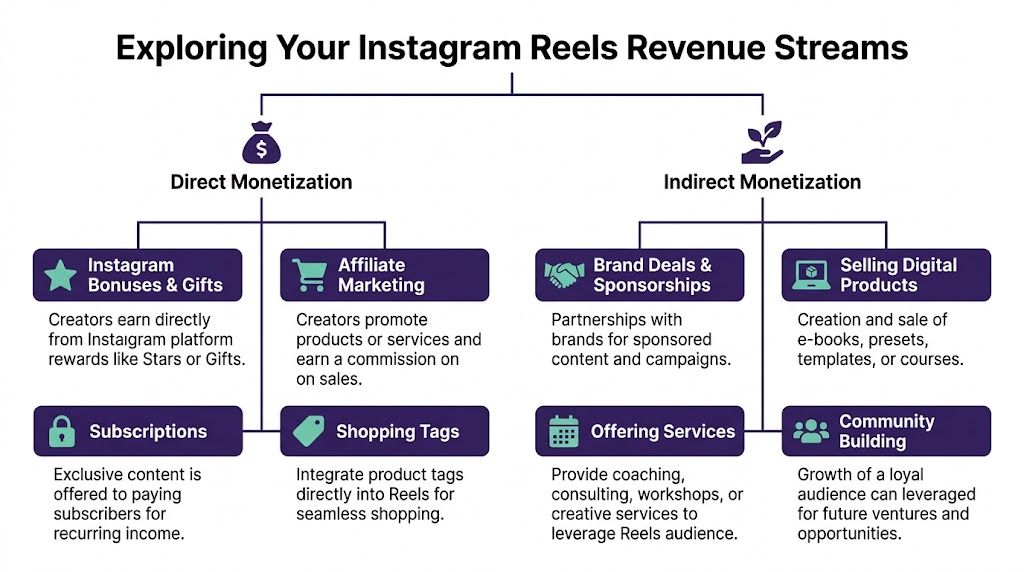
Exploring Your Instagram Reels Revenue Streams
There isn’t one way to make money with Reels. There are several, and the strongest creator businesses usually combine a few of them.
The mistake is picking a monetization method that doesn’t match your stage. A smaller creator often does better with affiliate offers, UGC-style work, or service leads. A more established creator can layer in brand deals, subscriptions, and shoppable Reels. The right stack depends on audience trust, niche clarity, and whether you sell your own thing or someone else’s.
Direct monetization inside the platform
Some income comes from Instagram-native features. These are worth using, but they rarely replace a real business model on their own.
Bonuses and gifts
If your account is eligible, these can turn audience support and platform incentives into direct payouts. Useful, but unpredictable. Treat them as upside, not the foundation of your business.Subscriptions
This works best when your audience wants ongoing access to something specific. Behind-the-scenes analysis, niche breakdowns, private Q&As, bonus clips, and community access are better bets than vague “exclusive content.”Shopping tags
This is one of the cleanest ways to connect Reels to revenue if you already sell products. According to Influencer Marketing Hub’s Instagram money calculator guide, product tagging in Reels can drive direct results, and one educational Reel campaign for a wellness brand drove 18% of the brand’s website traffic within 60 days.
Brand deals are the most obvious revenue stream
For many creators, brand partnerships become the biggest line item.
The reason is simple. Brands pay for distribution plus trust. Reels are strong at both. The same Influencer Marketing Hub source notes that micro-influencers with 25,000 followers often charge $100 to $500 per Reel, while macro-influencers with over 1 million followers can charge $5,000 or more. It also notes a 5.53% average engagement rate for Reels and an advertising audience of over 726.8 million users.
That doesn’t mean every creator should rush into sponsorships. Brand deals work when your audience believes your recommendations and your niche is clear enough for a company to see the fit quickly.
If you want a broader reality check on market pricing, how much influencers get paid is a useful reference point.
A sponsorship only feels lucrative if it doesn’t wreck your audience trust. Bad-fit deals cost more than they pay.
Affiliate marketing is underrated
Affiliate revenue is attractive because you don’t need a huge audience. You need relevance.
If you already talk about tools, books, software, gear, templates, beauty products, training programs, or creator workflows, affiliate offers can fit naturally into Reels. The key is demonstrating use, not just dropping a recommendation. “Here’s how I use this” almost always outperforms “you should buy this.”
A practical way to think about affiliate Reels:
- Show the problem.
- Show the product in action.
- Explain who it’s for.
- Add a clear next step.
This works especially well for creators with educational niches because the content itself becomes the sales argument.
Selling your own products usually has the best margins
If you have your own offers, Reels become a customer acquisition channel.
That might mean:
- Digital products such as templates, guides, presets, swipe files, or mini-courses
- Services like editing, consulting, strategy sessions, or coaching
- Physical products sold through Instagram shopping
- Memberships where Reels act as the public top of funnel
Creators move from “content creator” to “media business.” You’re not just renting attention to brands. You’re using attention to grow something you own.
Community is an indirect revenue stream too
Not every Reel needs to sell.
Some Reels should build authority. Some should prove your taste. Some should answer recurring audience questions. Some should make people remember you. That kind of content creates the trust that makes later monetization easier.
Here’s a simple way to organize your revenue stack:
| Revenue type | Best for | Main trade-off |
|---|---|---|
| Bonuses and gifts | Eligible creators with active engagement | Hard to predict |
| Brand deals | Creators with clear niche and audience trust | Requires outreach and negotiation |
| Affiliate revenue | Educational and review-style creators | Depends on strong intent |
| Shopping tags | Product-based brands and sellers | Needs catalog setup and offer clarity |
| Services and products | Creators with expertise to package | Requires backend fulfillment |
The strongest setup is rarely one stream. It’s a combination that lets one Reel do more than one job.
Crafting Reels That Attract Money and Followers
Monetization starts with retention. If people don’t watch, nothing else matters.
A lot of creators focus on polish too early. Better lighting helps. Better editing helps. But neither fixes a weak idea, a slow opening, or a Reel that takes too long to explain itself. Reels that make money usually feel simple on the surface and tightly engineered underneath.

According to InfluenceFlow’s guide to optimizing Instagram Reels for monetization, watch time carries a 40% weight in the algorithm, replays carry 15% weight, and a Reel with a 60%+ completion rate can outperform a Reel with more views but weaker retention. The same source recommends posting 3 to 5 times weekly and notes that top creators can see $0.05 to $0.15 CPM in the US, with some earning over $18,000 from a single viral Reel through bonuses and affiliate sales.
The first three seconds decide the rest
Most weak Reels fail at the opening.
The first line should create immediate tension, curiosity, or usefulness. Don’t open with your name, a soft intro, or unnecessary context. Open with the most valuable fragment.
Good hooks usually do one of these:
Call out a pain point
“Why your Reels get views but no sales.”Promise a result
“The Reel structure I use for affiliate conversions.”Challenge a common assumption
“More views won’t fix a weak offer.”Show a surprising contrast
“This Reel made less reach but more revenue.”
What doesn’t work is throat-clearing. If your first sentence could be deleted without changing the meaning, cut it.
Structure matters more than aesthetics
A profitable Reel usually follows a tight arc.
- Hook fast
- Deliver one clear idea
- Show proof or demonstration
- Close with one action
That action can be a comment prompt, a product click, a DM instruction, or a profile visit. Micro-CTAs work because they give the viewer a low-friction next step and can increase replay behavior.
Practical rule: If a Reel tries to teach five things, it usually teaches none of them well.
A lot of creators bury the sale because they’re afraid of being “too promotional.” That fear is expensive. The fix isn’t turning every Reel into an ad. It’s making the CTA feel native to the content.
Use trends carefully
Trending audio can help distribution, but it’s not a strategy by itself.
Use trends when they amplify your message, not when they replace it. If you’re in a professional niche, educational niche, or B2B niche, forced trend-chasing can make your content look less trustworthy. A trend is useful only if it packages your existing expertise more effectively.
If your account growth has stalled, this resource on https://contesimal.ai/blog/growth-instagram-followers/ gives a practical companion framework for audience building.
Here’s the part most creators skip. Build formats, not one-off ideas.
Build repeatable Reel formats
A format is a reusable shell. It saves time and makes your content library easier to repurpose.
Examples:
Breakdown Reel
Analyze a tactic, campaign, tool, or creator move.Myth-busting Reel
Take one common belief and challenge it.Before-and-after Reel
Show the transformation in process, output, or results.Clip-plus-commentary Reel
Pull a strong moment from a podcast or long-form video, then add context on screen.
Later in your workflow, this kind of structure helps you pull stronger clips from old content instead of guessing from scratch.
A useful reference example is below.
Consistency beats random bursts
Posting in bursts feels productive. It usually isn’t.
A regular cadence trains you to test hooks, tighten edits, and notice patterns. More important, it gives the algorithm and your audience a clearer sense of what you’re about. Consistency also makes monetization easier because brands, buyers, and subscribers can see you’re active and reliable.
The most profitable Reel creators don’t rely on inspiration. They rely on a repeatable production system and a clear point of view.
The Art of the Brand Deal Pitch and Negotiation
Brand deals don’t go to the creator with the best vibes. They go to the creator who makes the brand’s decision easy.
That’s where many good creators fall short. They have solid content, decent engagement, and a relevant niche, but their pitch is messy. No media kit. No angle. No offer. No evidence that they understand the brand’s customer.

According to Opus Pro’s guide to getting paid on Instagram Reels, creators should start with a Professional account, build toward 10K+ followers, prepare a media kit using a 3% to 5% engagement rate benchmark, and negotiate using 1% to 2% of audience reach as a baseline. The same source says creators with 10K+ followers who use direct outreach secure deals 60% of the time within 3 months.
What your media kit actually needs
Keep it sharp. A bloated media kit reads like insecurity.
Include:
- Audience snapshot with niche, content focus, and who your viewers are
- Performance proof using your strongest recent Reel examples
- Brand fit showing categories you align with
- Offer menu covering what you can deliver
- Contact details that make a reply easy
If you’ve done unpaid product tests or self-initiated mock campaigns, include those. Brands care about whether you can create convincing content, not whether you’ve already worked with huge companies.
A pitch that gets opened
The best outreach is specific and short.
Hi [Brand Name], I create Instagram Reels for [your niche] with a focus on [content angle]. I already speak to an audience interested in [relevant problem or category], and I have a few ideas for short-form content that would fit your product naturally.
One concept would be a Reel around [specific angle], and another would show [specific use case]. If helpful, I can send a quick mockup or examples of similar content from my page.
If you’re exploring creator partnerships, I’d love to discuss a paid Reel collaboration.
This works because it does three things fast. It shows fit, it shows initiative, and it lowers the effort required for the brand to continue the conversation.
Don’t pitch “collaboration opportunities.” Pitch a concrete idea the brand can already picture in feed.
Negotiation is not just about price
Price matters, but deal structure matters too.
Ask about:
- Usage rights so you know whether the brand wants to repost or run the Reel as an ad
- Exclusivity so you know if you’re blocked from working with competitors
- Revision limits so the project doesn’t expand unexpectedly
- Timeline so production expectations are clear
- Payment terms so you’re not chasing invoices later
Here’s a simple benchmark table based on the figures provided in the verified data.
| Follower Tier | Average Rate Per Reel (USD) |
|---|---|
| Around 25K followers | $100-$500 |
| Around 50K followers using the 1%-2% reach baseline | $500-$1K |
| 1M+ followers | $5,000+ |
If a brand says your rate is high, don’t panic and slash it immediately. First clarify the deliverables, usage, and campaign goal. Sometimes the issue isn’t price. It’s that the scope is vague.
A good negotiation leaves both sides clear on value. A bad one leaves the creator doing custom agency work for creator pay.
Scaling Your Reels Engine with a Content Library
Most creators don’t have a Reels problem. They have a retrieval problem.
They already have raw material. It’s buried in old podcast episodes, YouTube uploads, webinar recordings, newsletters, drafts, interviews, transcripts, and abandoned notes. Then they sit down to make a Reel and act like they need a brand new idea from nowhere.
That’s how creators stay busy without gaining a strategic advantage.
Your best Reel ideas are usually behind you
Old content is not old value.
A strong long-form episode can produce multiple short clips, several opinion Reels, a carousel, a newsletter angle, and a product pitch. A good blog post can become a myth-busting Reel series. A customer question from six months ago can become a recurring content bucket if people still ask it.
When creators say they’ve “run out of ideas,” what they often mean is they’ve run out of visible ideas. Their archive is unorganized.
Here’s the shift that changes everything. Build a content library with retrieval in mind, not just storage.
Organize by content buckets, not file names
“Episode 47 final v3” is not a strategy.
You need buckets that map to audience demand and monetization intent. For example:
Problem buckets
Reels based on recurring audience strugglesProof buckets
Testimonials, results, client transformations, demonstrationsOpinion buckets
Contrarian takes, trend responses, industry commentaryOffer buckets
Product education, objection handling, service explanationsArchive buckets
Old episodes or articles worth resurfacing in a new format
At this point, creators begin operating like publishers. You’re not making random short videos. You’re building a categorized library that supports discovery, conversion, and reuse.
A Reel library should help you answer two questions fast. What has already worked, and what can be repackaged next?
Repurposing works best when the source is strong
A weak long-form piece won’t magically become a strong Reel.
But a solid source asset can be cut in different directions. A podcast clip might become one educational Reel, one hot take Reel, and one CTA-driven Reel for a service. A YouTube tutorial might yield a fast checklist version for Reels. An older blog post might become a face-to-camera summary with stronger hooks.
That approach saves time and improves message consistency across platforms. It also helps you build recognizable themes instead of throwing unrelated ideas into the feed.
If you want a deeper look at how archived content can create audience and business upside, this piece on https://contesimal.ai/blog/content-libraries-new-revenue-brand-relationships/ is worth your time.
Build a simple production system
You do not need a giant team to work like a media operation.
You need a repeatable flow:
- Review long-form source content
- Tag strong moments, themes, and objections
- Sort those into repeatable Reel buckets
- Match each Reel idea to a business goal
- Publish, review, and recycle winners
Monetization compounds when the backend is clean. Once you know which topics bring followers, which angles attract sponsors, and which clips sell products, your Reel output becomes more deliberate and less exhausting.
The bigger play is library value
The creators who win long term don’t only grow an audience. They build intellectual property.
Every strong Reel can point back to a stronger base of content. Every short-form hit can revive an older asset. Every theme that proves itself can expand into a product, newsletter, collaboration, or sponsorship lane.
This is the primary business case for Reels. They aren’t just short videos. They’re the front-end distribution layer for your whole content ecosystem.
Your Questions on Reels Monetization Answered
A lot of the hard parts of Reels monetization show up after the basics. That’s where creators start second-guessing themselves. Here are the questions that matter once you’re working to turn this into income.
Can you make money with a small following
Yes, if the audience is specific and engaged.
Small creators often do better than expected with affiliate offers, UGC-style work, service sales, and niche brand deals. What matters is whether the right people trust you, not whether random viewers recognize your handle. A creator with a focused audience in a valuable niche can be easier for a brand to use than a larger creator with broad but vague reach.
The practical move is to make your niche obvious. A brand or buyer should understand your audience in seconds.
What if the algorithm changes
It will.
Creators get into trouble when they build around one trick instead of one principle. The trick might be a trending format, a particular edit style, or a temporary audio tactic. The principle is stronger. Hold attention fast, deliver value clearly, and give people a reason to act.
When performance drops, review your own posts like an editor:
- Check the hook and ask whether it earns the next second
- Check the pacing and remove anything slow
- Check the promise and make sure the Reel delivers what the opening implies
- Check the CTA and make sure the viewer knows what to do next
If you do that consistently, algorithm shifts become a production problem, not an identity crisis.
Do you need to disclose sponsored Reels
Yes.
If a brand pays you, sends free product in exchange for content, or has any material relationship to the post, disclose it clearly. Use the platform’s paid partnership tools when available and make the sponsorship obvious in the caption or creative if needed. Hiding the relationship is bad for trust and risky for your business.
A useful test is simple. If a viewer would feel misled after learning you were compensated, your disclosure wasn’t clear enough.
Should every Reel try to sell something
No.
If every post asks for the sale, people tune out. But if none of your posts connect to revenue, you’ve built a hobby with strong analytics. The balance matters.
A healthy mix usually includes:
- Discovery Reels that bring in new people
- Trust Reels that teach or entertain
- Proof Reels that show outcomes or experience
- Conversion Reels that direct people to an offer
That mix keeps the feed useful while still supporting the business behind it.
How often should you post if you also make long-form content
As often as you can sustain without wrecking quality or burning through your best ideas.
If you publish long-form content on YouTube, podcasts, or a blog, Reels should come from that engine whenever possible. That keeps your workflow lighter and your message more coherent. Short-form should support the rest of the library, not compete with it for all your energy.
What’s the biggest mistake creators make
They separate content from monetization for too long.
They spend months building reach with no clear offer, no pitch process, no affiliate stack, no product, and no system for repurposing winners. Then they wonder why the account looks busy but the business feels weak.
Reels monetization works best when three things line up:
- A repeatable content format
- A clear revenue path
- A library you can keep mining for ideas
Get those aligned and the platform becomes much more useful.
If you’re ready to turn scattered posts, old episodes, and buried ideas into a real revenue engine, Contesimal can help you organize your content library, surface reusable insights, and turn past work into new Reels, stronger campaigns, and more monetization opportunities. It’s a practical fit for creators and teams who want to stop guessing, start repurposing smarter, and build lasting value from the content they already own.