
You already have more content than you think you do. Old podcast episodes, YouTube transcripts, blog posts, landing pages, newsletter archives, show notes, even half-forgotten series that once performed well. The problem usually isn't a lack of assets. It's that the library sits scattered, under-labeled, and under-optimized, so strong work keeps aging into obscurity.
That's why a meta description creator matters. Not as a novelty writing tool, and not as a one-off shortcut for a single page, but as part of a system that helps you organize, understand, and act on your back catalog. If you're moving from hobbyist creator to professional operator, that shift matters. Search visibility isn't just about publishing the next thing. It's about reigniting what you already made and turning dormant assets into active distribution points across platforms.
For creators, publishers, and content teams with a real library, meta descriptions are one of the fastest places to impose order. They force clarity. They make you define what a page is for, who it serves, and why someone should click. Done at scale, they help transform a pile of content into a working content machine.
Why Your Content Library Needs More Than Just Good SEO
A lot of creators treat meta descriptions like cleanup work. You publish the page, maybe paste in a summary, and move on. That mindset leaves value on the table, especially when you've built years of content across blog posts, video pages, episode notes, category pages, and archived resources.
The bigger issue is operational. Most libraries weren't built with scale in mind. Titles drift. Page purpose gets fuzzy. Similar pieces compete with each other. Legacy content still earns impressions, but nobody has tightened the packaging around it. That's where a disciplined meta description process helps. It doesn't just polish search snippets. It helps you re-evaluate what each asset is supposed to do.
The common assumption is that meta descriptions are minor because Google may not use them anyway. That's only partly true. Google rewrites meta descriptions in about 70% of search results, which means your crafted description is only used about 30% of the time, according to SiteGuru's meta description generator analysis. That doesn't make the work pointless. It raises the bar.
Practical rule: Your job isn't to force Google to display your text. Your job is to give Google a snippet so relevant and clear that it has a reason to keep it.
For a creator with a deep archive, that changes the role of a meta description creator completely. It stops being a text box filler and becomes part of a library-wide optimization pass. You're not only writing summaries. You're classifying intent, clarifying page value, and making old content legible again.
What this looks like in practice
- A podcast archive gets sharper: Episode pages stop sounding interchangeable and start signaling who each episode is for.
- A blog library gets cleaner: Similar posts can each highlight a distinct angle instead of recycling generic summaries.
- A video catalog earns new life: Pages based on transcripts or show notes can better match the actual search intent behind the content.
That's how old work starts making money again. Not because one description magically changes everything, but because a system turns neglected assets into usable entry points.
Anatomy of a High-Performing Meta Description
A good meta description isn't long. It isn't clever for the sake of being clever. It's specific, readable, and aligned with the search intent behind the page.
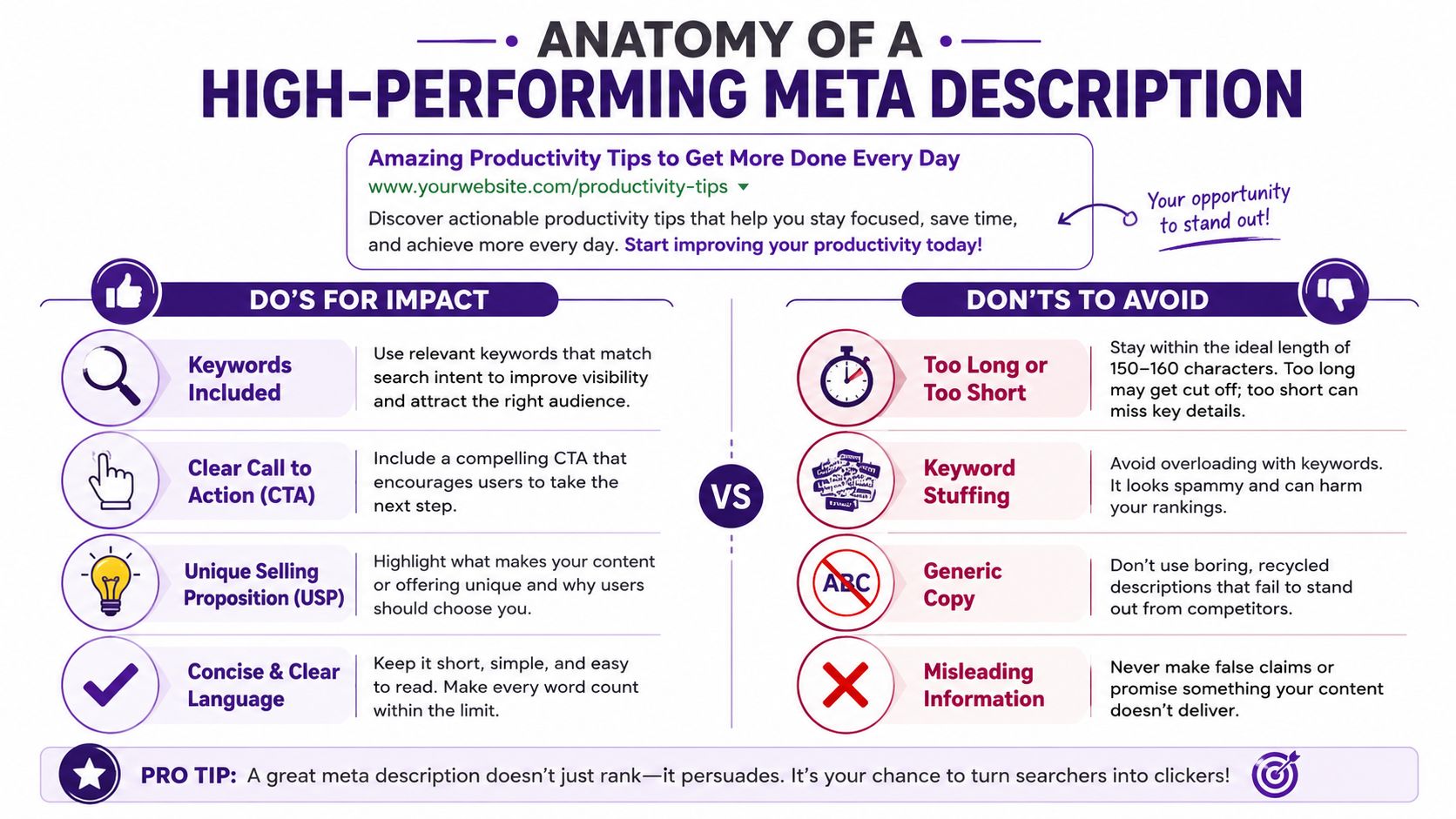
The old rule says to aim for 155 to 160 characters. That's still a useful drafting range, but it's not the full story. Google's average displayed snippet is shorter on mobile at 135.87 characters, which is why the most important information needs to appear early, as noted in Quattr's guidance on meta description length.
Put the core idea up front
If the primary keyword, topic, or promise appears late, you're taking a risk. Mobile truncation is less forgiving than desktop display, and character count alone won't save you because snippet display also depends on pixel width. Wide characters consume more space. A description can technically fit the character target and still get cut.
That's why the strongest descriptions front-load three things:
- Primary keyword early: Don't hide the main topic in the back half.
- Clear page value: Say what the reader gets.
- Actionable phrasing: Give the user a reason to click now.
A lot of AI outputs miss this because they write like mini summaries instead of search snippets. Summaries explain. Snippets compete.
Put the keyword and the payoff near the beginning. If mobile cuts the tail, the description should still make sense.
What professionals include
High-performing descriptions usually share the same bones, even when the tone changes by brand or format.
| Element | What it does |
|---|---|
| Primary keyword | Signals relevance without sounding forced |
| Specific benefit | Shows why this page is worth the click |
| Active voice | Keeps the phrasing direct and energetic |
| Clear CTA | Nudges action such as learn, compare, discover, or explore |
| Unique angle | Distinguishes this page from similar assets |
What weak descriptions usually get wrong
The failures are predictable. They read like templates, they repeat the title, or they describe the content so broadly that nothing stands out.
Watch for these habits:
- Generic copy: “Learn more about our services” tells the user almost nothing.
- Keyword stuffing: Repeating the phrase makes the snippet look spammy and weakens readability.
- Vague benefits: If every page “covers tips and strategies,” none of them feels distinct.
- Misalignment: If the snippet promises one thing and the page delivers another, users bounce and trust drops.
A professional meta description creator should help you produce sharper drafts faster. It still needs a human to judge whether the language sounds like a search result worth clicking.
A Scalable Workflow for AI Meta Description Creation
If you're managing more than a handful of pages, don't write meta descriptions in isolation. Treat them like a production workflow tied to your content inventory. That means organizing assets, assigning page intent, generating candidates in batches, and reviewing them with the same discipline you'd apply to headlines or thumbnails.
A strong AI workflow has five stages: setting context with brand voice and keywords, identifying keyword targets per page, generating optimized text, reviewing and approving content in a collaborative environment, and scaling the process across the site inventory, based on Jasper's meta description workflow.
Start with the library, not the prompt
Most bad AI outputs begin before the model writes a word. The underlying issue is weak input. If your content library is disorganized, your metadata will be too.
Before generation, sort pages into practical groups:
- Evergreen assets: Tutorials, cornerstone posts, glossary pages, flagship episodes
- Commercial pages: Product, service, landing, comparison, and category pages
- Archive pages worth reviving: Older posts or episode pages that still match current audience interest
- Repurposing candidates: Longform pieces that can support multiple platform-specific versions
If you're sitting on a large catalog, it also helps to review it routinely. CloudPresent's repurposing guidance recommends quarterly reviews and suggests prioritizing content from the past 12 months when looking for repurposing opportunities. That's a smart operating rhythm for metadata refreshes too.
Build context the AI can actually use
A meta description creator performs better when you give it constraints that resemble an editorial brief.
Useful inputs include:
- Page summary: One or two lines on what the page covers
- Primary keyword target: The main term or topic focus
- Secondary themes: Supporting ideas that help differentiate the page
- Brand voice notes: Crisp, formal, playful, authoritative, practical
- Length limit: A hard cap to avoid bloated output
- CTA style: Learn, compare, discover, get, start, explore
For teams building repeatable systems, the editorial process is paramount. If you need a framework for approvals, handoffs, and revision control, editorial workflow management software guidance is useful because metadata work gets messy fast when multiple people touch the same library.
A scalable workflow doesn't ask AI to guess. It gives AI enough context to make good decisions quickly.
Generate in batches, then review like an editor
Batch generation is where the time savings show up, but only if review standards stay high. Create multiple candidates per page, then choose the one that best balances relevance, clarity, and distinctiveness.
A simple review pass usually checks for:
- Intent match: Does the snippet reflect what the page is for?
- Keyword placement: Is the main term visible early enough?
- Uniqueness: Could this description accidentally fit three other pages?
- Click appeal: Would a real person prefer this result over nearby alternatives?
If you want a broader framework for using AI without flattening your content into generic copy, AI Tools for Local SEO's content advice is a useful companion read. The same principle applies here. AI should speed up production, but editorial judgment still decides what gets published.
That's the difference between automation and systemized quality. One produces more text. The other turns a library into a better business asset.
Ready-to-Use Prompts for Your AI Creator
Users often don't need a smarter tool first. They need better prompts. A meta description creator usually fails for one of two reasons: the prompt is vague, or the prompt asks for a summary instead of a search snippet.
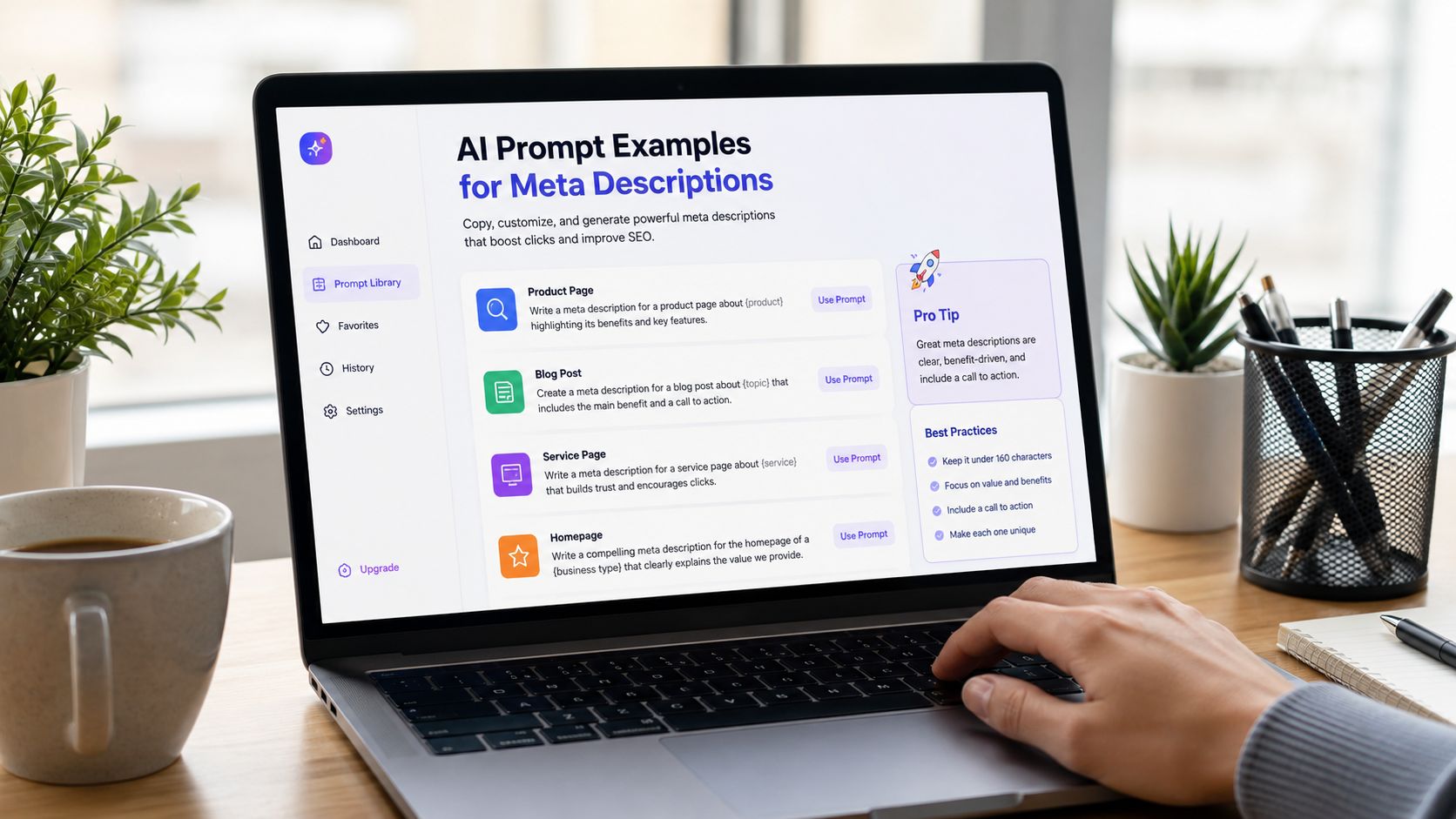
The fix is simple. Tell the model what the page is, who it's for, which keyword matters most, what tone to use, and what constraint cannot be broken. If you also want stronger alignment between search and paid acquisition messaging, it helps to study how teams optimize Google Ads with AI, because the discipline of writing concise, intent-matched copy carries over well.
AI Prompt Templates for Meta Descriptions
| Content Type | Prompt Template |
|---|---|
| YouTube video page | Write 5 meta description options for a page featuring a YouTube video. Primary keyword: [KEYWORD]. Audience: [AUDIENCE]. Summarize the page clearly, use active voice, include a subtle CTA, keep each option concise, and place the main keyword near the beginning. Avoid hype and avoid repeating the page title. |
| Podcast episode page | Create 5 meta descriptions for a podcast episode page about [TOPIC]. Include the primary keyword [KEYWORD] naturally near the start. Highlight the guest, lesson, or takeaway if relevant. Use a tone that is [TONE]. Make each option specific to this episode and end with a click-worthy CTA. |
| Long-form blog post | Generate 5 SEO-focused meta descriptions for a blog post about [TOPIC]. Primary keyword: [KEYWORD]. Audience intent: [INTENT]. Emphasize the practical benefit of the article, keep language clear and direct, and make each option distinct. |
| Product page | Write 5 meta descriptions for a product page. Product: [PRODUCT NAME]. Primary keyword: [KEYWORD]. Mention the main value proposition, use plain language, and include a direct CTA without sounding salesy. Make each version feel credible and precise. |
Prompt upgrades that improve output
You'll get better results if you add one layer of editorial control instead of accepting the first draft.
Try adding instructions like these:
- “Differentiate from similar pages” if your site has topic clusters or episode series.
- “Avoid generic phrases like learn more” when outputs start sounding interchangeable.
- “Use concrete benefit language” if the AI leans too abstract.
- “Match the tone of a professional creator brand” when the writing gets too corporate or too cute.
If your team is still figuring out where AI writing fits inside the broader content process, this guide to AI copywriting is useful for setting expectations. The important thing is to treat prompts like reusable production assets. Save the ones that work. Refine the ones that drift.
A simple review prompt for second-pass refinement
After the first generation, use a follow-up prompt such as:
Review these meta descriptions for clarity, uniqueness, keyword placement, and click appeal. Rewrite the top 3 options to sound more specific and more aligned with search intent. Remove generic language and keep the strongest value proposition near the beginning.
That second pass is often where the description becomes publishable.
Common Pitfalls and How to A/B Test Your Descriptions
Most underperforming meta descriptions don't fail because the writer forgot SEO theory. They fail because the description is bland, duplicated, too long, or too passive to compete.
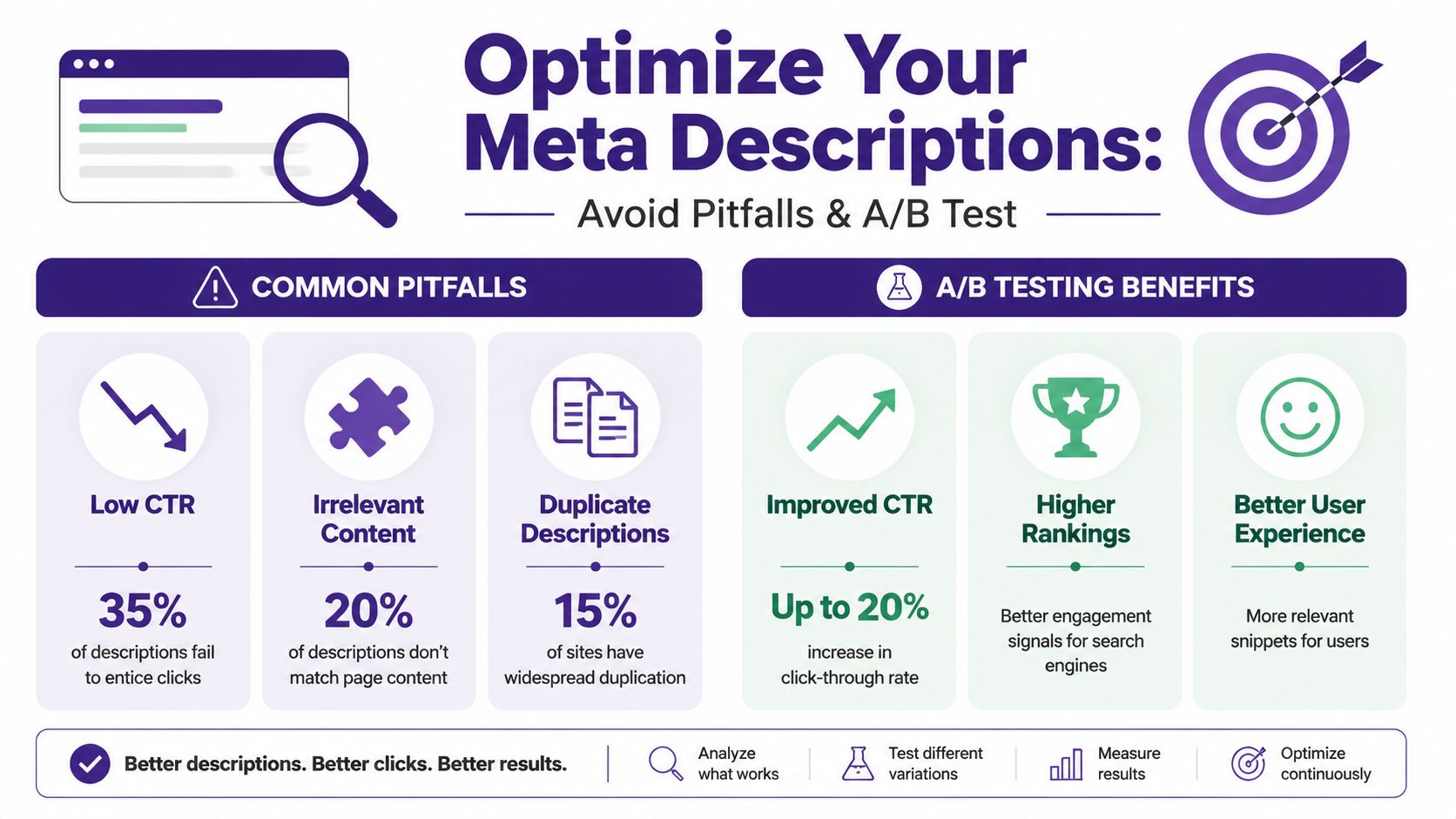
The impact can be material. According to Copy.ai's meta description guidance, exceeding the character limit can reduce CTR by up to 20%, while using passive voice or lacking a CTA can decrease clicks by 10 to 15%.
The mistakes worth fixing first
If you're cleaning up an existing library, don't chase perfection on every page immediately. Fix the recurring errors that damage performance across many URLs.
| Pitfall | Why it hurts |
|---|---|
| Overlength descriptions | They truncate and often lose the most persuasive part |
| Passive voice | The snippet feels weaker and less direct |
| Missing CTA | The result explains but doesn't invite action |
| Duplicate descriptions | Multiple pages blur together in search |
| Keyword lists instead of natural copy | The snippet reads awkwardly and looks low quality |
One more issue matters in larger archives. Duplicate metadata creates confusion inside topic clusters. When every episode page or article variation sounds nearly the same, your library stops signaling page-level value.
For teams that want a cleaner way to spot weak performers before rewriting, content performance analysis workflows can help identify which assets deserve attention first.
Testing metadata works best when you focus on pages that already earn impressions. Those pages are close enough to visibility that a better snippet can change behavior.
How to A/B test without overcomplicating it
You can't always run clean, simultaneous SERP tests the way you would with ad creative, but you can still test methodically.
A practical process looks like this:
- Pick pages with stable impressions: Don't start with pages that barely appear in search.
- Change one variable at a time: Lead with benefit in one version, lead with keyword in another, or test a stronger CTA.
- Let the version run: Give search enough time to reflect the update and gather comparison data.
- Watch click behavior: Use Google Search Console to compare changes in CTR and query alignment over time.
- Document winners: Save proven patterns by page type so future drafts improve faster.
What to test first
Not all tests are equal. Start with elements that most often change click behavior:
- Opening phrase
- Benefit framing
- CTA wording
- Specificity level
- Keyword placement near the beginning
A/B testing makes the meta description creator more useful because it closes the loop. Instead of generating text and hoping, you build a feedback system that teaches your team what your audience responds to.
Making AI a Collaborative Partner for Your Content Team
The best use of AI in metadata work isn't replacement. It's coordination. A solo creator can use it to move faster without losing quality. A marketing team can use it to standardize output across a large library. A publisher can use it to keep archives searchable, current, and commercially useful.
That only works when the team defines guardrails. Decide what “good” means for your brand. Set rules for tone, keyword placement, CTA style, and when a description needs human revision. Store those rules somewhere visible. Otherwise every contributor, human or AI, will reinvent the standard.
What a healthy collaboration model looks like
- AI drafts the first pass: Fast, structured, and consistent
- Editors refine for relevance: They catch nuance, overclaiming, and repetition
- Channel owners protect voice: They ensure the snippet sounds like the brand behind it
- Performance reviewers close the loop: They use search data to improve future prompts and standards
This matters even more when your library spans formats. Video pages, podcast episodes, blog articles, resource hubs, and product pages shouldn't all sound identical. They need shared logic, not flattened language.
The real upgrade isn't “using AI.” It's building a repeatable editorial system where AI, creators, and operators all know their role.
Once that system is in place, the meta description creator stops being a convenience feature. It becomes part of how you organize your content library, understand what each asset is for, and take action at scale. That's how old content gets upcycled into new value. That's how a scattered archive becomes an engine.
If you're ready to turn your archive into a more organized, monetizable content system, Contesimal helps teams classify, search, collaborate on, and reactivate their content libraries so past work can create fresh value across new channels.