
You've published for years. Your hard drives contain interviews, episodes, articles, research notes, transcripts, drafts, and ideas that once demanded serious effort. Yet when it's time to create the next video, newsletter, book chapter, or special edition, the process often starts from a blank page because finding the right material takes almost as long as making something new.
That's the central opportunity behind AI for knowledge management. Used well, AI doesn't replace editorial judgment or creative taste. It helps creators, publishers, researchers, and content teams organize what they already know, find relationships hidden across formats, and turn dormant archives into repeatable creative and commercial workflows.
Why Your Content Library Is Sitting on Untapped Revenue
A creator opens a folder called “Podcast Archive,” then another called “Final Episodes,” then a cloud drive filled with files named after guests and recording dates. The useful material is there, but it's difficult to retrieve. A strong explanation from an old interview might fit a new episode. A recurring audience question might support a short-form series. A decade of articles might contain the foundation for a themed collection. None of those opportunities are obvious from filenames alone.

Traditional content management systems are good at storage. They can preserve the file, record a date, and place an asset in a folder. They usually aren't designed to understand that one podcast episode discusses the same idea as three magazine articles, a research memo, and a video that performed well with a different audience.
That distinction matters. A content library is not automatically a knowledge asset. Storage answers, “Where is the file?” Knowledge management asks, “What does this material mean, how does it connect to other material, and where can we use it next?”
Storage preserves files, not opportunities
Creators often lose value through friction rather than lack of ideas. A publisher may know that a theme exists somewhere in its back catalogue but lack the time to locate every relevant article. A video producer may remember a guest made a useful point but not know which episode contains it. An editor may commission new research because the old research is technically available but practically invisible.
AI adds a discovery layer across that mess. It can help classify transcripts, identify themes, connect related passages, and make archives searchable by meaning rather than only by exact wording. The human still decides whether an idea is accurate, timely, original, and worth publishing.
Practical rule: If your team can store content but can't reliably retrieve and reuse it, you have an archive, not an operating knowledge system.
Turn distribution into a repeatable loop
Once a library becomes easier to use, repurposing becomes more deliberate. A longform interview can inform a clip series, a written summary, a social post, a research brief, or a follow-up conversation. Distribution tools then help you schedule and maintain that output. For creators managing multiple channels, a resource such as the PostSyncer social media planner can support the publishing side, while AI-powered KM supports the harder upstream work of finding and shaping the right source material.
The revenue case is practical. Reusing existing knowledge can reduce the need to begin every project with fresh research, create more consistent content clusters, and expose assets that might support memberships, licensing, sponsorship packages, courses, books, or special editions. The archive starts compounding when every new piece becomes easier to connect to what came before.
What AI for Knowledge Management Actually Does
AI-powered knowledge management works best when you treat it as a research assistant with an unusually good memory, not as an oracle. It reads and organizes available material, retrieves relevant context, and helps people decide what to do with that context.
A useful system usually performs four connected jobs.
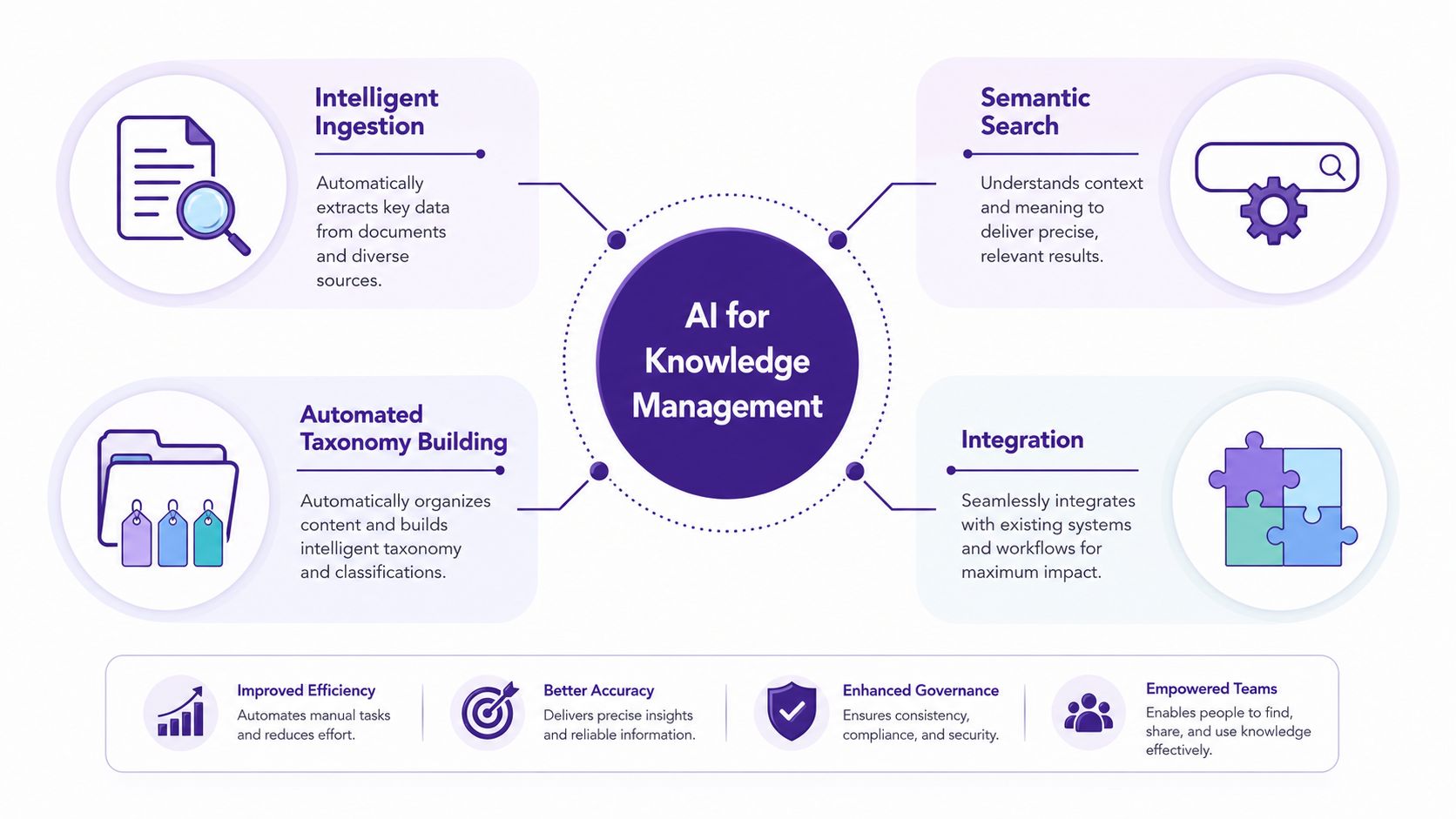
1. Intelligent ingestion
First, the system brings different formats into a common discovery layer. That may include articles, PDFs, video transcripts, podcast audio converted to text, research notes, captions, and metadata. Good ingestion preserves useful context such as speaker, publication date, series, topic, rights status, and source location.
This step is more important than it sounds. A transcript without episode identity is hard to cite. A scanned article without searchable text is difficult to reuse. A video without timestamps forces an editor to watch the entire file before locating one relevant passage.
2. Semantic search
Keyword search looks for matching terms. Semantic search looks for related meaning. A query such as “how independent creators build recurring revenue” may retrieve material that uses different language, including memberships, audience ownership, productized expertise, or subscription models.
Retrieval quality still depends on the underlying index and metadata. A generative answer can sound polished while pulling the wrong passage, so the system should show supporting sources and let users inspect the original material.
3. Automated taxonomy building
A taxonomy gives the library a usable structure. AI can propose topic labels, entities, formats, audience segments, recurring questions, and relationships between assets. Editors should review those proposals because a generic label such as “business” may be useless for a specialist publisher whose real distinctions involve pricing, operations, funding, or distribution.
The strongest taxonomies reflect the way a team works. They connect content to series, editorial themes, audience needs, production stages, and commercial possibilities.
4. Integration into creative workflows
Search alone creates another destination people must remember to visit. Integration places knowledge where work already happens, such as research planning, editorial review, episode development, content calendars, and distribution.
A well-structured content hub guide for creators can help clarify how central organization supports distributed publishing. The AI layer then makes that hub more useful by turning a static collection into a working source for new briefs, comparisons, references, and ideas.
Measurable Benefits of AI-Powered Knowledge Management
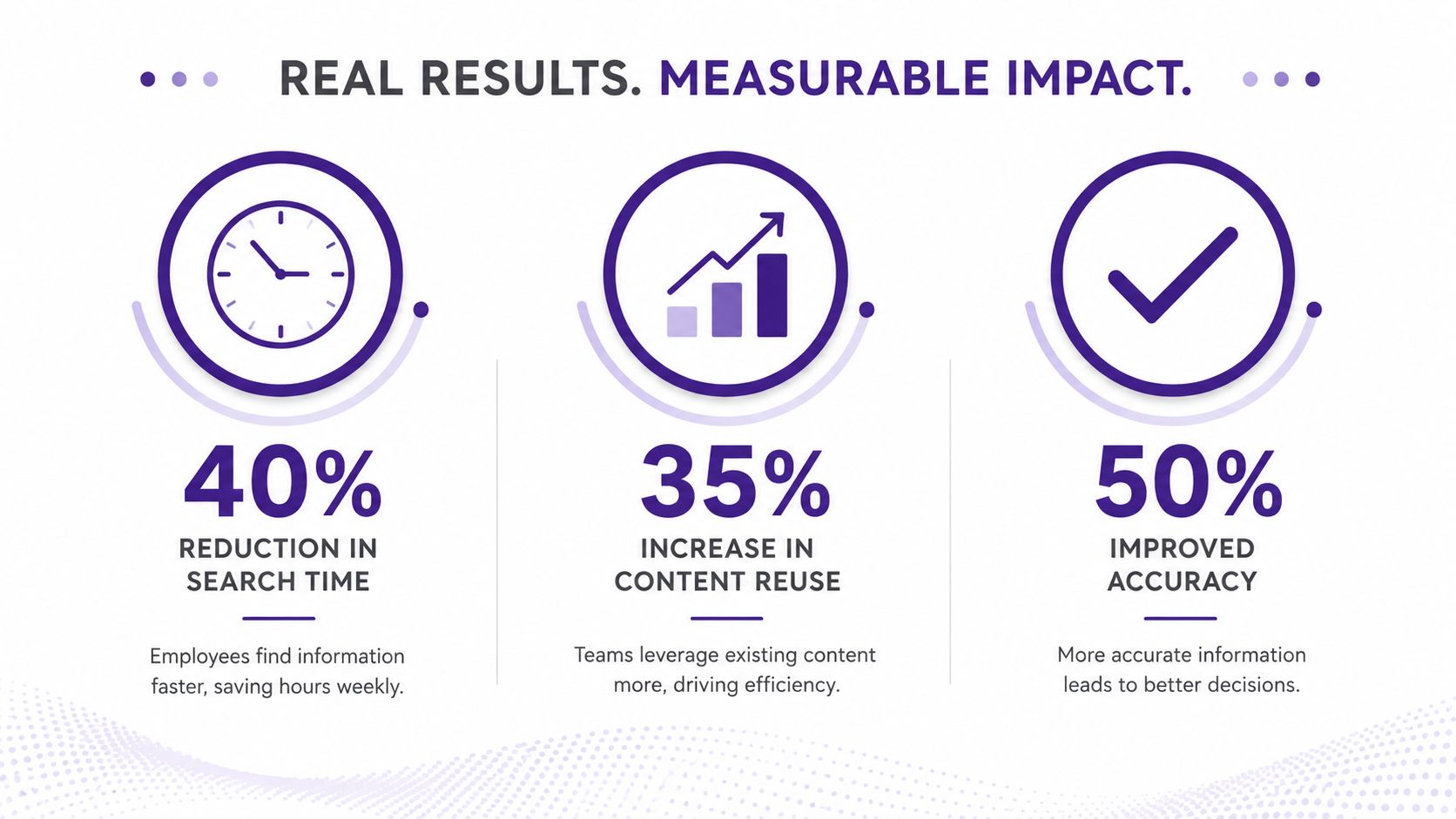
The clearest productivity case starts with search. McKinsey has been cited as finding that employees spend 19% of the workweek, or roughly 7.5 hours, looking for and gathering information that already exists inside their organization. The cited figure appears in this overview of AI knowledge management statistics, and it explains why retrieval is more than a convenience. Time spent hunting through archives is time not spent writing, editing, publishing, selling, or improving the next product.
An enterprise RAG system tested on a 1.2 million-document corpus during a six-week pilot improved Precision@10 from 0.58 to 0.81, reduced documentation retrieval latency from 45.6 seconds to 12.3 seconds, and cut average bug-resolution time from 18.4 hours to 7.2 hours. The results are reported in the enterprise RAG evaluation. A content team shouldn't assume it will reproduce those outcomes, but the pattern is useful: better retrieval can shorten the distance between finding evidence and completing work.
Measure the workflow, not the novelty
Users tend to value practical access improvements. One end-user study reported perceived advantages of speed at 25%, ease at 17%, and efficiency or effectiveness at 12%, with accuracy and precision also identified as benefits in the study of AI-aided KM tools.
For publishers and creators, those benefits translate into operational outcomes:
- Shorter research cycles: Editors can locate supporting material without repeatedly asking subject-matter experts.
- Faster repurposing: Teams can identify clips, quotations, themes, and related assets before assigning new production work.
- Lower duplication: Writers can see what the organization has already covered and choose whether to update, extend, or challenge it.
- Stronger commercial packaging: Similar assets can be grouped into collections, learning products, sponsorship concepts, or licensing packages.
The right business case connects the system to those outcomes. “We added a chatbot” is weak justification. “Editors can retrieve approved source material while preparing a new package” is a workflow proposition that can be tested.
Real-World Use Cases for Publishers, Podcasters, and Researchers
A magazine publisher may have years of reporting on a topic that deserves a new life. Instead of asking an editor to remember every relevant article, the team can search across the archive for themes, people, places, arguments, and unresolved questions. AI can assemble a working set for a themed collection, a digital special issue, a newsletter sequence, or a licensing discussion. The editor then checks dates, rights, accuracy, and editorial fit before anything moves forward.
For book publishers, the same approach can support catalogue development. A search across manuscripts, proposals, interviews, and backlist descriptions may reveal repeated themes that could inform an anthology, a companion guide, or a new author campaign. The system doesn't decide whether the market needs the product. It helps the publishing team see the available raw material sooner.
Podcasts and video libraries
A podcaster can query transcripts for every discussion of a subject, then review the relevant timestamps rather than replaying entire episodes. That supports clip selection, episode trailers, thematic compilations, listener question responses, and cross-episode references. A video team can search for moments where a guest explains a concept, tells a story, or disagrees with a common assumption, then route those passages into an editor's review queue.
The practical workflow is simple:
- Ingest episodes, transcripts, titles, guests, and dates.
- Tag topics, series, speakers, audience questions, and rights restrictions.
- Search by concept, not only by phrase.
- Review source passages and timestamps.
- Adapt the approved material for each platform.
Research and academic work
Researchers gain a different advantage. AI can connect findings across a body of work, group related arguments, identify recurring terminology, and highlight gaps that deserve closer reading. It can support literature review preparation, but it shouldn't replace source evaluation or citation checking.
For a more detailed example of research-oriented workflows, see the AI research assistant resource. The principle applies beyond academia: retrieval accelerates discovery, while humans remain responsible for interpretation and attribution.
How to Implement AI Knowledge Management in Your Content Workflow
A full archive migration sounds ambitious, but a focused pilot is usually more useful. Start with one editorial vertical, one show, one backlist category, or one defined period of content. The goal isn't to prove that AI can process everything. The goal is to learn whether it helps people complete a real knowledge task better.
Phase 1, audit the library
List the places where content lives and identify which assets matter most. Include cloud folders, publishing systems, video platforms, podcast hosts, transcripts, research repositories, newsletters, and private working documents. Record obvious gaps, duplicate files, missing metadata, outdated versions, and rights restrictions.
Choose a use case with a visible bottleneck. Examples include finding archive material for a weekly newsletter, locating clips for a podcast, or building a source pack for editors.
Phase 2, define the structure
Create a working taxonomy before asking AI to label everything. Include the terms your team uses for topics, formats, audiences, series, contributors, status, rights, and commercial potential. Then let the system suggest additional relationships or labels for review.
A taxonomy should be useful enough to guide retrieval without becoming an administrative burden. If nobody uses a label in planning or production, it probably doesn't belong in the first version.
Phase 3, ingest and test
Bring in a representative sample across the formats you publish. Test whether the system preserves timestamps, source links, speaker identity, publication dates, and version information. Ask practical questions that mirror daily work, then inspect the returned passages rather than judging only the generated summary.
Start narrow, but test deeply. A small pilot with trustworthy sources teaches more than a large upload nobody has time to validate.
Phase 4, add human review and feedback
Assign ownership for approving tags, correcting results, retiring outdated material, and handling sensitive content. Give editors a clear way to mark a result as useful, incomplete, irrelevant, or unsupported. Those signals can improve the workflow, but only if someone reviews patterns and updates the system.
Train the team on what AI can and can't guarantee. A creator moving from hobbyist publishing to a revenue-generating operation needs more than automation. They need shared standards for source use, approvals, collaboration, and distribution. The implementation workflow infographic captures the sequence, but the quality of the result depends on the review habits around it.

Risks and Governance Gaps Most Guides Ignore
The dangerous assumption is that a fluent answer is a reliable answer. Generative AI can retrieve the wrong context, combine separate claims, omit a qualification, or present uncertainty with unwarranted confidence. For a publisher, researcher, editor, or screenwriter, that can damage trust even when the original archive is accurate.
Recent academic work identifies 11 categories of risk associated with GenAI in organizational knowledge retrieval and transfer, including knowledge loss, system complexity, and erroneous outputs. The findings are discussed in this research on GenAI risks in knowledge management. The key lesson is that storage, retrieval, and transfer need a dedicated risk framework, not a generic policy copied from another AI use case.
Build provenance into the workflow
Every generated answer should point users back to the source material. For content teams, that means showing the article, episode, transcript passage, timestamp, document version, or research record behind a suggestion. If the system can't provide that trail, treat the output as an idea prompt rather than approved knowledge.
Governance also needs clear ownership:
- Source owners: Decide which materials are authoritative.
- Editorial reviewers: Check interpretation, context, and publication suitability.
- Rights managers: Confirm that archive material can be reused.
- System administrators: Manage permissions, ingestion, versioning, and retention.
- Subject specialists: Resolve disputes when labels or summaries distort meaning.
A practical metadata management guide can help teams make provenance, ownership, and classification part of daily operations instead of an afterthought.
Separate discovery from approval
AI can suggest a connection between two pieces of content. It shouldn't turn that connection into a published claim. Add checkpoints before external distribution, especially when material involves sensitive topics, legal exposure, academic citations, personal data, or changing factual information.
A 2025 study on responsible GenAI governance for KM shows that organizations are still working out how responsible oversight should function in practice. That uncertainty isn't a reason to stop. It's a reason to define review paths before the archive becomes embedded in automated publishing.
Choosing the Right AI Knowledge Management Platform
Content-heavy organizations need more than a chat box over a folder. Compare platforms by how well they handle the formats, relationships, and approvals that shape your work.
| Audience | Top Priority Features | Key Workflow Integration |
|---|---|---|
| Podcasters and video creators | Transcript search, timestamps, speaker recognition, thematic tagging | Episode planning, clip review, editing, distribution |
| Bloggers and content marketers | Article ingestion, semantic discovery, topic clusters, reuse tracking | Brief creation, calendars, SEO review, social publishing |
| Magazine and book publishers | Archive indexing, rights metadata, version control, collection building | Editorial planning, special editions, licensing, sales |
| Academics and researchers | Source-grounded retrieval, citation context, document comparison | Literature review, research notes, collaboration, manuscript preparation |
General-purpose tools versus domain-specific systems
General-purpose AI tools can be useful for summarizing a small collection or testing a workflow. They may become difficult to govern when the archive includes mixed formats, sensitive material, complex permissions, or years of evolving terminology.
Domain-specific platforms typically earn their place by supporting richer organization and repeatable discovery. Evaluate whether the system can ingest audio, video, and text, preserve source context, build layered taxonomies, support collaboration, and connect findings to production work.
Contesimal is one option designed for content organizations. It supports classification, organization, and search across documents, podcasts, videos, and articles, with AI-assisted research and taxonomy-based discovery. Teams considering a broader evaluation can use this content intelligence platform comparison to frame the questions.
Ask vendors to demonstrate a real task using your own sample material. Watch how the system handles an ambiguous query, conflicting versions, missing metadata, and a request that requires source verification. A polished demo is less informative than a traceable result.
KPIs to Track and Best Practices for Long-Term Success
Track whether the system changes work, not merely whether people log in. Useful measures include:
- Content reuse rate: How often archive-derived material contributes to new work.
- Time to repurpose: How long it takes to move from an approved source to a publishable adaptation.
- Search accuracy: Whether reviewers judge retrieved passages relevant and sufficiently complete.
- Repurposed-content engagement: How audiences respond to content built from existing assets.
- Library-derived revenue: Revenue that can be traced to archive-based products, campaigns, licensing, or subscriptions.
Pair those KPIs with maintenance habits. Review taxonomy terms as your editorial direction changes. Retire outdated assets. Preserve source links and rights information. Train new contributors on how to interrogate AI results and verify original context. Schedule governance checks at the points where research becomes a brief, a brief becomes a draft, and a draft becomes public.
For a broader operating checklist, the knowledge management best-practices guide from Rooy Development offers useful context. The durable advantage comes from consistency: every new episode, article, interview, and research file should enter the library in a form that makes future discovery easier.
A healthy AI knowledge management operation follows a simple loop: organize, understand, take action. Measure the loop, improve the taxonomy, and keep human judgment responsible for meaning and trust.
Contesimal helps creators, publishers, and researchers organize documents, podcasts, videos, and articles, then use AI-assisted research to uncover themes, connections, and reusable knowledge across their libraries. Visit Contesimal to explore how your dormant content can support the next piece of work and the next revenue opportunity.