
You've published the episode, cut the clips, and sent readers to a landing page. People watch, listen, and browse. But newsletter subscriptions barely move, membership sales feel unpredictable, and older posts keep attracting visitors without an obvious next step.
Learning how to improve conversion rates starts with identifying what those visitors need next. For creators, publishers, and research teams, that might mean subscribing, registering, returning, or watching another relevant video. The job isn't to squeeze a purchase out of every visit. It's to help the right audience progress toward something valuable, then measure whether that progress lasts.
Setting Conversion Goals and KPIs That Fit Your Content
A podcast download, blog view, or video play measures attention. It becomes useful business evidence only when you connect it to an intended outcome. A listener joining your newsletter, a researcher registering for archive access, and a viewer becoming a member represent different commitments.
Conversion rate means completed target actions divided by eligible opportunities, expressed as a percentage. Define that denominator carefully. Newsletter registrations divided by landing-page visitors answer a different question from registrations divided by podcast downloads, especially when you can't connect listeners across devices.
Define the progression you want
Map your content funnel around these stages:
- Discovery: Someone encounters an episode, article, clip, or search result.
- First meaningful interaction: They consume enough to find an answer or understand your perspective.
- Return visit: They deliberately come back for related material.
- Content-assisted conversion: Earlier content contributes to a later registration, inquiry, or purchase.
- Final conversion: They complete the business outcome your funnel supports.
The diagram below distinguishes attention from increasing levels of commitment.
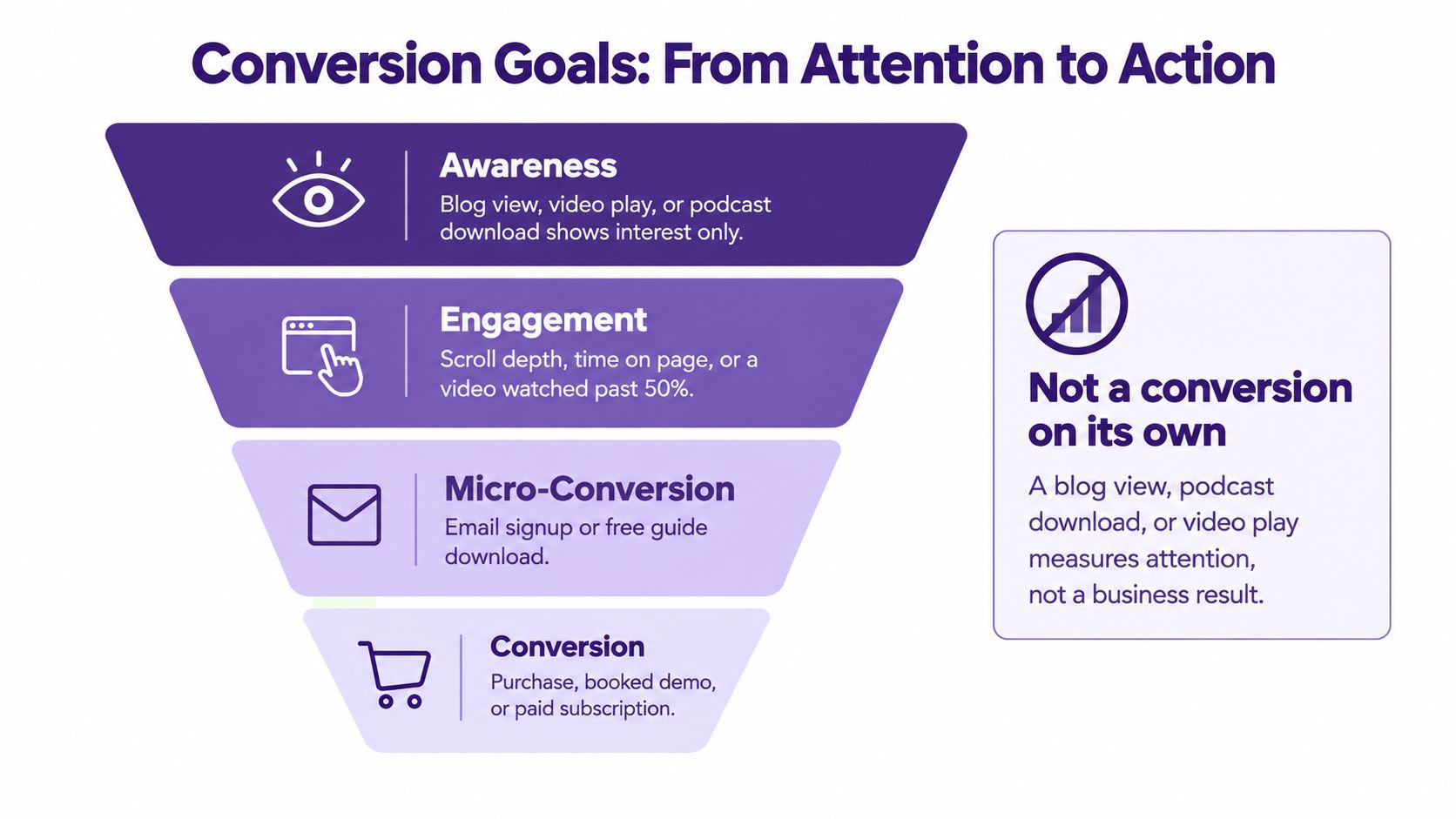
Don't assume everyone arrives ready to buy. A 2025 cart-abandonment benchmark discussed by Shopify found that 42% of shoppers who abandoned were browsing or weren't ready to purchase. That's ecommerce evidence, not a creator benchmark, but it's a useful warning against treating every nonpurchase as failure.
Choose a metric with a business consequence
For a podcast newsletter funnel, use confirmed subscriptions per eligible landing-page visitor as the primary metric. Protect subscriber quality with unsubscribe and complaint rates. For an archive registration funnel, protect subsequent research activity rather than celebrating empty accounts.
Establish your baseline across a complete publishing cycle before making changes. Record promotional activity, release dates, and unusual traffic spikes alongside it. Your comparison should reflect ordinary audience behavior, not an unusually successful guest appearance.
Practical rule: Choose the next valuable commitment, not the easiest event to count.
Auditing Analytics and Finding Friction Points
Start with the journey people take, not the homepage your team spends the most time discussing. Follow a listener from an episode description to the newsletter form. Follow a reader from an older search result to the research archive registration screen.
In analytics, compare entry pages, traffic sources, devices, and load performance. Look for the transition where interested visitors stop progressing. A mobile visitor who never sees the form needs a different fix from someone who completes it but encounters a confirmation error.
Translate checkout friction into content questions
Baymard's checkout-usability research reports 70.19% average cart abandonment across its historical analysis. The respondent shares below describe shopping abandonment, not predicted losses for your newsletter or membership.
Common Friction Causes and Their Content Equivalents
| Friction Cause | Share of Respondents Citing It | Content Equivalent to Check |
|---|---|---|
| Excessive extra costs | 48% | Subscription pricing or access restrictions revealed late |
| Forced account creation | 24% | Registration required before visitors can assess relevance |
| Low trust in credit-card handling | 18% | Unexplained payment requests or weak data-use explanations |
| Long or complicated checkout | 17% | Unnecessary signup questions or confusing verification |
The respondent figures in this table come from the Baymard research linked immediately above.
Use these categories as prompts, not diagnoses. A registration wall might be appropriate for licensed research. The problem could be that visitors can't preview the collection or understand what registration provides.
Attach evidence to each suspected problem
Combine your quantitative audit with qualitative checks:
- Watch task attempts: Ask a reader to find a relevant archived article and register for access. Notice hesitation without coaching.
- Check message comprehension: Briefly show the landing page, then ask what's offered and what happens next.
- Review recordings responsibly: Mask sensitive information and follow applicable consent requirements.
- Interview recent subscribers: Ask what nearly stopped them, rather than whether they like your design.
For a broader inventory, use this guide to analyzing content performance to connect individual pages with their editorial purpose.
Keep an audit log containing the observation, affected audience, evidence, and proposed explanation. Label explanations as hypotheses until you've tested them. “Visitors distrust the form” is a guess; repeated questions about email use are evidence worth investigating.
Prioritizing Hypotheses With a Simple Scoring Model
The most irritating issue isn't necessarily the most valuable test. A producer may dislike a button color while visitors struggle to understand whether the newsletter contains episode summaries or original research.
Prioritize the problem with the strongest connection to audience behavior. Expected impact, confidence, and implementation ease provide a lightweight scoring model. Use qualitative ratings rather than pretending you can forecast an exact lift.
Turn an observation into a prediction
Suppose your audit suggests that YouTube visitors leave when they reach a generic newsletter form. A testable hypothesis would be: replacing the generic invitation with an episode-specific checklist offer will increase confirmed subscriptions from that audience because the benefit matches the tutorial they watched.
That statement identifies the audience, change, outcome, and reasoning. “Improve the signup page” identifies none of them.
An illustrative backlog for a video channel might look like this:
| Candidate Test | Expected Impact | Evidence Confidence | Ease | Decision |
|---|---|---|---|---|
| Match the offer to the tutorial topic | High | Strong | High | Prioritize |
| Remove an optional company field | Moderate | Strong | High | Queue |
| Make a membership preview available | High | Moderate | Moderate | Investigate |
| Change the button color | Unclear | Weak | High | Defer |
| Add an immediate signup overlay | Moderate | Moderate | High | Review trust risk |
These are planning judgments, not measured outcomes. Update them as you learn.
Let guardrails overrule convenience
An overlay can score well because it's easy to launch and hard to miss. That doesn't make it a good choice if it interrupts playback, blocks keyboard navigation, or creates complaints.
A promising test must improve the experience you want to keep, not just the number you want to raise.
Keep the active backlog short enough that every item has an owner and a clear next action. Archive weak ideas instead of carrying them indefinitely. For smaller teams, finishing a defensible experiment is more useful than maintaining an impressive spreadsheet of untested opinions.
Running A/B and Multivariate Tests Without False Wins
Use an A/B test when you want to compare a control with a clearly defined alternative. For example, compare a podcast landing page with competing invitations against a version focused on the relevant newsletter offer. Keep unrelated elements stable so the result remains interpretable.
A multivariate test examines combinations of changes. It can help investigate interactions between an offer, headline, and layout, but dividing traffic among combinations increases sample requirements. If your audience can't support that design, staged A/B tests are the more practical choice.
Write the decision rule before launch
Your experiment plan should establish:
- Baseline: Use a representative publishing and promotional cycle.
- Primary outcome: Specify the completed action, not merely the button click.
- Detectable effect and sample: Choose a business-relevant improvement and calculate the required sample using your baseline and statistical assumptions.
- Assignment: Randomize consistently so returning visitors don't switch experiences unpredictably.
- Decision rule: Define when you'll analyze results and what would justify rollout, rejection, or an inconclusive result.
Use this sequence to keep implementation and analysis aligned.
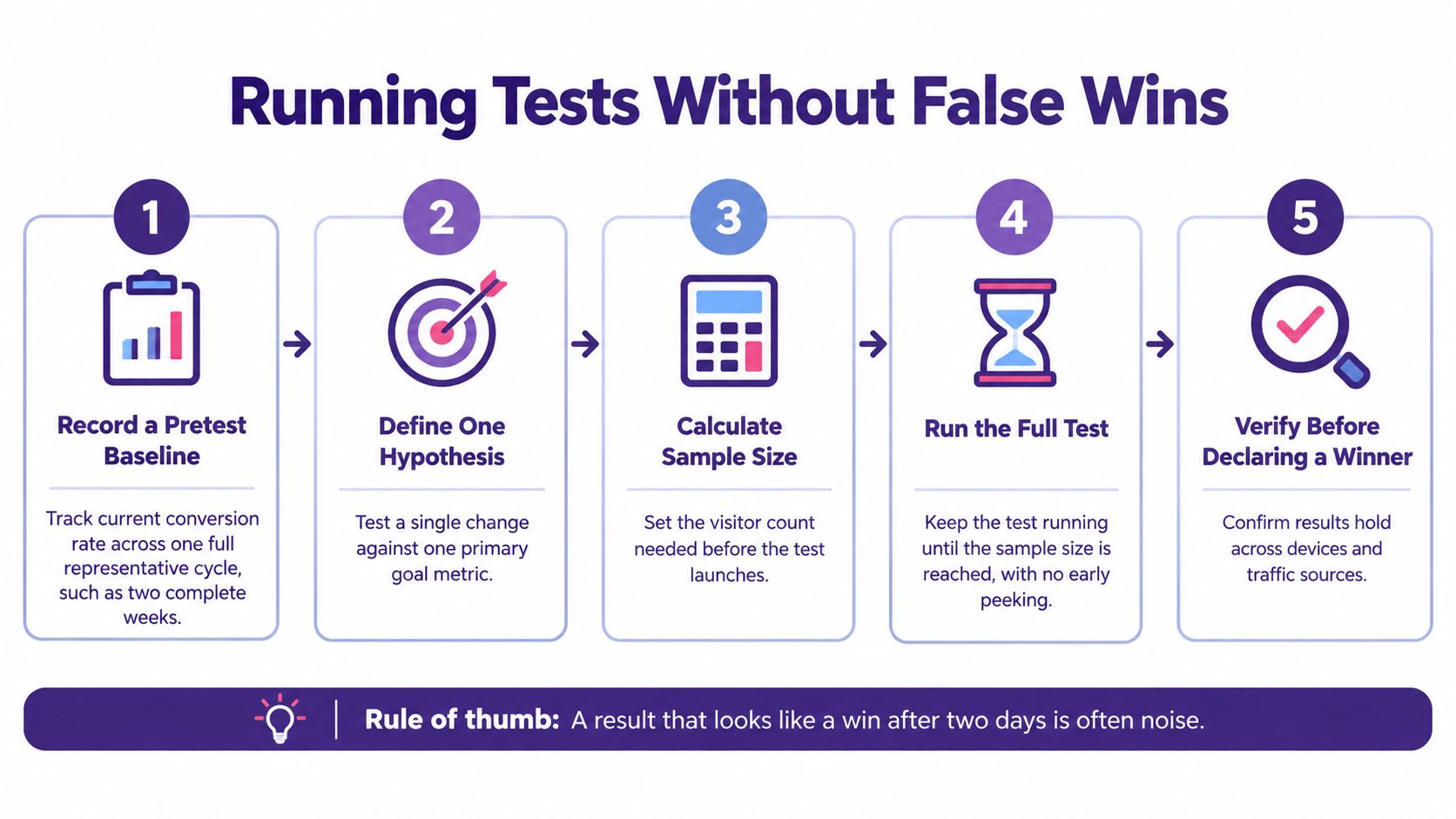
You can monitor broken forms and serious guardrail violations while a test runs. What you shouldn't do is repeatedly inspect ordinary fluctuations and stop when your preferred variant moves ahead.
Test the mechanism, not the slogan
“Fewer steps” isn't a sufficient hypothesis. Baymard's 2024 checkout benchmark found an average of 5.1 steps and 11.3 form fields, with 17% abandoning because of complexity. Its research emphasizes reducing fields users must review rather than compressing the step count.
Apply that distinction to onboarding. A readable sequence can be preferable to a crowded screen requesting the same information.
For acquisition-message ideas, this guide to Facebook ad copywriting can help you examine the promise visitors see before arrival. Test whether the landing page fulfills that promise.
A headline that increases clicks but reduces completed subscriptions hasn't won your subscription test. Statistical significance and business usefulness are separate decisions. Require both a defensible result and an outcome worth implementing.
Optimizing Copy and Personalization by Audience Segment
A first-time tutorial viewer needs a reason to stay. A loyal listener who already understands your work may need a clearer explanation of membership benefits. Giving both audiences the same invitation ignores the difference in their intent.
Start with the payoff. “Get the episode checklist” explains an immediate benefit more clearly than “Subscribe to our podcast,” provided a real checklist exists and the delivery terms are explicit. Don't promise a resource and enroll someone in unrelated marketing.

Match the offer to observable intent
Build useful segments from behavior you can legitimately observe:
- Topic interest: Offer a related archive collection rather than an unrelated download.
- Content depth: Give a substantial tutorial reader a practical next step, such as a worksheet.
- Return frequency: Let established visitors explore a deeper commitment without repeatedly presenting the introductory offer.
- Expressed purpose: Distinguish someone seeking research access from someone evaluating a commercial service.
Use website copywriting principles to keep the headline, supporting explanation, and call to action consistent. Personalization won't rescue an offer that remains vague.
Keep an unpersonalized fallback. If your classification is uncertain, show a useful general option rather than making confident assumptions about the visitor.
Make automation understandable
Explain why you request sensitive information and how recommendations are selected. If AI helps generate recommendations or interactions, disclose that involvement plainly. Let visitors browse outside the suggested path.
CartFlows' checkout statistics report that 18.7% of surveyed U.S. online shoppers abandoned after a failed CAPTCHA, while another 3.9% abandoned when one appeared. These figures aren't a forecast for your registration flow, but they justify scrutinizing verification rather than treating it as harmless.
Offer accessible alternatives and preserve completed form data when verification fails. Coordinate changes with whoever manages security, since removing protection without assessing abuse creates a different problem.
Useful personalization reduces uncertainty. Opaque personalization asks people to trust decisions they can't understand. Test relevance alongside complaints, opt-outs, and repeat engagement so short-term persuasion doesn't undermine the relationship.
Measurement Pitfalls That Quietly Kill Conversion Gains
A shorter form can produce more submissions and less business value. If it removes information needed to route research inquiries, your team may spend more time qualifying requests while fewer people reach a useful outcome.
Baymard's abandonment guidance warns against measuring form completion alone. It recommends evaluating qualified conversions, retained users per visitor, support contacts, and incomplete data by segment. Treat that as a reminder to define success beyond the confirmation screen.
Instrument the whole journey
For each meaningful stage, capture completion, abandonment, errors, device, traffic source, and time to completion. Establish consistent event definitions so editors, marketers, and analysts aren't using the same label for different actions.
Separate these questions in your reporting:
| Question | Measurement to Inspect |
|---|---|
| Did more people complete the target action? | Eligible visitors and completed conversions |
| Were those people a good fit? | Qualified conversions and subsequent activation |
| Did anyone encounter a worse experience? | Errors, support requests, complaints, and segment-level losses |
| Did the result persist? | Retention and repeat engagement after sufficient observation |
An aggregate improvement can conceal a mobile decline or a worse experience for returning readers. Inspect those segments before rollout, while avoiding confident conclusions from sparse subgroup data.
Give older content credit without inventing causality
Suppose a listener hears an archived interview, returns through a newsletter, and later buys a course. Last-click reporting would miss the interview's contribution. Record identifiable content interactions within your chosen attribution window, then report the interview as an assisted touchpoint, not proven cause.
Use stable asset identifiers across transcripts, clips, show notes, and related posts. Where tracking isn't possible or appropriate, supplement analytics with an optional purchase survey asking which content helped.
Reporting standard: State the outcome, the uncertainty, the guardrails, and the observation window together.
Don't add assisted conversions together as though each asset independently generated a sale. Keep final conversions distinct from contributing interactions. That distinction lets you evaluate old content without inflating its commercial contribution or discarding material that supports a longer decision.
Choosing Your Optimization Stack and Running Your First Test
Choose tools by the job they perform. A content library platform won't replace randomized experiment assignment. An analytics dashboard won't tell your editor which archived interview contains the strongest material for a new offer.
Keep the stack understandable enough that your team can explain how a visitor, asset, and conversion connect.
Compare tools by responsibility
| Tool Category | Best Job | What It Doesn't Establish |
|---|---|---|
| Spreadsheets, such as Google Sheets | Hypothesis scoring, ownership, and experiment logs | Reliable behavioral tracking or randomization |
| Analytics suites, such as Google Analytics | Funnel events, acquisition paths, and segment comparisons | Why a visitor hesitated |
| Dedicated testing platforms, such as VWO | Variant assignment and controlled experiment delivery | Whether the underlying offer deserves testing |
| Content library software | Classification, archive search, research, and editorial collaboration | Causal conversion lift without a separate test |
For archive-heavy teams, inspect the organizational layer closely. Can you classify podcasts, articles, and videos by subject? Can collaborators find source material, inspect context, and identify related assets without relying on whoever remembers the original project?
A resource on metadata and FAIR principles explains how descriptive metadata supports findability, accessibility, interoperability, and reuse. For creators, the practical implication is straightforward: store meaningful subjects, formats, dates, and relationships alongside the files.
Chat-based research and programmatic ingestion can help teams work across growing libraries, but keep human review in the workflow. Search results can suggest promising material; your analytics must establish whether it attracts the intended audience.
Launch a focused archive test
Choose an older episode or post that already receives relevant visits. Create a useful derivative, such as a checklist, annotated reading list, or topic collection. Test an invitation to that resource against the current call to action.
Complete this launch card before publishing:
- Hypothesis: A topic-matched resource will encourage qualified progression because it extends the visitor's current task.
- Primary metric: Confirmed registrations per eligible visitor exposed to the invitation.
- Guardrails: Resource activation, unsubscribes, complaints, and delivery errors.
- Sample size: Calculate from the baseline and the smallest improvement worth implementing.
- Stop date: Set a planned review date that allows the required sample and representative cycle, with documented safety-stop conditions.
Give the experiment an owner and verify the entire path, including resource delivery, on mobile. Launch this week if the instrumentation and sample plan are ready. If they aren't, use the week to establish them rather than publishing a test you can't interpret.
Contesimal helps teams organize, search, and understand their existing content libraries, with chat-based research, layered taxonomies, and collaboration between human and AI contributors. Visit Contesimal to see whether it fits your archive, then use a relevant older episode, article, or video as the starting point for your next conversion test.