
You probably already have more Facebook ad copy material than you think.
If you run a YouTube channel, podcast, newsletter, blog, or media brand, your best ad angles usually aren't hiding in a swipe file. They're buried in episode transcripts, audience replies, comments, sales messages, old launch posts, and the parts of past content where people leaned in. Many skip that step and go straight to formulas. Then they wonder why their Facebook ads sound polished but generic.
Good FB ads copywriting starts earlier. Before you write a headline, you need a system for finding what your audience already says, wants, fears, resists, and repeats.
Find Your Best Ad Angles Before You Write a Word
The hardest part of Facebook ads isn't writing. It's deciding what the ad is about.
A lot of advertisers default to the same angle stack: pain point, social proof, urgency, benefit. Those can work. But they also flatten your message into category clichés. A more useful starting point is your own archive. If you've been publishing for a while, your content library already contains the raw material for stronger ad angles.
Recent guidance on Facebook ad angles points to the same gap. Teams are told to use customer feedback as the source of truth and test very different angles, but the missing piece is the workflow for turning unstructured content into a repeatable angle system, as noted in this discussion of counter-angle Facebook ads.
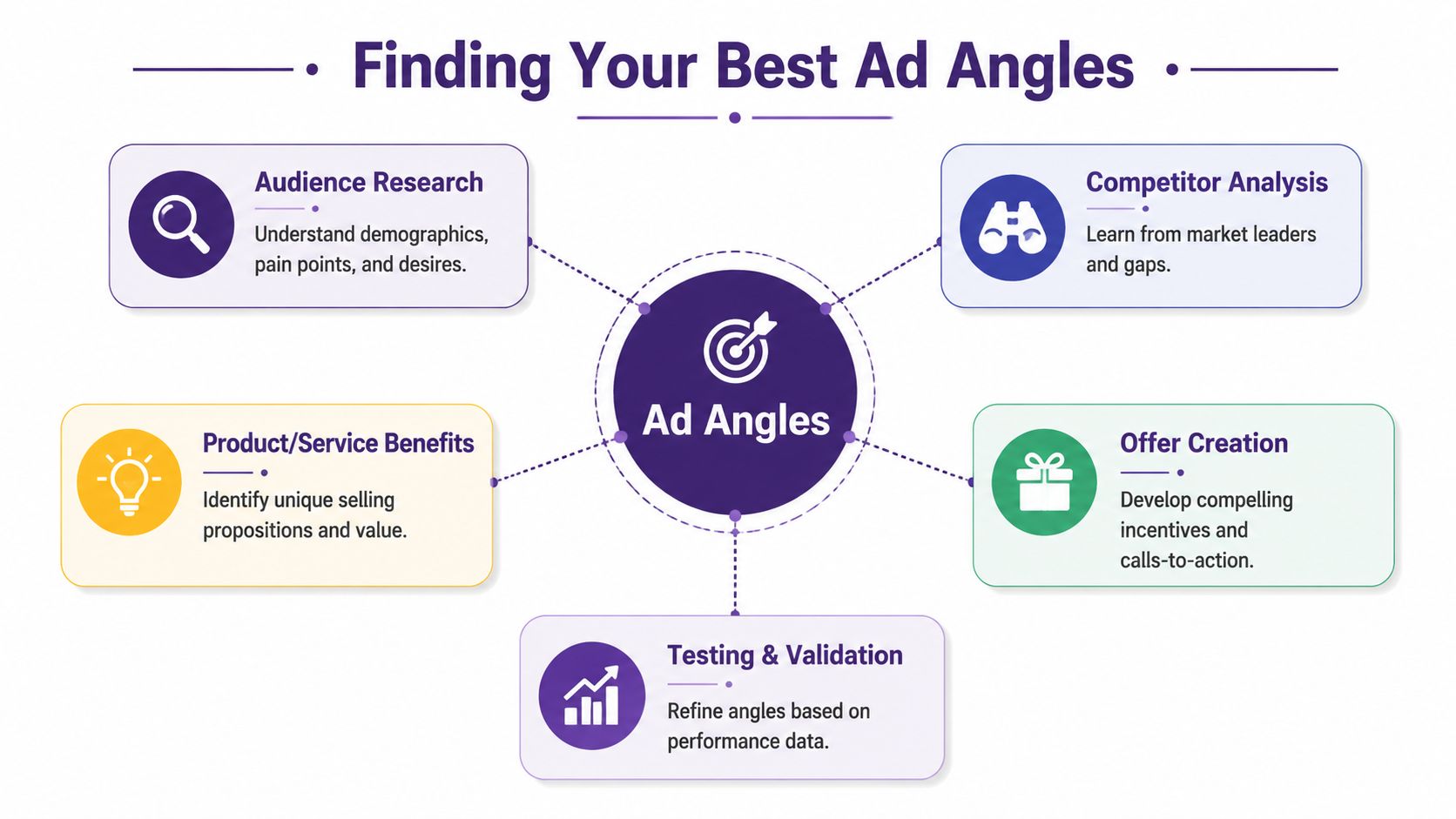
Mine the places where people speak naturally
The best ad angles rarely come from polished brand language. They come from messy audience language.
Look in places like these:
- Video transcripts: Pull repeated phrases from the sections with the strongest retention, strongest reactions, or most replay value.
- Comments and DMs: Readers and viewers often explain objections more clearly than your sales page does.
- Podcast listener emails: These are useful for capturing motivation in full sentences instead of short reactions.
- Old launch posts: Past promos reveal what you already believed would matter. Compare that with what the audience responded to.
- Support and onboarding questions: These show where confusion lives, which is often where good copy begins.
Turn loose language into an angle taxonomy
You don't need one great hook. You need a classified library of possible hooks.
I like to sort raw audience language into buckets such as:
| Angle bucket | What belongs in it | Example prompt for copy |
|---|---|---|
| Objections | Doubts, fears, friction | Why this won't be hard |
| Desired outcomes | What they want soon | What changes first |
| Identity | How they see themselves | For creators who are done winging it |
| Triggers | What makes them act now | When your library starts feeling wasted |
| Simplicity | Requests for easier paths | Start with the easiest next step |
That last one matters more than many advertisers think. Practitioner guidance has emphasized simplicity as a distinct angle for cold audiences who don't know the brand yet, especially when clarity beats heavier persuasion in the feed, as discussed in this practitioner video on simplicity angles.
Practical rule: If your archive gives you ten ways to sound clever and one way to sound obvious, test the obvious version first.
Build angles before copy drafts
Once you've tagged enough source material, write angle statements before writing ads. Not headlines. Not body copy. Angle statements.
For example:
Archive overwhelm angle
You already have enough content. You just can't surface the right pieces fast enough.Monetization angle
Old content isn't dead. It's undeployed.Cross-platform angle
One long-form asset can power multiple paid and organic messages if the source material is organized.Simplicity angle
You don't need a more creative ad. You need a clearer first sentence.
If you need a process for extracting themes from existing material, this guide on how to find content ideas is useful because the same content-mining discipline works for paid social.
When advertisers complain about the blank page, it's usually a research problem disguised as a writing problem.
Mastering Persuasive Copywriting Frameworks
Frameworks help when the angle is clear and the draft still feels loose. They don't create insight, but they do shape it.
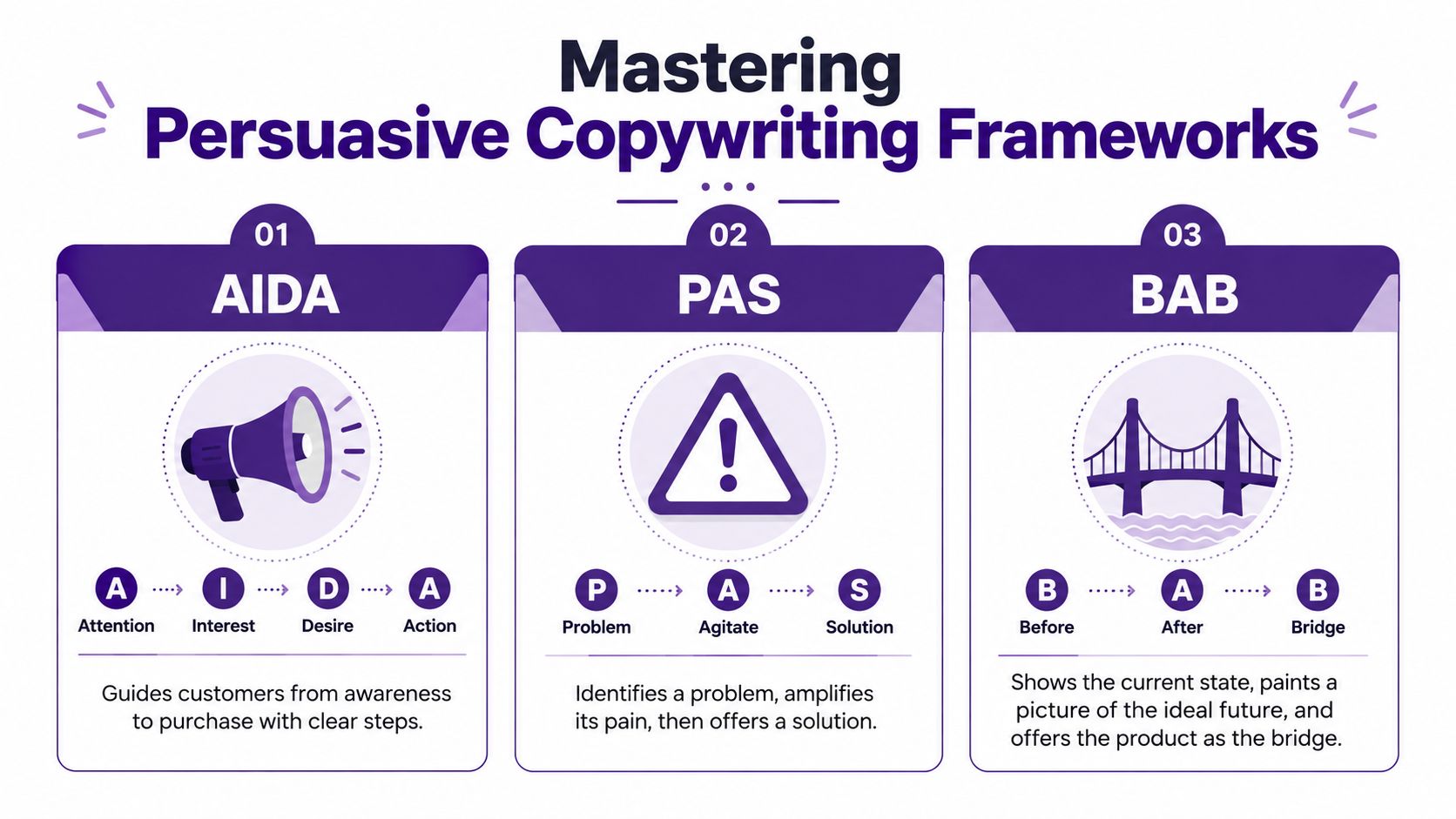
The three most dependable frameworks for FB ads copywriting are AIDA, PAS, and BAB. Each works best under different conditions, and picking the wrong one can make an otherwise strong angle feel forced.
When AIDA works best
AIDA stands for Attention, Interest, Desire, Action.
Use it when the audience is problem-aware or creator-aware, but still needs a structured path toward action. It's especially useful for offers that need a little context without becoming long-winded.
A podcaster promoting a premium private feed might write it like this:
- Attention: Still spending hours planning every episode from scratch?
- Interest: We built a private feed for creators who want a tighter publishing workflow.
- Desire: Save your best ideas, organize recurring themes, and reuse what already worked.
- Action: Join the waitlist.
AIDA works because it moves cleanly from interruption to intent. It suits offers where the value becomes stronger as the reader sees the sequence.
For a closer look at how the model works in marketing language, this explanation of the AIDA model is a helpful refresher.
When PAS is stronger
PAS means Problem, Agitate, Solution.
This is usually better when the pain is obvious and expensive in attention, time, or momentum. It fits operational frustrations well.
A publisher trying to drive newsletter sign-ups could use PAS like this:
Your archive keeps growing, but your best ideas are still hard to find. Every new issue starts with the same hunt through old drafts, notes, and links. Subscribe for weekly breakdowns on turning existing content into usable editorial systems.
PAS works when the audience already feels the problem in their day-to-day work. If they don't feel it yet, the agitation can sound melodramatic.
Where BAB feels most natural
BAB stands for Before, After, Bridge.
This one is strong when the transformation is easy to picture. It works well for creators, educators, and productized services because it lets you show movement without sounding hypey.
A YouTuber launching a course might use it this way:
| Framework part | Example |
|---|---|
| Before | You've got years of videos and still start every new campaign from zero |
| After | Your old content turns into ready-to-test hooks, offers, and scripts |
| Bridge | The course shows you how to tag, sort, and reuse your archive |
Match the framework to audience temperature
Cold audiences often respond better to clarity and reduced cognitive load than to dramatic persuasion. That's why simplicity deserves to be treated as an angle choice, not just a style preference. In practice, a stripped-down AIDA or BAB draft often beats an aggressive PAS draft for top-of-funnel traffic.
The same principle shows up on landing pages too. If you're thinking beyond the ad click, this guide on optimizing website copy for conversions is worth reviewing because the message after the ad needs to carry the same promise cleanly.
Frameworks are useful. Blind loyalty to one framework isn't. If the draft sounds like a template, the audience will feel it.
Anatomy of a Winning Facebook Ad
The ad unit itself forces discipline. You don't get infinite room, and you don't get equal attention across every text field.
Most advertisers put too much pressure on the body copy and not enough on how the full unit works together.
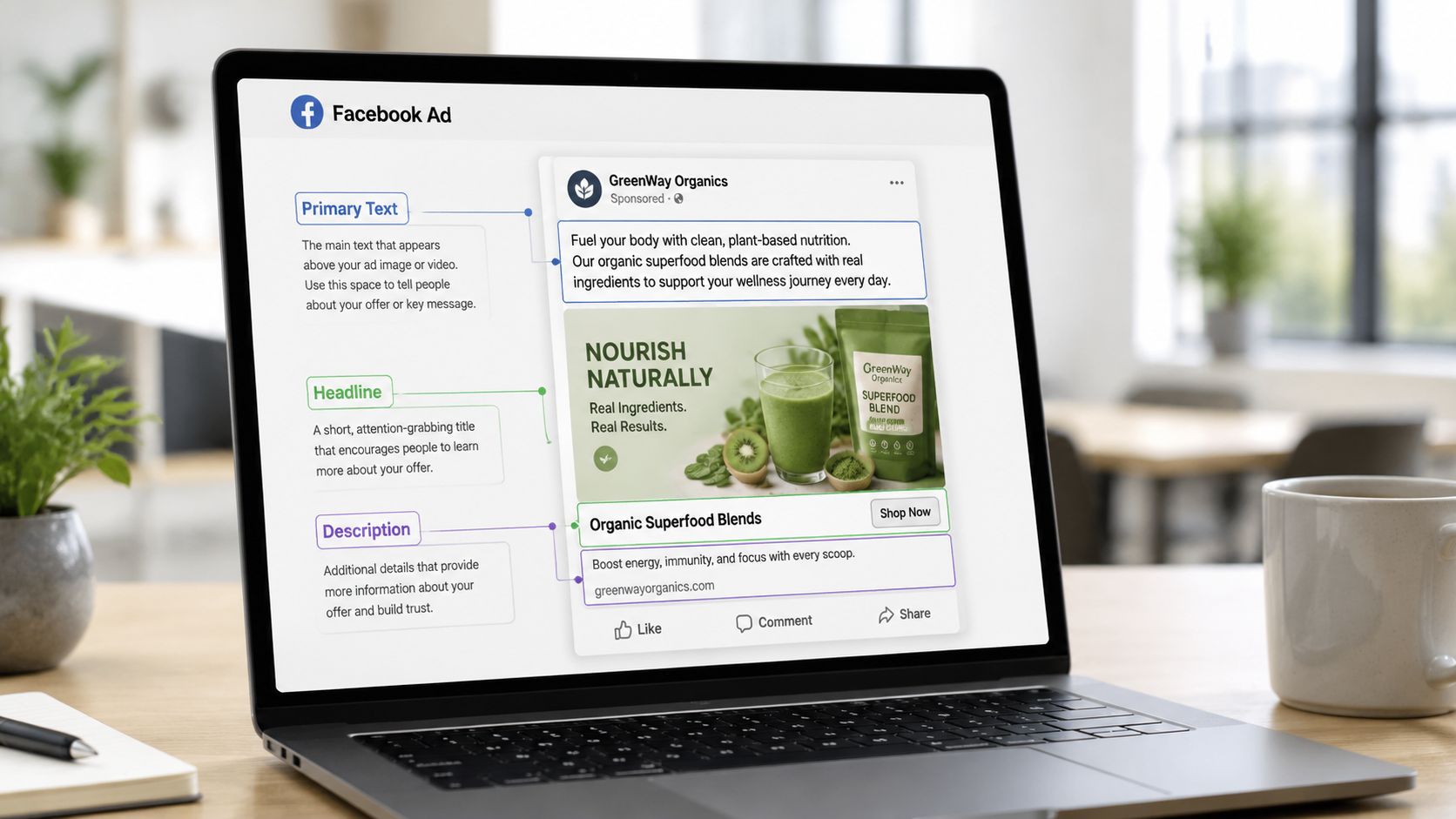
Primary text does the stopping
The first job of primary text is to earn the next second.
A foundational benchmark supports the short-first approach. One industry-cited source says Facebook ads with 1 to 15 words perform 50% better than longer ads, another found the median Facebook ad post text is 14 words, and the same source reports that descriptive adjectives can lift click-through rate by 20%, according to these Facebook copywriting statistics.
That doesn't mean every winning ad must be ultra-short. It means concise copy is the baseline, not the compromise.
Try these opening patterns in primary text:
- Direct audience callout: For creators sitting on years of unused content
- Operational pain: Stop rebuilding campaigns from scratch
- Simple benefit: Turn old episodes into fresh ad angles
- Specific adjective plus outcome: A cleaner way to organize your content backlog
Headline confirms the value
The headline's job isn't to be literary. It should either sharpen the benefit or frame the offer.
Good headline types for Facebook ads:
- Benefit headline: Organize Your Best Ideas Faster
- Outcome headline: Turn Old Content Into New Campaigns
- Offer headline: Join the Creator Workflow Workshop
- Curiosity headline: Your Archive Is More Useful Than You Think
Weak headlines usually fail in one of two ways. They're either too broad or too clever. If the image carries emotion, let the headline carry clarity.
Description supports, it doesn't rescue
The description field is often ignored, which is fine if the rest of the ad already works. But when used well, it adds a small final nudge.
Use it for one of three things:
- Context: Good for offers that need a brief qualifier.
- Urgency: Useful if the promotion has a real time-bound reason to act.
- Credibility: Helpful when the promise needs a bit more grounding.
A bad use of description is trying to wedge your whole argument into it. If the ad needs rescue, the problem usually sits in the hook or the offer.
A quick walkthrough helps show how these parts fit together:
Build the unit as a sequence
Think in reading order, not fields.
The image catches the eye. The primary text earns attention. The headline explains why to care. The description adds support if needed.
A simple ad for a blogger, publisher, or YouTuber might look like this:
| Ad part | Draft |
|---|---|
| Primary text | Your archive already contains your next winning ad angle |
| Headline | Stop Starting From Zero |
| Description | Use past content to launch smarter campaigns |
When one part tries to do every job, the ad gets bloated. Winning units feel simple because each component stays in its lane.
Writing Scroll-Stopping Hooks and Opening Lines
Most copy improvements come from the first line, not the last sentence.
One practical benchmark from a Facebook ads practitioner is to keep the body copy fixed and test different openings, with practical account-level targets of about 2-3% CTR overall and 1%+ outbound CTR, as explained in this hook-testing breakdown. That's the right instinct. You don't need a brand new ad every time. You need better entrances.
Hook swaps that change the whole ad
Take the same core offer: helping creators use old content to generate new campaigns.
Here are weaker openings:
- We help creators repurpose their content.
- Our platform makes content organization easier.
- Grow your brand with smarter workflows.
None of those are offensive. They're just easy to ignore.
Now rewrite the hook while keeping the offer basically unchanged:
- Question hook: Still digging through old videos every time you need a new ad?
- Contrarian hook: You probably don't need more content. You need better retrieval.
- Audience callout: For podcasters with a growing back catalog and no reuse system.
- Moment-based hook: When your archive gets big, creativity starts slowing down.
- Simplicity hook: Start with the content you've already paid to make.
Match hook type to the awareness level
Cold audiences tend to respond to recognizability before persuasion. They need to feel, "that's me," before they care what you're selling.
Warm audiences can handle more direct hooks:
| Audience | Better hook style | Example |
|---|---|---|
| Cold | Clear and low-friction | Your old content can do more work |
| Warm | Problem-aware | Stop rebuilding every campaign manually |
| Hot | Offer-led | Turn your archive into ad-ready angles |
Hook test advice: Change the first line first. If results don't move, then test the offer framing. Don't rewrite the whole ad at once.
Use source language, not brand theater
Your archive pays off again. Hooks improve when they borrow real phrasing from viewers, listeners, and readers.
If your audience keeps saying things like "I know I made something useful, I just can't find it," that's a hook seed. If they say "I have too many videos to keep track of," that's another. Generic copy usually comes from marketers inventing language instead of collecting it.
If you want extra examples of strong openings, these good hook examples are useful for studying how the first line creates momentum, even outside ad writing.
A hook doesn't need to be flashy. It needs to make the right person stop scrolling long enough to care about sentence two.
A Practical Plan for Testing and Optimizing Your Copy
Most ad accounts don't fail because the team can't write. They fail because the team can't isolate what changed.
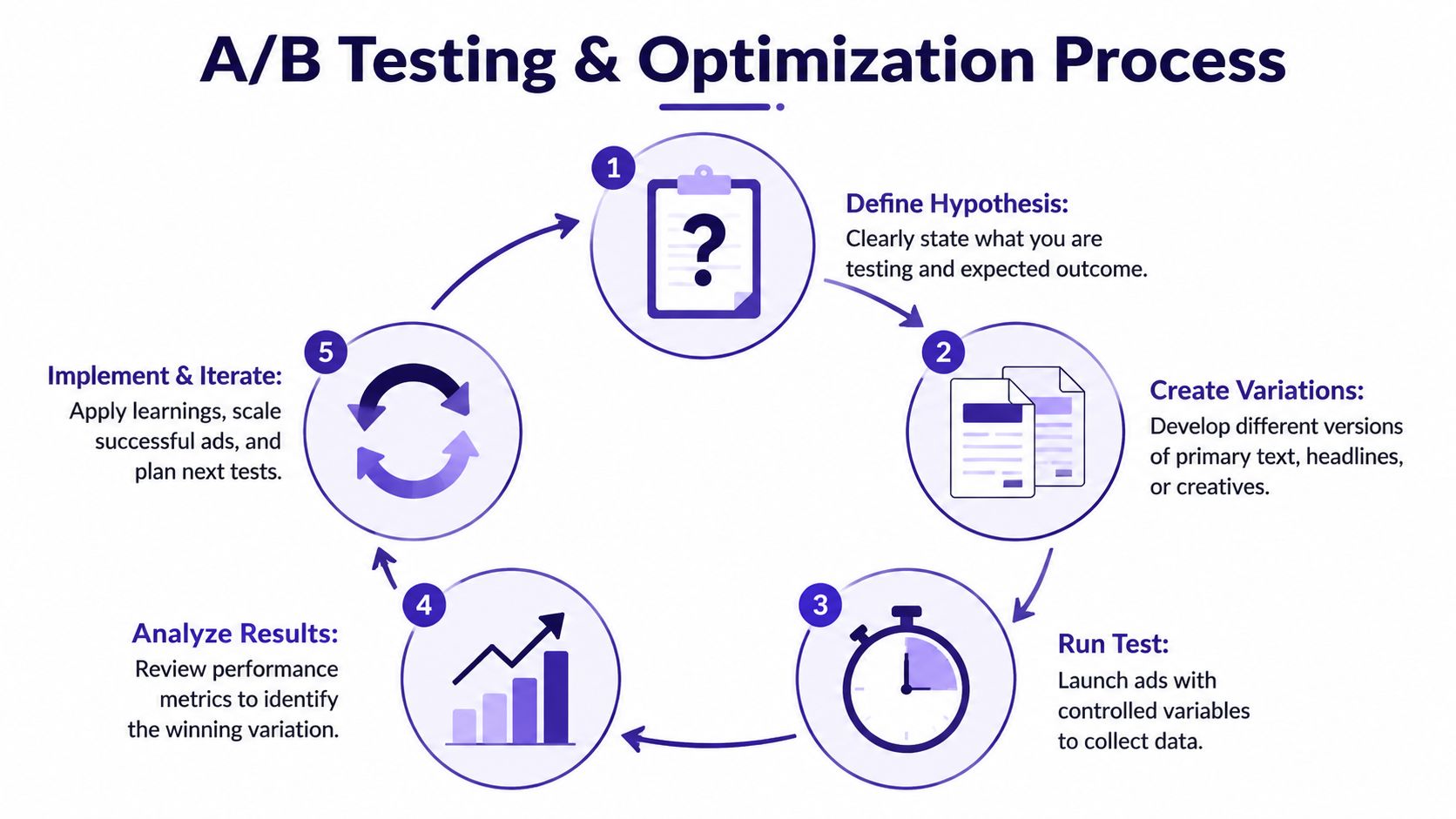
Testing copy well means reducing chaos. One variable at a time. One hypothesis at a time. One lesson per round.
Start with a single copy hypothesis
Don't launch three headlines, two offers, a different image, and a new CTA, then pretend the result means something.
Write hypotheses like these:
- Hook hypothesis: A direct audience callout will beat a broader benefit statement.
- Angle hypothesis: Simplicity language will outperform pain-focused language for cold traffic.
- Offer hypothesis: A workshop invitation will beat a generic learn-more CTA.
That gives you a real basis for interpreting the result.
Track the metrics that map to the job
Across industries, one widely cited benchmark reports an average Facebook ad CTR of 0.90% and an average conversion rate of 9.21%, while 26.94% of Facebook ads are conversion-focused, according to these Facebook ad benchmarks. Those numbers are useful because they give you a baseline for judging whether your copy is merely acceptable or competitive.
Use this simple diagnostic view:
| Metric | What it tells you | Common copy read |
|---|---|---|
| CTR | Whether people want to click | Hook, angle, and message-market fit |
| Conversion rate | Whether the click was qualified | Promise quality and landing page alignment |
| Outbound CTR | Whether the ad moves traffic off-platform | Clarity and offer pull |
If CTR is weak, the problem usually sits near the top of the ad. If CTR is healthy but conversion rate is weak, your copy may be attracting curiosity without enough purchase or signup intent.
Run cleaner tests
A practical testing cycle looks like this:
Pick one variable
Start with the hook, because it's often the biggest lever.Keep the offer constant
If the product, audience, and creative all change, the result gets muddy fast.Write distinct variations
Don't test two hooks that say nearly the same thing.Label what each variation is trying to prove
"Objection angle," "simplicity angle," "identity angle."Record the takeaway in plain English
Not "Ad B won." Write what it means. For example, "Cold creators responded better to clarity than pain."
Better optimization comes from better notes. The ad account forgets fast. Your team shouldn't.
Feed test results back into your angle library
This is the part many teams skip. Once you learn that a certain phrase, objection, or framing wins, add it back into your research system.
Keep a lightweight log with fields like:
- Winning phrase
- Audience segment
- Offer
- Hook type
- Observed lesson
That turns copy optimization into institutional knowledge instead of campaign trivia.
Closing the Loop From Ad Insights to Content Strategy
A Facebook ad is more than a sales message. It's a fast audience research tool.
When one hook beats another, that result tells you something important about how your audience interprets your category, your offer, and their own problem. If "stop rebuilding every campaign manually" gets stronger response than "create more content faster," you've learned that workflow pain matters more than output ambition. That's not just ad insight. That's editorial insight.
Use winning ad language to shape future content across channels:
- Turn a winning hook into a video title: If a hook stops the scroll in paid, it may also earn the click on YouTube or LinkedIn.
- Expand a strong angle into a newsletter issue: Ads identify compressed demand. Newsletters let you unpack it.
- Build series around repeated objections: If the same friction keeps appearing in comments and ad tests, it deserves a dedicated content bucket.
- Refine landing pages and offers: Strong ad response often reveals the exact promise the rest of your funnel should echo.
The teams that improve fastest don't treat paid social and content strategy as separate functions. They let each one train the other. Organic content gives you language, examples, and raw themes. Ads pressure-test those themes in the market. Then the market response sharpens the next round of content.
That's how FB ads copywriting stops being a one-off task and becomes part of a larger growth system. Your archive supplies angles. Your ads reveal what resonates. Your future content gets smarter because you listened.
If you're sitting on a growing library of videos, podcasts, articles, transcripts, or research and want a better way to surface reusable ideas from it, Contesimal is built for that job. It helps teams organize large content archives, find recurring themes and language patterns, and turn old material into new creative opportunities across channels.