
New YouTubers often start a YouTube channel with a mix of excitement and bad assumptions. They think the hard part is choosing a camera, naming the channel, or getting the first video uploaded. Those things matter, but they aren't what decides whether the channel becomes an asset or another abandoned experiment.
If you want to learn how to start a successful youtube channel, treat it like building a publishing system. That means choosing a niche YouTube can distribute, creating a brand viewers remember, producing videos on a schedule you can sustain, and using your own data to decide what comes next. The creators who last usually aren't the ones chasing a lucky spike. They're the ones who build repeatable momentum.
Find Your Niche and Validate It with Data
“Follow your passion” is incomplete advice. Passion helps you survive the slow part. It does not guarantee that viewers want the content, or that YouTube can match your videos to an audience.
A better approach is to look for the intersection of expertise, audience demand, and algorithmic viability. That last part gets ignored. As noted in this discussion of niche economics and channel strategy, many guides skip the question of whether a niche fits YouTube's recommendation system, even though niche choice can mean “five times more money for the same amount of views” for the right topic and audience fit, and creators need ways to test search demand, saturation, and retention patterns before they commit months of work to one direction (algorithmic niche validation on YouTube).
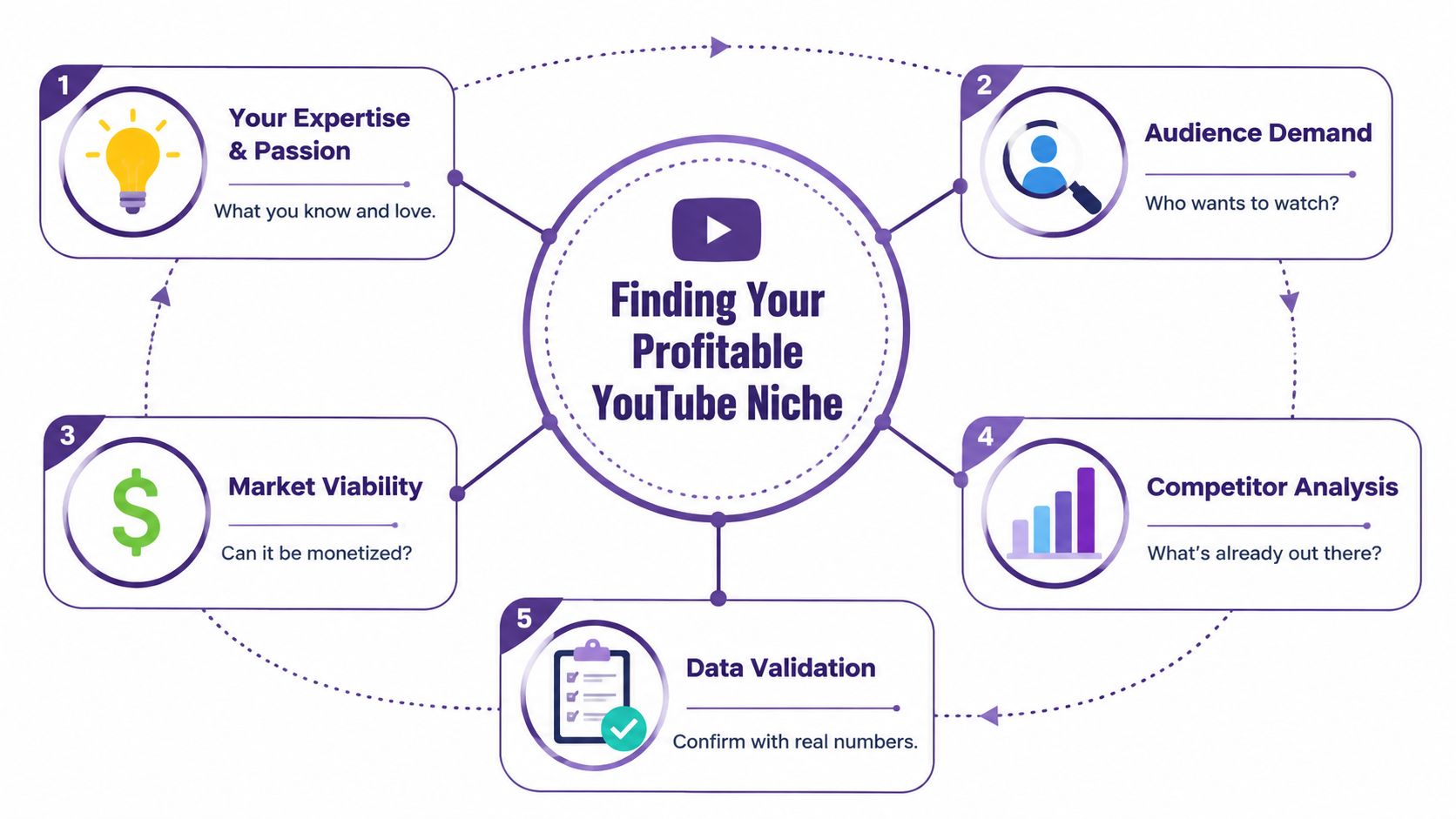
Use a niche filter that goes beyond interest
Start with three questions:
What can you explain clearly?
Not what do you enjoy casually. What can you teach, demonstrate, review, compare, or document with authority?Who has a recurring problem?
Good channels usually solve a repeat problem for a repeat audience. One-off curiosity is weaker than ongoing need.What format fits the platform?
Some topics produce endless searchable tutorials. Others work better as opinion, commentary, breakdowns, or visual demonstrations.
If you already publish elsewhere, mine your existing library. Your old podcast episodes, blog posts, webinars, workshops, and transcripts often reveal stronger niches than brainstorming does. Repeated audience questions matter. Topics you can revisit from multiple angles matter even more.
Practical rule: A niche is stronger when it can support a series, not just a single good video.
Validate before you commit
You don't need perfect certainty, but you do need evidence.
Use this quick validation pass:
- Search demand check: Type topic phrases into YouTube search and study autocomplete. The platform is telling you how people phrase demand.
- Saturation check: Look at the first page. If every result is from giant channels and all videos cover the exact same angle, entry will be tougher.
- Gap check: Find what competitors skip. Weak explanations, outdated workflows, bad visuals, vague titles, and long rambling intros are all opportunities.
- Retention logic: Ask whether the topic naturally keeps people watching. Transformation, comparison, troubleshooting, storytelling, and step-by-step problem solving usually hold attention better than abstract theory.
A niche can be personally exciting and still be a poor match for YouTube. On the other hand, a slightly narrower niche can become very profitable because viewers know exactly why they should subscribe. If you want examples of audience-first business thinking, this roundup of profitable niches for modern creators is a useful reference point.
Define one viewer, not everyone
Don't aim at “people interested in marketing” or “anyone who wants to grow online.” That's too broad to guide real decisions.
Build for a specific person:
- their current level
- the problem that frustrates them
- the result they want
- the format they prefer
- the language they use
That profile should shape your hooks, examples, titles, thumbnails, and upload plan. Broad channels often feel safer. In practice, they're harder to grow because nobody feels directly addressed.
Establish Your Channel's Brand and Identity
A strong YouTube brand isn't fancy design. It's a promise. Viewers should understand what kind of content you make, who it's for, and what tone to expect within a few seconds of landing on your channel.
Generic channels blur together fast. Cohesive channels feel intentional, even when the production is simple.

Build the core identity first
Your channel needs five basics working together:
- Channel name: Make it memorable, easy to spell, and relevant to your topic or point of view.
- Profile image: Use a clear face, logo, or mark that still reads at a small size.
- Banner: State the topic and value clearly. Don't waste that space on decoration only.
- Thumbnail system: Choose a repeatable visual style, not a random design every week.
- Voice: Decide whether you sound analytical, conversational, high-energy, minimal, cinematic, instructional, or something else.
A weak brand says, “I upload videos.” A clear brand says, “I help this kind of viewer get this result in this style.”
Think recognizable, not complicated
You do not need a full agency-style brand package. You do need consistency. That usually means:
- one or two main colors
- one display font and one simple body font
- a thumbnail layout pattern
- a repeatable title style
- a short channel description that makes a clear promise
Here's the contrast that matters:
| Channel presentation | What viewers feel |
|---|---|
| Random thumbnails, vague banner, mixed tone | “I'm not sure what this channel does.” |
| Consistent visuals, clear promise, familiar structure | “I know what I'll get if I subscribe.” |
A useful test is this. Hide the channel name and ask whether your last six thumbnails still look like they came from the same creator.
Keep your branding tied to the content
Creators often over-design the wrapper and under-design the experience. Your brand lives in repeatable choices: how you open videos, how you explain things, what you prioritize, what you cut, and how reliably you deliver on the title.
If you teach practical workflows, your branding should feel precise and clean. If you make personality-led commentary, your branding can be more expressive. The visual identity should support the content, not fight it.
Your first version doesn't need to be permanent. It does need to be coherent enough that a stranger can understand your channel in one visit.
Develop a Sustainable Content and Repurposing Strategy
Most channels don't fail because the creator ran out of ideas. They fail because the creator built a system that was too heavy to maintain.
That matters because channel growth is usually slower than beginners expect. Industry data shows the average YouTube channel reaches about 1,000 subscribers in roughly 22 months, which implies many channels add fewer than 50 subscribers per month on average. The same benchmark matters for monetization because the YouTube Partner Program generally requires 1,000 subscribers and 4,000 valid public watch hours, so your plan has to survive a long runway, not just an enthusiastic first month (YouTube growth and monetization benchmarks).
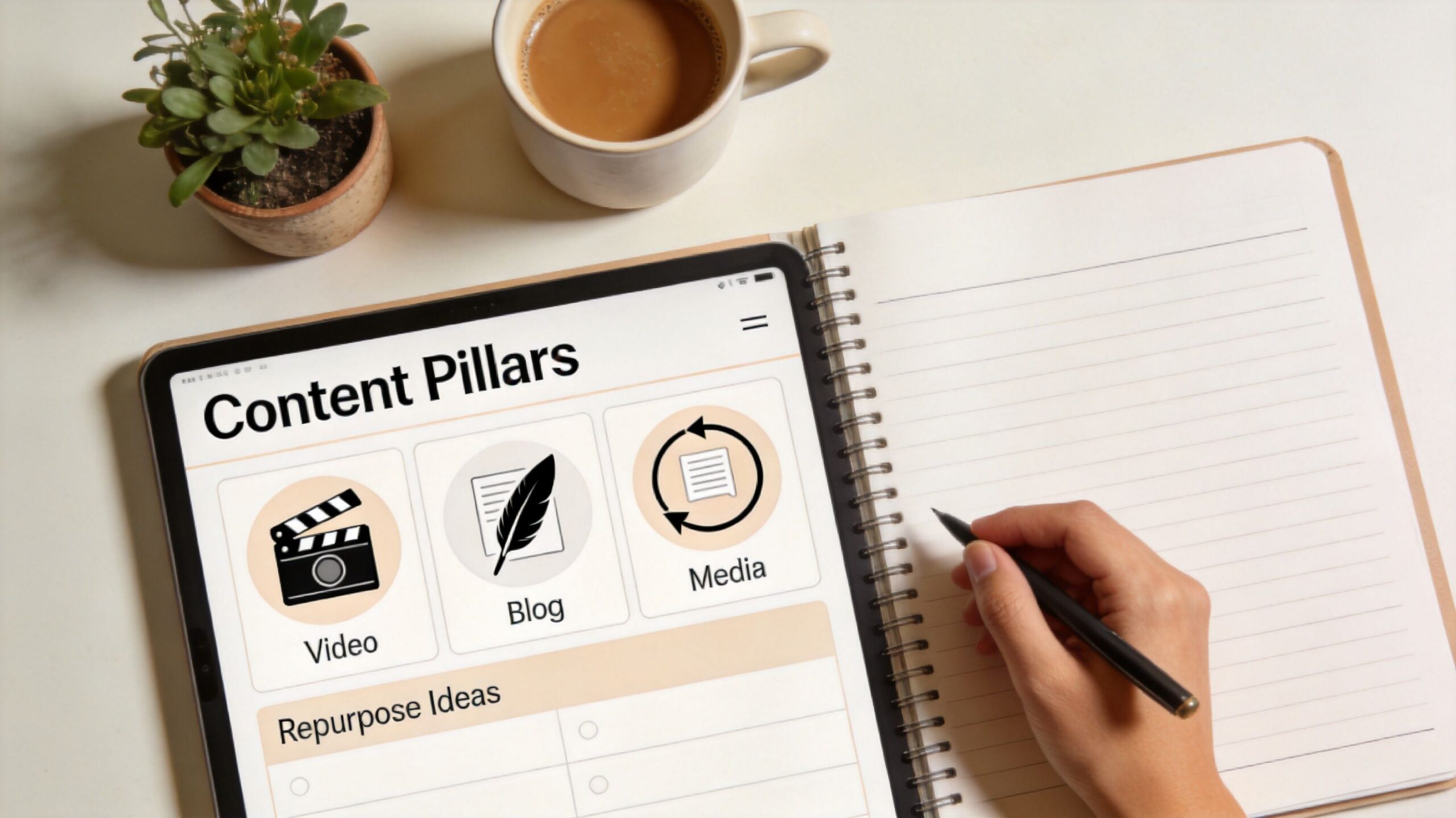
Build around pillars and series
Think like a publisher. Choose a small set of content pillars that your audience cares about and that you can sustain. For most channels, that means three to five durable topic buckets.
A good pillar is broad enough to produce many videos, but specific enough that the same viewer wants all of them.
For example:
- Tutorial pillar: How-to videos that solve immediate problems
- Breakdown pillar: Reviews, critiques, comparisons, or case analyses
- Workflow pillar: Behind-the-scenes process, systems, and tools
- Opinion pillar: Reactions, takes, trend interpretation, or lessons learned
Then turn each pillar into a series. Series reduce friction because you aren't inventing a new show every week. You're producing another episode inside a proven format.
Repurpose from your existing library
A common pitfall is that many creators leave money and momentum on the table. If you already have articles, podcast transcripts, recorded talks, interviews, customer calls, course material, or research notes, you already have raw material for YouTube.
Repurposing works best when you stop thinking in one-to-one conversions. A blog post doesn't have to become a narrated article. It can become:
- a tutorial
- a myth-busting video
- a case breakdown
- a checklist episode
- a Q&A
- a short clip series extracted from the core idea
Your past content contains patterns. Repeated questions point to demand. Evergreen posts point to durable topics. Strong audience reactions point to future series. This is the practical side of “create infinite content value.” You aren't squeezing old material. You're reorganizing proven insight into formats the platform can distribute.
If you want a deeper planning model, this guide to a content repurposing strategy is useful for turning one body of work into multiple outputs without making the process chaotic.
Create a schedule you can actually keep
A sustainable strategy is less impressive on paper and more durable in real life. That's the one you want.
Use a simple system:
- Keep a running idea bank by pillar.
- Pick a publishing cadence you can maintain without panic.
- Batch research and scripting.
- Record multiple pieces when you're already set up.
- Review what worked before you plan the next block.
Operating principle: The best content calendar is the one that survives busy weeks, low motivation, and imperfect conditions.
A smaller, repeatable machine beats a huge plan that collapses after six uploads.
Create an Efficient Production and Editing Workflow
Creators waste a lot of energy solving the same production problems over and over. That's why a workflow matters more than expensive gear. A clean system protects consistency, quality, and your time.
Think in three phases: pre-production, production, and post-production. Each phase should remove decisions, not create new ones.
Pre-production that prevents messy shoots
Before you hit record, lock the structure. That doesn't mean scripting every breath. It means knowing the hook, the main beats, the examples, and the ending.
A simple pre-production checklist helps:
- Hook first: Why should someone care in the opening seconds?
- Outline next: Keep the video on rails with clear sections.
- Proof points: Prepare examples, screenshots, props, or references.
- B-roll notes: Decide where visuals will support the explanation.
- Call to action: Know what action you want after the video.
For educational and analysis content, scene planning speeds everything up. A scene map avoids the common mistake of recording too much filler and then trying to rescue the video in editing. This scene breakdown template is a practical reference if you want a tighter production outline before filming.
Production that stays simple
Good lighting and clean audio do more for watchability than a premium camera body. If you're starting on a phone, that's fine. The key is control.
Use the same filming setup whenever possible:
- record in the quietest room available
- face a window or use a simple light source
- keep the camera at eye level
- frame consistently so your shots match from video to video
- monitor audio before recording a full take
When creators change location, framing, sound, and setup every time, they create editing problems they didn't need.
Edit for pace, not decoration
Most beginner edits are too slow, not too simple. Cut pauses, repeated phrasing, and any segment that doesn't move the viewer forward.
A practical edit pass usually looks like this:
- remove dead space
- tighten the intro
- add visual support where attention may dip
- clean up audio
- check whether each section earns its length
The viewer doesn't care how long something took to film. They care whether the next second feels worth watching.
Templates help here too. Save intro cards, lower thirds, text styles, music beds, export settings, and thumbnail specs. The less you rebuild from zero, the easier it is to keep publishing without burning out.
Master YouTube SEO for Maximum Discoverability
You can make strong videos and still get buried. That's normal on a platform where about 2.74 billion people use YouTube monthly and creators upload roughly 500 hours of video every minute (YouTube platform scale and upload volume). Discoverability isn't a bonus. It's part of the job.

Optimize the metadata people actually see
Titles, thumbnails, descriptions, tags, captions, and playlists all work together. The first goal is getting the click. The second goal is helping YouTube understand who should see the video next.
One set of benchmarks is especially useful here. To improve discovery, optimize titles at about 60 characters, make the first 150 characters of the description keyword-rich, and use 15 to 20 tags. The same protocol notes that topic-based playlists can increase session watch time by 30%, and channels following SEO and consistency practices can see a 20% to 50% lift in views, while 90% of channels fail to reach 1,000 subscribers due to inconsistency and poor SEO (YouTube SEO and consistency benchmarks).
That doesn't mean stuffing keywords everywhere. It means aligning the packaging with real viewer intent.
A practical SEO workflow
Use this for every upload:
- Start with search language: Type the topic into YouTube search and collect the phrases autocomplete suggests.
- Write the title for both clarity and curiosity: Clear first. Compelling second.
- Front-load the description: Put the topic and outcome in the opening lines.
- Use tags for context: Include broad and long-tail variations, but keep them relevant.
- Add accurate captions: Better accessibility helps more viewers consume the video.
- Group related videos into playlists: This improves navigation and keeps viewers in your content ecosystem.
If you want a broader content framework for search-driven publishing, this guide on optimizing content for search engines is a useful companion.
Thumbnails are part of SEO too
Many creators treat thumbnails as decoration. They're distribution assets. The thumbnail and title make a promise together. If either one is vague, the click suffers.
Good thumbnails usually do one of a few jobs:
- show a clear before-and-after
- visualize a problem
- create contrast
- highlight an outcome
- focus attention on one idea, not six
Later in the process, this video is worth studying for the packaging side of discoverability:
Play for both search and recommendations
Search helps new channels get found. Recommendations help them compound. The bridge between the two is viewer satisfaction. If the title gets the right click, the intro delivers, and the structure keeps people watching, YouTube gets better evidence about who else may want the video.
That's why SEO isn't separate from content quality. It's the packaging and architecture that give good content a chance to travel.
Implement Your Launch and Growth Flywheel
You publish a strong video on Tuesday. By Wednesday, the result is often already taking shape. Early clicks, comments, and watch behavior give YouTube its first read on who the video is for and whether it should keep testing it with more viewers.
That first push works better when it is planned before publish, not improvised after. If you validated your niche properly earlier, you already know the topic has demand on the platform. Now the job is to give that video enough early momentum and audience feedback to help YouTube place it with the right viewers.
Run a launch sequence, not a random promo burst
The first 24 to 72 hours matter because they create signal density. You want qualified viewers, fast feedback, and enough activity to spot weak points while the video is still fresh.
Use a simple checklist:
Audit the live page
Check the thumbnail, title, description links, chapters, pinned comment, and captions. A broken link or missing chapter looks small, but it lowers trust and wastes early traffic.Stay close to the comments
Early comments often reveal whether viewers understood the promise of the video. Reply quickly, ask follow-up questions, and pin a comment that pushes discussion in a useful direction.Distribute by audience context
Share differently on each platform. Your email list may respond to the result. LinkedIn may respond to the business angle. A niche Discord or subreddit may care about the specific problem solved.Promote the insight
Lead with the takeaway, tension, or result. A raw YouTube link gives people no reason to care.Create support assets from the same video
Cut one or two Shorts, a text post, a thread, or a carousel from the strongest moments. That extends the life of the upload and gives you more entry points into the same topic.
Turn one upload into a feedback loop
A channel grows faster when each video helps the next one perform.
The pattern is straightforward:
- publish the long-form video
- watch the first wave of comments and traffic sources
- note the questions, objections, and phrases viewers use
- turn those into Shorts, community posts, email content, and follow-up videos
- send viewers to the next relevant video or playlist
- strengthen the topic cluster over time
This is the flywheel. One video creates audience language, proof of interest, and ideas for the next three pieces of content.
Creators with an existing library have an advantage here. Your own catalog already shows which topics earn comments, which videos pull viewers into a second watch, and which formats attract the right audience but need better packaging. Mine that first. It is one of the fastest ways to grow with evidence instead of guesswork.
Use launches to start conversations that lead to revenue
Growth and monetization often start in the same place. A well-performing video attracts the right viewers. The right viewers attract the right business opportunities.
If your niche is sponsor-friendly, keep a short list of brands that fit your audience and content style. Once your channel shows consistent topic alignment and audience trust, brand deals become much easier to pitch and close. For a practical breakdown of what brands look for, read SponsorRadar's 2026 brand deal guide.
One rule matters here. Do not treat promotion as a one-time blast on publish day. Treat every upload as the center of a small campaign, then use what you learn to improve the next launch. That is how channels compound.
Analyze Performance and Scale Your Monetization
Analytics are not just scoreboards. They're audience behavior reports. If you read them well, they tell you what promise got the click, what section lost attention, and what topic deserves a follow-up.
The most useful starting benchmarks are straightforward. For content iteration, aim to benchmark CTR at 5% to 10% and audience retention at 40% to 50%. A/B testing thumbnails can raise CTR by 20% to 30%, and trimming intros to under 15 seconds can increase watch time by 15% (YouTube analytics benchmarks for iteration).
Read the story behind the numbers
Focus on three questions:
- CTR: Did the packaging make the right promise?
- Audience retention: Did the video deliver on that promise quickly enough?
- Traffic sources: Are viewers finding you through search, recommendations, or your own promotion?
If CTR is weak, fix titles and thumbnails before you reinvent the whole channel. If retention drops early, the issue is often the opening. If one topic attracts stronger traffic from search or recommendations, that topic deserves a series, not a one-off.
Low views don't always mean bad content. Sometimes they mean the idea was packaged poorly, aimed at the wrong viewer, or framed too broadly.
Match monetization to your channel stage
Early on, monetization usually starts with a mix of:
- YouTube Partner Program revenue once eligible
- affiliate links tied to tools or products you use
- consulting, services, or offers connected to your expertise
- digital products, memberships, courses, or workshops
- brand sponsorships when your audience becomes specific and trusted
Brand deals work best when your channel serves a clearly defined audience with a strong match to the sponsor. If you're preparing for that stage, SponsorRadar's 2026 brand deal guide is a practical reference for how creators position themselves for sponsorship conversations.
The most effective scaling move is simple. Double down on videos that attract the right viewers, hold attention, and connect naturally to an offer. Monetization gets easier when the content strategy and business model fit each other.
If you already have a backlog of videos, podcasts, articles, interviews, or research, Contesimal can help you organize that library, surface patterns across past content, and turn existing material into new YouTube ideas, repurposed assets, and more structured production workflows.