
So, you want to learn AI. Where on earth do you even begin? It’s a huge field, and diving in without a map can feel like trying to drink from a firehose. The secret isn't to just start watching random tutorials; it's to build a real, structured plan.
Think of this guide as your personal roadmap. It’s designed for anyone—content creators, podcasters, publishers, and marketers—who wants to actually use AI, not just talk about it. We’re going to turn that intimidating mountain of "learning AI" into a series of manageable steps to help you upcycle your old content, create new value, and even generate more audience across platforms.
Your Starting Point for Mastering AI
The path to understanding AI doesn't start with mind-bending algorithms. It starts with the basics. A solid plan keeps you from getting hopelessly lost in a sea of jargon and half-finished online courses.
Your journey will have a clear, logical progression. First, you'll get comfortable with the language of data—math. Then, you'll learn how to give instructions with code. Only then will you dive into the core AI concepts themselves.
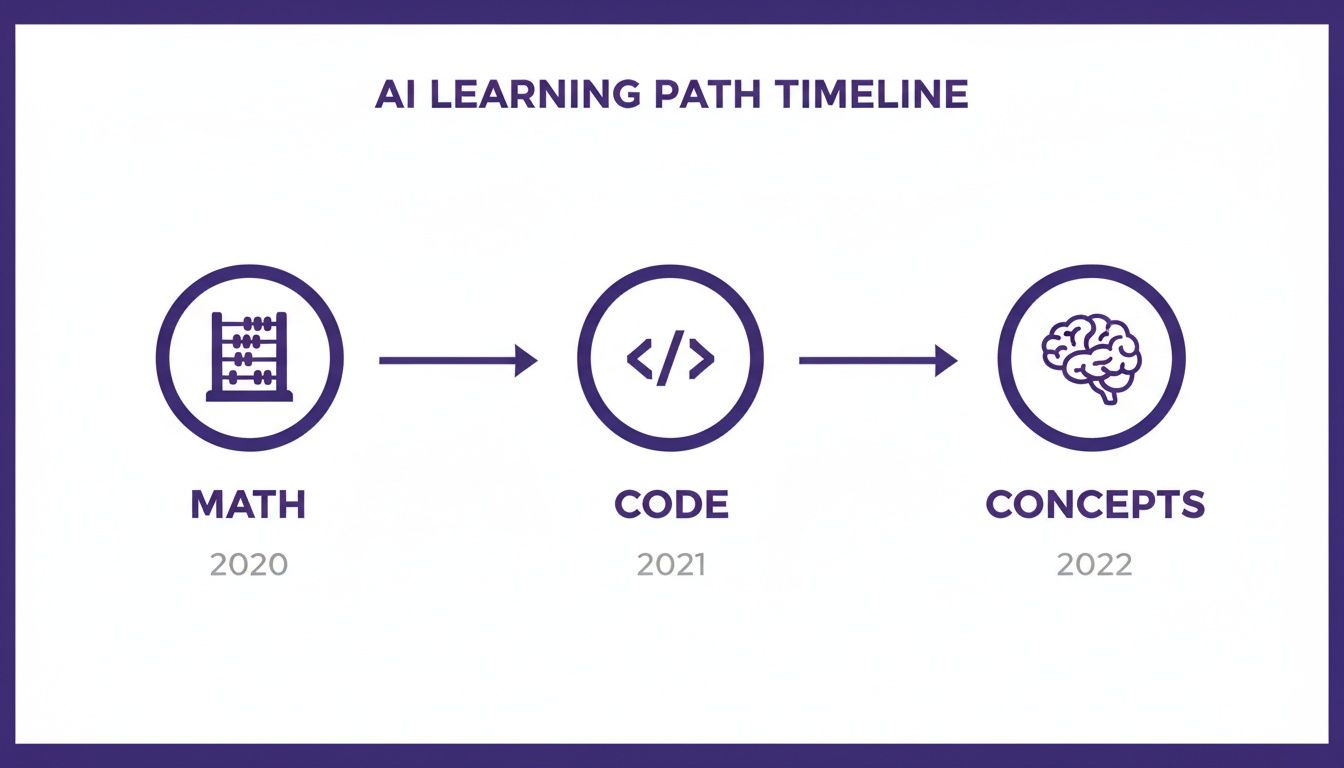
Each stage builds on the one before it. This way, you’re not just memorizing things; you’re genuinely building a foundation, piece by piece.
The Four Pillars of Your AI Learning Journey
To keep things from getting chaotic, we can break down your entire study plan into four essential pillars. Think of them as the legs of a table—if one is wobbly, the whole thing will feel unstable. Focusing on these four areas in order makes the whole process feel much less daunting.
| Pillar | Key Topics | Why It's Critical |
|---|---|---|
| Foundational Math | Linear Algebra, Calculus, Statistics & Probability | This is the language of AI. Math provides the framework for how models learn, optimize, and make predictions. |
| Programming | Python, NumPy, Pandas, Scikit-learn | Code is how you bring AI models to life. Python and its libraries are the essential tools for data manipulation and model building. |
| Core AI Concepts | Supervised, Unsupervised, and Reinforcement Learning | These are the fundamental 'learning styles' of AI. Understanding them helps you choose the right approach for any problem. |
| Practical Application | Capstone Projects, Data Cleaning, Model Evaluation | Applying your knowledge solidifies understanding and builds a portfolio that showcases your skills to collaborators or employers. |
Mastering these pillars isn't just an academic exercise; it's a massive opportunity for creators and publishers. The global AI market was valued at nearly $260 billion in 2025 and is on track to hit over $1,200 billion by 2030. That’s not a typo.
Much of that explosive growth comes from machine learning and natural language processing (NLP), which together account for more than half the market. This is exactly why your study plan needs to be grounded in these core areas.
As you work through tougher subjects, you don’t have to go it alone. Modern tools can help you grasp complex topics much faster. Using a homework helper AI, for instance, can turn passive reading into an active learning session where you can ask questions and get instant feedback.
Building Your Foundational Knowledge Block by Block

Before you can build anything meaningful in AI, you need to lay a proper foundation. Skipping this step is like trying to write a screenplay without understanding story structure—you might end up with words on a page, but it won't hold together.
Your starting point covers two major areas: math and programming. Don't let that scare you off. The goal isn’t to become a pure mathematician or a systems-level coder. It’s about building an intuition for why these tools are the bedrock of any good ai study guide.
The Three Pillars of AI Mathematics
I know, I know. The word “math” can make people’s eyes glaze over. But think of it less like a high school test and more like learning the three dialects that AI uses to understand the world. If you approach them with a practical mindset, they’re far more approachable than they sound.
Linear Algebra: This is the grammar of data. AI doesn’t see a cat picture or your last purchase; it sees a giant grid of numbers. These grids are called matrices and vectors, and linear algebra gives us the rules to work with them efficiently.
Calculus: This is the engine that drives learning. Specifically, derivatives are the secret sauce. They help a model figure out how to get better by measuring how its mistakes change with each attempt. This process of tiny, constant adjustments is what we call optimization.
Statistics & Probability: This is the science of guessing intelligently. The real world is messy, and AI rarely deals in certainties. Statistics helps a model make educated guesses, understand how confident it should be, and pull real meaning from noisy data.
Getting a handle on these mathematical pillars is non-negotiable. It’s the bedrock that all the impressive AI applications are built on. This is exactly why companies are investing so heavily in people who get it, instead of just buying off-the-shelf tools.
In fact, Gartner forecasts that global AI spending will hit $1.5 trillion in 2025 and more than double to $3.3 trillion by 2029. That kind of money isn't just for fancy software; it's for people who have a deep, functional understanding of how this stuff actually works.
Choosing Your Programming Toolkit
Once you start building that mathematical intuition, it's time to pick up your tools. While you can build AI with several languages, one has become the undisputed champion for its simplicity and incredible community support: Python.
Your focus should be on learning Python itself, plus a few core libraries that do all the heavy lifting for you. This lets you stand on the shoulders of giants and apply complex ideas without having to reinvent the wheel every single time.
Essential Python Libraries for AI:
- NumPy: This is the absolute cornerstone for working with numbers in Python. It makes all the matrix and array operations from linear algebra blazing fast and surprisingly simple.
- Pandas: Think of this as your master tool for organizing and cleaning up data. Pandas lets you load messy information into clean, table-like structures called DataFrames, getting it ready for your models.
- Scikit-learn: This is a massive toolbox filled with pre-built machine learning algorithms. From simple regressions to complex clustering models, it's all in there, ready for you to use.
As you start diving in, you’ll be collecting notes, code snippets, and useful articles left and right. Keeping all that organized from day one is a game-changer. Using tools like mind maps can help you visualize how these foundational concepts connect to the more advanced topics down the road.
Building this habit early prevents your personal knowledge base from turning into a digital junk drawer. By mastering these basics, you’re not just memorizing facts; you’re building a mental framework you can rely on for everything that comes next.
Alright, now that you have the essential math and coding down, it's time to get into the real engine room of modern AI: Machine Learning (ML).
Don’t worry, this isn’t about memorizing a bunch of formulas. It's about building an intuition for how AI actually learns. This part of your ai study guide is your backstage tour.
Think of it like this: you're teaching a robot to sort your massive library of video clips. You have three main ways to teach it, and these line up perfectly with the three major types of machine learning.
Supervised Learning: Teaching with an Answer Key
Supervised Learning is the most common approach you'll see. In our robot analogy, this is like handing the robot a stack of videos along with a detailed answer key. You've already labeled each one: "this is a product review," "this is a funny outtake," "this one is a tutorial."
The robot studies these labeled examples, finding the patterns that connect a video's content to the label you gave it. After crunching through thousands of these, it can start sorting new, unlabeled videos all by itself. We call it "supervised" because you gave it the correct answers upfront to learn from.
For a content creator, this is incredibly useful. You could use supervised learning to:
- Predict YouTube Views: Train a model on your past videos—using things like topic, title length, and thumbnail style—to predict how many views a new video idea might get.
- Automate Content Tagging: Teach a model to automatically apply tags like "comedy," "tech review," or "vlog" to your content, saving you hours of manual work.
- Filter Spam Comments: Train a model to spot and hide spam or hateful comments based on examples you’ve already flagged.
The key here is that you need a decent amount of clean, labeled data to get good results. Your own content library is often the perfect place to find it.
Unsupervised Learning: Letting the AI Find the Patterns
So, what happens if you don't have an answer key? That’s where Unsupervised Learning steps in.
Instead of giving the robot pre-labeled clips, you just dump your entire unsorted archive in front of it and say, "Find the interesting groups in here."
The robot starts analyzing everything and clustering clips based on similarities you might not have even noticed. It might group videos by who is speaking, the type of background music, or the core topics being discussed. It finds the hidden structure in your data all on its own.
As a creator or publisher, this method is fantastic for uncovering hidden gems in your own work.
- Segment Your Audience: By analyzing viewer data, an unsupervised model could identify distinct audience clusters, like "binge-watchers who love long-form interviews" and "new viewers who prefer short, punchy clips."
- Discover Content Pillars: The model might find that your most engaging videos consistently revolve around three specific themes, helping you figure out which content "buckets" to double down on.
Unsupervised learning is your secret weapon for understanding your content library on a much deeper level. It helps you move from simply organizing your assets to truly understanding the patterns and value hidden inside them—a core principle of turning a content archive into a money-making asset.
Reinforcement Learning: Learning from Trial and Error
The last teaching method is Reinforcement Learning. This is more like teaching the robot to play a game. You don't give it instructions or an answer key. You just define the rules and a goal, like "get the highest score."
The robot starts by making random moves. When it does something that gets it closer to the goal, you give it a reward (a point). When it makes a bad move, it gets a penalty. After millions of trials, it learns a strategy—a policy—that gets it the most rewards.
This is the exact technique used to train AI to master complex games like Go or to control robotic arms. While it's less common for creators, the applications are exciting. For instance, you could use it to optimize your YouTube channel's homepage layout to maximize subscriber conversions by having it try different video arrangements and learn which ones perform best over time.
Getting a feel for these three learning styles is the first big step. The next is to get familiar with the specific algorithms that power them, like the ones used in natural language processing to understand text. This knowledge is what takes you from just knowing what AI can do to understanding how it actually thinks.
Alright, let's step up our game and move from the fundamentals of machine learning into the really powerful stuff: Deep Learning and Neural Networks.
Advancing to Deep Learning and Neural Networks

If standard machine learning is the workhorse of AI, then Deep Learning is the specialized racehorse. This is where AI starts doing things that feel less like calculation and more like genuine understanding—analyzing images, generating human-like text, and even composing music.
The whole thing is powered by a concept modeled loosely on our own brains: Artificial Neural Networks (ANNs).
Imagine an ANN is like an assembly line of tiny, specialized workers. Each worker, or "neuron," gets a piece of information, makes a tiny judgment call about it, and passes its decision down the line. When you stack thousands or millions of these workers into layers, you get a "deep" network that can learn incredibly subtle patterns.
This layered approach is key. The first layer of a network looking at an image might just spot basic things like edges and colors. The next layer takes that info and learns to identify shapes like eyes and noses. By the time the information gets to the final layer, the network can recognize a complete face. It builds understanding one step at a time.
The Eyes and Ears of AI
Now, while a basic ANN is cool, the real magic for creators comes from specialized networks built for specific jobs. For anyone publishing content, two types are absolutely essential to grasp. You’re probably already using tools built on them without even knowing it.
Convolutional Neural Networks (CNNs): Think of these as the 'eyes' of AI. CNNs are brilliant at processing visual information. They’re designed to understand pixels and how they relate to each other in space, making them the engine behind image recognition, object detection in videos, and those slick social media filters.
Recurrent Neural Networks (RNNs): These are the 'ears' and 'mouth' of AI. RNNs are built to handle sequences where order is everything. This makes them perfect for understanding the flow of words in a sentence, the melody in a song, or the logical progression of topics in a long article.
Getting a feel for these two network types gives you a massive advantage. It’s the difference between just using an AI tool and actually understanding how it works, which lets you push it to get far better results.
Practical Applications for Content Creators
So what does all this tech jargon mean for someone sitting on a mountain of content? It means you have new, powerful ways to analyze, automate, and create. Once you know how CNNs and RNNs "think," you start seeing opportunities everywhere.
Examples of Deep Learning in Action:
- Automatic Video Tagging: A CNN can rip through your entire video archive and automatically add descriptive tags like "outdoor shot," "product close-up," or "interview setting." Suddenly, your entire library is searchable, and finding the perfect B-roll clip takes seconds, not hours.
- Script and Transcript Analysis: An RNN can scan your podcast transcripts or video scripts to pull out recurring themes, track the sentiment of a conversation, or even generate a summary of the key points. This is gold for figuring out what your audience loves and finding your next big content idea.
- Content Generation: More advanced models, like Generative Adversarial Networks (GANs) and Transformers, are built on these core ideas. They can help you generate alternate headlines, compose background music, or even write a first draft of a blog post from a simple prompt.
By learning the basics of deep learning, you’re not just moving to the next chapter of an ai study guide. You're learning the language needed to collaborate with some of the most powerful creative partners ever developed. This knowledge turns you from a passive user into an active director of the technology.
This is exactly how creators and publishers can breathe new life into their existing content. It’s all about getting your library organized, understanding the deep patterns hidden inside it, and using those insights to create fresh value—whether that’s finding the perfect clip for a social post or discovering your next hit series buried in your own archives.
Putting Theory Into Practice With Your First AI Projects

Alright, you’ve waded through the core concepts of machine learning. Now what? All that theory is just abstract information until you actually use it to build something. This is the part of your ai study guide where you get your hands dirty and the real learning begins.
This is where passive knowledge becomes an active, problem-solving skill. It’s also how you start building a portfolio that proves to anyone—from potential collaborators to future employers—that you can do more than just talk the talk.
Your First Project Roadmap
Don't try to build the next Skynet on your first attempt. The real goal here is to simply get through the entire machine learning workflow from start to finish. Trust me, completing one project end-to-end will teach you more than a dozen online tutorials ever could.
A great place to start is by picking one project for each of the learning types we’ve covered: supervised and unsupervised.
Project Idea 1: Movie Revenue Predictor (Supervised Learning)
- The Goal: Build a model that can predict a movie's box office revenue using data like its budget, cast, and genre.
- Why It's a Great Start: This is a classic regression problem. It forces you to handle different data types (both numbers and categories) and gives you a feel for how AI is used in real-world business decisions.
Project Idea 2: Blog Post Topic Modeler (Unsupervised Learning)
- The Goal: Point an algorithm at your own blog posts or a collection of articles and have it discover the hidden themes.
- Why It's a Great Start: This project is a perfect entry point into clustering and natural language processing. Plus, it gives you immediate, practical value by helping you understand your own content library. If you want to go deeper, you could check out our guide on the best LLM models available to see how different architectures tackle text.
The Essential Project Workflow
No matter which project you pick, the fundamental steps are pretty much the same. Sticking to this structure will keep you on track and help you build solid habits from day one.
Define Your Objective: Get crystal clear on what you're trying to predict or find. If your goal is fuzzy, your project will be a mess.
Gather and Clean Your Data: This is the unglamorous part, but it's where most projects are won or lost. You’ll need to hunt down a good dataset (sites like Kaggle are fantastic for this), then wrestle with it—handling missing values, fixing errors, and getting it into shape for your model.
Train the Model: Now for the fun part. You feed your clean data to an algorithm—like Linear Regression for the movie predictor or K-Means for the topic modeler—and let it chew on the patterns.
Evaluate Performance: How did it do? You need to use specific metrics to see if your model is actually intelligent or just making lucky guesses.
Document everything. Your project isn't just the code. It's the story of how you built it. Your notes on why you cleaned the data a certain way, which models you experimented with, and your final results are what transform a simple exercise into a portfolio piece that tells a story. That documentation is the real proof of what you learned from your AI study guide.
By tackling these hands-on projects, you’re not just studying AI—you’re learning how to apply it. You’re turning abstract ideas into a skill set you can actually use.
Organizing Your AI Knowledge for Long-Term Growth
As you dive into your ai study guide, you're going to find yourself buried in a mountain of stuff. It happens to everyone. Suddenly, you've got bookmarks, code snippets, research papers, and notes scattered across a dozen different apps and folders.
Without a system, that goldmine of information turns into a digital junk drawer. You know what's in there is valuable, but you can’t find anything when you need it. The real test isn't just learning AI; it’s organizing what you learn so you can actually use it later. This is what separates the pros from the hobbyists.
From Static Notes to a Dynamic Knowledge Base
Start thinking of your notes as raw material, not a final destination. Your goal should be to build a personal library you can search, question, and pull ideas from on demand. A great way to do this is to create a knowledgebase that turns your study materials into a powerful, searchable asset.
This approach transforms you from a passive reader into an active learner. Imagine being able to ask your own notes, "What was the difference between CNNs and RNNs from that article I read three months ago?" and getting a clear, synthesized answer instantly. This is where AI-powered platforms are a total game-changer for your learning journey.
The Power of AI-Assisted Organization
If you're a content creator, marketer, or storyteller, all that AI knowledge you're gathering is a content library in itself. When you organize it properly, you can upcycle old ideas and find new angles you never saw before.
This is exactly what tools like Contesimal were built for. They help you make sense of all your content, whether it's your own research notes or a decade’s worth of blog posts.
- Curate Knowledge: Pull articles, transcripts, and notes into one clean, organized space.
- Collaborate Seamlessly: Work alongside human teammates and AI assistants to dig for insights hidden in your materials.
- Generate New Value: Uncover connections between concepts that spark fresh ideas for videos, blog posts, or marketing campaigns.
By turning your study materials into a dynamic knowledge base, you’re not just learning about AI—you're building a system that helps you think better. It allows you to find patterns, collaborate on ideas, and ultimately turn your expertise into a tangible, money-making asset.
This is the kind of structure that lets you move beyond just researching your next piece of content. It’s the infrastructure that supports your growth from someone who makes content to a true content entrepreneur, building on what works and driving more engagement across the board.
Your AI Learning Questions Answered
Jumping into AI is exciting, but it almost always brings up a few big questions. If you're feeling a little stuck or unsure about the path ahead, you're not alone. Let's tackle some of the most common hurdles people face so you can keep your momentum going.
How Much Math Do I Really Need for AI?
This is probably the biggest question on everyone's mind. The short answer: you don't need a Ph.D., but you do need to get comfortable with a few core ideas. The goal isn’t to scribble complex proofs on a whiteboard; it's to build an intuition for why the tools work the way they do.
Think of it like this:
- Linear Algebra is how you'll understand data itself. It’s the language for how information is arranged and transformed in a model.
- Calculus is the engine that makes models learn. It’s all about tiny, continuous improvements, which is the heart of training an AI.
- Statistics & Probability give models the ability to make smart guesses and deal with the messy, uncertain nature of the real world.
Don't start with a pure theory textbook. Find an applied course that shows you exactly how the math connects to building an actual AI model. That approach is way more motivating.
Can I Learn AI Without a Computer Science Degree?
Absolutely. A formal degree is just one road to the destination, and it’s definitely not the only one. Some of the sharpest minds in AI today are self-taught or pivoted from completely different fields.
If you’re going the self-taught route, the two things that matter most are discipline and proof. A solid study plan and a steady stream of projects are your curriculum. Your portfolio of what you’ve built will always speak louder than a diploma—it's tangible proof you have the skills to get the job done.
What Is the Best First Project for a Beginner?
Keep it simple. Your first project should be a classic supervised learning problem using a clean, famous dataset. This lets you focus on learning the entire workflow—from wrangling data to training and testing your model—without getting tripped up by messy, complicated data.
A perfect first project is something like predicting house prices or classifying survivors on the Titanic dataset. These are small enough to be manageable but big enough to teach you the fundamental process you'll use on every project that follows.
How Do I Stay Motivated When It Gets Tough?
Focus on small, consistent wins. You’re not trying to master "AI" in a weekend. The real goal is to understand one new concept this week, or finish one small part of a project this month. Breaking this massive field into tiny, achievable pieces makes it feel a lot less overwhelming.
Find a community of other learners you can talk to. Share your wins, ask for help, and remember that every single expert out there was once a beginner who felt just as lost as you might right now. Your growing collection of small projects will become its own source of motivation as you look back and see how far you've come.
Ready to organize all your AI research and learning materials into a powerful, searchable library? Contesimal helps creators, researchers, and publishers turn scattered notes and content into a dynamic knowledge base, making it easier to connect ideas and create new value. Learn more and start building your AI-powered library today at https://contesimal.ai.