
You've got a library problem, not an idea problem. Your podcast archive is full of episodes, your blog has years of posts, or your video channel contains a long trail of experiments, but the next move still feels like a guess. The useful question isn't what performed well. It's which repeatable choices kept appearing when the work connected with people, and which apparent wins were just noise.
Learning how to find patterns in content turns an archive into working intelligence. The process combines editorial judgment, careful tagging, lightweight analysis, and validation. Done properly, it helps you organize old work, create new value from it, and build a clearer path from one longform asset to videos, newsletters, social posts, podcasts, or other revenue-producing formats.
The Library Problem Every Creator Eventually Hits
A podcaster opens a spreadsheet and sees 312 archived episodes. A blogger has six years of posts bookmarked in a workbook. A YouTuber waits for an analytics dashboard to finish loading, already suspecting that the answer will be a collection of charts rather than a useful creative decision.
All three creators face the same wall. Their libraries are large enough to contain meaningful repetition, but small enough that every piece still carries personal history. They remember the difficult interview, the unexpectedly popular tutorial, and the video that took days to produce and barely moved. Memory gives them vivid examples, not reliable patterns.
The fear underneath the search is specific: which past moves were skill, and which were luck? A creator with 200 episodes may still be unable to say whether a particular opening format, topic bucket, guest profile, or publishing rhythm consistently influences retention, saves, shares, downloads, or read time. The archive is an asset, but only when its repeated choices can be read.
The practical question: Don't ask which piece won. Ask what the winning pieces have in common that you could deliberately repeat.
Finding patterns has a long history in statistics and computing. Bayes' theorem dates to the 1700s, regression analysis emerged in the 1800s, and discriminant analysis appeared in 1936 as an early formal method for separating patterns into categories. The field became a distinct international discipline in the 1970s, with the first international pattern-recognition conference held in 1974 and the International Association for Pattern Recognition created in 1978. The history of pattern recognition explains why today's approach blends statistics, computing, classification, clustering, and human interpretation.
For creators, the useful version is less intimidating. You need four deliberate moves:
- Frame a question that can be answered.
- Prepare the library so pieces can be compared fairly.
- Analyze it with a method suited to the question.
- Validate the result before turning it into a rule.
That sequence changes the archive from a scrapbook into a testing ground. You're not trying to squeeze certainty from every old post. You're looking for a defensible pattern that improves what you make next.
Framing a Pattern Question Worth Answering
“Which topics perform best?” sounds strategic, but it's too broad to guide analysis. It mixes topic, format, audience, distribution, timing, and measurement into one foggy prompt. A useful question names the variable, the unit of comparison, the metric, and the condition that should remain stable.
Consider a sharper hypothesis: Do interviews where the host challenges the guest in minute two produce more saves than interviews that open with a five-minute biography? The unit is the interview, the variable is the opening structure, the metric is saves, and the comparison holds the general interview format constant.
Start with the decision
Begin with the action you might take if the pattern is real. If the answer wouldn't change your brief, publishing schedule, thumbnail process, or repurposing plan, the question probably isn't ready.
Use this sequence:
- Choose one creative variable. Examples include headline structure, opening type, guest role, episode format, thumbnail treatment, or publishing day.
- Choose one primary outcome. Pick the metric closest to the decision, such as completion, read time, saves, shares, downloads, or click-through.
- Define the comparison. Separate list headlines from how-to headlines, Tuesday releases from Friday releases, or anecdotal openings from direct explanations.
- Name the holding condition. Keep the channel, content type, audience context, or measurement window as consistent as the library allows.
- Write the expected result before looking. This prevents the archive from persuading you after the fact.
A newsletter writer might ask whether list-format headlines outperform how-to headlines for a chosen engagement metric. A podcaster could test whether Tuesday episodes drive more first-week downloads than Friday episodes. A blogger might examine whether posts with a personal anecdote in paragraph two correlate with longer average read time.
| Weak Question | Why It Fails | Sharp Rewrite |
|---|---|---|
| What topics perform best? | It combines too many variables and has no defined outcome. | Do troubleshooting posts generate more saves than opinion posts within the same newsletter format? |
| What makes a good episode? | “Good” has no operational meaning. | Do episodes with a listener question in the opening retain more listeners through the first segment than episodes without one? |
| Which headlines work? | It ignores headline type, channel, and metric. | Do list-format headlines produce more clicks than how-to headlines in the same email series? |
| When should I publish? | Timing may be confounded by topic or format. | Do Tuesday episodes produce stronger first-week downloads than Friday episodes when format is comparable? |
The pattern-finding workflow described in statistical practice starts with defining the problem, then collecting and inspecting data before testing a discovered structure on an independent holdout set. That order matters. If you browse the archive first and invent the question afterward, you'll notice the most memorable coincidence.
If you can answer the question with a clear comparison and a number attached, it's probably specific enough to run.
Preparing Your Content Library for Real Analysis
Analysis becomes unreliable when the library uses inconsistent labels. One episode is tagged “interview,” another “guest show,” and a third “conversation,” even though all three describe the same format. A spreadsheet can hold the material, but it won't repair ambiguous definitions.
Create one row per content piece. Start with fields that connect directly to the question you framed:
- Publish date: Use one date format throughout.
- Format: Separate solo, interview, tutorial, case discussion, review, or other meaningful types.
- Length: Record minutes for audio and video, or word count for written work.
- Headline pattern: Label structures such as list, how-to, question, opinion, or direct promise.
- Topic bucket: Use broad subjects that survive a hand count.
- Primary metric: Choose the outcome being tested.
- Secondary metric: Add one supporting signal, not every available dashboard field.
- Context notes: Capture unusual guests, collaborations, seasonal events, paid promotion, redesigns, or technical problems.
The free-text notes field protects the analysis from false precision. A post might underperform because its distribution failed, not because its topic was weak. A video might have an unusual thumbnail experiment. Record those conditions rather than forcing every explanation into a category.
Clean before you categorize
Over-tagging is one of the fastest ways to make a library look advanced while making it useless. 47 categories with two posts each won't reveal a dependable pattern. Collapse the archive into 8 to 12 topic buckets and 4 to 6 format buckets, then check every label manually.
Normalize dates, use identical units for length, and define an exclusion rule for one-off pieces. Anniversary posts, experimental series, sponsored exceptions, and unusual platform launches may belong in a separate “context” group rather than the main comparison.
A 200-row blog library might become a clean table with one consistent date field, four format buckets, ten topic buckets, headline labels, a primary metric, and notes for anomalies. That table is sufficient for qualitative coding, clustering, topic modeling, or sequence analysis. For teams managing more complex repositories, guidance on improving support with AI agents can help clarify how human judgment and AI assistance should work together. You can also use this content inventory template to establish a repeatable starting structure.
Four Analytical Techniques That Actually Surface Patterns
The best method depends on the shape of your library and the question you're asking. Start with the least complicated technique that can answer the question. Analysis won't rescue vague tags or mismatched metrics.
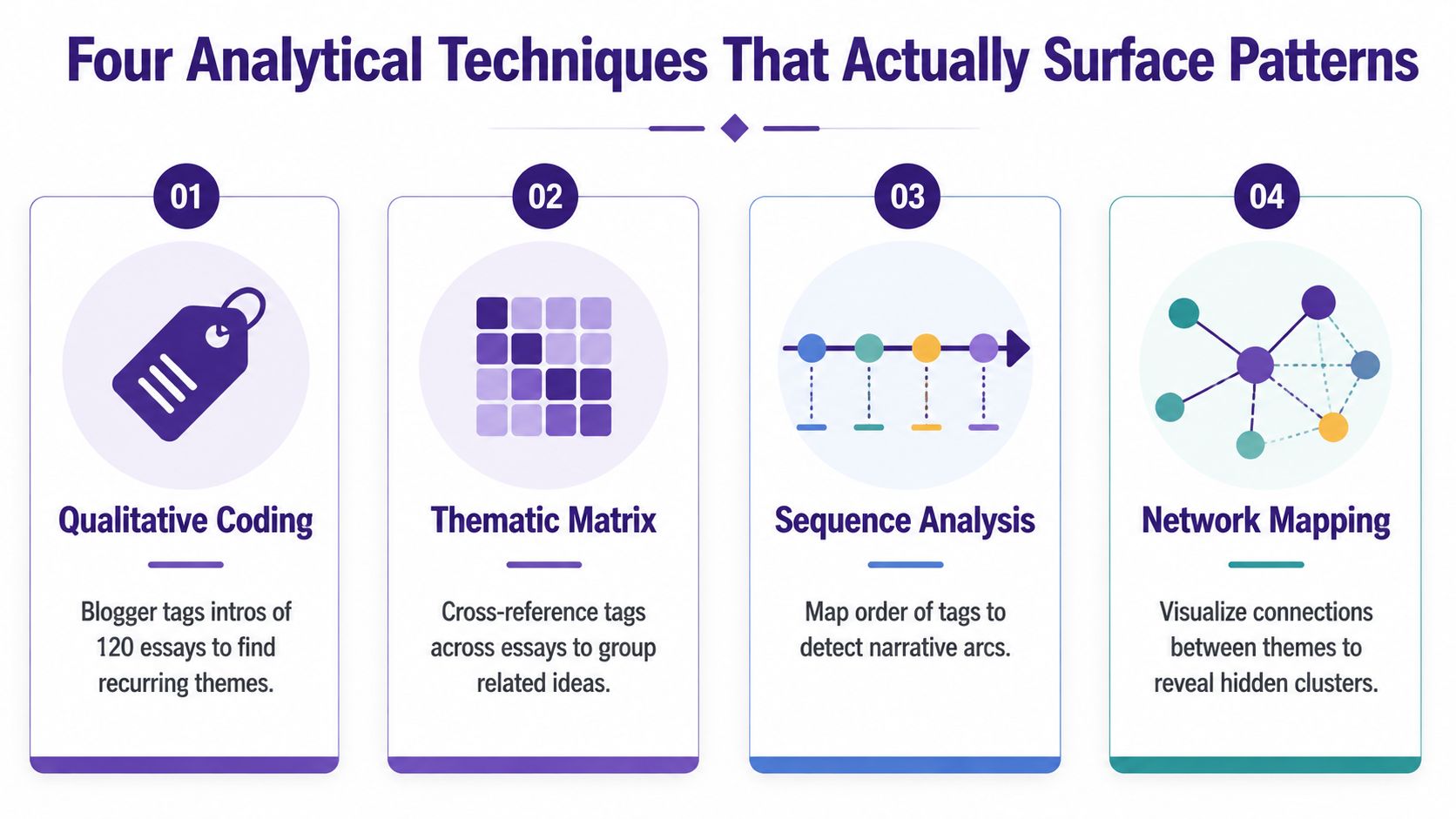
Qualitative coding
A blogger with 120 essays can read the first paragraphs and assign labels such as contradiction hook, confession hook, or stat hook. She then compares those labels with read-through, rather than relying on a general sense of which introductions “feel strong.”
Coding works because it preserves editorial meaning. It's especially useful when the pattern lives in language, narrative structure, emotional framing, or the order of ideas. The weakness is subjectivity, so write the coding rules before tagging and apply them consistently.
Overkill threshold: Skip elaborate coding when you have under 30 pieces or when every piece uses a single, nearly identical format. A simple hand count may be enough.
Clustering
A podcaster can group 80 episodes by transcript similarity and discover an unexpected divide. Solo conversations about money may cluster apart from co-hosted episodes about craft, even when the publishing calendar never defined those as separate shows.
Clustering is useful for discovery because you don't need to decide every category in advance. Similarity can expose a format or theme you weren't actively tracking. It can also produce nonsense when transcripts are short, metadata is inconsistent, or the algorithm groups episodes around repeated filler phrases.
Overkill threshold: Don't cluster a small archive just because the tool offers the feature. Under 50 hours of content, manual tagging and a thematic matrix will often produce a more interpretable result.
Topic modeling
A newsletter publisher can run topic modeling across two years of issues and surface a “tactical teardown” theme that gradually became a larger share of the editorial output without anyone naming it. Topic modeling looks across word use and co-occurrence, making it useful for long archives where themes overlap.
Treat the output as a prompt for investigation, not a final taxonomy. Models can split one coherent theme into several technical variations or merge distinct ideas because they share vocabulary.
Overkill threshold: Skip topic modeling when your library contains only one short format or when the content is too brief for recurring language to emerge. Start with coded themes instead.
Sequence analysis
A YouTuber can map title and thumbnail pairings over time, then examine what happened after each format. The useful finding may not be that numbered series outperform standalone videos in general, but that a three-part series works only when a recap episode follows it.
Sequence analysis is valuable when order matters. It can reveal narrative arcs, sequel effects, lead magnets followed by sales content, or the relationship between an opening promise and later audience behavior. It demands clean dates and a clear definition of what counts as a sequence.
Overkill threshold: If you have fewer than 30 pieces, no recurring series, or no meaningful order between assets, don't build a sequence model. Draw the publishing chain and inspect it manually.
Tools can support different layers of this work. For example, LinkedIn analytics tools may help marketers inspect platform-specific performance, while a structured content analysis workflow keeps the editorial variables connected to the metrics.
Validating Patterns Without Fooling Yourself
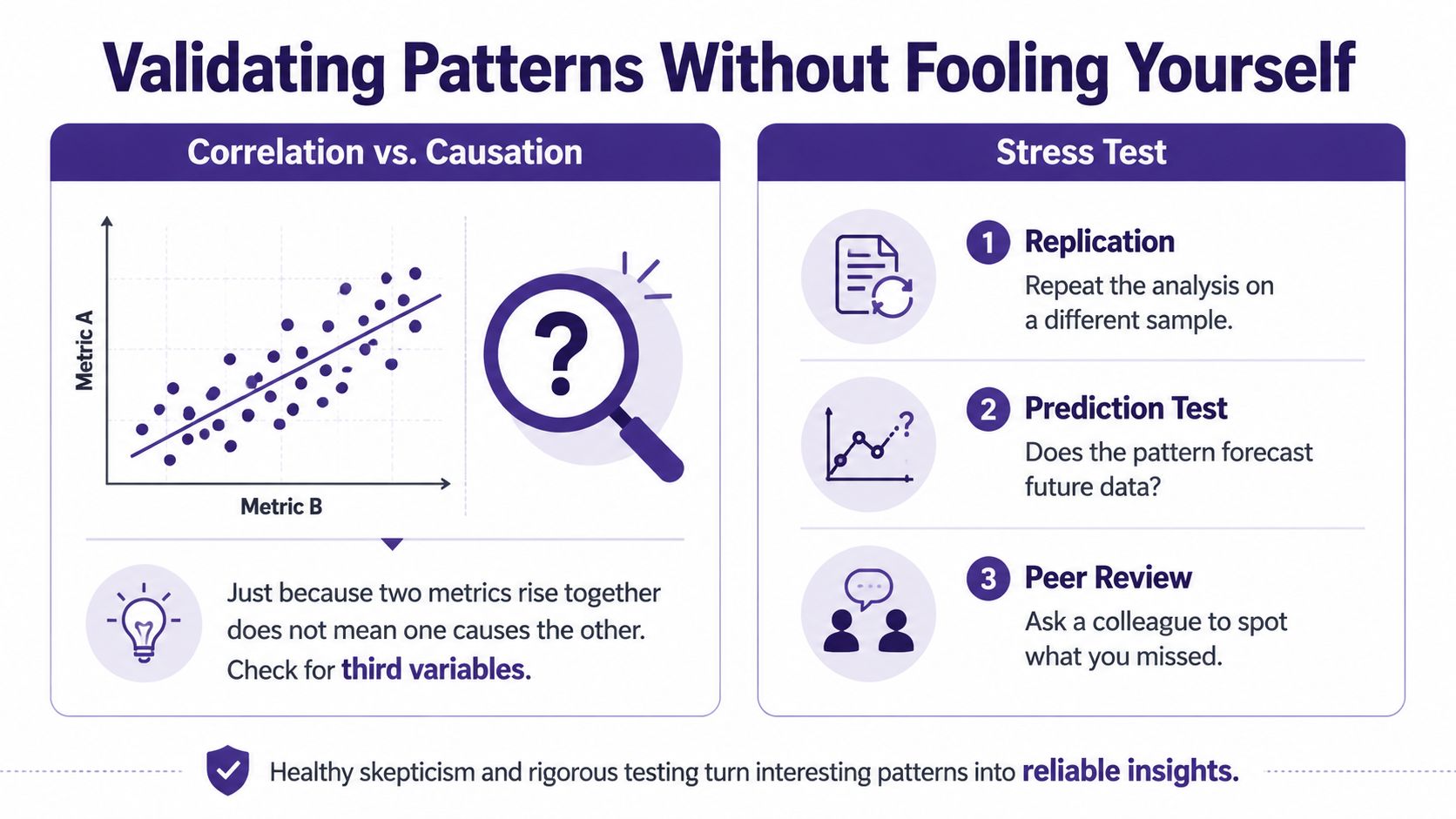
Most exciting findings are coincidences wearing a confident headline. A blogger notices that Tuesday posts outperform Monday posts and prepares to redesign the publishing calendar. Then she checks the archive and sees that Tuesday is also when she publishes longform pieces. The apparent day-of-week effect may be a length or format effect.
That's the difference between correlation and causation. A dataset can show that two variables move together without proving that one creates the other. The basic guidance on finding patterns in data sets emphasizes this distinction, which becomes more important as creators analyze large collections of text, images, audio, and behavioral data.
Give the pattern a fair test
Use an out-of-sample check, the creator's version of a holdout set. Split the archive into a discovery group and a test group. Develop the hypothesis on the first group, then ask whether it appears in unseen work.
A podcaster might notice that a three-bullet recap outro seems connected to higher completion. She shouldn't retroactively declare victory by comparing every episode after changing the definition. She should use the rule on the next five episodes and record the result before deciding whether it belongs in the production workflow.
Apply three skepticism checks
- Minimum sample: Aim for at least 20 pieces per variant before treating a comparison as stable. This is a practical operating rule for this workflow, not a universal statistical threshold.
- Quarterly stability: Check whether the relationship appears across different periods rather than in one concentrated run.
- Plausible mechanism: Explain why the choice might work. If you can't describe a credible audience or editorial mechanism, treat the result as provisional.
Statistical pattern discovery also carries a false-discovery risk, especially when many candidate patterns are examined. Appropriate statistical tests and out-of-sample checks help filter variations that appear in a sample but fail in the broader population, as discussed in this tutorial on statistically sound pattern discovery.
Validation isn't a gate you pass once. It's a habit that keeps interesting observations from becoming brittle rules. Keep a record of the hypothesis, the comparison, the test group, and the decision. That small discipline makes it easier to retire a pattern when the evidence stops supporting it.
Turning a Validated Pattern Into a Repeatable Workflow
A validated pattern has no business value if it remains a note in a dashboard. Suppose a podcaster confirms that episodes opening with a listener question keep completion above 70%. The useful outcome isn't remembering that number. It's making the listener-question format part of the next brief, draft, review, and publishing decision.
Encode the pattern in the brief
First, add the finding to the content taxonomy or brief template. A new episode brief might include a field called “opening device,” with “listener question” as an approved option and a short explanation of the evidence behind it.
Second, add a pre-publish check. An editor or creator should be able to answer a simple question: does the opening use the validated device, and if not, is there a documented reason? This prevents a useful pattern from depending on memory during a busy production week.
Third, create an AI-assisted review prompt. A simple GPT workflow can read a draft and return a verdict against the stored rule:
- Does the opening contain a clear listener question?
- Where does that question appear?
- Does the surrounding copy establish a reason to continue?
- If the rule isn't met, what alternative opening is present?
The assistant should flag and explain. It shouldn't rewrite the creator's voice or turn a probabilistic observation into an absolute command.
Put the rule where work happens
A Notion database can hold a pattern compliance field. An Airtable view can filter high-performing episodes and show the tags, transcripts, and notes behind the pattern. A shared editorial document can store the rule beside the creative brief instead of burying it in a quarterly report.
Creators with large mixed-format archives may also need a system that connects search, classification, thematic discovery, and collaborative review across articles, podcasts, videos, and transcripts. Contesimal provides AI-assisted research, keyword search, topical discovery, and content analysis for connecting ideas across a content library and turning archival findings into new creative work.
The feedback loop matters more than the initial insight. Re-test each operational pattern every quarter against new output. A workflow that hardens into a permanent rule can drift from audience behavior, platform conditions, or the creator's own evolving style. Use a structured approach to generate insights from existing content while keeping the final editorial decision with the people who understand the audience and the work.
Your Pattern-Finding Checklist for This Week
Treat this as a working sheet, not a summary. Print it, keep it beside your notebook, and complete the process on a small slice of your archive before expanding the analysis.
Before analysis
- Choose one question: Write a focused comparison involving one creative variable and one primary metric.
- Define the finding: Describe what evidence would make you change a brief, format, schedule, or distribution plan.
- Freeze the wording: Record the question before opening the performance dashboard.
Prepare the sample
- Select 20 to 30 pieces: Choose work that maps to the question.
- Tag only relevant fields: Capture format, date, length, topic, headline or opening type, primary metric, and context notes.
- Remove misleading exceptions: Separate one-off collaborations, anniversary pieces, and unusual experiments.
Analyze and validate
- Run two techniques: Pair a human method such as qualitative coding with a structural method such as clustering, topic modeling, or sequence analysis.
- Compare the findings: Look for overlap, then investigate disagreements instead of averaging them away.
- Test the strongest pattern: Check it against at least one holdout piece, one contrarian piece, and one weak channel.
Operationalize
- Draft one new asset: Apply the confirmed pattern to a video, episode, post, or newsletter.
- Schedule the test: Put the asset on the calendar and record the result.
- Set a review date: Revisit the rule after new work accumulates.
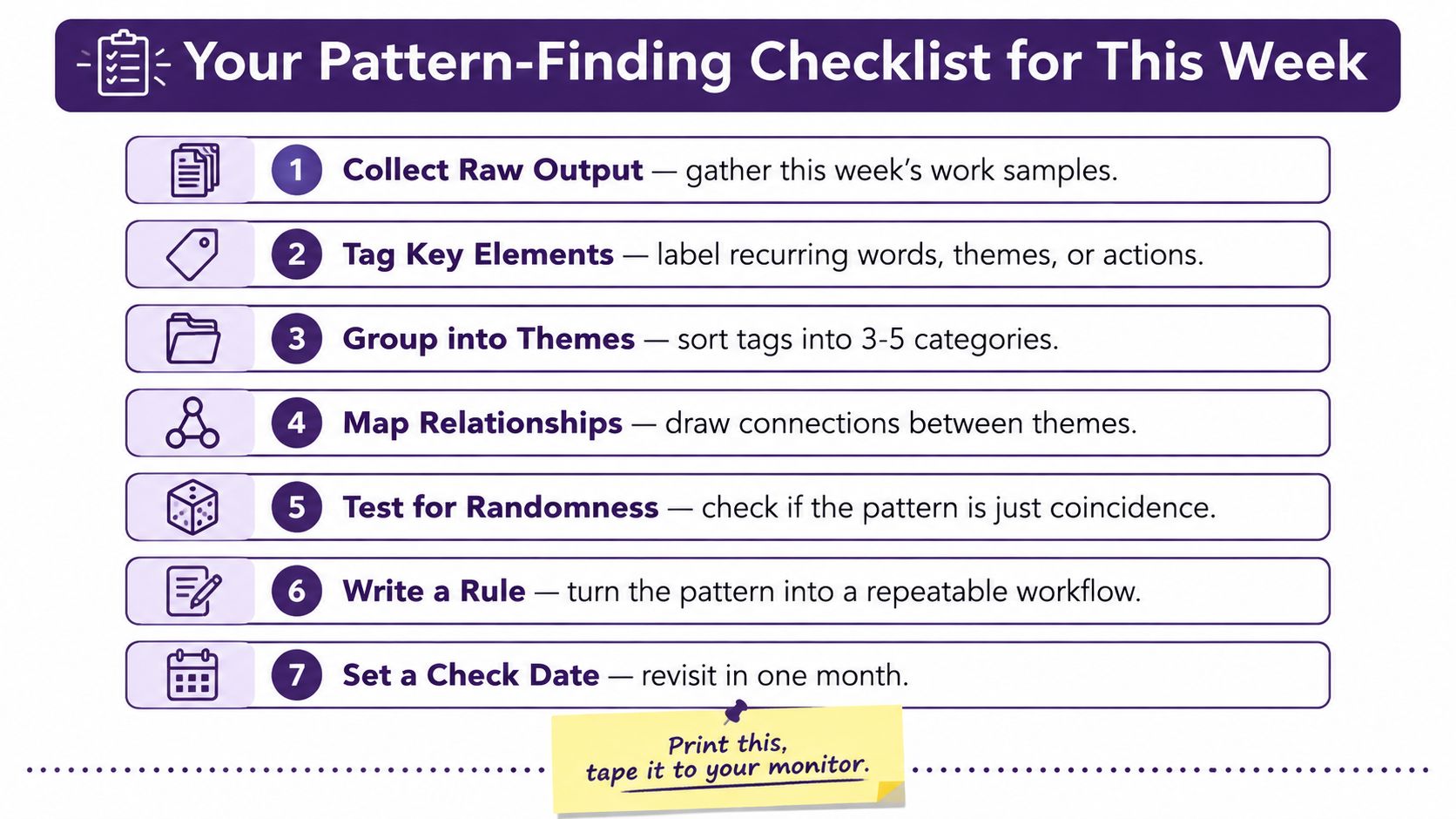
This checklist doesn't replace external benchmarks, audience surveys, or analysis of platform-side algorithm shifts. Those deserve their own workflow before you treat an internal pattern as load-bearing. Your archive can tell you what has repeated in your work, but it can't explain every change in the world around it.
Use Contesimal to organize your content library, search across archived media, and connect recurring themes to new creative opportunities. Start with one focused question, turn the resulting insight into a draft, and give your old longform content a practical route to become fresh, useful, revenue-generating work.