
You're staring at a finished draft, a folder of old clips, and a new question that keeps showing up in different forms. Which parts of your library are pulling attention right now, and which ones are just taking up space?
That question matters because content output doesn't slow down when your archive grows. A podcast episode can become a clip, a post, a newsletter angle, a short video, a quoted graphic, or a research note, but only if you can see what still has life in it. Realtime content insights give you that visibility while the material is still useful, so you stop guessing and start working with evidence.
The Hidden Goldmine in Your Content Library
A podcast episode goes live on Monday. By Friday, the recording, transcript, article, and clips are scattered across folders, while audience questions begin pointing toward a related topic. The work is published, yet its most useful signals may be appearing only now. Without a clear way to connect those signals to the archive, a creator starts another piece from scratch and leaves the earlier material idle.

A healthy content library works like a workshop, not a storage room. Each article, episode, transcript, or clip is a usable part, and current audience behavior helps you decide which part to pick up next. Attention is spread across multiple platforms, so performance on one publishing channel cannot fully show whether a topic still has demand.
Practical rule: when one episode topic resurfaces in comments, searches, or several formats, record it as a possible follow-up signal rather than treating each appearance as a coincidence.
The workflow is straightforward. Match a live behavior pattern to the specific asset that addresses it, then check whether the original format, angle, title, or opening needs adjustment. An old episode may supply the explanation, while a new question reveals the section worth clipping or updating. This turns the archive into a decision tool, because real-time evidence guides what you revisit instead of asking memory to select the next idea.
A monthly report can confirm what happened, but it may arrive after audience interest has shifted. Watching new behavior alongside your existing library gives you a chance to respond while a useful theme is still active. For more ideas on mining your content library for fresh ideas, start with the assets already connected to recurring audience needs.
What Real-Time Content Insights Actually Are
A creator notices the same question appearing in a comment, search query, and video response. The useful decision is not to publish three more pieces. It is to trace that signal back to the specific article, episode, transcript, or clip that already addresses part of the need, then decide whether to update, excerpt, retitle, or reframe it. Realtime content insights make that connection while the decision is still timely.
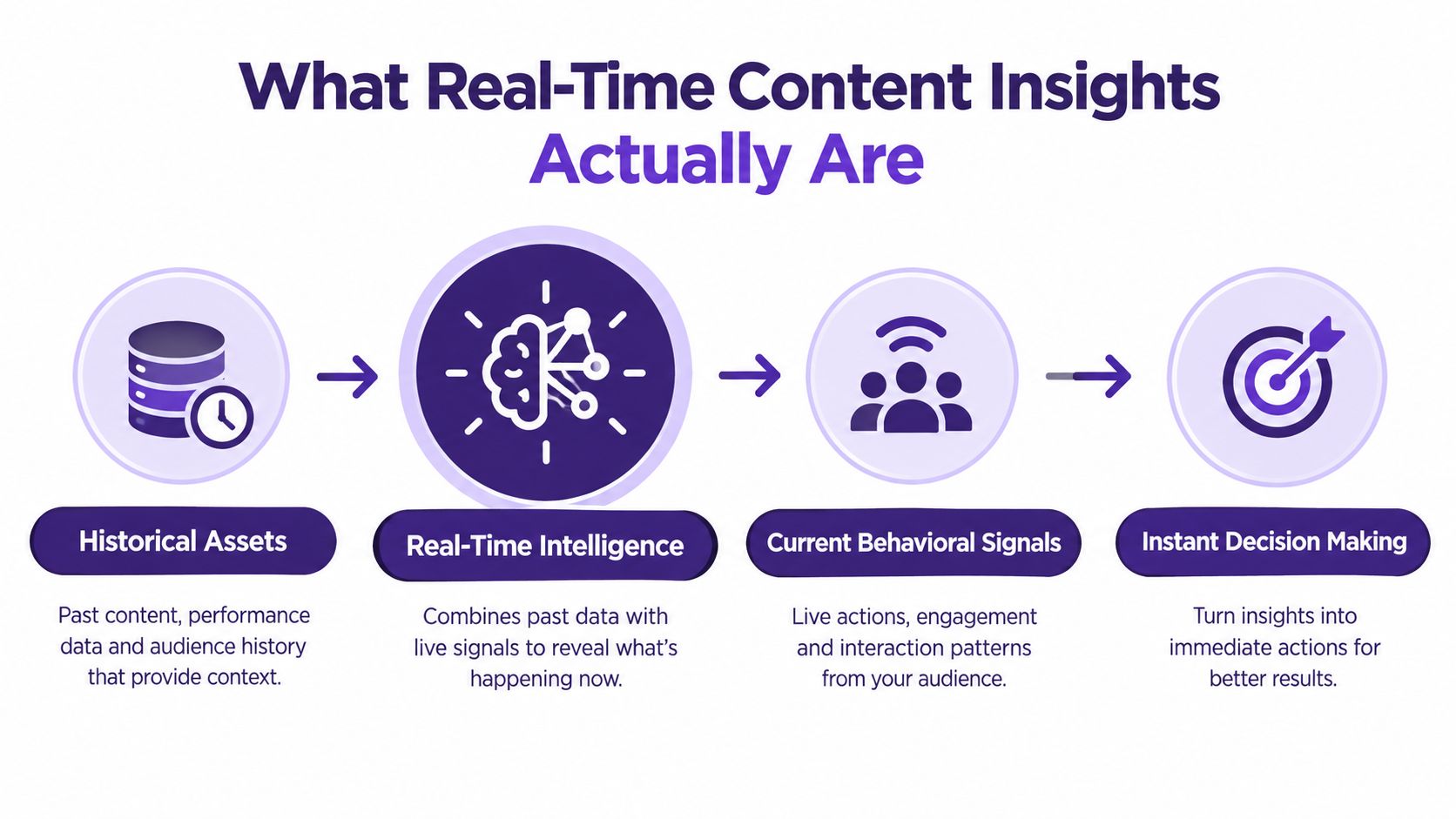
A dashboard can show activity, but activity alone is not insight. Insight connects a current behavior pattern to an owned asset and a practical next action. Because audiences discover information through search, social feeds, video platforms, and direct visits, one channel rarely explains the full demand for a topic.
The working parts are straightforward:
- Historical assets are the articles, episodes, clips, transcripts, and slides already in your library.
- Current behavioral signals include new comments, searches, shares, watch patterns, and topic spikes. Each signal offers context, especially when it appears around a known asset.
- Instant decision making turns that context into a choice: revise the opening, extract a section, change the format, or create a focused follow-up.
For a broader reference on how content intelligence can support visibility across media, ContentBuck's guide to SaaS visibility through video content offers useful context. The principle applies to any archive: current audience behavior should influence how you reuse a specific piece, not merely increase your publishing volume.
An archive is therefore an active reference system, not a static folder. A new transcript can reveal a phrase worth targeting. A reaction can expose an explanation that needs updating. A weak response can show that the topic is sound but the format or opening is wrong. The value comes from making those relationships visible quickly, so your next content decision rests on observed use rather than memory or assumption.
Building the Engine for Instant Discovery
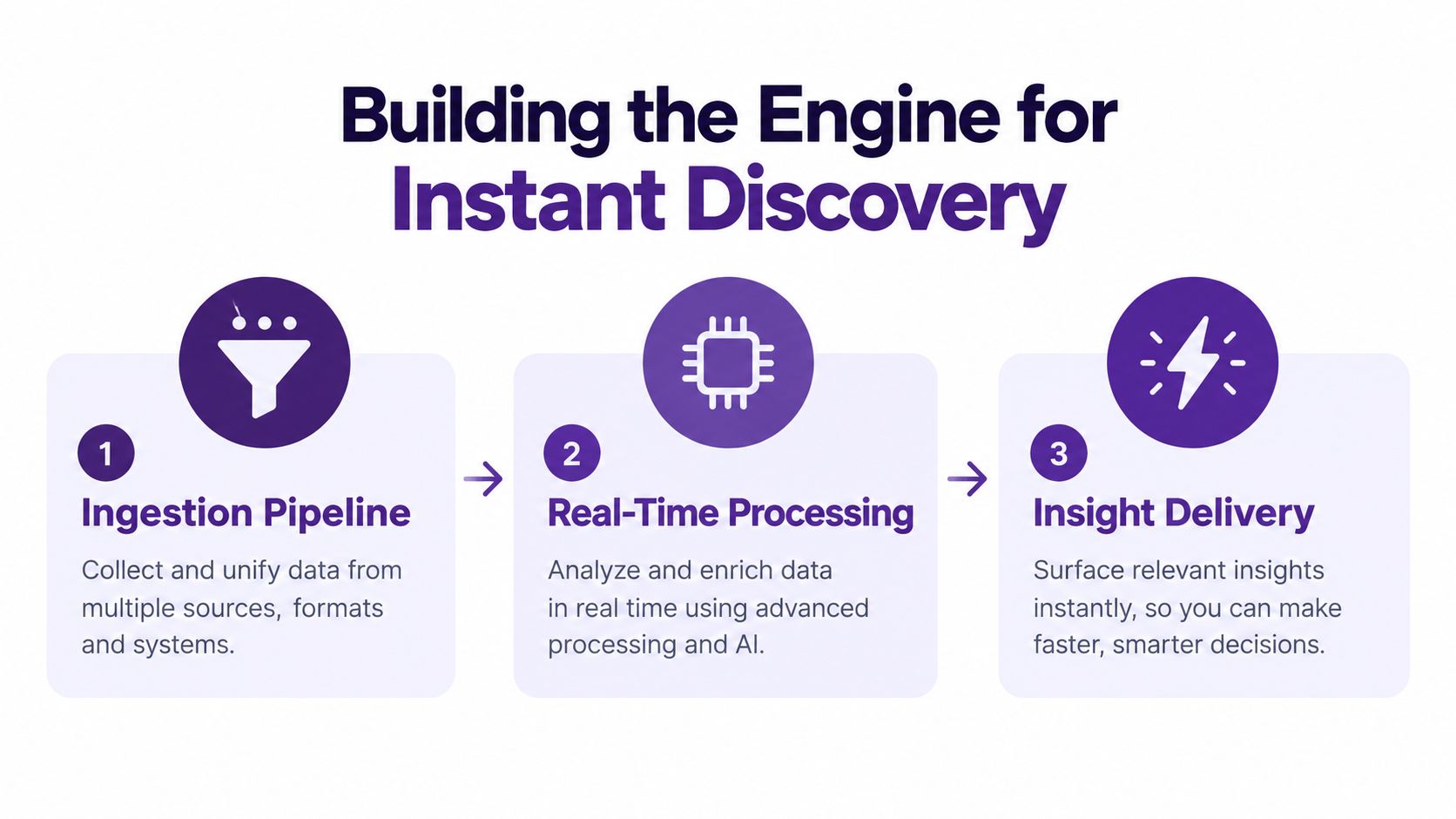
Fast insight depends on the path from raw file to usable knowledge. If every upload has to wait behind manual tagging, your “real-time” system is already behind. The better pattern is to separate capture from enrichment, so the first step stays light and the second step can do the heavier analysis without blocking the workflow.
Start with durable ingestion
The first requirement is reliable intake. New files, transcripts, metadata, and audience events need to land in a system that won't drop them when traffic spikes or a job fails halfway through. The architecture described in stream-processing benchmarks favors event-at-a-time handling for this reason, since Apache Flink is reported at roughly 10 to 50 ms for simple operations and 100 to 200 ms for more complex stateful computations, while Spark Streaming commonly sits in the 500 ms to 2 s range because of micro-batching stream-processing benchmark.
That difference matters when you're updating taxonomy labels or search layers as soon as a piece lands. Use durable ingestion, keyed state for per-series or per-author aggregates, and event-time windows for comparisons across episodes, posts, or campaigns. Then measure latency from upload or interaction all the way through transcription, classification, indexing, and retrieval, not just inside the processor.
Separate enrichment from retrieval
Once content lands safely, the system can enrich it. That means transcription, entity recognition, topic labeling, related-asset matching, and index updates happen without forcing the user to wait for every step to finish before they can search. If you blur those stages together, the interface may look polished while the underlying workflow still feels slow.
Keep the capture path boring and dependable, then make enrichment smart and recoverable.
For teams evaluating tools, the true test begins here. A clean UI doesn't tell you whether the engine can handle late-arriving content, preserve correctness, or recover after failure. AI-powered search is only useful if the underlying pipeline is built to keep pace with the work.
Watch the full path, not one metric
A 50 ms enrichment stage can still create a poor user experience if transcription or reranking is slow. Separate service-level objectives for ingestion, enrichment, and retrieval keep teams honest about where the bottleneck lives. That's the difference between a system that feels instant and one that merely looks modern.
From Raw Data to Actionable Intelligence
Speed alone doesn't help if the answer is wrong. That's why retrieval design has to balance quality and latency instead of treating them like separate projects. The strongest systems give you a quick answer path for ordinary queries and a deeper path for the cases that need better judgment.
| Method | Accuracy Profile | Typical Use Case |
|---|---|---|
| BM25 | Solid for exact terms, weaker on semantic variation | Fast lookup when you know the wording |
| Dense retrieval | Better at matching meaning across paraphrases | Finding related clips, passages, or scenes |
| Multi-vector retrieval | Stronger when several parts of an item matter | Comparing transcripts, titles, and metadata together |
| LLM-reranked pipeline | Highest quality, slowest response | Ambiguous or high-value searches |
A reported multimodal retrieval benchmark shows that BM25 reached 0.45 NDCG@10 at 50 ms, dense retrieval reached 0.68 at 120 ms, multi-vector retrieval reached 0.72 at 140 ms, and an LLM-reranked pipeline reached 0.84 at 350 ms multimodal benchmark. The pattern is useful because it shows the trade-off plainly, richer scoring improves relevance, but each extra stage costs time.
That's why tiered retrieval makes sense for creators and publishers. Use fast lexical or embedding search to gather candidates quickly, then apply modality-aware fusion across transcript, title, speaker, visual, and metadata fields when the question deserves more depth. Reserve expensive reranking for moments where accuracy matters more than instant simplicity.
Insight generation becomes much more useful when the result includes evidence spans and timestamps. Without that, people can't check why the system surfaced a clip or why a topic got flagged. With it, the output is something a creator can trust, edit, and reuse.
The simplest way to think about this is to ask one question, “What answer do I need right now?” If the answer is “good enough to shortlist,” use fast retrieval. If the answer affects a launch, a series direction, or a monetization decision, pay for the deeper pass.
Ethical Insights and Durable Value
A content archive becomes useful only when creators can trust the decisions built on it. Before a system turns an old interview, article, or video into a new recommendation, the workflow should record consent, preserve provenance, and provide a clear review point. These safeguards belong in the discovery and reuse process, not as repairs added after publication.

NIST's AI Risk Management Framework groups governance into Govern, Map, Measure, and Manage, while its Generative AI Profile applies that structure to generative systems NIST AI RMF. In a content team, this means assigning ownership of the source library, defining what each insight is meant to support, testing whether recommendations fit the evidence, and deciding who responds when the system is wrong. NIST's human-AI interaction guidance also emphasizes clear roles and responsibilities for people overseeing AI system performance NIST human-AI interaction guidance.
Practical rule: if you cannot trace a recommendation to its source, context, and permissions, do not publish it as settled truth.
This check becomes especially important when an archive includes sensitive material, withdrawn permissions, or assets with restricted reuse. Adobe's 2025 global survey found that 86% of more than 16,000 creators across eight major markets use generative AI, while 69% worry that their content may train AI without permission Adobe creator survey. Source-level citations, role-based access, deletion workflows, and human approval give editors practical control over what realtime signals can influence.
Measure value beyond immediate clicks. Digital Content Next reports that 41% of profitable publishers have logged-in rates above 7.5%, compared with 15% of unprofitable publishers Digital Content Next research archive. The figures do not establish one universal formula, but they point toward a durable goal: use evidence from your own archive to support repeat visits, trust, subscriptions, and responsible reuse.
Realtime insight should guide judgment, not replace it. A recommendation earns its place when an editor can verify its origin, understand its limits, and connect it to a lasting audience or business outcome.
Your Roadmap to Smarter Content Workflows
A creator searching an old interview may find a strong quote, but only if the archive explains what the file contains, where it came from, and how it may be reused. Start by cleaning the metadata. The Library of Congress explains that descriptive, technical, and administrative metadata make digital objects easier to manage and transfer, especially when captured early in the object's lifecycle Library of Congress metadata guidance. Standardize titles, formats, rights status, dates, and related assets before asking an insight system to identify patterns.
Then select a tool that connects archive history with current signals. It should search transcripts, clips, and articles while showing why a topic matters now. A prettier file store will not help an editor decide which past material deserves a new brief. To compare how teams organize repeatable content services, browse the OGTool service overview. Use that comparison to test whether a platform supports your actual workflow, from discovery to approval and publication.
Keep an editor in the loop. NIST's governance guidance makes the accountability piece clear, and that is the part teams often skip while scaling. The reviewer should confirm context, attribution, rights, and audience fit before a recommendation becomes a deliverable. A useful system makes those checks visible rather than hiding them behind an automatic score.
With these foundations, your archive becomes a working source of decisions, not merely a storage system. Contesimal helps teams organize content, search it in real time, and surface current relevance signals so older work can inform the next piece. Visit Contesimal to assess whether your library can support clearer ideas, repeatable workflows, and stronger audience choices.