
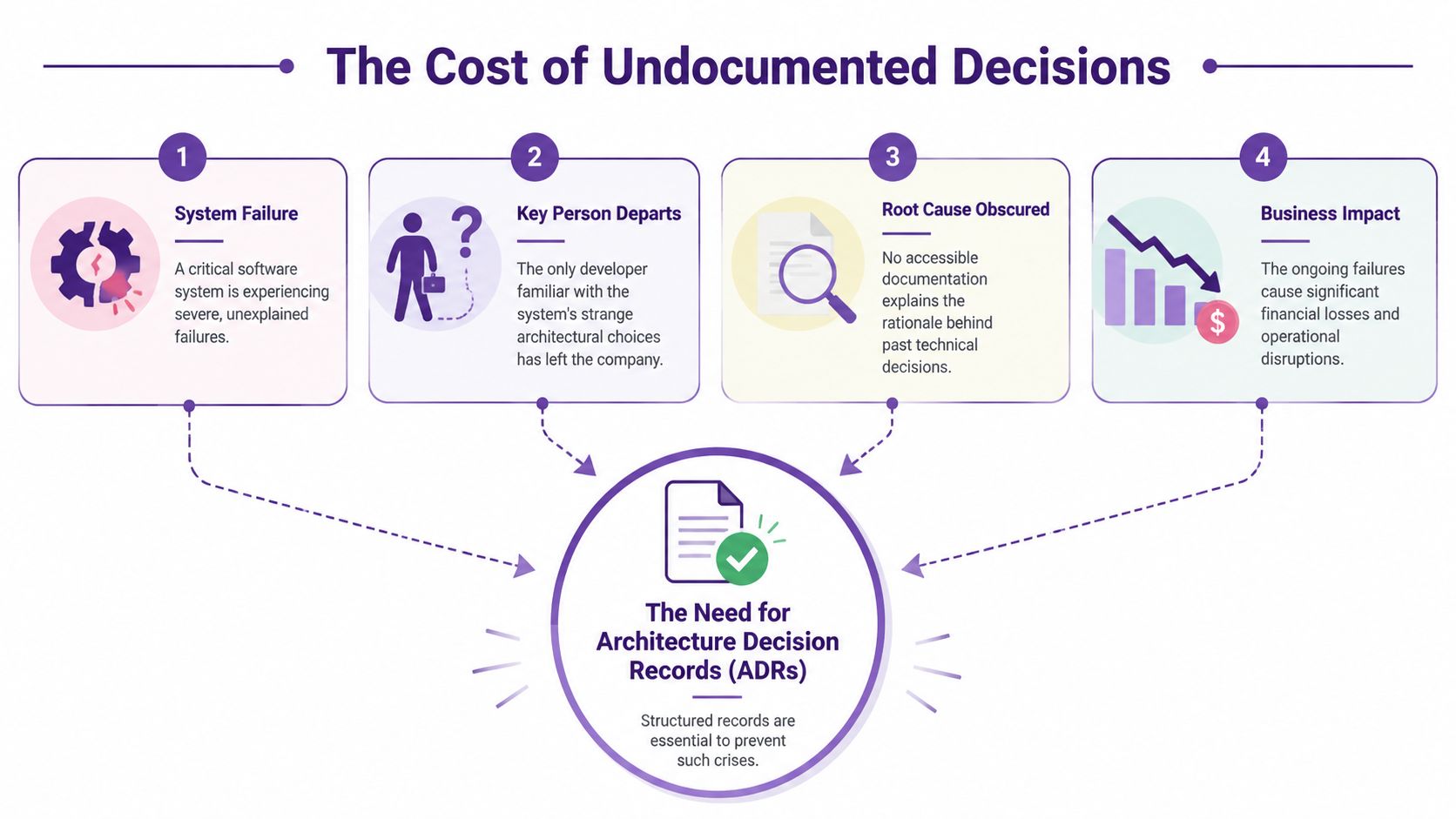
A service starts failing at the worst possible time. Logs point to a strange queueing pattern, the retry policy looks backwards, and the database timeout seems oddly intentional. Then someone asks the question that always arrives too late: why was it built this way?
The answer often left with a developer who changed teams, left the company, or stopped working on that part of the system. That's organizational amnesia. Teams lose the reasoning, keep the code, and inherit the consequences.
A good architecture practice fixes that. It doesn't require a heavyweight review board or a giant document set. It requires a reliable way to capture the handful of technical choices that shape a system over time, then keep those choices searchable like a well-run content library.
What Is an Architecture Decision Record
An Architecture Decision Record is the simplest useful form of architectural memory. It captures one important decision, why the team made it, and what happened because of it. Martin Fowler defines an ADR as a concise, lightweight document, typically limited to a single page or a maximum of two pages, for one architecturally significant decision with its context and consequences, and he recommends an inverted pyramid style where the decision comes first in the document (Martin Fowler on Architecture Decision Records).
That short length matters. If the record becomes a mini whitepaper, people stop writing it and nobody reads it later.
Which decisions deserve an ADR
Not every technical choice is an architecture decision. Changing a button color doesn't need a formal record. Choosing a primary database, a service boundary, an eventing model, an authentication approach, or a frontend rendering strategy probably does.
A practical rule is to write an ADR for decisions that change one of these:
- System qualities: Performance, reliability, security, scalability, observability, maintainability.
- Team speed: Build pipeline choices, framework adoption, integration patterns, deployment topology.
- Business outcomes: Decisions that affect delivery risk, operating constraints, compliance posture, or customer experience.
Practical rule: If a future teammate could reasonably ask “why on earth did we choose this?” and the answer would matter, write the ADR.
That's why I like the content library analogy. A creator who keeps raw clips, transcripts, notes, and drafts in a searchable archive can reuse old material and avoid recreating work from scratch. A software team can do the same with decisions. The ADR log becomes a library of judgment.
Why teams benefit from a decision library
A healthy ADR collection helps with more than incident response.
- Onboarding gets easier: New engineers can trace how the system took shape.
- Trade-offs stay visible: Teams don't repeat debates that already happened.
- Past work creates new value: Decisions made under one set of constraints can still inform the next design round.
- Cross-functional conversations improve: Product, engineering, security, and operations can all review the same record.
Teams already working toward clearer engineering rituals often pair ADRs with stronger planning practices. If your team is also tightening up how it turns intent into implementation, this deep dive into spec-driven development is worth reading.
For teams that need a more discoverable home for shared knowledge, the mechanics overlap with building an internal knowledge base. A useful reference is this guide on how to make a wiki.
The Anatomy of a Great ADR Template
The best ADR template is boring in the best sense. It's easy to copy, fast to fill out, and obvious to scan in a pull request. If the template asks for too much, people delay writing. If it asks for too little, the future reader gets no value.
Minimalist ADR Template
| Field | Purpose |
|---|---|
| Title | Names the decision clearly so it's easy to find later |
| Status | Shows whether the decision is still being discussed, active, or replaced |
| Context | Explains the problem, constraints, and forces behind the decision |
| Decision | States the choice in plain language |
| Consequences | Records expected outcomes, trade-offs, and follow-up effects |
What each field needs to do
Title should identify the choice, not the meeting where it came up. “Adopt PostgreSQL for primary database” is useful. “Database discussion notes” is not.
Status keeps the library trustworthy. A future reader needs to know whether the record is active, in debate, or no longer current. Status is one of the first things people look for when they're debugging a live system or planning a migration.
Context is where weak ADRs usually fall apart. Don't dump background noise into it. Capture only the constraints that shaped the decision: traffic pattern, deployment model, operational burden, compliance concerns, team skill set, integration requirements, or a deadline that forced a simpler path.
A good context section gives the next engineer enough information to disagree intelligently.
Decision should be direct and assertive. Avoid “we may consider” or “one possible approach is.” A reader should know exactly what the team decided.
Consequences is where the ADR earns its keep. Record what becomes easier, what becomes harder, what new work was created, and what risks remain. This is also the place to note when one choice is likely to trigger later decisions.
A copy-ready structure
Use something close to this:
- Title: One line that names the decision
- Status: Current lifecycle state
- Context: Why this choice had to be made now
- Decision: The selected approach
- Consequences: Positive effects, negative effects, follow-up work, open watch items
Some teams add fields for alternatives considered, related links, or confidence. That can work well if the extra fields sharpen thinking rather than create ceremony.
If your team already documents interfaces and developer-facing behavior in a structured way, it helps to keep ADRs equally compact. This API documentation template example is a good reminder that useful technical docs are usually lean, consistent, and written for the next person who needs them fast.
Real-World Architecture Decision Record Examples
Teams usually understand ADRs once they see one. The format feels abstract until it's anchored to an actual choice with real consequences.
Example one accepted decision
ADR 001: Adopt PostgreSQL for Primary Database
Status: Accepted
Context: The application needs a transactional primary datastore for customer accounts, billing relationships, and operational reporting. The team needs strong consistency for core writes, mature backup tooling, and a query model that supports both product features and internal support workflows. Alternatives considered included a document database for schema flexibility and a managed key-value store for operational simplicity.
Decision: Use PostgreSQL as the primary database for the core application.
Consequences:
Positive: The team gets relational modeling, transactional guarantees, and broad ecosystem support. Reporting queries can evolve without introducing a second system immediately.
Negative: Schema changes require discipline. Poor query design can create operational pain if indexes and migrations aren't handled carefully.
Follow-up: Define migration conventions, backup ownership, and query review guidelines.
This is enough. It gives the future reader the choice, the pressure around the choice, and the trade-offs.
Example two superseded decision
The second example matters more because most real systems don't stand still.
ADR 002: Use Server-Side Rendering for Public Web Application
Status: Superseded by ADR 005
Context: The team needed a fast path to ship a content-heavy public site with strong initial page delivery and straightforward templating. At the time, the engineering team had more backend experience than frontend application experience, and the delivery schedule favored a simpler rendering model.
Decision: Use server-side rendering for the public web application.
Consequences:
Positive: The team can ship quickly using existing skills. Initial render behavior is predictable, and infrastructure remains simple.
Negative: Interactive features become harder to scale in complexity. Frontend state management starts leaking into server templates. Reuse across platforms becomes limited.
Follow-up: Reevaluate if the application shifts from content delivery toward richer client-side interaction.
ADR 005: Adopt a Hybrid Rendering Approach for the Public Web Application
Status: Accepted
Context: The public site evolved into an application with heavier user interaction, richer filtering, and more client-side state. The constraints that justified ADR 002 no longer dominate.
Decision: Replace the all-in server-side rendering approach with a hybrid rendering model.
Consequences:
Positive: Interactive flows become easier to build and maintain. Frontend concerns move into a more appropriate architecture.
Negative: Build complexity increases, and the team must tighten frontend performance discipline.
Follow-up: Establish rendering guidelines by route type and document migration boundaries.
What these examples get right
A usable architecture decision record does three things well:
- It captures the trade-off, not just the verdict. “We chose PostgreSQL” is incomplete without the constraints behind it.
- It stays concise. Nobody needs meeting transcript energy in an ADR.
- It preserves change over time. Superseding an ADR is often more valuable than the first record, because it shows how the team learned.
If you want examples of adjacent operational docs that support this kind of discipline, these process documentation examples are helpful because they show how teams turn recurring work into reusable knowledge.
Integrating ADRs into Your Team Workflow
The common pitfall with ADRs isn't that the format is hard. It's that the habit never settles into the workflow. The record gets written only after a painful incident, which means the team is using ADRs as archaeology instead of guidance.
The better pattern is to make ADRs part of the normal path from idea to implementation.

Where ADRs fit in day-to-day work
The trigger is usually obvious. A team is choosing a framework, defining an API boundary, selecting a messaging approach, introducing a new dependency, or changing a deployment pattern. That's the moment to draft the record.
Good teams surface ADR candidates in routine delivery work:
- Backlog grooming: A ticket implies an architectural trade-off.
- Sprint planning: Implementation depends on a nontrivial technical choice.
- Design review: Several options are on the table and the team needs one clear path.
- Pull request review: The code reveals a broad design choice that should be documented.
Keep the review cycle lightweight
Microsoft's guidance is useful here: best practice suggests one to three ADR readout meetings should be enough, and the status should be tracked as Proposed, Accepted, or Superseded (Microsoft guidance for ADR workflow).
That advice lines up with what works in practice. If a team needs endless meetings to approve a short decision record, the issue usually isn't the ADR. The issue is that the decision scope is still muddy, or key people weren't involved early enough.
A workable rhythm looks like this:
- Draft while the decision is live. Don't wait for perfect certainty.
- Run a readout review. Let people read first, then comment.
- Resolve substantive disagreements. Ignore cosmetic edits until the substance is settled.
- Accept and link it. Connect the ADR to the code, issue, or design doc.
- Supersede instead of editing history. A decision log should show evolution.
Operating habit: Treat ADRs like source-controlled editorial assets. They should be easy to review, easy to diff, and easy to find when the next decision builds on the last one.
Where to store the library
There isn't one right answer.
Git repository storage works well when the decision applies tightly to a codebase. Engineers can review ADRs in the same place they review changes. Version history is built in.
Confluence or Notion can work when broader business or platform stakeholders need easy access and contribution. The trade-off is that ADRs can drift away from the code unless someone maintains the linkage carefully.
Teams that are bringing AI into documentation and decision support should also think about retrieval quality. A searchable archive is only useful if people trust what comes back. Broader operational thinking aids in this regard. The same habits that improve ADR collaboration also support strategies for AI team integration, especially when teams want shared knowledge to stay usable across humans and AI tools.
Best Practices and Common Pitfalls
An ADR practice succeeds when the records stay short, the library stays current, and people can find what they need. It fails when the process turns into a committee ritual or a dumping ground.
The distinction is mostly behavioral, not technical.
Habits that make ADRs useful
- Write early: The closer the record is to the decision moment, the sharper the rationale.
- Preserve history: Don't rewrite an accepted ADR to match today's thinking. Create a new one that supersedes it.
- Focus on rationale: The code already shows what was built. The ADR should explain why.
- Make the library searchable: Naming, indexing, and linking matter more than formatting polish.
- Keep stakeholders involved: ADRs improve when the right voices contribute before approval.
AWS guidance reinforces two of the most important maturity signals: teams typically review each ADR one month later in an after-action review, and they involve relevant stakeholders before review and approval (AWS ADR process guidance).
That one-month review is underrated. Teams often write decent predicted consequences, then never check whether reality matched the document. Without that step, the library becomes a shelf of untested assumptions.
Failure modes that kill adoption
The most common pitfall is over-documentation. A team starts with good intent, then decides every library upgrade, endpoint rename, and minor refactor deserves a formal record. The archive fills with noise, and the important decisions disappear into it.
The second pitfall is bureaucracy. If the ADR becomes a gate that delays all work, people route around it. Engineers won't defend a process that blocks delivery without adding clarity.
A few warning signs show up fast:
- Records read like defensive legal briefs: People are writing to protect themselves instead of helping future teammates.
- Context is missing: The ADR says what was chosen but not what pressures shaped the choice.
- No one can find anything: The records exist, but they're buried in a folder nobody searches.
- The log stagnates: Decisions remain “current” long after the system moved on.
ADRs should never become a blame ledger. They are a knowledge asset, not a courtroom exhibit.
The standard worth holding
A strong architecture decision record library acts like a high-value content archive. It protects institutional memory, makes reuse possible, and compounds value over time. The team doesn't have to remember everything. It has to remember where the decision lives and whether the record still reflects reality.
That's a manageable standard. Teams can reach it if they stay disciplined about scope and avoid turning a lightweight document into a governance machine.
Frequently Asked Questions about ADRs
Teams usually hit the same handful of edge cases once they begin writing ADRs consistently. None of them are hard to solve, but they do need a clear house style.
How do we handle disagreement on a proposed decision
Treat disagreement as part of the ADR's job. If two strong options remain on the table, write the trade-offs directly into the context and consequences. Then ask the decision owner to make the call after relevant stakeholders have weighed in.
The record shouldn't pretend consensus exists when it doesn't. It should show that the alternatives were considered and that the team chose anyway.
What should we do in a legacy system when the original context is gone
Start writing ADRs from today forward, and backfill only where the missing decision still causes confusion or risk. For brownfield systems, it's better to capture “current best understanding” than to wait for perfect historical reconstruction.
When you're reconstructing older choices, label assumptions plainly. Don't write fiction just to make the archive look complete.
Do temporary fixes or experiments need an ADR
Sometimes yes. If the temporary decision changes architecture meaningfully, creates a dependency that other work will build on, or introduces risk that people need to remember later, it deserves a record.
The ADR can say the choice is intentionally temporary. That's often more valuable than silence, because temporary solutions have a habit of becoming part of the furniture.
Who should have final approval
Approval should sit with the person or group accountable for the architectural outcome in that area. In some teams that's a tech lead. In others it's a small architecture group or an engineering manager with platform ownership.
What matters is clarity. If nobody knows who decides, the ADR process becomes commentary without closure.
Can AI help draft ADRs
Yes, if the team treats AI as a drafting assistant rather than the source of truth. AI can help summarize meeting notes, compare alternatives, and turn rough bullets into a readable first pass. A human still needs to verify the rationale, the trade-offs, and the actual decision.
For teams thinking through how personalized AI systems should answer nuanced workflow questions, this collection of answers on personalized AI is a useful parallel read.
If your team likes the idea of turning past work into a searchable library of reusable value, Contesimal is built for that mindset. It helps organizations organize documents, audio, video, and research so people can find what matters, collaborate around it, and create new value from what they've already produced.