
You already have the raw material.
There's a YouTube channel with strong episodes buried under newer uploads. A podcast archive with sharp interviews no one remembers six weeks later. A blog category full of thoughtful posts that still answer the same questions your audience asks today. The problem usually isn't that you need more ideas. The problem is that your best ideas are trapped in formats your audience can't easily revisit, search, or act on.
That's why building a newsletter matters so much for creators moving from hobbyist to operator. A newsletter gives you a direct line to the people who care enough to come back. It also forces a useful discipline. You stop treating each video, episode, or article like a one-time event and start treating your library like an asset that can be organized, resurfaced, and turned into recurring value.
I've seen this shift happen when creators stop asking, “What should I make next?” and start asking, “What have I already made that still deserves distribution?” That's a better question. It leads to stronger editorial systems, clearer positioning, and a business model that isn't dependent on algorithm luck.
A good newsletter isn't just another channel. It's the hub that connects your archive, your audience, and your offers. It can pull together past videos, fresh commentary, product recommendations, premium insights, sponsorship inventory, and community feedback in one place.
For creators, publishers, and content teams with an existing library, that changes everything.
From Content Library to Direct Connection
Most creators don't start with a newsletter problem. They start with an accumulation problem.
You publish enough over time and the library gets messy. Great podcast episodes live in old feeds. Useful clips disappear into social timelines. Articles rank, then drift. Video playlists hint at a bigger editorial strategy, but nobody has stitched the body of work into something coherent. The archive exists, but it isn't working as hard as it should.
A newsletter fixes that when it becomes the editorial layer on top of your catalog.
Instead of inventing from scratch every week, you can pull one strong idea from an old interview, connect it to a current trend, add a short perspective, and send readers toward a deeper asset you already own. One email can revive a back-catalog episode, a transcript, a download, and a product path at the same time. That's how the newsletter stops being “more content” and becomes content infrastructure.
What changes when the newsletter becomes the hub
The biggest shift is strategic. You stop publishing in isolated bursts and start building a system with memory.
- Your archive becomes usable: Old videos, articles, and podcast episodes turn into source material instead of dead inventory.
- Your audience relationship gets stronger: Subscribers choose to hear from you directly, outside rented platforms.
- Your editorial decisions improve: Patterns emerge when you repeatedly pull from your best-performing themes.
- Monetization gets cleaner: Sponsors, offers, affiliates, and premium content all work better when there's a reliable owned channel.
A newsletter is where scattered content turns into an organized point of view.
That matters for anyone with a real library. YouTubers with playlists. Podcasters with transcripts. Editors managing categories across a publication. Authors with essays, notes, interviews, and excerpts spread across platforms. The more content you've already made, the more value a newsletter can create.
The professional move
Hobbyists often chase output. Professionals build compounding systems.
Building a newsletter from an existing library does both jobs at once. It creates a recurring product for the audience and a repeatable workflow for the team. That's what moves a creator from “I publish when I have time” to “I operate a media asset.”
Defining Your Newsletter Strategy and Niche
A newsletter with no strategic center turns into a recap email. Those don't build much loyalty.
The strongest newsletters have a narrow promise. Readers know what they'll get, why it matters, and whether it belongs in their inbox. If you already have a content library, your advantage is that the answer is usually hidden in your past work. Look at what you return to repeatedly. Look at which themes deserve an ongoing series, not just a single post.
Start with one job
Pick the primary job of the newsletter before you choose a format.
Some newsletters are built to deepen audience trust. Others drive leads, sell products, support sponsorships, or create a bridge into a paid membership. You can do more than one thing over time, but the early version needs one dominant outcome.
Use a simple test:
- Audience growth: You want more of your existing social, video, or podcast audience on an owned list.
- Relationship depth: You want to move casual viewers into repeat readers and buyers.
- Revenue support: You want a channel that can carry offers, sponsorships, or premium content consistently.
If you can't name the primary job in one sentence, the audience won't understand the value fast enough.
Pick the micro-niche, not the broad category
Broad positioning sounds safe and performs poorly. “Marketing insights” is weak. “Behind-the-scenes email strategy for independent publishers” is stronger. “Wellness” is forgettable. “Science and spirituality for skeptical readers” has shape.
Recent 2025 data indicates that 50 micro-niche ideas are emerging as the fastest-growing segments, and creators report that building the “middle place” bridge from social media listeners to newsletter subscribers is hard unless the newsletter aligns to a specific micro-niche rather than a broad topic, as noted in this micro-niche newsletter analysis.
That “middle place” is where many creators get stuck. A person may like your podcast, follow your Instagram, and still never subscribe because the newsletter offer feels generic. “Join my newsletter for updates” isn't a bridge. It's a shrug.
Practical rule: Your newsletter should promise a sharper outcome than your main content channel.
Write the mission statement readers actually need
Try this formula:
This newsletter helps [specific audience] understand [specific topic] so they can [specific result].
A few examples:
- Independent filmmakers who want practical story breakdowns they can apply to their next short.
- Podcast listeners who want one distilled idea and three useful resources each week.
- Local business owners who need neighborhood-level audience insight, not national marketing fluff.
Audit your library for proof
Before finalizing the niche, scan your archive and ask:
- Which topics have you covered repeatedly?
- Which angles attract the most engaged comments, replies, or shares?
- Which themes can sustain ongoing curation, not just a launch burst?
- What does your audience already trust you to interpret?
If your archive can't support the niche for several months, it isn't a niche yet. It's a headline.
Designing Your Newsletter Content and Structure
Most newsletter design problems are editorial problems wearing visual clothes.
Creators often obsess over banners, colors, and templates before they've decided what belongs in the email and in what order. That's backwards. A newsletter works when the structure respects attention, especially on mobile screens where people scan before they commit.
Research on a 5-step newsletter design process found that 87% of high-performing newsletters prioritize content structure before visual design, and that approach produced a 32% higher click-through rate than decoration-first workflows. The same analysis found that skipping semantic elements like heading levels can reduce mobile engagement by 21%.
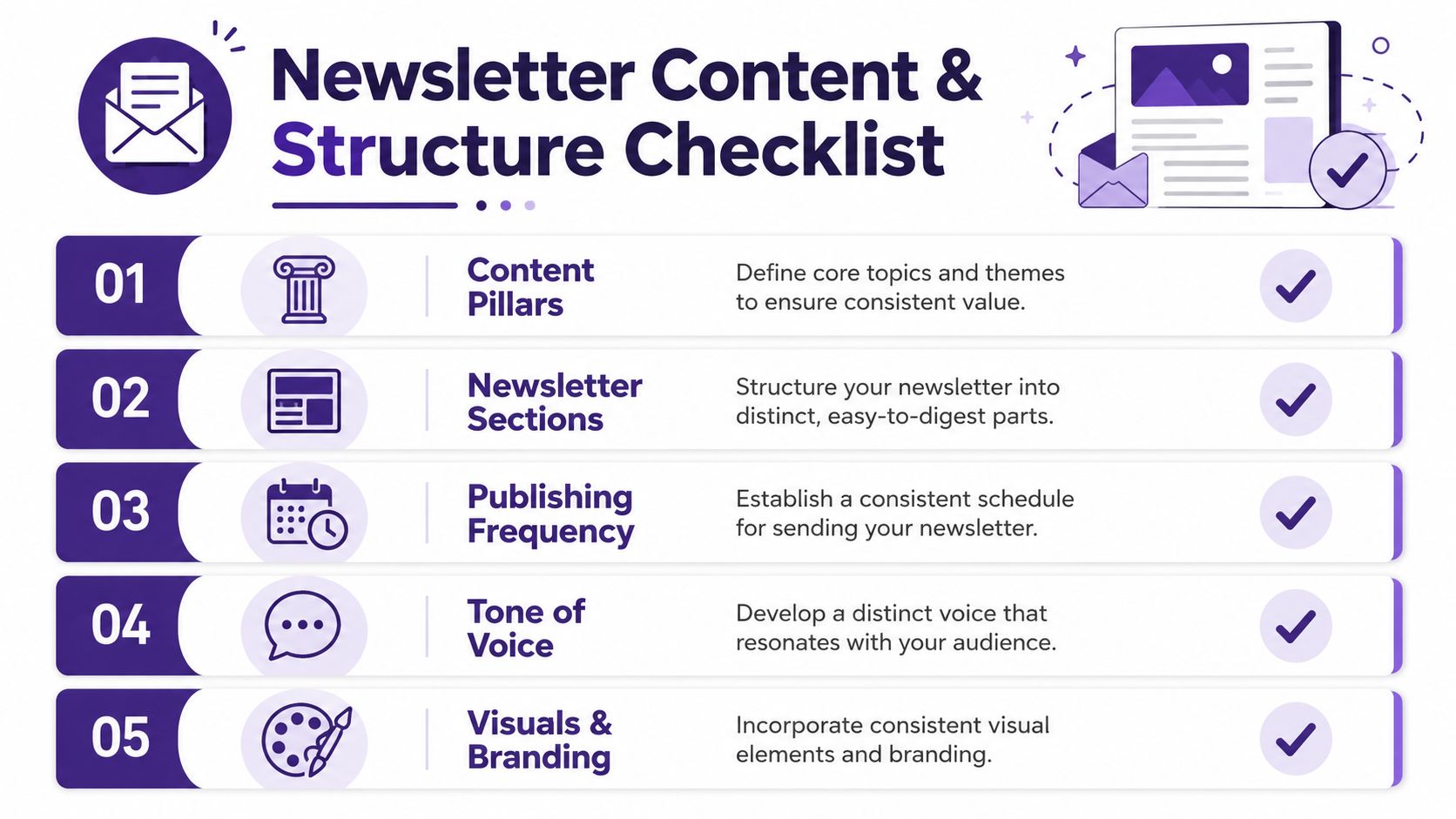
Use a repeatable editorial format
The easiest way to fail at building a newsletter is to reinvent it every send.
A repeatable format lowers production stress and trains the audience to expect value quickly. One reliable structure looks like this:
Sample newsletter structure
One big idea
Three supporting links or examples
One recommended asset from your archive
One short question that invites reply
That format works because it gives each issue a spine. The big idea creates focus. The links add utility. The archival pick reinforces your library. The question creates conversation and audience research at the same time.
You can also adapt the format by role:
| Creator type | Strong recurring section |
|---|---|
| YouTuber | Breakdown of one lesson from a recent or older video |
| Podcaster | Key takeaway plus one quote-worthy moment from the episode |
| Publisher | Editor's note plus curated article picks from the archive |
| Consultant or educator | One framework, one case reflection, one resource |
Build for skimmability first
A lot of email fatigue comes from bad structure, not lack of interest.
Use H1 to H3 logic, keep section ordering predictable, and create visible breathing room. The documented design process above recommends semantic formatting, step-increased font sizing of 2/4/8px, strategic spacing, mobile-first validation, white-space optimization, and CTA button grouping with text for clickable integrity in the email layout.
What this means in practice:
- Lead with the main point: Don't bury the strongest idea under a long personal intro.
- Break sections clearly: Use headings and short blocks so readers can jump.
- Use real lists and buttons: Don't fake structure with plain text spacing.
- Keep CTAs attached to context: A button works better when the copy around it tells the reader why to click.
Avoid the design mistakes that quietly hurt performance
Bad newsletter structure usually shows up in familiar ways:
- Heading chaos: Jumping from H2 to H5 makes the message harder to parse.
- Decorative clutter: Large graphics that delay the first useful sentence.
- Link dumping: Too many equal-priority links with no editorial hierarchy.
- CTA isolation: A button with no supporting text or reason to act.
A well-built newsletter doesn't need to look flashy. It needs to feel legible, coherent, and worth opening again next week.
Choosing Your Tech Stack and Automation Workflow
Your email platform should match your operating model, not your ambition fantasy.
A solo creator with one weekly send doesn't need the same setup as a publication with multiple segments, sponsorship inventory, and handoff points between editorial and marketing. The right stack is the one your team will use consistently.
Start with the core system: the email service provider, or ESP. Three categories cover most use cases.
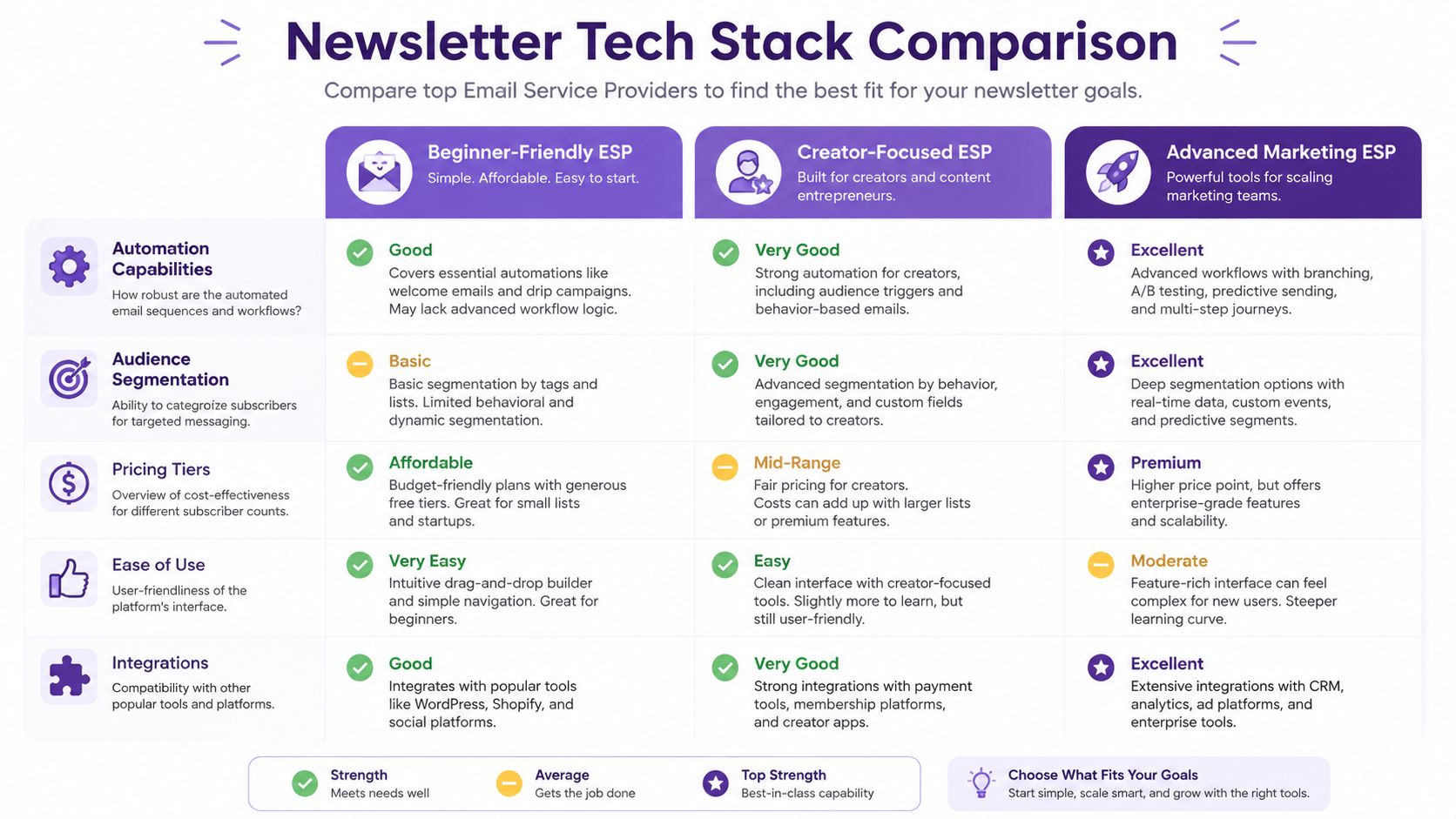
Three realistic ESP paths
| ESP type | Best for | Strengths | Trade-offs |
|---|---|---|---|
| Beginner-friendly ESP | New creators testing consistency | Simple setup, low friction, basic automations | Can feel limiting once segmentation gets deeper |
| Creator-focused ESP | Media-style newsletters and personal brands | Cleaner editorial workflow, audience-first features, easier sponsorship ops | Some advanced marketing logic may be lighter |
| Advanced marketing ESP | Teams with multiple funnels and complex lifecycle needs | Strong automation, tagging, segmentation, integrations | More setup overhead and more room for unnecessary complexity |
Tools in these categories include options like Mailchimp, ConvertKit, Beehiiv, Kit, ActiveCampaign, and Brevo. The right choice depends less on brand loyalty and more on how you publish.
Use four criteria when comparing them:
- Can your team build automations without frustration
- Can you segment by topic, source, or behavior
- Does the editor support your content format cleanly
- Will the pricing still make sense when the list grows
If you're evaluating broader systems that support research, workflow design, and content operations around the newsletter itself, this guide to content intelligence platforms is a useful companion.
The minimum automation every newsletter needs
A lot of creators overbuild early. Start with one sequence that welcomes the subscriber properly.
Your welcome workflow should do three jobs:
- Confirm what the subscriber signed up for.
- Deliver immediate value from your existing library.
- Train the reader to expect the rhythm and style of future emails.
That often means a first email with a short welcome note, a second with your best evergreen asset, and a third that points people to a few core themes or playlists. Keep it simple enough that you'll maintain it.
Later, you can add branching logic for interest tags, source-specific onboarding, or product intent.
A short walkthrough can help if you're wiring this up visually:
Don't confuse tooling depth with readiness
An advanced automation builder won't rescue weak editorial positioning. If your newsletter promise is still fuzzy, fancy workflows will just distribute that fuzziness more efficiently.
Choose the lightest stack that supports your current publishing discipline, then upgrade when the workflow earns it.
Fueling Growth with Your Existing Content Library
The archive is where your newsletter gets its unfair advantage.
Creators who already have a body of work don't need an endless stream of brand-new ideas. They need a system for discovering what's still relevant, packaging it for the inbox, and connecting isolated assets into a stronger editorial product. That's what turns old content into a growth engine.
Industry best practice is to conduct quarterly reviews of your content library using page views, conversion rates, and time-on-page, while focusing repurposing efforts on content from the past 12 months, according to this guide on repurposing content in 2025.
Audit the library like an editor, not a hoarder
Many libraries look large and feel unusable because nobody has organized them around decisions.
A useful review asks editorial questions:
- What keeps attracting attention: These pieces deserve resurfacing or expansion.
- What converts attention into action: These are strong candidates for newsletter CTAs.
- What still has conceptual relevance: These can be reframed with fresh commentary.
- What clusters naturally with other assets: These often become recurring newsletter themes.
This process matters most for creators with scattered formats. A single newsletter issue can pull from a long-form podcast, a transcript excerpt, a YouTube clip, an older article, and a recent social post. The raw material already exists. The advantage comes from organization.
For a deeper framework on turning archived material into fresh formats, this piece on content repurposing strategies is worth reading.
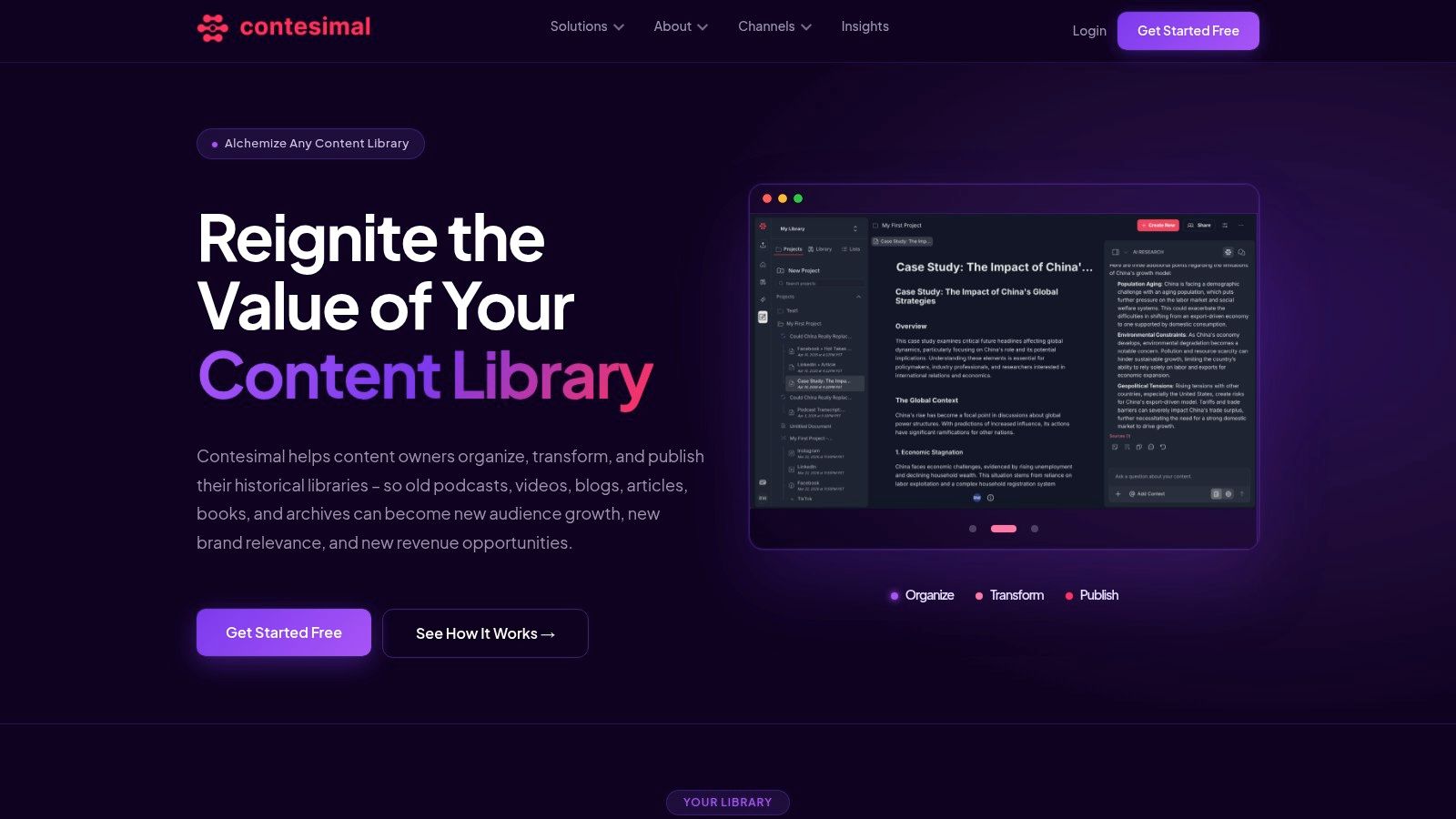
Build an idea mine, not a storage closet
A strong content library should answer questions quickly:
- Which episodes discuss this topic most clearly?
- Which articles support this angle?
- Which recurring themes deserve a newsletter series?
- Which audience questions show up across formats?
That's where AI-assisted organization becomes practical. When a system can ingest videos, podcasts, documents, and articles, classify them, and make them searchable, the newsletter workflow gets faster and smarter. Teams can find old insights, compare patterns, and surface underused material without digging through folders and transcripts manually.
The newsletter gets easier when your archive becomes queryable instead of merely searchable.
That distinction matters. Search helps you retrieve known items. A better research layer helps you discover relationships between assets, themes, and audience interests.
What professional repurposing looks like
Professional creators don't just recycle. They reframe.
An old interview becomes a “what changed since then” analysis. A successful tutorial becomes a weekly checklist. A long article becomes a distilled insight plus one recommended action. A cluster of related episodes becomes a mini-series for new subscribers.
When you organize the library properly, building a newsletter stops feeling like a recurring blank page. It becomes an editorial selection process.
Launching Your Newsletter and Measuring Success
A clean launch beats a dramatic launch.
You don't need a cinematic rollout. You need a credible reason to subscribe, a clear publishing rhythm, and enough internal discipline to keep sending after the initial excitement wears off. Most newsletter launches fade away because the creator announces once, then disappears for a month.
Launch with a distribution plan, not a single post
Use the channels you already control.
A YouTuber can mention the newsletter in the intro or outro for several uploads. A podcaster can add it to the spoken callout and show notes. A publisher can place it inside high-intent articles and site navigation. Social posts help, but they rarely do the whole job on their own.
Keep the offer specific. Don't say “subscribe for updates.” Say what the reader will receive, how often, and why it's different from the free content they already see elsewhere.
A practical pre-send checklist also helps. Before your first campaign, test rendering, read every link, and run the copy through a free email spam checker so a preventable deliverability issue doesn't undercut launch week.
Track the numbers that indicate viability
A newsletter becomes a business asset when you can judge performance clearly.
According to Litmus benchmarking on newsletter best practices, subject lines with 6 to 10 words generate 24% more opens, and 68% of top newsletters test at least three subject line iterations before launch. The same benchmark notes that neglecting preview text can reduce open rates by 15%, and it sets useful viability targets at CTR at or above 4.5% and open rate at or above 28%.
Those aren't vanity metrics. They tell you whether the package and the content are working together.
A focused measurement stack should include:
- Open rate: A signal about subject line, sender trust, and audience fit.
- Click-through rate: The clearest indicator that the content moved someone to act.
- Read rate: Useful for understanding whether people are consuming the email.
- Unsubscribe rate: Important context about expectation mismatch or list quality.
If you want a stronger analytical workflow around what content themes drive action, this guide on how to analyze content performance is a good next step.
Improve through testing, not hunches
Subject line testing matters, but don't stop there.
Test the framing of your lead section. Test whether one primary CTA outperforms multiple smaller links. Test archive-based issues against commentary-heavy issues. Use UTM-parameterized click tracking so you can identify which links, themes, and placements resonate.
The inbox gives fast feedback if you're disciplined enough to read it.
You'll learn quickly whether your audience wants curation, analysis, recommendations, tools, personal notes, or deeper breakdowns from your existing library. That feedback should shape the editorial calendar, not sit ignored in a dashboard.
Monetizing Your Newsletter and Growing Revenue
Revenue usually arrives in layers, not all at once.
The first layer is often simple. An affiliate recommendation that fits your audience. A sponsor that wants access to a focused niche. A relevant product from your own catalog. Later layers are more durable: paid subscriptions, premium research, consulting, community access, courses, or productized services. The mistake is trying to jump to the most advanced model before the audience trust is ready.
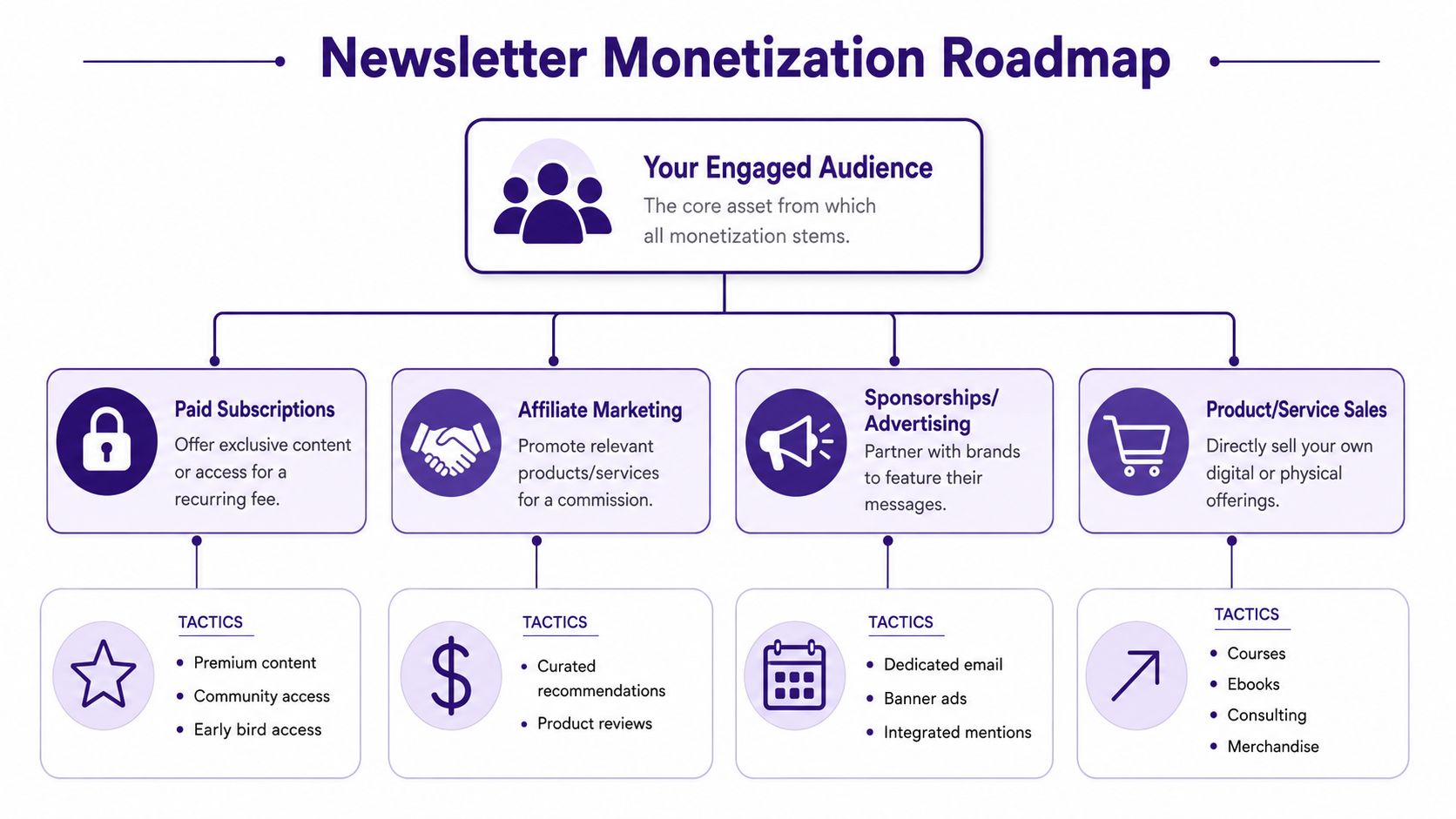
Start with the monetization path that matches your newsletter type
Different newsletter models monetize differently.
If your newsletter is curation-heavy, affiliate offers and sponsorship placements may fit naturally. If it delivers expert interpretation or proprietary research, paid access can work. If the newsletter supports a creator business, it can become the distribution engine for courses, events, consulting, books, memberships, or merchandise.
A practical progression looks like this:
- Affiliate marketing first: Best when you already recommend tools, books, platforms, or workflows.
- Sponsorships next: Best when your audience is specific enough that an advertiser sees a fit.
- Own products and services: Best when your expertise can be packaged and sold directly.
- Paid newsletter or premium tier: Best when the free version consistently proves your value.
Use the archive to support every revenue stream
Your library doesn't just help you publish. It helps you sell without sounding repetitive.
A strong affiliate mention can link back to older tutorials or breakdowns where the recommendation already appears in context. A sponsor gets a better placement when the issue theme aligns with proven audience interest from your past work. A product launch feels more credible when the newsletter can reference years of content that led to it.
That's why organized archives matter financially, not just editorially.
Look at underserved models, not only mainstream ones
One of the more interesting projection areas for 2025 to 2026 is hyper-local newsletter monetization. An emerging trend shows that creators can monetize hyper-local newsletters by using targeted Facebook and Instagram lead ads with low daily spend, which creates an opening for underserved local demographics that broader newsletter advice often ignores, as discussed in this hyper-local newsletter strategy video.
That matters because a lot of newsletter guidance assumes national-scale audiences or generic business niches. Local creators, publishers, and community builders often have stronger relevance and weaker playbooks. A focused local brief with good curation can become attractive to sponsors, service providers, and community partners faster than a broad lifestyle newsletter trying to please everyone.
Growth loops matter once monetization starts
Once the newsletter has traction, referrals can outperform constant cold acquisition because they bring in readers who already trust the sender. If you want a practical model for scaling that channel, this guide can help you build a newsletter referral program.
Paid growth works better when the newsletter already has a clear promise and a reliable issue format.
That principle applies across every revenue model. Don't chase monetization with a vague editorial product. Build an engaged audience around a distinct point of view, then attach the right offers in the right order.
The newsletter becomes valuable when it does three things at once. It organizes attention. It compounds trust. It gives your existing content library a path to earn again.
If you've already built a body of work, the next smart move isn't more scattered output. It's turning that archive into a system. Contesimal helps creators, publishers, and content teams organize large libraries, surface patterns across past work, and collaborate with AI to turn old assets into fresh newsletter ideas, sharper research, and new revenue opportunities.