
You've probably been here already. A policy changes, a deadline moves, or a team needs to follow a new process. Someone drops the update into Slack, three people react with a thumbs-up, one person misses it, and a week later everyone is operating from different assumptions.
That's when you stop sending casual messages and write a memo.
If you want to know how to write a memorandum that people read, understand, and act on, the trick isn't sounding formal. It's making the document easy to scan, hard to misread, and clear about what happens next. Good memos save time later because they reduce follow-up questions, conflicting interpretations, and forgotten decisions.
Why Memos Still Matter in a World of Instant Messages
A manager posts a policy change in Slack at 4:42 p.m. The team reacts, the thread drifts, and by Tuesday three people are following different versions of the rule.
That is the job for a memo.
Chat is built for quick coordination. A memo is built for messages that need to hold up after the conversation ends. If you are recording a decision, announcing a process change, assigning responsibility across teams, or explaining the reason behind a shift, a memo gives people one place to find the official version.
When speed is not the main priority
Instant messages help teams respond fast. Memos help teams align.
The difference matters because internal communication often fails after the first read, not during it. People skim. They join a project late. They remember the headline but forget the exception. A memo creates a stable reference point, which is one reason clear structure in writing keeps paying off long after the message is sent.
I use a simple standard:
- Use chat for quick back-and-forth and minor coordination.
- Use email for straightforward updates that do not need much explanation.
- Use a memo when readers need the decision, the context, and the expected action in one document.
That choice is partly about recordkeeping. It is also about risk. The more expensive a misunderstanding would be, the more useful a memo becomes.
The judgment call templates rarely teach
Templates can tell you where to put the subject line. They do not tell you how much background an internal audience needs.
That is the key writing decision. A finance team may need only the policy change and effective date. A cross-functional group may need the business reason, the impact on their workflow, and the exact owner for follow-up. Good memo writers adjust the level of context instead of dumping every detail they have.
AI tools can help here, but they need supervision. Use them to tighten wording, surface missing questions, or produce a first pass for different audiences. Do not let them flatten nuance or invent confidence where the situation is still unsettled. If the memo will shape how people work, you still need human judgment on what to include, what to leave out, and what must be stated plainly.
This is also why memos matter to teams investing in documentation and retention. Written decisions are easier to reuse, search, and hand off than chat threads, especially for organizations focused on implementing knowledge systems for creators.
A memo is not old-fashioned. It is the format you choose when clarity, accountability, and shared understanding matter more than speed.
The Anatomy of an Effective Memorandum
A memo usually succeeds or fails in the first screenful. If the subject line is generic, the purpose shows up late, or the writer opens with throat-clearing, readers start guessing. Once that happens, you spend the rest of the memo correcting confusion you created up front.
A reliable structure prevents that. It gives busy internal readers a fast way to identify the topic, the decision, and their role.
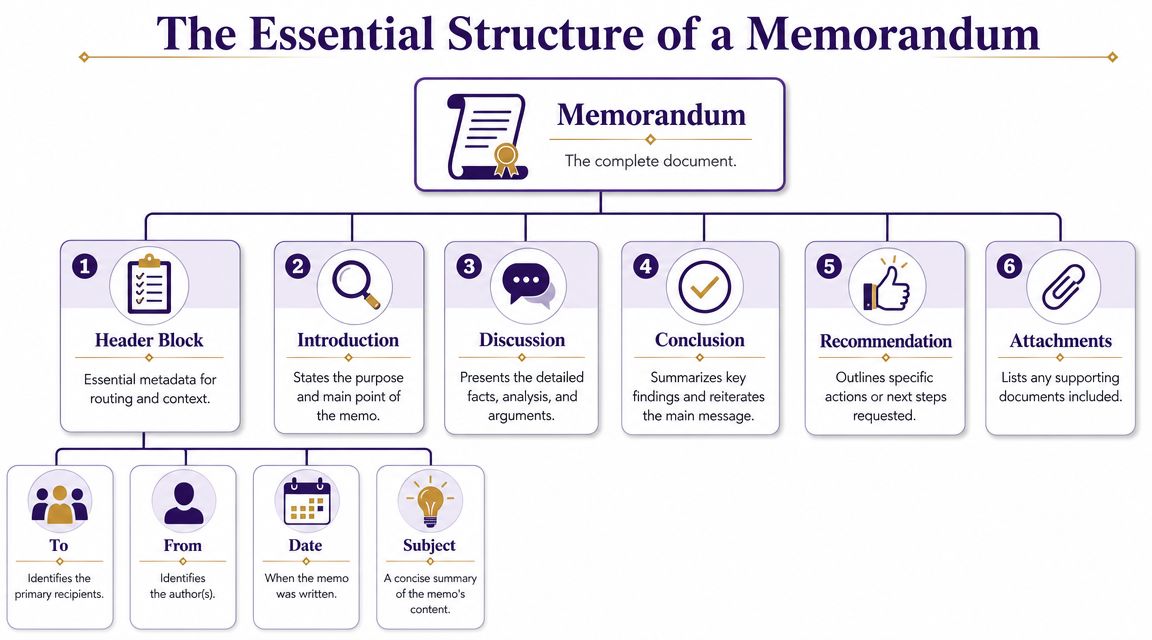
Start with the header block
The standard header uses To, From, Date, and Subject. Keep it plain and easy to scan. Then follow it with a short opening that states the point early. In internal writing, readers should know within a few lines why the memo exists.
Each line has a specific job:
| Part | What it does | What good looks like |
|---|---|---|
| To | Identifies the recipients | Name the team, role, or individual clearly |
| From | Establishes authorship | Include the responsible person or function |
| Date | Anchors timing | Use the date the memo is issued |
| Subject | Frames the topic instantly | Be specific enough that no one guesses |
The subject line carries more weight than new writers expect. “Update” tells the reader nothing. “Revised Approval Process for Sponsored Content” tells them what changed and helps them find the memo later in search, inboxes, and shared folders.
That retrieval point matters. Teams that invest in implementing knowledge systems for creators usually get better results from memos because naming conventions and document structure stay consistent across departments.
Write the opening before the background
The opening paragraph should answer three practical questions:
- What is changing, being decided, or being announced?
- Why does it matter now?
- What does the reader need to do, know, or approve?
Write that paragraph as if some recipients will read only that part. Many will.
I coach new hires to draft the opening before they write the background because it forces a decision about purpose. If you cannot state the memo's point in two or three sentences, you probably have not decided whether you are informing, requesting, recommending, or directing.
For example, a policy memo should lead with the policy.
Weak opening:
Following several conversations over the last few weeks regarding workflow consistency across different teams, it has become clear that there may be a need to revisit the current approval process.
Better opening:
Effective Monday, all sponsored content must be approved by editorial operations before publication. This change reduces last-minute revisions and gives teams one review path.
If you want a practical companion on ordering ideas clearly, keep this guide to structure in writing handy.
Build the body in short, purposeful sections
After the opening, organize the body by function, not by the order in which you learned the information. In practice, four blocks work well:
- Context for the minimum background the reader needs
- Discussion for the key facts, reasoning, risks, or implications
- Action or recommendation for what should happen next
- Conclusion for a short closing that reinforces the ask or decision
That does not mean every memo needs formal subheads. A one-page memo to your department may only need tight paragraphs. A memo going to multiple teams usually benefits from labeled sections because readers scan for the part that affects them.
This is also where judgment matters more than templates suggest. Internal audiences do not all need the same amount of context. A leadership team may want the decision, trade-offs, and risk. An operations team may care more about dates, owner names, and process changes. AI can help you draft versions for different audiences, but you still need to check that it preserved the main point, the right level of certainty, and the actions people are expected to take.
Keep the body selective. A memo is a working document for alignment and action, not a place to dump every meeting note or side issue. If attachments matter, name them clearly and tell the reader why they should open them. If they do not matter, leave them out.
Mastering a Professional Tone and Direct Phrasing
A memo can have the right format and still fail if the language is soft, vague, or bloated.
Professional memo writing depends on deductive writing. The main point belongs first, then the supporting facts and reasoning follow. That approach is central to policy and professional memo traditions, as outlined in the University of Chicago Harris memo guide.
Put the point in the first sentence
Readers shouldn't have to infer your position. State it.
That doesn't mean sounding harsh. It means sounding responsible. You're helping the reader understand what matters, why it matters, and what to do with the information.
Compare these:
Before
There have been some concerns raised about the current timeline, and it may be beneficial for teams to take another look at the delivery schedule.
After
Please submit revised delivery dates by Thursday so operations can reset the launch calendar.
The second version is better because it names the action, the deadline, and the reason. It reduces interpretation.
Remove phrasing that weakens authority
A lot of memo language gets padded with polite fog. You see phrases like “it may be helpful,” “there appears to be,” or “it would be appreciated if.” Those phrases aren't professional. They're evasive.
Use this quick rewrite table:
| Weak phrasing | Better memo phrasing |
|---|---|
| It would be great if | Please |
| There are concerns that | We identified |
| It has been decided that | The team will |
| At this point in time | Now |
| Due to the fact that | Because |
Clear writing sounds more professional than inflated writing.
Sound direct without sounding robotic
Some new managers overcorrect and write memos that feel cold. That's not the goal. The goal is to be clear, specific, and controlled.
That usually means:
- Choose active verbs. “Send,” “review,” “approve,” “confirm.”
- Name the actor. Don't say “the report should be reviewed” if you mean “finance should review the report.”
- Cut ornamental language. If a sentence doesn't clarify, support, or direct, remove it.
When you need supporting detail, place it after the claim, not before it. That sequence helps the reader stay oriented. If you want more examples of clean factual prose, this collection on informative writing examples is a useful reference.
One more point matters here. Tone should match consequences. If the memo is a procedural reminder, keep it light and businesslike. If it documents a compliance issue or a formal decision, tighten the language and remove any casual phrasing that makes the message feel optional.
Adapting Your Memo for Different Contexts
A memo is a format, not a single personality. The version you write for a marketing team won't read like the version you write for legal counsel or a department chair.
That doesn't change the core principle. It changes the amount of evidence, the degree of formality, and the kind of analysis the reader expects.
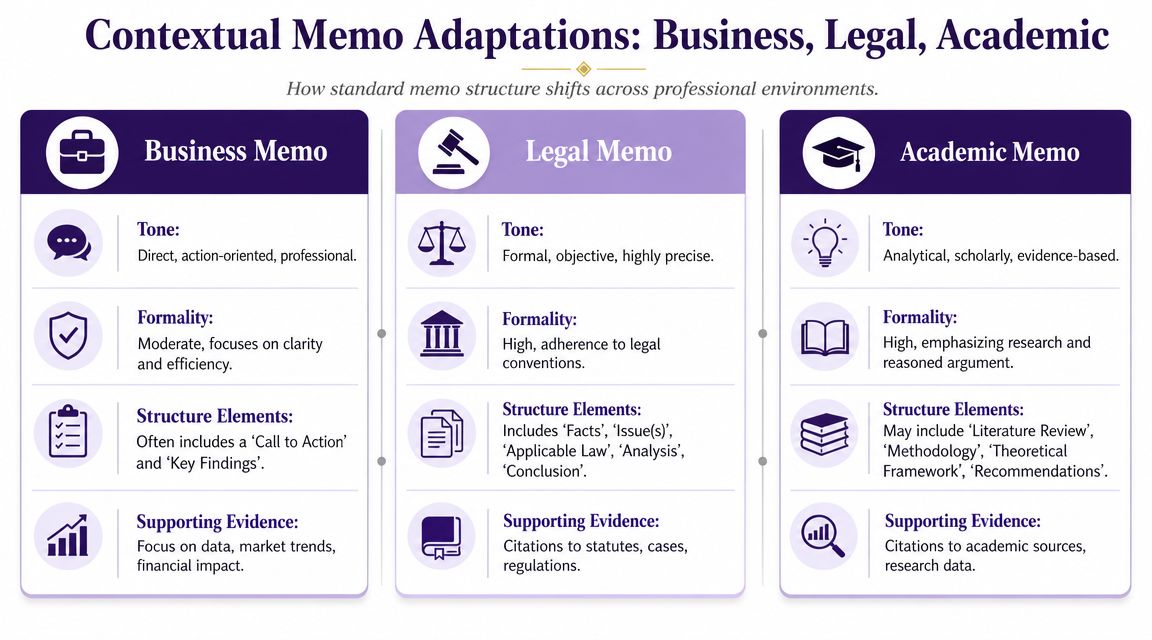
Business memos
In business settings, a memo usually needs to move work forward.
The reader wants to know what changed, what it means, and what to do next. That means a direct tone, compact background, and a visible call to action. Supporting evidence often centers on timelines, operational impact, customer implications, or internal process logic.
A business memo works best when the recommendation is unmistakable.
Legal memos
Legal memos demand more precision and more disciplined analysis.
The audience expects objective treatment of facts, a careful statement of the issue, and reasoning tied to authority. Even when the format differs from a classic internal business memo, the same principle applies. The reader should find the governing question quickly, then move through facts, applicable law, analysis, and conclusion in a controlled order.
If your memo touches legal risk, don't improvise the evidence standard. Use credible materials and be careful about claims. This guide on what makes a source credible is a practical reminder when accuracy is paramount.
Academic memos
Academic memos often sit somewhere between administration and analysis.
They may summarize a departmental issue, recommend a process change, outline research planning, or frame a decision for faculty leadership. The tone is usually more analytical than a business memo, but it still needs discipline. Academic readers may tolerate more context, but they still don't want a wandering document.
The biggest mistake in academic and business memos is often the same. The writer confuses background knowledge with necessary context.
Here's a simple comparison:
| Context | Reader cares most about | Memo should emphasize |
|---|---|---|
| Business | Action and impact | Decision, timeline, owner |
| Legal | Precision and authority | Issue, facts, analysis, conclusion |
| Academic | Reasoned explanation | Background, implications, recommendation |
Adapt the memo to the room you're in. Don't drag one environment's habits into another without thinking.
Common Memo Mistakes and How to Avoid Them
Most memo problems aren't literary. They're structural.
The common failures are familiar: omitting the subject line, burying the action request, and overloading the body with detail. Practical guidance also stresses short paragraphs, smaller chunks of information, and a conclusion that is only 1–2 sentences and clearly states the expected action, as noted in Indeed's memo writing guide.

The mistakes I see most often
New writers usually make one of these errors:
- Vague subject line. The memo arrives with a label like “Important” or “Update,” which tells the reader nothing.
- Buried request. The actual ask shows up near the end, after the reader has already worked too hard.
- Too much backstory. The writer includes every meeting, debate, and side issue.
- No ownership. The memo says what should happen but never says who should do it.
- Soft ending. The conclusion fades out instead of closing with a clear next step.
A good memo is easier to act on than to ignore.
Simple fixes that improve almost every draft
Use these as your working standard:
- Name the issue precisely: Write a subject line that identifies the topic in plain language.
- Lead with the decision or request: Put the point in the first paragraph, not the fifth.
- Trim context aggressively: Keep only the background needed to understand the action.
- Assign responsibility: Name the person, team, or function that owns the next step.
- Close with direction: End with a short conclusion that says what happens now.
This short video is a useful quick refresher if you want another pass on memo fundamentals before you finalize a draft.
If the recipient finishes the memo and still asks, “What do you need from me?” the memo failed.
One more mistake deserves attention. Writers sometimes try to sound impressive by adding jargon. That usually backfires unless the audience uses the same terms every day. Plain language is not simplistic. It's efficient.
Your Final Pre-Distribution Checklist
Before you send a memo, do one last review as if you were the busiest person on the recipient list.
That mindset changes what you notice. You stop asking whether the memo sounds polished and start asking whether it can be understood quickly, trusted, and acted on without clarification.
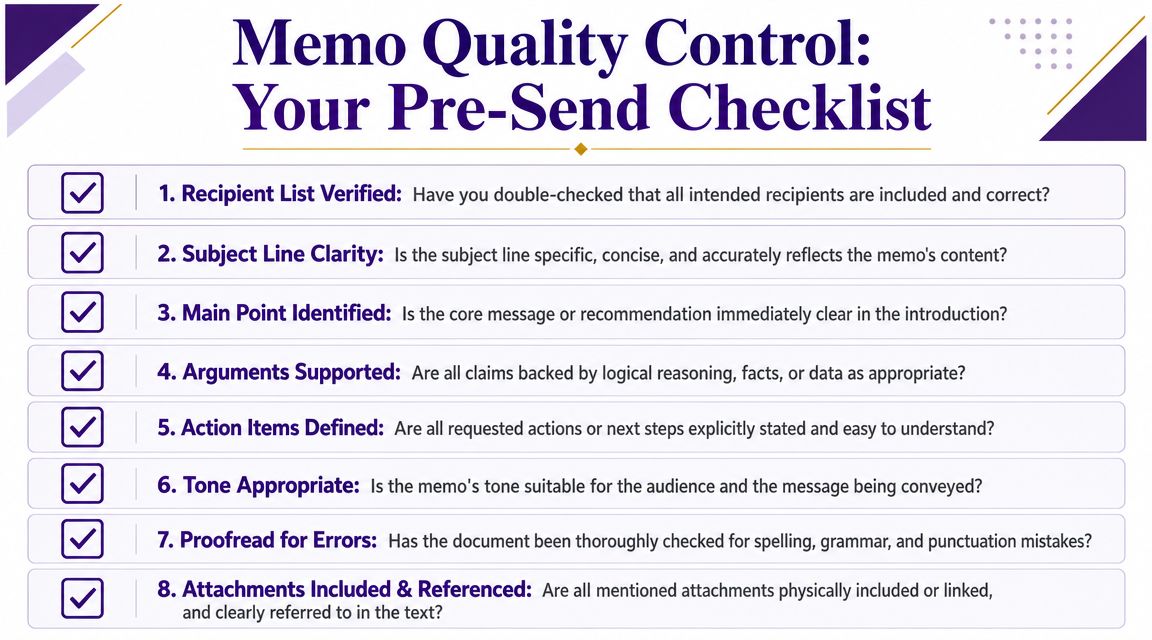
Run this check before you hit send
Use this list every time:
- Check recipients: Did you include everyone who needs to read or act?
- Check the subject line: Is it specific enough to stand alone in an inbox or document folder?
- Check the first paragraph: Can someone read only that part and still understand the point?
- Check the support: Does every key assertion have a reason, fact, or relevant evidence behind it?
- Check the ask: Is the requested action explicit?
- Check the tone: Does it fit the audience and the stakes?
- Check mechanics: Fix typos, grammar slips, and formatting inconsistencies.
- Check attachments: If you mentioned a document, is it included?
Review AI-assisted drafts with skepticism
This matters more now than it did a few years ago. 77% of business professionals say generative AI helps them work more efficiently, and 76% say it helps them save time, according to Adobe's memo template and AI guidance. That means a lot of memos are being drafted with AI support already.
That's useful, but it creates a new editing job. You need to check for hallucinated facts, generic tone, and unnecessary length. AI can give you a first draft. It cannot take responsibility for accuracy or audience judgment.
If your work overlaps with legal or compliance-sensitive material, the bar is even higher. Tools used for tasks like AI for contract review show how helpful AI can be in structured document workflows, but they also reinforce the same lesson. Human review is not optional.
A final gut check helps: if the memo were forwarded to senior leadership without explanation, would it still make sense and hold up?
If yes, send it.
If your team produces a steady flow of documents, episodes, articles, or internal briefs, the next challenge isn't just writing one good memo. It's organizing what your organization already knows so every future memo gets faster and sharper. Contesimal helps teams classify, search, and reuse knowledge across large content libraries so research, drafting, and collaboration happen with more clarity and less reinvention.